What is wrong with these?
 My house in Seoul.
 Is on the desk.
 Because I‟m tired.
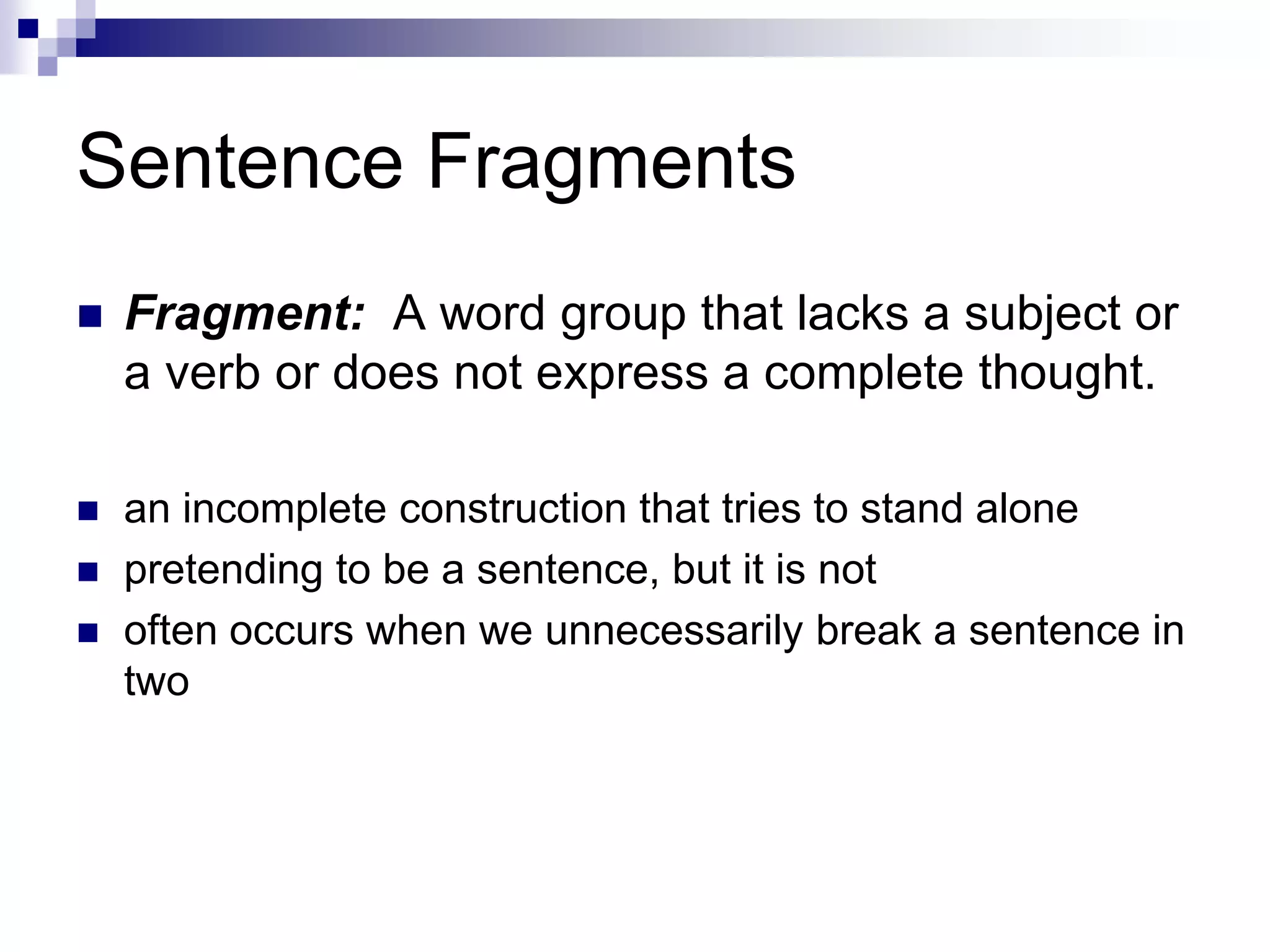
Sentence Fragments
   Fragment: A word group that lacks a subject or
    a verb or does not express a complete thought.

   an incomplete construction that tries to stand alone
   pretending to be a sentence, but it is not
   often occurs when we unnecessarily break a sentence in
    two
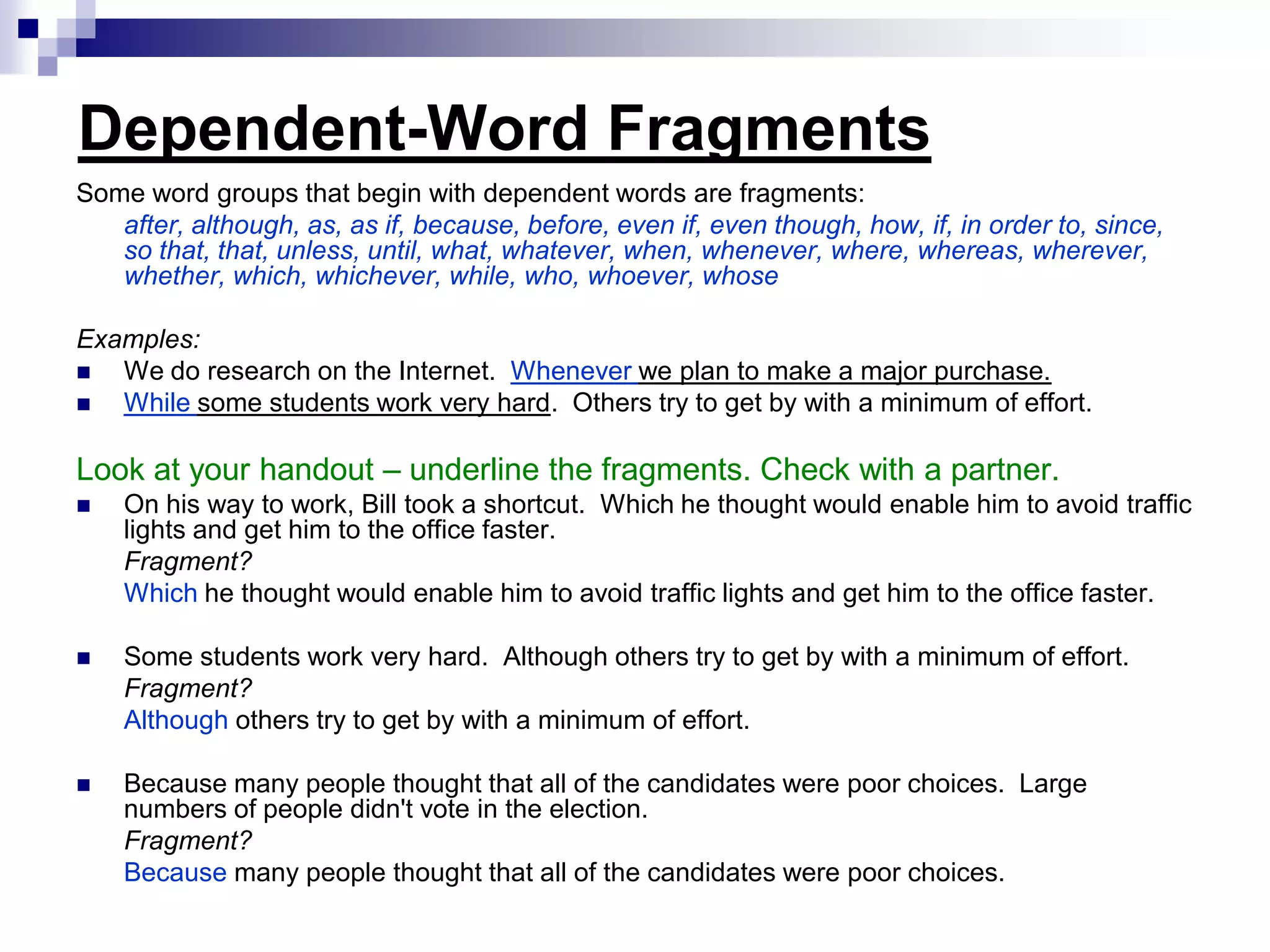
Dependent-Word Fragments
Some word groups that begin with dependent words are fragments:
   after, although, as, as if, because, before, even if, even though, how, if, in order to, since,
   so that, that, unless, until, what, whatever, when, whenever, where, whereas, wherever,
   whether, which, whichever, while, who, whoever, whose

Examples:
  We do research on the Internet. Whenever we plan to make a major purchase.
  While some students work very hard. Others try to get by with a minimum of effort.

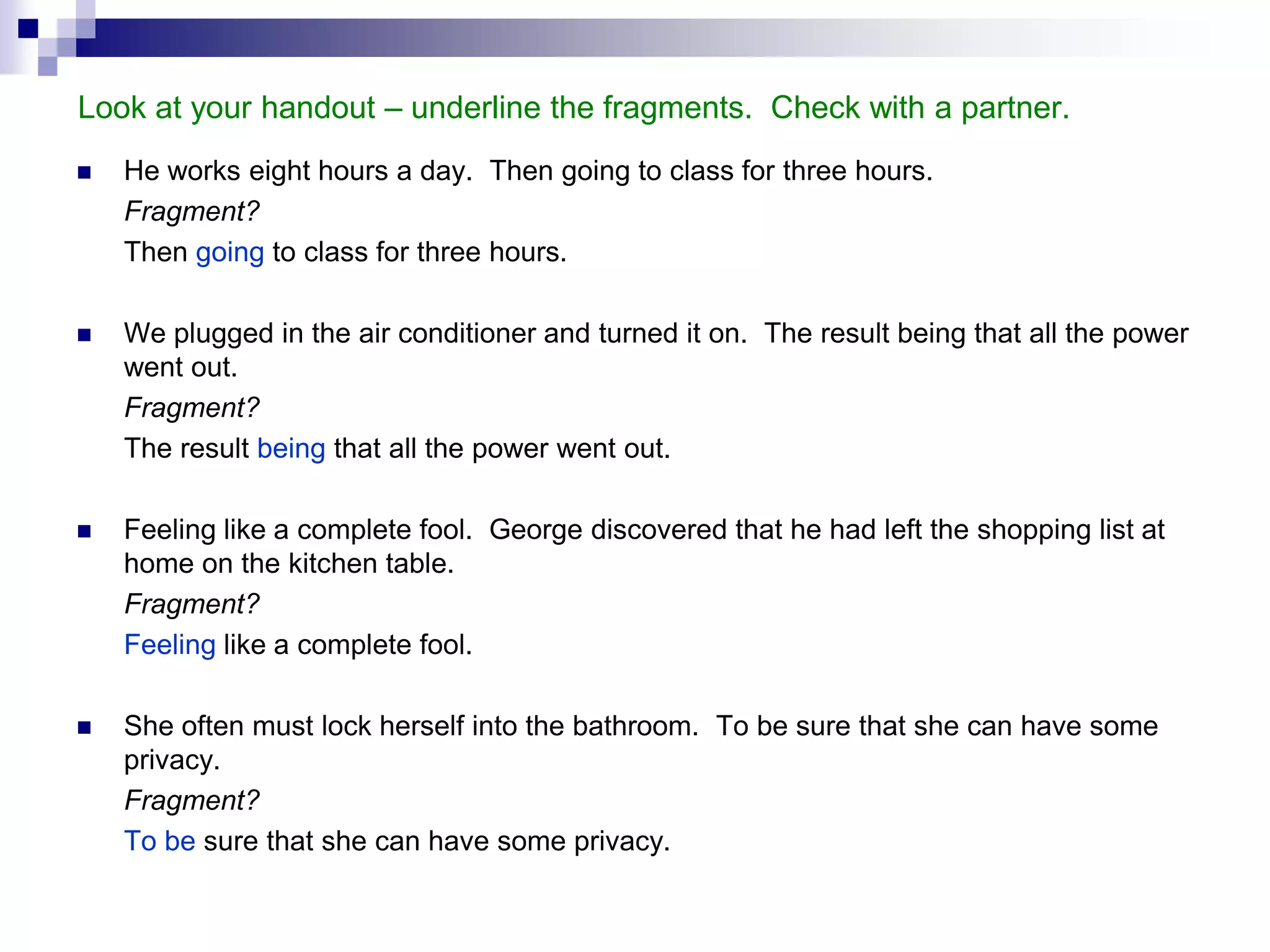
Look at your handout – underline the fragments. Check with a partner.
   On his way to work, Bill took a shortcut. Which he thought would enable him to avoid traffic
    lights and get him to the office faster.
    Fragment?
    Which he thought would enable him to avoid traffic lights and get him to the office faster.

   Some students work very hard. Although others try to get by with a minimum of effort.
    Fragment?
    Although others try to get by with a minimum of effort.

   Because many people thought that all of the candidates were poor choices. Large
    numbers of people didn't vote in the election.
    Fragment?
    Because many people thought that all of the candidates were poor choices.
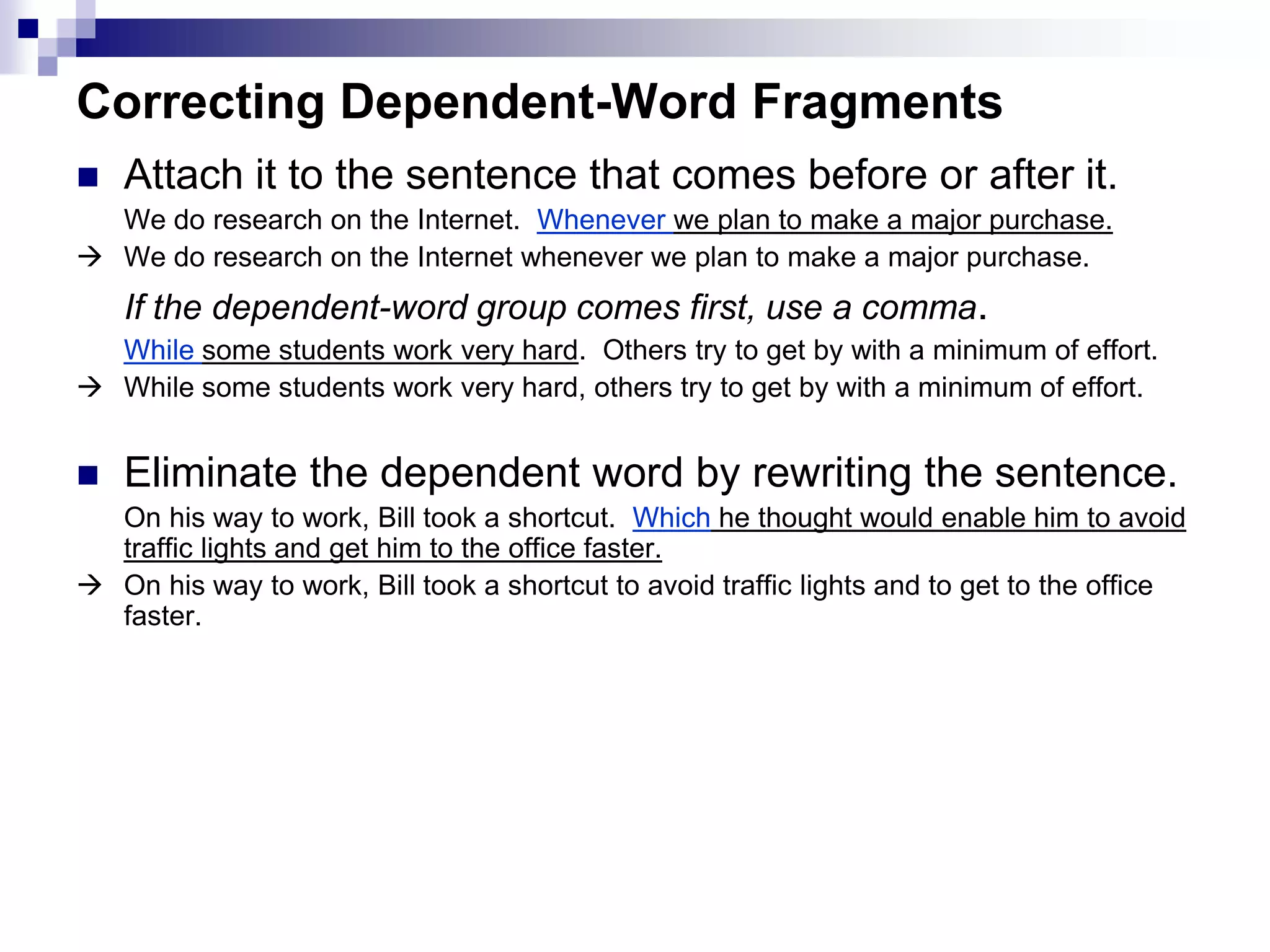
Correcting Dependent-Word Fragments
   Attach it to the sentence that comes before or after it.
  We do research on the Internet. Whenever we plan to make a major purchase.
 We do research on the Internet whenever we plan to make a major purchase.
    If the dependent-word group comes first, use a comma.
  While some students work very hard. Others try to get by with a minimum of effort.
 While some students work very hard, others try to get by with a minimum of effort.


   Eliminate the dependent word by rewriting the sentence.
  On his way to work, Bill took a shortcut. Which he thought would enable him to avoid
  traffic lights and get him to the office faster.
 On his way to work, Bill took a shortcut to avoid traffic lights and to get to the office
  faster.
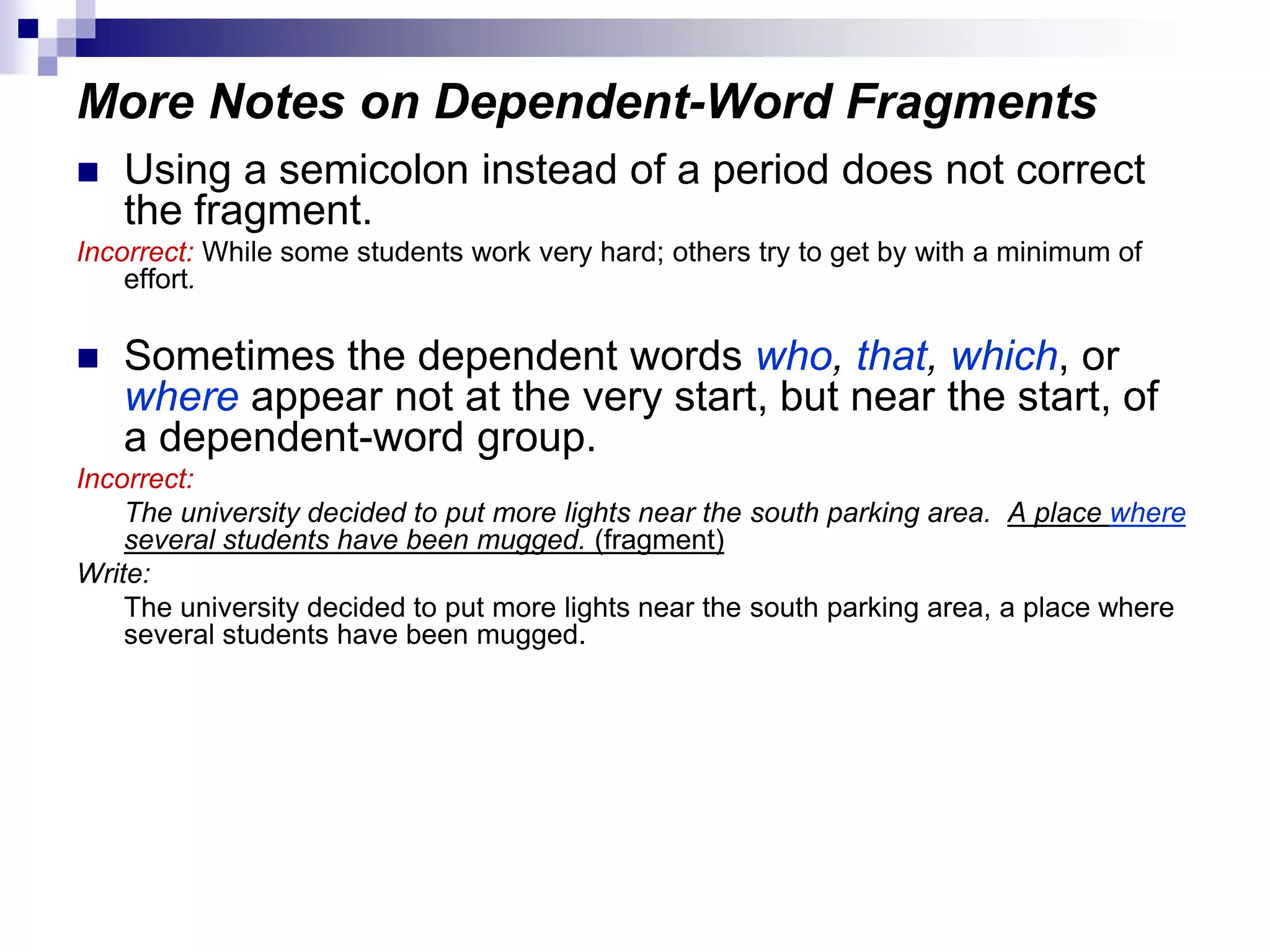
More Notes on Dependent-Word Fragments
   Using a semicolon instead of a period does not correct
    the fragment.
Incorrect: While some students work very hard; others try to get by with a minimum of
    effort.

   Sometimes the dependent words who, that, which, or
    where appear not at the very start, but near the start, of
    a dependent-word group.
Incorrect:
    The university decided to put more lights near the south parking area. A place where
    several students have been mugged. (fragment)
Write:
    The university decided to put more lights near the south parking area, a place where
    several students have been mugged.
–ing and to Fragments
   –ing word at or near the start of the word group - often a
    participial phrase.
   to + verb at or near the start of the word group - often an
    infinitive phrase.

Examples:
   The astronomer gazed intently through the telescope. Hoping to catch a
   glimpse of the meteor.

    In an effort to get to the airport on time. We left the house at four o'clock in
    the morning.
Look at your handout – underline the fragments. Check with a partner.
   He works eight hours a day. Then going to class for three hours.
    Fragment?
    Then going to class for three hours.

   We plugged in the air conditioner and turned it on. The result being that all the power
    went out.
    Fragment?
    The result being that all the power went out.

   Feeling like a complete fool. George discovered that he had left the shopping list at
    home on the kitchen table.
    Fragment?
    Feeling like a complete fool.

   She often must lock herself into the bathroom. To be sure that she can have some
    privacy.
    Fragment?
    To be sure that she can have some privacy.
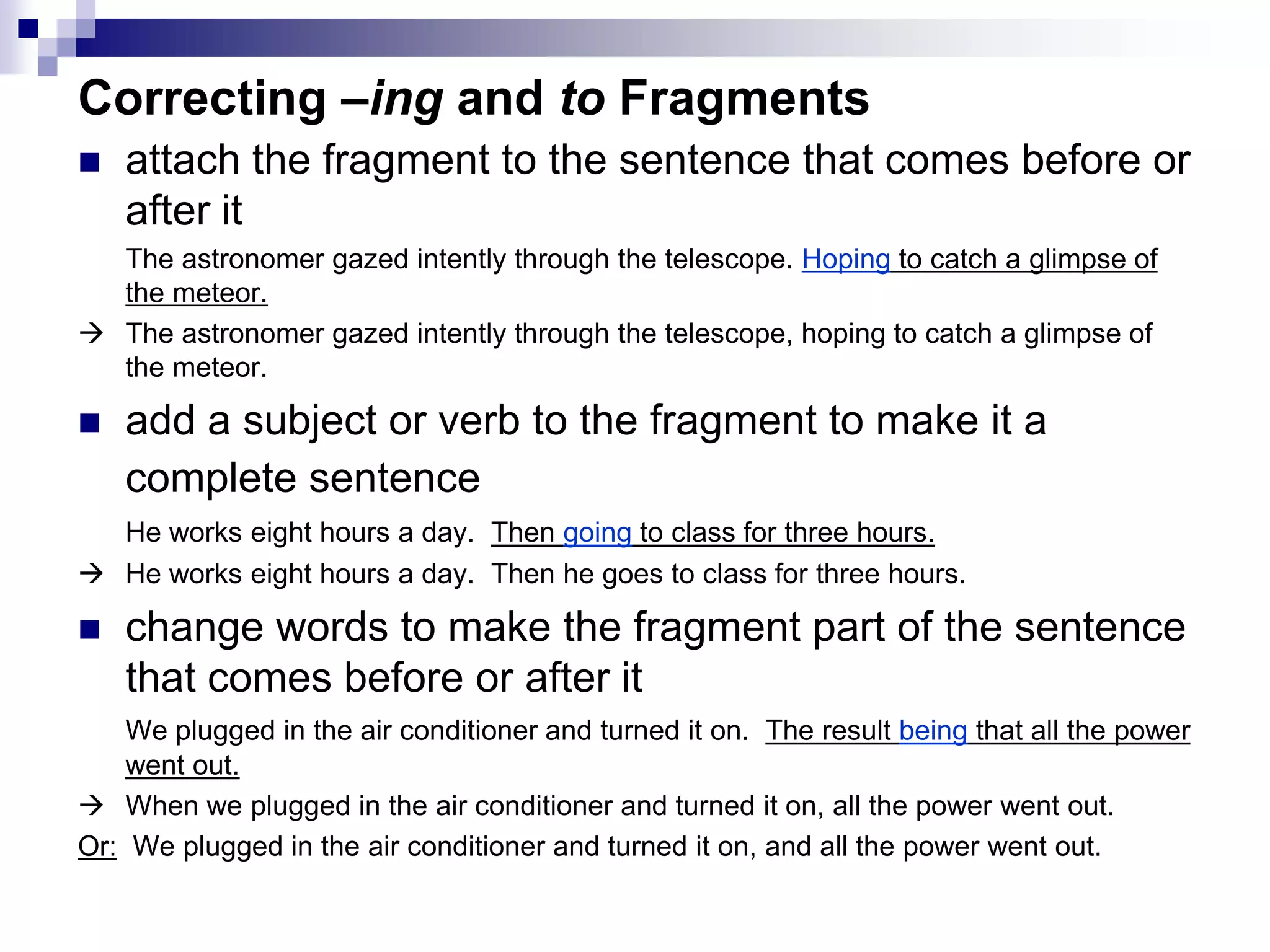
Correcting –ing and to Fragments
   attach the fragment to the sentence that comes before or
    after it
  The astronomer gazed intently through the telescope. Hoping to catch a glimpse of
  the meteor.
 The astronomer gazed intently through the telescope, hoping to catch a glimpse of
  the meteor.

   add a subject or verb to the fragment to make it a
    complete sentence
  He works eight hours a day. Then going to class for three hours.
 He works eight hours a day. Then he goes to class for three hours.

   change words to make the fragment part of the sentence
    that comes before or after it
    We plugged in the air conditioner and turned it on. The result being that all the power
    went out.
 When we plugged in the air conditioner and turned it on, all the power went out.
Or: We plugged in the air conditioner and turned it on, and all the power went out.
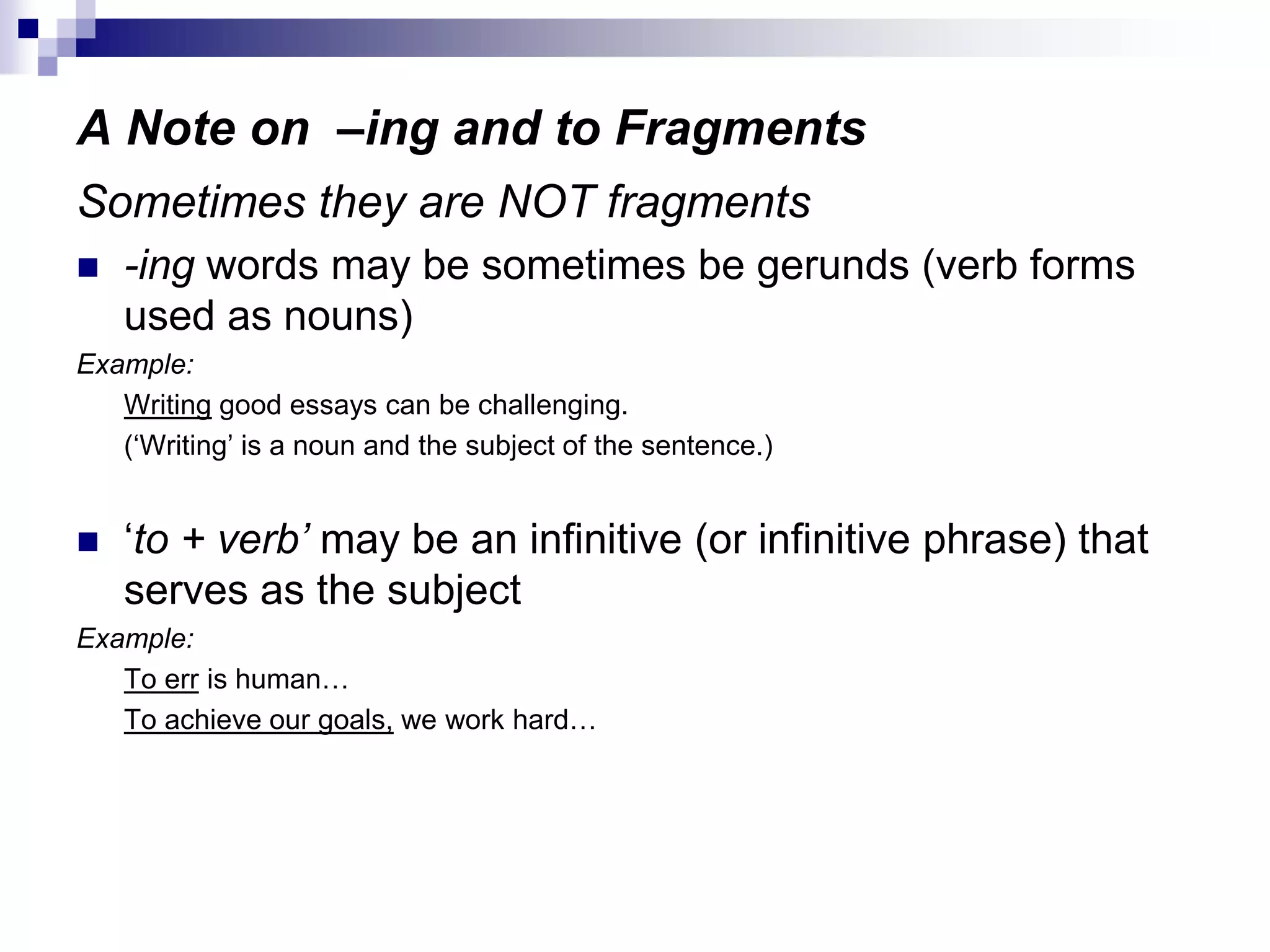
A Note on –ing and to Fragments
Sometimes they are NOT fragments
   -ing words may be sometimes be gerunds (verb forms
    used as nouns)
Example:
   Writing good essays can be challenging.
   („Writing‟ is a noun and the subject of the sentence.)


   „to + verb’ may be an infinitive (or infinitive phrase) that
    serves as the subject
Example:
   To err is human…
   To achieve our goals, we work hard…
Added-Detail Fragments
Lack a subject and verb.
Some common words and phrases lead to these
  fragments:
   especially, except, for example, including, not even, particularly, such as
Examples:
  All software in the store is on sale. Except video games.
  Our class usually starts late. For example, yesterday at quarter past six instead of at
   six o'clock.
   Fragment?
   For example, yesterday at quarter past six instead of at six o'clock.
  Several basic courses are required for graduation. Among them, English
   Composition, an introductory math course, and one general science course.
   Fragment?
   Among them, English Composition, an introductory math course, and one general
   science course.


   You can correct these in the same way as „-ing‟ and „to‟
   fragments.
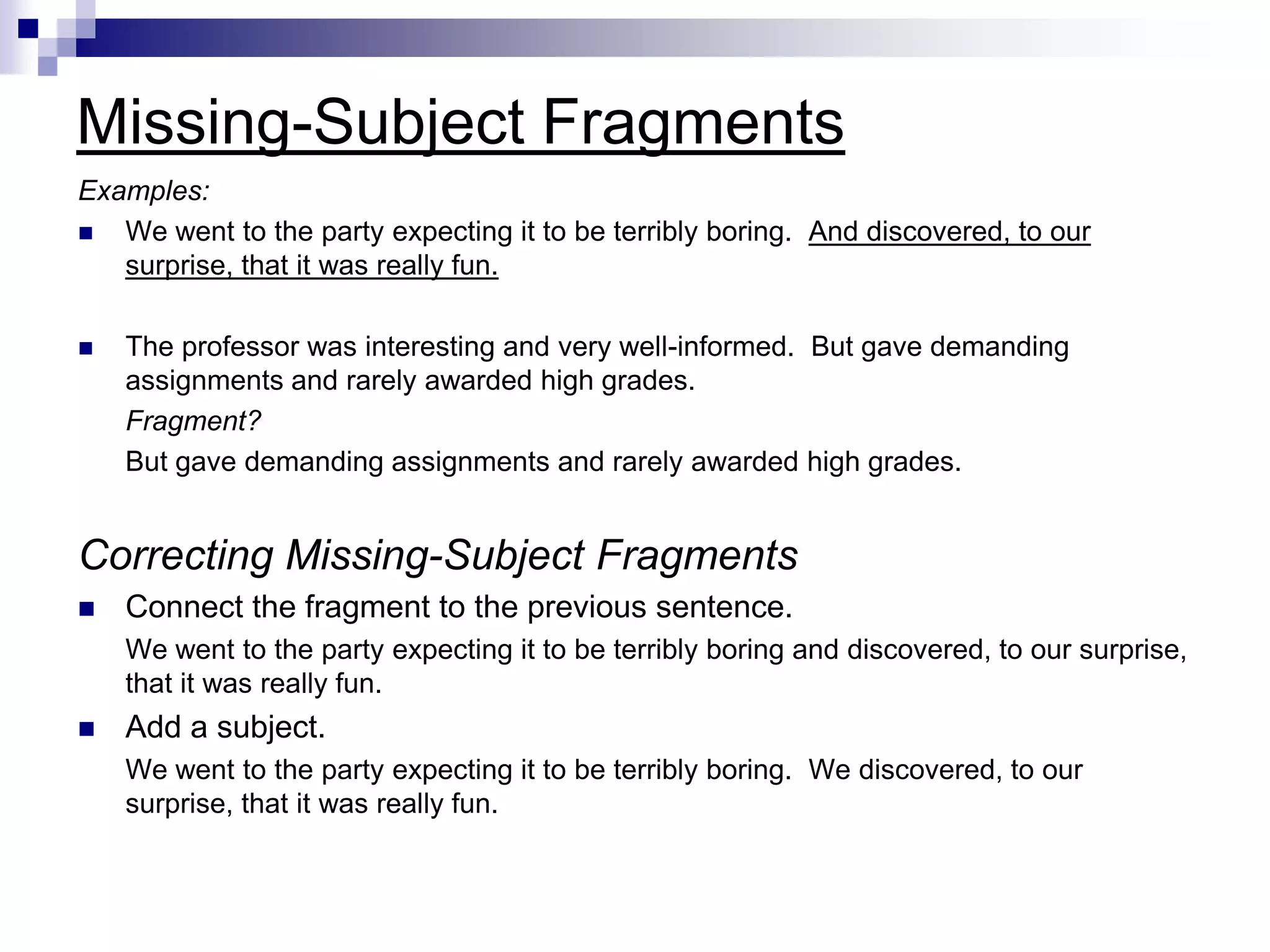
Missing-Subject Fragments
Examples:
  We went to the party expecting it to be terribly boring. And discovered, to our
   surprise, that it was really fun.

   The professor was interesting and very well-informed. But gave demanding
    assignments and rarely awarded high grades.
    Fragment?
    But gave demanding assignments and rarely awarded high grades.


Correcting Missing-Subject Fragments
   Connect the fragment to the previous sentence.
    We went to the party expecting it to be terribly boring and discovered, to our surprise,
    that it was really fun.
   Add a subject.
    We went to the party expecting it to be terribly boring. We discovered, to our
    surprise, that it was really fun.
Talk with your partner. How would you correct the second sentence?
   The professor was interesting and very well-informed. But gave demanding
   assignments and rarely awarded high grades.

 The professor was interesting and very well-informed, but s/he gave demanding
  assignments and rarely awarded high grades.
 The professor was interesting and very well-informed. However, s/he gave
  demanding assignments and rarely awarded high grades.


   IMPORTANT: In academic writing, DO NOT use coordinating conjunctions
   like and, but, or, so to begin sentences – this can result in sentence
   fragments.
   Instead, use these conjunctions to join two ideas in one sentence.
   Examples: I did some shopping, and then I went home.
   I was tired, so I went to bed.

   **See page 30 for more information about coordinating conjunctions.**
With thanks to:
The Grammar Curmudgeon
“English 101 Help - Sentence Fragments: Basics”
<http://www.grammarmudge.cityslide.com/articles/article/2569239/3638
   1.htm>

Sentence fragments

  • 1.
    What is wrongwith these?  My house in Seoul.  Is on the desk.  Because I‟m tired.
  • 2.
    Sentence Fragments  Fragment: A word group that lacks a subject or a verb or does not express a complete thought.  an incomplete construction that tries to stand alone  pretending to be a sentence, but it is not  often occurs when we unnecessarily break a sentence in two
  • 3.
    Dependent-Word Fragments Some wordgroups that begin with dependent words are fragments: after, although, as, as if, because, before, even if, even though, how, if, in order to, since, so that, that, unless, until, what, whatever, when, whenever, where, whereas, wherever, whether, which, whichever, while, who, whoever, whose Examples:  We do research on the Internet. Whenever we plan to make a major purchase.  While some students work very hard. Others try to get by with a minimum of effort. Look at your handout – underline the fragments. Check with a partner.  On his way to work, Bill took a shortcut. Which he thought would enable him to avoid traffic lights and get him to the office faster. Fragment? Which he thought would enable him to avoid traffic lights and get him to the office faster.  Some students work very hard. Although others try to get by with a minimum of effort. Fragment? Although others try to get by with a minimum of effort.  Because many people thought that all of the candidates were poor choices. Large numbers of people didn't vote in the election. Fragment? Because many people thought that all of the candidates were poor choices.
  • 4.
    Correcting Dependent-Word Fragments  Attach it to the sentence that comes before or after it. We do research on the Internet. Whenever we plan to make a major purchase.  We do research on the Internet whenever we plan to make a major purchase. If the dependent-word group comes first, use a comma. While some students work very hard. Others try to get by with a minimum of effort.  While some students work very hard, others try to get by with a minimum of effort.  Eliminate the dependent word by rewriting the sentence. On his way to work, Bill took a shortcut. Which he thought would enable him to avoid traffic lights and get him to the office faster.  On his way to work, Bill took a shortcut to avoid traffic lights and to get to the office faster.
  • 5.
    More Notes onDependent-Word Fragments  Using a semicolon instead of a period does not correct the fragment. Incorrect: While some students work very hard; others try to get by with a minimum of effort.  Sometimes the dependent words who, that, which, or where appear not at the very start, but near the start, of a dependent-word group. Incorrect: The university decided to put more lights near the south parking area. A place where several students have been mugged. (fragment) Write: The university decided to put more lights near the south parking area, a place where several students have been mugged.
  • 6.
    –ing and toFragments  –ing word at or near the start of the word group - often a participial phrase.  to + verb at or near the start of the word group - often an infinitive phrase. Examples: The astronomer gazed intently through the telescope. Hoping to catch a glimpse of the meteor. In an effort to get to the airport on time. We left the house at four o'clock in the morning.
  • 7.
    Look at yourhandout – underline the fragments. Check with a partner.  He works eight hours a day. Then going to class for three hours. Fragment? Then going to class for three hours.  We plugged in the air conditioner and turned it on. The result being that all the power went out. Fragment? The result being that all the power went out.  Feeling like a complete fool. George discovered that he had left the shopping list at home on the kitchen table. Fragment? Feeling like a complete fool.  She often must lock herself into the bathroom. To be sure that she can have some privacy. Fragment? To be sure that she can have some privacy.
  • 8.
    Correcting –ing andto Fragments  attach the fragment to the sentence that comes before or after it The astronomer gazed intently through the telescope. Hoping to catch a glimpse of the meteor.  The astronomer gazed intently through the telescope, hoping to catch a glimpse of the meteor.  add a subject or verb to the fragment to make it a complete sentence He works eight hours a day. Then going to class for three hours.  He works eight hours a day. Then he goes to class for three hours.  change words to make the fragment part of the sentence that comes before or after it We plugged in the air conditioner and turned it on. The result being that all the power went out.  When we plugged in the air conditioner and turned it on, all the power went out. Or: We plugged in the air conditioner and turned it on, and all the power went out.
  • 9.
    A Note on–ing and to Fragments Sometimes they are NOT fragments  -ing words may be sometimes be gerunds (verb forms used as nouns) Example: Writing good essays can be challenging. („Writing‟ is a noun and the subject of the sentence.)  „to + verb’ may be an infinitive (or infinitive phrase) that serves as the subject Example: To err is human… To achieve our goals, we work hard…
  • 10.
    Added-Detail Fragments Lack asubject and verb. Some common words and phrases lead to these fragments: especially, except, for example, including, not even, particularly, such as Examples:  All software in the store is on sale. Except video games.  Our class usually starts late. For example, yesterday at quarter past six instead of at six o'clock. Fragment? For example, yesterday at quarter past six instead of at six o'clock.  Several basic courses are required for graduation. Among them, English Composition, an introductory math course, and one general science course. Fragment? Among them, English Composition, an introductory math course, and one general science course. You can correct these in the same way as „-ing‟ and „to‟ fragments.
  • 11.
    Missing-Subject Fragments Examples:  We went to the party expecting it to be terribly boring. And discovered, to our surprise, that it was really fun.  The professor was interesting and very well-informed. But gave demanding assignments and rarely awarded high grades. Fragment? But gave demanding assignments and rarely awarded high grades. Correcting Missing-Subject Fragments  Connect the fragment to the previous sentence. We went to the party expecting it to be terribly boring and discovered, to our surprise, that it was really fun.  Add a subject. We went to the party expecting it to be terribly boring. We discovered, to our surprise, that it was really fun.
  • 12.
    Talk with yourpartner. How would you correct the second sentence? The professor was interesting and very well-informed. But gave demanding assignments and rarely awarded high grades.  The professor was interesting and very well-informed, but s/he gave demanding assignments and rarely awarded high grades.  The professor was interesting and very well-informed. However, s/he gave demanding assignments and rarely awarded high grades. IMPORTANT: In academic writing, DO NOT use coordinating conjunctions like and, but, or, so to begin sentences – this can result in sentence fragments. Instead, use these conjunctions to join two ideas in one sentence. Examples: I did some shopping, and then I went home. I was tired, so I went to bed. **See page 30 for more information about coordinating conjunctions.**
  • 13.
    With thanks to: TheGrammar Curmudgeon “English 101 Help - Sentence Fragments: Basics” <http://www.grammarmudge.cityslide.com/articles/article/2569239/3638 1.htm>