Dangling Modifiers
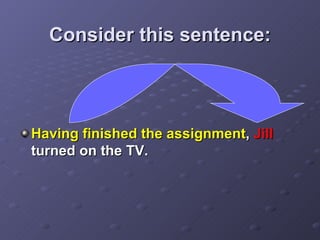
Consider this sentence: Having finished the assignment ,  Jill  turned on the TV.
"Having finished"  states an action but  does not name the doer  of that action.  In English sentences, the doer must be the subject of the main clause that follows.  In this sentence, it is Jill. She seems logically to be the one doing the action ("having finished"), and this sentence therefore  does not have a dangling modifier.
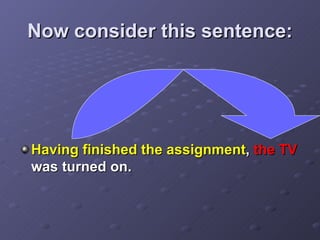
Now consider this sentence: Having finished the assignment ,  the TV  was turned on.
Having finished  is a participle expressing action, but the doer is not the TV set (the subject of the main clause):  TV sets don't finish assignments. Since the doer of the action expressed in the participle has not been clearly stated, the participial phrase is said to be a  dangling modifier.
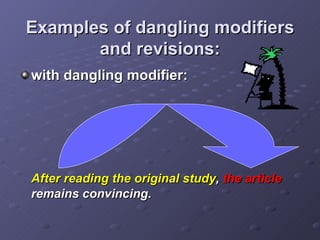
Examples of dangling modifiers and revisions: with dangling modifier: After reading the original study ,  the article  remains convincing.
possible revisions: After reading the original study ,  I  find the article unconvincing.
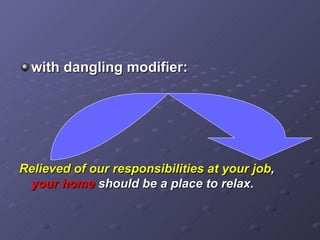
with dangling modifier: Relieved of our responsibilities at your job ,  your home  should be a place to relax.
possible revision: Relieved of your responsibilities at your job ,  you  should be able to relax at home.
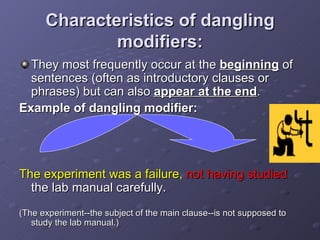
Characteristics of dangling modifiers: They most frequently occur at the  beginning  of sentences (often as introductory clauses or phrases) but can also  appear at the end . Example of dangling modifier: The experiment was a failure,   not having studied  the lab manual carefully. (The experiment--the subject of the main clause--is not supposed to study the lab manual.)
possible revision: They  failed the experiment,  not having studied  the lab manual carefully. [They often have an -ing word (gerund) or a to+verb (infinitive) phrase near the start of the sentence.]
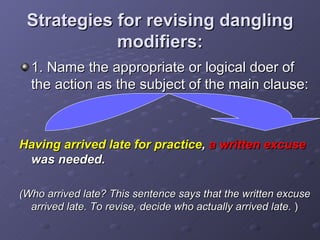
Strategies for revising dangling modifiers: 1. Name the appropriate or logical doer of the action as the subject of the main clause: Having arrived late for practice ,  a written excuse  was needed. (Who arrived late? This sentence says that the written excuse arrived late. To revise, decide who actually arrived late.  )
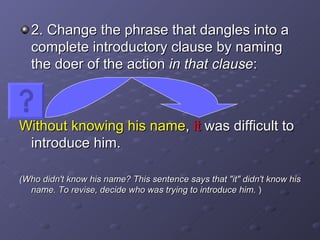
2. Change the phrase that dangles into a complete introductory clause by naming the doer of the action  in that clause : Without knowing his name ,  it  was difficult to introduce him.  (Who didn't know his name? This sentence says that "it" didn't know his name. To revise, decide who was trying to introduce him.  )
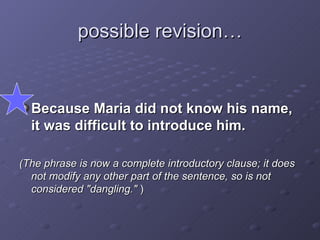
possible revision… Because Maria did not know his name, it was difficult to introduce him.  (The phrase is now a complete introductory clause; it does not modify any other part of the sentence, so is not considered "dangling."  )
3. Combine the phrase and main clause into one: With dangling modifier: To improve his results ,  the experiment  was done again. (Who wanted to improve results? This sentence says that the experiment was trying to improve its own results. To revise, combine the phrase and the main clause into one sentence.) He improved his results by doing the experiment again.
Basic Principle: Modifiers are like teenagers: they fall in love with whatever they're next to. Make sure they're next to something they ought to modify!
DANGLING MODIFIER When we begin a sentence with a modifying word, phrase, or clause, we must make sure the next thing that comes along can, in fact, be modified by that modifier. When a modifier improperly modifies something, it is called a "dangling modifier." This often happens with beginning  participial phrases , making "dangling participles" an all too common phenomenon. In the sentence below, we can't have a car changing its own oil.
Confusion  Changing the oil every 3,000 miles, the car seemed to run better.  Repair Work  Changing the oil every 3,000 miles, Fred found he could get much better gas mileage.
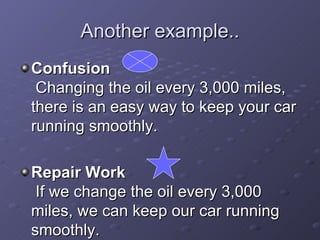
Another example.. Confusion  Changing the oil every 3,000 miles, there is an easy way to keep your car running smoothly.  Repair Work  If we change the oil every 3,000 miles, we can keep our car running smoothly.
What to do? This faulty sentence can be remedied by changing the participial phrase into a full-fledged clause with a subject and verb.
But wait… there’s more… A participial phrase followed by a  Passive Verb  is also apt to be a dangler because the real actor of the sentence will be disguised.
Confusion  Changing the oil every 3,000 miles, the car was kept in excellent condition.  Repair Work  Changing the oil every 3,000 miles, we kept the car in excellent condition.
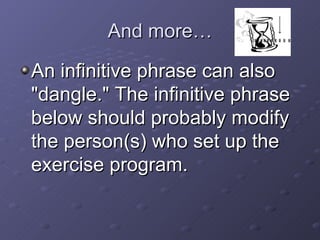
And more… An infinitive phrase can also "dangle." The infinitive phrase below should probably modify the person(s) who set up the exercise program.
An infinitive phrase can also "dangle." The infinitive phrase below should probably modify the person(s) who set up the exercise program.
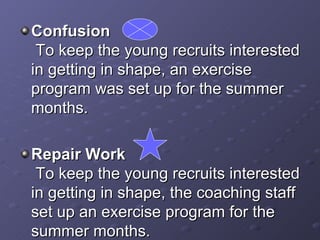
Confusion  To keep the young recruits interested in getting in shape, an exercise program was set up for the summer months.  Repair Work  To keep the young recruits interested in getting in shape, the coaching staff set up an exercise program for the summer months.
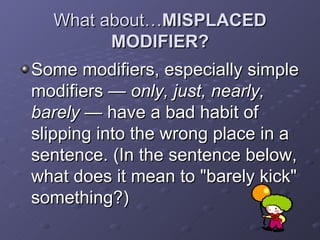
What about… MISPLACED MODIFIER? Some modifiers, especially simple modifiers —  only, just, nearly, barely  — have a bad habit of slipping into the wrong place in a sentence. (In the sentence below, what does it mean to "barely kick" something?)
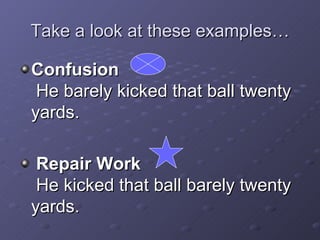
Take a look at these examples… Confusion   He barely kicked that ball twenty yards. Repair Work   He kicked that ball barely twenty yards.
Ready for drills?
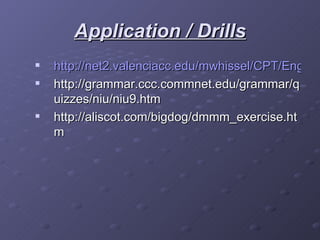
Application / Drills http://net2.valenciacc.edu/mwhissel/CPT/English/modifier_quiz01.htm http://grammar.ccc.commnet.edu/grammar/quizzes/niu/niu9.htm http://aliscot.com/bigdog/dmmm_exercise.htm
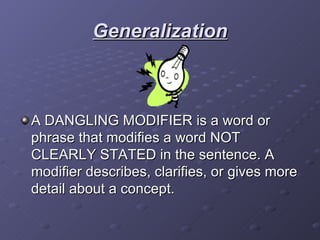
Generalization A DANGLING MODIFIER is a word or phrase that modifies a word NOT CLEARLY STATED in the sentence. A modifier describes, clarifies, or gives more detail about a concept.
I hope you learn something new…

Dangling modifiers

  • 1.
  • 2.
    Consider this sentence:Having finished the assignment , Jill turned on the TV.
  • 3.
    "Having finished" states an action but does not name the doer of that action. In English sentences, the doer must be the subject of the main clause that follows. In this sentence, it is Jill. She seems logically to be the one doing the action ("having finished"), and this sentence therefore does not have a dangling modifier.
  • 4.
    Now consider thissentence: Having finished the assignment , the TV was turned on.
  • 5.
    Having finished is a participle expressing action, but the doer is not the TV set (the subject of the main clause): TV sets don't finish assignments. Since the doer of the action expressed in the participle has not been clearly stated, the participial phrase is said to be a dangling modifier.
  • 6.
    Examples of danglingmodifiers and revisions: with dangling modifier: After reading the original study , the article remains convincing.
  • 7.
    possible revisions: Afterreading the original study , I find the article unconvincing.
  • 8.
    with dangling modifier:Relieved of our responsibilities at your job , your home should be a place to relax.
  • 9.
    possible revision: Relievedof your responsibilities at your job , you should be able to relax at home.
  • 10.
    Characteristics of danglingmodifiers: They most frequently occur at the beginning of sentences (often as introductory clauses or phrases) but can also appear at the end . Example of dangling modifier: The experiment was a failure, not having studied the lab manual carefully. (The experiment--the subject of the main clause--is not supposed to study the lab manual.)
  • 11.
    possible revision: They failed the experiment, not having studied the lab manual carefully. [They often have an -ing word (gerund) or a to+verb (infinitive) phrase near the start of the sentence.]
  • 12.
    Strategies for revisingdangling modifiers: 1. Name the appropriate or logical doer of the action as the subject of the main clause: Having arrived late for practice , a written excuse was needed. (Who arrived late? This sentence says that the written excuse arrived late. To revise, decide who actually arrived late. )
  • 13.
    2. Change thephrase that dangles into a complete introductory clause by naming the doer of the action in that clause : Without knowing his name , it was difficult to introduce him. (Who didn't know his name? This sentence says that "it" didn't know his name. To revise, decide who was trying to introduce him. )
  • 14.
    possible revision… BecauseMaria did not know his name, it was difficult to introduce him. (The phrase is now a complete introductory clause; it does not modify any other part of the sentence, so is not considered "dangling." )
  • 15.
    3. Combine thephrase and main clause into one: With dangling modifier: To improve his results , the experiment was done again. (Who wanted to improve results? This sentence says that the experiment was trying to improve its own results. To revise, combine the phrase and the main clause into one sentence.) He improved his results by doing the experiment again.
  • 16.
    Basic Principle: Modifiersare like teenagers: they fall in love with whatever they're next to. Make sure they're next to something they ought to modify!
  • 17.
    DANGLING MODIFIER Whenwe begin a sentence with a modifying word, phrase, or clause, we must make sure the next thing that comes along can, in fact, be modified by that modifier. When a modifier improperly modifies something, it is called a "dangling modifier." This often happens with beginning participial phrases , making "dangling participles" an all too common phenomenon. In the sentence below, we can't have a car changing its own oil.
  • 18.
    Confusion Changingthe oil every 3,000 miles, the car seemed to run better. Repair Work Changing the oil every 3,000 miles, Fred found he could get much better gas mileage.
  • 19.
    Another example.. Confusion Changing the oil every 3,000 miles, there is an easy way to keep your car running smoothly. Repair Work If we change the oil every 3,000 miles, we can keep our car running smoothly.
  • 20.
    What to do?This faulty sentence can be remedied by changing the participial phrase into a full-fledged clause with a subject and verb.
  • 21.
    But wait… there’smore… A participial phrase followed by a Passive Verb is also apt to be a dangler because the real actor of the sentence will be disguised.
  • 22.
    Confusion Changingthe oil every 3,000 miles, the car was kept in excellent condition. Repair Work Changing the oil every 3,000 miles, we kept the car in excellent condition.
  • 23.
    And more… Aninfinitive phrase can also "dangle." The infinitive phrase below should probably modify the person(s) who set up the exercise program.
  • 24.
    An infinitive phrasecan also "dangle." The infinitive phrase below should probably modify the person(s) who set up the exercise program.
  • 25.
    Confusion Tokeep the young recruits interested in getting in shape, an exercise program was set up for the summer months. Repair Work To keep the young recruits interested in getting in shape, the coaching staff set up an exercise program for the summer months.
  • 26.
    What about… MISPLACEDMODIFIER? Some modifiers, especially simple modifiers — only, just, nearly, barely — have a bad habit of slipping into the wrong place in a sentence. (In the sentence below, what does it mean to "barely kick" something?)
  • 27.
    Take a lookat these examples… Confusion He barely kicked that ball twenty yards. Repair Work He kicked that ball barely twenty yards.
  • 28.
  • 29.
    Application / Drillshttp://net2.valenciacc.edu/mwhissel/CPT/English/modifier_quiz01.htm http://grammar.ccc.commnet.edu/grammar/quizzes/niu/niu9.htm http://aliscot.com/bigdog/dmmm_exercise.htm
  • 30.
    Generalization A DANGLINGMODIFIER is a word or phrase that modifies a word NOT CLEARLY STATED in the sentence. A modifier describes, clarifies, or gives more detail about a concept.
  • 31.
    I hope youlearn something new…