Unit 5 (2) - Solutions
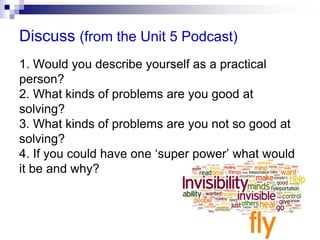
Discuss (from the Unit 5 Podcast)
1. Would you describe yourself as a practical
person?
2. What kinds of problems are you good at
solving?
3. What kinds of problems are you not so good at
solving?
4. If you could have one ‘super power’ what would
it be and why?
Comparatives & Superlatives review
Fill in the blanks
We use ~er / the ~est when the adjective has __ syllable(s)
OR has __ syllable(s) and ends with the letter __.
We use more (less) ~ than / the most(least) ~ when the
adjective has __ or more syllables.
We can use modifier words like __, __ or __ to show a big
difference, and __, __ or __ to show a small difference.
To emphasize, we can use __.
P. 57, 4B – fill in the blanks
5A - fill in the blanks
Discuss
[*Fun/funny: fun = enjoyable; funny = makes you laugh]
 What do you think is the funniest TV show or movie you have
seen recently? Why?
 Which campus is more fun* – Sinchon or Songdo? Why?
 *fun is an exception  more fun / the most fun; not funner/ the funnest
 What’s the biggest meal you’ve ever eaten? How did you feel
afterwards?
 Who is the friendliest person you’ve met this semester?
 Which subject was harder in high school – math or English?
Why?
 Who is the most interesting person you know? Why?
 Would you prefer to have a longer life or a more exciting life?
Why?
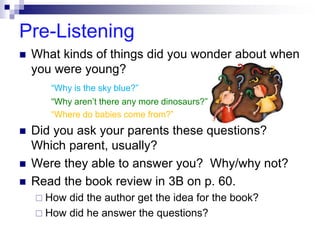
Pre-Listening
 What kinds of things did you wonder about when
you were young?
“Why is the sky blue?”
“Why aren’t there any more dinosaurs?”
“Where do babies come from?”
 Did you ask your parents these questions?
Which parent, usually?
 Were they able to answer you? Why/why not?
 Read the book review in 3B on p. 60.
 How did the author get the idea for the book?
 How did he answer the questions?
Question tags
To agree, you must use the same form (positive or
negative) as in the first part (the statement):
e.g. You live in Songdo, don’t you?
Yes, I do (live in Songdo).
You aren’t Japanese, are you?
No, I’m not (Japanese).
To disagree, you must use the same form (positive or
negative) as in the last part (the tag):
e.g. You live in Seoul, don’t you?
[Actually,] No, I don’t (live in Seoul).
You aren’t Korean, are you?
[Actually,] Yes, I am (Korean).
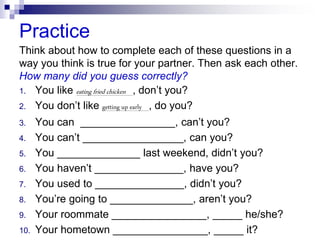
Practice
Think about how to complete each of these questions in a
way you think is true for your partner. Then ask each other.
How many did you guess correctly?
1. You like eating fried chicken , don’t you?
2. You don’t like getting up early , do you?
3. You can ________________, can’t you?
4. You can’t _________________, can you?
5. You ______________ last weekend, didn’t you?
6. You haven’t _______________, have you?
7. You used to _______________, didn’t you?
8. You’re going to ______________, aren’t you?
9. Your roommate ________________, _____ he/she?
10. Your hometown ________________, _____ it?

Speakout Unit 5 (2)

  • 1.
    Unit 5 (2)- Solutions
  • 2.
    Discuss (from theUnit 5 Podcast) 1. Would you describe yourself as a practical person? 2. What kinds of problems are you good at solving? 3. What kinds of problems are you not so good at solving? 4. If you could have one ‘super power’ what would it be and why?
  • 3.
    Comparatives & Superlativesreview Fill in the blanks We use ~er / the ~est when the adjective has __ syllable(s) OR has __ syllable(s) and ends with the letter __. We use more (less) ~ than / the most(least) ~ when the adjective has __ or more syllables. We can use modifier words like __, __ or __ to show a big difference, and __, __ or __ to show a small difference. To emphasize, we can use __. P. 57, 4B – fill in the blanks 5A - fill in the blanks
  • 4.
    Discuss [*Fun/funny: fun =enjoyable; funny = makes you laugh]  What do you think is the funniest TV show or movie you have seen recently? Why?  Which campus is more fun* – Sinchon or Songdo? Why?  *fun is an exception  more fun / the most fun; not funner/ the funnest  What’s the biggest meal you’ve ever eaten? How did you feel afterwards?  Who is the friendliest person you’ve met this semester?  Which subject was harder in high school – math or English? Why?  Who is the most interesting person you know? Why?  Would you prefer to have a longer life or a more exciting life? Why?
  • 5.
    Pre-Listening  What kindsof things did you wonder about when you were young? “Why is the sky blue?” “Why aren’t there any more dinosaurs?” “Where do babies come from?”  Did you ask your parents these questions? Which parent, usually?  Were they able to answer you? Why/why not?  Read the book review in 3B on p. 60.  How did the author get the idea for the book?  How did he answer the questions?
  • 6.
    Question tags To agree,you must use the same form (positive or negative) as in the first part (the statement): e.g. You live in Songdo, don’t you? Yes, I do (live in Songdo). You aren’t Japanese, are you? No, I’m not (Japanese). To disagree, you must use the same form (positive or negative) as in the last part (the tag): e.g. You live in Seoul, don’t you? [Actually,] No, I don’t (live in Seoul). You aren’t Korean, are you? [Actually,] Yes, I am (Korean).
  • 7.
    Practice Think about howto complete each of these questions in a way you think is true for your partner. Then ask each other. How many did you guess correctly? 1. You like eating fried chicken , don’t you? 2. You don’t like getting up early , do you? 3. You can ________________, can’t you? 4. You can’t _________________, can you? 5. You ______________ last weekend, didn’t you? 6. You haven’t _______________, have you? 7. You used to _______________, didn’t you? 8. You’re going to ______________, aren’t you? 9. Your roommate ________________, _____ he/she? 10. Your hometown ________________, _____ it?