Sentence Structure
By:
Saveeda Hina
Sentence
 The sentence is generally defined as a word or a group of words
that expresses a complete idea by giving a statement/order, or
asking a question, or exclaiming.
Example:
 He is a good boy (statement), Is he a good boy? (question), What
a nice weather! (exclaiming).
 Ideally, a sentence requires at least one subject and one verb.
Sometimes the subject of a sentence can be hidden, but the verb
must be visible and present in the sentence. Verb is called the
heart of a sentence.
 Example:
 Do it. (In this sentence, a subject ‘you’ is hidden but verb ‘do’ is
visible)
 “[A sentence is] a group of words, usually containing a verb,
that expresses a thought in the form of
a statement, question, instruction, or exclamation and starts with
a capital letter when written.” - (Cambridge Advanced Learner’s
Dictionary & Thesaurus © Cambridge University Press.)
Christian Lehmann
 "The sentence has been defined as the largest unit for which there
are rules of grammar."
 (Christian Lehmann, "Theoretical Implications of
Grammaticalization Phenomena," Published in "The Role of
Theory in Language Description," ed. by William A. Foley.
Mouton de Gruyter, 1993)
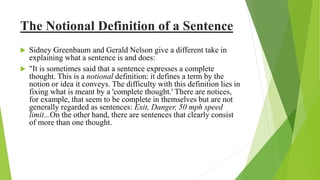
The Notional Definition of a Sentence
 Sidney Greenbaum and Gerald Nelson give a different take in
explaining what a sentence is and does:
 "It is sometimes said that a sentence expresses a complete
thought. This is a notional definition: it defines a term by the
notion or idea it conveys. The difficulty with this definition lies in
fixing what is meant by a 'complete thought.' There are notices,
for example, that seem to be complete in themselves but are not
generally regarded as sentences: Exit, Danger, 50 mph speed
limit...On the other hand, there are sentences that clearly consist
of more than one thought.
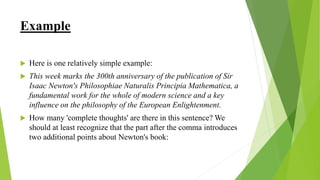
Example
 Here is one relatively simple example:
 This week marks the 300th anniversary of the publication of Sir
Isaac Newton's Philosophiae Naturalis Principia Mathematica, a
fundamental work for the whole of modern science and a key
influence on the philosophy of the European Enlightenment.
 How many 'complete thoughts' are there in this sentence? We
should at least recognize that the part after the comma introduces
two additional points about Newton's book:
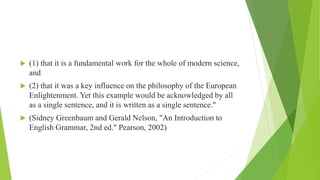
 (1) that it is a fundamental work for the whole of modern science,
and
 (2) that it was a key influence on the philosophy of the European
Enlightenment. Yet this example would be acknowledged by all
as a single sentence, and it is written as a single sentence."
 (Sidney Greenbaum and Gerald Nelson, "An Introduction to
English Grammar, 2nd ed." Pearson, 2002)
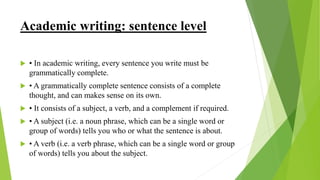
Academic writing: sentence level
 • In academic writing, every sentence you write must be
grammatically complete.
 • A grammatically complete sentence consists of a complete
thought, and can makes sense on its own.
 • It consists of a subject, a verb, and a complement if required.
 • A subject (i.e. a noun phrase, which can be a single word or
group of words) tells you who or what the sentence is about.
 • A verb (i.e. a verb phrase, which can be a single word or group
of words) tells you about the subject.
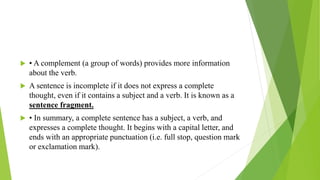
 • A complement (a group of words) provides more information
about the verb.
 A sentence is incomplete if it does not express a complete
thought, even if it contains a subject and a verb. It is known as a
sentence fragment.
 • In summary, a complete sentence has a subject, a verb, and
expresses a complete thought. It begins with a capital letter, and
ends with an appropriate punctuation (i.e. full stop, question mark
or exclamation mark).
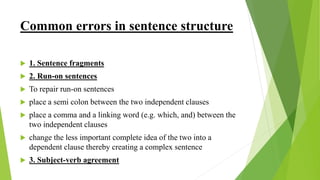
Common errors in sentence structure
 1. Sentence fragments
 2. Run-on sentences
 To repair run-on sentences
 place a semi colon between the two independent clauses
 place a comma and a linking word (e.g. which, and) between the
two independent clauses
 change the less important complete idea of the two into a
dependent clause thereby creating a complex sentence
 3. Subject-verb agreement
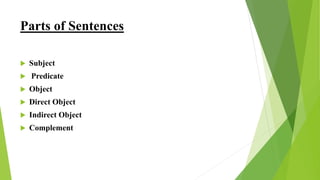
Parts of Sentences
 Subject
 Predicate
 Object
 Direct Object
 Indirect Object
 Complement
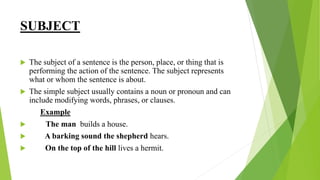
SUBJECT
 The subject of a sentence is the person, place, or thing that is
performing the action of the sentence. The subject represents
what or whom the sentence is about.
 The simple subject usually contains a noun or pronoun and can
include modifying words, phrases, or clauses.
Example
 The man builds a house.
 A barking sound the shepherd hears.
 On the top of the hill lives a hermit.
PREDICATE
 The predicate expresses action or being within the sentence. The
simple predicate contains the verb and can also contain modifying
words, phrases, or clauses.
Examples
 The man builds a house.
 A barking sound the shepherd hears.
 On the top of the hill lives a hermit.
 The subject and predicate make up the two basic structural parts
of any complete sentence.
 In addition, there are other elements, contained within the subject
or predicate, that add meaning or detail. These elements include
the direct object, indirect object, and subject complement.
OBJECT
 An object in grammar is a part of a sentence, and often part of
the predicate. It refers to someone or something involved in
the subject's "performance" of the verb.
 The direct object is the receiver of the action mentioned in the
sentence.
 A direct object answers the question "what?" or "who?"
Examples
 The man builds a house.
 A boy is playing football.
 We planted a tree.
INDIRECT OBJECT
 The indirect object indicates to whom or for whom the action of
the sentence is being done. The indirect object is usually a noun
or pronoun.
Examples
 The man builds his family a house.
 The man builds them a house.
 My mother bought me a dictionary. ( ‘a dictionary’ is for ‘me’.)
 We sent our boss a report. ( ‘a report’ is for ‘our boss’.)
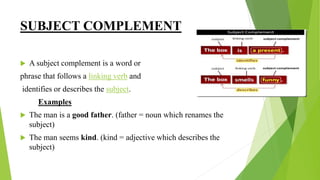
SUBJECT COMPLEMENT
 A subject complement is a word or
phrase that follows a linking verb and
identifies or describes the subject.
Examples
 The man is a good father. (father = noun which renames the
subject)
 The man seems kind. (kind = adjective which describes the
subject)
Structure Of Sentence
 Sentences are made up of clauses and phrases. All sentences must
have at least one independent clause.
 Clauses
A clause is a group of words which has
 a single idea expressed by atleast two elements: the subject and
verb. Sometimes there is a third element can be an object or
compliment.
 The subject is the actor performing the action.
 The verb is the action being performed.
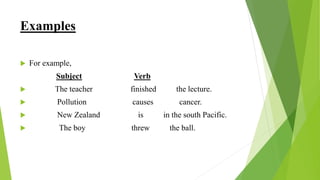
Examples
 For example,
Subject Verb
 The teacher finished the lecture.
 Pollution causes cancer.
 New Zealand is in the south Pacific.
 The boy threw the ball.
Kinds Of Clauses
 There are two kinds of clauses: independent (or main) clauses and
dependent (or subordinate) clauses.
Independent Clause
 An independent clause expresses a complete thought and can
stand on its own as a sentence.
Dependent Clause
 A dependent clause does not express a complete thought and
needs to be joined to an independent clause to become a sentence.
It usually begins with a word such as although, while, because,
who, which, if, etc.
Examples
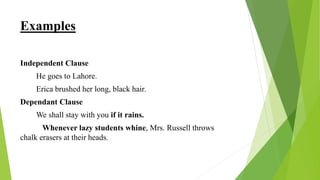
Independent Clause
He goes to Lahore.
Erica brushed her long, black hair.
Dependant Clause
We shall stay with you if it rains.
Whenever lazy students whine, Mrs. Russell throws
chalk erasers at their heads.
Expanding The Clause
 A simple clause can be expanded to provide more detailed
information.
 This is accomplished by adding adjectives and adverbs to the
word groups in the clause.
 Adjectives and adverbs are usually kept immediately beside
what they describe.
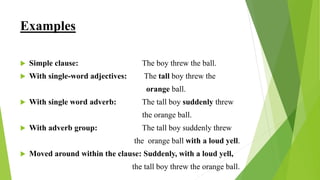
Examples
 Simple clause: The boy threw the ball.
 With single-word adjectives: The tall boy threw the
orange ball.
 With single word adverb: The tall boy suddenly threw
the orange ball.
 With adverb group: The tall boy suddenly threw
the orange ball with a loud yell.
 Moved around within the clause: Suddenly, with a loud yell,
the tall boy threw the orange ball.
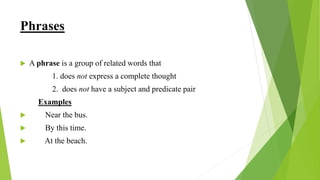
Phrases
 A phrase is a group of related words that
1. does not express a complete thought
2. does not have a subject and predicate pair
Examples
 Near the bus.
 By this time.
 At the beach.
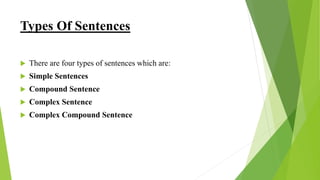
Types Of Sentences
 There are four types of sentences which are:
 Simple Sentences
 Compound Sentence
 Complex Sentence
 Complex Compound Sentence
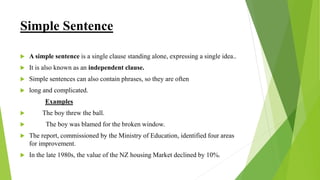
Simple Sentence
 A simple sentence is a single clause standing alone, expressing a single idea..
 It is also known as an independent clause.
 Simple sentences can also contain phrases, so they are often
 long and complicated.
Examples
 The boy threw the ball.
 The boy was blamed for the broken window.
 The report, commissioned by the Ministry of Education, identified four areas
for improvement.
 In the late 1980s, the value of the NZ housing Market declined by 10%.
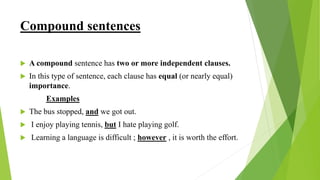
Compound sentences
 A compound sentence has two or more independent clauses.
 In this type of sentence, each clause has equal (or nearly equal)
importance.
Examples
 The bus stopped, and we got out.
 I enjoy playing tennis, but I hate playing golf.
 Learning a language is difficult ; however , it is worth the effort.
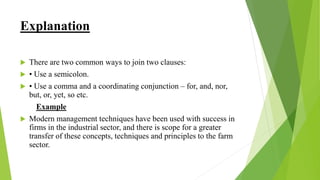
Explanation
 There are two common ways to join two clauses:
 • Use a semicolon.
 • Use a comma and a coordinating conjunction – for, and, nor,
but, or, yet, so etc.
Example
 Modern management techniques have been used with success in
firms in the industrial sector, and there is scope for a greater
transfer of these concepts, techniques and principles to the farm
sector.
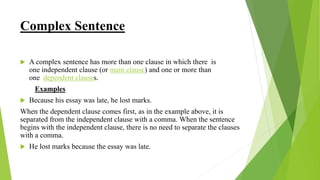
Complex Sentence
 A complex sentence has more than one clause in which there is
one independent clause (or main clause) and one or more than
one dependent clauses.
Examples
 Because his essay was late, he lost marks.
When the dependent clause comes first, as in the example above, it is
separated from the independent clause with a comma. When the sentence
begins with the independent clause, there is no need to separate the clauses
with a comma.
 He lost marks because the essay was late.
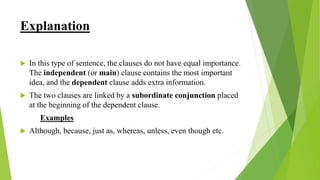
Explanation
 In this type of sentence, the clauses do not have equal importance.
The independent (or main) clause contains the most important
idea, and the dependent clause adds extra information.
 The two clauses are linked by a subordinate conjunction placed
at the beginning of the dependent clause.
Examples
 Although, because, just as, whereas, unless, even though etc.
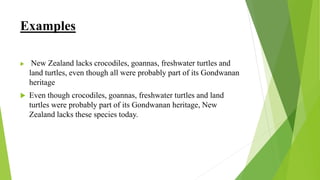
Examples
 New Zealand lacks crocodiles, goannas, freshwater turtles and
land turtles, even though all were probably part of its Gondwanan
heritage
 Even though crocodiles, goannas, freshwater turtles and land
turtles were probably part of its Gondwanan heritage, New
Zealand lacks these species today.
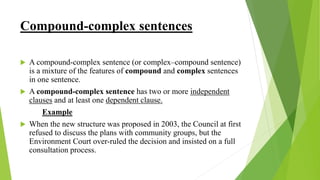
Compound-complex sentences
 A compound-complex sentence (or complex–compound sentence)
is a mixture of the features of compound and complex sentences
in one sentence.
 A compound-complex sentence has two or more independent
clauses and at least one dependent clause.
Example
 When the new structure was proposed in 2003, the Council at first
refused to discuss the plans with community groups, but the
Environment Court over-ruled the decision and insisted on a full
consultation process.
Types Of Sentences By Function
 Functionally, sentences are of mainly four types:
 Declarative sentence
 Imperative sentence
 Interrogative sentence,
 Exclamatory sentence
Declarative sentence
 An assertive sentence (declarative sentence) simply expresses an
opinion/feeling, or makes a statement, or describes things. In
other words, it declares something.
Examples:
 I want to be a good cricketer. (a statement)
 I am very happy today. (a feeling)
Imperative sentence:
 We use an imperative sentence to make a request or to give a
command. Imperative sentences usually end with a period (i.e., a
full stop), but under certain circumstances, it can end with a note
of exclamation (i.e., exclamation mark).
Examples:
 Please sit down.
 I need you to sit down now!
Interrogative sentence
 An interrogative sentence asks a question. Interrogative
sentences must end with a note of interrogation (i.e., question
mark)
Examples:
 When are you going to submit your assignment?
 Do you know him?
Exclamatory sentence
 An exclamatory sentence expresses overflow of emotions. These
emotions can be of happiness, wonder, sorrow, anger, etc.
 Examples:
 What a day it was!
 I cannot believe he would do that!
Thank You

Sentence structure

  • 1.
  • 2.
    Sentence  The sentenceis generally defined as a word or a group of words that expresses a complete idea by giving a statement/order, or asking a question, or exclaiming. Example:  He is a good boy (statement), Is he a good boy? (question), What a nice weather! (exclaiming).  Ideally, a sentence requires at least one subject and one verb. Sometimes the subject of a sentence can be hidden, but the verb must be visible and present in the sentence. Verb is called the heart of a sentence.
  • 3.
     Example:  Doit. (In this sentence, a subject ‘you’ is hidden but verb ‘do’ is visible)  “[A sentence is] a group of words, usually containing a verb, that expresses a thought in the form of a statement, question, instruction, or exclamation and starts with a capital letter when written.” - (Cambridge Advanced Learner’s Dictionary & Thesaurus © Cambridge University Press.)
  • 4.
    Christian Lehmann  "Thesentence has been defined as the largest unit for which there are rules of grammar."  (Christian Lehmann, "Theoretical Implications of Grammaticalization Phenomena," Published in "The Role of Theory in Language Description," ed. by William A. Foley. Mouton de Gruyter, 1993)
  • 5.
    The Notional Definitionof a Sentence  Sidney Greenbaum and Gerald Nelson give a different take in explaining what a sentence is and does:  "It is sometimes said that a sentence expresses a complete thought. This is a notional definition: it defines a term by the notion or idea it conveys. The difficulty with this definition lies in fixing what is meant by a 'complete thought.' There are notices, for example, that seem to be complete in themselves but are not generally regarded as sentences: Exit, Danger, 50 mph speed limit...On the other hand, there are sentences that clearly consist of more than one thought.
  • 6.
    Example  Here isone relatively simple example:  This week marks the 300th anniversary of the publication of Sir Isaac Newton's Philosophiae Naturalis Principia Mathematica, a fundamental work for the whole of modern science and a key influence on the philosophy of the European Enlightenment.  How many 'complete thoughts' are there in this sentence? We should at least recognize that the part after the comma introduces two additional points about Newton's book:
  • 7.
     (1) thatit is a fundamental work for the whole of modern science, and  (2) that it was a key influence on the philosophy of the European Enlightenment. Yet this example would be acknowledged by all as a single sentence, and it is written as a single sentence."  (Sidney Greenbaum and Gerald Nelson, "An Introduction to English Grammar, 2nd ed." Pearson, 2002)
  • 8.
    Academic writing: sentencelevel  • In academic writing, every sentence you write must be grammatically complete.  • A grammatically complete sentence consists of a complete thought, and can makes sense on its own.  • It consists of a subject, a verb, and a complement if required.  • A subject (i.e. a noun phrase, which can be a single word or group of words) tells you who or what the sentence is about.  • A verb (i.e. a verb phrase, which can be a single word or group of words) tells you about the subject.
  • 9.
     • Acomplement (a group of words) provides more information about the verb.  A sentence is incomplete if it does not express a complete thought, even if it contains a subject and a verb. It is known as a sentence fragment.  • In summary, a complete sentence has a subject, a verb, and expresses a complete thought. It begins with a capital letter, and ends with an appropriate punctuation (i.e. full stop, question mark or exclamation mark).
  • 10.
    Common errors insentence structure  1. Sentence fragments  2. Run-on sentences  To repair run-on sentences  place a semi colon between the two independent clauses  place a comma and a linking word (e.g. which, and) between the two independent clauses  change the less important complete idea of the two into a dependent clause thereby creating a complex sentence  3. Subject-verb agreement
  • 11.
    Parts of Sentences Subject  Predicate  Object  Direct Object  Indirect Object  Complement
  • 12.
    SUBJECT  The subjectof a sentence is the person, place, or thing that is performing the action of the sentence. The subject represents what or whom the sentence is about.  The simple subject usually contains a noun or pronoun and can include modifying words, phrases, or clauses. Example  The man builds a house.  A barking sound the shepherd hears.  On the top of the hill lives a hermit.
  • 13.
    PREDICATE  The predicateexpresses action or being within the sentence. The simple predicate contains the verb and can also contain modifying words, phrases, or clauses. Examples  The man builds a house.  A barking sound the shepherd hears.  On the top of the hill lives a hermit.
  • 14.
     The subjectand predicate make up the two basic structural parts of any complete sentence.  In addition, there are other elements, contained within the subject or predicate, that add meaning or detail. These elements include the direct object, indirect object, and subject complement.
  • 15.
    OBJECT  An objectin grammar is a part of a sentence, and often part of the predicate. It refers to someone or something involved in the subject's "performance" of the verb.  The direct object is the receiver of the action mentioned in the sentence.  A direct object answers the question "what?" or "who?" Examples  The man builds a house.  A boy is playing football.  We planted a tree.
  • 16.
    INDIRECT OBJECT  Theindirect object indicates to whom or for whom the action of the sentence is being done. The indirect object is usually a noun or pronoun. Examples  The man builds his family a house.  The man builds them a house.  My mother bought me a dictionary. ( ‘a dictionary’ is for ‘me’.)  We sent our boss a report. ( ‘a report’ is for ‘our boss’.)
  • 17.
    SUBJECT COMPLEMENT  Asubject complement is a word or phrase that follows a linking verb and identifies or describes the subject. Examples  The man is a good father. (father = noun which renames the subject)  The man seems kind. (kind = adjective which describes the subject)
  • 18.
    Structure Of Sentence Sentences are made up of clauses and phrases. All sentences must have at least one independent clause.  Clauses A clause is a group of words which has  a single idea expressed by atleast two elements: the subject and verb. Sometimes there is a third element can be an object or compliment.  The subject is the actor performing the action.  The verb is the action being performed.
  • 19.
    Examples  For example, SubjectVerb  The teacher finished the lecture.  Pollution causes cancer.  New Zealand is in the south Pacific.  The boy threw the ball.
  • 20.
    Kinds Of Clauses There are two kinds of clauses: independent (or main) clauses and dependent (or subordinate) clauses. Independent Clause  An independent clause expresses a complete thought and can stand on its own as a sentence. Dependent Clause  A dependent clause does not express a complete thought and needs to be joined to an independent clause to become a sentence. It usually begins with a word such as although, while, because, who, which, if, etc.
  • 21.
    Examples Independent Clause He goesto Lahore. Erica brushed her long, black hair. Dependant Clause We shall stay with you if it rains. Whenever lazy students whine, Mrs. Russell throws chalk erasers at their heads.
  • 22.
    Expanding The Clause A simple clause can be expanded to provide more detailed information.  This is accomplished by adding adjectives and adverbs to the word groups in the clause.  Adjectives and adverbs are usually kept immediately beside what they describe.
  • 23.
    Examples  Simple clause:The boy threw the ball.  With single-word adjectives: The tall boy threw the orange ball.  With single word adverb: The tall boy suddenly threw the orange ball.  With adverb group: The tall boy suddenly threw the orange ball with a loud yell.  Moved around within the clause: Suddenly, with a loud yell, the tall boy threw the orange ball.
  • 24.
    Phrases  A phraseis a group of related words that 1. does not express a complete thought 2. does not have a subject and predicate pair Examples  Near the bus.  By this time.  At the beach.
  • 25.
    Types Of Sentences There are four types of sentences which are:  Simple Sentences  Compound Sentence  Complex Sentence  Complex Compound Sentence
  • 26.
    Simple Sentence  Asimple sentence is a single clause standing alone, expressing a single idea..  It is also known as an independent clause.  Simple sentences can also contain phrases, so they are often  long and complicated. Examples  The boy threw the ball.  The boy was blamed for the broken window.  The report, commissioned by the Ministry of Education, identified four areas for improvement.  In the late 1980s, the value of the NZ housing Market declined by 10%.
  • 27.
    Compound sentences  Acompound sentence has two or more independent clauses.  In this type of sentence, each clause has equal (or nearly equal) importance. Examples  The bus stopped, and we got out.  I enjoy playing tennis, but I hate playing golf.  Learning a language is difficult ; however , it is worth the effort.
  • 28.
    Explanation  There aretwo common ways to join two clauses:  • Use a semicolon.  • Use a comma and a coordinating conjunction – for, and, nor, but, or, yet, so etc. Example  Modern management techniques have been used with success in firms in the industrial sector, and there is scope for a greater transfer of these concepts, techniques and principles to the farm sector.
  • 29.
    Complex Sentence  Acomplex sentence has more than one clause in which there is one independent clause (or main clause) and one or more than one dependent clauses. Examples  Because his essay was late, he lost marks. When the dependent clause comes first, as in the example above, it is separated from the independent clause with a comma. When the sentence begins with the independent clause, there is no need to separate the clauses with a comma.  He lost marks because the essay was late.
  • 30.
    Explanation  In thistype of sentence, the clauses do not have equal importance. The independent (or main) clause contains the most important idea, and the dependent clause adds extra information.  The two clauses are linked by a subordinate conjunction placed at the beginning of the dependent clause. Examples  Although, because, just as, whereas, unless, even though etc.
  • 31.
    Examples  New Zealandlacks crocodiles, goannas, freshwater turtles and land turtles, even though all were probably part of its Gondwanan heritage  Even though crocodiles, goannas, freshwater turtles and land turtles were probably part of its Gondwanan heritage, New Zealand lacks these species today.
  • 32.
    Compound-complex sentences  Acompound-complex sentence (or complex–compound sentence) is a mixture of the features of compound and complex sentences in one sentence.  A compound-complex sentence has two or more independent clauses and at least one dependent clause. Example  When the new structure was proposed in 2003, the Council at first refused to discuss the plans with community groups, but the Environment Court over-ruled the decision and insisted on a full consultation process.
  • 33.
    Types Of SentencesBy Function  Functionally, sentences are of mainly four types:  Declarative sentence  Imperative sentence  Interrogative sentence,  Exclamatory sentence
  • 34.
    Declarative sentence  Anassertive sentence (declarative sentence) simply expresses an opinion/feeling, or makes a statement, or describes things. In other words, it declares something. Examples:  I want to be a good cricketer. (a statement)  I am very happy today. (a feeling)
  • 35.
    Imperative sentence:  Weuse an imperative sentence to make a request or to give a command. Imperative sentences usually end with a period (i.e., a full stop), but under certain circumstances, it can end with a note of exclamation (i.e., exclamation mark). Examples:  Please sit down.  I need you to sit down now!
  • 36.
    Interrogative sentence  Aninterrogative sentence asks a question. Interrogative sentences must end with a note of interrogation (i.e., question mark) Examples:  When are you going to submit your assignment?  Do you know him?
  • 37.
    Exclamatory sentence  Anexclamatory sentence expresses overflow of emotions. These emotions can be of happiness, wonder, sorrow, anger, etc.  Examples:  What a day it was!  I cannot believe he would do that!
  • 38.