Sensor-based Nitrogen
Management for Cotton in
Coastal Plain Soils
Sensor-based Nitrogen
Management for Cotton in
Coastal Plain Soils
Phillip Williams, Ahmad Khalilian,
Michael Marshall, Jose Payero,
Ali Mirzakhani
71st SWCS International Annual Conference
Louisville, KY, July 24-27, 2016
ACKNOWLEDGMENTS
This Demonstration project is supported by:
USDA/NRCS CIG
Award No. 69-3A75-14-268
Clemson Public Service Activities
This Demonstration project is supported by:
USDA/NRCS CIG
Award No. 69-3A75-14-268
Clemson Public Service Activities
ClayClay
SandSand
Sandy LoamSandy Loam
Field variations result in the development
of plants with a tremendous amount of
growth variability, which have a major
impact on fertilizer management strategies.
Cotton Yield
CottonLint(lbs/acre)
Soil EC (mS/m)
R
2
= 0.9202
0
300
600
900
1200
0 2 4 6 8
Soil EC, at planting
N Rate (lbs/A)
LowEC: Medium High
0
500
1000
1500
2000
2500
0 20 40 60 80 100 120 140
Effects of soil EC and N rate on seed
cotton yields (lbs/acre)SeedCottonYield
 Several researchers have developed
algorithms for sensor-based N
applications for corn, cotton & wheat.
 However, due to higher precipitation,
significant variation in soil texture, low
soil organic matter content, and low
nutrient holding capacity of soils in
Coastal Plain regions, N-application
algorithms, developed at other regions,
either under- or over-estimated
nitrogen rates for crop production.
EC Zones
SeedCottonYield
Effects of Nitrogen Management
Systems on Cotton Yield
Clemson
Farmer
OSU
Low Medium High
0
500
1000
1500
2000
2500
3000
Clemson Yield Prediction Equations
INSEY
Seed Cotton Yield
y = 320.31e112.2x
R² = 0.761
y = 502.82e116.07x
R² = 0.8837
0
500
1000
1500
2000
2500
3000
3500
0 0.005 0.01 0.015 0.02 0.025
Irrigated
Dry Land
Algorithm Comparison
Clemson Algorithm OSU Algorithm
YP0= 235.96 e 2216.2 * INSEY
INSEY= NDVI/Cumulative 
GDD
RI = 1.8579 * RINDVI – 0.932
%N= 0.09
NUE = 0.50
(YP0 * RI –YP0) * %N
N Rate =
NUE
 YP0= 413.46 e104.98 * INSEY
 INSEY= NDVI/# Days After 
emergence
 RI = High NDVI/Field Avg. NDVI
 %N= 0.04
 NUE= 0.50
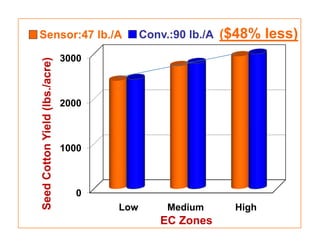
EC Zones
SeedCottonYield(lbs./acre)
Sensor:47 lb./A Conv.:90 lb./A ($48% less)
Low Medium High
0
1000
2000
3000
 On average, growers in the US apply
about 90 lb./acre N for cotton, for a
total of 1.7 million tons.
 Sensor-based N application has the
potential to reduce nitrogen rates by
half. Even a 20% reduction in
nitrogen rate could save our cotton
growers over $100 million annually.
Objective
To demonstrate the benefits of
sensor-based nitrogen
management strategies to growers,
utilizing plant NDVI, Clemson
algorithms for Irrigated and dry land
cotton, soil amendments, and soil
electrical conductivity (EC) data
(management zones).
Overall Objective
To assist cotton, corn, and wheat
farmers in the Southeastern
Coastal Plain region, to adopt
innovative and proven conservation
technologies for achieving 4R (right
source, rate, time, and place)
nutrient management.
Demonstration Sites (2015-16)
Al Cribb Farm
Walker Nix Farm
Jeff Lucas Farm
Williams Farm
JB Farms
Bates Farm
Edisto REC (3 sites)
Pee Dee REC (2 sites)
Identifying management zones
Establishing nitrogen rich strips
Measuring NDVI utilizing sensors
Calculating nitrogen requirements
Methods for Managing Nitrogen
Soil Electrical
Conductivity (EC) meter
EC Map, Cribb Farm
Identifying management zones
4 rows by 50 feet; More nitrogen than the
plants can use is applied (150 lbs/A for cotton).
Establishing nitrogen rich strips
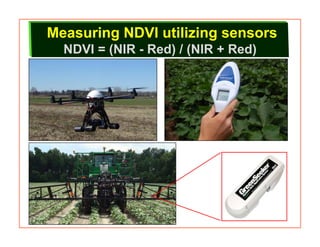
Measuring NDVI utilizing sensors
NDVI = (NIR - Red) / (NIR + Red)
Handheld Data Collection
• Handheld units
–Mobile
–Cost effective
• Only does small area
but gives average
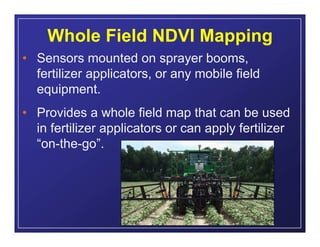
Whole Field NDVI Mapping
• Sensors mounted on sprayer booms,
fertilizer applicators, or any mobile field
equipment.
• Provides a whole field map that can be used
in fertilizer applicators or can apply fertilizer
“on-the-go”.
Aerial Mapping
• Unmanned Aerial Vehicle (UAV) can be
used to fly over fields and collect data that
can then be made into a prescription map.
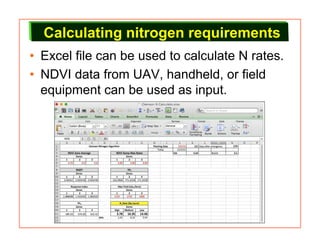
Calculating nitrogen requirements
• Excel file can be used to calculate N rates.
• NDVI data from UAV, handheld, or field
equipment can be used as input.
Mobile Application and Website
The application is designed for smartphones, tablets
and computers.
Planting Date
NDVI: N Rich Strip
NDVI: Field
Max Yield History
Irrigated or
Dryland
N-rates for each zone
Variable-rate Nitrogen Applicator
Rawson Hydraulic Controller
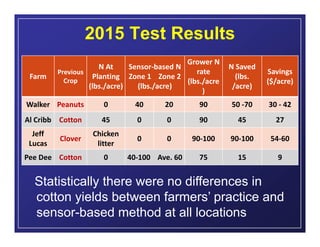
2015 Test Results
Farm
Previous 
Crop
N At 
Planting 
(lbs./acre)
Sensor‐based N 
Zone 1    Zone 2
(lbs./acre)
Grower N 
rate
(lbs./acre
)
N Saved 
(lbs. 
/acre)
Savings 
($/acre)
Walker Peanuts 0 40 20 90 50 ‐70 30 ‐ 42
Al Cribb Cotton 45 0 0 90 45 27
Jeff 
Lucas
Clover
Chicken 
litter
0 0 90‐100 90‐100 54‐60
Pee Dee Cotton 0 40‐100    Ave. 60 75 15 9
Statistically there were no differences in
cotton yields between farmers’ practice and
sensor-based method at all locations
There is a potential to use mid-
season plant NDVI data for variable-
rate application of N fertilizer in
cotton production, in a user friendly
manner that growers and extension
can utilize.
Summary
Soil EC management zones should be
used for calculating nitrogen
application rates in the Southeastern
Coastal Plain region. This in addition to
sensor technology can work in
conjunction to give growers more
information to make better
management decisions.
Summary
Soil amendments (such as poultry
litter) and/or previous crops (such as a
legume like peanuts or soybeans) had
a significant effect on required
nitrogen rates determined by a sensor.
Summary
 Sensor-based N management
techniques, reduced nitrogen usage
by 15 to 100 lbs./acre in cotton,
compared to growers‘ application
rates. This resulted in $9 to $60
savings/acre.
Summary
Questions?Questions?

Sensor nutrient management swcs williams

  • 1.
    Sensor-based Nitrogen Management forCotton in Coastal Plain Soils Sensor-based Nitrogen Management for Cotton in Coastal Plain Soils Phillip Williams, Ahmad Khalilian, Michael Marshall, Jose Payero, Ali Mirzakhani 71st SWCS International Annual Conference Louisville, KY, July 24-27, 2016
  • 2.
    ACKNOWLEDGMENTS This Demonstration projectis supported by: USDA/NRCS CIG Award No. 69-3A75-14-268 Clemson Public Service Activities This Demonstration project is supported by: USDA/NRCS CIG Award No. 69-3A75-14-268 Clemson Public Service Activities
  • 3.
  • 4.
    Field variations resultin the development of plants with a tremendous amount of growth variability, which have a major impact on fertilizer management strategies.
  • 5.
    Cotton Yield CottonLint(lbs/acre) Soil EC(mS/m) R 2 = 0.9202 0 300 600 900 1200 0 2 4 6 8 Soil EC, at planting
  • 6.
    N Rate (lbs/A) LowEC:Medium High 0 500 1000 1500 2000 2500 0 20 40 60 80 100 120 140 Effects of soil EC and N rate on seed cotton yields (lbs/acre)SeedCottonYield
  • 7.
     Several researchershave developed algorithms for sensor-based N applications for corn, cotton & wheat.  However, due to higher precipitation, significant variation in soil texture, low soil organic matter content, and low nutrient holding capacity of soils in Coastal Plain regions, N-application algorithms, developed at other regions, either under- or over-estimated nitrogen rates for crop production.
  • 8.
    EC Zones SeedCottonYield Effects ofNitrogen Management Systems on Cotton Yield Clemson Farmer OSU Low Medium High 0 500 1000 1500 2000 2500 3000
  • 9.
    Clemson Yield PredictionEquations INSEY Seed Cotton Yield y = 320.31e112.2x R² = 0.761 y = 502.82e116.07x R² = 0.8837 0 500 1000 1500 2000 2500 3000 3500 0 0.005 0.01 0.015 0.02 0.025 Irrigated Dry Land
  • 10.
    Algorithm Comparison Clemson AlgorithmOSU Algorithm YP0= 235.96 e 2216.2 * INSEY INSEY= NDVI/Cumulative  GDD RI = 1.8579 * RINDVI – 0.932 %N= 0.09 NUE = 0.50 (YP0 * RI –YP0) * %N N Rate = NUE  YP0= 413.46 e104.98 * INSEY  INSEY= NDVI/# Days After  emergence  RI = High NDVI/Field Avg. NDVI  %N= 0.04  NUE= 0.50
  • 11.
    EC Zones SeedCottonYield(lbs./acre) Sensor:47 lb./AConv.:90 lb./A ($48% less) Low Medium High 0 1000 2000 3000
  • 12.
     On average,growers in the US apply about 90 lb./acre N for cotton, for a total of 1.7 million tons.  Sensor-based N application has the potential to reduce nitrogen rates by half. Even a 20% reduction in nitrogen rate could save our cotton growers over $100 million annually.
  • 13.
    Objective To demonstrate thebenefits of sensor-based nitrogen management strategies to growers, utilizing plant NDVI, Clemson algorithms for Irrigated and dry land cotton, soil amendments, and soil electrical conductivity (EC) data (management zones).
  • 14.
    Overall Objective To assistcotton, corn, and wheat farmers in the Southeastern Coastal Plain region, to adopt innovative and proven conservation technologies for achieving 4R (right source, rate, time, and place) nutrient management.
  • 15.
    Demonstration Sites (2015-16) AlCribb Farm Walker Nix Farm Jeff Lucas Farm Williams Farm JB Farms Bates Farm Edisto REC (3 sites) Pee Dee REC (2 sites)
  • 16.
    Identifying management zones Establishingnitrogen rich strips Measuring NDVI utilizing sensors Calculating nitrogen requirements Methods for Managing Nitrogen
  • 17.
    Soil Electrical Conductivity (EC)meter EC Map, Cribb Farm Identifying management zones
  • 18.
    4 rows by50 feet; More nitrogen than the plants can use is applied (150 lbs/A for cotton). Establishing nitrogen rich strips
  • 19.
    Measuring NDVI utilizingsensors NDVI = (NIR - Red) / (NIR + Red)
  • 20.
    Handheld Data Collection •Handheld units –Mobile –Cost effective • Only does small area but gives average
  • 21.
    Whole Field NDVIMapping • Sensors mounted on sprayer booms, fertilizer applicators, or any mobile field equipment. • Provides a whole field map that can be used in fertilizer applicators or can apply fertilizer “on-the-go”.
  • 22.
    Aerial Mapping • UnmannedAerial Vehicle (UAV) can be used to fly over fields and collect data that can then be made into a prescription map.
  • 23.
    Calculating nitrogen requirements •Excel file can be used to calculate N rates. • NDVI data from UAV, handheld, or field equipment can be used as input.
  • 24.
    Mobile Application andWebsite The application is designed for smartphones, tablets and computers.
  • 25.
    Planting Date NDVI: NRich Strip NDVI: Field Max Yield History Irrigated or Dryland N-rates for each zone
  • 26.
  • 27.
    2015 Test Results Farm Previous  Crop N At  Planting  (lbs./acre) Sensor‐based N  Zone 1    Zone 2 (lbs./acre) Grower N  rate (lbs./acre ) N Saved  (lbs.  /acre) Savings  ($/acre) WalkerPeanuts 0 40 20 90 50 ‐70 30 ‐ 42 Al Cribb Cotton 45 0 0 90 45 27 Jeff  Lucas Clover Chicken  litter 0 0 90‐100 90‐100 54‐60 Pee Dee Cotton 0 40‐100    Ave. 60 75 15 9 Statistically there were no differences in cotton yields between farmers’ practice and sensor-based method at all locations
  • 28.
    There is apotential to use mid- season plant NDVI data for variable- rate application of N fertilizer in cotton production, in a user friendly manner that growers and extension can utilize. Summary
  • 29.
    Soil EC managementzones should be used for calculating nitrogen application rates in the Southeastern Coastal Plain region. This in addition to sensor technology can work in conjunction to give growers more information to make better management decisions. Summary
  • 30.
    Soil amendments (suchas poultry litter) and/or previous crops (such as a legume like peanuts or soybeans) had a significant effect on required nitrogen rates determined by a sensor. Summary
  • 31.
     Sensor-based Nmanagement techniques, reduced nitrogen usage by 15 to 100 lbs./acre in cotton, compared to growers‘ application rates. This resulted in $9 to $60 savings/acre. Summary
  • 32.