Funded in part by the soybean checkoff
Urban-Ag Partnerships: Middle Cedar
Partnership Project (MCPP)
Todd Sutphin
Iowa Soybean Association
2017 SWCS Conference Symposium
Leadership for Midwestern Watersheds
August 2, 2017
I S A R E S E A R C H
Advancing Agricultural Performance® and Environmental Stewardship
Funded in part by the soybean checkoff
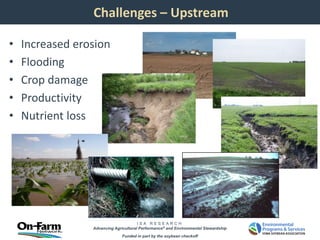
Challenges – Upstream
• Increased erosion
• Flooding
• Crop damage
• Productivity
• Nutrient loss
I S A R E S E A R C H
Advancing Agricultural Performance® and Environmental Stewardship
Funded in part by the soybean checkoff
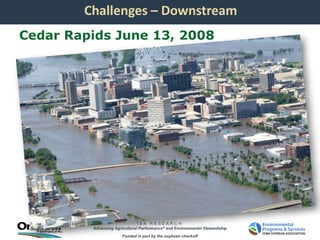
Cedar Rapids June 13, 2008
Challenges – Downstream
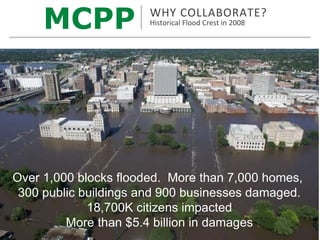
MCPP WHY COLLABORATE?
Historical Flood Crest in 2008
Over 1,000 blocks flooded. More than 7,000 homes,
300 public buildings and 900 businesses damaged.
18,700K citizens impacted
More than $5.4 billion in damages
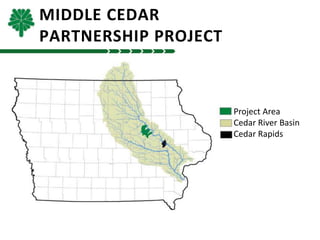
MIDDLE CEDAR
PARTNERSHIP PROJECT
Project Area
Cedar River Basin
Cedar Rapids
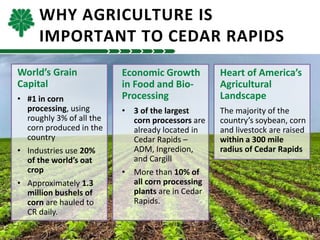
WHY AGRICULTURE IS
IMPORTANT TO CEDAR RAPIDS
WHY AGRICULTURE IS
IMPORTANT TO CEDAR RAPIDS
Heart of America’s
Agricultural
Landscape
The majority of the
country’s soybean, corn
and livestock are raised
within a 300 mile
radius of Cedar Rapids
World’s Grain
Capital
• #1 in corn
processing, using
roughly 3% of all the
corn produced in the
country
• Industries use 20%
of the world’s oat
crop
• Approximately 1.3
million bushels of
corn are hauled to
CR daily.
Economic Growth
in Food and Bio-
Processing
• 3 of the largest
corn processors are
already located in
Cedar Rapids –
ADM, Ingredion,
and Cargill
• More than 10% of
all corn processing
plants are in Cedar
Rapids.
2009 2010 2011 2012 2013 2014 2015
year
0
10
20
30
40
50
60
70
80
90
100
Daysavedailynitrateconcentration
was10mg/lorgreater
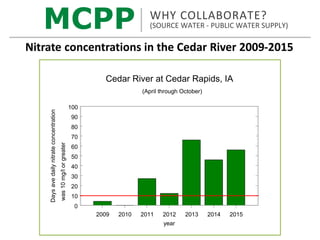
Cedar River at Cedar Rapids, IA
(April through October)
MCPP WHY COLLABORATE?
(SOURCE WATER - PUBLIC WATER SUPPLY)
Nitrate concentrations in the Cedar River 2009-2015
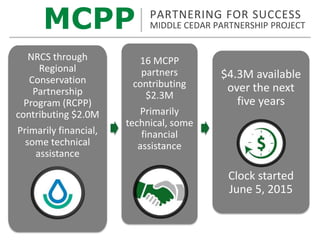
NRCS through
Regional
Conservation
Partnership
Program (RCPP)
contributing $2.0M
Primarily financial,
some technical
assistance
16 MCPP
partners
contributing
$2.3M
Primarily
technical, some
financial
assistance
$4.3M available
over the next
five years
Clock started
June 5, 2015
MCPP PARTNERING FOR SUCCESS
MIDDLE CEDAR PARTNERSHIP PROJECT
MCPP PARTNERING FOR SUCCESS
MIDDLE CEDAR PARTNERSHIP PROJECT
11
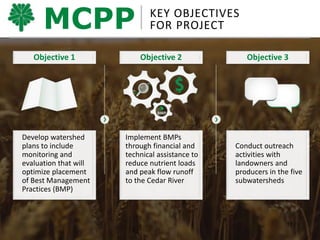
Objective 1
Implement BMPs
through financial and
technical assistance to
reduce nutrient loads
and peak flow runoff
to the Cedar River
Objective 2
Develop watershed
plans to include
monitoring and
evaluation that will
optimize placement
of Best Management
Practices (BMP)
Objective 3
Conduct outreach
activities with
landowners and
producers in the five
subwatersheds
MCPP KEY OBJECTIVES
FOR PROJECT
MCPP
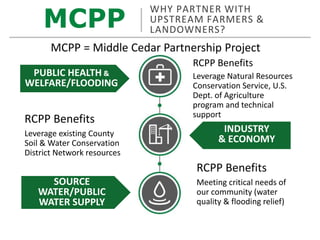
PUBLIC HEALTH &
WELFARE/FLOODING
SOURCE
WATER/PUBLIC
WATER SUPPLY
WHY PARTNER WITH
UPSTREAM FARMERS &
LANDOWNERS?
INDUSTRY
& ECONOMY
RCPP Benefits
Leverage existing County
Soil & Water Conservation
District Network resources
RCPP Benefits
Leverage Natural Resources
Conservation Service, U.S.
Dept. of Agriculture
program and technical
support
RCPP Benefits
Meeting critical needs of
our community (water
quality & flooding relief)
MCPP = Middle Cedar Partnership Project
Expanding Partnership Opportunities
• Iowa Water Quality Initiative (Miller Creek) ~$1+M
• Iowa Nutrient Reduction Demonstration Project
(Benton & Tama Counties) ~$1+M
• Iowa Flood Center – HUD Disaster Resilience Grant
($96.9M)
• Midwest Agriculture Water Quality Partnership (RCPP
2nd Round - $9.5M, project leverages total of $47M
MCPP LEVERAGING RESOURCES
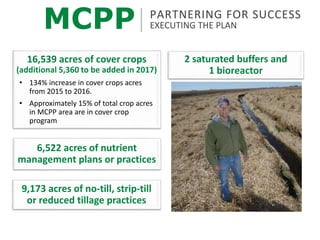
16,539 acres of cover crops
(additional 5,360 to be added in 2017)
• 134% increase in cover crops acres
from 2015 to 2016.
• Approximately 15% of total crop acres
in MCPP area are in cover crop
program
9,173 acres of no-till, strip-till
or reduced tillage practices
2 saturated buffers and
1 bioreactor
6,522 acres of nutrient
management plans or practices
MCPP PARTNERING FOR SUCCESS
EXECUTING THE PLAN
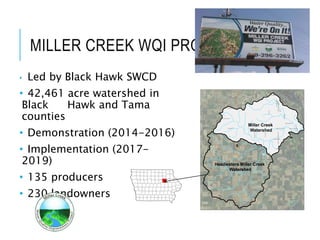
MILLER CREEK WQI PROJECT
• Led by Black Hawk SWCD
• 42,461 acre watershed in
Black Hawk and Tama
counties
• Demonstration (2014-2016)
• Implementation (2017-
2019)
• 135 producers
• 230 landowners
HessRd
Tama Rd
Eagle Rd
FoulkRd
AckerRd
DysartRd
Quarry Rd
KimballAve
Reinbeck Rd
HawkeyeRd
Washburn Rd
CotterRd
Schrock Rd
BeckRd
LaPorte
Rd
HammondAve
Orange Rd
AnsboroughAve
KlineRd
Griffith Rd
KoberRd
Petrie Rd
WeidenRd
GirschRd
CedarValleyNatureTrl
HoffRd
Ripple Rd
Miller Creek Rd
G
ilbertville
Rd
Payton Rd
3rd
St
Eastman Rd
5thSt
GolinvauxRd1stSt
McKevette Rd
Bienfang Dr
Aboretum Dr
Bristol Rd
Kennedy Ln
Lichty Blvd
Douglas Dr
PineSt
Rottinghaus Rd
Mc Kellar Rd
CommancheTrl
Vision St
McKellar Rd
North Ave
Millerdale Ct
Tama Rd
Miller Creek Rd
£¤218
rs21
Miller Creek
Wolf Creek
Miller Creek
Watershed
Headwaters Miller Creek
Watershed
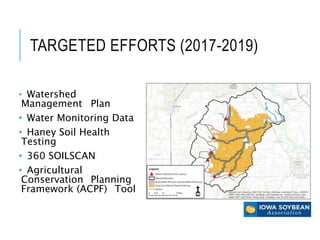
TARGETED EFFORTS (2017-2019)
• Watershed
Management Plan
• Water Monitoring Data
• Haney Soil Health
Testing
• 360 SOILSCAN
• Agricultural
Conservation Planning
Framework (ACPF) Tool
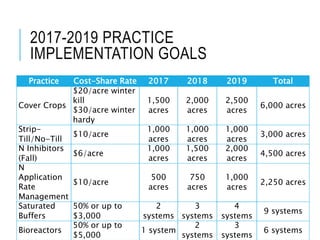
2017-2019 PRACTICE
IMPLEMENTATION GOALS
Practice Cost-Share Rate 2017 2018 2019 Total
Cover Crops
$20/acre winter
kill
$30/acre winter
hardy
1,500
acres
2,000
acres
2,500
acres
6,000 acres
Strip-
Till/No-Till
$10/acre
1,000
acres
1,000
acres
1,000
acres
3,000 acres
N Inhibitors
(Fall)
$6/acre
1,000
acres
1,500
acres
2,000
acres
4,500 acres
N
Application
Rate
Management
$10/acre
500
acres
750
acres
1,000
acres
2,250 acres
Saturated
Buffers
50% or up to
$3,000
2
systems
3
systems
4
systems
9 systems
Bioreactors
50% or up to
$5,000
1 system
2
systems
3
systems
6 systems
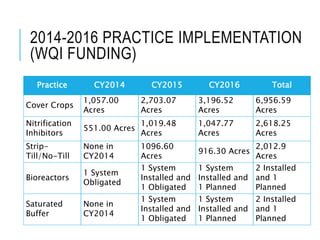
2014-2016 PRACTICE IMPLEMENTATION
(WQI FUNDING)
Practice CY2014 CY2015 CY2016 Total
Cover Crops
1,057.00
Acres
2,703.07
Acres
3,196.52
Acres
6,956.59
Acres
Nitrification
Inhibitors
551.00 Acres
1,019.48
Acres
1,047.77
Acres
2,618.25
Acres
Strip-
Till/No-Till
None in
CY2014
1096.60
Acres
916.30 Acres
2,012.9
Acres
Bioreactors
1 System
Obligated
1 System
Installed and
1 Obligated
1 System
Installed and
1 Planned
2 Installed
and 1
Planned
Saturated
Buffer
None in
CY2014
1 System
Installed and
1 Obligated
1 System
Installed and
1 Planned
2 Installed
and 1
Planned
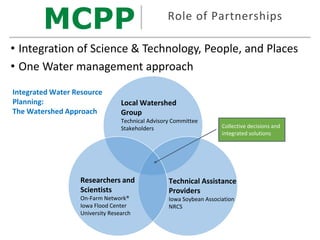
MCPP Role of Partnerships
• Integration of Science & Technology, People, and Places
• One Water management approach
Collective decisions and
integrated solutions
Integrated Water Resource
Planning:
The Watershed Approach
Researchers and
Scientists
On-Farm Network®
Iowa Flood Center
University Research
Local Watershed
Group
Technical Advisory Committee
Stakeholders
Technical Assistance
Providers
Iowa Soybean Association
NRCS
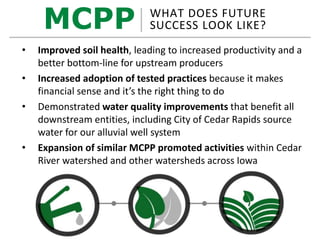
MCPP WHAT DOES FUTURE
SUCCESS LOOK LIKE?
• Improved soil health, leading to increased productivity and a
better bottom-line for upstream producers
• Increased adoption of tested practices because it makes
financial sense and it’s the right thing to do
• Demonstrated water quality improvements that benefit all
downstream entities, including City of Cedar Rapids source
water for our alluvial well system
• Expansion of similar MCPP promoted activities within Cedar
River watershed and other watersheds across Iowa

Urban-AG Partnerships

  • 1.
    Funded in partby the soybean checkoff Urban-Ag Partnerships: Middle Cedar Partnership Project (MCPP) Todd Sutphin Iowa Soybean Association 2017 SWCS Conference Symposium Leadership for Midwestern Watersheds August 2, 2017
  • 2.
    I S AR E S E A R C H Advancing Agricultural Performance® and Environmental Stewardship Funded in part by the soybean checkoff Challenges – Upstream • Increased erosion • Flooding • Crop damage • Productivity • Nutrient loss
  • 3.
    I S AR E S E A R C H Advancing Agricultural Performance® and Environmental Stewardship Funded in part by the soybean checkoff Cedar Rapids June 13, 2008 Challenges – Downstream
  • 4.
    MCPP WHY COLLABORATE? HistoricalFlood Crest in 2008 Over 1,000 blocks flooded. More than 7,000 homes, 300 public buildings and 900 businesses damaged. 18,700K citizens impacted More than $5.4 billion in damages
  • 5.
    MIDDLE CEDAR PARTNERSHIP PROJECT ProjectArea Cedar River Basin Cedar Rapids
  • 6.
  • 7.
    WHY AGRICULTURE IS IMPORTANTTO CEDAR RAPIDS Heart of America’s Agricultural Landscape The majority of the country’s soybean, corn and livestock are raised within a 300 mile radius of Cedar Rapids World’s Grain Capital • #1 in corn processing, using roughly 3% of all the corn produced in the country • Industries use 20% of the world’s oat crop • Approximately 1.3 million bushels of corn are hauled to CR daily. Economic Growth in Food and Bio- Processing • 3 of the largest corn processors are already located in Cedar Rapids – ADM, Ingredion, and Cargill • More than 10% of all corn processing plants are in Cedar Rapids.
  • 8.
    2009 2010 20112012 2013 2014 2015 year 0 10 20 30 40 50 60 70 80 90 100 Daysavedailynitrateconcentration was10mg/lorgreater Cedar River at Cedar Rapids, IA (April through October) MCPP WHY COLLABORATE? (SOURCE WATER - PUBLIC WATER SUPPLY) Nitrate concentrations in the Cedar River 2009-2015
  • 9.
    NRCS through Regional Conservation Partnership Program (RCPP) contributing$2.0M Primarily financial, some technical assistance 16 MCPP partners contributing $2.3M Primarily technical, some financial assistance $4.3M available over the next five years Clock started June 5, 2015 MCPP PARTNERING FOR SUCCESS MIDDLE CEDAR PARTNERSHIP PROJECT
  • 10.
    MCPP PARTNERING FORSUCCESS MIDDLE CEDAR PARTNERSHIP PROJECT
  • 11.
    11 Objective 1 Implement BMPs throughfinancial and technical assistance to reduce nutrient loads and peak flow runoff to the Cedar River Objective 2 Develop watershed plans to include monitoring and evaluation that will optimize placement of Best Management Practices (BMP) Objective 3 Conduct outreach activities with landowners and producers in the five subwatersheds MCPP KEY OBJECTIVES FOR PROJECT
  • 12.
    MCPP PUBLIC HEALTH & WELFARE/FLOODING SOURCE WATER/PUBLIC WATERSUPPLY WHY PARTNER WITH UPSTREAM FARMERS & LANDOWNERS? INDUSTRY & ECONOMY RCPP Benefits Leverage existing County Soil & Water Conservation District Network resources RCPP Benefits Leverage Natural Resources Conservation Service, U.S. Dept. of Agriculture program and technical support RCPP Benefits Meeting critical needs of our community (water quality & flooding relief) MCPP = Middle Cedar Partnership Project
  • 13.
    Expanding Partnership Opportunities •Iowa Water Quality Initiative (Miller Creek) ~$1+M • Iowa Nutrient Reduction Demonstration Project (Benton & Tama Counties) ~$1+M • Iowa Flood Center – HUD Disaster Resilience Grant ($96.9M) • Midwest Agriculture Water Quality Partnership (RCPP 2nd Round - $9.5M, project leverages total of $47M MCPP LEVERAGING RESOURCES
  • 14.
    16,539 acres ofcover crops (additional 5,360 to be added in 2017) • 134% increase in cover crops acres from 2015 to 2016. • Approximately 15% of total crop acres in MCPP area are in cover crop program 9,173 acres of no-till, strip-till or reduced tillage practices 2 saturated buffers and 1 bioreactor 6,522 acres of nutrient management plans or practices MCPP PARTNERING FOR SUCCESS EXECUTING THE PLAN
  • 15.
    MILLER CREEK WQIPROJECT • Led by Black Hawk SWCD • 42,461 acre watershed in Black Hawk and Tama counties • Demonstration (2014-2016) • Implementation (2017- 2019) • 135 producers • 230 landowners HessRd Tama Rd Eagle Rd FoulkRd AckerRd DysartRd Quarry Rd KimballAve Reinbeck Rd HawkeyeRd Washburn Rd CotterRd Schrock Rd BeckRd LaPorte Rd HammondAve Orange Rd AnsboroughAve KlineRd Griffith Rd KoberRd Petrie Rd WeidenRd GirschRd CedarValleyNatureTrl HoffRd Ripple Rd Miller Creek Rd G ilbertville Rd Payton Rd 3rd St Eastman Rd 5thSt GolinvauxRd1stSt McKevette Rd Bienfang Dr Aboretum Dr Bristol Rd Kennedy Ln Lichty Blvd Douglas Dr PineSt Rottinghaus Rd Mc Kellar Rd CommancheTrl Vision St McKellar Rd North Ave Millerdale Ct Tama Rd Miller Creek Rd £¤218 rs21 Miller Creek Wolf Creek Miller Creek Watershed Headwaters Miller Creek Watershed
  • 16.
    TARGETED EFFORTS (2017-2019) •Watershed Management Plan • Water Monitoring Data • Haney Soil Health Testing • 360 SOILSCAN • Agricultural Conservation Planning Framework (ACPF) Tool
  • 17.
    2017-2019 PRACTICE IMPLEMENTATION GOALS PracticeCost-Share Rate 2017 2018 2019 Total Cover Crops $20/acre winter kill $30/acre winter hardy 1,500 acres 2,000 acres 2,500 acres 6,000 acres Strip- Till/No-Till $10/acre 1,000 acres 1,000 acres 1,000 acres 3,000 acres N Inhibitors (Fall) $6/acre 1,000 acres 1,500 acres 2,000 acres 4,500 acres N Application Rate Management $10/acre 500 acres 750 acres 1,000 acres 2,250 acres Saturated Buffers 50% or up to $3,000 2 systems 3 systems 4 systems 9 systems Bioreactors 50% or up to $5,000 1 system 2 systems 3 systems 6 systems
  • 18.
    2014-2016 PRACTICE IMPLEMENTATION (WQIFUNDING) Practice CY2014 CY2015 CY2016 Total Cover Crops 1,057.00 Acres 2,703.07 Acres 3,196.52 Acres 6,956.59 Acres Nitrification Inhibitors 551.00 Acres 1,019.48 Acres 1,047.77 Acres 2,618.25 Acres Strip- Till/No-Till None in CY2014 1096.60 Acres 916.30 Acres 2,012.9 Acres Bioreactors 1 System Obligated 1 System Installed and 1 Obligated 1 System Installed and 1 Planned 2 Installed and 1 Planned Saturated Buffer None in CY2014 1 System Installed and 1 Obligated 1 System Installed and 1 Planned 2 Installed and 1 Planned
  • 19.
    MCPP Role ofPartnerships • Integration of Science & Technology, People, and Places • One Water management approach Collective decisions and integrated solutions Integrated Water Resource Planning: The Watershed Approach Researchers and Scientists On-Farm Network® Iowa Flood Center University Research Local Watershed Group Technical Advisory Committee Stakeholders Technical Assistance Providers Iowa Soybean Association NRCS
  • 20.
    MCPP WHAT DOESFUTURE SUCCESS LOOK LIKE? • Improved soil health, leading to increased productivity and a better bottom-line for upstream producers • Increased adoption of tested practices because it makes financial sense and it’s the right thing to do • Demonstrated water quality improvements that benefit all downstream entities, including City of Cedar Rapids source water for our alluvial well system • Expansion of similar MCPP promoted activities within Cedar River watershed and other watersheds across Iowa

Editor's Notes

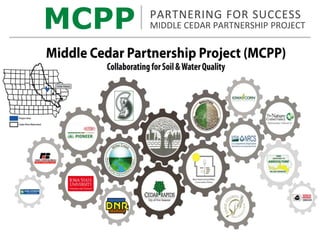
  • #6 The City of Cedar Rapids is the lead partner and will be working with 15 other partners on five HUC 12 watersheds on the Cedar River between Vinton and Waterloo Iowa Soybean Association is a key partner on MCPP, they had already established a WQI project in this area that we were able to significantly expand the outreach, scope, and longevity of practice adoption to an additional 13,000+ acres in these watersheds
  • #7 At full capacity, the ADM plant in Cedar Rapids will produce 2 times as much ethanol as any other American City.
  • #8 At full capacity, the ADM plant in Cedar Rapids will produce 2 times as much ethanol as any other American City.
  • #9 Upstream Cedar River nitrate trend has increased over time Nitrates are a particular area of concern for young infants and for individuals with suppressed immune systems Food processing industries, hospitals, nursing homes, and other care facilities (kidney dialysis) are concerned about drinking water safety if 10 mg/l nitrate limit is ever exceeded
  • #10 The City of Cedar Rapids is the lead partner and will be working with 15 other partners on five HUC 12 watersheds on the Cedar River between Vinton and Waterloo Iowa Soybean Association is a key partner on MCPP, they had already established a WQI project in this area that we were able to significantly expand the outreach, scope, and longevity of practice adoption to an additional 135,000 acres in these watersheds
  • #15 The City of Cedar Rapids is the lead partner and will be working with 15 other partners on five HUC 12 watersheds on the Cedar River between Vinton and Waterloo Iowa Soybean Association is a key partner on MCPP, they had already established a WQI project in this area that we were able to significantly expand the outreach, scope, and longevity of practice adoption to an additional 13,000+ acres in these watersheds