TELKOMNIKA Indonesian Journal of Electrical Engineering
Vol.12, No.1, January 2014, pp. 286 ~ 291
DOI: http://dx.doi.org/10.11591/telkomnika.v12i1.3969  286
Received June 23, 2013; Revised August 17, 2013; Accepted September 16, 2013
Sensitivity of Support Vector Machine Classification
to Various Training Features
Nanhai Yang, Shuang Li*, Jingwen Liu, FulingBian
International School of Software, Wuhan University
# 37 Luoyu Road, Wuhan, China, 430079, Fax: +86-27-68778221
*corresponding author, e-mail: lishuang129@gmail.com
Abstract
Remote sensing image classification is one of the most important techniques in image
interpretation, which can be used for environmental monitoring, evaluation and prediction. Many algorithms
have been developed for image classification in the literature. Support vector machine (SVM) is a kind of
supervised classification that has been widely used recently. The classification accuracy produced by SVM
may show variation depending on the choice of training features. In this paper, SVM was used for land
cover classification using Quickbird images. Spectral and textural features were extracted for the
classification and the results were analyzed thoroughly. Results showed that the number of features
employed in SVM was not the more the better. Different features are suitable for different type of land
cover extraction. This study verifies the effectiveness and robustness of SVM in the classification of high
spatial resolution remote sensing images.
Keywords: Remote sensing, image classification, support vector machine, feature extraction
Copyright © 2014 Institute of Advanced Engineering and Science. All rights reserved.
1. Introduction
High spatial resolution remote sensing images have played an important role in
mapping, urban planning, defense and military, land use and surveys, and many other areas [1-
3]. As the improvement of spatial resolution, single land cover shows a lot of different spectral
value, which increasing the probability of misclassification. The similar spectral characteristics of
different land covers often lead to confusing in classification, such as shadows and water
bodies, meadows and trees, are often mixed in spectral value. Thus, it is hard to obtain high
classification accuracy when only the spectral information is used. Compared with the traditional
classification methods, Support Vector Machine (SVM) possesses the merits of learning with
small samples, high anti-noise performance, etc. Moreover, SVM also has the advantages of
high learning and promotion efficiency. Therefore, SVM classification showed good performance
in remote sensing image information extraction [4-6].
In this study, SVM was used for land cover classification of Wuhan district in China
using Quickbird images. Various spectral and textural features were extracted for SVM
classification process and classification performances were analyzed thoroughly. It should be
pointed out that the selection of features has an effect on the performance of SVM.
Determination of their optimum combinations is regarded as critical for the success of
classification.
2. Support Vector Machine Algorithm
Support vector machine (SVM) is supervised heuristic algorithm based on statistical
learning theory [7]. The aim of SVM for classification is to determine a hyper plane that optimally
separates two classes. An optimum hyper plane is determined using training data sets and is
verified using test data sets.
Assume data set         1 1, ,..., , ,..., , , 1, 1i i N N ix y x y x y y   , where N is the
number of samples, ix is the training sample, iy is the class label of ix . Optimum hyper plane
is used to maximize the margin between classes. The hyper plane is defined as
 ISSN: 2302-4046 TELKOMNIKA
TELKOMNIKA Vol. 12, No. 1, January 2014: 286 – 291
287
0w x b   (1)
where x is a point lying on the hyper plane, w determines the orientation of the hyper plane, b
is the bias that indicates the distance between hyper plane and the origin. For the linearly
separable case, the hyper plane is defined as
  1i iy w x b   (2)
The training data points on the hyper planes are parallel to the optimum hyper plane. The
support vectorsare defined by the function 1iw x b    . If a hyper plane exists and satisfies
Eq. (2), the classes are linearly separable. Therefore, the margin between these planes is equal
to 2 / w . Thus, the optimum hyper plane can be found by minimizing
2
w under the constraint
Eq. (2). Determination of optimum hyper plane is equivalent to solve optimization problem given
by:
21
min
2
w
 
  
(3)
As nonlinearly separable data is the case in various classifications of remote sensing images,
the SVM technique can be extended to allow for nonlinear decision surfaces by introducing
penalty parameter C and slack variable :
2
1
1
min
2
N
i
i
w C 

 
 
 
 (4)
subject to constraints,
  1
1,2,..., , 0
i i i
i
y w x b
i N


   
 
(5)
where penalty parameterC allows striking a balance between two competing criteria of margin
maximization and error minimization, whereas the slack variable i indicate the distance of the
incorrectly classified points from the optimal hyper plane. The larger theC value, the higher the
penalty associated to misclassified samples.
When it is not possible to define the hyper plane by linear equations, the data may be mapped
into a higher dimensional space through some nonlinear mapping function . The input point x
can be represented by  x in high-dimensional space. The time-consuming computation of
   ix x  is reduced by using a kernel function. Thus, the classification decision function is
defined as:
   
1
sgn
N
i i i
i
f x y K x x b

 
   
 
 (6)
where  sgn  is the sign function,  K  is the kernel function and the magnitude of i is
determined by the parameterC . The widely used kernel function includes linear kernel,
polynomial kernel, sigmoid kernel and Gaussian radial basis kernel. By contrast tests, the linear
kernel function obtained better results in our study.
ISSN: 2302-4046 
Sensitivity of Support Vector Machine Classification to Various Training Features (Shuang Li)
288
3. Spectral and Textural Feature Extractions
Many algorithms have been developed for image classification using SVM. Several
factors (e.g. training features, kernel functions, window sizes) have significant impacts on the
classification performance, which should be considered carefully by the analyst. The selection of
appropriate training features depends on the knowledge of land cover types present in the
image by geographers. Thus, training features selection play an important role in the
classification accuracy [8].
3.1. Spectral Feature Extraction
The widely used spectral feature is mean value and the metric derived from spectral
value, i.e. Normalized Difference Vegetation Index (NDVI), Ratio Index (RI), Soil Adjusted
Vegetation Index (SAVI), Normalized Difference Water Index (NDWI). The metric is described in
Table 1.
Table 1. The spectral features used in the study
Metric Equation Description
NDVI R e
R e
N I R d
N I R d
B a n d B a n d
B a n d B a n d


It is used to extract vegetation, i.e. grassland.
RI R e d
N I R
B a n d
B a n d
It is used to extract high density vegetation, i.e. trees.
SAVI    R e
R e
1N I R d
N I R d
B a n d B a n d L
B a n d B a n d L
  
 
It is used to extract soil with low vegetation cover.
NDWI
G reen N IR
G reen N IR
B and B and
B and B and


It is used to extract water from land covers.
3.2. Textural Features Extraction
The Gray Lever Co-occurrence Matrix (GLCM) is proposed by Haralick in 1970s, which
is an important technique to analyze image texture. The GLCM is based on the second order
combination of probability density function, by calculating the correlation between two points in
the estimated images [9,10]. The texture features are derived from GLCM, i.e. Angular Second
Moment (ASM), Contrast, Entropy and Correlation. Let  ,G i j be the element in GLCM and
the size of the matrix be *k k , the metric are described in Table 2.
Table 2. The textural features used in the study
Metric Equation Description
ASM
   
 
2
1 1
,
k k
i j
G i j
It denotes the image gray uniformity and texture
coarseness.
Contrast
  

 

 
1
2
| |
0
,
k
i j n
i
n G i j
It reflects the texture clarity.
Entropy
 
 
  1 1
, l g ( , )
k k
i j
G i j G i j
It measures the amount of information contained in
the image.
Correlation    
   
   
   
 
   
 
 

   
 
 
 
   
 
 
1 1
1 1 1 1
22
1 1
22
1 1
* ,
, , ,
,
,
k k
i j
i j i j
k k k k
i j
i j i j
k k
i i
i j
k k
j j
i j
i j G i j U U
S S
U i G i j U j G i j
S G i j i U
S G i j j U
It describes the periodicity of texture element in a
certain positional relationship.
4. Experimental Results and Analyze
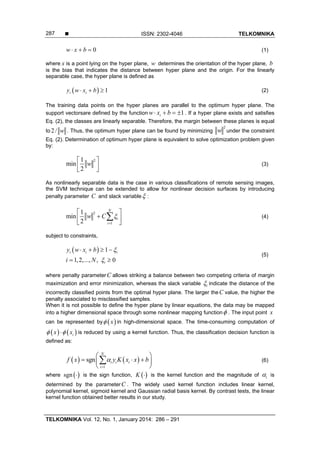
The test image is from Quickbird sensor, with the spectral band ranges from 450nm to
900 nm. The image size is 400*400, which covers water (W), grassland (GL), bare land (BL),
blue roof (BlR), brown roof (BrR), cement surface (CS) and trees (T). The original image is
shown in Figure 1.
 ISSN: 2302-4046 TELKOMNIKA
TELKOMNIKA Vol. 12, No. 1, January 2014: 286 – 291
289
Figure 1. The test image with the size of 400*400
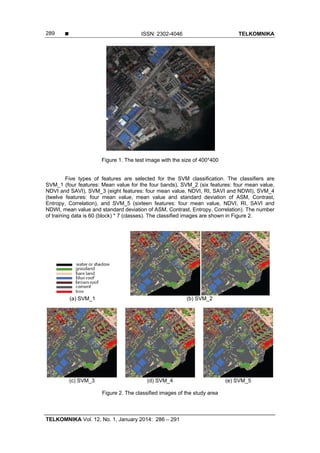
Five types of features are selected for the SVM classification. The classifiers are
SVM_1 (four features: Mean value for the four bands), SVM_2 (six features: four mean value,
NDVI and SAVI), SVM_3 (eight features: four mean value, NDVI, RI, SAVI and NDWI), SVM_4
(twelve features: four mean value, mean value and standard deviation of ASM, Contrast,
Entropy, Correlation), and SVM_5 (sixteen features: four mean value, NDVI, RI, SAVI and
NDWI, mean value and standard deviation of ASM, Contrast, Entropy, Correlation). The number
of training data is 60 (block) * 7 (classes). The classified images are shown in Figure 2.
(a) SVM_1 (b) SVM_2
(c) SVM_3 (d) SVM_4 (e) SVM_5
Figure 2. The classified images of the study area
ISSN: 2302-4046 
Sensitivity of Support Vector Machine Classification to Various Training Features (Shuang Li)
290
From Figure 2, it can be seen that the SVM classifiers perform well on image
classification. The water, blue roof and brown roof are detected accurately. As it is hard to
distinguish between water and shadow, we classify them as a class. To compare the results
from different SVMs, we calculate the overall accuracy (OA) and Kappa coefficient by confusion
matrix, which is shown in Table 3 to Table 7. The test data sets were formed using random pixel
selection strategy with proportional number of samples for each class. A total number of 350
pixels are selected for testing classified images.
Table 3. Confusion matrix for SVM_1
SVM_1 W GL BL BlR BrR CS T
W 33 2 0 0 1 5 0
GL 3 27 0 1 1 0 1
BL 0 0 43 0 6 3 1
BlR 0 0 3 12 0 1 0
BrR 0 0 0 0 13 1 0
CS 9 0 6 2 2 161 0
T 0 0 0 0 1 0 12
OA 86%
Kappa 0.8
Table 4. Confusion matrix for SVM_2
SVM_2 W GL BL BlR BrR CS T
W 33 2 0 0 1 5 0
GL 3 27 0 1 1 0 1
BL 0 0 42 0 7 3 1
BlR 0 0 3 12 0 1 0
BrR 0 0 0 0 13 1 0
CS 9 0 6 2 2 161 0
T 0 0 0 0 1 0 12
OA 86%
Kappa 0.8
Table 5. Confusion matrix for SVM_3
SVM_3 W GL BL BlR BrR CS T
W 34 2 0 0 1 4 0
GL 3 27 0 1 1 0 1
BL 0 0 48 0 4 0 1
BlR 0 0 3 12 0 1 0
BrR 0 0 1 0 12 1 0
CS 9 0 0 2 2 167 0
T 0 0 0 0 1 0 12
OA 89%
Kappa 0.84
Table 6. Confusion matrix for SVM_4
SVM_4 W GL BL BlR BrR CS T
W 34 3 0 0 0 4 0
GL 3 27 0 1 1 0 1
BL 0 0 45 0 7 0 1
BlR 0 0 3 12 0 1 0
BrR 0 0 1 0 12 1 0
CS 9 0 3 2 2 164 0
T 0 0 0 0 1 0 12
OA 87%
Kappa 0.82
Table 7. Confusion matrix for SVM_5
SVM_5 W GL BL BlR BrR CS T
W 34 3 0 0 0 4 0
GL 3 27 0 1 1 0 1
BL 0 0 49 0 3 0 1
BlR 0 0 3 12 0 1 0
BrR 0 0 0 0 13 1 0
CS 9 0 0 2 2 167 0
T 0 0 0 0 1 0 12
OA 90%
Kappa 0.85
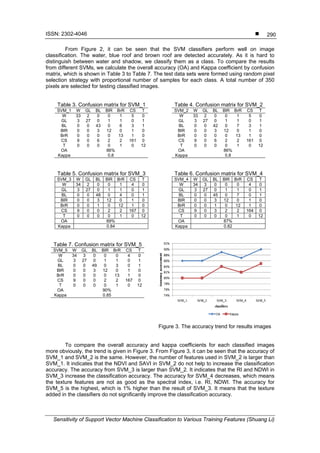
Figure 3. The accuracy trend for results images
To compare the overall accuracy and kappa coefficients for each classified images
more obviously, the trend is given in Figure 3. From Figure 3, it can be seen that the accuracy of
SVM_1 and SVM_2 is the same. However, the number of features used in SVM_2 is larger than
SVM_1. It indicates that the NDVI and SAVI in SVM_2 do not help to increase the classification
accuracy. The accuracy from SVM_3 is larger than SVM_2. It indicates that the RI and NDWI in
SVM_3 increase the classification accuracy. The accuracy for SVM_4 decreases, which means
the texture features are not as good as the spectral index, i.e. RI, NDWI. The accuracy for
SVM_5 is the highest, which is 1% higher than the result of SVM_3. It means that the texture
added in the classifiers do not significantly improve the classification accuracy.
 ISSN: 2302-4046 TELKOMNIKA
TELKOMNIKA Vol. 12, No. 1, January 2014: 286 – 291
291
5. Conclusion
Classification of remote sensing images is an important application for image
interpretation. Support vector machine (SVM) have been recently used for many classification
problems. Although it is reported that SVM produce more accurate classification results than the
conventional methods, the selection of optimum training features is one of the most important
issues that affect their performance. In this study, five types of features are used in the
classifiers. From the experiments, several important conclusions can be drawn. Firstly, the
number of features is not the more the better for the classification accuracy, i.e. SVM_3 and
SVM_5. Secondly, the RI and NDWI features perform better than the texture features, including
ASM, Entropy, Contrast and Correlation. This conclusions made here are based on the limited
tests. More comprehensive tests will be conducted in the future.
Acknowledgement
This research was supported by a grant from 973 porject in China (Grant #
2012CB719901)
References
[1] Foody GM, Mathur A. A relative evaluation of multiclass image classification by support vector
machines. IEEE Transactions on Geoscience and Remote Sensing. 2004; 42: 1335-1343.
[2] Han F, Li H, Wen C, Zhao W. A New Incremental Support Vector Machine Algorithm. TELKOMNIKA
Indonesian Journal of Electrical Engineering. 2012; 10: 1171-1178.
[3] Yu Y, Zhou L. Acoustic Emission Signal Classification based on Support Vector Machine.
TELKOMNIKA Indonesian Journal of Electrical Engineering. 2012; 10: 1027-1032.
[4] Shao Y, Lunetta RS. Comparison of support vector machine, neural network, and CART algorithms for
the land-cover classification using limited training data points. ISPRS Journal of Photogrammetry and
Remote Sensing. 2012; 70: 78-87.
[5] Otukei J, Blaschke T. Land cover change assessment using decision trees, support vector machines
and maximum likelihood classification algorithms. International Journal of Applied Earth Observation
and Geoinformation. 2010; 12: S27-S31.
[6] Mountrakis G, Im J, Ogole C. Support vector machines in remote sensing: A review. ISPRS Journal of
Photogrammetry and Remote Sensing. 2011; 66: 247-259.
[7] Vapnik VN. An overview of statistical learning theory. IEEE Transactions on Neural Networks. 1999;
10: 988-999.
[8] Kavzoglu T, Colkesen I. A kernel functions analysis for support vector machines for land cover
classification. International Journal of Applied Earth Observation and Geoinformation. 2009; 11: 352-
359.
[9] Haralick RM, Shanmugam K, Dinstein IH. Textural features for image classification. IEEE
Transactions on Systems, Man and Cybernetics. 1973; 610-621.
[10] Dell'Acqua F, Gamba P. Texture-based characterization of urban environments on satellite SAR
images. IEEE Transactions on Geoscience and Remote Sensing. 2003; 41: 153-159.

Sensitivity of Support Vector Machine Classification to Various Training Features

  • 1.
    TELKOMNIKA Indonesian Journalof Electrical Engineering Vol.12, No.1, January 2014, pp. 286 ~ 291 DOI: http://dx.doi.org/10.11591/telkomnika.v12i1.3969  286 Received June 23, 2013; Revised August 17, 2013; Accepted September 16, 2013 Sensitivity of Support Vector Machine Classification to Various Training Features Nanhai Yang, Shuang Li*, Jingwen Liu, FulingBian International School of Software, Wuhan University # 37 Luoyu Road, Wuhan, China, 430079, Fax: +86-27-68778221 *corresponding author, e-mail: lishuang129@gmail.com Abstract Remote sensing image classification is one of the most important techniques in image interpretation, which can be used for environmental monitoring, evaluation and prediction. Many algorithms have been developed for image classification in the literature. Support vector machine (SVM) is a kind of supervised classification that has been widely used recently. The classification accuracy produced by SVM may show variation depending on the choice of training features. In this paper, SVM was used for land cover classification using Quickbird images. Spectral and textural features were extracted for the classification and the results were analyzed thoroughly. Results showed that the number of features employed in SVM was not the more the better. Different features are suitable for different type of land cover extraction. This study verifies the effectiveness and robustness of SVM in the classification of high spatial resolution remote sensing images. Keywords: Remote sensing, image classification, support vector machine, feature extraction Copyright © 2014 Institute of Advanced Engineering and Science. All rights reserved. 1. Introduction High spatial resolution remote sensing images have played an important role in mapping, urban planning, defense and military, land use and surveys, and many other areas [1- 3]. As the improvement of spatial resolution, single land cover shows a lot of different spectral value, which increasing the probability of misclassification. The similar spectral characteristics of different land covers often lead to confusing in classification, such as shadows and water bodies, meadows and trees, are often mixed in spectral value. Thus, it is hard to obtain high classification accuracy when only the spectral information is used. Compared with the traditional classification methods, Support Vector Machine (SVM) possesses the merits of learning with small samples, high anti-noise performance, etc. Moreover, SVM also has the advantages of high learning and promotion efficiency. Therefore, SVM classification showed good performance in remote sensing image information extraction [4-6]. In this study, SVM was used for land cover classification of Wuhan district in China using Quickbird images. Various spectral and textural features were extracted for SVM classification process and classification performances were analyzed thoroughly. It should be pointed out that the selection of features has an effect on the performance of SVM. Determination of their optimum combinations is regarded as critical for the success of classification. 2. Support Vector Machine Algorithm Support vector machine (SVM) is supervised heuristic algorithm based on statistical learning theory [7]. The aim of SVM for classification is to determine a hyper plane that optimally separates two classes. An optimum hyper plane is determined using training data sets and is verified using test data sets. Assume data set         1 1, ,..., , ,..., , , 1, 1i i N N ix y x y x y y   , where N is the number of samples, ix is the training sample, iy is the class label of ix . Optimum hyper plane is used to maximize the margin between classes. The hyper plane is defined as
  • 2.
     ISSN: 2302-4046TELKOMNIKA TELKOMNIKA Vol. 12, No. 1, January 2014: 286 – 291 287 0w x b   (1) where x is a point lying on the hyper plane, w determines the orientation of the hyper plane, b is the bias that indicates the distance between hyper plane and the origin. For the linearly separable case, the hyper plane is defined as   1i iy w x b   (2) The training data points on the hyper planes are parallel to the optimum hyper plane. The support vectorsare defined by the function 1iw x b    . If a hyper plane exists and satisfies Eq. (2), the classes are linearly separable. Therefore, the margin between these planes is equal to 2 / w . Thus, the optimum hyper plane can be found by minimizing 2 w under the constraint Eq. (2). Determination of optimum hyper plane is equivalent to solve optimization problem given by: 21 min 2 w      (3) As nonlinearly separable data is the case in various classifications of remote sensing images, the SVM technique can be extended to allow for nonlinear decision surfaces by introducing penalty parameter C and slack variable : 2 1 1 min 2 N i i w C          (4) subject to constraints,   1 1,2,..., , 0 i i i i y w x b i N         (5) where penalty parameterC allows striking a balance between two competing criteria of margin maximization and error minimization, whereas the slack variable i indicate the distance of the incorrectly classified points from the optimal hyper plane. The larger theC value, the higher the penalty associated to misclassified samples. When it is not possible to define the hyper plane by linear equations, the data may be mapped into a higher dimensional space through some nonlinear mapping function . The input point x can be represented by  x in high-dimensional space. The time-consuming computation of    ix x  is reduced by using a kernel function. Thus, the classification decision function is defined as:     1 sgn N i i i i f x y K x x b           (6) where  sgn  is the sign function,  K  is the kernel function and the magnitude of i is determined by the parameterC . The widely used kernel function includes linear kernel, polynomial kernel, sigmoid kernel and Gaussian radial basis kernel. By contrast tests, the linear kernel function obtained better results in our study.
  • 3.
    ISSN: 2302-4046  Sensitivityof Support Vector Machine Classification to Various Training Features (Shuang Li) 288 3. Spectral and Textural Feature Extractions Many algorithms have been developed for image classification using SVM. Several factors (e.g. training features, kernel functions, window sizes) have significant impacts on the classification performance, which should be considered carefully by the analyst. The selection of appropriate training features depends on the knowledge of land cover types present in the image by geographers. Thus, training features selection play an important role in the classification accuracy [8]. 3.1. Spectral Feature Extraction The widely used spectral feature is mean value and the metric derived from spectral value, i.e. Normalized Difference Vegetation Index (NDVI), Ratio Index (RI), Soil Adjusted Vegetation Index (SAVI), Normalized Difference Water Index (NDWI). The metric is described in Table 1. Table 1. The spectral features used in the study Metric Equation Description NDVI R e R e N I R d N I R d B a n d B a n d B a n d B a n d   It is used to extract vegetation, i.e. grassland. RI R e d N I R B a n d B a n d It is used to extract high density vegetation, i.e. trees. SAVI    R e R e 1N I R d N I R d B a n d B a n d L B a n d B a n d L      It is used to extract soil with low vegetation cover. NDWI G reen N IR G reen N IR B and B and B and B and   It is used to extract water from land covers. 3.2. Textural Features Extraction The Gray Lever Co-occurrence Matrix (GLCM) is proposed by Haralick in 1970s, which is an important technique to analyze image texture. The GLCM is based on the second order combination of probability density function, by calculating the correlation between two points in the estimated images [9,10]. The texture features are derived from GLCM, i.e. Angular Second Moment (ASM), Contrast, Entropy and Correlation. Let  ,G i j be the element in GLCM and the size of the matrix be *k k , the metric are described in Table 2. Table 2. The textural features used in the study Metric Equation Description ASM       2 1 1 , k k i j G i j It denotes the image gray uniformity and texture coarseness. Contrast          1 2 | | 0 , k i j n i n G i j It reflects the texture clarity. Entropy       1 1 , l g ( , ) k k i j G i j G i j It measures the amount of information contained in the image. Correlation                                              1 1 1 1 1 1 22 1 1 22 1 1 * , , , , , , k k i j i j i j k k k k i j i j i j k k i i i j k k j j i j i j G i j U U S S U i G i j U j G i j S G i j i U S G i j j U It describes the periodicity of texture element in a certain positional relationship. 4. Experimental Results and Analyze The test image is from Quickbird sensor, with the spectral band ranges from 450nm to 900 nm. The image size is 400*400, which covers water (W), grassland (GL), bare land (BL), blue roof (BlR), brown roof (BrR), cement surface (CS) and trees (T). The original image is shown in Figure 1.
  • 4.
     ISSN: 2302-4046TELKOMNIKA TELKOMNIKA Vol. 12, No. 1, January 2014: 286 – 291 289 Figure 1. The test image with the size of 400*400 Five types of features are selected for the SVM classification. The classifiers are SVM_1 (four features: Mean value for the four bands), SVM_2 (six features: four mean value, NDVI and SAVI), SVM_3 (eight features: four mean value, NDVI, RI, SAVI and NDWI), SVM_4 (twelve features: four mean value, mean value and standard deviation of ASM, Contrast, Entropy, Correlation), and SVM_5 (sixteen features: four mean value, NDVI, RI, SAVI and NDWI, mean value and standard deviation of ASM, Contrast, Entropy, Correlation). The number of training data is 60 (block) * 7 (classes). The classified images are shown in Figure 2. (a) SVM_1 (b) SVM_2 (c) SVM_3 (d) SVM_4 (e) SVM_5 Figure 2. The classified images of the study area
  • 5.
    ISSN: 2302-4046  Sensitivityof Support Vector Machine Classification to Various Training Features (Shuang Li) 290 From Figure 2, it can be seen that the SVM classifiers perform well on image classification. The water, blue roof and brown roof are detected accurately. As it is hard to distinguish between water and shadow, we classify them as a class. To compare the results from different SVMs, we calculate the overall accuracy (OA) and Kappa coefficient by confusion matrix, which is shown in Table 3 to Table 7. The test data sets were formed using random pixel selection strategy with proportional number of samples for each class. A total number of 350 pixels are selected for testing classified images. Table 3. Confusion matrix for SVM_1 SVM_1 W GL BL BlR BrR CS T W 33 2 0 0 1 5 0 GL 3 27 0 1 1 0 1 BL 0 0 43 0 6 3 1 BlR 0 0 3 12 0 1 0 BrR 0 0 0 0 13 1 0 CS 9 0 6 2 2 161 0 T 0 0 0 0 1 0 12 OA 86% Kappa 0.8 Table 4. Confusion matrix for SVM_2 SVM_2 W GL BL BlR BrR CS T W 33 2 0 0 1 5 0 GL 3 27 0 1 1 0 1 BL 0 0 42 0 7 3 1 BlR 0 0 3 12 0 1 0 BrR 0 0 0 0 13 1 0 CS 9 0 6 2 2 161 0 T 0 0 0 0 1 0 12 OA 86% Kappa 0.8 Table 5. Confusion matrix for SVM_3 SVM_3 W GL BL BlR BrR CS T W 34 2 0 0 1 4 0 GL 3 27 0 1 1 0 1 BL 0 0 48 0 4 0 1 BlR 0 0 3 12 0 1 0 BrR 0 0 1 0 12 1 0 CS 9 0 0 2 2 167 0 T 0 0 0 0 1 0 12 OA 89% Kappa 0.84 Table 6. Confusion matrix for SVM_4 SVM_4 W GL BL BlR BrR CS T W 34 3 0 0 0 4 0 GL 3 27 0 1 1 0 1 BL 0 0 45 0 7 0 1 BlR 0 0 3 12 0 1 0 BrR 0 0 1 0 12 1 0 CS 9 0 3 2 2 164 0 T 0 0 0 0 1 0 12 OA 87% Kappa 0.82 Table 7. Confusion matrix for SVM_5 SVM_5 W GL BL BlR BrR CS T W 34 3 0 0 0 4 0 GL 3 27 0 1 1 0 1 BL 0 0 49 0 3 0 1 BlR 0 0 3 12 0 1 0 BrR 0 0 0 0 13 1 0 CS 9 0 0 2 2 167 0 T 0 0 0 0 1 0 12 OA 90% Kappa 0.85 Figure 3. The accuracy trend for results images To compare the overall accuracy and kappa coefficients for each classified images more obviously, the trend is given in Figure 3. From Figure 3, it can be seen that the accuracy of SVM_1 and SVM_2 is the same. However, the number of features used in SVM_2 is larger than SVM_1. It indicates that the NDVI and SAVI in SVM_2 do not help to increase the classification accuracy. The accuracy from SVM_3 is larger than SVM_2. It indicates that the RI and NDWI in SVM_3 increase the classification accuracy. The accuracy for SVM_4 decreases, which means the texture features are not as good as the spectral index, i.e. RI, NDWI. The accuracy for SVM_5 is the highest, which is 1% higher than the result of SVM_3. It means that the texture added in the classifiers do not significantly improve the classification accuracy.
  • 6.
     ISSN: 2302-4046TELKOMNIKA TELKOMNIKA Vol. 12, No. 1, January 2014: 286 – 291 291 5. Conclusion Classification of remote sensing images is an important application for image interpretation. Support vector machine (SVM) have been recently used for many classification problems. Although it is reported that SVM produce more accurate classification results than the conventional methods, the selection of optimum training features is one of the most important issues that affect their performance. In this study, five types of features are used in the classifiers. From the experiments, several important conclusions can be drawn. Firstly, the number of features is not the more the better for the classification accuracy, i.e. SVM_3 and SVM_5. Secondly, the RI and NDWI features perform better than the texture features, including ASM, Entropy, Contrast and Correlation. This conclusions made here are based on the limited tests. More comprehensive tests will be conducted in the future. Acknowledgement This research was supported by a grant from 973 porject in China (Grant # 2012CB719901) References [1] Foody GM, Mathur A. A relative evaluation of multiclass image classification by support vector machines. IEEE Transactions on Geoscience and Remote Sensing. 2004; 42: 1335-1343. [2] Han F, Li H, Wen C, Zhao W. A New Incremental Support Vector Machine Algorithm. TELKOMNIKA Indonesian Journal of Electrical Engineering. 2012; 10: 1171-1178. [3] Yu Y, Zhou L. Acoustic Emission Signal Classification based on Support Vector Machine. TELKOMNIKA Indonesian Journal of Electrical Engineering. 2012; 10: 1027-1032. [4] Shao Y, Lunetta RS. Comparison of support vector machine, neural network, and CART algorithms for the land-cover classification using limited training data points. ISPRS Journal of Photogrammetry and Remote Sensing. 2012; 70: 78-87. [5] Otukei J, Blaschke T. Land cover change assessment using decision trees, support vector machines and maximum likelihood classification algorithms. International Journal of Applied Earth Observation and Geoinformation. 2010; 12: S27-S31. [6] Mountrakis G, Im J, Ogole C. Support vector machines in remote sensing: A review. ISPRS Journal of Photogrammetry and Remote Sensing. 2011; 66: 247-259. [7] Vapnik VN. An overview of statistical learning theory. IEEE Transactions on Neural Networks. 1999; 10: 988-999. [8] Kavzoglu T, Colkesen I. A kernel functions analysis for support vector machines for land cover classification. International Journal of Applied Earth Observation and Geoinformation. 2009; 11: 352- 359. [9] Haralick RM, Shanmugam K, Dinstein IH. Textural features for image classification. IEEE Transactions on Systems, Man and Cybernetics. 1973; 610-621. [10] Dell'Acqua F, Gamba P. Texture-based characterization of urban environments on satellite SAR images. IEEE Transactions on Geoscience and Remote Sensing. 2003; 41: 153-159.