TELKOMNIKA Indonesian Journal of Electrical Engineering
Vol. 14, No. 2, May 2015, pp. 343 ~ 352
DOI: 10.11591/telkomnika.v14i2.7505  343
Received February 11, 2015; Revised April 21, 2015; Accepted May 1, 2015
Data Exchange Design with SDMX Format for
Interoperability Statistical Data
Jaka Sembiring*1
, Ana Uluwiyah2
1
School of Electrical Engineering and Informatics, Institut Teknologi Bandung,
Jl. Ganesha 10 Bandung 40132, Indonesia, Ph./Fax:+62-22-2502260/+62-22-2534222
2
Education Training Center, Statistics Indonesia,
Jl. Jagakarsa Raya 70, Jakarta Selatan, Indonesia, Ph./Fax: +62-21-7873782-83/+62-21-7875497
*Corresponding author, e-mail: jaka@itb.ac.id
Abstract
Today’s concept of Open Government Data (OGD) for openness, transparency and ease of
access of data owned by government agencies becomes increasingly important. This initiative emerges
from the demand of data usersforthe data belongs to the government agencies. The data services
providing an easy access, cheap, fast, and interoperability are needed by the users and becomes
important indicator performance for respective government agencies. Statistical Data and Metadata
Exchange (SDMX) is a new standard format in the data dissemination activities particularly in the
exchange of statistical data and metadata via Internet. In this respect SDMX support the implementation of
OGD project. This paper is on the technical design, development and implementation of data and
metadata exchange service of statistical data using SDMX format to support interoperability data through
web services. Three results are proposed: (i) framework for standardization of structure of statistical
publications data model with SDMX; (ii) design architecture of data sharing model; and (iii) web service
implementation of data and metadata exchange service using Service Oriented Analysis and Design
(SOAD) method. Implementation at Statistics Indonesia (BPS) is chosen as a case study to prove the
design concept. It is shown through quantitative assessment and black box testing that the design
achieves its objective.
Keywords: open government data, statistical data and metadata exchange, web service
Copyright © 2015 Institute of Advanced Engineering and Science. All rights reserved.
1. Introduction
Initiative on Open Data Government (OGD) is increasingly getting
supportfrommanycountries. Opendata provides an easy accessto the data so
thatvarioususerssuch asinstitutions, scientistsorothercommunities are allowed to retrieve
datawithouta licenseorpatentrestrictions [1]. Providing freely availabledatato everyonevia
theWebiseasier when the data is interconnected each other. Opennessandconnectednessof
datais the goalof theparadigm oflinkedopendata [2]. Open data becomes an important aspect in
a public institution whose function is to serve the communities. With open data a public
institution can fulfill its obligation of creating aprime serviceas one of their Key Performance
Indicators for organizational performance [3]. Statistics Indonesia (BPS) as a public institution
also has a strategic objective of delivering a prime service to the public in providing and
disseminating high quality data and information. BPS is encouraged to change the method of
disseminating data and information to be in line with the OGD initiatives. One of thecrucial parts
is on how toexchange data and metadata that can provideinteroperabilityservices for openness
and connectedness.Statistical Data and Metadata Exchange (SDMX), which is initiated by world
seven statistical organizations, can be used as a framework in standardizing statistical data and
metadata exchange. With SDMX it is possible to simplify and streamline the process of
exchanging data and metadata usingthe same data structure and concept,in order to improve
the timeliness of data services, accessibility, interpretability and coherence [4-6].In this paper
we will use SDMX for standardizing the data and metadata where for clarity we will use BPS
data as our special case.The SDMX standard will be implemented in Service Oriented
Architecture (SOA) scheme described in [7], where in particular we will use the Service Oriented
Analysis and Design (SOAD) as a design approach [8]. We provide the prototype of
 ISSN: 2302-4046
TELKOMNIKA Vol. 14, No. 2, May 2015 : 343 – 352
344
implementation of the design using web services. This is a natural choice since the web service
is designed to support interoperability and interactions between system on a network [9]. In this
paper we propose three main results: (i) standardization framework of statistical
publication/aggregate data model structure, (ii) design architecture of data sharing service
model, and (iii) implementation of design architecture of data exchangeusing web service. We
will also present the validationresult of the proposed design with both user/expert judgment and
black box testing.
2. Research Method
2.1. Standardization Framework of Statistical Data Structure with SDMX
This section will explain our first result on the standardization framework of statistical
publication data structure. For case illustration we will use the business process of Data
Dissemination Directorate (DDS) of BPS. The business process of the mentioned directorateis a
process flow of activities to disseminate the result of statistical information in the form of
services to the public users. The objective of our proposed scheme is to improve the value of
public organization, in this case BPS, through increasing the openess of data, ease of access,
and data interoperability. Openess of the data can be measured by availability of both data
structure and content that can be accessed and used, reused and redistributed by all data
users. Ease of access can be measured by data servicesmedium thatcan beaccessed
easilythrough thedevicegadgets, mobile phones, PCandlaptop, etc. Meanwhile interoperability
can be measured by capability service to be operated on different platforms.In order to achieve
thesevalues and to show the conceptproposed in this paper, we adopt General Statistic
Business Process Model (GSBPM) for business process flow [10]. By adopting GSBPM we can
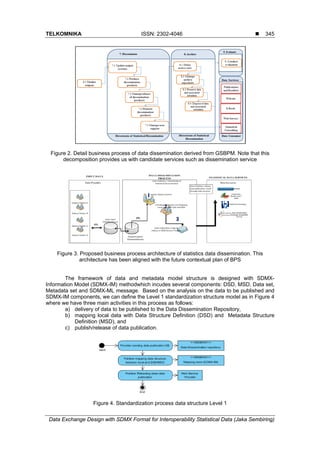
derive the business process as shown in Figure 1 whereas the business process of data
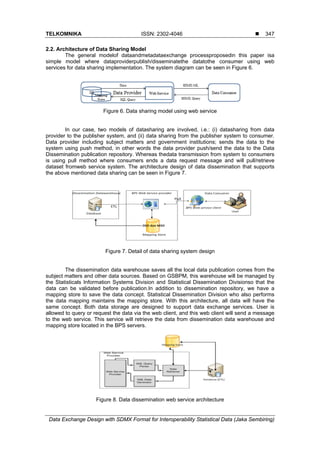
disseminationcan be elaborated further in Figure 2. In this business process model, the data to
be published will be taken from the dissemination data warehouse, not directly from subject
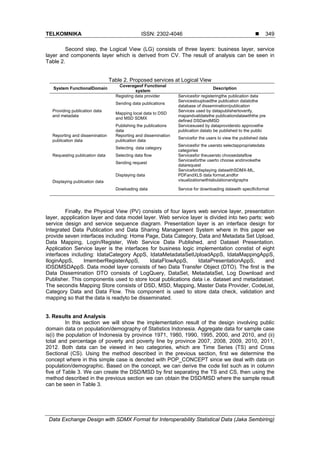
matters. Based on the GSBPM, we propose the new business process architecture for data
dissemination as shown in Figure 3. In this architecture, the published data is taken from a data
warehouse after being validated and analyzed by Analysis and Development Statistics
Directorate. Before publication, the data will be validated and mapped to the model
structures/data scheme predetermined in the form of DSD/MSD. This process is conducted as a
methodto standardize format and model structure of the published data, and to avoid the
inconsistency of data. The data is ready to be published/released to the web service provider
only after it is validated. We focus on the dissemination of statistics information through creating
services of data and metadata exchange where for this purpose we createa new service for
data and metadata exchange. This service provides easy access for the users.
Figure 1. Proposed business process activities at Data Dissemination Directorate of Statistics
Indonesia after adopting the GSBPM. Note that difference from existing condition, the data to be
published will be taken from the dissemination data warehouse, not directly from subject matters
TELKOMNIKA ISSN: 2302-4046 
Data Exchange Design with SDMX Format for Interoperability Statistical Data (Jaka Sembiring)
345
Figure 2. Detail business process of data dissemination derived from GSBPM. Note that this
decomposition provides us with candidate services such as dissemination service
Figure 3. Proposed business process architecture of statistics data dissemination. This
architecture has been aligned with the future contextual plan of BPS
The framework of data and metadata model structure is designed with SDMX-
Information Model (SDMX-IM) methodwhich incudes several components: DSD, MSD, Data set,
Metadata set and SDMX-ML message. Based on the analysis on the data to be published and
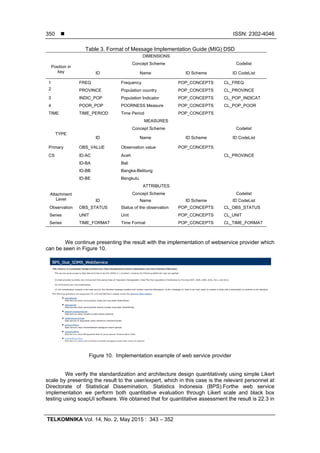
SDMX-IM components, we can define the Level 1 standardization structure model as in Figure 4
where we have three main activities in this process as follows:
a) delivery of data to be published to the Data Dissemination Repository,
b) mapping local data with Data Structure Definition (DSD) and Metadata Structure
Definition (MSD), and
c) publish/release of data publication.
Figure 4. Standardization process data structure Level 1
 ISSN: 2302-4046
TELKOMNIKA Vol. 14, No. 2, May 2015 : 343 – 352
346
We proceed to the Level 2 standardization of the model structure for detail process as
in Figure 5.
Figure 5. Standardization process data structure Level 2
The general process in Level 2 can be explained in detail as follows.
1) Determine the Concept and Concept Scheme. Concept has a very important role in the
SDMX-IM because it is used to describe the multi-dimensional table structure or metadata
structurere port. Concept structure consists of Dimensions, Measures, and Attributes. The
sample result of concept and concept scheme in this paper can be seen in Table 3.
2) Creating Code List. Code list in the SDMX-IM is a list containing codes that represent
concepts (dimension or attribute) in either DSD or MSD [11]. Sample of code list created in
this paper is shown in Table 3.
3) Data Structure Definition (DSD). DSD is basically a description for concepts that have been
identified and established. It describes whether the concept is a dimension or an attribute.
DSD can be used in Time Series (TS), Cross Sectional (CS) and multidimensional data
tables. In our case to create DSD, first we need to differentiate between TS data and CS
data. Then we identify the concept, determine the measure and make an association with
the Code Lists. The sample result for our case can be seen in Table 3.
4) Metadata Structure Definition (MSD). As in DSD, MSD is a structure for metadata. Metadata
is used as a description or reference for the object to be exchanged. The purpose of
metadata structure is to facilitate indexing, searching, processing and reporting of statistical
activities. BPS devide metadata into three types: descriptive metadata, structural metadata
and administrative metadata. These metadata are associated with reference metadata in
SDMX.
5) Mapping Data. The main problem of data exchange on the data sharing systems is that
there are various database structure integrated in one system, so that itis necessary to
perform data mapping amongst related database to improve the convergence [12]. In our
case we employ five steps for mapping between local databases and the predefined DSD
concept as follows.
a) List theconceptsthat existin thelocal data.
b) Pairingalllocal dataconceptwiththe DSD concept.
c) Pairinglocal codeswithDSDcodes.
d) TranslatingSDMXQuery.
e) Translate intodataset.
6) SDMX-ML message. SDMX-ML is created based on XML; so that SDMX complieswiththe
concept and the rules of XML.The most important component in the implement SDMX XML
are an XML namespace and XML Schema (XSD).
TELKOMNIKA ISSN: 2302-4046 
Data Exchange Design with SDMX Format for Interoperability Statistical Data (Jaka Sembiring)
347
2.2. Architecture of Data Sharing Model
The general modelof dataandmetadataexchange processproposedin this paper isa
simple model where dataproviderpublish/disseminatethe datatothe consumer using web
services for data sharing implementation. The system diagram can be seen in Figure 6.
Figure 6. Data sharing model using web service
In our case, two models of datasharing are involved, i.e.: (i) datasharing from data
provider to the publisher system, and (ii) data sharing from the publisher system to consumer.
Data provider including subject matters and government institutions; sends the data to the
system using push method, in other words the data provider push/send the data to the Data
Dissemination publication repository. Whereas thedata transmission from system to consumers
is using pull method where consumers ends a data request message and will pull/retrieve
dataset fromweb service system. The architecture design of data dissemination that supports
the above mentioned data sharing can be seen in Figure 7.
Figure 7. Detail of data sharing system design
The dissemination data warehouse saves all the local data publication comes from the
subject matters and other data sources. Based on GSBPM, this warehouse will be managed by
the Statisticals Information Systems Division and Statistical Dissemination Divisionso that the
data can be validated before publication.In addition to dissemination repository, we have a
mapping store to save the data concept. Statistical Dissemination Division who also performs
the data mapping maintains the mapping store. With this architecture, all data will have the
same concept. Both data storage are designed to support data exchange services. User is
allowed to query or request the data via the web client, and this web client will send a message
to the web service. This service will retrieve the data from dissemination data warehouse and
mapping store located in the BPS servers.
Figure 8. Data dissemination web service architecture
 ISSN: 2302-4046
TELKOMNIKA Vol. 14, No. 2, May 2015 : 343 – 352
348
The web service architecture for data exchange services is shown in Figure 8. Users
who send request data in SDMX Query messages, which will be translated by SDMX Query
Parser, initiate the process of data dissemination in the web service. The SQLQuery retrieve the
data structures and datasets from the store Mapping and data dissemination repository, and the
system will generate data in SDMX-ML format which will be sent to the webclient.
2.2. Design of Data Exchange Service with SOAD
In this section we will discuss the design process of data and metadata exchange
services. We use SOAD methodology as an approach of SOA [8]. Following the SOAD
methodology for analysis and design, first step is the Conceptual View (CV) where we obtain
the business process and sub business process for data and metadata service as shown in
Figure 9.
Figure 9. Business process and sub-business process analysis
Based the proposed system depicted in Figure 3, there are two systemswe need to
create, i.e.(i) Web Service Provider, which is used by data publisher to provide, report and
disseminate statistical data, and (ii) Web Application Client,which is usedbythe usersto invoke
data.The general function of the system is described in Table 1.
Table 1. General function of the proposed system
Integrated Data Publication and Data Sharing Management
System Service
Description
Web Service Provider
Providing publication data and
metadata
Facilitatethe
dataprovidertoprepareandtransmit
data/metadata for the users
Reporting and dissemination
publicationdata
Facilitatetheinstrumentforpublication and
reportingthe data for
publicationsafterbeingvalidated
Web Application Client
Requesting publication data
Facilitatetheuserstorequestthe databased on
the published categoryof data
Displaying publication data
Facilitate the users by displayingdata
fromthe userqueryaccording to the provided
format
TELKOMNIKA ISSN: 2302-4046 
Data Exchange Design with SDMX Format for Interoperability Statistical Data (Jaka Sembiring)
349
Second step, the Logical View (LG) consists of three layers: business layer, service
layer and components layer which is derived from CV. The result of analysis can be seen in
Table 2.
Table 2. Proposed services at Logical View
System FunctionalDomain
Coverageof Functional
system
Description
Providing publication data
and metadata
Registing data provider Servicesfor registeringthe publication data
Sending data publications
Servicestouploadthe publication datatothe
database of dissemination/publication
Mapping local data to DSD
and MSD SDMX
Services used by datapublishertoverify,
mapandvalidatethe publicationdatawiththe pre
defined DSDandMSD
Publishing the publications
data
Servicesused by dataprovidersto approvethe
publication datato be published to the public
Reporting and dissemination
publication data
Reporting and dissemination
publication data
Servicefor the users to view the published data
Requesting publication data
Selecting data category
Servicesfor the usersto selectappropriatedata
categories
Selecting data flow Servicesfor theusersto choosedataflow
Sending request
Servicesforthe userto choose andinvokethe
datarequest
Displaying publication data
Displaying data
Servicefordisplaying datawithSDMX-ML,
PDFandXLS data format,andfor
visualizationwithtabulationandgraphs
Dowloading data Service for downloading datawith specificformat
Finally, the Physical View (PV) consists of four layers web service layer, presentation
layer, appplication layer and data model layer. Web service layer is divided into two parts: web
service design and service sequence diagram. Presentation layer is an interface design for
Integrated Data Publication and Data Sharing Management System where in this paper we
provide seven interfaces including: Home Page, Data Category, Data and Metadata Set Upload,
Data Mapping, Login/Register, Web Service Data Published, and Dataset Presentation.
Application Service layer is the interfaces for business logic implementation constist of eight
interfaces including: IdataCategory AppS, IdataMetadataSetUploadAppS, IdataMappingAppS,
IloginAppS, ImemberRegisterAppS, IdataFlowAppS, IdataPresentationAppS, and
IDSDMSDAppS. Data model layer consists of two Data Transfer Object (DTO). The first is the
Data Dissemination DTO consists of LogQuery, DataSet, MetadataSet, Log Download and
Publisher. This componentis used to store local publications data i.e. dataset and metadataset.
The secondis Mapping Store consists of DSD, MSD, Mapping, Master Data Provider, CodeList,
Category Data and Data Flow. This component is used to store data check, validation and
mapping so that the data is readyto be disseminated.
3. Results and Analysis
In this section we will show the implementation result of the design involving public
domain data on population/demography of Statistics Indonesia. Aggregate data for sample case
is(i) the population of Indonesia by province 1971, 1980, 1990, 1995, 2000, and 2010, and (ii)
total and percentage of poverty and poverty line by province 2007, 2008, 2009, 2010, 2011,
2012. Both data can be viewed in two categories, which are Time Series (TS) and Cross
Sectional (CS). Using the method described in the previous section, first we determine the
concept where in this simple case is denoted with POP_CONCEPT since we deal with data on
population/demographic. Based on the concept, we can derive the code list such as in column
five of Table 3. We can create the DSD/MSD by first separating the TS and CS, then using the
method described in the previous section we can obtain the DSD/MSD where the sample result
can be seen in Table 3.
 ISSN: 2302-4046
TELKOMNIKA Vol. 14, No. 2, May 2015 : 343 – 352
350
Table 3. Format of Message Implementation Guide (MIG) DSD
DIMENSIONS
Position in
key
Concept Scheme Codelist
ID Name ID Scheme ID CodeList
1 FREQ Frequency POP_CONCEPTS CL_FREQ
2 PROVINCE Population country POP_CONCEPTS CL_PROVINCE
3 INDIC_POP Population Indicator POP_CONCEPTS CL_POP_INDICAT
4 POOR_POP POORNESS Measure POP_CONCEPTS CL_POP_POOR
TIME TIME_PERIOD Time Period POP_CONCEPTS
MEASURES
TYPE
Concept Scheme Codelist
ID Name ID Scheme ID CodeList
Primary OBS_VALUE Observation value POP_CONCEPTS
CS ID-AC Aceh CL_PROVINCE
ID-BA Bali
ID-BB Bangka-Belitung
ID-BE Bengkulu
ATTRIBUTES
Attachment
Level
Concept Scheme Codelist
ID Name ID Scheme ID CodeList
Observation OBS_STATUS Status of the observation POP_CONCEPTS CL_OBS_STATUS
Series UNIT Unit POP_CONCEPTS CL_UNIT
Series TIME_FORMAT Time Format POP_CONCEPTS CL_TIME_FORMAT
We continue presenting the result with the implementation of webservice provider which
can be seen in Figure 10.
Figure 10. Implementation example of web service provider
We verify the standardization and architecture design quantitatively using simple Likert
scale by presenting the result to the user/expert, which in this case is the relevant personnel at
Directorate of Statistical Dissemination, Statistics Indonesia (BPS).Forthe web service
implementation we perform both quantitative evaluation through Likert scale and black box
testing using soapUI software. We obtained that for quantitative assessment the result is 22.3 in
TELKOMNIKA ISSN: 2302-4046 
Data Exchange Design with SDMX Format for Interoperability Statistical Data (Jaka Sembiring)
351
Likert scale, whichmeansvery good. Meanwhile for black box testing resultusing soapUI can be
seen in Figure 11. We conclude that all of the designed service perform as intended.
Figure 11. Result of black box testing using soapUI
4. Conclusion
In this paper we report on the design of data and meta data exchange using SDMX
format for statistical data at Statistics Indonesia (BPS). We implement the design concept with
web services. Implementation at Statistics Indonesia (BPS) is chosen as a case study to prove
the design concept. We describe three main results. The first result is on the framework for
standardization of structure of statistical publications data model with SDMX. The simple case
we presented has been able to demonstrate the advantageous of the effort for interoperability of
data and metadata. Second result is on the design architecture of data sharing model. The
design is based on the user needs where we able to align the design with the long term master
plan of BPS. Finally, the third result is onthe implementation of data and metadata exchange
service using Service Oriented Analysis and Design (SOAD) method. We present the prototype
system implementation with web services.It is shown through quantitative Likert assessment
and black box testing that the overall standard, architecture design and implementation have
achievedtheirrespective objectives.
References
[1] Hoxha J, Brahaj A. Open Goverment Data on the Web: A Semantic Approach. International
Conference on Emerging Intelligent Data and Web Technologies. Tirana, Albania. 2011: 107-113.
[2] Bizer C, Health T, Berners Lee T. Linked Data-The Story So Far. International Journal on Semantic
Web and Information Systems (IJSWIS). 2009; 5(3): 1-22.
[3] Zakaria Z. Key Performance Indicators (KPIs) in the Public Sector: A Study in Malaysia. Canadian
Center of Science and Education. 2011; 7: 102-107.
[4] Statistical Data and Metadata eXchange. 2012. sdmx.org/page_id=10.
[5] SDMX Standards Section 1 -Framework. 2013. www.sdmx.org.
[6] SDMX Standards Section 1 -SDMX-Information Model. 2013. www.sdmx.org.
[7] Erl T. Service Oriented Architecture: Concept, Tehnology and Design. New York: Prentice Hall PTR.
2005.
 ISSN: 2302-4046
TELKOMNIKA Vol. 14, No. 2, May 2015 : 343 – 352
352
[8] Sarno R, Herdiyanti A. A Service Portfolio for an Enterprise Resource Planning. International Journal
of Computer Science and Network Security. 2010: 144-156.
[9] Web Services Architecture. 2004. http://www.w3.org/TR/ws-arch/.
[10] Vale S. GSBPM. http://www1.unece.org.
[11] Cross-Domain Code List. 2009. www.sdmx.org.
[12] Ning L, Bin X, Xin Z. Database Conversion Based on Relationship Schema Mapping. International
Conference on Internet Technology and Applications (iTAP). Wuhan. 2011: 16-18.

Data Exchange Design with SDMX Format for Interoperability Statistical Data

  • 1.
    TELKOMNIKA Indonesian Journalof Electrical Engineering Vol. 14, No. 2, May 2015, pp. 343 ~ 352 DOI: 10.11591/telkomnika.v14i2.7505  343 Received February 11, 2015; Revised April 21, 2015; Accepted May 1, 2015 Data Exchange Design with SDMX Format for Interoperability Statistical Data Jaka Sembiring*1 , Ana Uluwiyah2 1 School of Electrical Engineering and Informatics, Institut Teknologi Bandung, Jl. Ganesha 10 Bandung 40132, Indonesia, Ph./Fax:+62-22-2502260/+62-22-2534222 2 Education Training Center, Statistics Indonesia, Jl. Jagakarsa Raya 70, Jakarta Selatan, Indonesia, Ph./Fax: +62-21-7873782-83/+62-21-7875497 *Corresponding author, e-mail: jaka@itb.ac.id Abstract Today’s concept of Open Government Data (OGD) for openness, transparency and ease of access of data owned by government agencies becomes increasingly important. This initiative emerges from the demand of data usersforthe data belongs to the government agencies. The data services providing an easy access, cheap, fast, and interoperability are needed by the users and becomes important indicator performance for respective government agencies. Statistical Data and Metadata Exchange (SDMX) is a new standard format in the data dissemination activities particularly in the exchange of statistical data and metadata via Internet. In this respect SDMX support the implementation of OGD project. This paper is on the technical design, development and implementation of data and metadata exchange service of statistical data using SDMX format to support interoperability data through web services. Three results are proposed: (i) framework for standardization of structure of statistical publications data model with SDMX; (ii) design architecture of data sharing model; and (iii) web service implementation of data and metadata exchange service using Service Oriented Analysis and Design (SOAD) method. Implementation at Statistics Indonesia (BPS) is chosen as a case study to prove the design concept. It is shown through quantitative assessment and black box testing that the design achieves its objective. Keywords: open government data, statistical data and metadata exchange, web service Copyright © 2015 Institute of Advanced Engineering and Science. All rights reserved. 1. Introduction Initiative on Open Data Government (OGD) is increasingly getting supportfrommanycountries. Opendata provides an easy accessto the data so thatvarioususerssuch asinstitutions, scientistsorothercommunities are allowed to retrieve datawithouta licenseorpatentrestrictions [1]. Providing freely availabledatato everyonevia theWebiseasier when the data is interconnected each other. Opennessandconnectednessof datais the goalof theparadigm oflinkedopendata [2]. Open data becomes an important aspect in a public institution whose function is to serve the communities. With open data a public institution can fulfill its obligation of creating aprime serviceas one of their Key Performance Indicators for organizational performance [3]. Statistics Indonesia (BPS) as a public institution also has a strategic objective of delivering a prime service to the public in providing and disseminating high quality data and information. BPS is encouraged to change the method of disseminating data and information to be in line with the OGD initiatives. One of thecrucial parts is on how toexchange data and metadata that can provideinteroperabilityservices for openness and connectedness.Statistical Data and Metadata Exchange (SDMX), which is initiated by world seven statistical organizations, can be used as a framework in standardizing statistical data and metadata exchange. With SDMX it is possible to simplify and streamline the process of exchanging data and metadata usingthe same data structure and concept,in order to improve the timeliness of data services, accessibility, interpretability and coherence [4-6].In this paper we will use SDMX for standardizing the data and metadata where for clarity we will use BPS data as our special case.The SDMX standard will be implemented in Service Oriented Architecture (SOA) scheme described in [7], where in particular we will use the Service Oriented Analysis and Design (SOAD) as a design approach [8]. We provide the prototype of
  • 2.
     ISSN: 2302-4046 TELKOMNIKAVol. 14, No. 2, May 2015 : 343 – 352 344 implementation of the design using web services. This is a natural choice since the web service is designed to support interoperability and interactions between system on a network [9]. In this paper we propose three main results: (i) standardization framework of statistical publication/aggregate data model structure, (ii) design architecture of data sharing service model, and (iii) implementation of design architecture of data exchangeusing web service. We will also present the validationresult of the proposed design with both user/expert judgment and black box testing. 2. Research Method 2.1. Standardization Framework of Statistical Data Structure with SDMX This section will explain our first result on the standardization framework of statistical publication data structure. For case illustration we will use the business process of Data Dissemination Directorate (DDS) of BPS. The business process of the mentioned directorateis a process flow of activities to disseminate the result of statistical information in the form of services to the public users. The objective of our proposed scheme is to improve the value of public organization, in this case BPS, through increasing the openess of data, ease of access, and data interoperability. Openess of the data can be measured by availability of both data structure and content that can be accessed and used, reused and redistributed by all data users. Ease of access can be measured by data servicesmedium thatcan beaccessed easilythrough thedevicegadgets, mobile phones, PCandlaptop, etc. Meanwhile interoperability can be measured by capability service to be operated on different platforms.In order to achieve thesevalues and to show the conceptproposed in this paper, we adopt General Statistic Business Process Model (GSBPM) for business process flow [10]. By adopting GSBPM we can derive the business process as shown in Figure 1 whereas the business process of data disseminationcan be elaborated further in Figure 2. In this business process model, the data to be published will be taken from the dissemination data warehouse, not directly from subject matters. Based on the GSBPM, we propose the new business process architecture for data dissemination as shown in Figure 3. In this architecture, the published data is taken from a data warehouse after being validated and analyzed by Analysis and Development Statistics Directorate. Before publication, the data will be validated and mapped to the model structures/data scheme predetermined in the form of DSD/MSD. This process is conducted as a methodto standardize format and model structure of the published data, and to avoid the inconsistency of data. The data is ready to be published/released to the web service provider only after it is validated. We focus on the dissemination of statistics information through creating services of data and metadata exchange where for this purpose we createa new service for data and metadata exchange. This service provides easy access for the users. Figure 1. Proposed business process activities at Data Dissemination Directorate of Statistics Indonesia after adopting the GSBPM. Note that difference from existing condition, the data to be published will be taken from the dissemination data warehouse, not directly from subject matters
  • 3.
    TELKOMNIKA ISSN: 2302-4046 Data Exchange Design with SDMX Format for Interoperability Statistical Data (Jaka Sembiring) 345 Figure 2. Detail business process of data dissemination derived from GSBPM. Note that this decomposition provides us with candidate services such as dissemination service Figure 3. Proposed business process architecture of statistics data dissemination. This architecture has been aligned with the future contextual plan of BPS The framework of data and metadata model structure is designed with SDMX- Information Model (SDMX-IM) methodwhich incudes several components: DSD, MSD, Data set, Metadata set and SDMX-ML message. Based on the analysis on the data to be published and SDMX-IM components, we can define the Level 1 standardization structure model as in Figure 4 where we have three main activities in this process as follows: a) delivery of data to be published to the Data Dissemination Repository, b) mapping local data with Data Structure Definition (DSD) and Metadata Structure Definition (MSD), and c) publish/release of data publication. Figure 4. Standardization process data structure Level 1
  • 4.
     ISSN: 2302-4046 TELKOMNIKAVol. 14, No. 2, May 2015 : 343 – 352 346 We proceed to the Level 2 standardization of the model structure for detail process as in Figure 5. Figure 5. Standardization process data structure Level 2 The general process in Level 2 can be explained in detail as follows. 1) Determine the Concept and Concept Scheme. Concept has a very important role in the SDMX-IM because it is used to describe the multi-dimensional table structure or metadata structurere port. Concept structure consists of Dimensions, Measures, and Attributes. The sample result of concept and concept scheme in this paper can be seen in Table 3. 2) Creating Code List. Code list in the SDMX-IM is a list containing codes that represent concepts (dimension or attribute) in either DSD or MSD [11]. Sample of code list created in this paper is shown in Table 3. 3) Data Structure Definition (DSD). DSD is basically a description for concepts that have been identified and established. It describes whether the concept is a dimension or an attribute. DSD can be used in Time Series (TS), Cross Sectional (CS) and multidimensional data tables. In our case to create DSD, first we need to differentiate between TS data and CS data. Then we identify the concept, determine the measure and make an association with the Code Lists. The sample result for our case can be seen in Table 3. 4) Metadata Structure Definition (MSD). As in DSD, MSD is a structure for metadata. Metadata is used as a description or reference for the object to be exchanged. The purpose of metadata structure is to facilitate indexing, searching, processing and reporting of statistical activities. BPS devide metadata into three types: descriptive metadata, structural metadata and administrative metadata. These metadata are associated with reference metadata in SDMX. 5) Mapping Data. The main problem of data exchange on the data sharing systems is that there are various database structure integrated in one system, so that itis necessary to perform data mapping amongst related database to improve the convergence [12]. In our case we employ five steps for mapping between local databases and the predefined DSD concept as follows. a) List theconceptsthat existin thelocal data. b) Pairingalllocal dataconceptwiththe DSD concept. c) Pairinglocal codeswithDSDcodes. d) TranslatingSDMXQuery. e) Translate intodataset. 6) SDMX-ML message. SDMX-ML is created based on XML; so that SDMX complieswiththe concept and the rules of XML.The most important component in the implement SDMX XML are an XML namespace and XML Schema (XSD).
  • 5.
    TELKOMNIKA ISSN: 2302-4046 Data Exchange Design with SDMX Format for Interoperability Statistical Data (Jaka Sembiring) 347 2.2. Architecture of Data Sharing Model The general modelof dataandmetadataexchange processproposedin this paper isa simple model where dataproviderpublish/disseminatethe datatothe consumer using web services for data sharing implementation. The system diagram can be seen in Figure 6. Figure 6. Data sharing model using web service In our case, two models of datasharing are involved, i.e.: (i) datasharing from data provider to the publisher system, and (ii) data sharing from the publisher system to consumer. Data provider including subject matters and government institutions; sends the data to the system using push method, in other words the data provider push/send the data to the Data Dissemination publication repository. Whereas thedata transmission from system to consumers is using pull method where consumers ends a data request message and will pull/retrieve dataset fromweb service system. The architecture design of data dissemination that supports the above mentioned data sharing can be seen in Figure 7. Figure 7. Detail of data sharing system design The dissemination data warehouse saves all the local data publication comes from the subject matters and other data sources. Based on GSBPM, this warehouse will be managed by the Statisticals Information Systems Division and Statistical Dissemination Divisionso that the data can be validated before publication.In addition to dissemination repository, we have a mapping store to save the data concept. Statistical Dissemination Division who also performs the data mapping maintains the mapping store. With this architecture, all data will have the same concept. Both data storage are designed to support data exchange services. User is allowed to query or request the data via the web client, and this web client will send a message to the web service. This service will retrieve the data from dissemination data warehouse and mapping store located in the BPS servers. Figure 8. Data dissemination web service architecture
  • 6.
     ISSN: 2302-4046 TELKOMNIKAVol. 14, No. 2, May 2015 : 343 – 352 348 The web service architecture for data exchange services is shown in Figure 8. Users who send request data in SDMX Query messages, which will be translated by SDMX Query Parser, initiate the process of data dissemination in the web service. The SQLQuery retrieve the data structures and datasets from the store Mapping and data dissemination repository, and the system will generate data in SDMX-ML format which will be sent to the webclient. 2.2. Design of Data Exchange Service with SOAD In this section we will discuss the design process of data and metadata exchange services. We use SOAD methodology as an approach of SOA [8]. Following the SOAD methodology for analysis and design, first step is the Conceptual View (CV) where we obtain the business process and sub business process for data and metadata service as shown in Figure 9. Figure 9. Business process and sub-business process analysis Based the proposed system depicted in Figure 3, there are two systemswe need to create, i.e.(i) Web Service Provider, which is used by data publisher to provide, report and disseminate statistical data, and (ii) Web Application Client,which is usedbythe usersto invoke data.The general function of the system is described in Table 1. Table 1. General function of the proposed system Integrated Data Publication and Data Sharing Management System Service Description Web Service Provider Providing publication data and metadata Facilitatethe dataprovidertoprepareandtransmit data/metadata for the users Reporting and dissemination publicationdata Facilitatetheinstrumentforpublication and reportingthe data for publicationsafterbeingvalidated Web Application Client Requesting publication data Facilitatetheuserstorequestthe databased on the published categoryof data Displaying publication data Facilitate the users by displayingdata fromthe userqueryaccording to the provided format
  • 7.
    TELKOMNIKA ISSN: 2302-4046 Data Exchange Design with SDMX Format for Interoperability Statistical Data (Jaka Sembiring) 349 Second step, the Logical View (LG) consists of three layers: business layer, service layer and components layer which is derived from CV. The result of analysis can be seen in Table 2. Table 2. Proposed services at Logical View System FunctionalDomain Coverageof Functional system Description Providing publication data and metadata Registing data provider Servicesfor registeringthe publication data Sending data publications Servicestouploadthe publication datatothe database of dissemination/publication Mapping local data to DSD and MSD SDMX Services used by datapublishertoverify, mapandvalidatethe publicationdatawiththe pre defined DSDandMSD Publishing the publications data Servicesused by dataprovidersto approvethe publication datato be published to the public Reporting and dissemination publication data Reporting and dissemination publication data Servicefor the users to view the published data Requesting publication data Selecting data category Servicesfor the usersto selectappropriatedata categories Selecting data flow Servicesfor theusersto choosedataflow Sending request Servicesforthe userto choose andinvokethe datarequest Displaying publication data Displaying data Servicefordisplaying datawithSDMX-ML, PDFandXLS data format,andfor visualizationwithtabulationandgraphs Dowloading data Service for downloading datawith specificformat Finally, the Physical View (PV) consists of four layers web service layer, presentation layer, appplication layer and data model layer. Web service layer is divided into two parts: web service design and service sequence diagram. Presentation layer is an interface design for Integrated Data Publication and Data Sharing Management System where in this paper we provide seven interfaces including: Home Page, Data Category, Data and Metadata Set Upload, Data Mapping, Login/Register, Web Service Data Published, and Dataset Presentation. Application Service layer is the interfaces for business logic implementation constist of eight interfaces including: IdataCategory AppS, IdataMetadataSetUploadAppS, IdataMappingAppS, IloginAppS, ImemberRegisterAppS, IdataFlowAppS, IdataPresentationAppS, and IDSDMSDAppS. Data model layer consists of two Data Transfer Object (DTO). The first is the Data Dissemination DTO consists of LogQuery, DataSet, MetadataSet, Log Download and Publisher. This componentis used to store local publications data i.e. dataset and metadataset. The secondis Mapping Store consists of DSD, MSD, Mapping, Master Data Provider, CodeList, Category Data and Data Flow. This component is used to store data check, validation and mapping so that the data is readyto be disseminated. 3. Results and Analysis In this section we will show the implementation result of the design involving public domain data on population/demography of Statistics Indonesia. Aggregate data for sample case is(i) the population of Indonesia by province 1971, 1980, 1990, 1995, 2000, and 2010, and (ii) total and percentage of poverty and poverty line by province 2007, 2008, 2009, 2010, 2011, 2012. Both data can be viewed in two categories, which are Time Series (TS) and Cross Sectional (CS). Using the method described in the previous section, first we determine the concept where in this simple case is denoted with POP_CONCEPT since we deal with data on population/demographic. Based on the concept, we can derive the code list such as in column five of Table 3. We can create the DSD/MSD by first separating the TS and CS, then using the method described in the previous section we can obtain the DSD/MSD where the sample result can be seen in Table 3.
  • 8.
     ISSN: 2302-4046 TELKOMNIKAVol. 14, No. 2, May 2015 : 343 – 352 350 Table 3. Format of Message Implementation Guide (MIG) DSD DIMENSIONS Position in key Concept Scheme Codelist ID Name ID Scheme ID CodeList 1 FREQ Frequency POP_CONCEPTS CL_FREQ 2 PROVINCE Population country POP_CONCEPTS CL_PROVINCE 3 INDIC_POP Population Indicator POP_CONCEPTS CL_POP_INDICAT 4 POOR_POP POORNESS Measure POP_CONCEPTS CL_POP_POOR TIME TIME_PERIOD Time Period POP_CONCEPTS MEASURES TYPE Concept Scheme Codelist ID Name ID Scheme ID CodeList Primary OBS_VALUE Observation value POP_CONCEPTS CS ID-AC Aceh CL_PROVINCE ID-BA Bali ID-BB Bangka-Belitung ID-BE Bengkulu ATTRIBUTES Attachment Level Concept Scheme Codelist ID Name ID Scheme ID CodeList Observation OBS_STATUS Status of the observation POP_CONCEPTS CL_OBS_STATUS Series UNIT Unit POP_CONCEPTS CL_UNIT Series TIME_FORMAT Time Format POP_CONCEPTS CL_TIME_FORMAT We continue presenting the result with the implementation of webservice provider which can be seen in Figure 10. Figure 10. Implementation example of web service provider We verify the standardization and architecture design quantitatively using simple Likert scale by presenting the result to the user/expert, which in this case is the relevant personnel at Directorate of Statistical Dissemination, Statistics Indonesia (BPS).Forthe web service implementation we perform both quantitative evaluation through Likert scale and black box testing using soapUI software. We obtained that for quantitative assessment the result is 22.3 in
  • 9.
    TELKOMNIKA ISSN: 2302-4046 Data Exchange Design with SDMX Format for Interoperability Statistical Data (Jaka Sembiring) 351 Likert scale, whichmeansvery good. Meanwhile for black box testing resultusing soapUI can be seen in Figure 11. We conclude that all of the designed service perform as intended. Figure 11. Result of black box testing using soapUI 4. Conclusion In this paper we report on the design of data and meta data exchange using SDMX format for statistical data at Statistics Indonesia (BPS). We implement the design concept with web services. Implementation at Statistics Indonesia (BPS) is chosen as a case study to prove the design concept. We describe three main results. The first result is on the framework for standardization of structure of statistical publications data model with SDMX. The simple case we presented has been able to demonstrate the advantageous of the effort for interoperability of data and metadata. Second result is on the design architecture of data sharing model. The design is based on the user needs where we able to align the design with the long term master plan of BPS. Finally, the third result is onthe implementation of data and metadata exchange service using Service Oriented Analysis and Design (SOAD) method. We present the prototype system implementation with web services.It is shown through quantitative Likert assessment and black box testing that the overall standard, architecture design and implementation have achievedtheirrespective objectives. References [1] Hoxha J, Brahaj A. Open Goverment Data on the Web: A Semantic Approach. International Conference on Emerging Intelligent Data and Web Technologies. Tirana, Albania. 2011: 107-113. [2] Bizer C, Health T, Berners Lee T. Linked Data-The Story So Far. International Journal on Semantic Web and Information Systems (IJSWIS). 2009; 5(3): 1-22. [3] Zakaria Z. Key Performance Indicators (KPIs) in the Public Sector: A Study in Malaysia. Canadian Center of Science and Education. 2011; 7: 102-107. [4] Statistical Data and Metadata eXchange. 2012. sdmx.org/page_id=10. [5] SDMX Standards Section 1 -Framework. 2013. www.sdmx.org. [6] SDMX Standards Section 1 -SDMX-Information Model. 2013. www.sdmx.org. [7] Erl T. Service Oriented Architecture: Concept, Tehnology and Design. New York: Prentice Hall PTR. 2005.
  • 10.
     ISSN: 2302-4046 TELKOMNIKAVol. 14, No. 2, May 2015 : 343 – 352 352 [8] Sarno R, Herdiyanti A. A Service Portfolio for an Enterprise Resource Planning. International Journal of Computer Science and Network Security. 2010: 144-156. [9] Web Services Architecture. 2004. http://www.w3.org/TR/ws-arch/. [10] Vale S. GSBPM. http://www1.unece.org. [11] Cross-Domain Code List. 2009. www.sdmx.org. [12] Ning L, Bin X, Xin Z. Database Conversion Based on Relationship Schema Mapping. International Conference on Internet Technology and Applications (iTAP). Wuhan. 2011: 16-18.