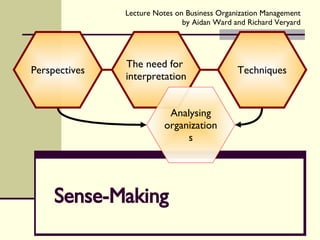
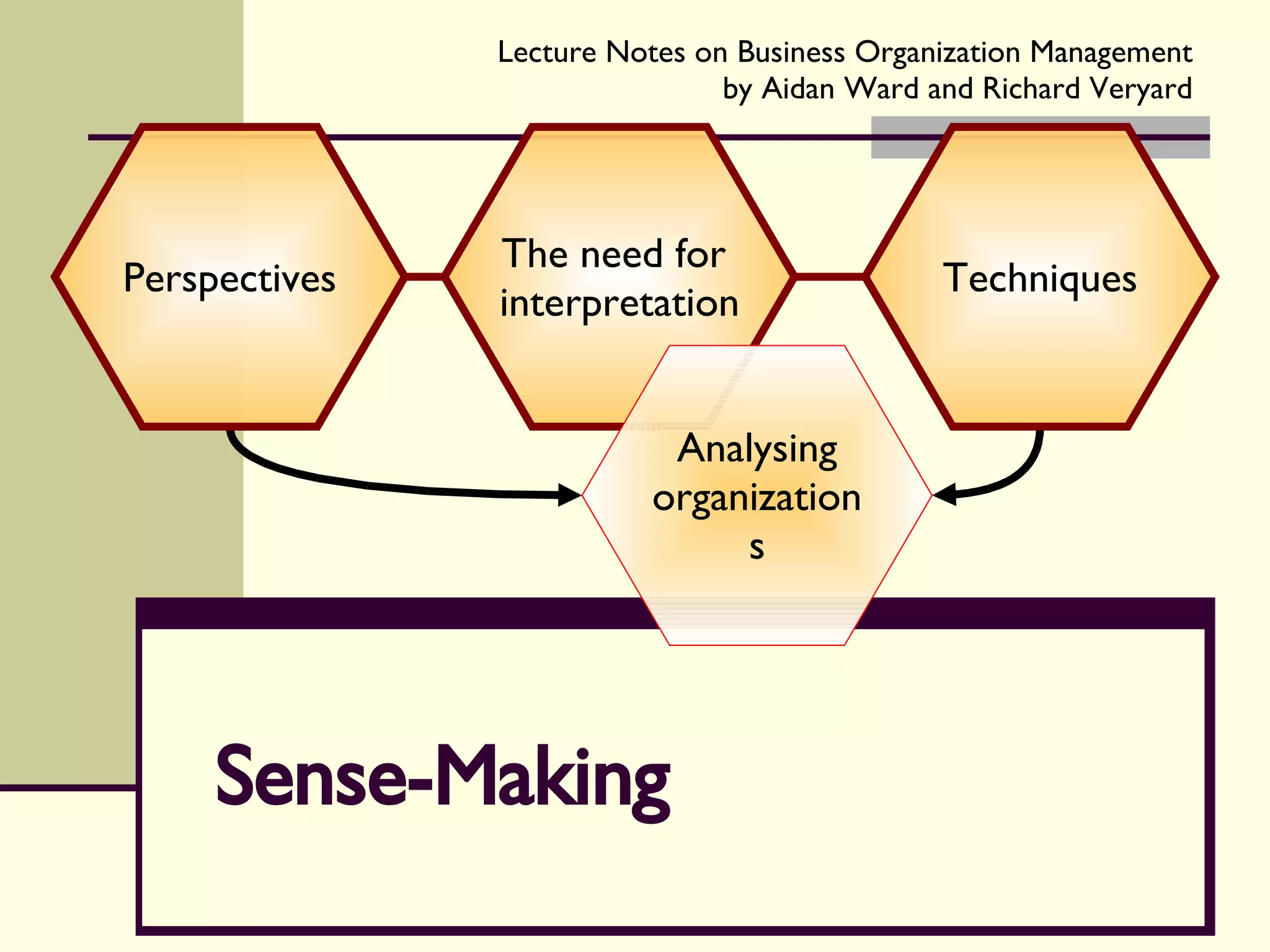
Sense-Making The need for  interpretation Perspectives Techniques Analysing organizations
Core Notions Finding the meaning of events Interpreting actions Learning and awareness of learning Reality and socially constructed reality The effect of the observer on what is observed  Making action contingent on situation There are many possible meanings and interpretation of the same actions and event. Often the way we set about investigating events determines what we will find. In some situations we want to take control of the way we choose interpretations.
Organizations Function Simplistic Critique All organizations are corrupt, exploitative, inefficient, inflexible, … All managers are manipulative, overpaid, prejudiced, unimaginative, … All workers are cynical, lazy, stupid, underpaid, ... BUT Such a simplistic critique provides no basis for  understanding differences between organizations planning and implementing improvements understanding problems and designing solutions
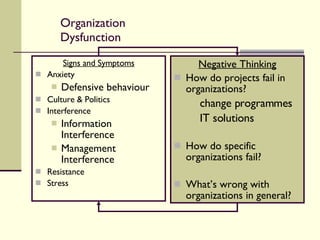
Organization Dysfunction Signs and Symptoms Anxiety Defensive behaviour Culture & Politics Interference Information Interference Management Interference Resistance Stress Negative Thinking How do projects fail in organizations? change programmes IT solutions How do specific organizations fail? What’s wrong with organizations in general?
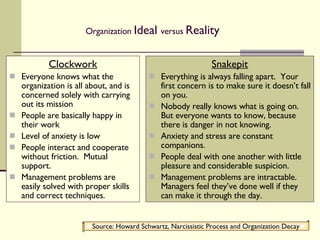
Organization  Ideal  versus  Reality Clockwork Everyone knows what the organization is all about, and is concerned solely with carrying out its mission People are basically happy in their work Level of anxiety is low People interact and cooperate without friction.  Mutual support. Management problems are easily solved with proper skills and correct techniques. Snakepit Everything is always falling apart.  Your first concern is to make sure it doesn’t fall on you. Nobody really knows what is going on. But everyone wants to know, because there is danger in not knowing. Anxiety and stress are constant companions. People deal with one another with little pleasure and considerable suspicion. Management problems are intractable. Managers feel they’ve done well if they can make it through the day. Source: Howard Schwartz, Narcissistic Process and Organization Decay
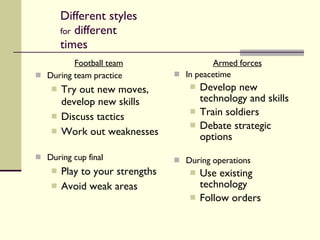
Different styles  for  different times Football team During team practice Try out new moves, develop new skills Discuss tactics Work out weaknesses During cup final Play to your strengths Avoid weak areas Armed forces In peacetime Develop new technology and skills Train soldiers Debate strategic options During operations Use existing technology Follow orders
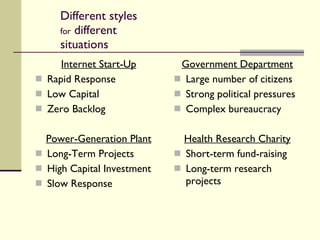
Different styles  for  different situations Internet Start-Up Rapid Response Low Capital Zero Backlog Power-Generation Plant Long-Term Projects High Capital Investment Slow Response Government Department Large number of citizens Strong political pressures Complex bureaucracy Health Research Charity Short-term fund-raising Long-term research projects
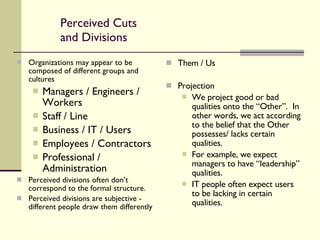
Perceived Cuts and Divisions Organizations may appear to be composed of different groups and cultures Managers / Engineers / Workers Staff / Line Business / IT / Users Employees / Contractors Professional / Administration Perceived divisions often don’t correspond to the formal structure. Perceived divisions are subjective - different people draw them differently Them / Us Projection We project good or bad qualities onto the “Other”.  In other words, we act according to the belief that the Other possesses/ lacks certain qualities. For example, we expect managers to have “leadership” qualities. IT people often expect users to be lacking in certain qualities.
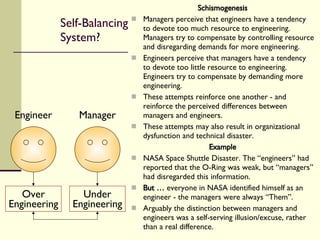
Self-Balancing  System? Schismogenesis Managers perceive that engineers have a tendency to devote too much resource to engineering. Managers try to compensate by controlling resource and disregarding demands for more engineering. Engineers perceive that managers have a tendency to devote too little resource to engineering. Engineers try to compensate by demanding more engineering. These attempts reinforce one another - and reinforce the perceived differences between managers and engineers. These attempts may also result in organizational dysfunction and technical disaster.  Example NASA Space Shuttle Disaster. The “engineers” had reported that the O-Ring was weak, but “managers” had disregarded this information. But …  everyone in NASA identified himself as an engineer - the managers were always “Them”. Arguably the distinction between managers and engineers was a self-serving illusion/excuse, rather than a real difference. Manager Engineer Under Engineering Over Engineering
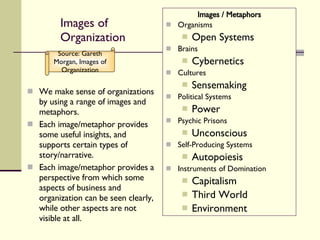
Images of Organization We make sense of organizations by using a range of images and metaphors. Each image/metaphor provides some useful insights, and supports certain types of story/narrative. Each image/metaphor provides a perspective from which some aspects of business and organization can be seen clearly, while other aspects are not visible at all. Images / Metaphors Organisms Open Systems Brains Cybernetics Cultures Sensemaking Political Systems Power Psychic Prisons Unconscious Self-Producing Systems Autopoiesis Instruments of Domination Capitalism Third World Environment Source: Gareth Morgan, Images of Organization
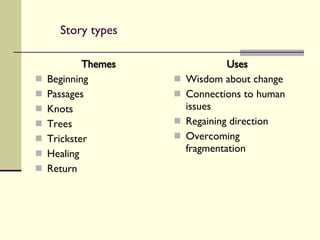
Story types Themes Beginning Passages Knots Trees Trickster Healing Return Uses Wisdom about change Connections to human issues Regaining direction Overcoming fragmentation
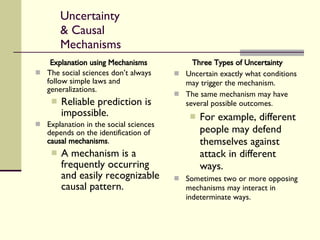
Uncertainty & Causal Mechanisms Explanation using Mechanisms The social sciences don’t always follow simple laws and generalizations. Reliable prediction is impossible. Explanation in the social sciences depends on the identification of  causal mechanisms . A mechanism is a frequently occurring and easily recognizable causal pattern. Three Types of Uncertainty Uncertain exactly what conditions may trigger the mechanism. The same mechanism may have several possible outcomes. For example, different people may defend themselves against attack in different ways. Sometimes two or more opposing mechanisms may interact in indeterminate ways.
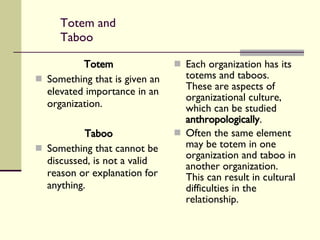
Totem and Taboo Totem Something that is given an elevated importance in an organization. Taboo Something that cannot be discussed, is not a valid reason or explanation for anything. Each organization has its totems and taboos.  These are aspects of organizational culture, which can be studied  anthropologically . Often the same element may be totem in one organization and taboo in another organization.  This can result in cultural difficulties in the relationship.
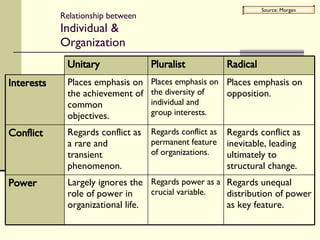
Relationship between  Individual & Organization Source: Morgan Regards unequal distribution of power as key feature. Regards power as a crucial variable. Largely ignores the role of power in organizational life. Power Regards conflict as inevitable, leading ultimately to structural change. Regards conflict as permanent feature of organizations. Regards conflict as a rare and transient phenomenon. Conflict Places emphasis on opposition. Places emphasis on the diversity of individual and group interests. Places emphasis on the achievement of common objectives. Interests Radical Pluralist Unitary
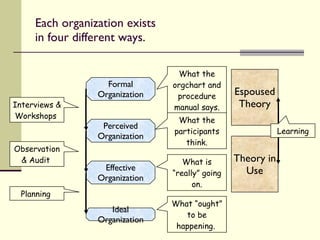
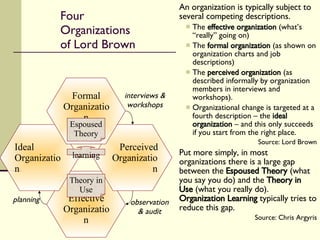
Each organization exists in four different ways. Formal Organization Perceived Organization Effective Organization Ideal Organization What the orgchart and procedure manual says. What the participants think. What is “really” going on. What “ought” to be happening.  Planning  Observation & Audit  Interviews & Workshops  Espoused Theory Theory in Use Learning
An organization is typically subject to several competing descriptions. The  effective organization  (what’s “really” going on) The  formal organization  (as shown on organization charts and job descriptions) The  perceived organization  (as described informally by organization members in interviews and workshops).  Organizational change is targeted at a fourth description – the  ideal organization  – and this only succeeds if you start from the right place. Source: Lord Brown Put more simply, in most organizations there is a large gap between the  Espoused Theory  (what you say you do) and the  Theory in Use  (what you really do).  Organization Learning  typically tries to reduce this gap. Source: Chris Argyris Four Organizations of Lord Brown Effective Organization Perceived Organization Ideal Organization Formal Organization Espoused Theory Theory in Use learning planning interviews & workshops observation & audit
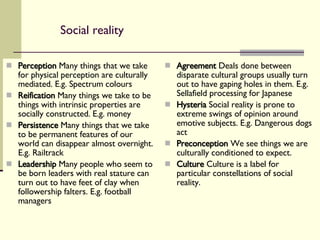
Social reality Perception  Many things that we take for physical perception are culturally mediated. E.g. Spectrum colours Reification  Many things we take to be things with intrinsic properties are socially constructed. E.g. money Persistence  Many things that we take to be permanent features of our world can disappear almost overnight. E.g. Railtrack Leadership  Many people who seem to be born leaders with real stature can turn out to have feet of clay when followership falters. E.g. football managers Agreement  Deals done between disparate cultural groups usually turn out to have gaping holes in them. E.g. Sellafield processing for Japanese Hysteria  Social reality is prone to extreme swings of opinion around emotive subjects. E.g. Dangerous dogs act Preconception  We see things we are culturally conditioned to expect. Culture  Culture is a label for particular constellations of social reality.
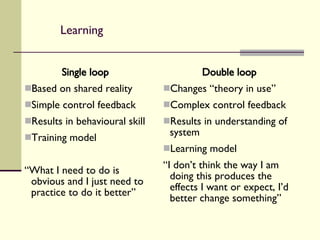
Learning Single loop Based on shared reality Simple control feedback  Results in behavioural skill Training model “ What I need to do is obvious and I just need to practice to do it better” Double loop Changes “theory in use” Complex control feedback Results in understanding of system Learning model “ I don’t think the way I am doing this produces the effects I want or expect, I’d better change something”
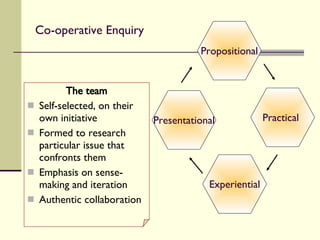
Co-operative Enquiry The team Self-selected, on their own initiative Formed to research particular issue that confronts them Emphasis on sense-making and iteration Authentic collaboration Propositional Presentational Experiential Practical
Observer Position Pseudo-objective I can describe behaviour as if it had nothing to do with me I can analyse the system and give objective advice about the impact of an intervention I can understand and factor out the effect of my observations on the system Necessarily involved I can neither observe nor intervene in the system without being part of it I can never fully understand the effects of my presence on the system I can only act from my subjective perception of the system and from my values
Questions to ponder You observe an organisation at work, but when you report your observations people inside the organization disagree. Think of at least five reasons why this might happen. To what degree are the measures used to assess productivity or workers socially constructed? What effect does this have on the usefulness of these measures? You can see that what someone says they are doing is very different from how they are acting. How could you communicate this gap?
Discussion There is a story that the architect Christopher Wren was touring the site where work was in progress for the construction of St Paul’s Cathedral.  Coming upon three men who were all engaged in the same task, he asked each of them what they were doing. The first said: “I’m laying bricks.” The second said: “I’m just earning my wages.” The third said: “I’m helping to build a great cathedral.”  Discuss this story, with reference to the theory and practice of organizational behaviour.
Reading Required Hatch, Organization Theory - chapters 1 & 2. Suggested Karl Weick, Making Sense of the Organization. Gareth Morgan, Images of Organization
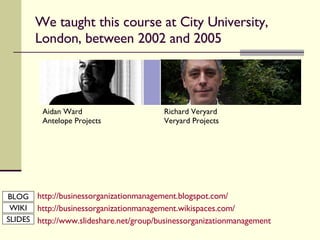
We taught this course at City University, London, between 2002 and 2005 http://businessorganizationmanagement.blogspot.com/ http://businessorganizationmanagement.wikispaces.com/ http://www. slideshare .net/group/ businessorganizationmanagement Aidan Ward Antelope Projects Richard Veryard Veryard Projects BLOG WIKI SLIDES

Sense-making

  • 1.
    Sense-Making The needfor interpretation Perspectives Techniques Analysing organizations
  • 2.
    Core Notions Findingthe meaning of events Interpreting actions Learning and awareness of learning Reality and socially constructed reality The effect of the observer on what is observed Making action contingent on situation There are many possible meanings and interpretation of the same actions and event. Often the way we set about investigating events determines what we will find. In some situations we want to take control of the way we choose interpretations.
  • 3.
    Organizations Function SimplisticCritique All organizations are corrupt, exploitative, inefficient, inflexible, … All managers are manipulative, overpaid, prejudiced, unimaginative, … All workers are cynical, lazy, stupid, underpaid, ... BUT Such a simplistic critique provides no basis for understanding differences between organizations planning and implementing improvements understanding problems and designing solutions
  • 4.
    Organization Dysfunction Signsand Symptoms Anxiety Defensive behaviour Culture & Politics Interference Information Interference Management Interference Resistance Stress Negative Thinking How do projects fail in organizations? change programmes IT solutions How do specific organizations fail? What’s wrong with organizations in general?
  • 5.
    Organization Ideal versus Reality Clockwork Everyone knows what the organization is all about, and is concerned solely with carrying out its mission People are basically happy in their work Level of anxiety is low People interact and cooperate without friction. Mutual support. Management problems are easily solved with proper skills and correct techniques. Snakepit Everything is always falling apart. Your first concern is to make sure it doesn’t fall on you. Nobody really knows what is going on. But everyone wants to know, because there is danger in not knowing. Anxiety and stress are constant companions. People deal with one another with little pleasure and considerable suspicion. Management problems are intractable. Managers feel they’ve done well if they can make it through the day. Source: Howard Schwartz, Narcissistic Process and Organization Decay
  • 6.
    Different styles for different times Football team During team practice Try out new moves, develop new skills Discuss tactics Work out weaknesses During cup final Play to your strengths Avoid weak areas Armed forces In peacetime Develop new technology and skills Train soldiers Debate strategic options During operations Use existing technology Follow orders
  • 7.
    Different styles for different situations Internet Start-Up Rapid Response Low Capital Zero Backlog Power-Generation Plant Long-Term Projects High Capital Investment Slow Response Government Department Large number of citizens Strong political pressures Complex bureaucracy Health Research Charity Short-term fund-raising Long-term research projects
  • 8.
    Perceived Cuts andDivisions Organizations may appear to be composed of different groups and cultures Managers / Engineers / Workers Staff / Line Business / IT / Users Employees / Contractors Professional / Administration Perceived divisions often don’t correspond to the formal structure. Perceived divisions are subjective - different people draw them differently Them / Us Projection We project good or bad qualities onto the “Other”. In other words, we act according to the belief that the Other possesses/ lacks certain qualities. For example, we expect managers to have “leadership” qualities. IT people often expect users to be lacking in certain qualities.
  • 9.
    Self-Balancing System?Schismogenesis Managers perceive that engineers have a tendency to devote too much resource to engineering. Managers try to compensate by controlling resource and disregarding demands for more engineering. Engineers perceive that managers have a tendency to devote too little resource to engineering. Engineers try to compensate by demanding more engineering. These attempts reinforce one another - and reinforce the perceived differences between managers and engineers. These attempts may also result in organizational dysfunction and technical disaster. Example NASA Space Shuttle Disaster. The “engineers” had reported that the O-Ring was weak, but “managers” had disregarded this information. But … everyone in NASA identified himself as an engineer - the managers were always “Them”. Arguably the distinction between managers and engineers was a self-serving illusion/excuse, rather than a real difference. Manager Engineer Under Engineering Over Engineering
  • 10.
    Images of OrganizationWe make sense of organizations by using a range of images and metaphors. Each image/metaphor provides some useful insights, and supports certain types of story/narrative. Each image/metaphor provides a perspective from which some aspects of business and organization can be seen clearly, while other aspects are not visible at all. Images / Metaphors Organisms Open Systems Brains Cybernetics Cultures Sensemaking Political Systems Power Psychic Prisons Unconscious Self-Producing Systems Autopoiesis Instruments of Domination Capitalism Third World Environment Source: Gareth Morgan, Images of Organization
  • 11.
    Story types ThemesBeginning Passages Knots Trees Trickster Healing Return Uses Wisdom about change Connections to human issues Regaining direction Overcoming fragmentation
  • 12.
    Uncertainty & CausalMechanisms Explanation using Mechanisms The social sciences don’t always follow simple laws and generalizations. Reliable prediction is impossible. Explanation in the social sciences depends on the identification of causal mechanisms . A mechanism is a frequently occurring and easily recognizable causal pattern. Three Types of Uncertainty Uncertain exactly what conditions may trigger the mechanism. The same mechanism may have several possible outcomes. For example, different people may defend themselves against attack in different ways. Sometimes two or more opposing mechanisms may interact in indeterminate ways.
  • 13.
    Totem and TabooTotem Something that is given an elevated importance in an organization. Taboo Something that cannot be discussed, is not a valid reason or explanation for anything. Each organization has its totems and taboos. These are aspects of organizational culture, which can be studied anthropologically . Often the same element may be totem in one organization and taboo in another organization. This can result in cultural difficulties in the relationship.
  • 14.
    Relationship between Individual & Organization Source: Morgan Regards unequal distribution of power as key feature. Regards power as a crucial variable. Largely ignores the role of power in organizational life. Power Regards conflict as inevitable, leading ultimately to structural change. Regards conflict as permanent feature of organizations. Regards conflict as a rare and transient phenomenon. Conflict Places emphasis on opposition. Places emphasis on the diversity of individual and group interests. Places emphasis on the achievement of common objectives. Interests Radical Pluralist Unitary
  • 15.
    Each organization existsin four different ways. Formal Organization Perceived Organization Effective Organization Ideal Organization What the orgchart and procedure manual says. What the participants think. What is “really” going on. What “ought” to be happening. Planning Observation & Audit Interviews & Workshops Espoused Theory Theory in Use Learning
  • 16.
    An organization istypically subject to several competing descriptions. The effective organization (what’s “really” going on) The formal organization (as shown on organization charts and job descriptions) The perceived organization (as described informally by organization members in interviews and workshops). Organizational change is targeted at a fourth description – the ideal organization – and this only succeeds if you start from the right place. Source: Lord Brown Put more simply, in most organizations there is a large gap between the Espoused Theory (what you say you do) and the Theory in Use (what you really do). Organization Learning typically tries to reduce this gap. Source: Chris Argyris Four Organizations of Lord Brown Effective Organization Perceived Organization Ideal Organization Formal Organization Espoused Theory Theory in Use learning planning interviews & workshops observation & audit
  • 17.
    Social reality Perception Many things that we take for physical perception are culturally mediated. E.g. Spectrum colours Reification Many things we take to be things with intrinsic properties are socially constructed. E.g. money Persistence Many things that we take to be permanent features of our world can disappear almost overnight. E.g. Railtrack Leadership Many people who seem to be born leaders with real stature can turn out to have feet of clay when followership falters. E.g. football managers Agreement Deals done between disparate cultural groups usually turn out to have gaping holes in them. E.g. Sellafield processing for Japanese Hysteria Social reality is prone to extreme swings of opinion around emotive subjects. E.g. Dangerous dogs act Preconception We see things we are culturally conditioned to expect. Culture Culture is a label for particular constellations of social reality.
  • 18.
    Learning Single loopBased on shared reality Simple control feedback Results in behavioural skill Training model “ What I need to do is obvious and I just need to practice to do it better” Double loop Changes “theory in use” Complex control feedback Results in understanding of system Learning model “ I don’t think the way I am doing this produces the effects I want or expect, I’d better change something”
  • 19.
    Co-operative Enquiry Theteam Self-selected, on their own initiative Formed to research particular issue that confronts them Emphasis on sense-making and iteration Authentic collaboration Propositional Presentational Experiential Practical
  • 20.
    Observer Position Pseudo-objectiveI can describe behaviour as if it had nothing to do with me I can analyse the system and give objective advice about the impact of an intervention I can understand and factor out the effect of my observations on the system Necessarily involved I can neither observe nor intervene in the system without being part of it I can never fully understand the effects of my presence on the system I can only act from my subjective perception of the system and from my values
  • 21.
    Questions to ponderYou observe an organisation at work, but when you report your observations people inside the organization disagree. Think of at least five reasons why this might happen. To what degree are the measures used to assess productivity or workers socially constructed? What effect does this have on the usefulness of these measures? You can see that what someone says they are doing is very different from how they are acting. How could you communicate this gap?
  • 22.
    Discussion There isa story that the architect Christopher Wren was touring the site where work was in progress for the construction of St Paul’s Cathedral. Coming upon three men who were all engaged in the same task, he asked each of them what they were doing. The first said: “I’m laying bricks.” The second said: “I’m just earning my wages.” The third said: “I’m helping to build a great cathedral.” Discuss this story, with reference to the theory and practice of organizational behaviour.
  • 23.
    Reading Required Hatch,Organization Theory - chapters 1 & 2. Suggested Karl Weick, Making Sense of the Organization. Gareth Morgan, Images of Organization
  • 24.
    We taught thiscourse at City University, London, between 2002 and 2005 http://businessorganizationmanagement.blogspot.com/ http://businessorganizationmanagement.wikispaces.com/ http://www. slideshare .net/group/ businessorganizationmanagement Aidan Ward Antelope Projects Richard Veryard Veryard Projects BLOG WIKI SLIDES