© 2010 Dorling Kindersley India Pvt. Ltd.
All rights reserved.
PowerPoint Presentation by Rajeesh Viswanathan
Jansons school of Business
Organization Theory
Structure, Design, and Applications
Third Revised Edition
Stephen P. Robbins and Mary Mathew
C H A P T E R
5
PART II THE DETERMINANTS: WHAT CAUSES STRUCTURE?
An Overview
What is strategy ?
Strategy can be defined as the determination
of the basic long-term goals and objectives of
an enterprise, and the adoption of courses of
action and the allocation of resources
necessary for carrying out these goals.
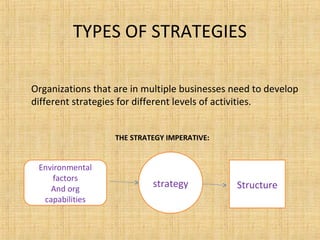
TYPES OF STRATEGIES
Organizations that are in multiple businesses need to develop
different strategies for different levels of activities.
THE STRATEGY IMPERATIVE:
Environmental
factors
And org
capabilities
strategy Structure
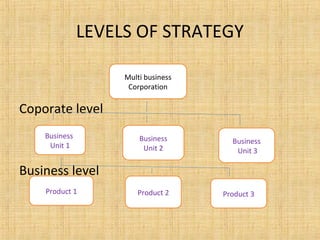
LEVELS OF STRATEGY
Coporate level
Business level
Multi business
Corporation
Business
Unit 1
Business
Unit 2
Business
Unit 3
Product 1 Product 2 Product 3
Corporate Level Strategy
If an organization is in more than one line of business, it will need a corporate-
level strategy. This strategy seeks to answer the question, In what set of
businesses should we be? Corporate-level strategy determines the roles that each
business in the organization will play
Business level strategy
Business-level strategy seeks to answer the question, How should we compete in
each of our businesses? For the small organization in only one line of business or
the large organization that has avoided diversification, business-level strategy is
typically the same as corporate strategy
CLASSIFYING STRATEGIC DIMENSIONS
• Innovation: An innovation strategy does not mean a strategy merely for simple or
cosmetic changes from previous offerings but rather one for meaningful and
unique innovations
• Market differentiation: The marketing differentiation strategy strives to create
customer loyalty by uniquely meeting a particular need
• Breadth: The breadth strategy refers to the scope of the market to which the
business caters: the variety of customers, their geographic range, and the number
of products
• Cost Control: the cost-control strategy considers the extent to which the
organization tightly controls costs, refrains from incurring unnecessary innovation
or marketing expenses, and cuts prices in selling a basic product.
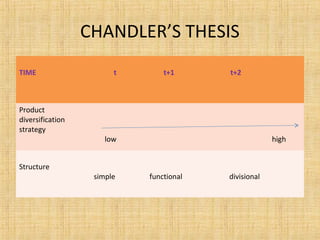
CHANDLER’S STRATEGY
A new strategy required a new or at least
refashioned structure if the enlarged enterprise
was to be operated efficiently… unless structure
follows strategy, inefficient results.
CHANDLER’S THESIS
TIME t t+1 t+2
Product
diversification
strategy
low high
Structure
simple functional divisional
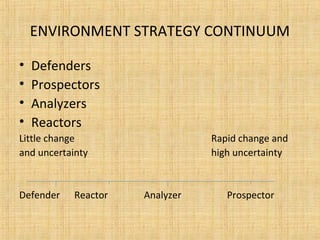
ENVIRONMENT STRATEGY CONTINUUM
• Defenders
• Prospectors
• Analyzers
• Reactors
Little change Rapid change and
and uncertainty high uncertainty
Defender Reactor Analyzer Prospector
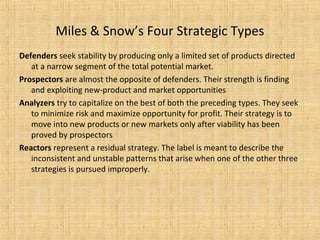
Miles & Snow’s Four Strategic Types
Defenders seek stability by producing only a limited set of products directed
at a narrow segment of the total potential market.
Prospectors are almost the opposite of defenders. Their strength is finding
and exploiting new-product and market opportunities
Analyzers try to capitalize on the best of both the preceding types. They seek
to minimize risk and maximize opportunity for profit. Their strategy is to
move into new products or new markets only after viability has been
proved by prospectors
Reactors represent a residual strategy. The label is meant to describe the
inconsistent and unstable patterns that arise when one of the other three
strategies is pursued improperly.
PORTERS COMPETITIVE STRATEGIES
Porter proposes management must select a
strategy that will give its organization a
competitive advantage.
TYPES:
• Cost-Leadership Strategy
• Differentiation Strategy
• Focus Strategy
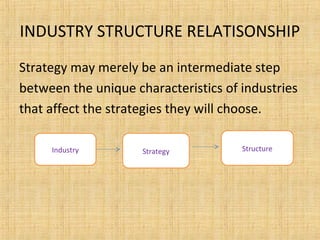
INDUSTRY STRUCTURE RELATISONSHIP
Strategy may merely be an intermediate step
between the unique characteristics of industries
that affect the strategies they will choose.
Industry Strategy Structure
Proposition Regarding the Effects of Structure on the Strategic
Decision Process
Complexity
• As the level of complexity increases, so does the probability that
• Members initially exposed to the decision stimulus will not recognize it as being strategic or
will ignore it because of parochial preferences;
• A decision must satisfy a large constraint set, which decreases the likelihood that decisions
will be made to achieve organization-level goals;
• Strategic action will be the result of an internal process of political bargaining, and moves will
be incremental; and
• Biases induced by members’ parochial perceptions will be the primary constraint on the
comprehensiveness of the strategic decision process. In general, the integration of decisions
will be low.
Formalization
• As the level of formalization increases, so does the probability that
• 1 The strategic decision process will be initiated only in response to problems or
crises that appear in variables monitored by the formal system;
• 2. Decisions will be made to achieve precise, yet remedial, goals, and means will
displace ends;
• Strategic action will be the result of standardized organizational processes, and
moves will be incremental; and
• The level of detail achieved in the standardized organizational processes will be
the primary constraint on the comprehensiveness of the strategic decision
process. The integration of decisions will be intermediate.
Centralization
• As the level of centralization increases, so does the probability that
• The strategic decision process will be initiated only by the dominant few,
and it will be the result of proactive, opportunity-seeking behavior;
• The decision process will be oriented toward achieving “positive” goals
(i.e., intended future domains) that will persist in spite of significant
changes in means;
• Strategic action will be the result of intendedly rational choices, and
moves will be major departures from the existing strategy; and
• Top management’s cognitive limitations will be the primary constraint on
the comprehensiveness of the strategic process. The integration of
decisions will be relatively high.

Ot chapter 5

  • 1.
    © 2010 DorlingKindersley India Pvt. Ltd. All rights reserved. PowerPoint Presentation by Rajeesh Viswanathan Jansons school of Business Organization Theory Structure, Design, and Applications Third Revised Edition Stephen P. Robbins and Mary Mathew C H A P T E R 5 PART II THE DETERMINANTS: WHAT CAUSES STRUCTURE? An Overview
  • 2.
    What is strategy? Strategy can be defined as the determination of the basic long-term goals and objectives of an enterprise, and the adoption of courses of action and the allocation of resources necessary for carrying out these goals.
  • 3.
    TYPES OF STRATEGIES Organizationsthat are in multiple businesses need to develop different strategies for different levels of activities. THE STRATEGY IMPERATIVE: Environmental factors And org capabilities strategy Structure
  • 4.
    LEVELS OF STRATEGY Coporatelevel Business level Multi business Corporation Business Unit 1 Business Unit 2 Business Unit 3 Product 1 Product 2 Product 3
  • 5.
    Corporate Level Strategy Ifan organization is in more than one line of business, it will need a corporate- level strategy. This strategy seeks to answer the question, In what set of businesses should we be? Corporate-level strategy determines the roles that each business in the organization will play Business level strategy Business-level strategy seeks to answer the question, How should we compete in each of our businesses? For the small organization in only one line of business or the large organization that has avoided diversification, business-level strategy is typically the same as corporate strategy
  • 6.
    CLASSIFYING STRATEGIC DIMENSIONS •Innovation: An innovation strategy does not mean a strategy merely for simple or cosmetic changes from previous offerings but rather one for meaningful and unique innovations • Market differentiation: The marketing differentiation strategy strives to create customer loyalty by uniquely meeting a particular need • Breadth: The breadth strategy refers to the scope of the market to which the business caters: the variety of customers, their geographic range, and the number of products • Cost Control: the cost-control strategy considers the extent to which the organization tightly controls costs, refrains from incurring unnecessary innovation or marketing expenses, and cuts prices in selling a basic product.
  • 7.
    CHANDLER’S STRATEGY A newstrategy required a new or at least refashioned structure if the enlarged enterprise was to be operated efficiently… unless structure follows strategy, inefficient results.
  • 8.
    CHANDLER’S THESIS TIME tt+1 t+2 Product diversification strategy low high Structure simple functional divisional
  • 9.
    ENVIRONMENT STRATEGY CONTINUUM •Defenders • Prospectors • Analyzers • Reactors Little change Rapid change and and uncertainty high uncertainty Defender Reactor Analyzer Prospector
  • 10.
    Miles & Snow’sFour Strategic Types Defenders seek stability by producing only a limited set of products directed at a narrow segment of the total potential market. Prospectors are almost the opposite of defenders. Their strength is finding and exploiting new-product and market opportunities Analyzers try to capitalize on the best of both the preceding types. They seek to minimize risk and maximize opportunity for profit. Their strategy is to move into new products or new markets only after viability has been proved by prospectors Reactors represent a residual strategy. The label is meant to describe the inconsistent and unstable patterns that arise when one of the other three strategies is pursued improperly.
  • 11.
    PORTERS COMPETITIVE STRATEGIES Porterproposes management must select a strategy that will give its organization a competitive advantage. TYPES: • Cost-Leadership Strategy • Differentiation Strategy • Focus Strategy
  • 12.
    INDUSTRY STRUCTURE RELATISONSHIP Strategymay merely be an intermediate step between the unique characteristics of industries that affect the strategies they will choose. Industry Strategy Structure
  • 13.
    Proposition Regarding theEffects of Structure on the Strategic Decision Process Complexity • As the level of complexity increases, so does the probability that • Members initially exposed to the decision stimulus will not recognize it as being strategic or will ignore it because of parochial preferences; • A decision must satisfy a large constraint set, which decreases the likelihood that decisions will be made to achieve organization-level goals; • Strategic action will be the result of an internal process of political bargaining, and moves will be incremental; and • Biases induced by members’ parochial perceptions will be the primary constraint on the comprehensiveness of the strategic decision process. In general, the integration of decisions will be low.
  • 14.
    Formalization • As thelevel of formalization increases, so does the probability that • 1 The strategic decision process will be initiated only in response to problems or crises that appear in variables monitored by the formal system; • 2. Decisions will be made to achieve precise, yet remedial, goals, and means will displace ends; • Strategic action will be the result of standardized organizational processes, and moves will be incremental; and • The level of detail achieved in the standardized organizational processes will be the primary constraint on the comprehensiveness of the strategic decision process. The integration of decisions will be intermediate.
  • 15.
    Centralization • As thelevel of centralization increases, so does the probability that • The strategic decision process will be initiated only by the dominant few, and it will be the result of proactive, opportunity-seeking behavior; • The decision process will be oriented toward achieving “positive” goals (i.e., intended future domains) that will persist in spite of significant changes in means; • Strategic action will be the result of intendedly rational choices, and moves will be major departures from the existing strategy; and • Top management’s cognitive limitations will be the primary constraint on the comprehensiveness of the strategic process. The integration of decisions will be relatively high.