©M. S. Ramaiah University of Applied Sciences
1
Seminar preparation
&
Seminar presentation
Dr SEJAL K M
READER
Dept. of OMFS, FDS
©M. S. Ramaiah University of Applied Sciences
2
History
• Seminarium:
”plot where plants are raised from seeds”
or
“plant nursery” from Latin word.
• 1580 first recorded:
used to describe "school for training priests"
©M. S. Ramaiah University of Applied Sciences
3
©M. S. Ramaiah University of Applied Sciences
4
• Reading maketh a full man; writing an exact man;
and conference a ready man stated by Francis Bacon.
• The skills such as reading, writing and talking are
essential for the personality development of a person.
• The seminar method integrates such skills of reading
and writing with presentation skills.
©M. S. Ramaiah University of Applied Sciences
5
Objectives of the Session
At the end of this session students should be able to:
• Define and list types of seminar
• list the objectives of seminar method
• Understand the pre-requisites for the seminar
preparation
• acquire the skills of preparing , and implementing the
seminar
• analyze the limitations of seminar method
©M. S. Ramaiah University of Applied Sciences
6
Definition
A seminar is an instructional technique which
involves generating a situation for a group to have
guided interaction among themselves on a theme
which is generally presented to the group by one or
more members.
©M. S. Ramaiah University of Applied Sciences
7
• Seminar is a form of a class organization that utilizes a
scientific approach for the analysis of a problem
chosen for discussion.
• The students plays an active role in seminar.
• No audience , Everybody participates .
©M. S. Ramaiah University of Applied Sciences
8
Objective of a seminar
Cognitive objectives
It creates opportunities to:
• Explore topics in more depth
• Share ideas that will advance our thinking
• Learn from other’s experience and knowledge
• Gain perspectives and points of view
• develop ability to seek clarification
• Develop ability to defend the ideas effectively
©M. S. Ramaiah University of Applied Sciences
9
Affective objectives
It helps to develop the
• feeling of tolerance to ideas of others.
• feelings of co-operation with others.
• emotional ability among the participants
• manner of questioning and answering the questions
of others effectively.
©M. S. Ramaiah University of Applied Sciences
10
It will also help you to develop a wide range of valuable
study skills and transferable skills like
SEMINAR
ORAL
COMMUNICATI
ON
SHARING
KNOWLEDGE
DEVELOP
ARGUMENT
TIME
MANAGEMENT
AUDIOVISUAL
AID
LISTENING
©M. S. Ramaiah University of Applied Sciences
11
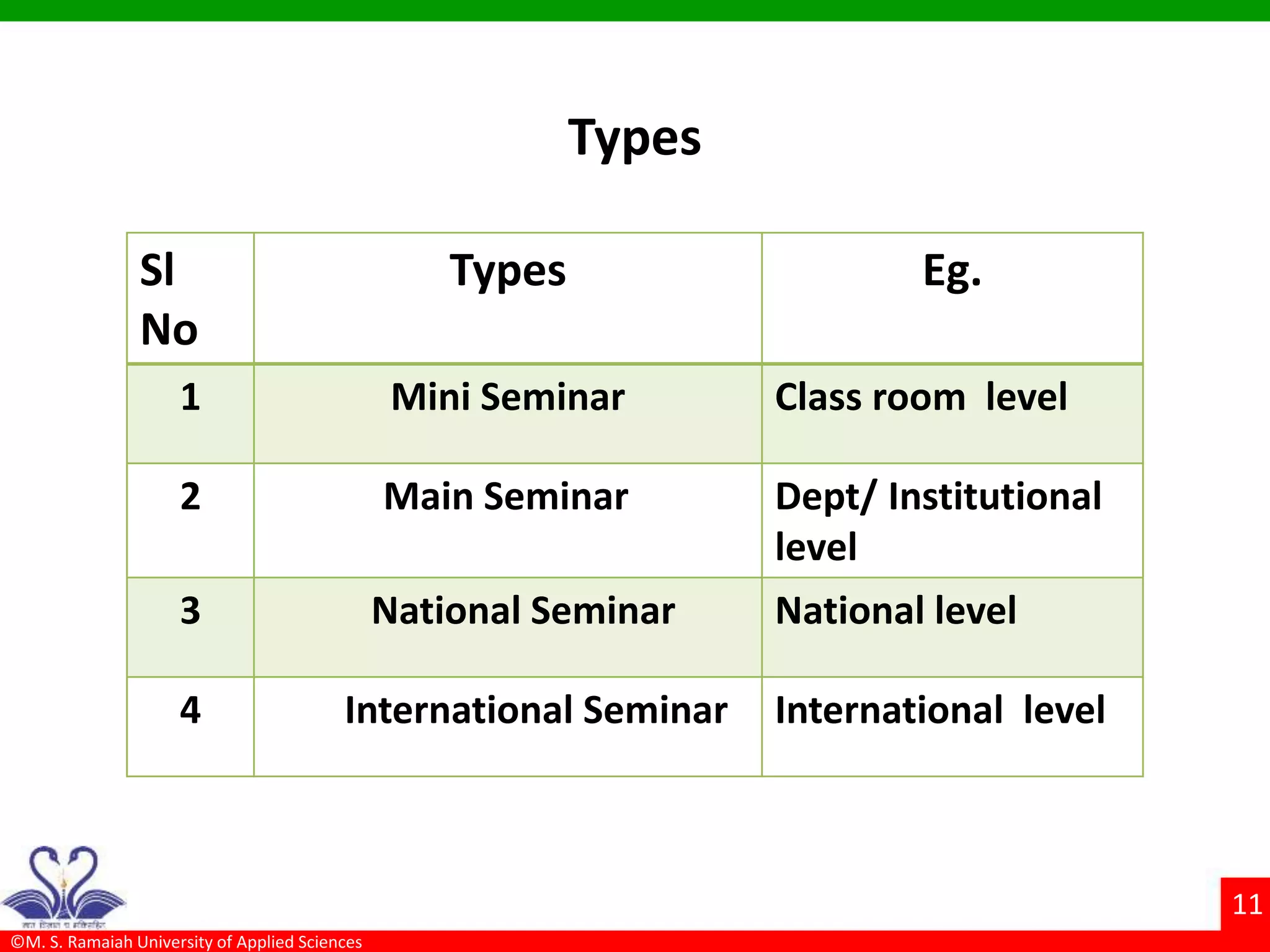
Types
Sl
No
Types Eg.
1 Mini Seminar Class room level
2 Main Seminar Dept/ Institutional
level
3 National Seminar National level
4 International Seminar International level
©M. S. Ramaiah University of Applied Sciences
12
Classroom Seminar
©M. S. Ramaiah University of Applied Sciences
13
• It is a small group method of learning in an informal
group of 10-15 ( not more than 25 )
• It provides a higher level of learning experience.
• It is theme or concept centered and need more
evidences and explanations to lead the discussion
©M. S. Ramaiah University of Applied Sciences
14
Steps for a good seminar preparation
• Select the topic
• Collect and organize information
• Design the Slides
• Make the slides
• Present the seminar
©M. S. Ramaiah University of Applied Sciences
15
Selection of Topic
• The topic selected should
 contribute more to academics.
 be within the content prescribed in the module.
 relate the topic of seminar to attain the objectives of
the present module.
©M. S. Ramaiah University of Applied Sciences
16
Selection of topic
• As a presenter one’s seminar should
 initiate discussion
 create interest in the topic
 be covered comprehensively within the
allotted time period.(45 min)
©M. S. Ramaiah University of Applied Sciences
17
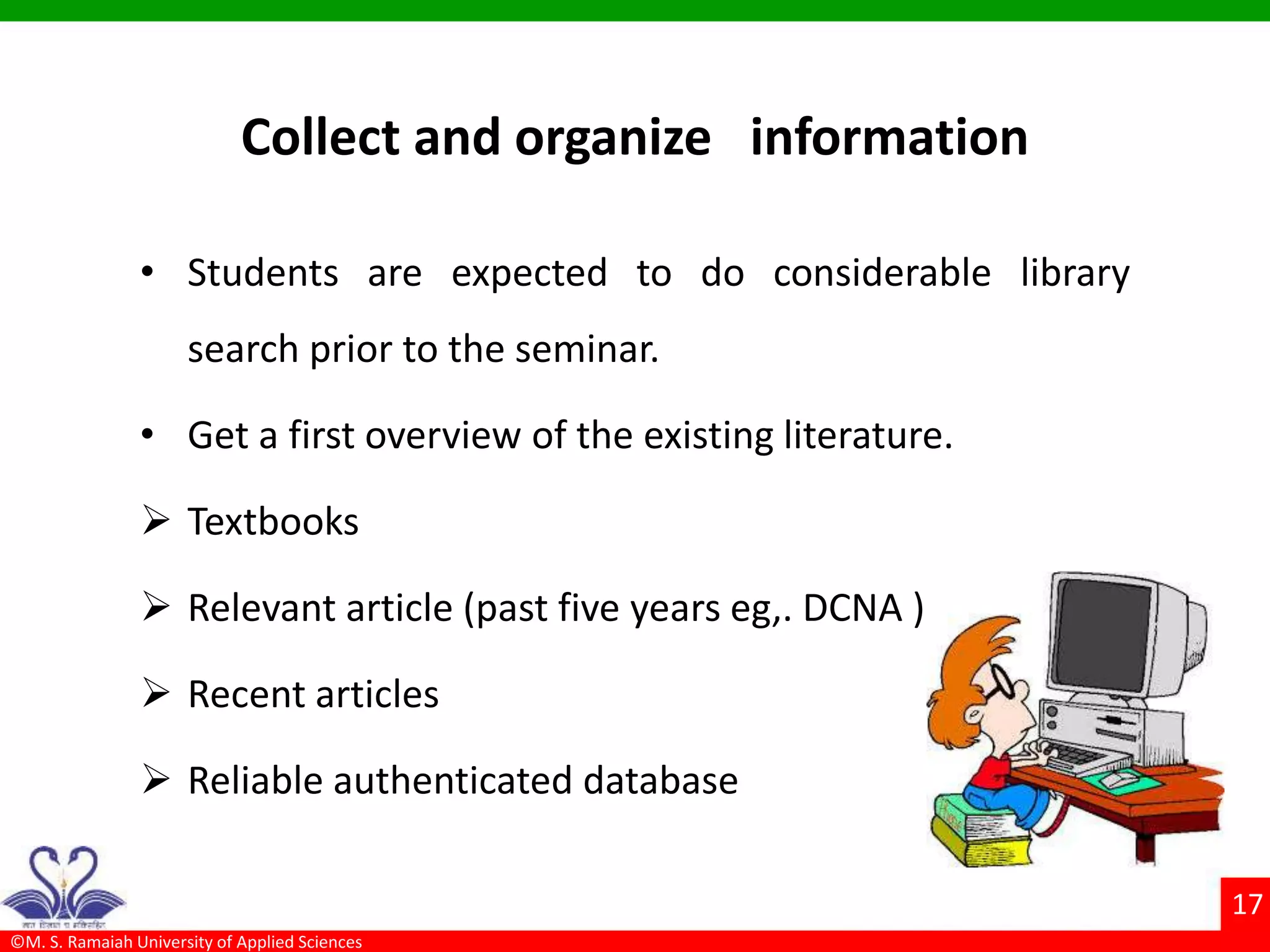
Collect and organize information
• Students are expected to do considerable library
search prior to the seminar.
• Get a first overview of the existing literature.
 Textbooks
 Relevant article (past five years eg,. DCNA )
 Recent articles
 Reliable authenticated database
©M. S. Ramaiah University of Applied Sciences
18
Literature search…………….
The key methods for searching literature are:
• Find the most relevant research material on the topic.
• Track the references used in them.
• Conduct literature searches in databases (and
Google…) using identified key terms.
©M. S. Ramaiah University of Applied Sciences
19
Literature search…………….
• If you have found several articles,
try to find the most frequently cited ones.
 look into the past:
 Look into the future:
 How has this area further developed?
 Has the approach been dropped or are
many following papers based on it?
©M. S. Ramaiah University of Applied Sciences
20
Literature search…………….
• Your understanding of the material must be
deep enough to
 make a judicious selection of the material.
 help you answer questions which transcend the
material / literature.
©M. S. Ramaiah University of Applied Sciences
21
Literature search…………….
• The selection of what to present is critical.
• Reorganize and condense the material.
• Augment seminar by your own literature search.
• Presentation of relevant information and evidences.
• Thoughts and opinions with appropriate references.
• No direct transfer of text from your sources
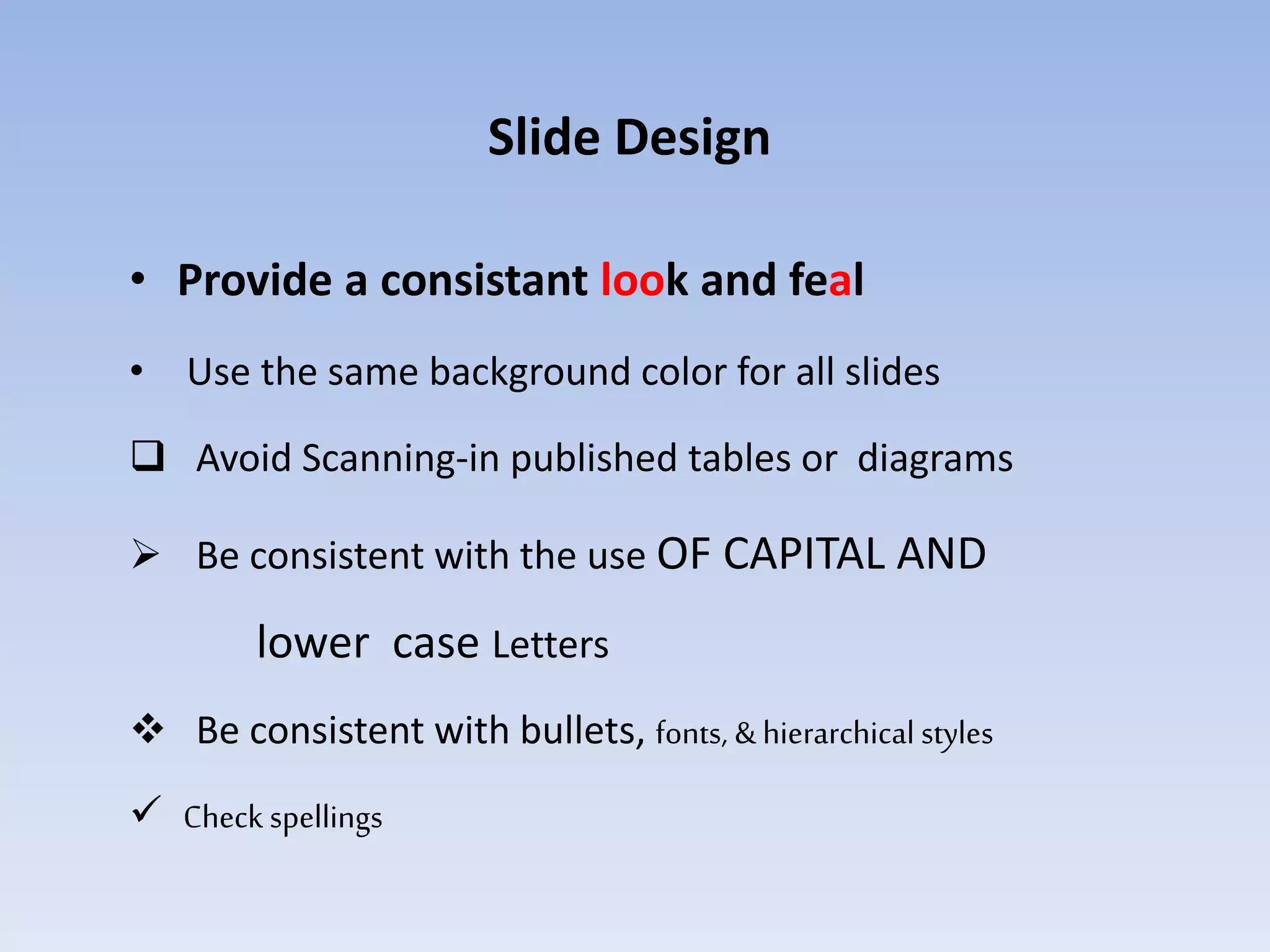
Slide Design
• Provide a consistant look and feal
• Use the same background color for all slides
 Avoid Scanning-in published tables or diagrams
 Be consistent with the use OF CAPITAL AND
lower case Letters
 Be consistent with bullets, fonts, & hierarchical styles
 Check spellings
©M. S. Ramaiah University of Applied Sciences
23
©M. S. Ramaiah University of Applied Sciences
24
©M. S. Ramaiah University of Applied Sciences
25
Slide Design
• Check grammar.
• Watch the justification.
• Make effective use of the space available on each
slide.
©M. S. Ramaiah University of Applied Sciences
26
Slide Design
• One main point.
• One thought per line.
• No more than 5-7 words per line.
• No more than 5-7 lines per slide.
OR
• Follow rule of 6
©M. S. Ramaiah University of Applied Sciences
27
Slide Design
6 x 6 x 6 rule
• six words per bullet
• six bullets per slide
• no more than 35 words per slide
©M. S. Ramaiah University of Applied Sciences
28
Selecting herbicide resistant crops based on broad acre selection procedures.
Possible reasons why susceptible individuals survive herbicide application
under field conditions
I. Unevenness of spray application - because of drift, imperfect
nozzle spacing or height, asymmetrical nozzles, and so on.
II. Unevenness in soil conditions - leading to greater vigor and thus
more survival in one area than another.
III. Inadequate mortality - because the calculations of the rate at
which to apply the herbicide were based on inadequate
premises, or because of unpredictable climatic events (e.g., rain)
after spraying.
IV. Avoidance of the herbicide. (e.g., by delayed germination).
V. Protection of plants by neighbors or weeds from foliar
application, or by stones or deep sowing from preemergence
applications.
VI. Differential interception of spray because of varying orientations
of leaves at spraying.
• Example of a bad slide
©M. S. Ramaiah University of Applied Sciences
29
REASONS WHY SUSCEPTIBLE PLANTS
SURVIVE
HERBICIDE APPLICATION
1. Uneven spray application
2. Uneven soil conditions
3. Rate of application
4. Avoidance Example of a good slide
5. Shading
6. Leaf orientation
©M. S. Ramaiah University of Applied Sciences
30
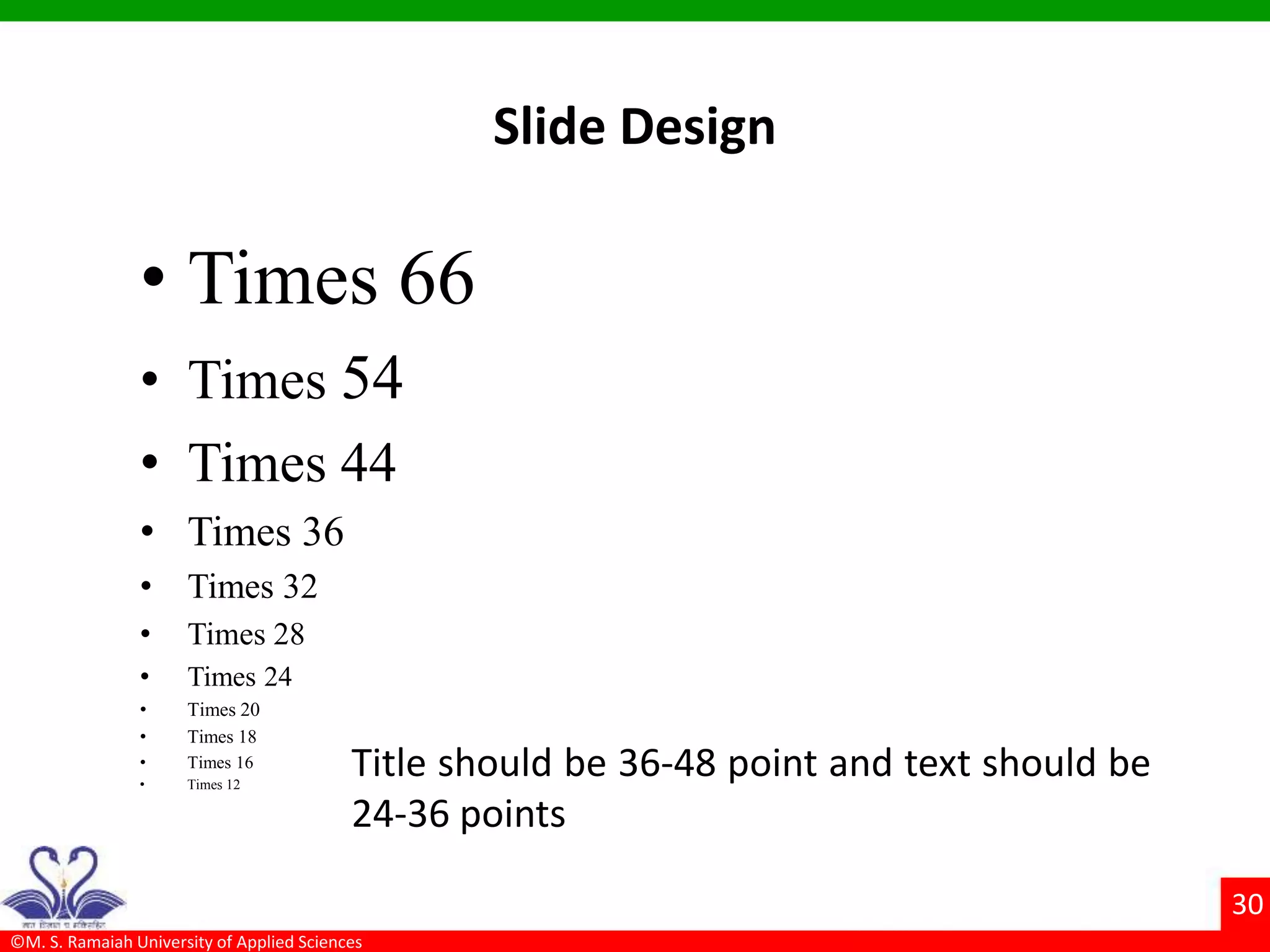
Slide Design
• Times 66
• Times 54
• Times 44
• Times 36
• Times 32
• Times 28
• Times 24
• Times 20
• Times 18
• Times 16
• Times 12
Title should be 36-48 point and text should be
24-36 points
©M. S. Ramaiah University of Applied Sciences
31
Slide design
• Use simple cues to direct to important points or
content
• Models , Easels with charts, white board etc
• This can be done by using bolding italics or
highlighting the text
©M. S. Ramaiah University of Applied Sciences
32
Make the Slide
• Develop an outline for a logical flow of ideas.
 Introduction and background information
 Objectives of the seminar
 Body
 Summary
©M. S. Ramaiah University of Applied Sciences
33
Introduction……..
• Introduction should serve to provide a
 focus (statement of main idea)
 reason to listen (significance of the main idea)
 an orientation (division of presentation)
©M. S. Ramaiah University of Applied Sciences
34
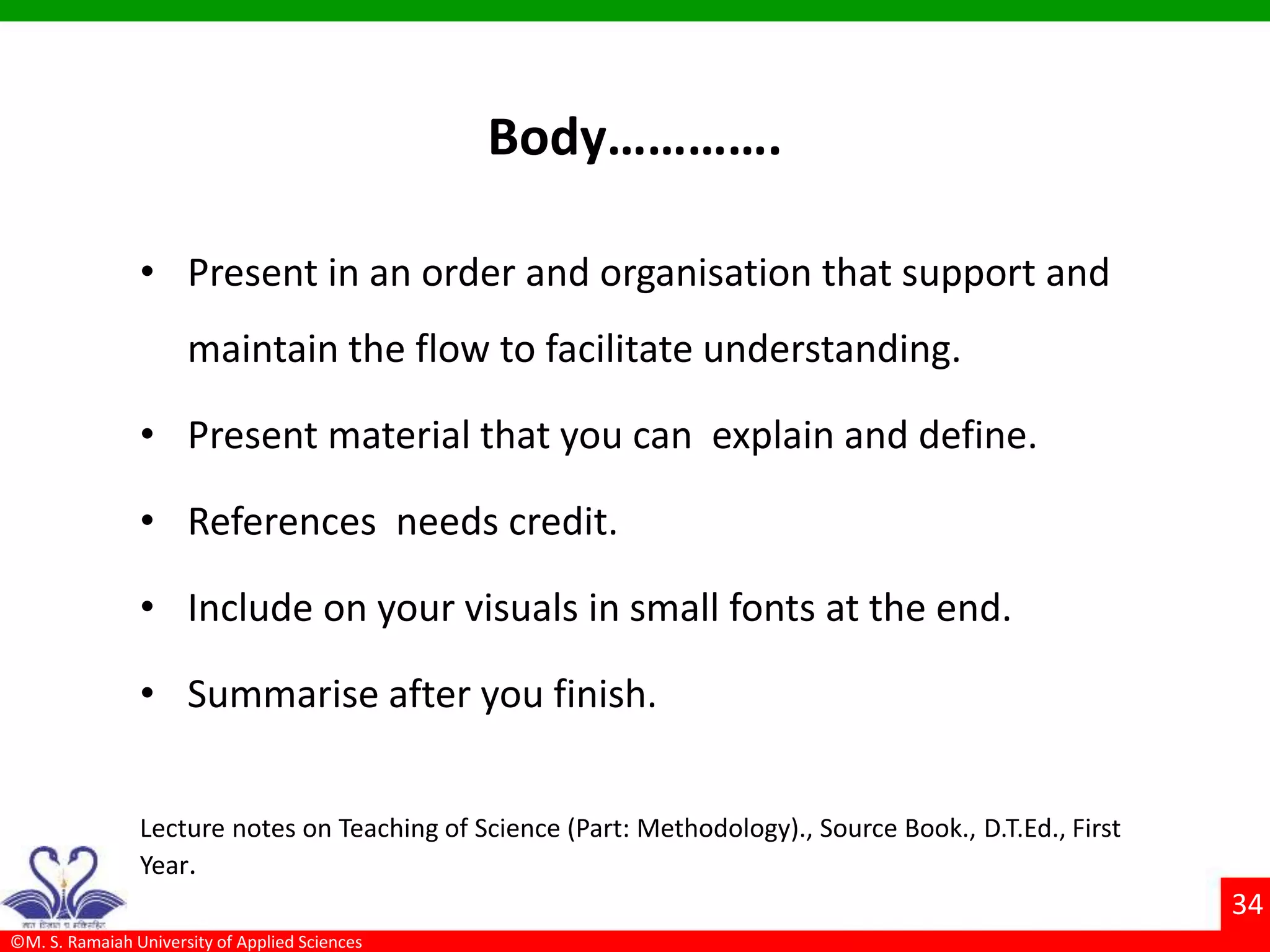
Body………….
• Present in an order and organisation that support and
maintain the flow to facilitate understanding.
• Present material that you can explain and define.
• References needs credit.
• Include on your visuals in small fonts at the end.
• Summarise after you finish.
Lecture notes on Teaching of Science (Part: Methodology)., Source Book., D.T.Ed., First
Year.
©M. S. Ramaiah University of Applied Sciences
35
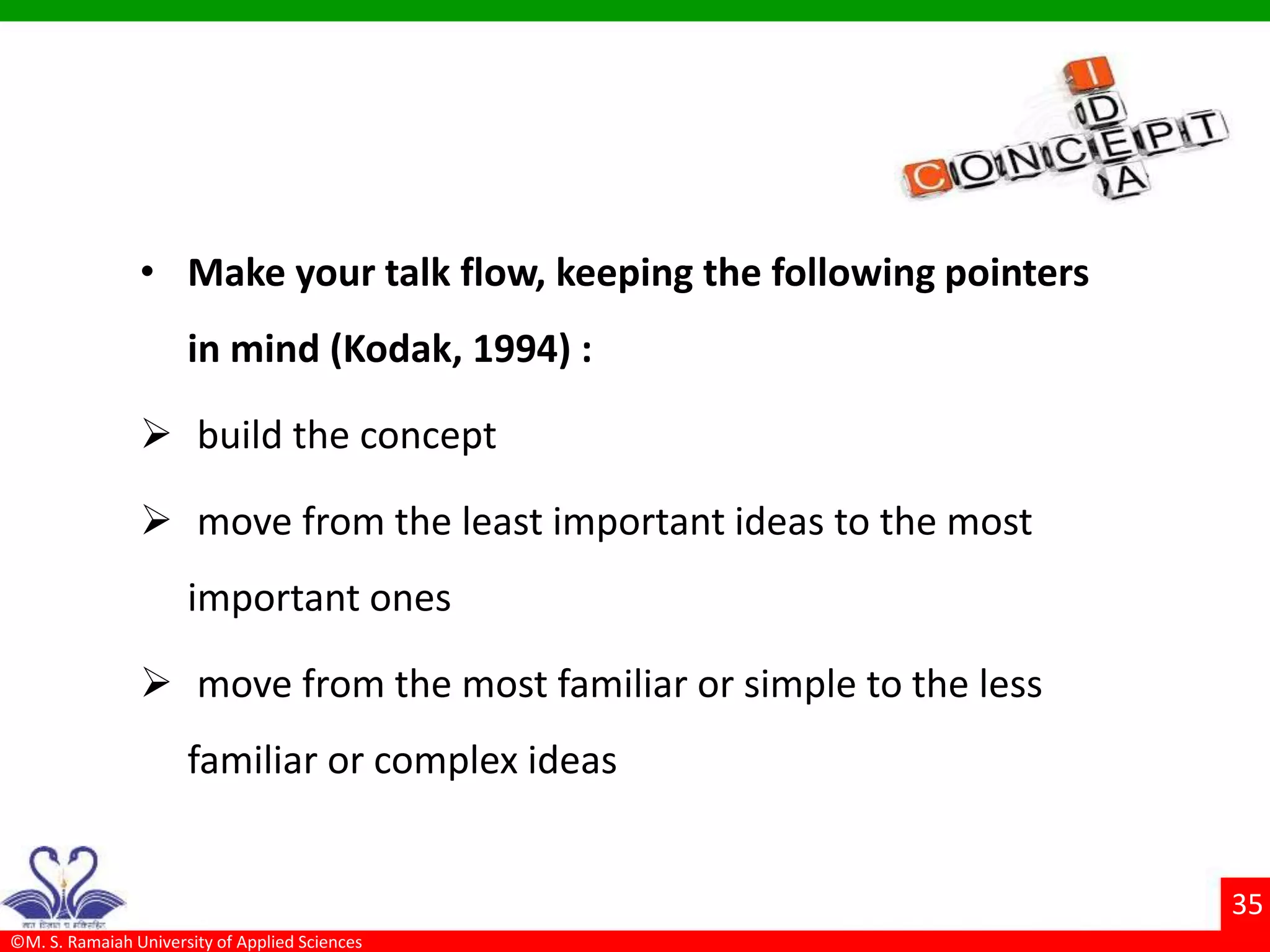
• Make your talk flow, keeping the following pointers
in mind (Kodak, 1994) :
 build the concept
 move from the least important ideas to the most
important ones
 move from the most familiar or simple to the less
familiar or complex ideas
©M. S. Ramaiah University of Applied Sciences
36
Summary
The Conclusion should summarize the main
points covered in the seminar
©M. S. Ramaiah University of Applied Sciences
37
Studies……..
Edelman and Harring in their research concluded that
student learn more when :
• Material is presented in short phrases rather than full
paragraphs.
• Explained rather than student reading the slide.
• Relevent pictures are used.
©M. S. Ramaiah University of Applied Sciences
38
Edelman and Harring advice on leveraging
the working memory with powerpoint:
• Minimise distraction by removing irrelevant material
such as animations and images.
3939
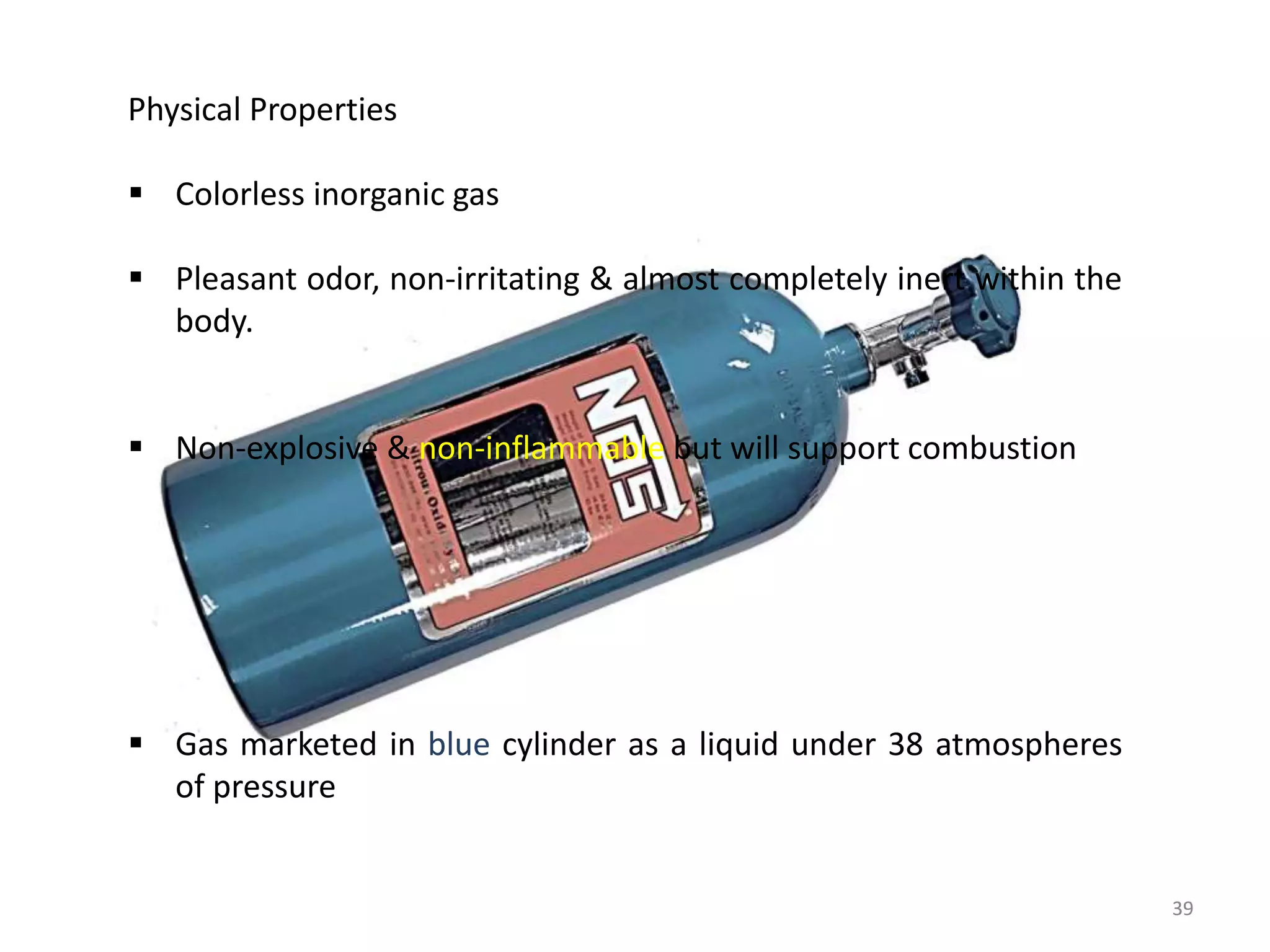
Physical Properties
 Colorless inorganic gas
 Pleasant odor, non-irritating & almost completely inert within the
body.
 Non-explosive & non-inflammable but will support combustion
 Gas marketed in blue cylinder as a liquid under 38 atmospheres
of pressure
©M. S. Ramaiah University of Applied Sciences
40
Regeneration capacity of soybean genotypes
Cultivar No. embryos
/cotyledon
Manchu 2.09
Century 1.85
Palmetto 0.05
Lee 0.03
Cobb 0.02
Dividing the information between visual and auditory modality reducing
one system overload. Lessens cognitive effort
©M. S. Ramaiah University of Applied Sciences
41
Pre Seminar
• Practice
 Scheduling
 Final checklists
• 2. Before the seminar
 Familiarize yourself with the room
 Review your slides
 Does the equipment work?
©M. S. Ramaiah University of Applied Sciences
42
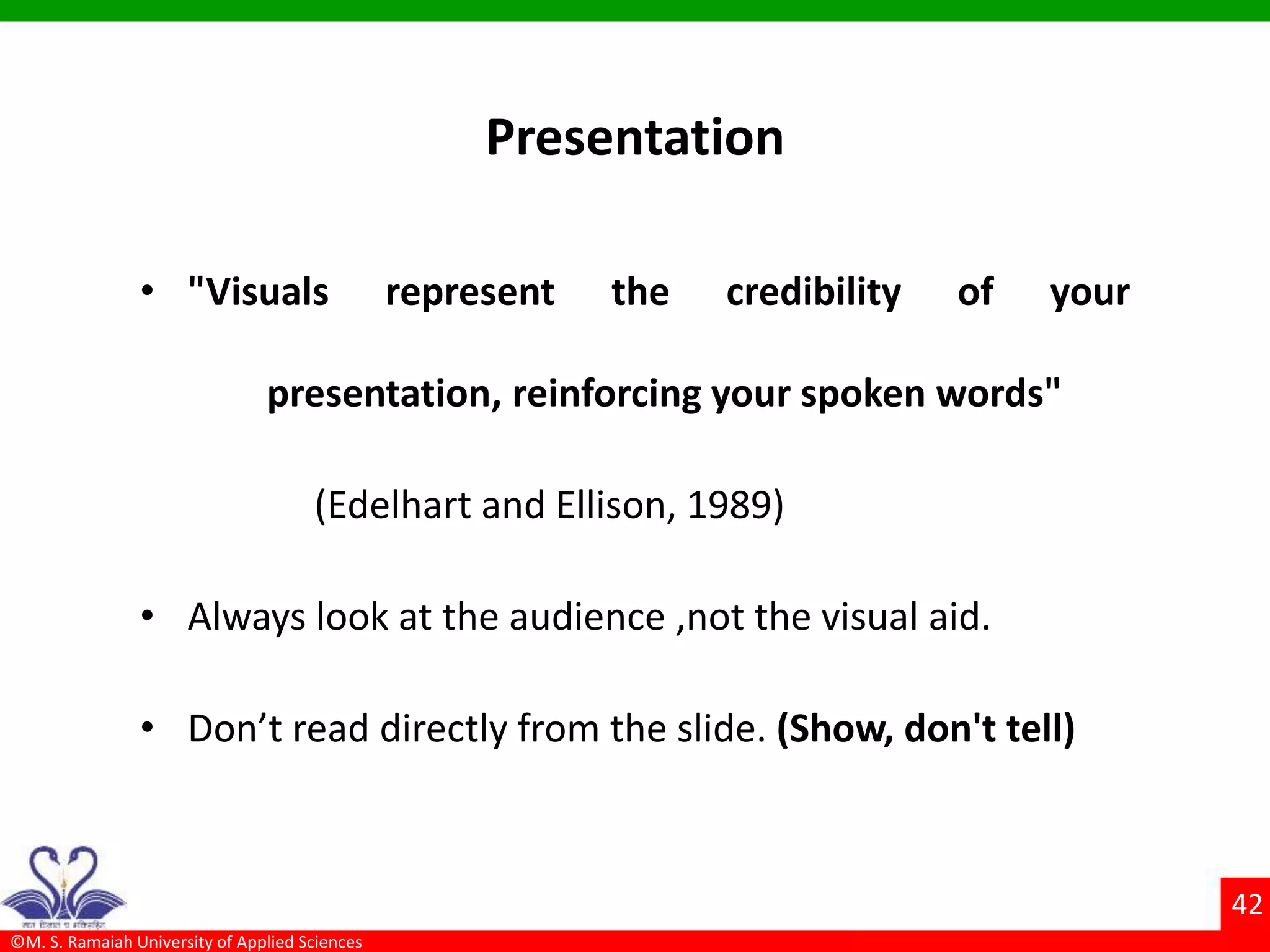
Presentation
• "Visuals represent the credibility of your
presentation, reinforcing your spoken words"
(Edelhart and Ellison, 1989)
• Always look at the audience ,not the visual aid.
• Don’t read directly from the slide. (Show, don't tell)
©M. S. Ramaiah University of Applied Sciences
43
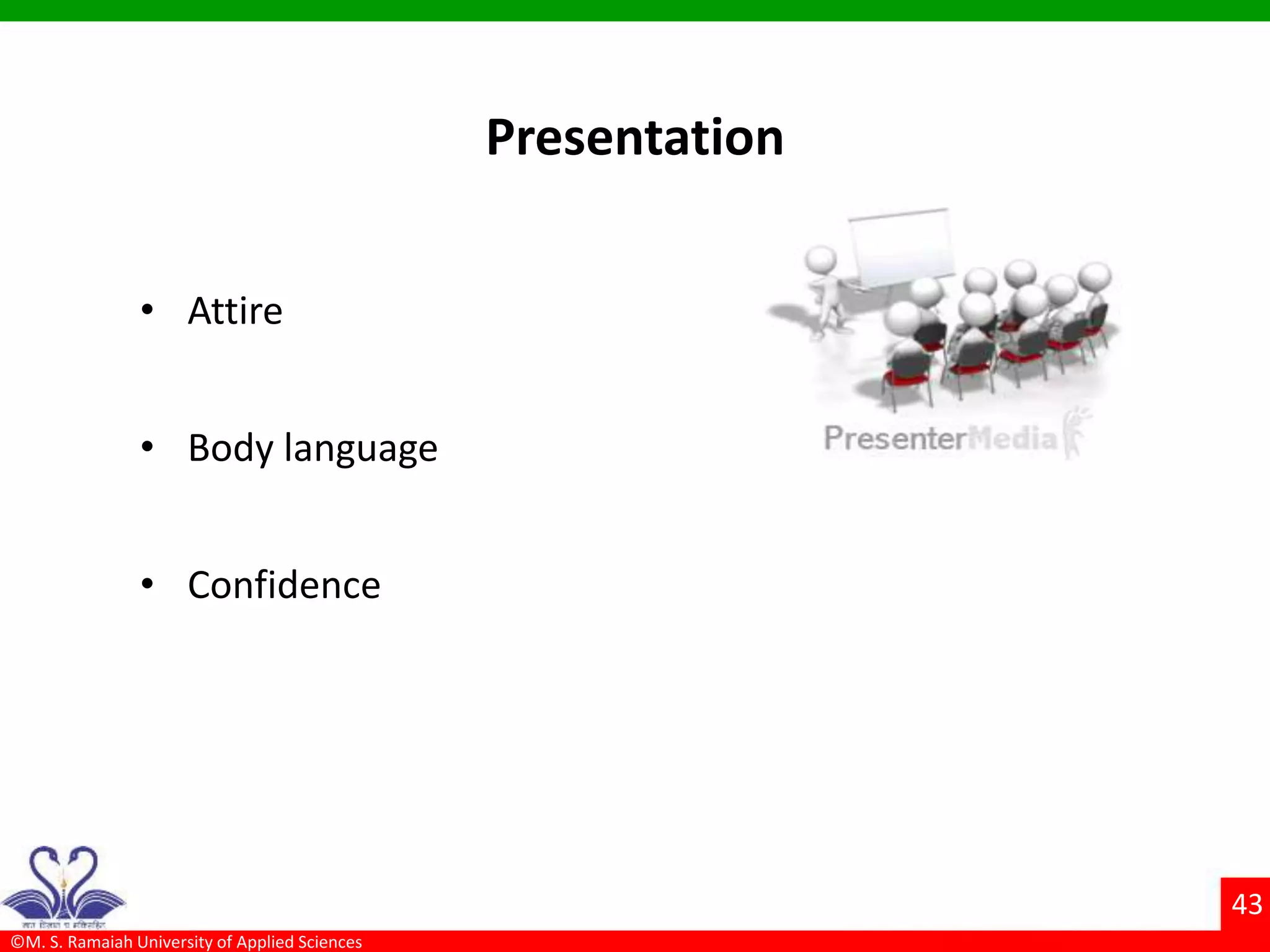
Presentation
• Attire
• Body language
• Confidence
©M. S. Ramaiah University of Applied Sciences
44
• Start with a deep breath
• Know the beginning remarks well
• Do not memorize the presentation, extempore
• Do not speak with your back to the audience
• Pointer ethics
©M. S. Ramaiah University of Applied Sciences
45
• Speak clearly and at suitable pace
• Maintain a good amount of eye contact with your
participants
• Maintain good posture and positive body language
(ie. Stand up straight ,and don’t fold your arms or
keep your hands in your pockets)
©M. S. Ramaiah University of Applied Sciences
46
Attire
• Beware of wearing clothing that can distract from the
message you are conveying.
• If your clothing is unusual or gaudy, and your bracelet
clinks, or tie or scarf distracting you can lose the
attention of the participants.
©M. S. Ramaiah University of Applied Sciences
47
Role of Participants
• Participants should
 be well acquainted with the topic
 appreciate the performance of the speaker
 be able to put questions and seek clarification
©M. S. Ramaiah University of Applied Sciences
48
Advantages
It provides
 a forum for stimulating discussion.
 an opportunity for students to ask questions and
clarify .
 an opportunity for students/trainees to learn
from each other
 an opportunity for teachers to probe students’
understanding.
©M. S. Ramaiah University of Applied Sciences
49
Disadvantages
• Seminars may result in a mini-lecture if
 there is no participation by others.
 the class size is larger than required.
• It inhibits less confident members from participating
• They need to be skillfully managed to achieve the
objectives of the seminar.
©M. S. Ramaiah University of Applied Sciences
50
Review/Evaluation
• Replay the event in your mind
Points to consider
 What happened
 What was observed
 Objectives achieved
 Ideas to improve future seminar presentation
 Make a judgement
©M. S. Ramaiah University of Applied Sciences
51
Conclusion
• A good seminar requires significant planning
• There are many rules to consider, but they are simple
and requires common sense.
• With a well thought-out visual presentation, the words
will follow
©M. S. Ramaiah University of Applied Sciences
52

Seminar preparation

  • 1.
    ©M. S. RamaiahUniversity of Applied Sciences 1 Seminar preparation & Seminar presentation Dr SEJAL K M READER Dept. of OMFS, FDS
  • 2.
    ©M. S. RamaiahUniversity of Applied Sciences 2 History • Seminarium: ”plot where plants are raised from seeds” or “plant nursery” from Latin word. • 1580 first recorded: used to describe "school for training priests"
  • 3.
    ©M. S. RamaiahUniversity of Applied Sciences 3
  • 4.
    ©M. S. RamaiahUniversity of Applied Sciences 4 • Reading maketh a full man; writing an exact man; and conference a ready man stated by Francis Bacon. • The skills such as reading, writing and talking are essential for the personality development of a person. • The seminar method integrates such skills of reading and writing with presentation skills.
  • 5.
    ©M. S. RamaiahUniversity of Applied Sciences 5 Objectives of the Session At the end of this session students should be able to: • Define and list types of seminar • list the objectives of seminar method • Understand the pre-requisites for the seminar preparation • acquire the skills of preparing , and implementing the seminar • analyze the limitations of seminar method
  • 6.
    ©M. S. RamaiahUniversity of Applied Sciences 6 Definition A seminar is an instructional technique which involves generating a situation for a group to have guided interaction among themselves on a theme which is generally presented to the group by one or more members.
  • 7.
    ©M. S. RamaiahUniversity of Applied Sciences 7 • Seminar is a form of a class organization that utilizes a scientific approach for the analysis of a problem chosen for discussion. • The students plays an active role in seminar. • No audience , Everybody participates .
  • 8.
    ©M. S. RamaiahUniversity of Applied Sciences 8 Objective of a seminar Cognitive objectives It creates opportunities to: • Explore topics in more depth • Share ideas that will advance our thinking • Learn from other’s experience and knowledge • Gain perspectives and points of view • develop ability to seek clarification • Develop ability to defend the ideas effectively
  • 9.
    ©M. S. RamaiahUniversity of Applied Sciences 9 Affective objectives It helps to develop the • feeling of tolerance to ideas of others. • feelings of co-operation with others. • emotional ability among the participants • manner of questioning and answering the questions of others effectively.
  • 10.
    ©M. S. RamaiahUniversity of Applied Sciences 10 It will also help you to develop a wide range of valuable study skills and transferable skills like SEMINAR ORAL COMMUNICATI ON SHARING KNOWLEDGE DEVELOP ARGUMENT TIME MANAGEMENT AUDIOVISUAL AID LISTENING
  • 11.
    ©M. S. RamaiahUniversity of Applied Sciences 11 Types Sl No Types Eg. 1 Mini Seminar Class room level 2 Main Seminar Dept/ Institutional level 3 National Seminar National level 4 International Seminar International level
  • 12.
    ©M. S. RamaiahUniversity of Applied Sciences 12 Classroom Seminar
  • 13.
    ©M. S. RamaiahUniversity of Applied Sciences 13 • It is a small group method of learning in an informal group of 10-15 ( not more than 25 ) • It provides a higher level of learning experience. • It is theme or concept centered and need more evidences and explanations to lead the discussion
  • 14.
    ©M. S. RamaiahUniversity of Applied Sciences 14 Steps for a good seminar preparation • Select the topic • Collect and organize information • Design the Slides • Make the slides • Present the seminar
  • 15.
    ©M. S. RamaiahUniversity of Applied Sciences 15 Selection of Topic • The topic selected should  contribute more to academics.  be within the content prescribed in the module.  relate the topic of seminar to attain the objectives of the present module.
  • 16.
    ©M. S. RamaiahUniversity of Applied Sciences 16 Selection of topic • As a presenter one’s seminar should  initiate discussion  create interest in the topic  be covered comprehensively within the allotted time period.(45 min)
  • 17.
    ©M. S. RamaiahUniversity of Applied Sciences 17 Collect and organize information • Students are expected to do considerable library search prior to the seminar. • Get a first overview of the existing literature.  Textbooks  Relevant article (past five years eg,. DCNA )  Recent articles  Reliable authenticated database
  • 18.
    ©M. S. RamaiahUniversity of Applied Sciences 18 Literature search……………. The key methods for searching literature are: • Find the most relevant research material on the topic. • Track the references used in them. • Conduct literature searches in databases (and Google…) using identified key terms.
  • 19.
    ©M. S. RamaiahUniversity of Applied Sciences 19 Literature search……………. • If you have found several articles, try to find the most frequently cited ones.  look into the past:  Look into the future:  How has this area further developed?  Has the approach been dropped or are many following papers based on it?
  • 20.
    ©M. S. RamaiahUniversity of Applied Sciences 20 Literature search……………. • Your understanding of the material must be deep enough to  make a judicious selection of the material.  help you answer questions which transcend the material / literature.
  • 21.
    ©M. S. RamaiahUniversity of Applied Sciences 21 Literature search……………. • The selection of what to present is critical. • Reorganize and condense the material. • Augment seminar by your own literature search. • Presentation of relevant information and evidences. • Thoughts and opinions with appropriate references. • No direct transfer of text from your sources
  • 22.
    Slide Design • Providea consistant look and feal • Use the same background color for all slides  Avoid Scanning-in published tables or diagrams  Be consistent with the use OF CAPITAL AND lower case Letters  Be consistent with bullets, fonts, & hierarchical styles  Check spellings
  • 23.
    ©M. S. RamaiahUniversity of Applied Sciences 23
  • 24.
    ©M. S. RamaiahUniversity of Applied Sciences 24
  • 25.
    ©M. S. RamaiahUniversity of Applied Sciences 25 Slide Design • Check grammar. • Watch the justification. • Make effective use of the space available on each slide.
  • 26.
    ©M. S. RamaiahUniversity of Applied Sciences 26 Slide Design • One main point. • One thought per line. • No more than 5-7 words per line. • No more than 5-7 lines per slide. OR • Follow rule of 6
  • 27.
    ©M. S. RamaiahUniversity of Applied Sciences 27 Slide Design 6 x 6 x 6 rule • six words per bullet • six bullets per slide • no more than 35 words per slide
  • 28.
    ©M. S. RamaiahUniversity of Applied Sciences 28 Selecting herbicide resistant crops based on broad acre selection procedures. Possible reasons why susceptible individuals survive herbicide application under field conditions I. Unevenness of spray application - because of drift, imperfect nozzle spacing or height, asymmetrical nozzles, and so on. II. Unevenness in soil conditions - leading to greater vigor and thus more survival in one area than another. III. Inadequate mortality - because the calculations of the rate at which to apply the herbicide were based on inadequate premises, or because of unpredictable climatic events (e.g., rain) after spraying. IV. Avoidance of the herbicide. (e.g., by delayed germination). V. Protection of plants by neighbors or weeds from foliar application, or by stones or deep sowing from preemergence applications. VI. Differential interception of spray because of varying orientations of leaves at spraying. • Example of a bad slide
  • 29.
    ©M. S. RamaiahUniversity of Applied Sciences 29 REASONS WHY SUSCEPTIBLE PLANTS SURVIVE HERBICIDE APPLICATION 1. Uneven spray application 2. Uneven soil conditions 3. Rate of application 4. Avoidance Example of a good slide 5. Shading 6. Leaf orientation
  • 30.
    ©M. S. RamaiahUniversity of Applied Sciences 30 Slide Design • Times 66 • Times 54 • Times 44 • Times 36 • Times 32 • Times 28 • Times 24 • Times 20 • Times 18 • Times 16 • Times 12 Title should be 36-48 point and text should be 24-36 points
  • 31.
    ©M. S. RamaiahUniversity of Applied Sciences 31 Slide design • Use simple cues to direct to important points or content • Models , Easels with charts, white board etc • This can be done by using bolding italics or highlighting the text
  • 32.
    ©M. S. RamaiahUniversity of Applied Sciences 32 Make the Slide • Develop an outline for a logical flow of ideas.  Introduction and background information  Objectives of the seminar  Body  Summary
  • 33.
    ©M. S. RamaiahUniversity of Applied Sciences 33 Introduction…….. • Introduction should serve to provide a  focus (statement of main idea)  reason to listen (significance of the main idea)  an orientation (division of presentation)
  • 34.
    ©M. S. RamaiahUniversity of Applied Sciences 34 Body…………. • Present in an order and organisation that support and maintain the flow to facilitate understanding. • Present material that you can explain and define. • References needs credit. • Include on your visuals in small fonts at the end. • Summarise after you finish. Lecture notes on Teaching of Science (Part: Methodology)., Source Book., D.T.Ed., First Year.
  • 35.
    ©M. S. RamaiahUniversity of Applied Sciences 35 • Make your talk flow, keeping the following pointers in mind (Kodak, 1994) :  build the concept  move from the least important ideas to the most important ones  move from the most familiar or simple to the less familiar or complex ideas
  • 36.
    ©M. S. RamaiahUniversity of Applied Sciences 36 Summary The Conclusion should summarize the main points covered in the seminar
  • 37.
    ©M. S. RamaiahUniversity of Applied Sciences 37 Studies…….. Edelman and Harring in their research concluded that student learn more when : • Material is presented in short phrases rather than full paragraphs. • Explained rather than student reading the slide. • Relevent pictures are used.
  • 38.
    ©M. S. RamaiahUniversity of Applied Sciences 38 Edelman and Harring advice on leveraging the working memory with powerpoint: • Minimise distraction by removing irrelevant material such as animations and images.
  • 39.
    3939 Physical Properties  Colorlessinorganic gas  Pleasant odor, non-irritating & almost completely inert within the body.  Non-explosive & non-inflammable but will support combustion  Gas marketed in blue cylinder as a liquid under 38 atmospheres of pressure
  • 40.
    ©M. S. RamaiahUniversity of Applied Sciences 40 Regeneration capacity of soybean genotypes Cultivar No. embryos /cotyledon Manchu 2.09 Century 1.85 Palmetto 0.05 Lee 0.03 Cobb 0.02 Dividing the information between visual and auditory modality reducing one system overload. Lessens cognitive effort
  • 41.
    ©M. S. RamaiahUniversity of Applied Sciences 41 Pre Seminar • Practice  Scheduling  Final checklists • 2. Before the seminar  Familiarize yourself with the room  Review your slides  Does the equipment work?
  • 42.
    ©M. S. RamaiahUniversity of Applied Sciences 42 Presentation • "Visuals represent the credibility of your presentation, reinforcing your spoken words" (Edelhart and Ellison, 1989) • Always look at the audience ,not the visual aid. • Don’t read directly from the slide. (Show, don't tell)
  • 43.
    ©M. S. RamaiahUniversity of Applied Sciences 43 Presentation • Attire • Body language • Confidence
  • 44.
    ©M. S. RamaiahUniversity of Applied Sciences 44 • Start with a deep breath • Know the beginning remarks well • Do not memorize the presentation, extempore • Do not speak with your back to the audience • Pointer ethics
  • 45.
    ©M. S. RamaiahUniversity of Applied Sciences 45 • Speak clearly and at suitable pace • Maintain a good amount of eye contact with your participants • Maintain good posture and positive body language (ie. Stand up straight ,and don’t fold your arms or keep your hands in your pockets)
  • 46.
    ©M. S. RamaiahUniversity of Applied Sciences 46 Attire • Beware of wearing clothing that can distract from the message you are conveying. • If your clothing is unusual or gaudy, and your bracelet clinks, or tie or scarf distracting you can lose the attention of the participants.
  • 47.
    ©M. S. RamaiahUniversity of Applied Sciences 47 Role of Participants • Participants should  be well acquainted with the topic  appreciate the performance of the speaker  be able to put questions and seek clarification
  • 48.
    ©M. S. RamaiahUniversity of Applied Sciences 48 Advantages It provides  a forum for stimulating discussion.  an opportunity for students to ask questions and clarify .  an opportunity for students/trainees to learn from each other  an opportunity for teachers to probe students’ understanding.
  • 49.
    ©M. S. RamaiahUniversity of Applied Sciences 49 Disadvantages • Seminars may result in a mini-lecture if  there is no participation by others.  the class size is larger than required. • It inhibits less confident members from participating • They need to be skillfully managed to achieve the objectives of the seminar.
  • 50.
    ©M. S. RamaiahUniversity of Applied Sciences 50 Review/Evaluation • Replay the event in your mind Points to consider  What happened  What was observed  Objectives achieved  Ideas to improve future seminar presentation  Make a judgement
  • 51.
    ©M. S. RamaiahUniversity of Applied Sciences 51 Conclusion • A good seminar requires significant planning • There are many rules to consider, but they are simple and requires common sense. • With a well thought-out visual presentation, the words will follow
  • 52.
    ©M. S. RamaiahUniversity of Applied Sciences 52

Editor's Notes

  • #33 This can also be used as checklist