SEMINAR ON POISONING
By :MERON GIRMA
ENGIDAW AMBELU
MODERATOR:
DR.GETA
OUTLINES:
• DEFINITION, TYPE AND EPIDEMIOLOGY
• HISTORY AND PHYSICAL EXAMINATION
• CLINICAL DIAGNOSIS
• PRINCIPLE OF MANAGEMENT
• COMMON SELECTED POISONINGS
Definition
Poison:
“Poison is a substance ( solid/ liquid or gaseous ),that produce
ill health or death, by its constitutional or local effects or both,
by altering cell structure or functions.”
The branch of medicine that deals with the detection and
treatment of poisons is known as toxicology.
Poisoning:
“The development of dose related adverse effects following
exposure to chemicals, drugs or other xenobiotics.”
It occurs when any substance interferes with normal body
functions after it is
Swallowed; ingested poisons => 78%
Inhaled; breathed in poisons => 5.4%
injected ;IV, IM, SQ or Intra Dermal => 0.3%
Absorbed; poisons taken in through unbroken skin =>6.8%
Enter through Opthalmic; => 5.9%
Types:
Deliberate (intentional)
Suicide & homicide
 Accidental (unintentional)
Dosage error
Recreational use
Environmental:
• Plants
• Food
Venomous stings/bites
Industrial exposures
• Epidemiology
• Each day a child is exposed to potential toxin
• Age
• most common in<5yrs(50-60%)
• Cause
• most(93-99%) are accidental
Hx content of poisoned patient
Identification of the patient and toxic agent.
What? Description of the toxin.
Product names (brand, generic, chemical) and
ingredients, along with their concentrations
Bring container to hospital with patient.
How much? Magnitude of the exposure.
determine as accurately as possible how much of the
substance has been consumed by counting the remaining
tablets or measuring the remaining volume of liquid or gas
after we ask the previous amount.
It is better to overestimate than to underestimate
When ?Time of exposure.
Knowing the time lapse between exposure and the onset of
symptoms and/or medical evaluation w influence decisions of
diagnostic testing as well as therapeutic intervention.
Period of exposure
• First time use or chronic user
• If unknown—estimate the shortest and longest possible
time.
Progression of symptoms.
Knowing the nature and progression of symptoms is very
helpful for assessing the need for immediate life support, the
prognosis, and the type of intervention needed
What interventions have been done?
– Traditional home remedies may be harmful
Medical history
Underlying diseases
Concurrent drug therapy
The effects of poisoning maybe None, Mild or Severe
depending on:
• The amount of poison ingested.
• The nature of the substance.
• The age of the child.
• The nutritional status of the child.
• The state of the stomach-whether empty or full of food.
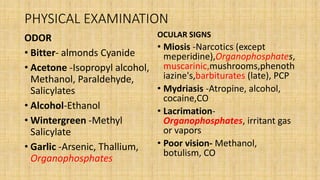
PHYSICAL EXAMINATION
ODOR
• Bitter- almonds Cyanide
• Acetone -Isopropyl alcohol,
Methanol, Paraldehyde,
Salicylates
• Alcohol-Ethanol
• Wintergreen -Methyl
Salicylate
• Garlic -Arsenic, Thallium,
Organophosphates
OCULAR SIGNS
• Miosis -Narcotics (except
meperidine),Organophosphates,
muscarinic,mushrooms,phenoth
iazine's,barbiturates (late), PCP
• Mydriasis -Atropine, alcohol,
cocaine,CO
• Lacrimation-
Organophosphates, irritant gas
or vapors
• Poor vision- Methanol,
botulism, CO
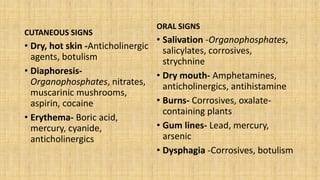
CUTANEOUS SIGNS
• Dry, hot skin -Anticholinergic
agents, botulism
• Diaphoresis-
Organophosphates, nitrates,
muscarinic mushrooms,
aspirin, cocaine
• Erythema- Boric acid,
mercury, cyanide,
anticholinergics
ORAL SIGNS
• Salivation -Organophosphates,
salicylates, corrosives,
strychnine
• Dry mouth- Amphetamines,
anticholinergics, antihistamine
• Burns- Corrosives, oxalate-
containing plants
• Gum lines- Lead, mercury,
arsenic
• Dysphagia -Corrosives, botulism
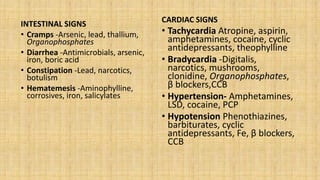
INTESTINAL SIGNS
• Cramps -Arsenic, lead, thallium,
Organophosphates
• Diarrhea -Antimicrobials, arsenic,
iron, boric acid
• Constipation -Lead, narcotics,
botulism
• Hematemesis -Aminophylline,
corrosives, iron, salicylates
CARDIAC SIGNS
• Tachycardia Atropine, aspirin,
amphetamines, cocaine, cyclic
antidepressants, theophylline
• Bradycardia -Digitalis,
narcotics, mushrooms,
clonidine, Organophosphates,
β blockers,CCB
• Hypertension- Amphetamines,
LSD, cocaine, PCP
• Hypotension Phenothiazines,
barbiturates, cyclic
antidepressants, Fe, β blockers,
CCB
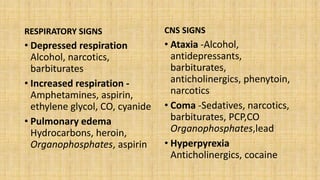
RESPIRATORY SIGNS
• Depressed respiration
Alcohol, narcotics,
barbiturates
• Increased respiration -
Amphetamines, aspirin,
ethylene glycol, CO, cyanide
• Pulmonary edema
Hydrocarbons, heroin,
Organophosphates, aspirin
CNS SIGNS
• Ataxia -Alcohol,
antidepressants,
barbiturates,
anticholinergics, phenytoin,
narcotics
• Coma -Sedatives, narcotics,
barbiturates, PCP,CO
Organophosphates,lead
• Hyperpyrexia
Anticholinergics, cocaine
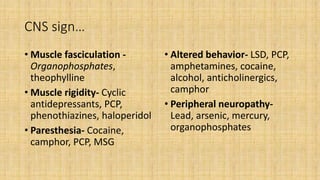
CNS sign…
• Muscle fasciculation -
Organophosphates,
theophylline
• Muscle rigidity- Cyclic
antidepressants, PCP,
phenothiazines, haloperidol
• Paresthesia- Cocaine,
camphor, PCP, MSG
• Altered behavior- LSD, PCP,
amphetamines, cocaine,
alcohol, anticholinergics,
camphor
• Peripheral neuropathy-
Lead, arsenic, mercury,
organophosphates
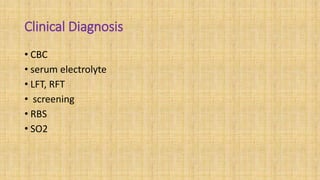
Clinical Diagnosis
• CBC
• serum electrolyte
• LFT, RFT
• screening
• RBS
• SO2
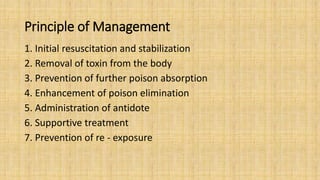
Principle of Management
1. Initial resuscitation and stabilization
2. Removal of toxin from the body
3. Prevention of further poison absorption
4. Enhancement of poison elimination
5. Administration of antidote
6. Supportive treatment
7. Prevention of re - exposure
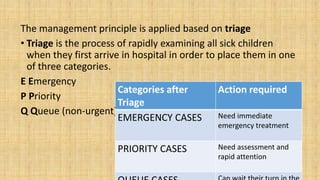
The management principle is applied based on triage
• Triage is the process of rapidly examining all sick children
when they first arrive in hospital in order to place them in one
of three categories.
E Emergency
P Priority
Q Queue (non-urgent)
Categories after
Triage
Action required
EMERGENCY CASES Need immediate
emergency treatment
PRIORITY CASES Need assessment and
rapid attention
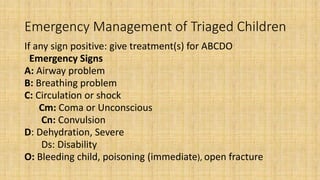
Emergency Management of Triaged Children
If any sign positive: give treatment(s) for ABCDO
Emergency Signs
A: Airway problem
B: Breathing problem
C: Circulation or shock
Cm: Coma or Unconscious
Cn: Convulsion
D: Dehydration, Severe
Ds: Disability
O: Bleeding child, poisoning (immediate), open fracture
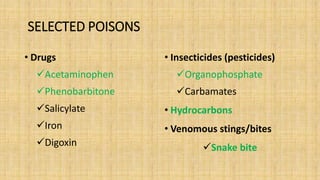
SELECTED POISONS
• Drugs
Acetaminophen
Phenobarbitone
Salicylate
Iron
Digoxin
• Insecticides (pesticides)
Organophosphate
Carbamates
• Hydrocarbons
• Venomous stings/bites
Snake bite
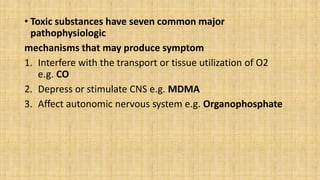
• Toxic substances have seven common major
pathophysiologic
mechanisms that may produce symptom
1. Interfere with the transport or tissue utilization of O2
e.g. CO
2. Depress or stimulate CNS e.g. MDMA
3. Affect autonomic nervous system e.g. Organophosphate
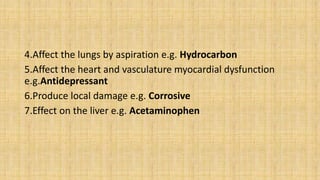
4.Affect the lungs by aspiration e.g. Hydrocarbon
5.Affect the heart and vasculature myocardial dysfunction
e.g.Antidepressant
6.Produce local damage e.g. Corrosive
7.Effect on the liver e.g. Acetaminophen
Organophosphate poisoning
• Less common (< 1%) in children
• Mostly accidental and unintentional
• More common in lower socioeconomic class
• Used in agriculture(crop sprays) and home as insecticides &
pesticides
e.g.
Insecticides – malathion(MLT), parathion, ethion, diazinon
Nerve gases - sarin, tabun
ophthalmic agents - echothiophate, isoflurophate
Herbicides - tributes [DEF], merphos
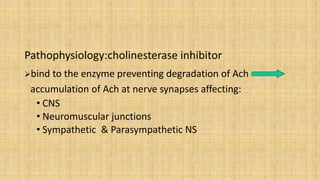
Pathophysiology:cholinesterase inhibitor
bind to the enzyme preventing degradation of Ach
accumulation of Ach at nerve synapses affecting:
• CNS
• Neuromuscular junctions
• Sympathetic & Parasympathetic NS
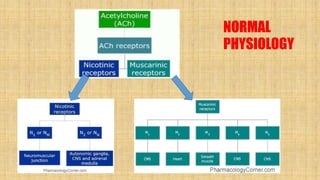
NORMAL
PHYSIOLOGY
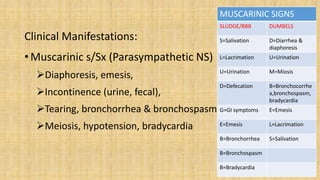
Clinical Manifestations:
• Muscarinic s/Sx (Parasympathetic NS)
Diaphoresis, emesis,
Incontinence (urine, fecal),
Tearing, bronchorrhea & bronchospasm
Meiosis, hypotension, bradycardia
MUSCARINIC SIGNS
SLUDGE/BBB DUMBELS
S=Salivation D=Diarrhea &
diaphoresis
L=Lacrimation U=Urination
U=Urination M=Miosis
D=Defecation B=Bronchocorrhe
a,bronchospasm,
bradycardia
G=GI symptoms E=Emesis
E=Emesis L=Lacrimation
B=Bronchorrhea S=Salivation
B=Bronchospasm
B=Bradycardia
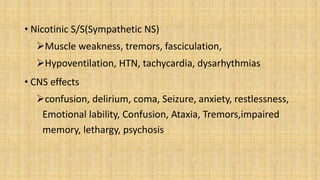
• Nicotinic S/S(Sympathetic NS)
Muscle weakness, tremors, fasciculation,
Hypoventilation, HTN, tachycardia, dysarhythmias
• CNS effects
confusion, delirium, coma, Seizure, anxiety, restlessness,
Emotional lability, Confusion, Ataxia, Tremors,impaired
memory, lethargy, psychosis
the balance between stimulation of muscarinic and nicotinic
receptor depend on the
- Type of organophosphate
- Dose
- Route and rate of absorption
- Individual factor
Management:
Supportive
GID
Antidotes (atropine)
Hydrocarbon Poisoning
• Most commonly ingested hydrocarbons - gasoline,
lubricating oil, motor oil, mineral spirits, lighter
fluid/naphtha, lamp oil,and kerosene.
• Other common sources of hydrocarbons -dry cleaning
solutions, paint, spot remover, rubber cement, and solvents
• Type of toxic response depends on:
• amount of ingestion
• volatility(viscosity)
• Pathophysiology
o Cause toxicity in 2 ways :
a. Aspiration (most common) results in
→ Spasm, edema, inflammatory rxn, and necrosis of
the respiratory passages & alveoli.
→ Vascular thrombosis & hemorrhage with chemical
pneumonitis, atelectasis, & emphysema.
b. Systemic effects
• volatile or low viscosity → degenerative changes in
various organs (mostly CNS)
Clinical Manifestations:mainly respiratory
Choking, Coughing
vomiting & diarrhea, which may be bloody
 dyspnea and cyanosis
mild tracheobronchitis, severe necrotizing
bronchopneumonia & pul.hemmorrhage
atelectasis , pneumatocele, bacterial infection (secondary),
pneumomediastinum
 mild to moderate fever within 48hrs
CNS -tremors, irritability, confusion, drowsiness, sz,&
coma
management
Correction of hypoxia & acidosis
 NO emesis
 NO lavage
 NO prophylactic Antibiotic
 NO STEROIDS
Paracetamol (Acetaminophen) Poisoning
• mostly used & available at home
• analgesic and antipyretic
• overdose cause fatal and nonfatal hepatic necrosis with
certain risk factors ,but is nearly always good if the antidote,
N-acetylcysteine (NAC), is administered within 8 to 10 hours
of ingestion
Patterns of exposure could be:
1) Intentional: more common in older children and
adolescents with a single event and high dose.
2) Unintentional: common among younger children. occur
through "exploratory" behavior or inappropriate dosing
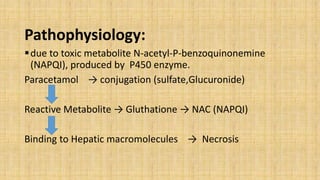
Pathophysiology:
due to toxic metabolite N-acetyl-P-benzoquinonemine
(NAPQI), produced by P450 enzyme.
Paracetamol → conjugation (sulfate,Glucuronide)
Reactive Metabolite → Gluthatione → NAC (NAPQI)
Binding to Hepatic macromolecules → Necrosis
Risk factors in children — Liver damage caused by excess N-
acetyl-p-benzoquinoneimine (NAPQI) can occur in four
circumstances :
• Excessive intake of acetaminophen
• Decreased capacity for glucuronidation or sulfation
• Increased cytochrome P450 (CYP2E1) activity
• Depletion of glutathione stores
Clinical Manifestations:
if untreated, poisoned patient passes through 4 stages;
• Stage I (up to 24 hrs) – Asymptomatic, but less commonly:
nausea, vomiting, and, in large doses, lethargy and malaise
• Stage II (24 to 72 hours after overdose) – RUQ pain, elevation
in liver enzymes, prothrombin time (PT) and, in severe cases,
evidence of nephrotoxicity (elevated blood urea nitrogen,
creatinine, oliguria) and/or pancreatitis (elevated serum
amylase, lipase)
• Stage III (72 to 96 hrs) – Evidence of liver failure and, in
severe cases, renal failure and multi-organ failure;
death most commonly occurs in this stage
• Stage IV (4 to 14 days) – Recovery
Management:
- Supportive
-Emesis/lavage
-NAC/Mucomyst
PHENOBARBITONE POISONING
• Pathphysiology
• 50% of phenobabitone is non-protein-bound,
available to equilibrate with tissues.
• ability to cross cell memrane(BBB) is inversely
correlated with its degree of ionization.
• cause depression of the brainstem RAS with
resultant generalised depression of the CNS
•May result in :
mild sedation, sleep or
high doses—coma,& respiratory arrest
 Absorbed from oral ingestion
 onset of effects in 20-60min.
 Slowly metabolized by liver microsomal
enzymes & are eliminated –half-lives of
2-6days
Clinical Manifestations:
 Early
Euphoria
Disinhibition
Ataxia
Dysarthric
Nystagmus
slow respiration but adequate
superficial reflexes disappear
corneal reflexes present
pupils react briskly to light
Late
limbs become flaccid
DTR disappear
pupils become constricted
Sometimesbullous eruptions
Terminal phase
shallow & periodic respiration
decreased BP-Shock
Management
Supportive
GID
AC
Saline catharsis
Diuresis
Alkalinization
Dialysis
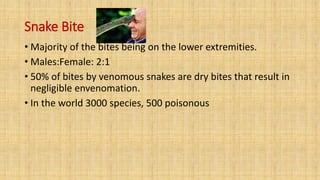
Snake Bite
• Majority of the bites being on the lower extremities.
• Males:Female: 2:1
• 50% of bites by venomous snakes are dry bites that result in
negligible envenomation.
• In the world 3000 species, 500 poisonous
Early Signs and Symptoms of Venomation
• Increasing local pain (burning, bursting,throbbing) at the site
of the bite
• Local swelling that gradually extends proximally up the
bitten limb and tender
• painful enlargement of the Regional Lymph nodes.
However, bites by kraits and sea snakes may be virtually
painless.
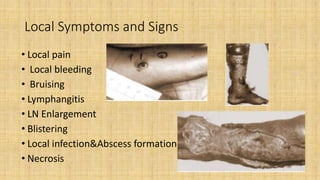
Local Symptoms and Signs
• Local pain
• Local bleeding
• Bruising
• Lymphangitis
• LN Enlargement
• Blistering
• Local infection&Abscess formation
• Necrosis
Systemic Symptoms
General
• Nausea
• Vomiting
• Malaise
• Abdominal pain
• Weakness
• Drowsiness
• Prostration
Cardiovascular(vipridae)
• Visual disturbances
• Dizziness
• Faintness
• Collapse
• Shock, Hypotension
• Cardiac arrhythmias
• Pulmonary oedema
• Conjunctival oedema
Bleeding and clotting disorders
( vipridae)
• Bleeding from recent wounds
(including fang marks,
venepunctures etc) and from
old partlyhealed wounds
• Spontaneous systemic
bleeding
Neurological (Elapidae,Russell’s viper)
• Drowsiness
• Paraesthesiae
• Abnormal taste and smell
• “Heavy” eyelids,Ptosis,Ext. ophthalmoplegia
• Facial paralysis
• Aphonia
• Difficulty in swallowing secretion
• Respiratory and generalised flaccid paralysis
Rhabdomyolisis
• Generalised pain, stiffness and tenderness of muscles, trismus,
myoglobinuria, hyperkalemia, cardiac arrest, acute renal failure
• Occur with sea snakes, Russell’s viper
Renal (Viperidae, Sea snakes)
• Loin (lower back) pain
• Haematuria
• Haemoglobinuria
• Myoglobinuria
• Oliguria / Anuria
• Symptoms and signs of Uraemia
Endocrine
• Acute pituitary/adrenal insuff.
• with Russell’s viper
• Acute phase: Shock, Hypoglycaemia
• Chronic phase (mnths to yrs after): Weakness,
• Loss of 2ry sexual hair, Amenorrhoea,
• Testicular atrophy, Hypothyroidism etc
Management of Snake Bite
• First aid treatment
• Transport to hospital
• Rapid clinical assessment
and resuscitation
• Detailed clinical assessment
and species diagnosis
• Investigations/laboratory
tests
• Antivenom treatment
• Observation of the response
to antivenom:
• decision about the need for
further dose(s) of antivenom
• Supportive/ancillary
treatment
• Treatment of the bitten part
• Rehabilitation
• Treatment of chronic
complications
• Antivenom is immunoglobulin (usually the enzyme refined F(ab)2
fragment of IgG) purified from the serum or plasma of a horse or
sheep that has been immunised with the venoms of one or more
species of snake.
Seminar on poisoning

Seminar on poisoning

  • 1.
    SEMINAR ON POISONING By:MERON GIRMA ENGIDAW AMBELU MODERATOR: DR.GETA
  • 2.
    OUTLINES: • DEFINITION, TYPEAND EPIDEMIOLOGY • HISTORY AND PHYSICAL EXAMINATION • CLINICAL DIAGNOSIS • PRINCIPLE OF MANAGEMENT • COMMON SELECTED POISONINGS
  • 3.
    Definition Poison: “Poison is asubstance ( solid/ liquid or gaseous ),that produce ill health or death, by its constitutional or local effects or both, by altering cell structure or functions.” The branch of medicine that deals with the detection and treatment of poisons is known as toxicology.
  • 4.
    Poisoning: “The development ofdose related adverse effects following exposure to chemicals, drugs or other xenobiotics.” It occurs when any substance interferes with normal body functions after it is Swallowed; ingested poisons => 78% Inhaled; breathed in poisons => 5.4% injected ;IV, IM, SQ or Intra Dermal => 0.3% Absorbed; poisons taken in through unbroken skin =>6.8% Enter through Opthalmic; => 5.9%
  • 5.
    Types: Deliberate (intentional) Suicide &homicide  Accidental (unintentional) Dosage error Recreational use Environmental: • Plants • Food Venomous stings/bites Industrial exposures
  • 6.
    • Epidemiology • Eachday a child is exposed to potential toxin • Age • most common in<5yrs(50-60%) • Cause • most(93-99%) are accidental
  • 7.
    Hx content ofpoisoned patient Identification of the patient and toxic agent. What? Description of the toxin. Product names (brand, generic, chemical) and ingredients, along with their concentrations Bring container to hospital with patient.
  • 8.
    How much? Magnitudeof the exposure. determine as accurately as possible how much of the substance has been consumed by counting the remaining tablets or measuring the remaining volume of liquid or gas after we ask the previous amount. It is better to overestimate than to underestimate
  • 9.
    When ?Time ofexposure. Knowing the time lapse between exposure and the onset of symptoms and/or medical evaluation w influence decisions of diagnostic testing as well as therapeutic intervention. Period of exposure • First time use or chronic user • If unknown—estimate the shortest and longest possible time.
  • 10.
    Progression of symptoms. Knowingthe nature and progression of symptoms is very helpful for assessing the need for immediate life support, the prognosis, and the type of intervention needed What interventions have been done? – Traditional home remedies may be harmful
  • 11.
  • 12.
    The effects ofpoisoning maybe None, Mild or Severe depending on: • The amount of poison ingested. • The nature of the substance. • The age of the child. • The nutritional status of the child. • The state of the stomach-whether empty or full of food.
  • 13.
    PHYSICAL EXAMINATION ODOR • Bitter-almonds Cyanide • Acetone -Isopropyl alcohol, Methanol, Paraldehyde, Salicylates • Alcohol-Ethanol • Wintergreen -Methyl Salicylate • Garlic -Arsenic, Thallium, Organophosphates OCULAR SIGNS • Miosis -Narcotics (except meperidine),Organophosphates, muscarinic,mushrooms,phenoth iazine's,barbiturates (late), PCP • Mydriasis -Atropine, alcohol, cocaine,CO • Lacrimation- Organophosphates, irritant gas or vapors • Poor vision- Methanol, botulism, CO
  • 14.
    CUTANEOUS SIGNS • Dry,hot skin -Anticholinergic agents, botulism • Diaphoresis- Organophosphates, nitrates, muscarinic mushrooms, aspirin, cocaine • Erythema- Boric acid, mercury, cyanide, anticholinergics ORAL SIGNS • Salivation -Organophosphates, salicylates, corrosives, strychnine • Dry mouth- Amphetamines, anticholinergics, antihistamine • Burns- Corrosives, oxalate- containing plants • Gum lines- Lead, mercury, arsenic • Dysphagia -Corrosives, botulism
  • 15.
    INTESTINAL SIGNS • Cramps-Arsenic, lead, thallium, Organophosphates • Diarrhea -Antimicrobials, arsenic, iron, boric acid • Constipation -Lead, narcotics, botulism • Hematemesis -Aminophylline, corrosives, iron, salicylates CARDIAC SIGNS • Tachycardia Atropine, aspirin, amphetamines, cocaine, cyclic antidepressants, theophylline • Bradycardia -Digitalis, narcotics, mushrooms, clonidine, Organophosphates, β blockers,CCB • Hypertension- Amphetamines, LSD, cocaine, PCP • Hypotension Phenothiazines, barbiturates, cyclic antidepressants, Fe, β blockers, CCB
  • 16.
    RESPIRATORY SIGNS • Depressedrespiration Alcohol, narcotics, barbiturates • Increased respiration - Amphetamines, aspirin, ethylene glycol, CO, cyanide • Pulmonary edema Hydrocarbons, heroin, Organophosphates, aspirin CNS SIGNS • Ataxia -Alcohol, antidepressants, barbiturates, anticholinergics, phenytoin, narcotics • Coma -Sedatives, narcotics, barbiturates, PCP,CO Organophosphates,lead • Hyperpyrexia Anticholinergics, cocaine
  • 17.
    CNS sign… • Musclefasciculation - Organophosphates, theophylline • Muscle rigidity- Cyclic antidepressants, PCP, phenothiazines, haloperidol • Paresthesia- Cocaine, camphor, PCP, MSG • Altered behavior- LSD, PCP, amphetamines, cocaine, alcohol, anticholinergics, camphor • Peripheral neuropathy- Lead, arsenic, mercury, organophosphates
  • 18.
    Clinical Diagnosis • CBC •serum electrolyte • LFT, RFT • screening • RBS • SO2
  • 19.
    Principle of Management 1.Initial resuscitation and stabilization 2. Removal of toxin from the body 3. Prevention of further poison absorption 4. Enhancement of poison elimination 5. Administration of antidote 6. Supportive treatment 7. Prevention of re - exposure
  • 20.
    The management principleis applied based on triage • Triage is the process of rapidly examining all sick children when they first arrive in hospital in order to place them in one of three categories. E Emergency P Priority Q Queue (non-urgent) Categories after Triage Action required EMERGENCY CASES Need immediate emergency treatment PRIORITY CASES Need assessment and rapid attention
  • 21.
    Emergency Management ofTriaged Children If any sign positive: give treatment(s) for ABCDO Emergency Signs A: Airway problem B: Breathing problem C: Circulation or shock Cm: Coma or Unconscious Cn: Convulsion D: Dehydration, Severe Ds: Disability O: Bleeding child, poisoning (immediate), open fracture
  • 22.
    SELECTED POISONS • Drugs Acetaminophen Phenobarbitone Salicylate Iron Digoxin •Insecticides (pesticides) Organophosphate Carbamates • Hydrocarbons • Venomous stings/bites Snake bite
  • 23.
    • Toxic substanceshave seven common major pathophysiologic mechanisms that may produce symptom 1. Interfere with the transport or tissue utilization of O2 e.g. CO 2. Depress or stimulate CNS e.g. MDMA 3. Affect autonomic nervous system e.g. Organophosphate
  • 24.
    4.Affect the lungsby aspiration e.g. Hydrocarbon 5.Affect the heart and vasculature myocardial dysfunction e.g.Antidepressant 6.Produce local damage e.g. Corrosive 7.Effect on the liver e.g. Acetaminophen
  • 25.
    Organophosphate poisoning • Lesscommon (< 1%) in children • Mostly accidental and unintentional • More common in lower socioeconomic class • Used in agriculture(crop sprays) and home as insecticides & pesticides e.g. Insecticides – malathion(MLT), parathion, ethion, diazinon Nerve gases - sarin, tabun ophthalmic agents - echothiophate, isoflurophate Herbicides - tributes [DEF], merphos
  • 26.
    Pathophysiology:cholinesterase inhibitor bind tothe enzyme preventing degradation of Ach accumulation of Ach at nerve synapses affecting: • CNS • Neuromuscular junctions • Sympathetic & Parasympathetic NS
  • 27.
  • 28.
    Clinical Manifestations: • Muscarinics/Sx (Parasympathetic NS) Diaphoresis, emesis, Incontinence (urine, fecal), Tearing, bronchorrhea & bronchospasm Meiosis, hypotension, bradycardia MUSCARINIC SIGNS SLUDGE/BBB DUMBELS S=Salivation D=Diarrhea & diaphoresis L=Lacrimation U=Urination U=Urination M=Miosis D=Defecation B=Bronchocorrhe a,bronchospasm, bradycardia G=GI symptoms E=Emesis E=Emesis L=Lacrimation B=Bronchorrhea S=Salivation B=Bronchospasm B=Bradycardia
  • 29.
    • Nicotinic S/S(SympatheticNS) Muscle weakness, tremors, fasciculation, Hypoventilation, HTN, tachycardia, dysarhythmias • CNS effects confusion, delirium, coma, Seizure, anxiety, restlessness, Emotional lability, Confusion, Ataxia, Tremors,impaired memory, lethargy, psychosis
  • 30.
    the balance betweenstimulation of muscarinic and nicotinic receptor depend on the - Type of organophosphate - Dose - Route and rate of absorption - Individual factor
  • 31.
  • 32.
    Hydrocarbon Poisoning • Mostcommonly ingested hydrocarbons - gasoline, lubricating oil, motor oil, mineral spirits, lighter fluid/naphtha, lamp oil,and kerosene. • Other common sources of hydrocarbons -dry cleaning solutions, paint, spot remover, rubber cement, and solvents
  • 33.
    • Type oftoxic response depends on: • amount of ingestion • volatility(viscosity)
  • 34.
    • Pathophysiology o Causetoxicity in 2 ways : a. Aspiration (most common) results in → Spasm, edema, inflammatory rxn, and necrosis of the respiratory passages & alveoli. → Vascular thrombosis & hemorrhage with chemical pneumonitis, atelectasis, & emphysema.
  • 35.
    b. Systemic effects •volatile or low viscosity → degenerative changes in various organs (mostly CNS) Clinical Manifestations:mainly respiratory Choking, Coughing
  • 36.
    vomiting & diarrhea,which may be bloody  dyspnea and cyanosis mild tracheobronchitis, severe necrotizing bronchopneumonia & pul.hemmorrhage atelectasis , pneumatocele, bacterial infection (secondary), pneumomediastinum  mild to moderate fever within 48hrs CNS -tremors, irritability, confusion, drowsiness, sz,& coma
  • 37.
    management Correction of hypoxia& acidosis  NO emesis  NO lavage  NO prophylactic Antibiotic  NO STEROIDS
  • 38.
    Paracetamol (Acetaminophen) Poisoning •mostly used & available at home • analgesic and antipyretic • overdose cause fatal and nonfatal hepatic necrosis with certain risk factors ,but is nearly always good if the antidote, N-acetylcysteine (NAC), is administered within 8 to 10 hours of ingestion
  • 39.
    Patterns of exposurecould be: 1) Intentional: more common in older children and adolescents with a single event and high dose. 2) Unintentional: common among younger children. occur through "exploratory" behavior or inappropriate dosing
  • 40.
    Pathophysiology: due to toxicmetabolite N-acetyl-P-benzoquinonemine (NAPQI), produced by P450 enzyme. Paracetamol → conjugation (sulfate,Glucuronide) Reactive Metabolite → Gluthatione → NAC (NAPQI) Binding to Hepatic macromolecules → Necrosis
  • 41.
    Risk factors inchildren — Liver damage caused by excess N- acetyl-p-benzoquinoneimine (NAPQI) can occur in four circumstances : • Excessive intake of acetaminophen • Decreased capacity for glucuronidation or sulfation • Increased cytochrome P450 (CYP2E1) activity • Depletion of glutathione stores
  • 42.
    Clinical Manifestations: if untreated,poisoned patient passes through 4 stages; • Stage I (up to 24 hrs) – Asymptomatic, but less commonly: nausea, vomiting, and, in large doses, lethargy and malaise • Stage II (24 to 72 hours after overdose) – RUQ pain, elevation in liver enzymes, prothrombin time (PT) and, in severe cases, evidence of nephrotoxicity (elevated blood urea nitrogen, creatinine, oliguria) and/or pancreatitis (elevated serum amylase, lipase)
  • 43.
    • Stage III(72 to 96 hrs) – Evidence of liver failure and, in severe cases, renal failure and multi-organ failure; death most commonly occurs in this stage • Stage IV (4 to 14 days) – Recovery
  • 44.
  • 45.
    PHENOBARBITONE POISONING • Pathphysiology •50% of phenobabitone is non-protein-bound, available to equilibrate with tissues. • ability to cross cell memrane(BBB) is inversely correlated with its degree of ionization. • cause depression of the brainstem RAS with resultant generalised depression of the CNS
  • 46.
    •May result in: mild sedation, sleep or high doses—coma,& respiratory arrest  Absorbed from oral ingestion  onset of effects in 20-60min.  Slowly metabolized by liver microsomal enzymes & are eliminated –half-lives of 2-6days
  • 47.
    Clinical Manifestations:  Early Euphoria Disinhibition Ataxia Dysarthric Nystagmus slowrespiration but adequate superficial reflexes disappear corneal reflexes present pupils react briskly to light
  • 48.
    Late limbs become flaccid DTRdisappear pupils become constricted Sometimesbullous eruptions Terminal phase shallow & periodic respiration decreased BP-Shock
  • 49.
  • 50.
    Snake Bite • Majorityof the bites being on the lower extremities. • Males:Female: 2:1 • 50% of bites by venomous snakes are dry bites that result in negligible envenomation. • In the world 3000 species, 500 poisonous
  • 51.
    Early Signs andSymptoms of Venomation • Increasing local pain (burning, bursting,throbbing) at the site of the bite • Local swelling that gradually extends proximally up the bitten limb and tender • painful enlargement of the Regional Lymph nodes. However, bites by kraits and sea snakes may be virtually painless.
  • 52.
    Local Symptoms andSigns • Local pain • Local bleeding • Bruising • Lymphangitis • LN Enlargement • Blistering • Local infection&Abscess formation • Necrosis
  • 53.
    Systemic Symptoms General • Nausea •Vomiting • Malaise • Abdominal pain • Weakness • Drowsiness • Prostration
  • 54.
    Cardiovascular(vipridae) • Visual disturbances •Dizziness • Faintness • Collapse • Shock, Hypotension • Cardiac arrhythmias • Pulmonary oedema • Conjunctival oedema Bleeding and clotting disorders ( vipridae) • Bleeding from recent wounds (including fang marks, venepunctures etc) and from old partlyhealed wounds • Spontaneous systemic bleeding
  • 55.
    Neurological (Elapidae,Russell’s viper) •Drowsiness • Paraesthesiae • Abnormal taste and smell • “Heavy” eyelids,Ptosis,Ext. ophthalmoplegia • Facial paralysis • Aphonia • Difficulty in swallowing secretion • Respiratory and generalised flaccid paralysis
  • 56.
    Rhabdomyolisis • Generalised pain,stiffness and tenderness of muscles, trismus, myoglobinuria, hyperkalemia, cardiac arrest, acute renal failure • Occur with sea snakes, Russell’s viper
  • 57.
    Renal (Viperidae, Seasnakes) • Loin (lower back) pain • Haematuria • Haemoglobinuria • Myoglobinuria • Oliguria / Anuria • Symptoms and signs of Uraemia
  • 58.
    Endocrine • Acute pituitary/adrenalinsuff. • with Russell’s viper • Acute phase: Shock, Hypoglycaemia • Chronic phase (mnths to yrs after): Weakness, • Loss of 2ry sexual hair, Amenorrhoea, • Testicular atrophy, Hypothyroidism etc
  • 59.
    Management of SnakeBite • First aid treatment • Transport to hospital • Rapid clinical assessment and resuscitation • Detailed clinical assessment and species diagnosis • Investigations/laboratory tests • Antivenom treatment • Observation of the response to antivenom: • decision about the need for further dose(s) of antivenom • Supportive/ancillary treatment • Treatment of the bitten part • Rehabilitation • Treatment of chronic complications
  • 60.
    • Antivenom isimmunoglobulin (usually the enzyme refined F(ab)2 fragment of IgG) purified from the serum or plasma of a horse or sheep that has been immunised with the venoms of one or more species of snake.