Poisoning & Its Management
BY:
Md. Monirul Islam
Pharmacy Discipline
Khulna University
Khulna.
Poison
 A poison is any substance that is harmful to
the body
 Many poisonous substances are products
people have around the house. Even
medicines that aren't taken as directed can
be harmful.
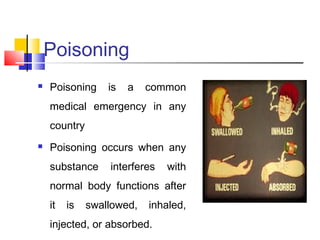
Poisoning
 Poisoning is a common
medical emergency in any
country
 Poisoning occurs when any
substance interferes with
normal body functions after
it is swallowed, inhaled,
injected, or absorbed.
Types of Poisoning
1. Deliberate
2. Accidental
3. Environmental
4. Industrial exposures.
Poisoning Causes
 Cleaning products
 Household products, such as nail polish remover and other
personal care products
 Pesticides
 Metals, such as lead ,Mercury, which can be found in old
thermometers and batteries
 Prescription and over-the-counter drugs when combined or
taken the wrong way
 Contaminated food
 Plants, such as poison ivy and poison oak
 Venom from certain snake
Substances that may act as poisons include the
following:
Symptoms of Poisoning
 Vomiting
 Diarrhea
 Nausea
 Redness or sores around the mouth
 Drooling or dry mouth
 Dilated pupils or constricted pupils
 Rash
 Confusion
 Shaking or seizures
 Trouble breathing
Management of Poisoning
The holistic management of toxic exposures should
include the following considerations based on a risk
assessment approach:
 Resuscitation and stabilization
 Toxic diagnosis
 Therapeutic interventions
• Decontamination
• Enhanced elimination of absorbed toxins
• Antidotes
 IV. Supportive care
Resuscitation & Stabilization
 First priorities are ABC’s (Airways, Breathing
& Circulation)
 Vital sign including pulse and hypoglycemia
must be corrected
 Unresponsive patients treated empirically with
coma cocktail
 Oxygen, naloxone, dextrose 50W (D50W), and
100mg thiamine
 50 ml of D50W for adults and 1g/kg glucose for
children (4ml/kg D25W of 10ml/kg of D10W)
 Thiamine not usually given to children
Toxicological Diagnosis
 History
 Need to obtain as much information as possible about exposure
i.e. number of exposed persons, type of exposure, amount or
dose, route
 Patients intent must be determined
 Examination
 Undress patient completely for thorough examination
 Check clothing for objects or substances
 Assess general appearance of patient
 Examine skin for bruising, cyanosis, flushing
 Assess ABCDE (Airways, Breathing, Circulation, Disability,
Exposure)
Toxicological Diagnosis
 Toxicological Investigation

In the acute care setting toxicological screen is very
limited and does not contribute significantly
 Toxicological screens may play a role in evaluation of
children
Gastric Emptying
 Emesis: achieved by using syrup of ipecac
 Dosing: 15 ml for 1-12 yo and 30 ml for adults;
may repeat once if no emesis in 12 hr
 90% vomit within 20 minutes of first dose and
97% vomit with second dose
 Usually 3-5 episodes of emesis and resolve
in two hours; if protracted emesis occurs
consider toxin as etiology
Gastric Emptying
 Orogastric lavage: 36-40 French tube used in
adults and 22-24 French tube in children.
 Measure from chin to xiphoid and confirm with air
insufflation
 Lavage with room temperature water until it
runs clear
 Charcoal should be used before withdrawal of
tube
Toxin Adsorption in Gut
 Activated Charcoal
 Multiple-Dose Activated Charcoal
 Cathartics
 Whole-Bowel Irrigation
Activated Charcoal
 Most appropriate agent to decontaminate GI tract
 Adsorbs toxin in gut lumen
 Safety proven in adults and children
 Dose 1g/kg
 Indications: any drug known to absorb it or after
unknown ingestions by patient’s with protected
airways
Multi-Dose Charcoal
 One dose usually sufficient
 Indications for multi-dose activated charcoal:
ingestion of large doses, substances that form
bezoars, slow release toxins, toxins that slow
gut function, toxins with enterohepatic or
enteroenteric circulation
 Repeat dose is 0.25-0.5 g/kg
Cathartics
 Osmotic cathartic usually given with activated
charcoal
 70% sorbitol (1 g/kg) or 10% magnesium
citrate
 Shown to decrease transit time of activated
charcoal
 No definitive clinical human data suggest that
a cathartic limits toxins bioavailability or
changes patient’s outcome
Enhanced Elimination
 Alkalinization
 Forced diuresis
 Hemodialysis/Hemoperfusion
Alkalinization
 Beneficial in certain ingestions: 2-4-D
(herbicide), phenobarbital, chlorpropamide,
salicylates, methanol
 Alkalinization achieved by IV dose of
bicarbonate at 1-2 mEq/kg, followed by
intermittent boluses or continuous
bicarbonate drip for urine pH 7.5-8.0
 Profound hypokalemia may result, must
aggressively replace
Hemodialysis/Hemoperfusion
 Dialysis reserved for specific toxins:
salicylates, methanol, ethylene glycol, lithium,
theophylline, amanita (mushrooms)
 Benefits: removal of toxins already absorbed
by gut, ability to remove parent compound
and active metabolite,
 Less effective when toxin has large volume of
distribution (>1 L/kg), has large molecular
weight, or highly protein bound
Hemoperfusion
 Used for decontamination of patient’s
systemic circulation
 Involves placing a filter filled with activated
charcoal into dialysis circuit
 Alleviates constraints of protein binding and
molecular size
 Toxins must be well absorbed by charcoal
and have small volume of distribution
Poison Prevention
 Only take prescription medications that are
prescribed by a healthcare professional.
 Never take larger or more frequent doses of
your medications, particularly prescription
pain medications, to try to get faster or more
powerful effects.
 Never share or sell your prescription drugs.
 Follow directions on the label when you give
or take medicines.
Poison Prevention
 Turn on a light when you give or take
medicines at night so that you know you have
the correct amount of the right medicine.
 Keep medicines in their original bottles or
containers.
 Monitor the use of medicines prescribed for
children and teenagers, such as medicines
for attention deficit hyperactivity disorder, or
ADHD.
Thanks to
All

Poisoning & its management

  • 1.
    Poisoning & ItsManagement BY: Md. Monirul Islam Pharmacy Discipline Khulna University Khulna.
  • 2.
    Poison  A poisonis any substance that is harmful to the body  Many poisonous substances are products people have around the house. Even medicines that aren't taken as directed can be harmful.
  • 3.
    Poisoning  Poisoning isa common medical emergency in any country  Poisoning occurs when any substance interferes with normal body functions after it is swallowed, inhaled, injected, or absorbed.
  • 4.
    Types of Poisoning 1.Deliberate 2. Accidental 3. Environmental 4. Industrial exposures.
  • 5.
    Poisoning Causes  Cleaningproducts  Household products, such as nail polish remover and other personal care products  Pesticides  Metals, such as lead ,Mercury, which can be found in old thermometers and batteries  Prescription and over-the-counter drugs when combined or taken the wrong way  Contaminated food  Plants, such as poison ivy and poison oak  Venom from certain snake Substances that may act as poisons include the following:
  • 6.
    Symptoms of Poisoning Vomiting  Diarrhea  Nausea  Redness or sores around the mouth  Drooling or dry mouth  Dilated pupils or constricted pupils  Rash  Confusion  Shaking or seizures  Trouble breathing
  • 7.
    Management of Poisoning Theholistic management of toxic exposures should include the following considerations based on a risk assessment approach:  Resuscitation and stabilization  Toxic diagnosis  Therapeutic interventions • Decontamination • Enhanced elimination of absorbed toxins • Antidotes  IV. Supportive care
  • 8.
    Resuscitation & Stabilization First priorities are ABC’s (Airways, Breathing & Circulation)  Vital sign including pulse and hypoglycemia must be corrected  Unresponsive patients treated empirically with coma cocktail  Oxygen, naloxone, dextrose 50W (D50W), and 100mg thiamine  50 ml of D50W for adults and 1g/kg glucose for children (4ml/kg D25W of 10ml/kg of D10W)  Thiamine not usually given to children
  • 9.
    Toxicological Diagnosis  History Need to obtain as much information as possible about exposure i.e. number of exposed persons, type of exposure, amount or dose, route  Patients intent must be determined  Examination  Undress patient completely for thorough examination  Check clothing for objects or substances  Assess general appearance of patient  Examine skin for bruising, cyanosis, flushing  Assess ABCDE (Airways, Breathing, Circulation, Disability, Exposure)
  • 10.
    Toxicological Diagnosis  ToxicologicalInvestigation  In the acute care setting toxicological screen is very limited and does not contribute significantly  Toxicological screens may play a role in evaluation of children
  • 11.
    Gastric Emptying  Emesis:achieved by using syrup of ipecac  Dosing: 15 ml for 1-12 yo and 30 ml for adults; may repeat once if no emesis in 12 hr  90% vomit within 20 minutes of first dose and 97% vomit with second dose  Usually 3-5 episodes of emesis and resolve in two hours; if protracted emesis occurs consider toxin as etiology
  • 12.
    Gastric Emptying  Orogastriclavage: 36-40 French tube used in adults and 22-24 French tube in children.  Measure from chin to xiphoid and confirm with air insufflation  Lavage with room temperature water until it runs clear  Charcoal should be used before withdrawal of tube
  • 13.
    Toxin Adsorption inGut  Activated Charcoal  Multiple-Dose Activated Charcoal  Cathartics  Whole-Bowel Irrigation
  • 14.
    Activated Charcoal  Mostappropriate agent to decontaminate GI tract  Adsorbs toxin in gut lumen  Safety proven in adults and children  Dose 1g/kg  Indications: any drug known to absorb it or after unknown ingestions by patient’s with protected airways
  • 15.
    Multi-Dose Charcoal  Onedose usually sufficient  Indications for multi-dose activated charcoal: ingestion of large doses, substances that form bezoars, slow release toxins, toxins that slow gut function, toxins with enterohepatic or enteroenteric circulation  Repeat dose is 0.25-0.5 g/kg
  • 16.
    Cathartics  Osmotic catharticusually given with activated charcoal  70% sorbitol (1 g/kg) or 10% magnesium citrate  Shown to decrease transit time of activated charcoal  No definitive clinical human data suggest that a cathartic limits toxins bioavailability or changes patient’s outcome
  • 17.
    Enhanced Elimination  Alkalinization Forced diuresis  Hemodialysis/Hemoperfusion
  • 18.
    Alkalinization  Beneficial incertain ingestions: 2-4-D (herbicide), phenobarbital, chlorpropamide, salicylates, methanol  Alkalinization achieved by IV dose of bicarbonate at 1-2 mEq/kg, followed by intermittent boluses or continuous bicarbonate drip for urine pH 7.5-8.0  Profound hypokalemia may result, must aggressively replace
  • 19.
    Hemodialysis/Hemoperfusion  Dialysis reservedfor specific toxins: salicylates, methanol, ethylene glycol, lithium, theophylline, amanita (mushrooms)  Benefits: removal of toxins already absorbed by gut, ability to remove parent compound and active metabolite,  Less effective when toxin has large volume of distribution (>1 L/kg), has large molecular weight, or highly protein bound
  • 20.
    Hemoperfusion  Used fordecontamination of patient’s systemic circulation  Involves placing a filter filled with activated charcoal into dialysis circuit  Alleviates constraints of protein binding and molecular size  Toxins must be well absorbed by charcoal and have small volume of distribution
  • 21.
    Poison Prevention  Onlytake prescription medications that are prescribed by a healthcare professional.  Never take larger or more frequent doses of your medications, particularly prescription pain medications, to try to get faster or more powerful effects.  Never share or sell your prescription drugs.  Follow directions on the label when you give or take medicines.
  • 22.
    Poison Prevention  Turnon a light when you give or take medicines at night so that you know you have the correct amount of the right medicine.  Keep medicines in their original bottles or containers.  Monitor the use of medicines prescribed for children and teenagers, such as medicines for attention deficit hyperactivity disorder, or ADHD.
  • 23.