HYDROGRAPHIC PRINTING
Technical Seminar On
 Contents:
 Abstract
 Introduction
 History
 The Process Of Hydrographic Printing
 Methods Of Hydrographic Printing
 Advantages & disadvantages
 Applications
 Conclusion
 References
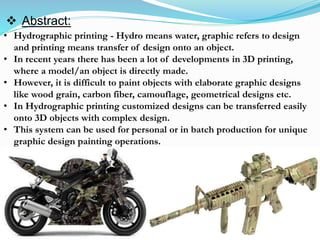
• Hydrographic printing - Hydro means water, graphic refers to design
and printing means transfer of design onto an object.
• In recent years there has been a lot of developments in 3D printing,
where a model/an object is directly made.
• However, it is difficult to paint objects with elaborate graphic designs
like wood grain, carbon fiber, camouflage, geometrical designs etc.
• In Hydrographic printing customized designs can be transferred easily
onto 3D objects with complex design.
• This system can be used for personal or in batch production for unique
graphic design painting operations.
 Abstract:
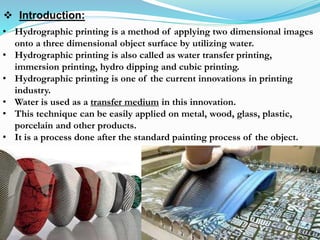
• Hydrographic printing is a method of applying two dimensional images
onto a three dimensional object surface by utilizing water.
• Hydrographic printing is also called as water transfer printing,
immersion printing, hydro dipping and cubic printing.
• Hydrographic printing is one of the current innovations in printing
industry.
• Water is used as a transfer medium in this innovation.
• This technique can be easily applied on metal, wood, glass, plastic,
porcelain and other products.
• It is a process done after the standard painting process of the object.
 Introduction:
History:
• The earliest patent records credit the invention of water transfer printing to
Motoyasu Nakanishi of Kabushiki Kaisha Cubic Engineering in 1982 (filed for
patent in 1982 and got it in 1984).
• It is not clear who invented Hydrographic printing.
• Before the patent was issued there were 3 different companies that clammed
rights for this invention.
• Taica corporation claimed that in 1974, Cubic printing was invented by their
engineer (not named and an accidental invention).
• In 1976, they established Shizuko Cubic Co. (renamed Cubic Co. Ltd in 1989
later renamed as Taica Corporation in 2006) for sales expansion of cubic
printing.
• TWN industries doesn’t lay claim to themselves, yet they give credit to Cubic
Engineering.
• Researchers of Zheijiang University and Columbia University-including
Yizhong Zhang, Chunji Yin, Changxi Zheng, and Kun Zhou have created a
software for precision printing. They presented their research on Computational
hydrographic printing in Los Angeles on August 2015.
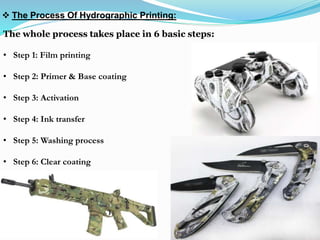
The whole process takes place in 6 basic steps:
• Step 1: Film printing
• Step 2: Primer & Base coating
• Step 3: Activation
• Step 4: Ink transfer
• Step 5: Washing process
• Step 6: Clear coating
 The Process Of Hydrographic Printing:
 Step 1 : Film printing:
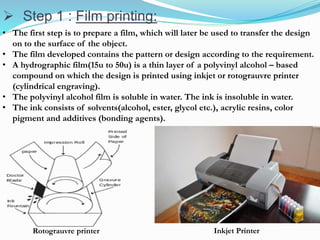
• The first step is to prepare a film, which will later be used to transfer the design
on to the surface of the object.
• The film developed contains the pattern or design according to the requirement.
• A hydrographic film(15u to 50u) is a thin layer of a polyvinyl alcohol – based
compound on which the design is printed using inkjet or rotograuvre printer
(cylindrical engraving).
• The polyvinyl alcohol film is soluble in water. The ink is insoluble in water.
• The ink consists of solvents(alcohol, ester, glycol etc.), acrylic resins, color
pigment and additives (bonding agents).
Rotograuvre printer Inkjet Printer
 Step 2 : Primer & Base coating:
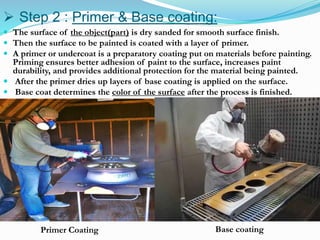
 The surface of the object(part) is dry sanded for smooth surface finish.
 Then the surface to be painted is coated with a layer of primer.
 A primer or undercoat is a preparatory coating put on materials before painting.
Priming ensures better adhesion of paint to the surface, increases paint
durability, and provides additional protection for the material being painted.
 After the primer dries up layers of base coating is applied on the surface.
 Base coat determines the color of the surface after the process is finished.
Primer Coating Base coating
 Step 3 : Activation:
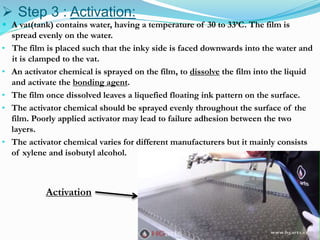
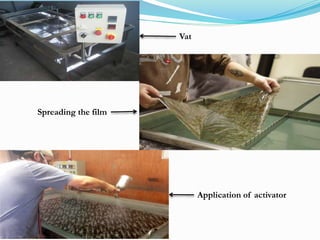
 A vat(tank) contains water, having a temperature of 30 to 33’C. The film is
spread evenly on the water.
• The film is placed such that the inky side is faced downwards into the water and
it is clamped to the vat.
• An activator chemical is sprayed on the film, to dissolve the film into the liquid
and activate the bonding agent.
• The film once dissolved leaves a liquefied floating ink pattern on the surface.
• The activator chemical should be sprayed evenly throughout the surface of the
film. Poorly applied activator may lead to failure adhesion between the two
layers.
• The activator chemical varies for different manufacturers but it mainly consists
of xylene and isobutyl alcohol.
Activation
Vat
Spreading the film
Application of activator
 Step 4 : Ink Transfer
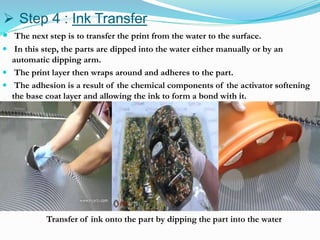
 The next step is to transfer the print from the water to the surface.
 In this step, the parts are dipped into the water either manually or by an
automatic dipping arm.
 The print layer then wraps around and adheres to the part.
 The adhesion is a result of the chemical components of the activator softening
the base coat layer and allowing the ink to form a bond with it.
Transfer of ink onto the part by dipping the part into the water
 Step 5 : Washing Process
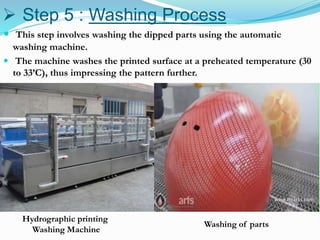
 This step involves washing the dipped parts using the automatic
washing machine.
 The machine washes the printed surface at a preheated temperature (30
to 33’C), thus impressing the pattern further.
Hydrographic printing
Washing Machine
Washing of parts
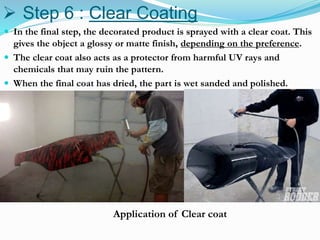
 Step 6 : Clear Coating
 In the final step, the decorated product is sprayed with a clear coat. This
gives the object a glossy or matte finish, depending on the preference.
 The clear coat also acts as a protector from harmful UV rays and
chemicals that may ruin the pattern.
 When the final coat has dried, the part is wet sanded and polished.
Application of Clear coat
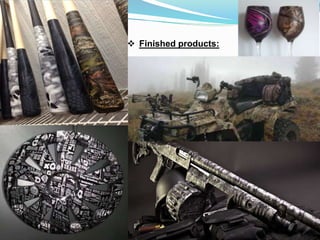
 Finished products:
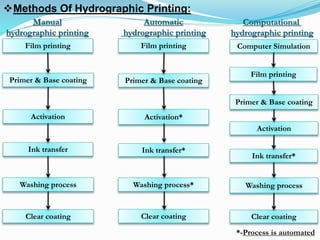
Methods Of Hydrographic Printing:
Film printing Film printing
Film printing
Primer & Base coating
Activation
Ink transfer
Washing process
Clear coating
Primer & Base coating
Activation*
Ink transfer*
Washing process*
Clear coating
Primer & Base coating
Activation
Ink transfer*
Washing process
Clear coating
Computer Simulation
Manual
hydrographic printing
Automatic
hydrographic printing
Computational
hydrographic printing
*-Process is automated
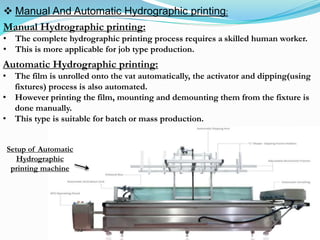
 Manual And Automatic Hydrographic printing:
Manual Hydrographic printing:
• The complete hydrographic printing process requires a skilled human worker.
• This is more applicable for job type production.
Automatic Hydrographic printing:
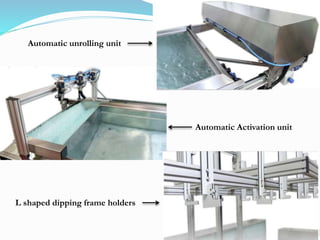
• The film is unrolled onto the vat automatically, the activator and dipping(using
fixtures) process is also automated.
• However printing the film, mounting and demounting them from the fixture is
done manually.
• This type is suitable for batch or mass production.
Setup of Automatic
Hydrographic
printing machine
Automatic unrolling unit
Automatic Activation unit
L shaped dipping frame holders
 Computational Hydrographic Printing:
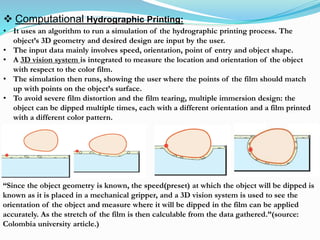
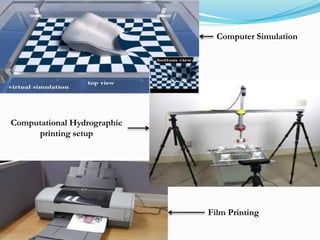
• It uses an algorithm to run a simulation of the hydrographic printing process. The
object’s 3D geometry and desired design are input by the user.
• The input data mainly involves speed, orientation, point of entry and object shape.
• A 3D vision system is integrated to measure the location and orientation of the object
with respect to the color film.
• The simulation then runs, showing the user where the points of the film should match
up with points on the object’s surface.
• To avoid severe film distortion and the film tearing, multiple immersion design: the
object can be dipped multiple times, each with a different orientation and a film printed
with a different color pattern.
“Since the object geometry is known, the speed(preset) at which the object will be dipped is
known as it is placed in a mechanical gripper, and a 3D vision system is used to see the
orientation of the object and measure where it will be dipped in the film can be applied
accurately. As the stretch of the film is then calculable from the data gathered.”(source:
Colombia university article.)
Computer Simulation
Computational Hydrographic
printing setup
Film Printing
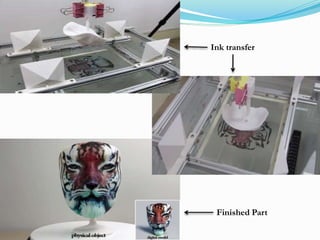
Ink transfer
Finished Part
 Advantages:
 Disadvantages:
• It is extremely difficult to precisely align the colored film with the object’s
surface.
• Skilled labour is required.
• Initial preparations must be proper.
• Very bulky objects are difficult to paint.
• It is difficult to use it on rubber and fabric materials.
• The process is simple.
• It provides greater accuracy to paint customized designs.
• Setup and process cost is less.
• It allows for multiple immersions.
• Customized designs can be easily printed on object having complex shapes.
• Durability is high.
• It can be used on objects such as metal, wood, glass, plastic, porcelain and
other products.
• Water can be reused after it is filtering.
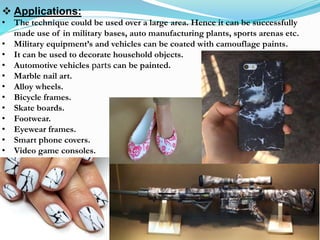
 Applications:
• The technique could be used over a large area. Hence it can be successfully
made use of in military bases, auto manufacturing plants, sports arenas etc.
• Military equipment’s and vehicles can be coated with camouflage paints.
• It can be used to decorate household objects.
• Automotive vehicles parts can be painted.
• Marble nail art.
• Alloy wheels.
• Bicycle frames.
• Skate boards.
• Footwear.
• Eyewear frames.
• Smart phone covers.
• Video game consoles.
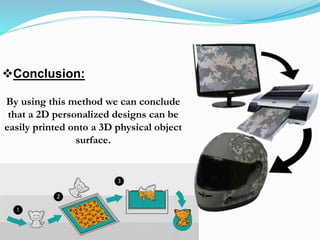
Conclusion:
By using this method we can conclude
that a 2D personalized designs can be
easily printed onto a 3D physical object
surface.
 References:
• New computational technique advances color 3-D printing process from PHYSORG
• The Origin of Hydro-Dipping. Dip Junkies. Retrieved 2015-03-01.
• SIGGRAPH 2015 Papers.
• WIKIPEDIA, 2014. Hydrographics (printing).
http://en.wikipedia.org/wiki/Hydrographics_(printing).
• www.youtube.com
• http://www.taica.co.jp/cubic-english/cubicprinting/
• http://www.watertransferprinting.com/
• ZHOU, K., WANG, X., TONG, Y., DESBRUN, M., GUO, B., AND SHUM, H.-Y. 2005.
Texturemontage: Seamless texturing of arbitrary surfaces from multiple images. ACM
Trans. Graph. 24, 3.
• http://patents.justia.com/inventor/motoyasu-nakanishi
• http://dipjunkies.com/qa-with-hydrographics-industry-professionals/
• http://hgarts.com
• Articles of Zheijiang University and Columbia University
• http://www.britannica.com/technology/surface-coating
/
Technical

Technical

  • 1.
  • 2.
     Contents:  Abstract Introduction  History  The Process Of Hydrographic Printing  Methods Of Hydrographic Printing  Advantages & disadvantages  Applications  Conclusion  References
  • 3.
    • Hydrographic printing- Hydro means water, graphic refers to design and printing means transfer of design onto an object. • In recent years there has been a lot of developments in 3D printing, where a model/an object is directly made. • However, it is difficult to paint objects with elaborate graphic designs like wood grain, carbon fiber, camouflage, geometrical designs etc. • In Hydrographic printing customized designs can be transferred easily onto 3D objects with complex design. • This system can be used for personal or in batch production for unique graphic design painting operations.  Abstract:
  • 4.
    • Hydrographic printingis a method of applying two dimensional images onto a three dimensional object surface by utilizing water. • Hydrographic printing is also called as water transfer printing, immersion printing, hydro dipping and cubic printing. • Hydrographic printing is one of the current innovations in printing industry. • Water is used as a transfer medium in this innovation. • This technique can be easily applied on metal, wood, glass, plastic, porcelain and other products. • It is a process done after the standard painting process of the object.  Introduction:
  • 5.
    History: • The earliestpatent records credit the invention of water transfer printing to Motoyasu Nakanishi of Kabushiki Kaisha Cubic Engineering in 1982 (filed for patent in 1982 and got it in 1984). • It is not clear who invented Hydrographic printing. • Before the patent was issued there were 3 different companies that clammed rights for this invention. • Taica corporation claimed that in 1974, Cubic printing was invented by their engineer (not named and an accidental invention). • In 1976, they established Shizuko Cubic Co. (renamed Cubic Co. Ltd in 1989 later renamed as Taica Corporation in 2006) for sales expansion of cubic printing. • TWN industries doesn’t lay claim to themselves, yet they give credit to Cubic Engineering. • Researchers of Zheijiang University and Columbia University-including Yizhong Zhang, Chunji Yin, Changxi Zheng, and Kun Zhou have created a software for precision printing. They presented their research on Computational hydrographic printing in Los Angeles on August 2015.
  • 6.
    The whole processtakes place in 6 basic steps: • Step 1: Film printing • Step 2: Primer & Base coating • Step 3: Activation • Step 4: Ink transfer • Step 5: Washing process • Step 6: Clear coating  The Process Of Hydrographic Printing:
  • 7.
     Step 1: Film printing: • The first step is to prepare a film, which will later be used to transfer the design on to the surface of the object. • The film developed contains the pattern or design according to the requirement. • A hydrographic film(15u to 50u) is a thin layer of a polyvinyl alcohol – based compound on which the design is printed using inkjet or rotograuvre printer (cylindrical engraving). • The polyvinyl alcohol film is soluble in water. The ink is insoluble in water. • The ink consists of solvents(alcohol, ester, glycol etc.), acrylic resins, color pigment and additives (bonding agents). Rotograuvre printer Inkjet Printer
  • 8.
     Step 2: Primer & Base coating:  The surface of the object(part) is dry sanded for smooth surface finish.  Then the surface to be painted is coated with a layer of primer.  A primer or undercoat is a preparatory coating put on materials before painting. Priming ensures better adhesion of paint to the surface, increases paint durability, and provides additional protection for the material being painted.  After the primer dries up layers of base coating is applied on the surface.  Base coat determines the color of the surface after the process is finished. Primer Coating Base coating
  • 9.
     Step 3: Activation:  A vat(tank) contains water, having a temperature of 30 to 33’C. The film is spread evenly on the water. • The film is placed such that the inky side is faced downwards into the water and it is clamped to the vat. • An activator chemical is sprayed on the film, to dissolve the film into the liquid and activate the bonding agent. • The film once dissolved leaves a liquefied floating ink pattern on the surface. • The activator chemical should be sprayed evenly throughout the surface of the film. Poorly applied activator may lead to failure adhesion between the two layers. • The activator chemical varies for different manufacturers but it mainly consists of xylene and isobutyl alcohol. Activation
  • 10.
  • 11.
     Step 4: Ink Transfer  The next step is to transfer the print from the water to the surface.  In this step, the parts are dipped into the water either manually or by an automatic dipping arm.  The print layer then wraps around and adheres to the part.  The adhesion is a result of the chemical components of the activator softening the base coat layer and allowing the ink to form a bond with it. Transfer of ink onto the part by dipping the part into the water
  • 12.
     Step 5: Washing Process  This step involves washing the dipped parts using the automatic washing machine.  The machine washes the printed surface at a preheated temperature (30 to 33’C), thus impressing the pattern further. Hydrographic printing Washing Machine Washing of parts
  • 13.
     Step 6: Clear Coating  In the final step, the decorated product is sprayed with a clear coat. This gives the object a glossy or matte finish, depending on the preference.  The clear coat also acts as a protector from harmful UV rays and chemicals that may ruin the pattern.  When the final coat has dried, the part is wet sanded and polished. Application of Clear coat
  • 14.
  • 15.
    Methods Of HydrographicPrinting: Film printing Film printing Film printing Primer & Base coating Activation Ink transfer Washing process Clear coating Primer & Base coating Activation* Ink transfer* Washing process* Clear coating Primer & Base coating Activation Ink transfer* Washing process Clear coating Computer Simulation Manual hydrographic printing Automatic hydrographic printing Computational hydrographic printing *-Process is automated
  • 16.
     Manual AndAutomatic Hydrographic printing: Manual Hydrographic printing: • The complete hydrographic printing process requires a skilled human worker. • This is more applicable for job type production. Automatic Hydrographic printing: • The film is unrolled onto the vat automatically, the activator and dipping(using fixtures) process is also automated. • However printing the film, mounting and demounting them from the fixture is done manually. • This type is suitable for batch or mass production. Setup of Automatic Hydrographic printing machine
  • 17.
    Automatic unrolling unit AutomaticActivation unit L shaped dipping frame holders
  • 18.
     Computational HydrographicPrinting: • It uses an algorithm to run a simulation of the hydrographic printing process. The object’s 3D geometry and desired design are input by the user. • The input data mainly involves speed, orientation, point of entry and object shape. • A 3D vision system is integrated to measure the location and orientation of the object with respect to the color film. • The simulation then runs, showing the user where the points of the film should match up with points on the object’s surface. • To avoid severe film distortion and the film tearing, multiple immersion design: the object can be dipped multiple times, each with a different orientation and a film printed with a different color pattern. “Since the object geometry is known, the speed(preset) at which the object will be dipped is known as it is placed in a mechanical gripper, and a 3D vision system is used to see the orientation of the object and measure where it will be dipped in the film can be applied accurately. As the stretch of the film is then calculable from the data gathered.”(source: Colombia university article.)
  • 19.
  • 20.
  • 21.
     Advantages:  Disadvantages: •It is extremely difficult to precisely align the colored film with the object’s surface. • Skilled labour is required. • Initial preparations must be proper. • Very bulky objects are difficult to paint. • It is difficult to use it on rubber and fabric materials. • The process is simple. • It provides greater accuracy to paint customized designs. • Setup and process cost is less. • It allows for multiple immersions. • Customized designs can be easily printed on object having complex shapes. • Durability is high. • It can be used on objects such as metal, wood, glass, plastic, porcelain and other products. • Water can be reused after it is filtering.
  • 22.
     Applications: • Thetechnique could be used over a large area. Hence it can be successfully made use of in military bases, auto manufacturing plants, sports arenas etc. • Military equipment’s and vehicles can be coated with camouflage paints. • It can be used to decorate household objects. • Automotive vehicles parts can be painted. • Marble nail art. • Alloy wheels. • Bicycle frames. • Skate boards. • Footwear. • Eyewear frames. • Smart phone covers. • Video game consoles.
  • 23.
    Conclusion: By using thismethod we can conclude that a 2D personalized designs can be easily printed onto a 3D physical object surface.
  • 24.
     References: • Newcomputational technique advances color 3-D printing process from PHYSORG • The Origin of Hydro-Dipping. Dip Junkies. Retrieved 2015-03-01. • SIGGRAPH 2015 Papers. • WIKIPEDIA, 2014. Hydrographics (printing). http://en.wikipedia.org/wiki/Hydrographics_(printing). • www.youtube.com • http://www.taica.co.jp/cubic-english/cubicprinting/ • http://www.watertransferprinting.com/ • ZHOU, K., WANG, X., TONG, Y., DESBRUN, M., GUO, B., AND SHUM, H.-Y. 2005. Texturemontage: Seamless texturing of arbitrary surfaces from multiple images. ACM Trans. Graph. 24, 3. • http://patents.justia.com/inventor/motoyasu-nakanishi • http://dipjunkies.com/qa-with-hydrographics-industry-professionals/ • http://hgarts.com • Articles of Zheijiang University and Columbia University • http://www.britannica.com/technology/surface-coating /