SEMINAR COURSE
PRESENTATION
YOLO Algorithm for object detection
Presented by: Prasenjit Biswas
Mtech 1st semester
230302011
Content
1. Object Detection
2. Yolo
3. How YOLO works
4. Intersection over Union (IoU)
5. Average Precision (AP)
6. Conclusion
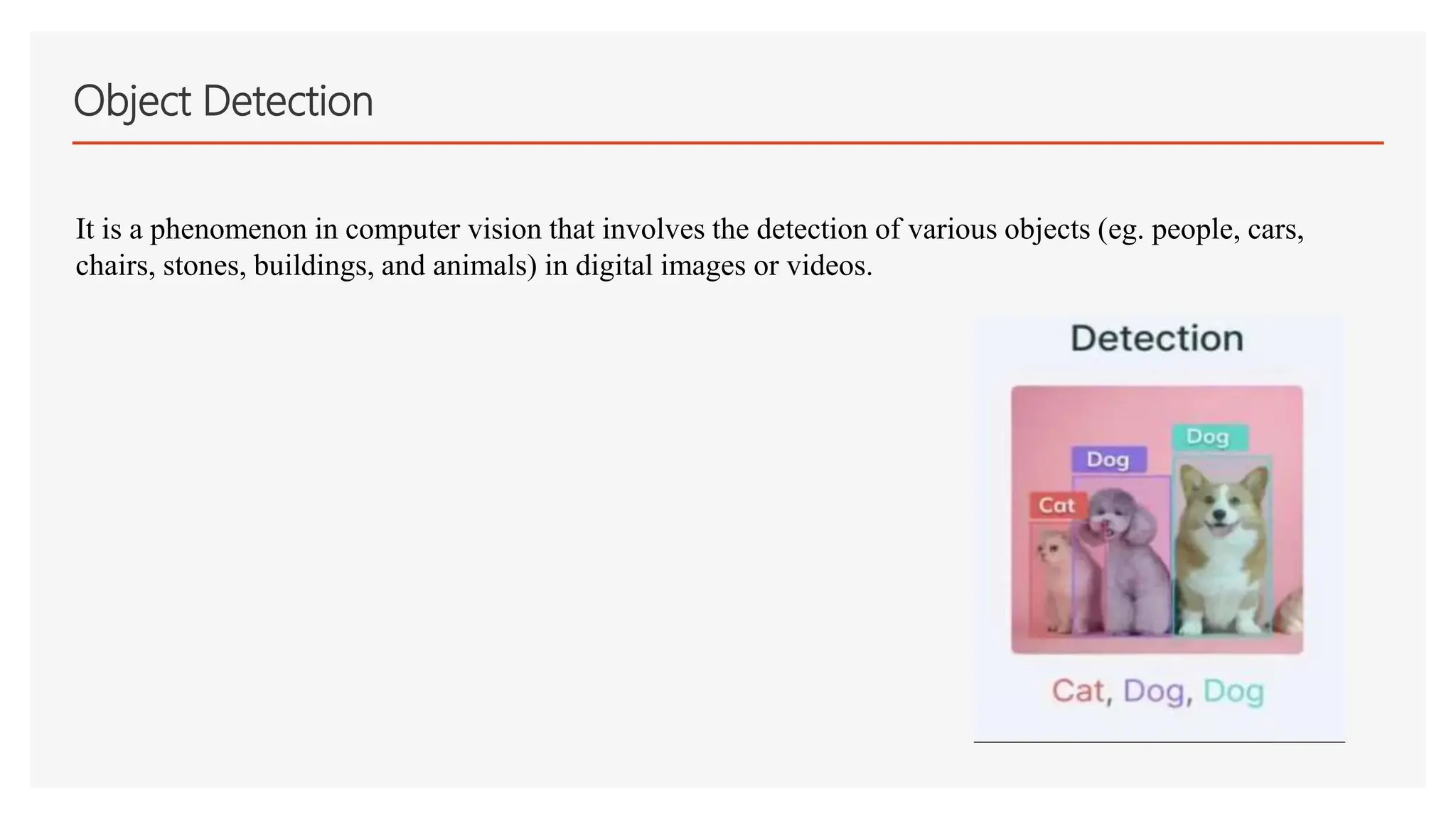
Object Detection
It is a phenomenon in computer vision that involves the detection of various objects (eg. people, cars,
chairs, stones, buildings, and animals) in digital images or videos.
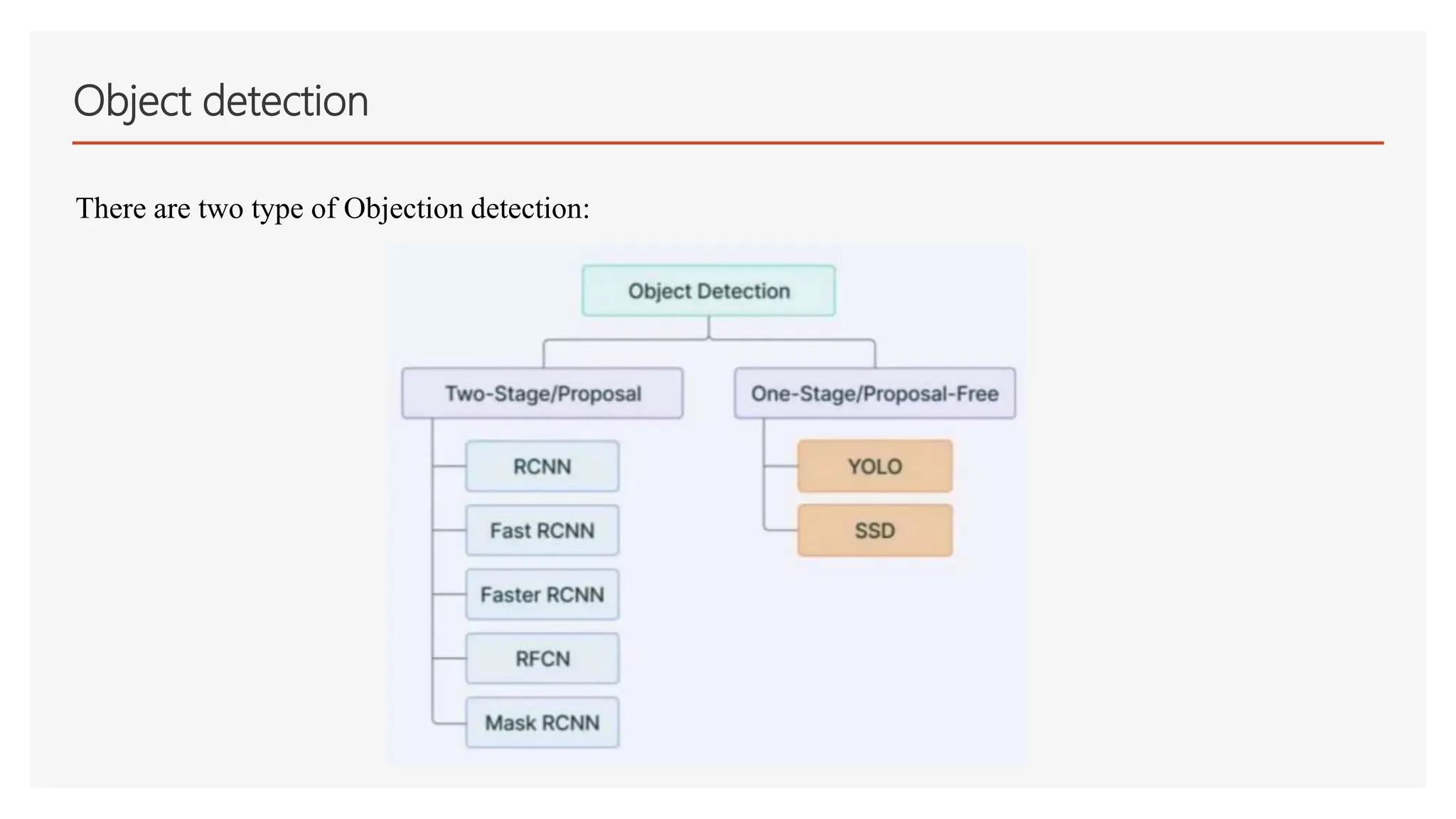
Object detection
There are two type of Objection detection:
YOLO
• You Only Look Once (YOLO) is a state-of-the-art, real-time object detection algorithm introduced in
2015.
• In Comparison with other object detection algorithms, YOLO proposes the use of an end-to-end neural
network that makes predictions of bounding boxes and class probabilities all at once.
How YOLO works
• The YOLO algorithm works by dividing the
image into N grids, each having an equal
dimensional region of SxS.
• Each of these N grids is responsible for the
detection and localization of the object it
contains.
• Correspondingly, these grids predict B
bounding box coordinates relative to their
cell coordinates, along with the object label
and probability of the object being present in
the cell.
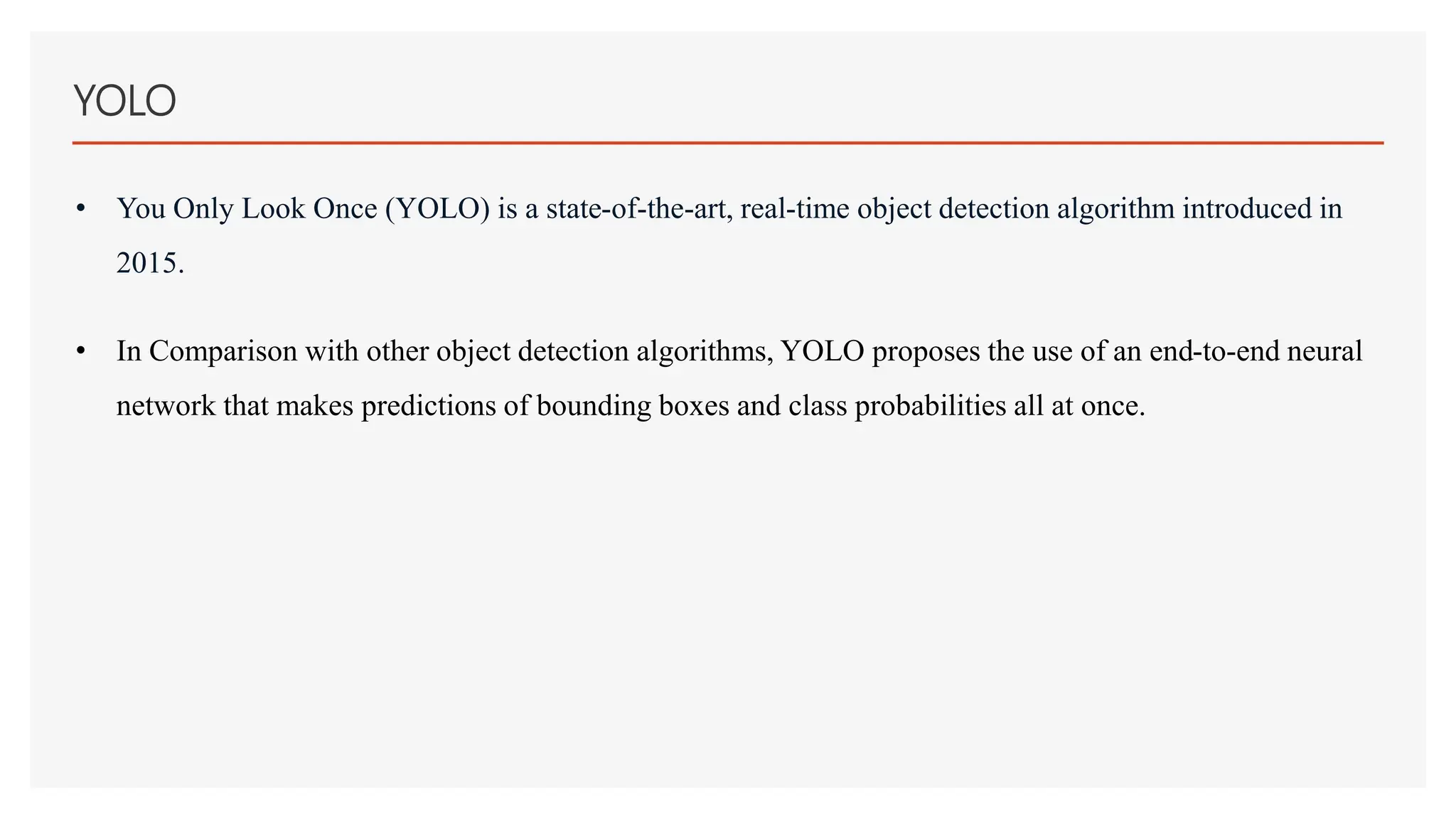
Residual blocks
First, the image is divided into various
grids. Each grid has a dimension of SxS.
The following image shows how an input
image is divided into grids.
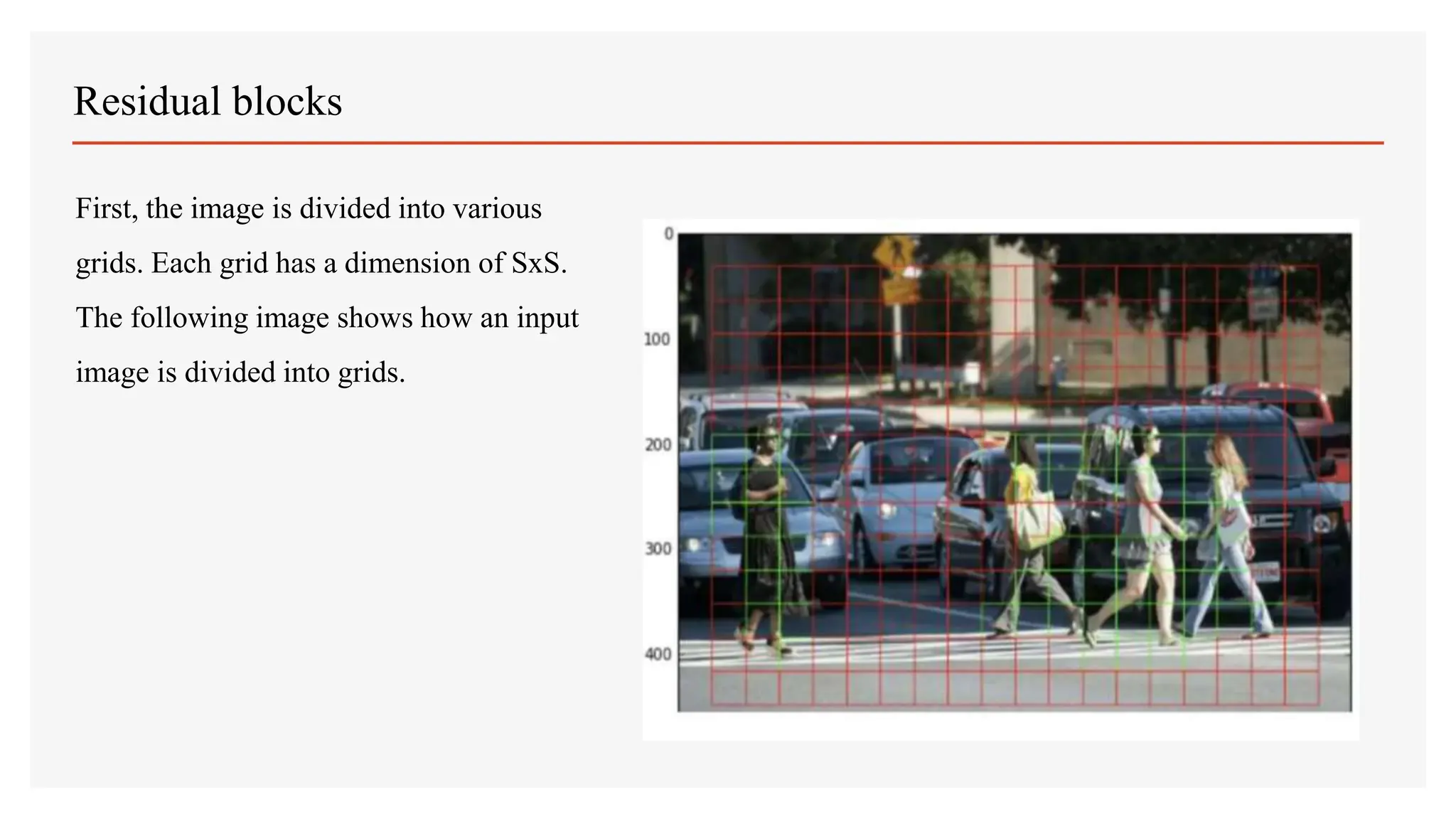
Bounding box regression
• A bounding box is an outline that highlights an
object in an image.
• Every bounding box in the image consists of the
following attributes:
• Width (bw)
• Height (bh)
• Class (for example, person, car, traffic light,
etc.) - This is represented by the letter c.
• Bounding box center (bx, by)
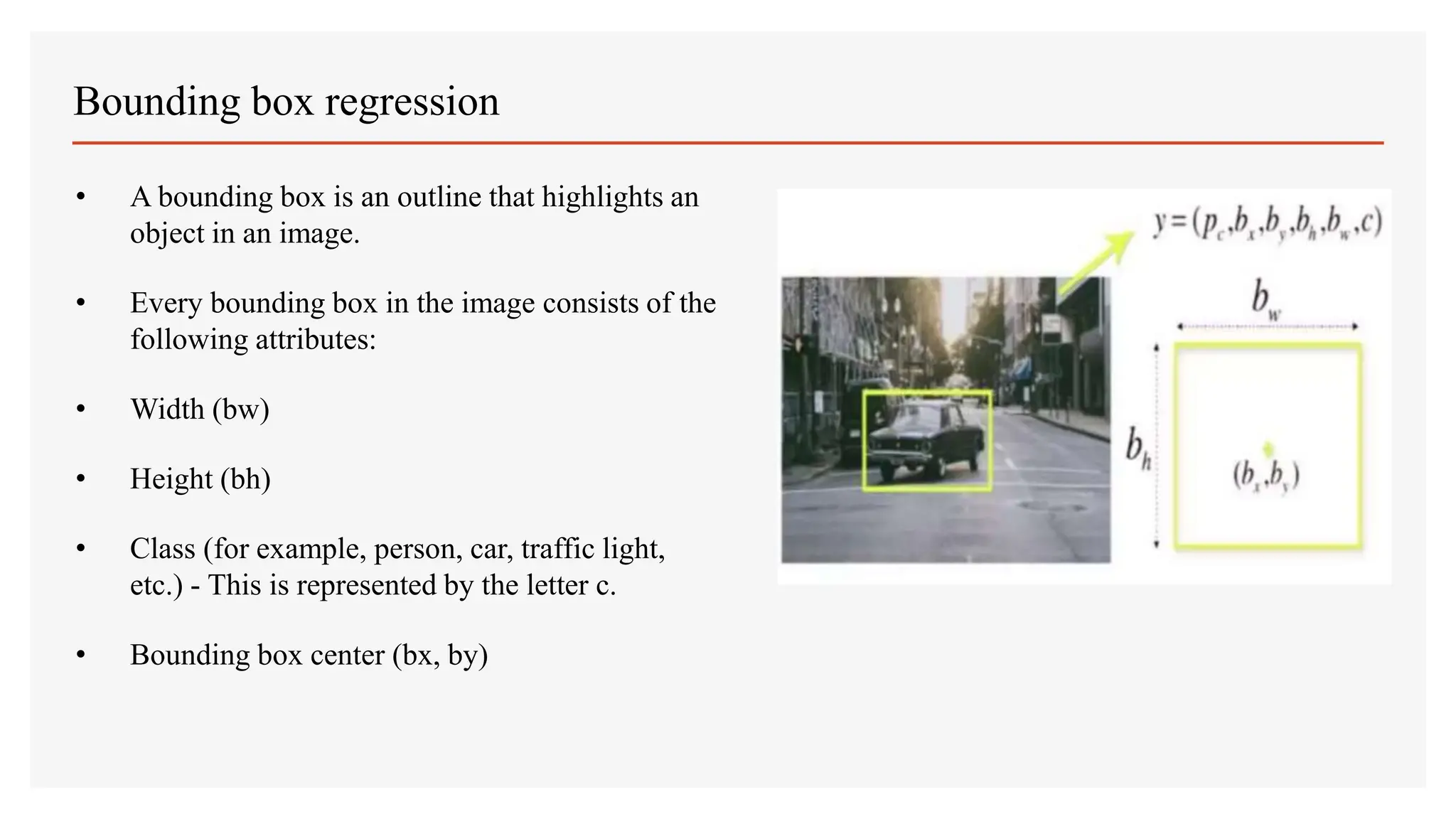
Intersection over Union
• Intersection over union is a popular metric to measure localization
accuracy and calculate localization errors in object detection
models.
• To calculate the loU with the predictions and the ground truth, we
first take the intersecting area between the bounding boxes for al
particular prediction and the ground truth bounding boxes of the
same area. Following this, we calculate the total area covered by
the two bounding boxes-also known as the Union.
• The intersection divided by the Union, gives us the ratio of the
overlap to the total area, providing a good estimate of how close
the bounding box is to the original prediction.
Intersection over Union
• Intersection over union ensures that the predicted bounding boxes are equal to the real boxes of the
objects.
• This phenomenon eliminates unnecessary bounding boxes that do not meet the characteristics of the
objects (like height and width). The final detection will consist of unique bounding boxes that fit the
objects perfectly.
• Other methods brings forth a lot of
duplicate predictions due to multiple
cells predicting the same object with
different bounding box predictions.
• YOLO makes use of Non Maximal
Suppression to deal with this issue.
• In Non Maximal Suppression, YOLO suppresses all bounding boxes that have lower
probability scores.
• YOLO achieves this by first looking at the probability scores associated with each decision
and taking the largest one. Following this, suppresses the bounding boxes having the largest
Intersection over Union with the current high probability bounding box.
• This step is repeated till the final bounding boxes are obtained.
Average Precision (AP)
• Average Precision is calculated as the area under a precision vs recall curve for a set of predictions.
• Recall is calculated as the ratio of the total predictions made by the model under a class with a total of
existing labels for the class.
• On the other hand, Precision refers to the ratio of true positives with respect to the total predictions
made by the model.
• The area under the precision vs recall curve gives us the Average Precision per class for the model. The
average of this value, taken over all classes, is termed as mean Average Precision (mAP).
YOLO Architecture
• Inspired by the GoogleNet architecture, The first YOLO architecture has a total of 24 convolutional
layers with 2 fully connected layers at the end.
Conclusion
• YOLO, for object detection, is simple to construct and can be trained directly on full images.
• YOLO is the fastest general-purpose object detector and YOLO pushes the state-of-the-art in real-time
object detection. YOLO also generalizes well to new domains making it ideal for applications that rely on
fast, robust object detection.
THANK YOU

SEMINAR COURSE PRESENTATION on YOLO algorithm for object detection

  • 1.
    SEMINAR COURSE PRESENTATION YOLO Algorithmfor object detection Presented by: Prasenjit Biswas Mtech 1st semester 230302011
  • 2.
    Content 1. Object Detection 2.Yolo 3. How YOLO works 4. Intersection over Union (IoU) 5. Average Precision (AP) 6. Conclusion
  • 3.
    Object Detection It isa phenomenon in computer vision that involves the detection of various objects (eg. people, cars, chairs, stones, buildings, and animals) in digital images or videos.
  • 4.
    Object detection There aretwo type of Objection detection:
  • 5.
    YOLO • You OnlyLook Once (YOLO) is a state-of-the-art, real-time object detection algorithm introduced in 2015. • In Comparison with other object detection algorithms, YOLO proposes the use of an end-to-end neural network that makes predictions of bounding boxes and class probabilities all at once.
  • 6.
    How YOLO works •The YOLO algorithm works by dividing the image into N grids, each having an equal dimensional region of SxS. • Each of these N grids is responsible for the detection and localization of the object it contains. • Correspondingly, these grids predict B bounding box coordinates relative to their cell coordinates, along with the object label and probability of the object being present in the cell.
  • 7.
    Residual blocks First, theimage is divided into various grids. Each grid has a dimension of SxS. The following image shows how an input image is divided into grids.
  • 8.
    Bounding box regression •A bounding box is an outline that highlights an object in an image. • Every bounding box in the image consists of the following attributes: • Width (bw) • Height (bh) • Class (for example, person, car, traffic light, etc.) - This is represented by the letter c. • Bounding box center (bx, by)
  • 9.
    Intersection over Union •Intersection over union is a popular metric to measure localization accuracy and calculate localization errors in object detection models. • To calculate the loU with the predictions and the ground truth, we first take the intersecting area between the bounding boxes for al particular prediction and the ground truth bounding boxes of the same area. Following this, we calculate the total area covered by the two bounding boxes-also known as the Union. • The intersection divided by the Union, gives us the ratio of the overlap to the total area, providing a good estimate of how close the bounding box is to the original prediction.
  • 10.
    Intersection over Union •Intersection over union ensures that the predicted bounding boxes are equal to the real boxes of the objects. • This phenomenon eliminates unnecessary bounding boxes that do not meet the characteristics of the objects (like height and width). The final detection will consist of unique bounding boxes that fit the objects perfectly.
  • 11.
    • Other methodsbrings forth a lot of duplicate predictions due to multiple cells predicting the same object with different bounding box predictions. • YOLO makes use of Non Maximal Suppression to deal with this issue.
  • 12.
    • In NonMaximal Suppression, YOLO suppresses all bounding boxes that have lower probability scores. • YOLO achieves this by first looking at the probability scores associated with each decision and taking the largest one. Following this, suppresses the bounding boxes having the largest Intersection over Union with the current high probability bounding box. • This step is repeated till the final bounding boxes are obtained.
  • 13.
    Average Precision (AP) •Average Precision is calculated as the area under a precision vs recall curve for a set of predictions. • Recall is calculated as the ratio of the total predictions made by the model under a class with a total of existing labels for the class. • On the other hand, Precision refers to the ratio of true positives with respect to the total predictions made by the model. • The area under the precision vs recall curve gives us the Average Precision per class for the model. The average of this value, taken over all classes, is termed as mean Average Precision (mAP).
  • 14.
    YOLO Architecture • Inspiredby the GoogleNet architecture, The first YOLO architecture has a total of 24 convolutional layers with 2 fully connected layers at the end.
  • 15.
    Conclusion • YOLO, forobject detection, is simple to construct and can be trained directly on full images. • YOLO is the fastest general-purpose object detector and YOLO pushes the state-of-the-art in real-time object detection. YOLO also generalizes well to new domains making it ideal for applications that rely on fast, robust object detection.
  • 16.