OBJECT AND MOTION
DEDUCTION SYSTEM USING
YOLO IN DEEP LEARNING
G L Jishnu
22202014
Introduction to Object and motion
deduction
• YOLO (You Only Look Once) is a deep learning-based object detection
algorithm.
• Unlike traditional methods that scan an image multiple times, YOLO divides
the image into a grid and detects objects in one pass, making it fast and
efficient.
• It predicts both the location (bounding boxes) and class of objects. While
primarily used for object detection, YOLO can be combined with tracking
techniques for motion deduction in videos.
• Its speed and accuracy have made it a popular choice in real-time
applications.
Introduction to Object and motion
deduction
• While YOLO is primarily an object detection algorithm, it can
be combined with other techniques to deduce motion or
track objects across frames in a video.
• Techniques like SORT (Simple Online and Realtime Tracking)
or DeepSORT can be combined with YOLO for real-time
object tracking
Object Detection vs. Image Classification
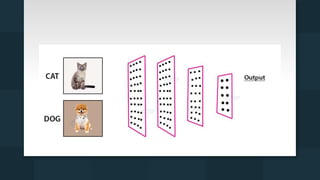
• Image Classification:
Definition: Assigning an image to one of several predefined
categories.
Example: Given a picture of a dog, the system classifies it as
a "Person".
Output: A single label for the entire image.
Object Detection vs. Image Classification
• Object Detection
• Definition: Identifying objects in an image and providing their
locations with bounding boxes.
• Example: In an image with a dog and a cat, the system
identifies both animals and draws a box around each.
• Output: Multiple labels and their respective bounding boxes for
each detected object in the image.
YOLO Algorithm
• YOLO (You Only Look Once) is a deep learning algorithm for
object detection. It divides an image into a grid, with each cell
predicting bounding boxes and class probabilities. Unlike
traditional methods, YOLO detects objects in a single pass,
making it fast.
• It outputs both the location and class of multiple objects, and
its real-time performance has made it popular in various
applications.
What is YOLO?
• YOLO stands for "You Only Look Once." It's a revolutionary
approach to object detection because, as the name suggests, it
processes an image in one forward pass, making it extremely
fast.
• Traditional object detection systems, like R-CNN and its variants,
would scan the image multiple times at different scales and
locations to identify objects.
• YOLO, on the other hand, divides the image into a grid and
predicts bounding boxes and class probabilities simultaneously.
Dataset Description
• The full form of "COCO" in the context of the dataset is "Common Objects
in Context."
Description in Short:
COCO is a large-scale dataset designed for object detection,
segmentation, person key points detection, stuff segmentation, and
caption generation. The dataset contains photos of complex everyday
scenes with annotations.
• These annotations provide detailed information about the objects
present, their positions, and their relationships to one another. COCO has
become one of the standard datasets for evaluating the performance of
different models on the tasks of object detection and segmentation due
to its size and complexity.
YOLO's Architecture
• YOLO uses a single convolutional neural network (CNN) that
predicts multiple bounding boxes and class probabilities for
those boxes.
• The network divides the image into an SxS grid. Each grid cell
predicts B bounding boxes and C class probabilities. The final
prediction is a combination of these bounding boxes and
associated class probabilities.
Purpose of using object and motion
deduction
• Safety and Surveillance: Object detection is widely used in
surveillance systems to identify and track unauthorized individuals,
detect left-behind items, or recognize license plates.
• Retail: In retail settings, object detection can analyze customer
behavior, track products, and even prevent theft.
• Healthcare: In medical imaging, object detection algorithms can
identify and locate tumors, lesions, and other anomalies.
• Autonomous Vehicles: Cars and drones use object detection to
identify and avoid obstacles, recognize traffic signs, and detect
pedestrians.
Purpose of using object and motion
deduction
• Security: Motion detection is a cornerstone of modern security
systems, triggering alarms when unexpected movement is
detected.
• Video Analysis: In sports, motion detection can track players,
analyze their movements, and even predict future positions.
• Traffic Monitoring: Motion detection can be used to analyze traffic
flow, detect traffic jams, and even identify accidents in real-time.
• Wildlife Monitoring: Scientists and researchers use motion
detection to track animal movements without human intervention.
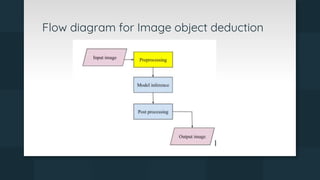
Flow diagram for Image object deduction
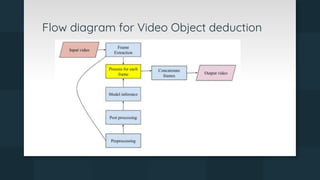
Flow diagram for Video Object deduction
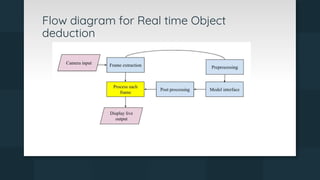
Flow diagram for Real time Object
deduction
Conclusion
• YOLO has revolutionized the field of object detection in deep
learning due to its speed and accuracy. It's a versatile
algorithm that can be used in various applications, from
surveillance to autonomous driving. When combined with
motion deduction techniques, it becomes a powerful tool for
video analysis and real-time tracking.

OBJECT AND MOTION DEDUCTION SYSTEM USING YOLO IN DEEP LEARNING.pptx

  • 1.
    OBJECT AND MOTION DEDUCTIONSYSTEM USING YOLO IN DEEP LEARNING G L Jishnu 22202014
  • 2.
    Introduction to Objectand motion deduction • YOLO (You Only Look Once) is a deep learning-based object detection algorithm. • Unlike traditional methods that scan an image multiple times, YOLO divides the image into a grid and detects objects in one pass, making it fast and efficient. • It predicts both the location (bounding boxes) and class of objects. While primarily used for object detection, YOLO can be combined with tracking techniques for motion deduction in videos. • Its speed and accuracy have made it a popular choice in real-time applications.
  • 3.
    Introduction to Objectand motion deduction • While YOLO is primarily an object detection algorithm, it can be combined with other techniques to deduce motion or track objects across frames in a video. • Techniques like SORT (Simple Online and Realtime Tracking) or DeepSORT can be combined with YOLO for real-time object tracking
  • 4.
    Object Detection vs.Image Classification • Image Classification: Definition: Assigning an image to one of several predefined categories. Example: Given a picture of a dog, the system classifies it as a "Person". Output: A single label for the entire image.
  • 6.
    Object Detection vs.Image Classification • Object Detection • Definition: Identifying objects in an image and providing their locations with bounding boxes. • Example: In an image with a dog and a cat, the system identifies both animals and draws a box around each. • Output: Multiple labels and their respective bounding boxes for each detected object in the image.
  • 8.
    YOLO Algorithm • YOLO(You Only Look Once) is a deep learning algorithm for object detection. It divides an image into a grid, with each cell predicting bounding boxes and class probabilities. Unlike traditional methods, YOLO detects objects in a single pass, making it fast. • It outputs both the location and class of multiple objects, and its real-time performance has made it popular in various applications.
  • 9.
    What is YOLO? •YOLO stands for "You Only Look Once." It's a revolutionary approach to object detection because, as the name suggests, it processes an image in one forward pass, making it extremely fast. • Traditional object detection systems, like R-CNN and its variants, would scan the image multiple times at different scales and locations to identify objects. • YOLO, on the other hand, divides the image into a grid and predicts bounding boxes and class probabilities simultaneously.
  • 10.
    Dataset Description • Thefull form of "COCO" in the context of the dataset is "Common Objects in Context." Description in Short: COCO is a large-scale dataset designed for object detection, segmentation, person key points detection, stuff segmentation, and caption generation. The dataset contains photos of complex everyday scenes with annotations. • These annotations provide detailed information about the objects present, their positions, and their relationships to one another. COCO has become one of the standard datasets for evaluating the performance of different models on the tasks of object detection and segmentation due to its size and complexity.
  • 11.
    YOLO's Architecture • YOLOuses a single convolutional neural network (CNN) that predicts multiple bounding boxes and class probabilities for those boxes. • The network divides the image into an SxS grid. Each grid cell predicts B bounding boxes and C class probabilities. The final prediction is a combination of these bounding boxes and associated class probabilities.
  • 12.
    Purpose of usingobject and motion deduction • Safety and Surveillance: Object detection is widely used in surveillance systems to identify and track unauthorized individuals, detect left-behind items, or recognize license plates. • Retail: In retail settings, object detection can analyze customer behavior, track products, and even prevent theft. • Healthcare: In medical imaging, object detection algorithms can identify and locate tumors, lesions, and other anomalies. • Autonomous Vehicles: Cars and drones use object detection to identify and avoid obstacles, recognize traffic signs, and detect pedestrians.
  • 13.
    Purpose of usingobject and motion deduction • Security: Motion detection is a cornerstone of modern security systems, triggering alarms when unexpected movement is detected. • Video Analysis: In sports, motion detection can track players, analyze their movements, and even predict future positions. • Traffic Monitoring: Motion detection can be used to analyze traffic flow, detect traffic jams, and even identify accidents in real-time. • Wildlife Monitoring: Scientists and researchers use motion detection to track animal movements without human intervention.
  • 14.
    Flow diagram forImage object deduction
  • 15.
    Flow diagram forVideo Object deduction
  • 16.
    Flow diagram forReal time Object deduction
  • 17.
    Conclusion • YOLO hasrevolutionized the field of object detection in deep learning due to its speed and accuracy. It's a versatile algorithm that can be used in various applications, from surveillance to autonomous driving. When combined with motion deduction techniques, it becomes a powerful tool for video analysis and real-time tracking.