Chapter-5 Synchronization
Introduction A DS consists of a collection of distinct processes that are separated spatially and run concurrently Sharing of resources may be co-operative or competitive. The rules for enforcing correct interaction are implemented in the form of synchronization. The number of resources in a computing system is restricted , one process must influence the action of other concurrently executing processes as it competes for resources. The synchronization mechanisms suitable for distributed system are Clock synchronization Event ordering Mutual exclusion Election algorithm
Clock synchronization issues Practically no two clocks can be perfectly synchronized A set of clocks are said to synchronized if their clock skew less than some constant(∂) Clock synchronization requires each node to read other nodes’ clock Time must never run backward Clock synchronization algorithms Broadly classified into two types Centralized algorithms Distributed algorithms Centralized algorithms In this mechanism, one node has a real time receiver. This node is called  TIME SERVER NODE  and clock time of this node is used as a reference. The clocks of all other nodes are synchronized with respect to  time server node Two types of clock synchronizations ( Active, Passive )
Passive time server centralized algorithms In this method. Each node periodically sends a message to the time server When the time server receives the message, it quickly responds with current TIME message (T) Unpredictable variation of message passing duration effects on ‘T’ Message passing duration is considered based on a threshold value. Active time server centralized algorithms In this scheme, the time server periodically broadcasts it clock time. The other nodes receive the broadcast message and  use the clock time in the message  for correcting their own clocks. Each node has a priori knowledge of the propagation delay Disadvantages These are subject to single point failure – Time server fails, synchronization cannot be performed Makes system unreliable Not supports scalability (difficult) Propagation delay is unpredictable
Distributed algorithms Externally synchronized clocks are also internally synchronized Each node of the system are synchronized wrt real-time server Multiple real-time clocks  are used Global averaging The clock process at each node broadcasts its local clock time in the form of  ‘resync’  message (Resynchronization) It takes the average of the estimated skews and use it as the correction for the local clock The estimated skew is compared with threshold value It discards highest and lowest estimated skews  Calculates the average of the remaining skews Localized averaging In this approach, all the nodes of the  distributed system are logically arranged in some pattern ( Ring, grid, etc) Periodically, each node exchanges its clock time with its neighbors in the ring or grid Set the clock time to the average of its own and clock times of neighbor
Event ordering For most applications it is not necessary and difficult to keep the clocks in a distributed system synchronized. It is sufficient to ensure that, all events that occur in a DS be totally ordered in a consistent manner with an observed behavior. For partial ordering of events Happened-Before and logical clocks relation is used. Happened-Before relation The happened-before relation (  )on a set of events satisfies If  a  and  b  are events in the same process and  a  occurs before  b, then a  b. If  a  is the event of sending message to  b,  and  b  is the event of receiving from  a  then  a  b Satisfies Causality-  A receiver cannot receive a message until the sender sends it. The propagation delay is always positive If  a  b and b  c, the a  c  (transitive law) It is irreflexive  a  a if  a  and  b  are said to be concurrent, then  a  b  is not possible.
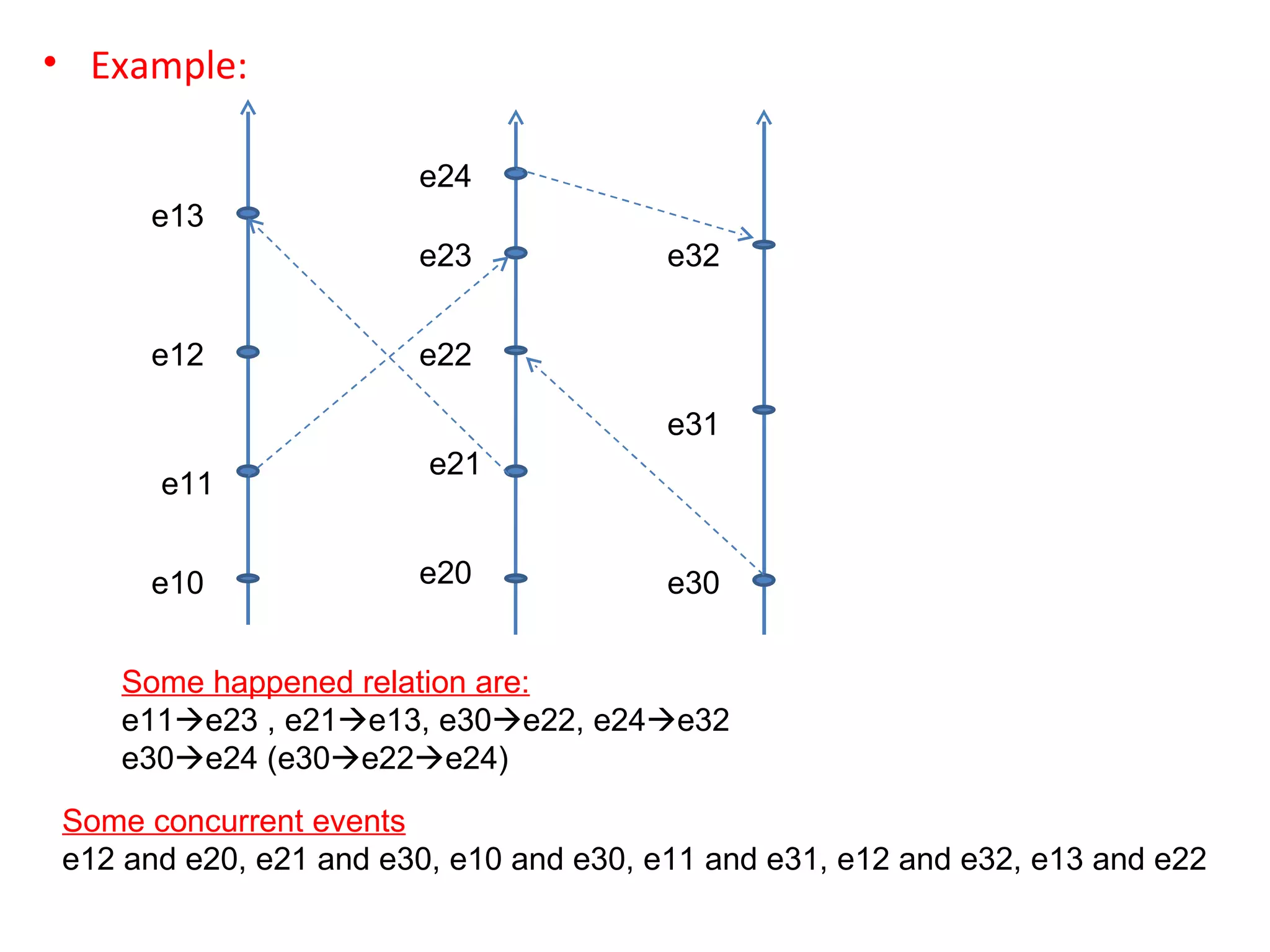
Example: e10 e13 e12 e11 e24 e23 e22 e21 e20 e30 e31 e32 Some happened relation are: e11  e23 , e21  e13, e30  e22, e24  e32 e30  e24 (e30  e22  e24) Some concurrent events e12 and e20, e21 and e30, e10 and e30, e11 and e31, e12 and e32, e13 and e22
Logical clocks concept It is a way to associate a timestamp (a number independent of any clock time) with each system event so that events that are related to each other by happened-before relation can be properly ordered. Each process  Pi  has a clock  Ci  associated with a number  Ci(a)  to any event  a Conditions If  a  and  b  are two events within the same process  Pi  and  a  occurs before  b , then  Ci(a)<Ci(b) If  a  is sending a message by  Pi  and  b  is the receipt of that message by process  Pj  , then  Ci(a)<Cj(b) A clock of  Ci  associated with process  Pi  must always go forward Implementation of logical clocks using counters The counters acts as logical clocks At beginning,  counters are initialized to zero A process increments its counter by 1 whenever an event occurs For receiving message, the counter value should always greater than the counter value of sender

Chap 5

  • 1.
  • 2.
    Introduction A DSconsists of a collection of distinct processes that are separated spatially and run concurrently Sharing of resources may be co-operative or competitive. The rules for enforcing correct interaction are implemented in the form of synchronization. The number of resources in a computing system is restricted , one process must influence the action of other concurrently executing processes as it competes for resources. The synchronization mechanisms suitable for distributed system are Clock synchronization Event ordering Mutual exclusion Election algorithm
  • 3.
    Clock synchronization issuesPractically no two clocks can be perfectly synchronized A set of clocks are said to synchronized if their clock skew less than some constant(∂) Clock synchronization requires each node to read other nodes’ clock Time must never run backward Clock synchronization algorithms Broadly classified into two types Centralized algorithms Distributed algorithms Centralized algorithms In this mechanism, one node has a real time receiver. This node is called TIME SERVER NODE and clock time of this node is used as a reference. The clocks of all other nodes are synchronized with respect to time server node Two types of clock synchronizations ( Active, Passive )
  • 4.
    Passive time servercentralized algorithms In this method. Each node periodically sends a message to the time server When the time server receives the message, it quickly responds with current TIME message (T) Unpredictable variation of message passing duration effects on ‘T’ Message passing duration is considered based on a threshold value. Active time server centralized algorithms In this scheme, the time server periodically broadcasts it clock time. The other nodes receive the broadcast message and use the clock time in the message for correcting their own clocks. Each node has a priori knowledge of the propagation delay Disadvantages These are subject to single point failure – Time server fails, synchronization cannot be performed Makes system unreliable Not supports scalability (difficult) Propagation delay is unpredictable
  • 5.
    Distributed algorithms Externallysynchronized clocks are also internally synchronized Each node of the system are synchronized wrt real-time server Multiple real-time clocks are used Global averaging The clock process at each node broadcasts its local clock time in the form of ‘resync’ message (Resynchronization) It takes the average of the estimated skews and use it as the correction for the local clock The estimated skew is compared with threshold value It discards highest and lowest estimated skews Calculates the average of the remaining skews Localized averaging In this approach, all the nodes of the distributed system are logically arranged in some pattern ( Ring, grid, etc) Periodically, each node exchanges its clock time with its neighbors in the ring or grid Set the clock time to the average of its own and clock times of neighbor
  • 6.
    Event ordering Formost applications it is not necessary and difficult to keep the clocks in a distributed system synchronized. It is sufficient to ensure that, all events that occur in a DS be totally ordered in a consistent manner with an observed behavior. For partial ordering of events Happened-Before and logical clocks relation is used. Happened-Before relation The happened-before relation (  )on a set of events satisfies If a and b are events in the same process and a occurs before b, then a  b. If a is the event of sending message to b, and b is the event of receiving from a then a  b Satisfies Causality- A receiver cannot receive a message until the sender sends it. The propagation delay is always positive If a  b and b  c, the a  c (transitive law) It is irreflexive a  a if a and b are said to be concurrent, then a  b is not possible.
  • 7.
    Example: e10 e13e12 e11 e24 e23 e22 e21 e20 e30 e31 e32 Some happened relation are: e11  e23 , e21  e13, e30  e22, e24  e32 e30  e24 (e30  e22  e24) Some concurrent events e12 and e20, e21 and e30, e10 and e30, e11 and e31, e12 and e32, e13 and e22
  • 8.
    Logical clocks conceptIt is a way to associate a timestamp (a number independent of any clock time) with each system event so that events that are related to each other by happened-before relation can be properly ordered. Each process Pi has a clock Ci associated with a number Ci(a) to any event a Conditions If a and b are two events within the same process Pi and a occurs before b , then Ci(a)<Ci(b) If a is sending a message by Pi and b is the receipt of that message by process Pj , then Ci(a)<Cj(b) A clock of Ci associated with process Pi must always go forward Implementation of logical clocks using counters The counters acts as logical clocks At beginning, counters are initialized to zero A process increments its counter by 1 whenever an event occurs For receiving message, the counter value should always greater than the counter value of sender