Semi-fermented and
Fermented Products
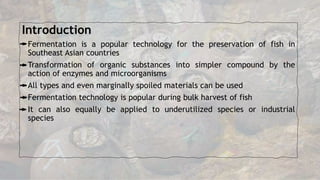
Introduction
• Fermentation is a popular technology for the preservation of fish in
Southeast Asian countries
• Transformation of organic substances into simpler compound by the
action of enzymes and microorganisms
• All types and even marginally spoiled materials can be used
• Fermentation technology is popular during bulk harvest of fish
• It can also equally be applied to underutilized species or industrial
species
Suitability of Raw Materials
In general, three types of raw materials are used in fish
meal manufacture which includes-
Mainly small bony fish,
Oily short-lived,
Fast-growing fish where there is little or no demand for human
consumption.
Quality
Availability
Price
Processing
Cost and Profitability
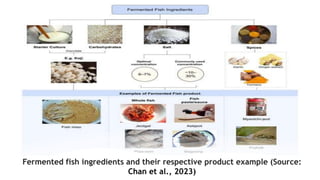
Fermented fish ingredients and their respective product example (Source:
Chan et al., 2023)
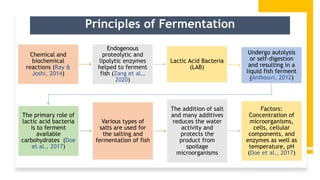
Principles of Fermentation
Chemical and
biochemical
reactions (Ray &
Joshi, 2014)
Endogenous
proteolytic and
lipolytic enzymes
helped to ferment
fish (Zang et al.,
2020)
Lactic Acid Bacteria
(LAB)
Undergo autolysis
or self-digestion
and resulting in a
liquid fish ferment
(Anihouvi, 2012)
The primary role of
lactic acid bacteria
is to ferment
available
carbohydrates (Doe
et al., 2017)
Various types of
salts are used for
the salting and
fermentation of fish
The addition of salt
and many additives
reduces the water
activity and
protects the
product from
spoilage
microorganisms
Factors:
Concentration of
microorganisms,
cells, cellular
components, and
enzymes as well as
temperature, pH
(Doe et al., 2017)
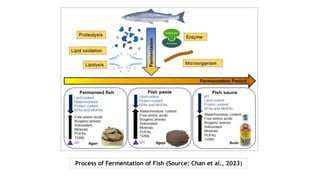
Process of Fermentation of Fish (Source: Chan et al., 2023)
Types of Fermented Fishery Products
Products primarily involving enzymatic hydrolysis.
Products preserved by microbial fermentation.
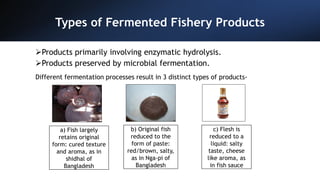
Different fermentation processes result in 3 distinct types of products-
a) Fish largely
retains original
form: cured texture
and aroma, as in
shidhal of
Bangladesh
b) Original fish
reduced to the
form of paste:
red/brown, salty,
as in Nga-pi of
Bangladesh
c) Flesh is
reduced to a
liquid: salty
taste, cheese
like aroma, as
in fish sauce
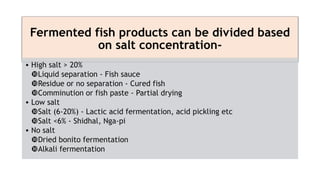
Fermented fish products can be divided based
on salt concentration-
• High salt > 20%
Liquid separation - Fish sauce
Residue or no separation - Cured fish
Comminution or fish paste - Partial drying
• Low salt
Salt (6-20%) - Lactic acid fermentation, acid pickling etc
Salt <6% - Shidhal, Nga-pi
• No salt
Dried bonito fermentation
Alkali fermentation
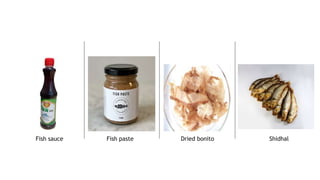
Fish sauce Fish paste Dried bonito Shidhal
Techniques of Fermentation
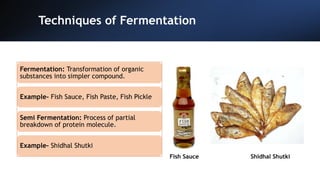
Fish Sauce Shidhal Shutki
Fermentation: Transformation of organic
substances into simpler compound.
Example- Fish Sauce, Fish Paste, Fish Pickle
Semi Fermentation: Process of partial
breakdown of protein molecule.
Example- Shidhal Shutki
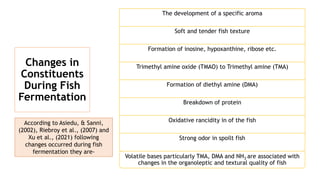
Changes in
Constituents
During Fish
Fermentation
The development of a specific aroma
Soft and tender fish texture
Formation of inosine, hypoxanthine, ribose etc.
Trimethyl amine oxide (TMAO) to Trimethyl amine (TMA)
Formation of diethyl amine (DMA)
Breakdown of protein
Oxidative rancidity in of the fish
Strong odor in spoilt fish
According to Asiedu, & Sanni,
(2002), Riebroy et al., (2007) and
Xu et al., (2021) following
changes occurred during fish
fermentation they are-
Volatile bases particularly TMA, DMA and NH3 are associated with
changes in the organoleptic and textural quality of fish
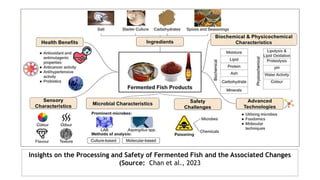
Insights on the Processing and Safety of Fermented Fish and the Associated Changes
(Source: Chan et al., 2023
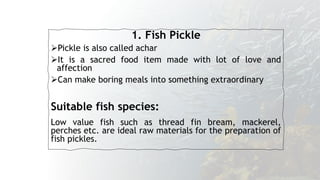
1. Fish Pickle
Pickle is also called achar
It is a sacred food item made with lot of love and
affection
Can make boring meals into something extraordinary
Suitable fish species:
Low value fish such as thread fin bream, mackerel,
perches etc. are ideal raw materials for the preparation of
fish pickles.
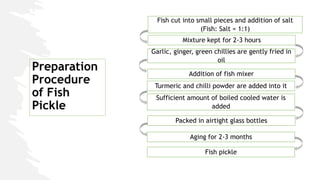
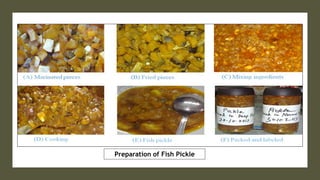
Preparation
Procedure
of Fish
Pickle
Fish cut into small pieces and addition of salt
(Fish: Salt = 1:1)
Mixture kept for 2-3 hours
Garlic, ginger, green chillies are gently fried in
oil
Addition of fish mixer
Turmeric and chilli powder are added into it
Sufficient amount of boiled cooled water is
added
Packed in airtight glass bottles
Aging for 2-3 months
Fish pickle
Preparation of Fish Pickle
2. Shidal Shutki
Salt-free fermented fish product
Very much popular due to its strong flavour
Locally called shidal, sepaa and hidal.
Suitable Fish Species:
For the production of Shidal Sutki, Puntius spp.
are used mostly, and winter season is mostly
favoured for the production of Shidal Sutki
throughout the country.
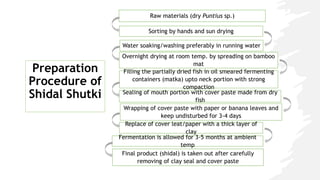
Raw materials (dry Puntius sp.)
Preparation
Procedure of
Shidal Shutki
Sorting by hands and sun drying
Water soaking/washing preferably in running water
Overnight drying at room temp. by spreading on bamboo
mat
Filling the partially dried fish in oil smeared fermenting
containers (matka) upto neck portion with strong
compaction
Sealing of mouth portion with cover paste made from dry
fish
Wrapping of cover paste with paper or banana leaves and
keep undisturbed for 3-4 days
Replace of cover leat/paper with a thick layer of
clay
Fermentation is allowed for 3-5 months at ambient
temp
Final product (shidal) is taken out after carefully
removing of clay seal and cover paste
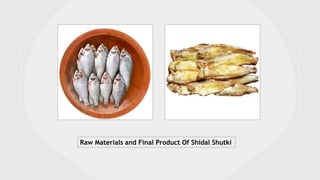
Raw Materials and Final Product Of Shidal Shutki
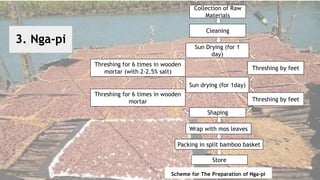
3. Nga-pi
Collection of Raw
Materials
Cleaning
Sun Drying (for 1
day)
Sun drying (for 1day)
Threshing by feet
Threshing for 6 times in wooden
mortar (with 2-2.5% salt)
Shaping
Wrap with mos leaves
Packing in split bamboo basket
Threshing by feet
Store
Threshing for 6 times in wooden
mortar
Scheme for The Preparation of Nga-pi
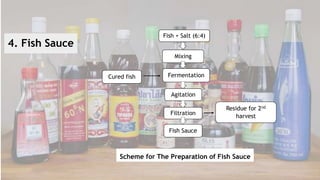
4. Fish Sauce
Scheme for The Preparation of Fish Sauce
Fish + Salt (6:4)
Mixing
Fermentation
Agitation
Fish Sauce
Cured fish
Residue for 2nd
harvest
Filtration
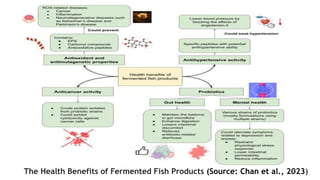
The Health Benefits of Fermented Fish Products (Source: Chan et al., 2023)
Conclusion
Fermented fish products play a crucial role in various cultures and cuisines
worldwide. They offer unique flavors, enhanced nutritional value, and
preservation benefits. The appreciation and utilization of these products
contribute to culinary diversity and the promotion of sustainable food
practices.
References
Anihouvi, V. B., Kindossi, J. M., & Hounhouigan, J. D. (2012). Processing and quality characteristics of some
major fermented fish products from Africa: a critical review. International Research Journal of Biological
Sciences, 1(7), 72-84.
Asiedu, M., & Sanni, A. I. (2002). Chemical composition and microbiological changes during spontaneous and
starter culture fermentation of enam ne–setaakye, a West African fermented fish-carbohydrate product.
European Food Research and Technology, 215, 8- 12.
Chan, S. X. Y., Fitri, N., Mio Asni, N. S., Sayuti, N. H., Azlan, U. K., Qadi, W. S., ... & Mediani, A. (2023). A
Comprehensive Review with Future Insights on the Processing and Safety of Fermented Fish and the
Associated Changes. Foods, 12(3), 558.
Doe, P., Sikorski, Z., Haard, N., Olley, J., & Pan, B. S. (2017). Basic principles. In Fish Drying & Smoking (pp.
13-45). Routledge.
Ray, R. C., & Joshi, V. K. (2014). Fermented foods: past, present and future. Microorganisms and
fermentation of traditional foods, 1-36.
Riebroy, S., Benjakul, S., Visessanguan, W., & Tanaka, M. (2007). Changes during fermentation and properties
of som‐fug produced from different marine fish. Journal of Food Processing and Preservation, 31(6), 751-
770.
Xu, Y., Zang, J., Regenstein, J. M., & Xia, W. (2021). Technological roles of microorganisms in fish
fermentation: a review. Critical Reviews in Food Science and Nutrition, 61(6), 1000- 1012.
Zang, J., Xu, Y., Xia, W., & Regenstein, J. M. (2020). Quality, functionality, and microbiology of fermented
fish: a review. Critical Reviews in Food Science and Nutrition, 60(7), 1228- 1242.
Thank You

Semi fermented and fermented fish products.pptx

  • 1.
  • 2.
    Introduction • Fermentation isa popular technology for the preservation of fish in Southeast Asian countries • Transformation of organic substances into simpler compound by the action of enzymes and microorganisms • All types and even marginally spoiled materials can be used • Fermentation technology is popular during bulk harvest of fish • It can also equally be applied to underutilized species or industrial species
  • 3.
    Suitability of RawMaterials In general, three types of raw materials are used in fish meal manufacture which includes- Mainly small bony fish, Oily short-lived, Fast-growing fish where there is little or no demand for human consumption. Quality Availability Price Processing Cost and Profitability
  • 4.
    Fermented fish ingredientsand their respective product example (Source: Chan et al., 2023)
  • 5.
    Principles of Fermentation Chemicaland biochemical reactions (Ray & Joshi, 2014) Endogenous proteolytic and lipolytic enzymes helped to ferment fish (Zang et al., 2020) Lactic Acid Bacteria (LAB) Undergo autolysis or self-digestion and resulting in a liquid fish ferment (Anihouvi, 2012) The primary role of lactic acid bacteria is to ferment available carbohydrates (Doe et al., 2017) Various types of salts are used for the salting and fermentation of fish The addition of salt and many additives reduces the water activity and protects the product from spoilage microorganisms Factors: Concentration of microorganisms, cells, cellular components, and enzymes as well as temperature, pH (Doe et al., 2017)
  • 6.
    Process of Fermentationof Fish (Source: Chan et al., 2023)
  • 7.
    Types of FermentedFishery Products Products primarily involving enzymatic hydrolysis. Products preserved by microbial fermentation. Different fermentation processes result in 3 distinct types of products- a) Fish largely retains original form: cured texture and aroma, as in shidhal of Bangladesh b) Original fish reduced to the form of paste: red/brown, salty, as in Nga-pi of Bangladesh c) Flesh is reduced to a liquid: salty taste, cheese like aroma, as in fish sauce
  • 8.
    Fermented fish productscan be divided based on salt concentration- • High salt > 20% Liquid separation - Fish sauce Residue or no separation - Cured fish Comminution or fish paste - Partial drying • Low salt Salt (6-20%) - Lactic acid fermentation, acid pickling etc Salt <6% - Shidhal, Nga-pi • No salt Dried bonito fermentation Alkali fermentation
  • 9.
    Fish sauce Fishpaste Dried bonito Shidhal
  • 10.
    Techniques of Fermentation FishSauce Shidhal Shutki Fermentation: Transformation of organic substances into simpler compound. Example- Fish Sauce, Fish Paste, Fish Pickle Semi Fermentation: Process of partial breakdown of protein molecule. Example- Shidhal Shutki
  • 11.
    Changes in Constituents During Fish Fermentation Thedevelopment of a specific aroma Soft and tender fish texture Formation of inosine, hypoxanthine, ribose etc. Trimethyl amine oxide (TMAO) to Trimethyl amine (TMA) Formation of diethyl amine (DMA) Breakdown of protein Oxidative rancidity in of the fish Strong odor in spoilt fish According to Asiedu, & Sanni, (2002), Riebroy et al., (2007) and Xu et al., (2021) following changes occurred during fish fermentation they are- Volatile bases particularly TMA, DMA and NH3 are associated with changes in the organoleptic and textural quality of fish
  • 12.
    Insights on theProcessing and Safety of Fermented Fish and the Associated Changes (Source: Chan et al., 2023
  • 13.
    1. Fish Pickle Pickleis also called achar It is a sacred food item made with lot of love and affection Can make boring meals into something extraordinary Suitable fish species: Low value fish such as thread fin bream, mackerel, perches etc. are ideal raw materials for the preparation of fish pickles.
  • 14.
    Preparation Procedure of Fish Pickle Fish cutinto small pieces and addition of salt (Fish: Salt = 1:1) Mixture kept for 2-3 hours Garlic, ginger, green chillies are gently fried in oil Addition of fish mixer Turmeric and chilli powder are added into it Sufficient amount of boiled cooled water is added Packed in airtight glass bottles Aging for 2-3 months Fish pickle
  • 15.
  • 16.
    2. Shidal Shutki Salt-freefermented fish product Very much popular due to its strong flavour Locally called shidal, sepaa and hidal. Suitable Fish Species: For the production of Shidal Sutki, Puntius spp. are used mostly, and winter season is mostly favoured for the production of Shidal Sutki throughout the country.
  • 17.
    Raw materials (dryPuntius sp.) Preparation Procedure of Shidal Shutki Sorting by hands and sun drying Water soaking/washing preferably in running water Overnight drying at room temp. by spreading on bamboo mat Filling the partially dried fish in oil smeared fermenting containers (matka) upto neck portion with strong compaction Sealing of mouth portion with cover paste made from dry fish Wrapping of cover paste with paper or banana leaves and keep undisturbed for 3-4 days Replace of cover leat/paper with a thick layer of clay Fermentation is allowed for 3-5 months at ambient temp Final product (shidal) is taken out after carefully removing of clay seal and cover paste
  • 18.
    Raw Materials andFinal Product Of Shidal Shutki
  • 19.
    3. Nga-pi Collection ofRaw Materials Cleaning Sun Drying (for 1 day) Sun drying (for 1day) Threshing by feet Threshing for 6 times in wooden mortar (with 2-2.5% salt) Shaping Wrap with mos leaves Packing in split bamboo basket Threshing by feet Store Threshing for 6 times in wooden mortar Scheme for The Preparation of Nga-pi
  • 20.
    4. Fish Sauce Schemefor The Preparation of Fish Sauce Fish + Salt (6:4) Mixing Fermentation Agitation Fish Sauce Cured fish Residue for 2nd harvest Filtration
  • 21.
    The Health Benefitsof Fermented Fish Products (Source: Chan et al., 2023)
  • 22.
    Conclusion Fermented fish productsplay a crucial role in various cultures and cuisines worldwide. They offer unique flavors, enhanced nutritional value, and preservation benefits. The appreciation and utilization of these products contribute to culinary diversity and the promotion of sustainable food practices.
  • 23.
    References Anihouvi, V. B.,Kindossi, J. M., & Hounhouigan, J. D. (2012). Processing and quality characteristics of some major fermented fish products from Africa: a critical review. International Research Journal of Biological Sciences, 1(7), 72-84. Asiedu, M., & Sanni, A. I. (2002). Chemical composition and microbiological changes during spontaneous and starter culture fermentation of enam ne–setaakye, a West African fermented fish-carbohydrate product. European Food Research and Technology, 215, 8- 12. Chan, S. X. Y., Fitri, N., Mio Asni, N. S., Sayuti, N. H., Azlan, U. K., Qadi, W. S., ... & Mediani, A. (2023). A Comprehensive Review with Future Insights on the Processing and Safety of Fermented Fish and the Associated Changes. Foods, 12(3), 558. Doe, P., Sikorski, Z., Haard, N., Olley, J., & Pan, B. S. (2017). Basic principles. In Fish Drying & Smoking (pp. 13-45). Routledge. Ray, R. C., & Joshi, V. K. (2014). Fermented foods: past, present and future. Microorganisms and fermentation of traditional foods, 1-36. Riebroy, S., Benjakul, S., Visessanguan, W., & Tanaka, M. (2007). Changes during fermentation and properties of som‐fug produced from different marine fish. Journal of Food Processing and Preservation, 31(6), 751- 770. Xu, Y., Zang, J., Regenstein, J. M., & Xia, W. (2021). Technological roles of microorganisms in fish fermentation: a review. Critical Reviews in Food Science and Nutrition, 61(6), 1000- 1012. Zang, J., Xu, Y., Xia, W., & Regenstein, J. M. (2020). Quality, functionality, and microbiology of fermented fish: a review. Critical Reviews in Food Science and Nutrition, 60(7), 1228- 1242.
  • 24.