AQ 100 fish handling processing and transportation
1.
SOKOINE UNIVERSITY OFAGRICULTURE
COLLEGE OF AGRICULTURE
DEPARTMENT OF ANIMAL,AQUACULTUREAND RANGE SCIENCES
DEGREE PROGRAM;BACHELOR OF VETERINARY MEDICINE
COURSE NAME;INTRODUCTION TO AQUACULTURE
COURSE CODE;AQ1OO
INSTRUCTOR;MADAM ZIPORA EDWIN
GROUP ;3
QUESTION 12;
INTRODUCTION TO FISH POSTHARVEST HANDLING AND PROCESSING
2.
Fish Post-Harvest Handling
•Refers to activities undergoing after fishes are
harvested until they reach consumers.
• Includes cleaning, chilling, storage, transport,
marketing.
• Aims to maintain quality, freshness, safety and
reduce post harvest losses.
3.
Characteristics of Fishas a Food Commodity
• Fish flesh is rich in high-quality protein, essential
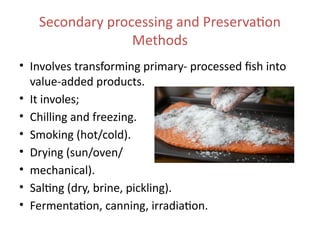
amino acids, omega-3 fatty acids, vitamins (A, D, B-
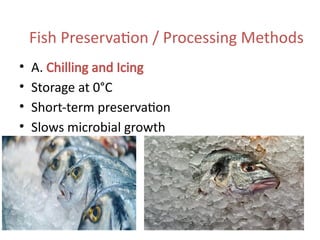
complex), and minerals such as calcium,
phosphorus, iodine, and selenium. However, fish
spoils faster than meat because of high enzymatic
activity, presence of spoilage bacteria(.
Psychrotrophic (Cold-tolerant) Bacteria
egPseudomonas spp. (most dominant) and rapid
oxidation of fats.
4.
FISH HANDLING
• Gentleand hygienic methods to avoid
spoilage, contamination, physical damage and
quality losses.
• Includes catching, bleeding, washing, icing,
packaging, transporting and storage
• Reduces contamination and maintains quality.
5.
CAUSES OF FISHSPOILAGE
• Fish spoilage is caused by
• enzymatic autolysis,
• microbial activity, and
• chemical oxidation.
• Immediately after death, enzymes begin breaking
down muscle tissues Bacteria from the skin, gills,
and gut multiply rapidly, producing off-odors and
toxins. Oxidative rancidity affects fatty fish,
leading to unpleasant flavors.
6.
Postharvest Losses inFish
• Postharvest losses include physical losses
(discarded fish), quality losses (reduced price),
and nutritional losses.
• Major causes include poor handling, lack of
ice, inadequate storage facilities, poor
transportation, and unhygienic processing.
7.
Handling at HarvestSite
•.Objectives of Proper Fish Handling at Harvest Site
•Prevent physical damage
•Reduce bacterial contamination
•Slow enzymatic and microbial spoilage
•Maintain market value and consumer safety
8.
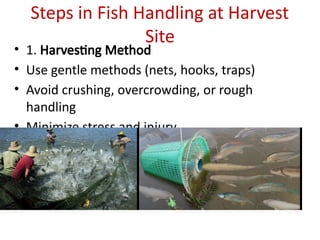
Steps in FishHandling at Harvest
Site
• 1. Harvesting Method
• Use gentle methods (nets, hooks, traps)
• Avoid crushing, overcrowding, or rough
handling
• Minimize stress and injury
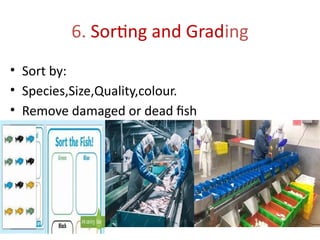
6. Sorting andGrading
• Sort by:
• Species,Size,Quality,colour.
• Remove damaged or dead fish
14.
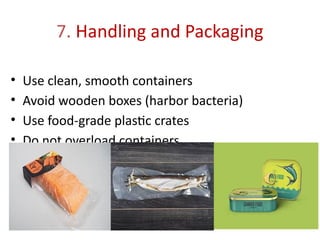
7. Handling andPackaging
• Use clean, smooth containers
• Avoid wooden boxes (harbor bacteria)
• Use food-grade plastic crates
• Do not overload containers
15.
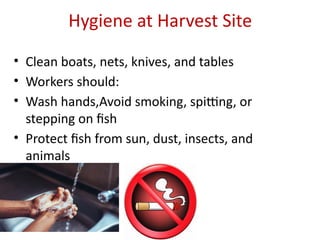
Hygiene at HarvestSite
• Clean boats, nets, knives, and tables
• Workers should:
• Wash hands,Avoid smoking, spitting, or
stepping on fish
• Protect fish from sun, dust, insects, and
animals
16.
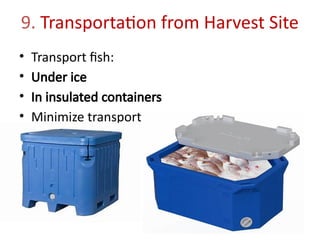
9. Transportation fromHarvest Site
• Transport fish:
• Under ice
• In insulated containers
• Minimize transport time
17.
Common Mistakes atHarvest Site
• ❌ Delayed icing
• ❌ Throwing fish on sand or soil
• ❌ Using dirty water for washing
• ❌ Exposing fish to direct sunlight
• ❌ Overstacking fish
18.
On-site Handling
• Washfish with clean water.
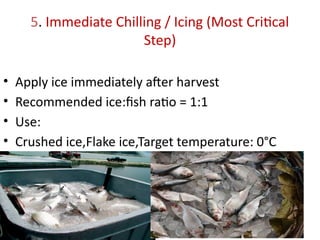
• Ice fish at 1:1 ratio (ice: fish).
• Sort, grade, and store under cold conditions.
• Transport in insulated containers.
19.
Fish Processing
• Mechanical,physical, chemical or biological
operations aiming at transformation, preserving
or enhancing market values.
• or Fish processing refers to all operations
carried out after harvest to preserve fish,
improve shelf life, ensure safety, and add value.
• Includes chilling, freezing, salting, drying,
smoking, value addition.
• it extends shelf life and increases market value.
20.
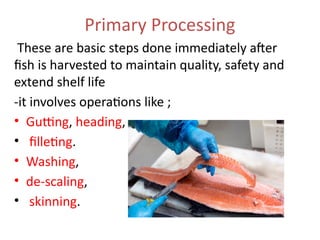
Primary Processing
These arebasic steps done immediately after
fish is harvested to maintain quality, safety and
extend shelf life
-it involves operations like ;
• Gutting, heading,
• filleting.
• Washing,
• de-scaling,
• skinning.
21.
Major Steps inFish Processing
• 1. Reception and Inspection
• Check freshness (odor, eyes, gills, firmness)
• Reject spoiled or damaged fish
• 2. Washing and Cleaning
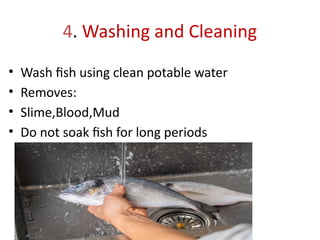
• Wash with clean potable water
• Remove slime, blood, mud
• Avoid excessive washingMaintain cold chain
22.
Sorting and Grading
•3. Sorting and Grading
• By species
• By size and weight
• By quality
• 4. Dressing
• Includes:
• Scaling
• Heading
• Gutting (evisceration
• Filleting
23.
Secondary processing andPreservation
Methods
• Involves transforming primary- processed fish into
value-added products.
• It involes;
• Chilling and freezing.
• Smoking (hot/cold).
• Drying (sun/oven/
• mechanical).
• Salting (dry, brine, pickling).
• Fermentation, canning, irradiation.
24.
Fish Preservation /Processing Methods
• A. Chilling and Icing
• Storage at 0°C
• Short-term preservation
• Slows microbial growth
25.
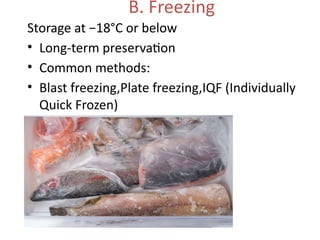
B. Freezing
Storage at−18°C or below
• Long-term preservation
• Common methods:
• Blast freezing,Plate freezing,IQF (Individually
Quick Frozen)
26.
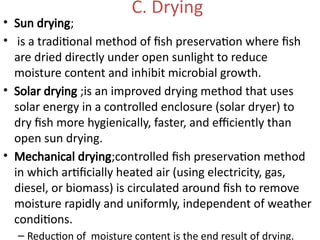
C. Drying
• Sundrying;
• is a traditional method of fish preservation where fish
are dried directly under open sunlight to reduce
moisture content and inhibit microbial growth.
• Solar drying ;is an improved drying method that uses
solar energy in a controlled enclosure (solar dryer) to
dry fish more hygienically, faster, and efficiently than
open sun drying.
• Mechanical drying;controlled fish preservation method
in which artificially heated air (using electricity, gas,
diesel, or biomass) is circulated around fish to remove
moisture rapidly and uniformly, independent of weather
conditions.
– Reduction of moisture content is the end result of drying.
27.
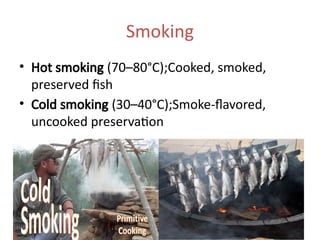
Smoking
• Hot smoking(70–80°C);Cooked, smoked,
preserved fish
• Cold smoking (30–40°C);Smoke-flavored,
uncooked preservation
• aim;
• Adds flavor and preservative effect
28.
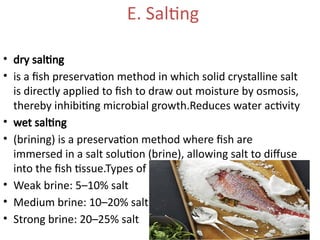
E. Salting
• drysalting
• is a fish preservation method in which solid crystalline salt
is directly applied to fish to draw out moisture by osmosis,
thereby inhibiting microbial growth.Reduces water activity
• wet salting
• (brining) is a preservation method where fish are
immersed in a salt solution (brine), allowing salt to diffuse
into the fish tissue.Types of Brining
• Weak brine: 5–10% salt
• Medium brine: 10–20% salt
• Strong brine: 20–25% salt
29.
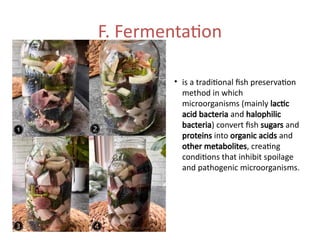
F. Fermentation
• isa traditional fish preservation
method in which
microorganisms (mainly lactic
acid bacteria and halophilic
bacteria) convert fish sugars and
proteins into organic acids and
other metabolites, creating
conditions that inhibit spoilage
and pathogenic microorganisms.
30.
MICROORGANISMS INVOLVED IN
FERMENTATION
•Microorganisms Involved Lactobacillus spp,Pediococcus
spp,Leuconost spp,Halophilic bacteria,Yeasts (in some products)
• General Procedure
• Fresh fish are washed and dressed
• Fish are mixed with salt (5–25%)
• Fish are packed tightly in containers
• Kept under anaerobic or semi-anaerobic conditions
• Fermentation allowed for weeks to months
• Final product develops characteristic flavor and aroma
31.
G. Canning
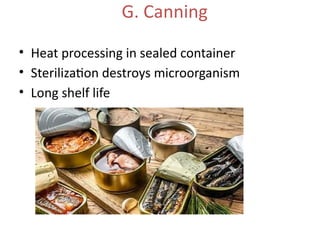
• Heatprocessing in sealed container
• Sterilization destroys microorganism
• Long shelf life
32.
H. Pickling
•
is afish preservation method in which fish are preserved
by acidification, usually using vinegar (acetic acid), often in
combination with salt, sugar, spices, and sometimes oil, to
inhibit microbial growth.
• Principle of Fish Pickling
• Preservation is achieved by:
• Lowering pH (≤4.5) → inhibits spoilage and pathogenic
bacteria
• Salt addition → reduces water activity
• Spices → provide antimicrobial and flavoring effects
33.
Common Processing Defects
•rancidity;refers to the decomposition or spoilage of fish fats (lipids),
leading to unpleasant odors, flavors, and reduced quality. It is one
of the main reasons fish becomes unacceptable for consumption
even before microbial spoilage becomes severe. There are two
main types of rancidity in fish: hydrolytic and oxidative
• texture softening;refers to the loss of firmness or structural
integrity of fish muscle, which makes the flesh soft, mushy, and less
appealing. It is a major quality deterioration that affects shelf life,
often linked to both post-mortem changes and microbial activity.
• Off-odors;
• Insect infestation
FISH PROCESSING EQUIPMENTS
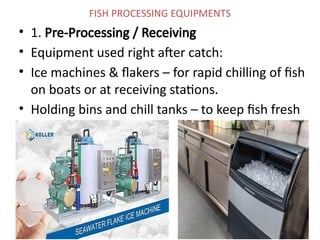
•1. Pre-Processing / Receiving
• Equipment used right after catch:
• Ice machines & flakers – for rapid chilling of fish
on boats or at receiving stations.
• Holding bins and chill tanks – to keep fish fresh
before processing.
36.
EQUIPMENTS CONT.........
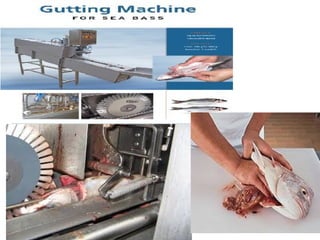
• Cleaning& Gutting
• Removes scales, entrails, and preps the fish:
• Descalers – roll or blade systems that remove
scales fast.
• Fish gutting machines – automatically remove
internal organs.
• Washing systems – high-pressure water sprays
and conveyors for cleaning
38.
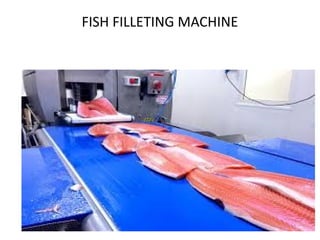
Filleting & Cutting
•For boneless portions and uniform cuts:
• Mechanical filleting machines – produce fillets
with minimal labor.
• Butterfly cutting machines – open fish like a
book for specific products.
• Portion cutters/slicers – cut fillets into
consumer sizes.
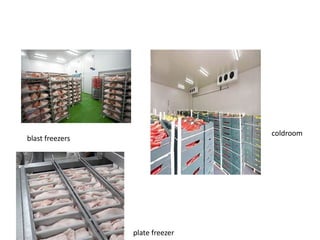
Chilling & Freezing
•Preserves quality and safety:
• Blast freezers – rapid freezing to −18 °C or
lower.
• Plate freezers – fish pressed between cold
plates.
• Cold storage rooms – large freezers for bulk
product storage
7. Packing &Packaging
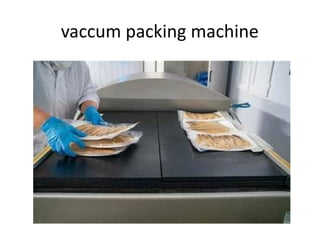
• Preparing for sale and distribution:
• Vacuum pack machines – extend shelf life
• Skin-pack machines – attractive retail packaging.
• Tray sealers – lock fish in trays with protective
film.
• Weighing and labeling systems – for accurate
portioning and traceability.
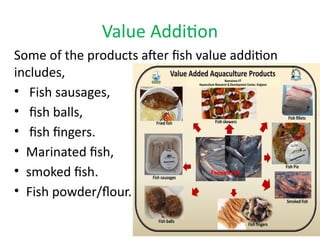
Value Addition
Some ofthe products after fish value addition
includes,
• Fish sausages,
• fish balls,
• fish fingers.
• Marinated fish,
• smoked fish.
• Fish powder/flour.
45.
Factors Affecting Handling
•Temperature,
• hygiene,
• time to icing.
• Species (fatty fish spoil faster).
• Physical damage during harvest.
46.
Importance of properhandling and
processing
• Reduces losses
• improves food security.
• Improves quality and safety.
• Increases market value and income.


![Fish Preservation Techniques[2].pptx](https://cdn.slidesharecdn.com/ss_thumbnails/fishpreservationtechniques2-230819113244-8a367f8e-thumbnail.jpg?width=640&height=640&fit=bounds)


