
Reported by: Calderon, Ma. Angelica C.
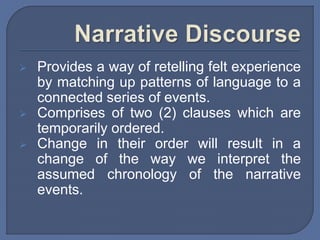
 Provides a way of retelling felt experience
by matching up patterns of language to a
connected series of events.
 Comprises of two (2) clauses which are
temporarily ordered.
 Change in their order will result in a
change of the way we interpret the
assumed chronology of the narrative
events.
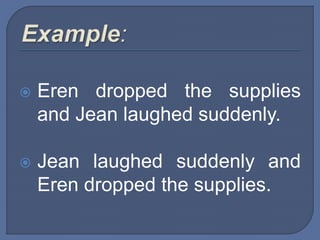
 Eren dropped the supplies
and Jean laughed suddenly.
 Jean laughed suddenly and
Eren dropped the supplies.
Has argued that narratives require certain
essential elements of structure which when
absent, render the narrative ‘ill-formed’.
Example:
“Well this person had a little too much to
drink and he attacked me and the friend
came in and she stopped it.”
Narrative structure is only
one side of a coin of which
narrative comprehension is
the other.
 The abstract storyline of
a narrative.
 Creates the ‘inner core’
of the narrative.
 Manner or means that the plot
is narrated.
 The use of stylistic devices
such as: flashback, prevision
and repetition – all of which
disrupt the basic chronology of
the narrative’s plot.
Although there are substantial
areas of overlap between these
units, they nonetheless offer a
useful set of reference points for
pinpointing the specific aspects of
narrative which can inform a
stylistic analysis.
 Physical channel of
communication through which a
story is narrated.
Examples:
Film, novel, ballet, musical, strip
cartoon
 Spoken Verbal Interaction
Medium
 Expresses through language
the historical, cultural and
linguistic setting which
frames a narrative.
 Encompasses the varieties of
accent and dialect used in a
narrative.
 Describes how the
development of character
precipitates and intersects
with the actions and events of
a story.
 Explores the relationship between
‘mode of narration’ and a
character’s or narrator’s ‘point of
view’.
 Mode of narration – specifies whether the
narrative is relayed in the first person, the
third person or even the second person.
 Point of view – stipulates whether the
events of story are viewed from the
perspective of a particular character or
from that of an omniscient narrator, or
indeed from some mixture of the two.
 The way individual narrative
units are arranged and
organized in a story.
 The sixth narrative component, is
reserved for the technique of
‘allusion’.
 The complex interrelationship
between a text and other texts
‘taken as base’ to the creation or
interpretation of the text.
 Narrative fiction, like all writing, does not
exist in a social and historical vacuum, and
it often echoes other texts and images
either as ‘implicit’ intertextuality or as
‘manifest’ intertextuality.
 Implicit – capable of being understood
from something else though unexpressed.
 Manifest – clearly shown or visible.
 In a certain respect, the concept of
intertextuality overlaps with the notion
of sociolinguistic code in its
application to narrative.
 The sociolinguistic code involves the
importing of other external texts.
 The intertextuality refers more
generally to the variety or varieties of
language in and through which a
narrative is developed.
Narrative Stylistics

Narrative Stylistics

  • 1.
    Reported by: Calderon,Ma. Angelica C.
  • 2.
     Provides away of retelling felt experience by matching up patterns of language to a connected series of events.  Comprises of two (2) clauses which are temporarily ordered.  Change in their order will result in a change of the way we interpret the assumed chronology of the narrative events.
  • 3.
     Eren droppedthe supplies and Jean laughed suddenly.  Jean laughed suddenly and Eren dropped the supplies.
  • 4.
    Has argued thatnarratives require certain essential elements of structure which when absent, render the narrative ‘ill-formed’. Example: “Well this person had a little too much to drink and he attacked me and the friend came in and she stopped it.”
  • 5.
    Narrative structure isonly one side of a coin of which narrative comprehension is the other.
  • 6.
     The abstractstoryline of a narrative.  Creates the ‘inner core’ of the narrative.
  • 7.
     Manner ormeans that the plot is narrated.  The use of stylistic devices such as: flashback, prevision and repetition – all of which disrupt the basic chronology of the narrative’s plot.
  • 9.
    Although there aresubstantial areas of overlap between these units, they nonetheless offer a useful set of reference points for pinpointing the specific aspects of narrative which can inform a stylistic analysis.
  • 10.
     Physical channelof communication through which a story is narrated. Examples: Film, novel, ballet, musical, strip cartoon  Spoken Verbal Interaction Medium
  • 11.
     Expresses throughlanguage the historical, cultural and linguistic setting which frames a narrative.  Encompasses the varieties of accent and dialect used in a narrative.
  • 12.
     Describes howthe development of character precipitates and intersects with the actions and events of a story.
  • 13.
     Explores therelationship between ‘mode of narration’ and a character’s or narrator’s ‘point of view’.
  • 14.
     Mode ofnarration – specifies whether the narrative is relayed in the first person, the third person or even the second person.  Point of view – stipulates whether the events of story are viewed from the perspective of a particular character or from that of an omniscient narrator, or indeed from some mixture of the two.
  • 15.
     The wayindividual narrative units are arranged and organized in a story.
  • 16.
     The sixthnarrative component, is reserved for the technique of ‘allusion’.  The complex interrelationship between a text and other texts ‘taken as base’ to the creation or interpretation of the text.
  • 17.
     Narrative fiction,like all writing, does not exist in a social and historical vacuum, and it often echoes other texts and images either as ‘implicit’ intertextuality or as ‘manifest’ intertextuality.  Implicit – capable of being understood from something else though unexpressed.  Manifest – clearly shown or visible.
  • 18.
     In acertain respect, the concept of intertextuality overlaps with the notion of sociolinguistic code in its application to narrative.  The sociolinguistic code involves the importing of other external texts.  The intertextuality refers more generally to the variety or varieties of language in and through which a narrative is developed.