What is Semantics?
•
•
Semantics is the area of linguistics that
analyzes the meaning of words, phrases
and sentences in language.
Summarizing: We are going to study the
study of meaning
Warm-up
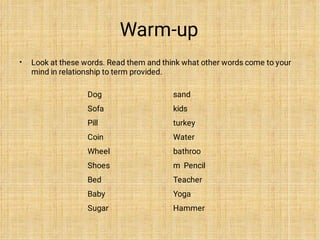
• Look at these words. Read them and think what other words come to your
mind in relationship to term provided.
Dog
Sofa
Pill
Coin
Wheel
Shoes
Bed
Baby
Sugar
sand
kids
turkey
Water
bathroo
m Pencil
Teacher
Yoga
Hammer
Meaning
•
•
All the words mentioned before and the
concepts that we linked to them have a
meaning
Meaning: Conceptual & Associative
Conceptual and
Associative
Meaning
•
–
•
•
–
•
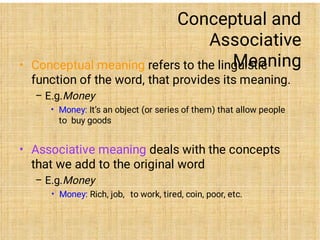
Conceptual meaning refers to the linguistic
function of the word, that provides its meaning.
E.g.Money
Money: It’s an object (or series of them) that allow people
to buy goods
Associative meaning deals with the concepts
that we add to the original word
E.g.Money
Money: Rich, job, to work, tired, coin, poor, etc.
Analyze:
•
•
•
•
•
•
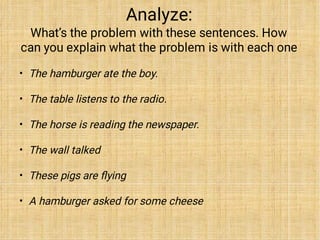
What’s the problem with these sentences. How
can you explain what the problem is with each one
The hamburger ate the boy.
The table listens to the radio.
The horse is reading the newspaper.
The wall talked
These pigs are flying
A hamburger asked for some cheese
Semantic Features
•
•
•
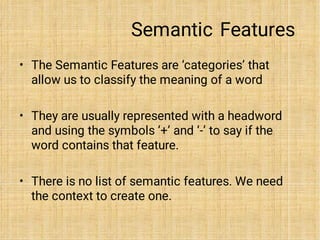
The Semantic Features are ‘categories’ that
allow us to classify the meaning of a word
They are usually represented with a headword
and using the symbols ‘+’ and ‘-’ to say if the
word contains that feature.
There is no list of semantic features. We need
the context to create one.
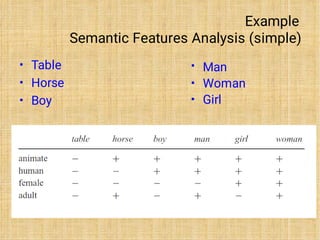
Example
Semantic Features Analysis (simple)
•
•
•
Table
Horse
Boy
•
•
•
Man
Woman
Girl
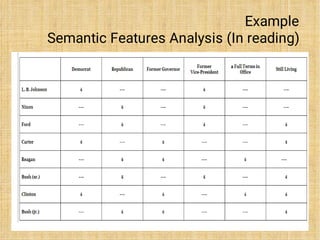
Example
Semantic Features Analysis (In reading)
Semantic Roles
•
•
–
–
–
–
–
–
–
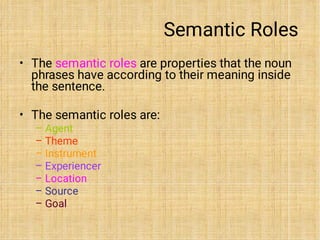
The semantic roles are properties that the noun
phrases have according to their meaning inside
the sentence.
The semantic roles are:
Agent
Theme
Instrument
Experiencer
Location
Source
Goal
Agent & Theme
•
•
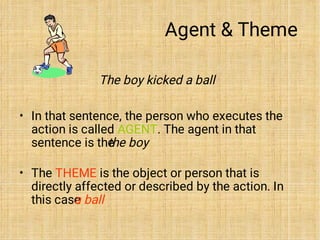
The boy kicked a ball
In that sentence, the person who executes the
action is called AGENT. The agent in that
sentence is the
the boy
The THEME is the object or person that is
directly affected or described by the action. In
this case
a ball
Instrument & Experiencer
•
•
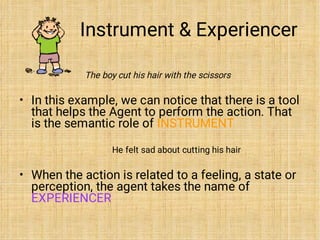
The boy cut his hair with the scissors
In this example, we can notice that there is a tool
that helps the Agent to perform the action. That
is the semantic role of INSTRUMENT
He felt sad about cutting his hair
When the action is related to a feeling, a state or
perception, the agent takes the name of
EXPERIENCER
Location, Source and Goal
•
•
•
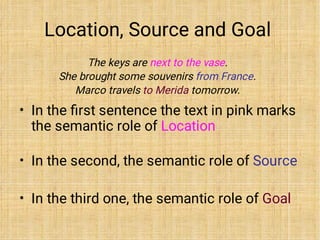
The keys are next to the vase.
She brought some souvenirs from France.
Marco travels to Merida tomorrow.
In the first sentence the text in pink marks
the semantic role of Location
In the second, the semantic role of Source
In the third one, the semantic role of Goal
Lexical Relations
• Not just the semantic roles provide a meaning to the words,
phrases or sentences. Sometimes meaning comes from the
semantic relationships that are built.
•
•
•
•
•
•
•
•
•
Synonymy Antonymy
Hyponymy Prototypes
Homophones and Homonyms
Polysemy
Word-play Metonymy
Collocations
Synonymy
• Two or more words with very closely related meanings are called
synonyms.
•
–
–
–
–
–
–
–
–
They can often, though not always, be substituted for each other in
sentences.
almost/nearly
big/large
broad/wide
buy/purchase ,
cab/taxi
car/automobile
couch/sofa
freedom/liberty
• It is important to consider that the idea of ‘sameness’ of meaning used in
discussing synonymy is not necessarily ‘total sameness’
Antonym
y
• Two forms with opposite meanings are called antonyms.
–
–
–
–
alive/dead
big/small
fast/slow
happy/sad ,
• There are two types of antonyms: Gradable and Non-gradable
• Gradable antonyms refer to contrary adjectives (Big, small) , while
Non-gradable antonyms refer to those words that don’t allow
comparison; however, they have a complementary word (alive/
dead)
Hyponymy
•
•
•
•
•
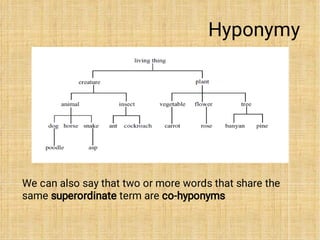
When the meaning of one form is
included in the meaning of another, the
relationship is described as hyponymy.
animal/dog
dog/poodle
vegetable/carrot
flower/rose
Hyponymy
We can also say that two or more words that share the
same superordinate term are co-hyponyms
Prototyp
e
•
•
•
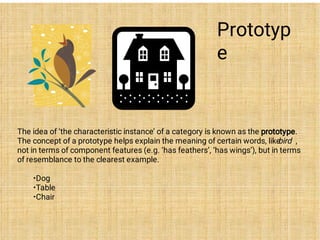
The idea of ‘the characteristic instance’ of a category is known as the prototype.
The concept of a prototype helps explain the meaning of certain words, like
bird ,
not in terms of component features (e.g. ‘has feathers’, ‘has wings’), but in terms
of resemblance to the clearest example.
Dog
Table
Chair
Homophones and
Homonyms
•
–
–
–
–
–
–
When two or more different (written)
forms have the same pronunciation, they
are described as homophones.
bare/bear
meat/meet
flour/flower
pail/pale
right/write
to/too/two .
Homophones and
Homonyms
•
–
–
–
–
–
We use the term homonyms when one form
(written or spoken) has two or more unrelated
meanings, as in these examples:
bank (of a river) –bank (financial institution)
bat (flying creature) –bat (used in sports)
mole (on skin) –mole (small animal)
pupil (at school) –pupil (in the eye)
race (contest of speed) –race (ethnic group)
Polysemy
•
–
–
–
–
Polysemy can be defined as one form
(written or spoken) having multiple
meanings that are all related by extension
Run
Foot
Head
Date
Word Play
• These last three lexical relations are the basis of a lot
of word play, usually for humorous effect.
•
•
•
–
–
Why is 6 afraid of 7? Because 7-8-9 Question:
If the plural of Hippopotamus is hippopotami, What is the
plural of whatafoolamus?
Answer:
Whatafoolami (what a fool am I)
http://www.youtube.com/watch?
v=m1TnzCiUSI0&feature=related
Metonym
y
•
–
–
–
It is a relationship between two words,
that is based on daily life experience.
Pen is mightier than sword.
"Pen” stands for “the written word”
“Sword” stands for “military aggression”
Metonyms are members of the figurative
language family, so they serve as colorful ways to
take the ordinary and dress it up in something
poetic or beautiful.
Collocation
A familiar grouping of words which
appears together because of their
habitual use and thus creating the
same meaning is called collocation.
Suppose, when we say heavy rain
instead of big or strong rain, it conveys
the meaning that it is raining heavily.
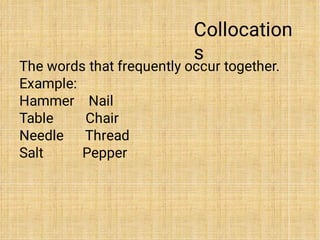
Collocation
s
The words that frequently occur together.
Example:
Hammer Nail
Table Chair
Needle Thread
Salt Pepper

Semantics

  • 1.
    What is Semantics? • • Semanticsis the area of linguistics that analyzes the meaning of words, phrases and sentences in language. Summarizing: We are going to study the study of meaning
  • 2.
    Warm-up • Look atthese words. Read them and think what other words come to your mind in relationship to term provided. Dog Sofa Pill Coin Wheel Shoes Bed Baby Sugar sand kids turkey Water bathroo m Pencil Teacher Yoga Hammer
  • 3.
    Meaning • • All the wordsmentioned before and the concepts that we linked to them have a meaning Meaning: Conceptual & Associative
  • 4.
    Conceptual and Associative Meaning • – • • – • Conceptual meaningrefers to the linguistic function of the word, that provides its meaning. E.g.Money Money: It’s an object (or series of them) that allow people to buy goods Associative meaning deals with the concepts that we add to the original word E.g.Money Money: Rich, job, to work, tired, coin, poor, etc.
  • 5.
    Analyze: • • • • • • What’s the problemwith these sentences. How can you explain what the problem is with each one The hamburger ate the boy. The table listens to the radio. The horse is reading the newspaper. The wall talked These pigs are flying A hamburger asked for some cheese
  • 6.
    Semantic Features • • • The SemanticFeatures are ‘categories’ that allow us to classify the meaning of a word They are usually represented with a headword and using the symbols ‘+’ and ‘-’ to say if the word contains that feature. There is no list of semantic features. We need the context to create one.
  • 7.
    Example Semantic Features Analysis(simple) • • • Table Horse Boy • • • Man Woman Girl
  • 8.
  • 9.
    Semantic Roles • • – – – – – – – The semanticroles are properties that the noun phrases have according to their meaning inside the sentence. The semantic roles are: Agent Theme Instrument Experiencer Location Source Goal
  • 10.
    Agent & Theme • • Theboy kicked a ball In that sentence, the person who executes the action is called AGENT. The agent in that sentence is the the boy The THEME is the object or person that is directly affected or described by the action. In this case a ball
  • 11.
    Instrument & Experiencer • • Theboy cut his hair with the scissors In this example, we can notice that there is a tool that helps the Agent to perform the action. That is the semantic role of INSTRUMENT He felt sad about cutting his hair When the action is related to a feeling, a state or perception, the agent takes the name of EXPERIENCER
  • 12.
    Location, Source andGoal • • • The keys are next to the vase. She brought some souvenirs from France. Marco travels to Merida tomorrow. In the first sentence the text in pink marks the semantic role of Location In the second, the semantic role of Source In the third one, the semantic role of Goal
  • 13.
    Lexical Relations • Notjust the semantic roles provide a meaning to the words, phrases or sentences. Sometimes meaning comes from the semantic relationships that are built. • • • • • • • • • Synonymy Antonymy Hyponymy Prototypes Homophones and Homonyms Polysemy Word-play Metonymy Collocations
  • 14.
    Synonymy • Two ormore words with very closely related meanings are called synonyms. • – – – – – – – – They can often, though not always, be substituted for each other in sentences. almost/nearly big/large broad/wide buy/purchase , cab/taxi car/automobile couch/sofa freedom/liberty • It is important to consider that the idea of ‘sameness’ of meaning used in discussing synonymy is not necessarily ‘total sameness’
  • 15.
    Antonym y • Two formswith opposite meanings are called antonyms. – – – – alive/dead big/small fast/slow happy/sad , • There are two types of antonyms: Gradable and Non-gradable • Gradable antonyms refer to contrary adjectives (Big, small) , while Non-gradable antonyms refer to those words that don’t allow comparison; however, they have a complementary word (alive/ dead)
  • 16.
    Hyponymy • • • • • When the meaningof one form is included in the meaning of another, the relationship is described as hyponymy. animal/dog dog/poodle vegetable/carrot flower/rose
  • 17.
    Hyponymy We can alsosay that two or more words that share the same superordinate term are co-hyponyms
  • 18.
    Prototyp e • • • The idea of‘the characteristic instance’ of a category is known as the prototype. The concept of a prototype helps explain the meaning of certain words, like bird , not in terms of component features (e.g. ‘has feathers’, ‘has wings’), but in terms of resemblance to the clearest example. Dog Table Chair
  • 19.
    Homophones and Homonyms • – – – – – – When twoor more different (written) forms have the same pronunciation, they are described as homophones. bare/bear meat/meet flour/flower pail/pale right/write to/too/two .
  • 20.
    Homophones and Homonyms • – – – – – We usethe term homonyms when one form (written or spoken) has two or more unrelated meanings, as in these examples: bank (of a river) –bank (financial institution) bat (flying creature) –bat (used in sports) mole (on skin) –mole (small animal) pupil (at school) –pupil (in the eye) race (contest of speed) –race (ethnic group)
  • 21.
    Polysemy • – – – – Polysemy can bedefined as one form (written or spoken) having multiple meanings that are all related by extension Run Foot Head Date
  • 22.
    Word Play • Theselast three lexical relations are the basis of a lot of word play, usually for humorous effect. • • • – – Why is 6 afraid of 7? Because 7-8-9 Question: If the plural of Hippopotamus is hippopotami, What is the plural of whatafoolamus? Answer: Whatafoolami (what a fool am I) http://www.youtube.com/watch? v=m1TnzCiUSI0&feature=related
  • 23.
    Metonym y • – – – It is arelationship between two words, that is based on daily life experience. Pen is mightier than sword. "Pen” stands for “the written word” “Sword” stands for “military aggression” Metonyms are members of the figurative language family, so they serve as colorful ways to take the ordinary and dress it up in something poetic or beautiful.
  • 24.
    Collocation A familiar groupingof words which appears together because of their habitual use and thus creating the same meaning is called collocation. Suppose, when we say heavy rain instead of big or strong rain, it conveys the meaning that it is raining heavily.
  • 25.
    Collocation s The words thatfrequently occur together. Example: Hammer Nail Table Chair Needle Thread Salt Pepper