Topic:
Semantics
 Semantics is the study of meanings of
words, phrases and sentences.
 In semantic analysis there is always an
attempt to focus on what the words
conventionally mean, rather than on what
a speaker might want the words on a
particular occasion.
 Conceptual meaning covers those basic
essential components of meaning which
are conveyed by the literal use of a word.
 For Example : Some of the basic
components of a word like needle in
English might include “ thin sharp steel
instrument”.
 In associative meaning you may have
‘associations’ or ‘connotations’ attached
to a word,
 For example : like needle which lead you
to think of ‘painful’ whenever you
encounter the said word.
 This ‘association’ is not treated as a
conceptual meaning of needle.
 How does semantic approach help us to
understand the nature of language?
 It might be helpful as a means of accounting for
the ‘oddness’ which we experience when we
read English sentences such as the follows:
 For example: 1- The hamburger ate the man. 2-
My cat studied linguistics. 3- A table was
listening to some music.
 Above sentences are syntactically right but
semantically odd.
Words are not just a “containers” of meanings
. They fulfill different “roles” within the
situation described by a sentence.
Eexample: If the situation is a simple event
such as
The boy kicked the ball
The verb ‘kicked’ describes an action.
The noun phrases ‘The boy’ and ‘the ball’
describe the roles of entities such as people
and things involved in the action.
 The entity that performs the action is
technically known as “agent”.
 For example:
The boy kicked the ball.
 As in the sentence one role is taken by the
boy and the boy performs the action, so it is
agent.
 Although agents are typically human, they
can also be non-human forces, machines or
creatures.
 For example: The wind blew the ball away.
The car ran over the ball.
The dog caught the ball.
 The entity that is involved in or affected by the
action is technically known as “theme”.
 For example:The boy kicked the ball.
 In this sentence “ball” is the theme because it is
affected by the action performed by the ‘agent’.
 The theme can also be an entity that is simply being
described, for example,The ball was red.
 The theme can also be human. Indeed the same
physical entity can appear in two semantic roles.
 For example: The boy kicked himself. Here boy is
agent and himself is theme.
 If an agent uses another entity in performing
an action, that other entity fills the role of
instrument.
 For example:
She hit the bug with the magazine.
 In “writing with a pen” or “eating with a
spoon” the phrases “a pen” and “a spoon”
have the semantic role of instrument.
 When an entity is in the description of the
event then it fills the role of Location. (on the
table, in the room etc).
 For example:
Mary saw a mosquito on the wall.
In this sentence “on the wall” is location.
 Where an entity moves from is the Source
and where it moves to is the Goal.
 For example: When we talk about transferring
money from ‘savings’ to ‘checking’, the source
is “savings” and goal is “checking”.
 Two forms with opposite meanings are called
antonyms.
 For example: quick=slow, big=small, long=short,
rich=poor, happy=sad, hot=cold, old=young,
male=female, true=false
 When the meaning of one form is included in
the meaning of another, the relationship is
described as hyponym. For example: Daffodil=
Flower, dog= animal, poodle= dog, carrot=
vegetable, banyan= tree.
 For example: If any object is a daffodil, then it is
necessary a flower, so the meaning of flower is
included in the meaning of daffodil. Daffodil is
hyponym of a flower.
 When two or more different written forms
have the same pronunciation, they are
described as “Homophones”.
For example: Bare – Bear,
Meat – Meet,
Flour – Flower
Sew – So.
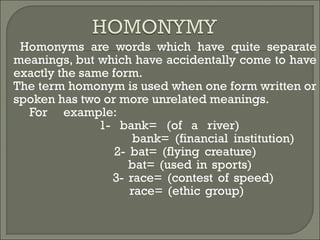
 Homonyms are words which have quite separate
meanings, but which have accidentally come to have
exactly the same form.
 The term homonym is used when one form written or
spoken has two or more unrelated meanings.
 For example:
1- bank= (of a river)
bank= (financial institution)
2- bat= (flying creature)
bat= (used in sports)
3- race= (contest of speed)
race= (ethic group)
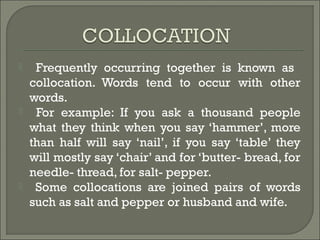
 Frequently occurring together is known as
collocation. Words tend to occur with other
words.
 For example: If you ask a thousand people
what they think when you say ‘hammer’, more
than half will say ‘nail’, if you say ‘table’ they
will mostly say ‘chair’ and for ‘butter- bread, for
needle- thread, for salt- pepper.
 Some collocations are joined pairs of words
such as salt and pepper or husband and wife.
Any
Question??
Semantics

Semantics

  • 1.
  • 2.
     Semantics isthe study of meanings of words, phrases and sentences.  In semantic analysis there is always an attempt to focus on what the words conventionally mean, rather than on what a speaker might want the words on a particular occasion.
  • 3.
     Conceptual meaningcovers those basic essential components of meaning which are conveyed by the literal use of a word.  For Example : Some of the basic components of a word like needle in English might include “ thin sharp steel instrument”.
  • 4.
     In associativemeaning you may have ‘associations’ or ‘connotations’ attached to a word,  For example : like needle which lead you to think of ‘painful’ whenever you encounter the said word.  This ‘association’ is not treated as a conceptual meaning of needle.
  • 5.
     How doessemantic approach help us to understand the nature of language?  It might be helpful as a means of accounting for the ‘oddness’ which we experience when we read English sentences such as the follows:  For example: 1- The hamburger ate the man. 2- My cat studied linguistics. 3- A table was listening to some music.  Above sentences are syntactically right but semantically odd.
  • 6.
    Words are notjust a “containers” of meanings . They fulfill different “roles” within the situation described by a sentence. Eexample: If the situation is a simple event such as The boy kicked the ball The verb ‘kicked’ describes an action. The noun phrases ‘The boy’ and ‘the ball’ describe the roles of entities such as people and things involved in the action.
  • 7.
     The entitythat performs the action is technically known as “agent”.  For example: The boy kicked the ball.  As in the sentence one role is taken by the boy and the boy performs the action, so it is agent.  Although agents are typically human, they can also be non-human forces, machines or creatures.  For example: The wind blew the ball away. The car ran over the ball. The dog caught the ball.
  • 8.
     The entitythat is involved in or affected by the action is technically known as “theme”.  For example:The boy kicked the ball.  In this sentence “ball” is the theme because it is affected by the action performed by the ‘agent’.  The theme can also be an entity that is simply being described, for example,The ball was red.  The theme can also be human. Indeed the same physical entity can appear in two semantic roles.  For example: The boy kicked himself. Here boy is agent and himself is theme.
  • 9.
     If anagent uses another entity in performing an action, that other entity fills the role of instrument.  For example: She hit the bug with the magazine.  In “writing with a pen” or “eating with a spoon” the phrases “a pen” and “a spoon” have the semantic role of instrument.
  • 10.
     When anentity is in the description of the event then it fills the role of Location. (on the table, in the room etc).  For example: Mary saw a mosquito on the wall. In this sentence “on the wall” is location.
  • 11.
     Where anentity moves from is the Source and where it moves to is the Goal.  For example: When we talk about transferring money from ‘savings’ to ‘checking’, the source is “savings” and goal is “checking”.
  • 12.
     Two formswith opposite meanings are called antonyms.  For example: quick=slow, big=small, long=short, rich=poor, happy=sad, hot=cold, old=young, male=female, true=false
  • 13.
     When themeaning of one form is included in the meaning of another, the relationship is described as hyponym. For example: Daffodil= Flower, dog= animal, poodle= dog, carrot= vegetable, banyan= tree.  For example: If any object is a daffodil, then it is necessary a flower, so the meaning of flower is included in the meaning of daffodil. Daffodil is hyponym of a flower.
  • 14.
     When twoor more different written forms have the same pronunciation, they are described as “Homophones”. For example: Bare – Bear, Meat – Meet, Flour – Flower Sew – So.
  • 15.
     Homonyms arewords which have quite separate meanings, but which have accidentally come to have exactly the same form.  The term homonym is used when one form written or spoken has two or more unrelated meanings.  For example: 1- bank= (of a river) bank= (financial institution) 2- bat= (flying creature) bat= (used in sports) 3- race= (contest of speed) race= (ethic group)
  • 16.
     Frequently occurringtogether is known as collocation. Words tend to occur with other words.  For example: If you ask a thousand people what they think when you say ‘hammer’, more than half will say ‘nail’, if you say ‘table’ they will mostly say ‘chair’ and for ‘butter- bread, for needle- thread, for salt- pepper.  Some collocations are joined pairs of words such as salt and pepper or husband and wife.
  • 17.