Semantic Sensor Service Networks


  Wei Wang, Payam Barnaghi, Gilbert Cassar, Frieder Ganz, Pirabakaran
                            Navaratnam
              Centre for Communication Systems Research
                          University of Surrey
                           Guildford, Surrey
                            United Kingdom


                                                                        1
Sensors, Sensor Networks and Internet of
“Things”
   Physical world objects
       e.g. A room, a car, A person;
   Feature of Interest
       e.g. Temperature of the room, Location of the car,
        heart-rate of the person;
   Sensors
       e.g. Temperature sensor, GPS, pulse sensor
   Embedded devices


                                                             2
Semantics and Sensor Networks


Image credits:
[1] Protocols and Architectures for Wireless Sensor Networks, Holger Karl, Andreas Willig, Wiley, 2005   3
[2] Cisco - Interne of Things
Distributed WSN


                  4
The Internet of Things
   A primary goal of interconnecting devices and
    collecting/processing data from them is to create
    situation awareness and enable applications,
    machines, and human users to better understand their
    surrounding environments.
   The understanding of a situation, or context,
    potentially enables services and applications to make
    intelligent decisions and to respond to the dynamics of
    their environments.
   A key enabler is providing Services that represent
    sensors/resources and integrating them into the
    cyber-space.
                                                              5
Semantics, sensors and services
   Semantics are machine-interpretable metadata (for mark-up),
    logical inference mechanisms, query mechanism, linked data
    solutions
   For semantic sensor services this means:
     ontologies for: devices (e.g. sensors), observation and
      measurement data (e.g. sensor readings), domain concepts (e.g.
      unit of measurement, location), service descriptions (e.g. IoT
      services) and other data sources (e.g. those available on linked
      open data)
   Semantic annotation should also supports data represented
    using existing forms
   Reasoning /processing to infer relationships or hierarchies
    between different resources, data
   Semantics (/ontologies) as meta-data (to describe the
    services/resources) / knowledge bases (domain knowledge).
                                                                         6
A layered model


                  7
Existing models for resources and data
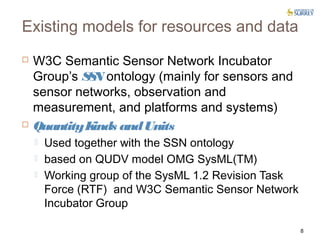
   W3C Semantic Sensor Network Incubator
    Group’s S N ontology (mainly for sensors and
             S
    sensor networks, observation and
    measurement, and platforms and systems)
   Quantity Kinds and Units
       Used together with the SSN ontology
       based on QUDV model OMG SysML(TM)
       Working group of the SysML 1.2 Revision Task
        Force (RTF) and W3C Semantic Sensor Network
        Incubator Group

                                                       8
SSN Ontology Modules


                       9
Existing models for services
   OWL-S and WSMO are heavy weight models: practical
    use?
   Minimal service model
       Deprecated
       Procedure-Oriented Service Model (POSM) and Resource-
        Oriented Service Model (ROSM): two different models for
        different service technologies
       Defines Operations and Messages
       No profile, no grounding
   SAWSDL: mixture of XML, XML schema, RDF and OWL
   hRESTS and SA-REST: mixture of HTML and reference
    to a semantic model; sensor services are not anticipated
    to have HTML
                                                                  10
Semantic modelling
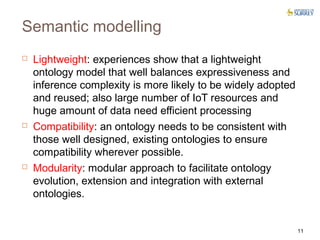
   Lightweight: experiences show that a lightweight
    ontology model that well balances expressiveness and
    inference complexity is more likely to be widely adopted
    and reused; also large number of IoT resources and
    huge amount of data need efficient processing
   Compatibility: an ontology needs to be consistent with
    those well designed, existing ontologies to ensure
    compatibility wherever possible.
   Modularity: modular approach to facilitate ontology
    evolution, extension and integration with external
    ontologies.


                                                               11
IoT.est service profile highlight
   ServiceType class represents the service technologies:
    RESTful and SOAP/WSDL services.
   serviceQos and serviceQoI are defined as subproperty of
    serviceParameter; they link to concepts in the QoS/QoI
    ontology.
   serviceArea: the area where the service is provided;
    different from the sensor observation area
   Links to the IoT resources through “exposedB property
                                                  y”
   Future extension:
       serviceNetwork, servicePlatform and serviceDeployment
       Service lifecycle, SLA…

                                                                12
A snapshot of the model


                          13
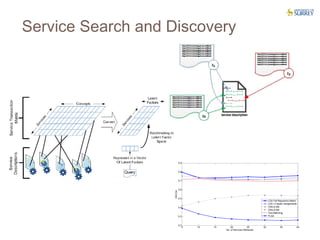
Service Search and Discovery


                               14
Linked data principles
    using URI’s as names for things: Everything is
     addressed using unique URI’s.
    using HTTP URI’s to enable people to look up
     those names: All the URI’s are accessible via
     HTTP interfaces.
    provide useful RDF information related to
     URI’s that are looked up by machine or
     people;
    including RDF statements that link to other
     URI’s to enable discovery of other related
     concepts of the Web of Data: The URI’s are
     linked to other URI’s.
                                                      15
Linked data layer for not only IoT…


Diagram from Stefan Decker, http://fi-ghent.fi-week.eu/files/2010/10/Linked-Data-scheme1.png; linked data diagram: http://richard.cyganiak.de/2007/10/lod/
                                                                                                                                                             16
A Sample demonstrator


http://ccsriottb3.ee.surrey.ac.uk:8080/IOTA/


                                               17
Sensor discovery using linked sensor
data


                                       18
Conclusions
   Sensor service connectivity, discovery and
    composition are some of the most key issues
    in semantic sensor service networks.
   SOA based design can support seamless
    integration to existing applications on cyber-
    space.
   While the direct access method uses the
    standard HTTP protocols for service
    communications, the intermediate access
    method is designed on the top of the
    Constrained Application Protocol (CoAp) and
    6LowPan for devices operating in constrained
    environments.                                    19
Questions?
   Thank you.


                 20

Semantic Sensor Service Networks

  • 1.
    Semantic Sensor ServiceNetworks Wei Wang, Payam Barnaghi, Gilbert Cassar, Frieder Ganz, Pirabakaran Navaratnam Centre for Communication Systems Research University of Surrey Guildford, Surrey United Kingdom 1
  • 2.
    Sensors, Sensor Networksand Internet of “Things”  Physical world objects  e.g. A room, a car, A person;  Feature of Interest  e.g. Temperature of the room, Location of the car, heart-rate of the person;  Sensors  e.g. Temperature sensor, GPS, pulse sensor  Embedded devices 2
  • 3.
    Semantics and SensorNetworks Image credits: [1] Protocols and Architectures for Wireless Sensor Networks, Holger Karl, Andreas Willig, Wiley, 2005 3 [2] Cisco - Interne of Things
  • 4.
  • 5.
    The Internet ofThings  A primary goal of interconnecting devices and collecting/processing data from them is to create situation awareness and enable applications, machines, and human users to better understand their surrounding environments.  The understanding of a situation, or context, potentially enables services and applications to make intelligent decisions and to respond to the dynamics of their environments.  A key enabler is providing Services that represent sensors/resources and integrating them into the cyber-space. 5
  • 6.
    Semantics, sensors andservices  Semantics are machine-interpretable metadata (for mark-up), logical inference mechanisms, query mechanism, linked data solutions  For semantic sensor services this means:  ontologies for: devices (e.g. sensors), observation and measurement data (e.g. sensor readings), domain concepts (e.g. unit of measurement, location), service descriptions (e.g. IoT services) and other data sources (e.g. those available on linked open data)  Semantic annotation should also supports data represented using existing forms  Reasoning /processing to infer relationships or hierarchies between different resources, data  Semantics (/ontologies) as meta-data (to describe the services/resources) / knowledge bases (domain knowledge). 6
  • 7.
  • 8.
    Existing models forresources and data  W3C Semantic Sensor Network Incubator Group’s S N ontology (mainly for sensors and S sensor networks, observation and measurement, and platforms and systems)  Quantity Kinds and Units  Used together with the SSN ontology  based on QUDV model OMG SysML(TM)  Working group of the SysML 1.2 Revision Task Force (RTF) and W3C Semantic Sensor Network Incubator Group 8
  • 9.
  • 10.
    Existing models forservices  OWL-S and WSMO are heavy weight models: practical use?  Minimal service model  Deprecated  Procedure-Oriented Service Model (POSM) and Resource- Oriented Service Model (ROSM): two different models for different service technologies  Defines Operations and Messages  No profile, no grounding  SAWSDL: mixture of XML, XML schema, RDF and OWL  hRESTS and SA-REST: mixture of HTML and reference to a semantic model; sensor services are not anticipated to have HTML 10
  • 11.
    Semantic modelling  Lightweight: experiences show that a lightweight ontology model that well balances expressiveness and inference complexity is more likely to be widely adopted and reused; also large number of IoT resources and huge amount of data need efficient processing  Compatibility: an ontology needs to be consistent with those well designed, existing ontologies to ensure compatibility wherever possible.  Modularity: modular approach to facilitate ontology evolution, extension and integration with external ontologies. 11
  • 12.
    IoT.est service profilehighlight  ServiceType class represents the service technologies: RESTful and SOAP/WSDL services.  serviceQos and serviceQoI are defined as subproperty of serviceParameter; they link to concepts in the QoS/QoI ontology.  serviceArea: the area where the service is provided; different from the sensor observation area  Links to the IoT resources through “exposedB property y”  Future extension:  serviceNetwork, servicePlatform and serviceDeployment  Service lifecycle, SLA… 12
  • 13.
    A snapshot ofthe model 13
  • 14.
    Service Search andDiscovery 14
  • 15.
    Linked data principles  using URI’s as names for things: Everything is addressed using unique URI’s.  using HTTP URI’s to enable people to look up those names: All the URI’s are accessible via HTTP interfaces.  provide useful RDF information related to URI’s that are looked up by machine or people;  including RDF statements that link to other URI’s to enable discovery of other related concepts of the Web of Data: The URI’s are linked to other URI’s. 15
  • 16.
    Linked data layerfor not only IoT… Diagram from Stefan Decker, http://fi-ghent.fi-week.eu/files/2010/10/Linked-Data-scheme1.png; linked data diagram: http://richard.cyganiak.de/2007/10/lod/ 16
  • 17.
  • 18.
    Sensor discovery usinglinked sensor data 18
  • 19.
    Conclusions  Sensor service connectivity, discovery and composition are some of the most key issues in semantic sensor service networks.  SOA based design can support seamless integration to existing applications on cyber- space.  While the direct access method uses the standard HTTP protocols for service communications, the intermediate access method is designed on the top of the Constrained Application Protocol (CoAp) and 6LowPan for devices operating in constrained environments. 19
  • 20.
    Questions?  Thank you. 20

Editor's Notes

  • #5 Scalability and interoperability problems
  • #11 Limitation: OWL-S and hREST complement each other; all of them do have connections to resources, platforms… do not consider the unique nature of IoT services
  • #16 Take about something on the web of data