Prepared By :
Bhavin Tank
DDIT, Nadiad
Contents
 What is Grid Computing?
 Why need grid computing?
 Types of grid
 Characteristics of Grid
 Benefits
 Applications
 Advantage & Disadvantages


                            2   tank.infotech@gmail.com
What is Grid Computing?
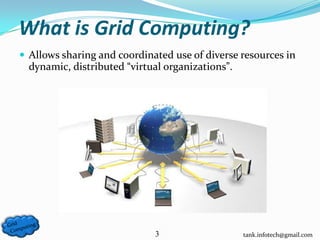
 Allows sharing and coordinated use of diverse resources in
  dynamic, distributed “virtual organizations”.


                             3                    tank.infotech@gmail.com
What is a Grid?
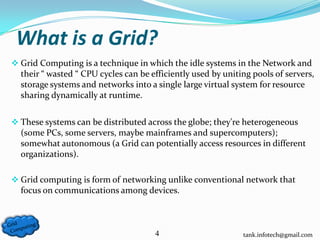
 Grid Computing is a technique in which the idle systems in the Network and
  their “ wasted “ CPU cycles can be efficiently used by uniting pools of servers,
  storage systems and networks into a single large virtual system for resource
  sharing dynamically at runtime.


 These systems can be distributed across the globe; they're heterogeneous
  (some PCs, some servers, maybe mainframes and supercomputers);
  somewhat autonomous (a Grid can potentially access resources in different
  organizations).

 Grid computing is form of networking unlike conventional network that
  focus on communications among devices.


                                      4                       tank.infotech@gmail.com
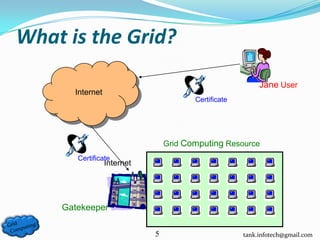
What is the Grid?
                                                          Jane User
      Internet
                                       Certificate


                                Grid Computing Resource
       Certificate
                 Internet


    Gatekeeper

                            5                        tank.infotech@gmail.com
Why need Grid Computing?
 Exploiting under utilized resources
 Parallel CPU capacity
 Virtual resources and virtual organizations for collaboration
 Access to additional resources
 Many large-scale problems cannot be solved by a single
  computer
 Globally distributed data and resources


                              6                  tank.infotech@gmail.com
Types of Grids
 Computational Grid:
    A computational grid is focused on setting aside resources specifically for
    computing power. In this type of grid, most of the machines are high-
    performance servers.

 Scavenging grid:
    A scavenging grid is most commonly used with large numbers of desktop
    machines. Machines are scavenged for available CPU cycles and other
    resources. Owners of the desktop machines are usually given control over
    when their resources are available to participate in the grid.

 Data Grid:
    A data grid is responsible for housing and providing access to data across
    multiple organizations. Users are not concerned with where this data is
    located as long as they have access to the data.


                                      7                         tank.infotech@gmail.com
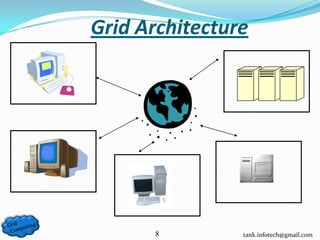
Grid Architecture


      8         tank.infotech@gmail.com
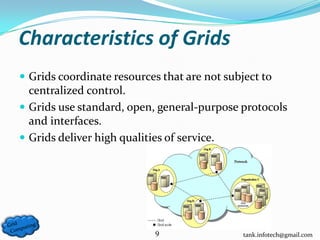
Characteristics of Grids
 Grids coordinate resources that are not subject to
  centralized control.
 Grids use standard, open, general-purpose protocols
  and interfaces.
 Grids deliver high qualities of service.


                            9                 tank.infotech@gmail.com
Grid User Roles
   (A User’s Perspective)
  Enrolling and installing grid software
  Logging onto the grid
  Queries and submitting jobs
  Data configuration
  Monitoring progress and recovery
  Reserving resources


                           10               tank.infotech@gmail.com
Grid User Roles
   (An Administrator’s Perspective)
 Planning
 Installation
 Managing enrollment of donors and users
 Certificate authority
 Resource management
 Data sharing


                          11                tank.infotech@gmail.com
Issues
 Security:
   Security issues include secure authentication, access rights and
    privileges. Reliable and secure communications, perhaps with
    encryption, are also a requirement.
   Maintaining confidentiality and privacy will also be issues if you are
    transferring personal data.
 Performance:
   For a grid performance is the main key is to deliver nontrivial
    qualities of service “. Some grid services might fall short because the
    scattering and gathering steps can incur significant delay.
   Grid performances include resource availability and reliability,
    utilization and load, response time, delay and delay variation. Data
    Integrity is another consideration.


                                   12                      tank.infotech@gmail.com
Benefits
(1)BUSSINESS BENEFITS:
   Can help improve productivity and collaboration.
   Bring together not only IT resources but also people.
   Create flexible, resilient operational infrastructures.


(2)INFRASTRUCTURE OPTIMIZATION:
   Consolidate workload management.
   Reduce cycle times.


                                      13                      tank.infotech@gmail.com
Benefits…
(3)INCREASE ACCESS TO DATA AND COLLABORATION:
   Federate data and distribute it globally.
   Support large multi-disciplinary collaboration..
   Enable collaboration across organizations and among businesses.

(4)RESILIENT, HIGHLY AVAILABLE INFRASTRUCTURE:
  Balance workloads.
  Foster business community
  Enable recovery and failure.


                                      14                    tank.infotech@gmail.com
 ADVANTAGES:
  Can solve larger, more complex problems in a shorter time

  Easier to collaborate with other organizations

  Make better use of existing hardware


 DISADVANTAGES:
  Grid software and standards are still evolving.

  Learning curve to get started.

  Non-interactive job submission.


                                     15                        tank.infotech@gmail.com
Characteristics of Grid Applications
 Data acquired by scientific instruments.
 Data are stored in archives on separate, perhaps geographically-
  separated sites.
 Data are managed by teams belonging to different organizations.
 Large quantities of data (tera- or petabytes) are collected.
 Software used to analyze and summarize the raw data.


                                     16                      tank.infotech@gmail.com
Questions……..?????
       17       tank.infotech@gmail.com
tank.infotech@gmail.com

Grid computing 2007

  • 1.
    Prepared By : BhavinTank DDIT, Nadiad
  • 2.
    Contents  What isGrid Computing?  Why need grid computing?  Types of grid  Characteristics of Grid  Benefits  Applications  Advantage & Disadvantages 2 tank.infotech@gmail.com
  • 3.
    What is GridComputing?  Allows sharing and coordinated use of diverse resources in dynamic, distributed “virtual organizations”. 3 tank.infotech@gmail.com
  • 4.
    What is aGrid?  Grid Computing is a technique in which the idle systems in the Network and their “ wasted “ CPU cycles can be efficiently used by uniting pools of servers, storage systems and networks into a single large virtual system for resource sharing dynamically at runtime.  These systems can be distributed across the globe; they're heterogeneous (some PCs, some servers, maybe mainframes and supercomputers); somewhat autonomous (a Grid can potentially access resources in different organizations).  Grid computing is form of networking unlike conventional network that focus on communications among devices. 4 tank.infotech@gmail.com
  • 5.
    What is theGrid? Jane User Internet Certificate Grid Computing Resource Certificate Internet Gatekeeper 5 tank.infotech@gmail.com
  • 6.
    Why need GridComputing?  Exploiting under utilized resources  Parallel CPU capacity  Virtual resources and virtual organizations for collaboration  Access to additional resources  Many large-scale problems cannot be solved by a single computer  Globally distributed data and resources 6 tank.infotech@gmail.com
  • 7.
    Types of Grids Computational Grid: A computational grid is focused on setting aside resources specifically for computing power. In this type of grid, most of the machines are high- performance servers.  Scavenging grid: A scavenging grid is most commonly used with large numbers of desktop machines. Machines are scavenged for available CPU cycles and other resources. Owners of the desktop machines are usually given control over when their resources are available to participate in the grid.  Data Grid: A data grid is responsible for housing and providing access to data across multiple organizations. Users are not concerned with where this data is located as long as they have access to the data. 7 tank.infotech@gmail.com
  • 8.
    Grid Architecture 8 tank.infotech@gmail.com
  • 9.
    Characteristics of Grids Grids coordinate resources that are not subject to centralized control.  Grids use standard, open, general-purpose protocols and interfaces.  Grids deliver high qualities of service. 9 tank.infotech@gmail.com
  • 10.
    Grid User Roles (A User’s Perspective)  Enrolling and installing grid software  Logging onto the grid  Queries and submitting jobs  Data configuration  Monitoring progress and recovery  Reserving resources 10 tank.infotech@gmail.com
  • 11.
    Grid User Roles (An Administrator’s Perspective)  Planning  Installation  Managing enrollment of donors and users  Certificate authority  Resource management  Data sharing 11 tank.infotech@gmail.com
  • 12.
    Issues  Security:  Security issues include secure authentication, access rights and privileges. Reliable and secure communications, perhaps with encryption, are also a requirement.  Maintaining confidentiality and privacy will also be issues if you are transferring personal data.  Performance:  For a grid performance is the main key is to deliver nontrivial qualities of service “. Some grid services might fall short because the scattering and gathering steps can incur significant delay.  Grid performances include resource availability and reliability, utilization and load, response time, delay and delay variation. Data Integrity is another consideration. 12 tank.infotech@gmail.com
  • 13.
    Benefits (1)BUSSINESS BENEFITS:  Can help improve productivity and collaboration.  Bring together not only IT resources but also people.  Create flexible, resilient operational infrastructures. (2)INFRASTRUCTURE OPTIMIZATION:  Consolidate workload management.  Reduce cycle times. 13 tank.infotech@gmail.com
  • 14.
    Benefits… (3)INCREASE ACCESS TODATA AND COLLABORATION:  Federate data and distribute it globally.  Support large multi-disciplinary collaboration..  Enable collaboration across organizations and among businesses. (4)RESILIENT, HIGHLY AVAILABLE INFRASTRUCTURE: Balance workloads. Foster business community Enable recovery and failure. 14 tank.infotech@gmail.com
  • 15.
     ADVANTAGES: Can solve larger, more complex problems in a shorter time  Easier to collaborate with other organizations  Make better use of existing hardware  DISADVANTAGES:  Grid software and standards are still evolving.  Learning curve to get started.  Non-interactive job submission. 15 tank.infotech@gmail.com
  • 16.
    Characteristics of GridApplications  Data acquired by scientific instruments.  Data are stored in archives on separate, perhaps geographically- separated sites.  Data are managed by teams belonging to different organizations.  Large quantities of data (tera- or petabytes) are collected.  Software used to analyze and summarize the raw data. 16 tank.infotech@gmail.com
  • 17.
    Questions……..????? 17 tank.infotech@gmail.com
  • 18.