Design 
Pa*erns 
for 
an 
Internet 
Of 
Things 
Architecture, 
Infrastructure, 
Models, 
and 
Protocols 
Michael 
J 
Koster 
ARM
Design 
Pa*ern 
• A 
Reusable 
Solu?on 
to 
a 
Commonly 
Occurring 
Problem 
• A 
Architecture 
Structured 
Collec?on 
of 
Design 
Pa*erns 
that 
solves 
a 
Par?cular 
Set 
of 
Problems 
10/19/14 
2
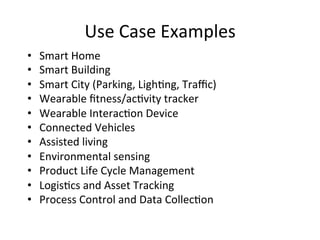
Use 
Case 
Examples 
• Smart 
Home 
• Smart 
Building 
• Smart 
City 
(Parking, 
Ligh?ng, 
Traffic) 
• Wearable 
fitness/ac?vity 
tracker 
• Wearable 
Interac?on 
Device 
• Connected 
Vehicles 
• Assisted 
living 
• Environmental 
sensing 
• Product 
Life 
Cycle 
Management 
• Logis?cs 
and 
Asset 
Tracking 
• Process 
Control 
and 
Data 
Collec?on
Some 
High 
Level 
Design 
Pa*erns 
For 
The 
Internet 
Of 
Things 
• Things 
geYng 
smarter 
and 
smarter 
un?l 
they 
start 
bossing 
each 
other 
around… 
• Billions 
of 
sensors 
genera?ng 
big 
data 
to 
monitor, 
analyze, 
and 
learn 
new 
stuff 
from… 
• A 
system 
of 
using 
networks 
to 
connect 
things 
and 
people, 
adding 
distributed 
intelligence 
to 
things, 
to 
create 
a 
so^ware 
virtualiza?on 
layer 
on 
top 
of 
the 
physical 
world
IoT 
Local 
System 
View 
Based 
On 
Things 
Interac?ng 
With 
Other 
Things 
LOCAL 
NETWORK
IoT 
System 
View 
For 
Big 
Data™ 
ANALYZE 
FILTER 
COLLECT
System 
View 
For 
Diverse 
Use 
Cases 
Things 
Control 
People 
Autonomic 
Feedback 
Loop 
So.ware 
Inform 
Inform 
Command 
Actuate 
Cyberne>c 
Feedback 
Loop 
Observe
Abstract 
Design 
Pa*erns
Connected 
Intelligence 
Disrupts 
Embedded 
Intelligence 
So^ware 
Network 
Thing 
Connected 
Intelligence 
Embedded 
Intelligence
Virtualiza?on 
of 
Things 
So^ware 
Applica?on 
Network 
So^ware 
Abstrac?on 
(Network) 
Thing 
Firmware, 
Middleware 
Device
Virtualiza?on 
Enables 
Many-­‐to-­‐Many 
So^ware 
Applica?ons 
to 
Things 
So^ware 
So^ware 
So^ware 
So^ware 
Abstrac?ons 
Thing 
Middleware 
Thing 
Thing
Data 
Model 
So^ware 
So^ware 
So^ware 
Data 
Model 
Thing
Data 
Model 
So^ware 
So^ware 
So^ware 
Middleware 
Thing
Design 
Pa*erns 
for 
Network 
Topology 
– 
Discovery 
and 
Interac?on
Interac?on 
Pa*erns 
Web 
Applica?on 
Applica?on 
Service 
e.g. 
LWM2M 
Sensor/ 
Actuator 
Device 
Device 
with 
Embedded 
Applica?on 
Applica?on 
Server 
Client 
Peer-­‐Peer 
Constrained 
Device, 
e.g. 
16KB 
RAM, 
128KB 
Flash 
Smart 
Object 
Registra?on, 
Discovery 
and 
Data 
Layer 
Service, 
Device 
Proxy 
and 
Cache 
Applica?ons 
can 
Discover 
and 
Interact 
with 
devices 
using 
Peer-­‐Peer 
networking 
or 
through 
Services, 
using 
the 
Same 
Seman?cs
Device 
Server 
Middleware 
Device 
Server 
BLE 
Device 
Web 
App 
Web 
Browser, 
Smartphone 
App 
APP 
Proxy 
Device 
h*p 
h*p/REST 
CoAP 
BLE 
So^ 
Endpoints 
IP 
Device 
IP 
Device 
IP 
Device 
Endpoints
Device 
Server 
Middleware 
Device 
Server 
BLE 
Device 
Web 
App 
Web 
Browser, 
Smartphone 
App 
APP 
Proxy 
Device 
h*p 
h*p/REST 
CoAP 
BLE 
So^ 
Endpoints 
IP 
Device 
IP 
Device 
IP 
Device 
Endpoints
Device 
Server 
Middleware 
Device 
Server 
BLE 
Device 
Web 
App 
Web 
Browser, 
Smartphone 
App 
APP 
Proxy 
Device 
h*p 
h*p/REST 
CoAP 
BLE 
So^ 
Endpoints 
IP 
Device 
IP 
Device 
IP 
Device 
Endpoints
Device 
Server 
Middleware 
Device 
Server 
BLE 
Device 
Web 
App 
Web 
Browser, 
Smartphone 
App 
APP 
Proxy 
Device 
h*p 
h*p/REST 
CoAP 
BLE 
So^ 
Endpoints 
IP 
Device 
IP 
Device 
IP 
Device 
Endpoints
Middleware 
Services 
Device 
Applica?on 
So^ware 
IP 
Reachable 
Web 
Services 
REST 
API 
Service 
Resource 
Directory 
Message 
Broker 
REGISTER 
DISCOVER 
PUB/SUB 
PUB/SUB 
UPDATE 
GET/NOTIFY 
More 
Constrained 
Less 
Reachable 
Less 
Constrained 
Less 
Reachable
Infrastructure 
Device 
NA 
T 
Applica?on 
So^ware 
NA 
T 
GW, 
AP 
GW, 
AP 
IP 
Reachable 
Web 
Services 
REST 
API 
Service 
Resource 
Directory 
Message 
Broker 
IP 
Reachable 
or 
Non 
Reachable 
Endpoints 
IP 
Reachable 
or 
Non 
Reachable
Example 
Configura?on 
using 
local 
REST 
Gateways 
Pub/Sub 
Updates 
Device 
REGISTER 
DISCOVER 
NA 
T 
Applica?on 
So^ware 
NA 
T 
REST 
GW 
REST 
GW 
Resource 
Directory 
Message 
Broker 
PUB/SUB 
PUB/SUB 
REST 
REST
Internet 
and 
Web 
Design 
Pa*erns
Layered 
Architecture, 
Narrow 
Waist 
Applica?on 
So^ware 
IPSO 
Objects 
LWM2M 
CoAP 
Device 
Management 
HTTP 
6LowPAN 
IPV4/IPV6 
802.15.4 
WiFi, 
Ethernet 
MCU 
– 
16KiB 
RAM 
MPU 
Applica?on 
Data 
Models 
API 
for 
data 
and 
metadata 
REST 
Protocol 
Rou?ng 
HW 
Network 
Hardware 
HTTP 
REST 
Server 
10/19/14 
24
REST 
API 
• Client-­‐Server 
• Resource 
Oriented 
• CRUD 
Seman?cs 
• Hypermedia 
Driven 
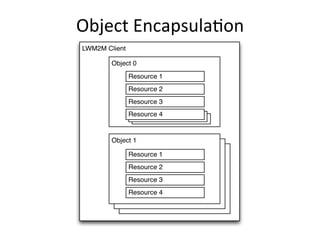
Object 
Encapsula?on 
• Path 
Hierarchy 
-­‐ 
Inclusion 
• Linking 
– 
Transclusion 
• Transclusion 
links 
shared 
resources
Client-­‐Server 
Design 
Pa*ern 
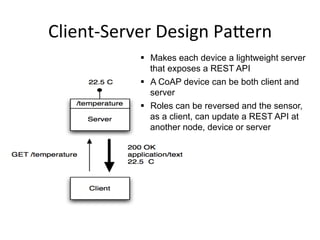
§ Makes each device a lightweight server 
that exposes a REST API 
§ A CoAP device can be both client and 
server 
§ Roles can be reversed and the sensor, 
as a client, can update a REST API at 
another node, device or server
Object 
Encapsula?on
Object 
Encapsula?on
Data 
Models
Data 
Models 
• Applica?on 
Seman?cs 
and 
Hypermedia 
• Device 
and 
Equipment 
Models 
• Resource 
Templates 
• Metadata 
Schemas 
• JSON, 
XML, 
Seman?c 
Link 
Formats 
• Vocabularies 
• Ontologies
Resource 
Model 
• So^ware 
understands 
the 
thing 
and 
how 
to 
interact 
with 
it 
through 
abstract 
models 
• REST 
is 
a 
resource 
oriented 
paradigm 
• REST 
data 
describes 
current 
state 
of 
the 
thing 
– 
state 
is 
external 
to 
applica?ons 
– 
enables 
shared 
state 
between 
applica?ons 
• Metadata 
describes 
the 
thing 
and 
it’s 
context 
• Real 
?me 
event 
no?fica?on 
using 
observers, 
and 
event 
bindings
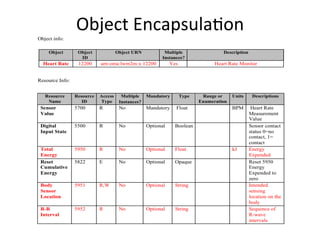
Object 
Models 
• Web 
object 
encapsula?on 
of 
related 
resources 
within 
a 
REST 
endpoint 
• Various 
Object 
Models 
and 
resource 
encapsula?ons 
are 
specified 
• OMA 
LWM2M 
& 
IPSO 
Smart 
Objects 
use 
an 
object 
template 
system 
• Core 
Interfaces 
and 
Core-­‐Link-­‐Format 
metadata 
to 
build 
seman?c 
models 
• Hypercat 
using 
JSON 
format 
and 
catalogs 
of 
links
Abstract 
Object 
Models 
– 
Virtual 
Composite 
Objects 
• Constructed 
or 
composed 
of 
resources 
from 
one 
or 
more 
endpoints 
• May 
be 
abstrac?ons 
or 
filtered 
versions 
of 
the 
resource, 
e.g. 
24 
hour 
running 
averages 
• May 
have 
limited 
access 
e.g. 
read-­‐only 
for 
publica?on 
on 
the 
web
Object 
Model 
Metadata 
• Hyperlinks 
for 
machines 
(sensors 
and 
so^ware) 
• Commonly 
use 
seman?c 
triples 
to 
describe 
links, 
e.g.: 
</sen/0/temp>; 
if=‘sensor’, 
rt=‘temperature’ 
• So^ware 
understandable 
metadata 
enables 
automa?c 
discovery 
and 
linkage 
of 
resources 
by 
so^ware 
• Devices 
and 
other 
data 
sources 
register 
their 
resource 
endpoints 
at 
Resource 
Directories 
or 
Catalogs 
by 
uploading 
metadata 
• Applica?ons 
discover 
resources 
by 
querying 
the 
Resource 
Directories 
based 
on 
rela?ons 
and 
a*ributes 
e.g.: 
GET /.well-known/core?if=‘sensor’!
Data 
(informa?on) 
Model 
Interoperability 
• Point 
of 
interoperability 
is 
the 
Resource 
Directory 
or 
Catalog 
• Applica?ons 
can 
access 
any 
sensor, 
actuator, 
or 
data 
stream 
using 
any 
protocol 
• If 
applica?ons 
can 
use 
the 
catalog, 
they 
can 
discover 
and 
interact 
with 
the 
endpoints 
of 
interest 
or 
their 
proxies 
• Interoperability 
is 
protocol-­‐agnos?c 
as 
long 
as 
the 
system 
supports 
the 
protocol 
endpoints 
• Protocol 
endpoints 
are 
mapped 
to 
resource 
endpoints 
using 
dynamic 
bindings 
• Protocols 
use 
data 
models, 
info 
models 
are 
higher 
level
Layered 
Resources 
in 
Models 
• Object 
Model 
– Resources 
represen?ng 
the 
generic 
object, 
i.e. 
new 
out 
of 
the 
box 
• Context 
– When 
the 
object 
is 
put 
to 
use, 
it’s 
loca?on, 
it’s 
ownership, 
what 
it’s 
measuring 
or 
controlling 
• Bindings 
– Other 
resources 
the 
object 
is 
connected 
to, 
e.g. 
a 
light 
switch 
controlling 
a 
light 
• Resources 
may 
be 
discovered 
by 
context 
and 
current 
binding 
in 
addi?on 
to 
object 
a*ributes
Protocols
Some 
Protocols 
Protocol 
State 
Externalized 
Event 
No>fica>on 
Applica>on 
Discovery 
Syndica>on 
Standards 
HTTP 
REST 
WS, 
PUT, 
Callbacks 
Resource 
Directory 
Server 
Group 
IETF, 
W3C 
CoAP 
REST 
PUT, 
GET 
+ 
Observe 
Resource 
Directory 
Server 
Group 
IETF, 
OMA, 
IPSO 
MQTT 
No 
Pub/Sub 
No 
Broker 
Oasis
CoAP 
• CoAP 
(RFC7252) 
is 
a 
REST 
API 
mapped 
to 
an 
efficient 
binary 
protocol 
• Can 
use 
IPV6, 
6LoWPAN, 
DTLS 
and 
UDP 
for 
underlying 
networking 
• Can 
also 
use 
IPV4 
and 
other 
bearers, 
e.g. 
SMS 
and 
serial 
comms 
• Observe 
op?on 
for 
asynchronous 
streaming 
updates 
• Real 
?me 
resource 
bindings 
to 
connect 
diverse 
protocols 
and 
event 
handlers 
• Embedded 
core-­‐link-­‐format 
metadata 
for 
discovery 
and 
linking
HTTP/REST 
• HTTP 
is 
used 
to 
create 
a 
REST 
API 
• CoAP 
REST 
APIs 
can 
be 
mapped 
trivially 
to 
HTTP/REST 
• CoAP-­‐HTTP 
proxy 
allows 
standard 
web 
applica?ons 
to 
connect 
to 
CoAP 
connected 
devices 
• HTTP 
PUT 
and 
WebSockets 
are 
used 
to 
perform 
asynchronous 
updates 
and 
invoke 
web 
applica?on 
handlers
MQTT 
• MQTT 
is 
a 
binary 
message 
protocol 
that 
uses 
the 
publish/subscribe 
pa*ern 
• MQTT 
server 
is 
a 
message 
broker, 
accep?ng 
subscrip?ons 
to 
topics 
and 
republishing 
topics 
to 
subscribers 
• Guaranteed 
delivery 
or 
fail 
is 
ensured 
by 
op?onal 
QOS 
seYng 
• MQTT 
can 
syndicate 
updates 
to 
many 
subscribers 
• Topics 
look 
like 
REST 
paths 
e.g. 
/sensors/ 
rhvWeather-­‐01/sealevel_pressure
Protocol 
Binding 
• API 
Hooks 
to 
bind 
ac?ons 
to 
resources 
• Update 
of 
resource 
triggers 
an 
ac?on 
• External 
ac?on 
can 
update 
resource 
• One 
example 
is 
binding 
REST 
API 
resources 
to 
MQTT 
topics 
• Update 
of 
REST 
resource 
causes 
MQTT 
PUBLISH 
ac?on 
• MQTT 
PUBLISH 
can 
update 
resource 
state
Design 
Pa*ern 
Summary 
• No 
one 
Architecture 
is 
suitable 
for 
all 
IoT 
use 
cases 
• Design 
Pa*ern 
thinking 
brings 
modularity 
• More 
reusability 
in 
a 
modular 
system 
• Enables 
a 
range 
of 
architecture 
solu?ons 
• Break 
down 
Silos 
of 
Thought 
• Easier 
to 
think 
about 
commonality 
and 
standards

Design patternsforiot

  • 1.
    Design Pa*erns for an Internet Of Things Architecture, Infrastructure, Models, and Protocols Michael J Koster ARM
  • 2.
    Design Pa*ern •A Reusable Solu?on to a Commonly Occurring Problem • A Architecture Structured Collec?on of Design Pa*erns that solves a Par?cular Set of Problems 10/19/14 2
  • 3.
    Use Case Examples • Smart Home • Smart Building • Smart City (Parking, Ligh?ng, Traffic) • Wearable fitness/ac?vity tracker • Wearable Interac?on Device • Connected Vehicles • Assisted living • Environmental sensing • Product Life Cycle Management • Logis?cs and Asset Tracking • Process Control and Data Collec?on
  • 4.
    Some High Level Design Pa*erns For The Internet Of Things • Things geYng smarter and smarter un?l they start bossing each other around… • Billions of sensors genera?ng big data to monitor, analyze, and learn new stuff from… • A system of using networks to connect things and people, adding distributed intelligence to things, to create a so^ware virtualiza?on layer on top of the physical world
  • 5.
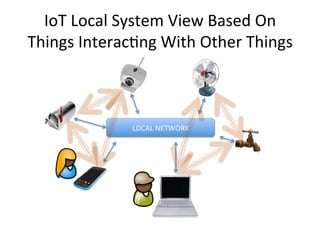
    IoT Local System View Based On Things Interac?ng With Other Things LOCAL NETWORK
  • 6.
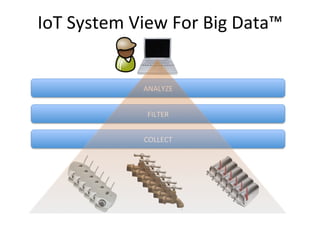
    IoT System View For Big Data™ ANALYZE FILTER COLLECT
  • 7.
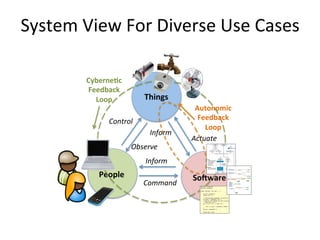
    System View For Diverse Use Cases Things Control People Autonomic Feedback Loop So.ware Inform Inform Command Actuate Cyberne>c Feedback Loop Observe
  • 8.
  • 9.
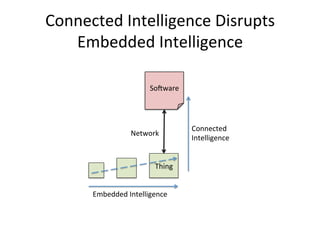
    Connected Intelligence Disrupts Embedded Intelligence So^ware Network Thing Connected Intelligence Embedded Intelligence
  • 10.
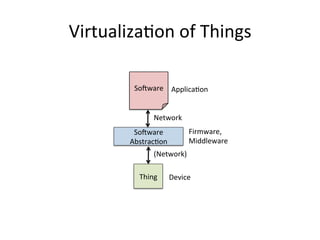
    Virtualiza?on of Things So^ware Applica?on Network So^ware Abstrac?on (Network) Thing Firmware, Middleware Device
  • 11.
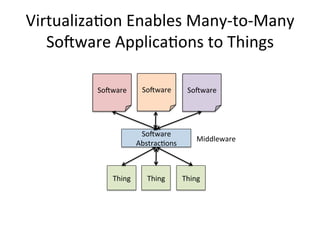
    Virtualiza?on Enables Many-­‐to-­‐Many So^ware Applica?ons to Things So^ware So^ware So^ware So^ware Abstrac?ons Thing Middleware Thing Thing
  • 12.
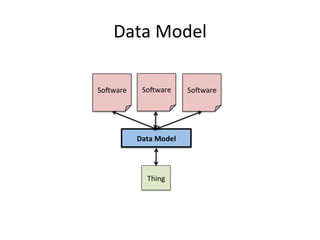
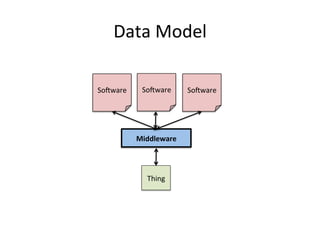
    Data Model So^ware So^ware So^ware Data Model Thing
  • 13.
    Data Model So^ware So^ware So^ware Middleware Thing
  • 14.
    Design Pa*erns for Network Topology – Discovery and Interac?on
  • 15.
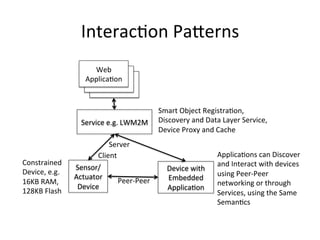
    Interac?on Pa*erns Web Applica?on Applica?on Service e.g. LWM2M Sensor/ Actuator Device Device with Embedded Applica?on Applica?on Server Client Peer-­‐Peer Constrained Device, e.g. 16KB RAM, 128KB Flash Smart Object Registra?on, Discovery and Data Layer Service, Device Proxy and Cache Applica?ons can Discover and Interact with devices using Peer-­‐Peer networking or through Services, using the Same Seman?cs
  • 16.
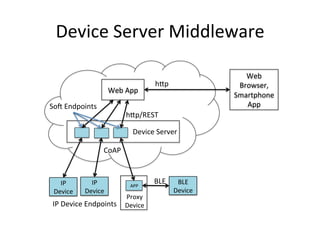
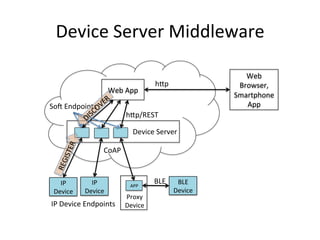
    Device Server Middleware Device Server BLE Device Web App Web Browser, Smartphone App APP Proxy Device h*p h*p/REST CoAP BLE So^ Endpoints IP Device IP Device IP Device Endpoints
  • 17.
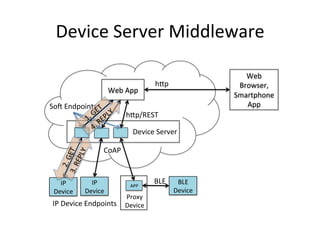
    Device Server Middleware Device Server BLE Device Web App Web Browser, Smartphone App APP Proxy Device h*p h*p/REST CoAP BLE So^ Endpoints IP Device IP Device IP Device Endpoints
  • 18.
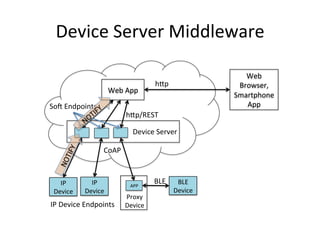
    Device Server Middleware Device Server BLE Device Web App Web Browser, Smartphone App APP Proxy Device h*p h*p/REST CoAP BLE So^ Endpoints IP Device IP Device IP Device Endpoints
  • 19.
    Device Server Middleware Device Server BLE Device Web App Web Browser, Smartphone App APP Proxy Device h*p h*p/REST CoAP BLE So^ Endpoints IP Device IP Device IP Device Endpoints
  • 20.
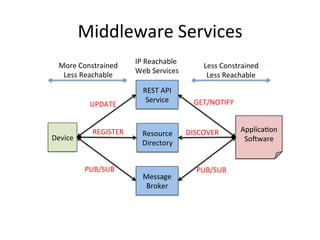
    Middleware Services Device Applica?on So^ware IP Reachable Web Services REST API Service Resource Directory Message Broker REGISTER DISCOVER PUB/SUB PUB/SUB UPDATE GET/NOTIFY More Constrained Less Reachable Less Constrained Less Reachable
  • 21.
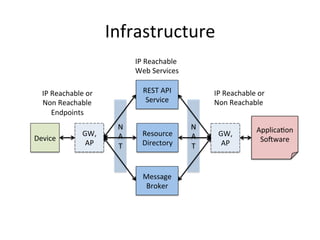
    Infrastructure Device NA T Applica?on So^ware NA T GW, AP GW, AP IP Reachable Web Services REST API Service Resource Directory Message Broker IP Reachable or Non Reachable Endpoints IP Reachable or Non Reachable
  • 22.
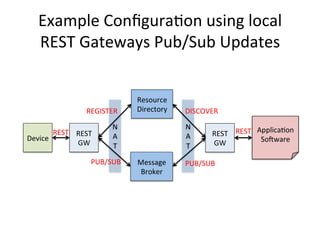
    Example Configura?on using local REST Gateways Pub/Sub Updates Device REGISTER DISCOVER NA T Applica?on So^ware NA T REST GW REST GW Resource Directory Message Broker PUB/SUB PUB/SUB REST REST
  • 23.
    Internet and Web Design Pa*erns
  • 24.
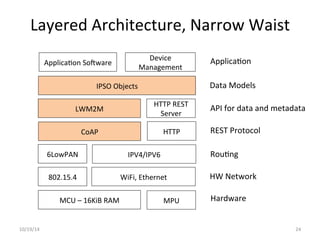
    Layered Architecture, Narrow Waist Applica?on So^ware IPSO Objects LWM2M CoAP Device Management HTTP 6LowPAN IPV4/IPV6 802.15.4 WiFi, Ethernet MCU – 16KiB RAM MPU Applica?on Data Models API for data and metadata REST Protocol Rou?ng HW Network Hardware HTTP REST Server 10/19/14 24
  • 25.
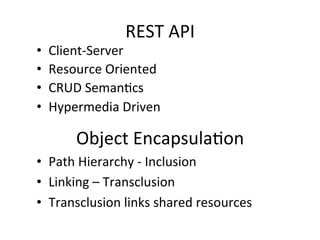
    REST API •Client-­‐Server • Resource Oriented • CRUD Seman?cs • Hypermedia Driven Object Encapsula?on • Path Hierarchy -­‐ Inclusion • Linking – Transclusion • Transclusion links shared resources
  • 26.
    Client-­‐Server Design Pa*ern § Makes each device a lightweight server that exposes a REST API § A CoAP device can be both client and server § Roles can be reversed and the sensor, as a client, can update a REST API at another node, device or server
  • 27.
  • 28.
  • 29.
  • 30.
    Data Models •Applica?on Seman?cs and Hypermedia • Device and Equipment Models • Resource Templates • Metadata Schemas • JSON, XML, Seman?c Link Formats • Vocabularies • Ontologies
  • 31.
    Resource Model •So^ware understands the thing and how to interact with it through abstract models • REST is a resource oriented paradigm • REST data describes current state of the thing – state is external to applica?ons – enables shared state between applica?ons • Metadata describes the thing and it’s context • Real ?me event no?fica?on using observers, and event bindings
  • 32.
    Object Models •Web object encapsula?on of related resources within a REST endpoint • Various Object Models and resource encapsula?ons are specified • OMA LWM2M & IPSO Smart Objects use an object template system • Core Interfaces and Core-­‐Link-­‐Format metadata to build seman?c models • Hypercat using JSON format and catalogs of links
  • 33.
    Abstract Object Models – Virtual Composite Objects • Constructed or composed of resources from one or more endpoints • May be abstrac?ons or filtered versions of the resource, e.g. 24 hour running averages • May have limited access e.g. read-­‐only for publica?on on the web
  • 34.
    Object Model Metadata • Hyperlinks for machines (sensors and so^ware) • Commonly use seman?c triples to describe links, e.g.: </sen/0/temp>; if=‘sensor’, rt=‘temperature’ • So^ware understandable metadata enables automa?c discovery and linkage of resources by so^ware • Devices and other data sources register their resource endpoints at Resource Directories or Catalogs by uploading metadata • Applica?ons discover resources by querying the Resource Directories based on rela?ons and a*ributes e.g.: GET /.well-known/core?if=‘sensor’!
  • 35.
    Data (informa?on) Model Interoperability • Point of interoperability is the Resource Directory or Catalog • Applica?ons can access any sensor, actuator, or data stream using any protocol • If applica?ons can use the catalog, they can discover and interact with the endpoints of interest or their proxies • Interoperability is protocol-­‐agnos?c as long as the system supports the protocol endpoints • Protocol endpoints are mapped to resource endpoints using dynamic bindings • Protocols use data models, info models are higher level
  • 36.
    Layered Resources in Models • Object Model – Resources represen?ng the generic object, i.e. new out of the box • Context – When the object is put to use, it’s loca?on, it’s ownership, what it’s measuring or controlling • Bindings – Other resources the object is connected to, e.g. a light switch controlling a light • Resources may be discovered by context and current binding in addi?on to object a*ributes
  • 37.
  • 38.
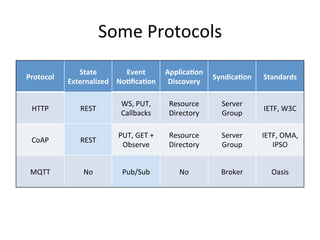
    Some Protocols Protocol State Externalized Event No>fica>on Applica>on Discovery Syndica>on Standards HTTP REST WS, PUT, Callbacks Resource Directory Server Group IETF, W3C CoAP REST PUT, GET + Observe Resource Directory Server Group IETF, OMA, IPSO MQTT No Pub/Sub No Broker Oasis
  • 39.
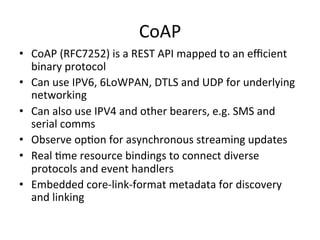
    CoAP • CoAP (RFC7252) is a REST API mapped to an efficient binary protocol • Can use IPV6, 6LoWPAN, DTLS and UDP for underlying networking • Can also use IPV4 and other bearers, e.g. SMS and serial comms • Observe op?on for asynchronous streaming updates • Real ?me resource bindings to connect diverse protocols and event handlers • Embedded core-­‐link-­‐format metadata for discovery and linking
  • 40.
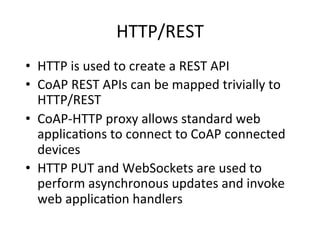
    HTTP/REST • HTTP is used to create a REST API • CoAP REST APIs can be mapped trivially to HTTP/REST • CoAP-­‐HTTP proxy allows standard web applica?ons to connect to CoAP connected devices • HTTP PUT and WebSockets are used to perform asynchronous updates and invoke web applica?on handlers
  • 41.
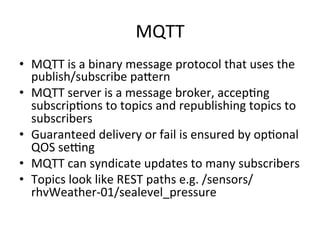
    MQTT • MQTT is a binary message protocol that uses the publish/subscribe pa*ern • MQTT server is a message broker, accep?ng subscrip?ons to topics and republishing topics to subscribers • Guaranteed delivery or fail is ensured by op?onal QOS seYng • MQTT can syndicate updates to many subscribers • Topics look like REST paths e.g. /sensors/ rhvWeather-­‐01/sealevel_pressure
  • 42.
    Protocol Binding •API Hooks to bind ac?ons to resources • Update of resource triggers an ac?on • External ac?on can update resource • One example is binding REST API resources to MQTT topics • Update of REST resource causes MQTT PUBLISH ac?on • MQTT PUBLISH can update resource state
  • 43.
    Design Pa*ern Summary • No one Architecture is suitable for all IoT use cases • Design Pa*ern thinking brings modularity • More reusability in a modular system • Enables a range of architecture solu?ons • Break down Silos of Thought • Easier to think about commonality and standards