Dynamic Semantics for the
Internet of Things
1
Payam Barnaghi
Institute for Communication Systems (ICS)
University of Surrey
Guildford, United Kingdom
2
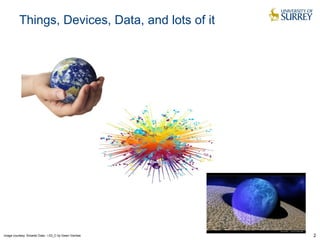
Things, Devices, Data, and lots of it
image courtesy: Smarter Data - I.03_C by Gwen Vanhee
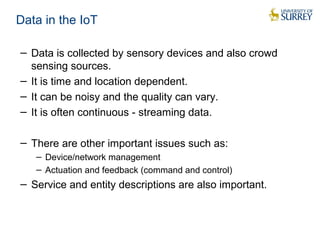
Data in the IoT
− Data is collected by sensory devices and also crowd
sensing sources.
− It is time and location dependent.
− It can be noisy and the quality can vary.
− It is often continuous - streaming data.
− There are other important issues such as:
− Device/network management
− Actuation and feedback (command and control)
− Service and entity descriptions are also important.
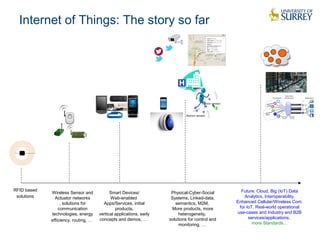
Internet of Things: The story so far
RFID based
solutions
Wireless Sensor and
Actuator networks
, solutions for
communication
technologies, energy
efficiency, routing, …
Smart Devices/
Web-enabled
Apps/Services, initial
products,
vertical applications, early
concepts and demos, …
Motion sensor
Motion sensor
ECG sensor
Physical-Cyber-Social
Systems, Linked-data,
semantics, M2M,
More products, more
heterogeneity,
solutions for control and
monitoring, …
Future: Cloud, Big (IoT) Data
Analytics, Interoperability,
Enhanced Cellular/Wireless Com.
for IoT, Real-world operational
use-cases and Industry and B2B
services/applications,
more Standards…
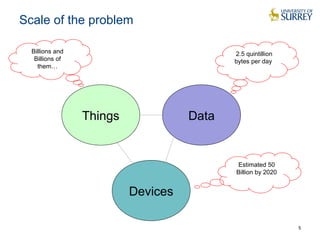
Scale of the problem
5
Things Data
Devices
2.5 quintillion
bytes per day
Billions and
Billions of
them…
Estimated 50
Billion by 2020
Heterogeneity, multi-modality and volume are
among the key issues.
We need interoperable and machine-
interpretable solutions…
6
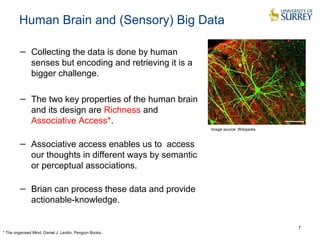
Human Brain and (Sensory) Big Data
− Collecting the data is done by human
senses but encoding and retrieving it is a
bigger challenge.
− The two key properties of the human brain
and its design are Richness and
Associative Access*.
− Associative access enables us to access
our thoughts in different ways by semantic
or perceptual associations.
− Brian can process these data and provide
actionable-knowledge.
7
Image source: Wikipedia
* The organised Mind, Daniel J. Levitin, Penguin Books.
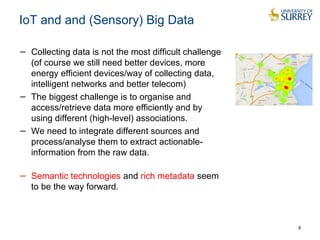
IoT and and (Sensory) Big Data
− Collecting data is not the most difficult challenge
(of course we still need better devices, more
energy efficient devices/way of collecting data,
intelligent networks and better telecom)
− The biggest challenge is to organise and
access/retrieve data more efficiently and by
using different (high-level) associations.
− We need to integrate different sources and
process/analyse them to extract actionable-
information from the raw data.
− Semantic technologies and rich metadata seem
to be the way forward.
8
9
But why don’t we still have fully
integrated semantic solutions in the
IoT?
10
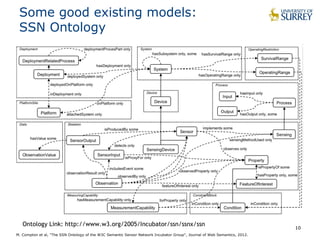
Some good existing models:
SSN Ontology
Ontology Link: http://www.w3.org/2005/Incubator/ssn/ssnx/ssn
M. Compton et al, "The SSN Ontology of the W3C Semantic Sensor Network Incubator Group", Journal of Web Semantics, 2012.
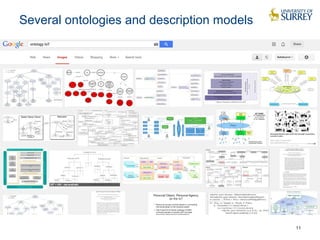
Several ontologies and description models
11
12
We have good models and description
frameworks;
The problem is that having good
models and developing ontologies is
not enough.
13
Semantic descriptions are intermediary
solutions, not the end product.
They should be transparent to the end-
user and probably to the data producer
as well.
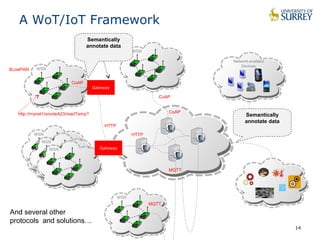
A WoT/IoT Framework
WSN
WSN
WSN
WSN
WSN
Network-enabled
Devices
Semantically
annotate data
14
Gateway
CoAP
HTTP
CoAP
CoAP
HTTP
6LowPAN
Semantically
annotate data
http://mynet1/snodeA23/readTemp?
WSN
MQTT
MQTT
Gateway
And several other
protocols and solutions…
Publishing Semantic annotations
− We need a model (ontology) – this is often the easy part
for a single application.
− Interoperability between the models is a big issue.
− Express-ability vs Complexity is a challenge.
− How and where to add the semantics
− Where to publish and store them
− Semantic descriptions for data, streams, devices
(resources) and entities that are represented by the
devices, and description of the services.
15
16
Simplicity can be very useful…
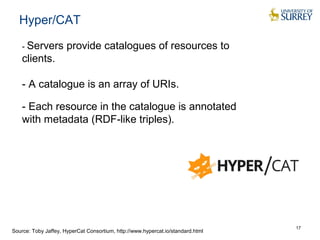
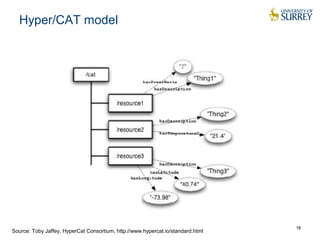
Hyper/CAT
17
Source: Toby Jaffey, HyperCat Consortium, http://www.hypercat.io/standard.html
- Servers provide catalogues of resources to
clients.
- A catalogue is an array of URIs.
- Each resource in the catalogue is annotated
with metadata (RDF-like triples).
Hyper/CAT model
18
Source: Toby Jaffey, HyperCat Consortium, http://www.hypercat.io/standard.html
19
Complex models are (sometimes) good
for publishing research papers….
But they are often difficult to
implement and use in real world
products.
What happens afterwards is more important
− How to index and query the annotated data
− How to make the publication suitable for constrained
environments and/or allow them to scale
− How to query them (considering the fact that here we are
dealing with live data and often reducing the processing
time and latency is crucial)
− Linking to other sources
20
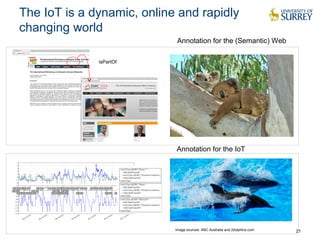
The IoT is a dynamic, online and rapidly
changing world
21
isPartOf
Annotation for the (Semantic) Web
Annotation for the IoT
Image sources: ABC Australia and 2dolphins.com
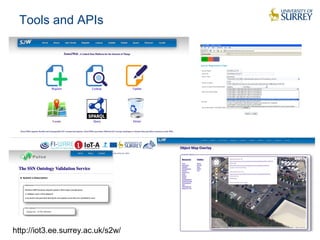
Tools and APIs
22
http://iot3.ee.surrey.ac.uk/s2w/
23
Creating common vocabularies and
taxonomies are also equally important
e.g. event taxonomies.
24
We should accept the fact that
sometimes we do not need (full)
semantic descriptions.
Think of the applications and use-cases
before starting to annotate the data.
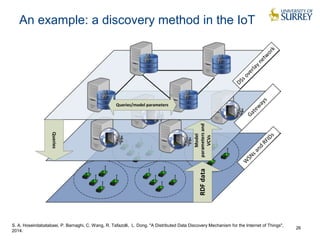
An example: a discovery
method in the IoT
time
location
type
Query formulating
[#location | #type | time][#location | #type | time]
Discovery ID
Discovery/
DHT Server
Data repository
(archived data)
#location
#type
#location
#type
#location
#type
Data hypercube
Gateway
Core network
Network Connection
Logical Connection
Data
An example: a discovery method in the IoT
26
S. A. Hoseinitabatabaei, P. Barnaghi, C. Wang, R. Tafazolli, L. Dong, "A Distributed Data Discovery Mechanism for the Internet of Things",
2014.
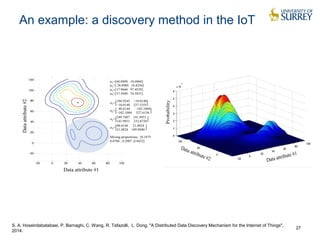
An example: a discovery method in the IoT
27
S. A. Hoseinitabatabaei, P. Barnaghi, C. Wang, R. Tafazolli, L. Dong, "A Distributed Data Discovery Mechanism for the Internet of Things",
2014.
28
Semantic descriptions can be fairly
static on the Web;
In the IoT, the meaning of data and
the annotations can change over
time/space…
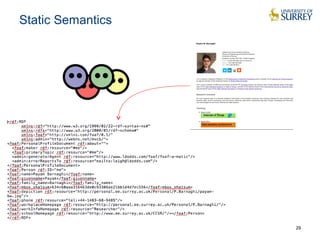
Static Semantics
29
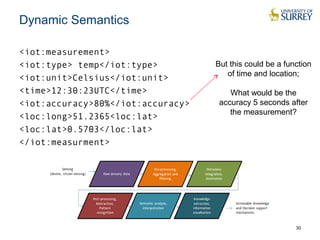
Dynamic Semantics
<iot:measurement>
<iot:type> temp</iot:type>
<iot:unit>Celsius</iot:unit>
<time>12:30:23UTC</time>
<iot:accuracy>80%</iot:accuracy>
<loc:long>51.2365<loc:lat>
<loc:lat>0.5703</loc:lat>
</iot:measurment>
30
But this could be a function
of time and location;
What would be the
accuracy 5 seconds after
the measurement?
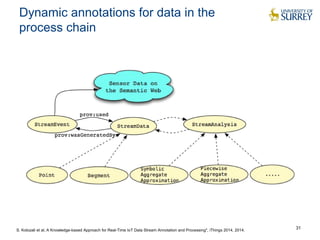
Dynamic annotations for data in the
process chain
31S. Kolozali et al, A Knowledge-based Approach for Real-Time IoT Data Stream Annotation and Processing", iThings 2014, 2014.
Overall, we need semantic technologies
in the IoT and these play a key role in
providing interoperability.
However, we should design and use
the semantics carefully and
consider the constraints and
dynamicity of the IoT environments.
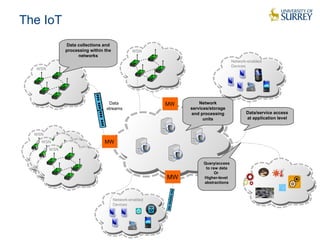
The IoT
WSN
WSN
WSN
WSN
WSN
Network-enabled
Devices
Network-enabled
Devices
Network
services/storage
and processing
units
Data/service access
at application level
Data collections and
processing within the
networks
Query/access
to raw data
Or
Higher-level
abstractions
MWMW
MWMW
MWMWData
streams
#1: Design for large-scale and provide tools and
APIs.
#2: Think of who will use the semantics and how
when you design your models.
#3: Provide means to update and change the
semantic annotations.
35
#4: Create tools for validation and interoperability
testing.
#5: Create taxonomies and vocabularies.
#6: Of course you can always create a better
model, but try to re-use existing ones as much as
you can.
36
#7: Link your data and descriptions to other
existing resources.
#8: Define rules and/or best practices for providing
the values for each attribute.
#9: Remember the widely used semantic
descriptions on the Web are simple ones like
FOAF.
37
#10: Semantics are only one part of the solution
and often not the end-product so the focus of the
design should be on creating effective methods,
tools and APIs to handle and process the
semantics.
Query methods, machine learning, reasoning and
data analysis techniques and methods should be
able to effectively use these semantics.
38
In Conclusion
Q&A
− Thank you.
− EU FP7 CityPulse Project:
http://www.ict-citypulse.eu/
@pbarnaghi
p.barnaghi@surrey.ac.uk
http://personal.ee.surrey.ac.uk/Personal/P.Barnaghi/

Dynamic Semantics for the Internet of Things

  • 1.
    Dynamic Semantics forthe Internet of Things 1 Payam Barnaghi Institute for Communication Systems (ICS) University of Surrey Guildford, United Kingdom
  • 2.
    2 Things, Devices, Data,and lots of it image courtesy: Smarter Data - I.03_C by Gwen Vanhee
  • 3.
    Data in theIoT − Data is collected by sensory devices and also crowd sensing sources. − It is time and location dependent. − It can be noisy and the quality can vary. − It is often continuous - streaming data. − There are other important issues such as: − Device/network management − Actuation and feedback (command and control) − Service and entity descriptions are also important.
  • 4.
    Internet of Things:The story so far RFID based solutions Wireless Sensor and Actuator networks , solutions for communication technologies, energy efficiency, routing, … Smart Devices/ Web-enabled Apps/Services, initial products, vertical applications, early concepts and demos, … Motion sensor Motion sensor ECG sensor Physical-Cyber-Social Systems, Linked-data, semantics, M2M, More products, more heterogeneity, solutions for control and monitoring, … Future: Cloud, Big (IoT) Data Analytics, Interoperability, Enhanced Cellular/Wireless Com. for IoT, Real-world operational use-cases and Industry and B2B services/applications, more Standards…
  • 5.
    Scale of theproblem 5 Things Data Devices 2.5 quintillion bytes per day Billions and Billions of them… Estimated 50 Billion by 2020
  • 6.
    Heterogeneity, multi-modality andvolume are among the key issues. We need interoperable and machine- interpretable solutions… 6
  • 7.
    Human Brain and(Sensory) Big Data − Collecting the data is done by human senses but encoding and retrieving it is a bigger challenge. − The two key properties of the human brain and its design are Richness and Associative Access*. − Associative access enables us to access our thoughts in different ways by semantic or perceptual associations. − Brian can process these data and provide actionable-knowledge. 7 Image source: Wikipedia * The organised Mind, Daniel J. Levitin, Penguin Books.
  • 8.
    IoT and and(Sensory) Big Data − Collecting data is not the most difficult challenge (of course we still need better devices, more energy efficient devices/way of collecting data, intelligent networks and better telecom) − The biggest challenge is to organise and access/retrieve data more efficiently and by using different (high-level) associations. − We need to integrate different sources and process/analyse them to extract actionable- information from the raw data. − Semantic technologies and rich metadata seem to be the way forward. 8
  • 9.
    9 But why don’twe still have fully integrated semantic solutions in the IoT?
  • 10.
    10 Some good existingmodels: SSN Ontology Ontology Link: http://www.w3.org/2005/Incubator/ssn/ssnx/ssn M. Compton et al, "The SSN Ontology of the W3C Semantic Sensor Network Incubator Group", Journal of Web Semantics, 2012.
  • 11.
    Several ontologies anddescription models 11
  • 12.
    12 We have goodmodels and description frameworks; The problem is that having good models and developing ontologies is not enough.
  • 13.
    13 Semantic descriptions areintermediary solutions, not the end product. They should be transparent to the end- user and probably to the data producer as well.
  • 14.
    A WoT/IoT Framework WSN WSN WSN WSN WSN Network-enabled Devices Semantically annotatedata 14 Gateway CoAP HTTP CoAP CoAP HTTP 6LowPAN Semantically annotate data http://mynet1/snodeA23/readTemp? WSN MQTT MQTT Gateway And several other protocols and solutions…
  • 15.
    Publishing Semantic annotations −We need a model (ontology) – this is often the easy part for a single application. − Interoperability between the models is a big issue. − Express-ability vs Complexity is a challenge. − How and where to add the semantics − Where to publish and store them − Semantic descriptions for data, streams, devices (resources) and entities that are represented by the devices, and description of the services. 15
  • 16.
    16 Simplicity can bevery useful…
  • 17.
    Hyper/CAT 17 Source: Toby Jaffey,HyperCat Consortium, http://www.hypercat.io/standard.html - Servers provide catalogues of resources to clients. - A catalogue is an array of URIs. - Each resource in the catalogue is annotated with metadata (RDF-like triples).
  • 18.
    Hyper/CAT model 18 Source: TobyJaffey, HyperCat Consortium, http://www.hypercat.io/standard.html
  • 19.
    19 Complex models are(sometimes) good for publishing research papers…. But they are often difficult to implement and use in real world products.
  • 20.
    What happens afterwardsis more important − How to index and query the annotated data − How to make the publication suitable for constrained environments and/or allow them to scale − How to query them (considering the fact that here we are dealing with live data and often reducing the processing time and latency is crucial) − Linking to other sources 20
  • 21.
    The IoT isa dynamic, online and rapidly changing world 21 isPartOf Annotation for the (Semantic) Web Annotation for the IoT Image sources: ABC Australia and 2dolphins.com
  • 22.
  • 23.
    23 Creating common vocabulariesand taxonomies are also equally important e.g. event taxonomies.
  • 24.
    24 We should acceptthe fact that sometimes we do not need (full) semantic descriptions. Think of the applications and use-cases before starting to annotate the data.
  • 25.
    An example: adiscovery method in the IoT time location type Query formulating [#location | #type | time][#location | #type | time] Discovery ID Discovery/ DHT Server Data repository (archived data) #location #type #location #type #location #type Data hypercube Gateway Core network Network Connection Logical Connection Data
  • 26.
    An example: adiscovery method in the IoT 26 S. A. Hoseinitabatabaei, P. Barnaghi, C. Wang, R. Tafazolli, L. Dong, "A Distributed Data Discovery Mechanism for the Internet of Things", 2014.
  • 27.
    An example: adiscovery method in the IoT 27 S. A. Hoseinitabatabaei, P. Barnaghi, C. Wang, R. Tafazolli, L. Dong, "A Distributed Data Discovery Mechanism for the Internet of Things", 2014.
  • 28.
    28 Semantic descriptions canbe fairly static on the Web; In the IoT, the meaning of data and the annotations can change over time/space…
  • 29.
  • 30.
  • 31.
    Dynamic annotations fordata in the process chain 31S. Kolozali et al, A Knowledge-based Approach for Real-Time IoT Data Stream Annotation and Processing", iThings 2014, 2014.
  • 32.
    Overall, we needsemantic technologies in the IoT and these play a key role in providing interoperability.
  • 33.
    However, we shoulddesign and use the semantics carefully and consider the constraints and dynamicity of the IoT environments.
  • 34.
    The IoT WSN WSN WSN WSN WSN Network-enabled Devices Network-enabled Devices Network services/storage and processing units Data/serviceaccess at application level Data collections and processing within the networks Query/access to raw data Or Higher-level abstractions MWMW MWMW MWMWData streams
  • 35.
    #1: Design forlarge-scale and provide tools and APIs. #2: Think of who will use the semantics and how when you design your models. #3: Provide means to update and change the semantic annotations. 35
  • 36.
    #4: Create toolsfor validation and interoperability testing. #5: Create taxonomies and vocabularies. #6: Of course you can always create a better model, but try to re-use existing ones as much as you can. 36
  • 37.
    #7: Link yourdata and descriptions to other existing resources. #8: Define rules and/or best practices for providing the values for each attribute. #9: Remember the widely used semantic descriptions on the Web are simple ones like FOAF. 37
  • 38.
    #10: Semantics areonly one part of the solution and often not the end-product so the focus of the design should be on creating effective methods, tools and APIs to handle and process the semantics. Query methods, machine learning, reasoning and data analysis techniques and methods should be able to effectively use these semantics. 38 In Conclusion
  • 39.
    Q&A − Thank you. −EU FP7 CityPulse Project: http://www.ict-citypulse.eu/ @pbarnaghi p.barnaghi@surrey.ac.uk http://personal.ee.surrey.ac.uk/Personal/P.Barnaghi/