Universidad Pedagógica Experimental Libertador
        Instituto Pedagógico de Caracas
           Departamento de Idiomas
           Evaluación de los procesos


        Testing Listening & vocabulary


                                               Luis Fontiveros
                                            Angélica Rodríguez
         Caracas, 25 de mayo de 2012
When we learn a language, there are four skills that we need in order to
complete communication. When we learn our native language, we usually learn
to listen first, then to speak, then to read, and finally to write. These are called
the four "language skills“


Skill # 1: LISTENING


Testing listening:


• Testing listening separately from speaking
Specifying what the candidate should be able to do

Macro- Skills:

• Listening for specific information

• Obtaining gist of what is being said

• Following directions

• Following instructions


Micro skills:

• Interpretation of intonation patterns (Recognition of sarcasm, etc)

•Recognition of function of structures (such as interrogative as request, for
example, Could you pass the salt?)
Types of text


   These might be first specified as monologue, dialogue or multiparticipant; and
further specified: announcement, talk or lecture, instructions, directions, etc.


Addressees
     Texts might be intended for general public, students (either specialists or
generalists), young children and so on.
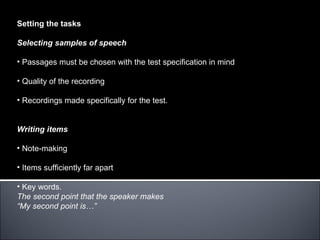
Setting the tasks

Selecting samples of speech

• Passages must be chosen with the test specification in mind

• Quality of the recording

• Recordings made specifically for the test.


Writing items

• Note-making

• Items sufficiently far apart

• Key words.
The second point that the speaker makes
“My second point is…”
Possible techniques

• Multiple choice: Alternatives must be short and simple.


   The following alternatives, which appear in a sample listening test of a well-
known examination , are probably too complex.

   When stopped by the police, how is the motorist advised to behave?

     A. He should say nothing until he has seen his lawyer.
     B. He should give only what additional information the law requires.
     C. He should say only what the law requires.
     D. He should in no circumstances say anything

• Short answer
•Note taking

• Recording or live presentations


 Scoring the listening test.
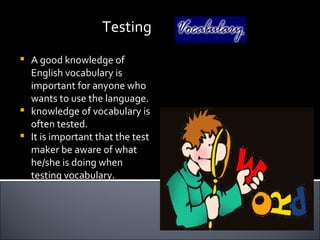
Testing
   A good knowledge of
    English vocabulary is
    important for anyone who
    wants to use the language.
   knowledge of vocabulary is
    often tested.
   It is important that the test
    maker be aware of what
    he/she is doing when
    testing vocabulary.
   *Speaking vocabulary

   *Listening vocabulary

   *Reading vocabulary

   *Writing vocabulary
   A test may test one or all of these types of
    vocabulary, but the test maker should be aware of
    the differences among these types and which is
    being tested.
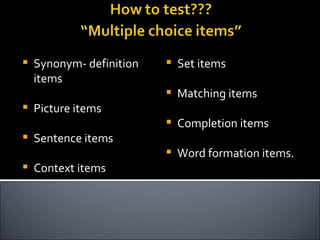
   Synonym- definition      Set items
    items
                             Matching items
   Picture items
                             Completion items
   Sentence items
                             Word formation items.
   Context items
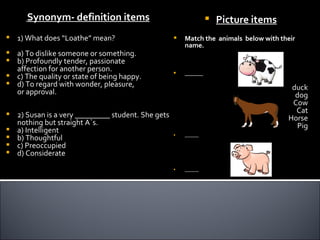
Synonym- definition items                                       Picture items
   1) What does “Loathe” mean?                         Match the animals below with their
                                                         name.
 a) To dislike someone or something.
 b) Profoundly tender, passionate
  affection for another person.                         _______
 c) The quality or state of being happy.
 d) To regard with wonder, pleasure,
                                                                                         duck
  or approval.                                                                            dog
                                                                                         Cow
                                                                                          Cat
   2) Susan is a very _________ student. She gets                                      Horse
    nothing but straight A`s.                                                             Pig
   a) Intelligent
    b) Thoughtful                                        _______
                                                     

   c) Preoccupied
   d) Considerate
                                                        _______
   Sentence items                                     Context items
                                                 Example 1.
                                                    Would you please _____ the proposal?
   You're blocking the TV.
                                                     a. consider b. think c. make d. give
    to block the TV = to obscure it from view.
                                                    “In this case, "think" (about) is similar to the
   The astronauts are preparing for                 correct answer, but it does not fit
                                                     grammatically. While a few of these types of
    touchdown tomorrow morning.                      items might be acceptable, too many of them
                                                     will put too much emphasis on grammar rather
    touchdown= the landing of a spacecraft.          than vocabulary.”
   It was not possible for the rescue           Example 2. Sometimes vocabulary items test
    workers to find the survivors.                  collocations.
                                                    I _____ my watch to see what time it was.
    rescue workers = workers helping people
    who suffered an accident.                        a. looked at b. saw c. watched d. gazed at
                                                    “In this case, what is being tested is the
                                                     knowledge of the collocation "look at my
                                                     watch." Again, knowing collocations is part of
                                                     knowing vocabulary, but the test should not be
                                                     dominated by such items.”
   Set items                    Matching items
   Example 1. Circle the word that      Match the karate techniques with its
                                          description by placing the letter of the
    does not fit.                         definition in the space.
    dollar
    yen                                  1.   _____   Kick          A. Yako zuki
    pound                                2.   _____   Punch          B. Geri
    money                                3.   _____   Block          C. Zuki
                                         4.   _____   Straight punch D. Barai
 Example 2. Write down the                                           E. Migi
  subject that each group of words                                    F. Yoko geri
  is related to.
 bedroom
  living room
  kitchen
  dining room
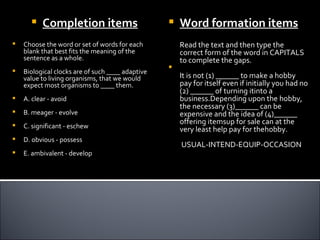
    Completion items                          Word formation items
   Choose the word or set of words for each          Read the text and then type the
    blank that best fits the meaning of the           correct form of the word in CAPITALS
    sentence as a whole.                              to complete the gaps.
                                                  
   Biological clocks are of such ____ adaptive
    value to living organisms, that we would          It is not (1) ______ to make a hobby
    expect most organisms to ____ them.               pay for itself even if initially you had no
                                                      (2) ______ of turning itinto a
   A. clear - avoid                                  business.Depending upon the hobby,
                                                      the necessary (3)______ can be
   B. meager - evolve                                expensive and the idea of (4)______
                                                      offering itemsup for sale can at the
   C. significant - eschew                           very least help pay for thehobby.
   D. obvious - possess
                                                      USUAL-INTEND-EQUIP-OCCASION
   E. ambivalent - develop
   S. Kathleen Kitao : Doshisha Women's College : Kyoto, Japan

    http://www.cis.doshisha.ac.jp/kkitao/library/article/test/vocab.htm

   http://dictionary.reference.com

   Baxter, A. Evaluating your students. Chapter 6,7.

   Harris, M. & McCann, P. Assessment; Chapter 1.

   Hughes Testing for lanuage teachers. Chapter 10,11.

Presentación2 (2) luis

  • 1.
    Universidad Pedagógica ExperimentalLibertador Instituto Pedagógico de Caracas Departamento de Idiomas Evaluación de los procesos Testing Listening & vocabulary Luis Fontiveros Angélica Rodríguez Caracas, 25 de mayo de 2012
  • 2.
    When we learna language, there are four skills that we need in order to complete communication. When we learn our native language, we usually learn to listen first, then to speak, then to read, and finally to write. These are called the four "language skills“ Skill # 1: LISTENING Testing listening: • Testing listening separately from speaking
  • 3.
    Specifying what thecandidate should be able to do Macro- Skills: • Listening for specific information • Obtaining gist of what is being said • Following directions • Following instructions Micro skills: • Interpretation of intonation patterns (Recognition of sarcasm, etc) •Recognition of function of structures (such as interrogative as request, for example, Could you pass the salt?)
  • 4.
    Types of text These might be first specified as monologue, dialogue or multiparticipant; and further specified: announcement, talk or lecture, instructions, directions, etc. Addressees Texts might be intended for general public, students (either specialists or generalists), young children and so on.
  • 5.
    Setting the tasks Selectingsamples of speech • Passages must be chosen with the test specification in mind • Quality of the recording • Recordings made specifically for the test. Writing items • Note-making • Items sufficiently far apart • Key words. The second point that the speaker makes “My second point is…”
  • 6.
    Possible techniques • Multiplechoice: Alternatives must be short and simple. The following alternatives, which appear in a sample listening test of a well- known examination , are probably too complex. When stopped by the police, how is the motorist advised to behave? A. He should say nothing until he has seen his lawyer. B. He should give only what additional information the law requires. C. He should say only what the law requires. D. He should in no circumstances say anything • Short answer
  • 7.
    •Note taking • Recordingor live presentations  Scoring the listening test.
  • 8.
    Testing  A good knowledge of English vocabulary is important for anyone who wants to use the language.  knowledge of vocabulary is often tested.  It is important that the test maker be aware of what he/she is doing when testing vocabulary.
  • 9.
    *Speaking vocabulary  *Listening vocabulary  *Reading vocabulary  *Writing vocabulary
  • 10.
    A test may test one or all of these types of vocabulary, but the test maker should be aware of the differences among these types and which is being tested.
  • 11.
    Synonym- definition  Set items items  Matching items  Picture items  Completion items  Sentence items  Word formation items.  Context items
  • 12.
    Synonym- definition items  Picture items  1) What does “Loathe” mean?  Match the animals below with their name.  a) To dislike someone or something.  b) Profoundly tender, passionate affection for another person.  _______  c) The quality or state of being happy.  d) To regard with wonder, pleasure, duck or approval. dog Cow Cat  2) Susan is a very _________ student. She gets Horse nothing but straight A`s. Pig  a) Intelligent b) Thoughtful _______    c) Preoccupied  d) Considerate  _______
  • 13.
    Sentence items  Context items Example 1.  Would you please _____ the proposal?  You're blocking the TV. a. consider b. think c. make d. give to block the TV = to obscure it from view.  “In this case, "think" (about) is similar to the  The astronauts are preparing for correct answer, but it does not fit grammatically. While a few of these types of touchdown tomorrow morning. items might be acceptable, too many of them will put too much emphasis on grammar rather touchdown= the landing of a spacecraft. than vocabulary.”  It was not possible for the rescue Example 2. Sometimes vocabulary items test workers to find the survivors. collocations.  I _____ my watch to see what time it was. rescue workers = workers helping people who suffered an accident. a. looked at b. saw c. watched d. gazed at  “In this case, what is being tested is the knowledge of the collocation "look at my watch." Again, knowing collocations is part of knowing vocabulary, but the test should not be dominated by such items.”
  • 14.
    Set items  Matching items  Example 1. Circle the word that  Match the karate techniques with its description by placing the letter of the does not fit. definition in the space. dollar yen  1. _____ Kick A. Yako zuki pound  2. _____ Punch B. Geri money  3. _____ Block C. Zuki  4. _____ Straight punch D. Barai  Example 2. Write down the E. Migi subject that each group of words F. Yoko geri is related to.  bedroom living room kitchen dining room
  • 15.
    Completion items  Word formation items  Choose the word or set of words for each Read the text and then type the blank that best fits the meaning of the correct form of the word in CAPITALS sentence as a whole. to complete the gaps.   Biological clocks are of such ____ adaptive value to living organisms, that we would It is not (1) ______ to make a hobby expect most organisms to ____ them. pay for itself even if initially you had no (2) ______ of turning itinto a  A. clear - avoid business.Depending upon the hobby, the necessary (3)______ can be  B. meager - evolve expensive and the idea of (4)______ offering itemsup for sale can at the  C. significant - eschew very least help pay for thehobby.  D. obvious - possess USUAL-INTEND-EQUIP-OCCASION  E. ambivalent - develop
  • 16.
    S. Kathleen Kitao : Doshisha Women's College : Kyoto, Japan http://www.cis.doshisha.ac.jp/kkitao/library/article/test/vocab.htm  http://dictionary.reference.com  Baxter, A. Evaluating your students. Chapter 6,7.  Harris, M. & McCann, P. Assessment; Chapter 1.  Hughes Testing for lanuage teachers. Chapter 10,11.