LEXICAL ANALYSIS
1.

WORD-FORMS
WORD-FORMS
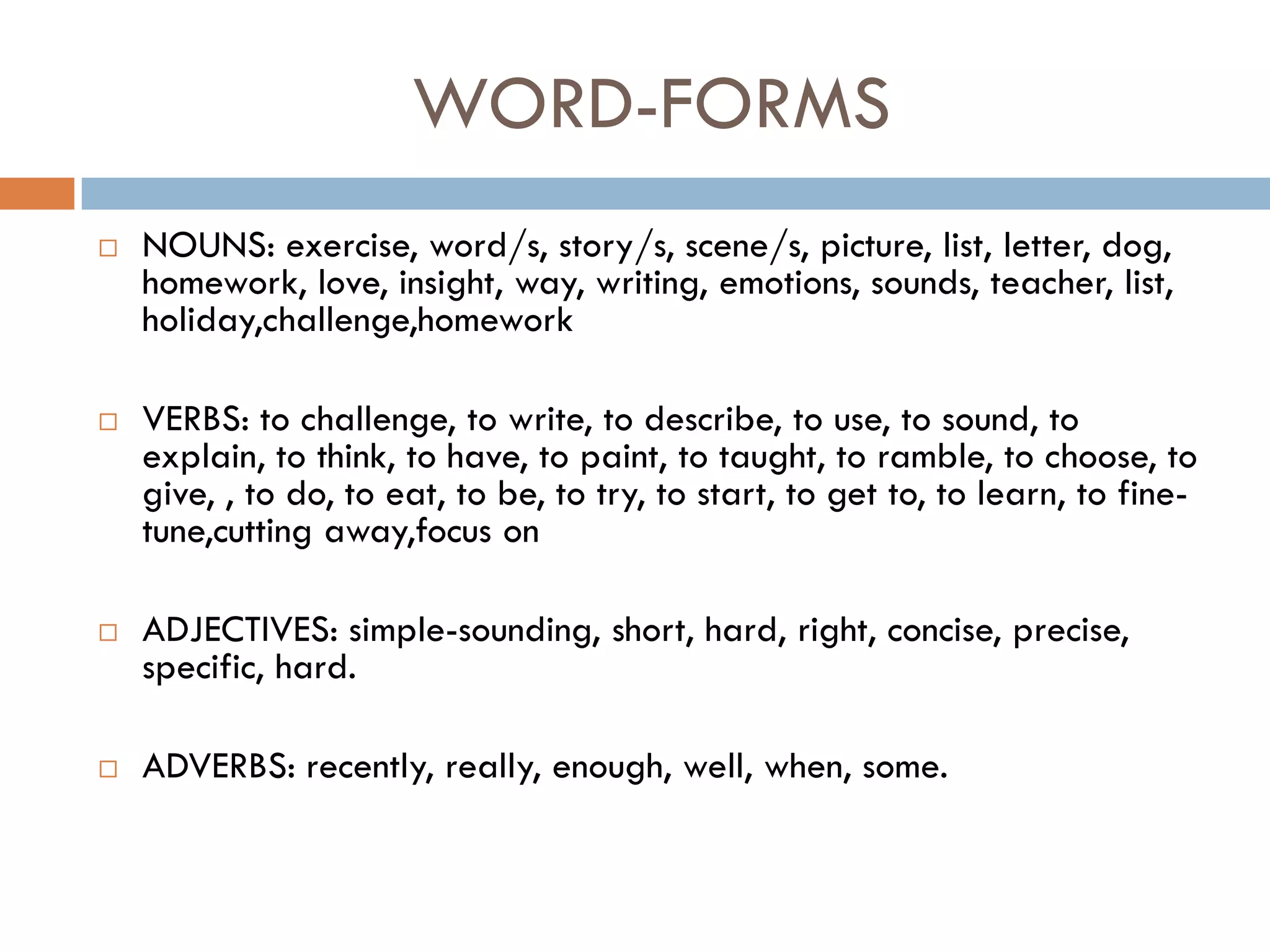
   NOUNS: exercise, word/s, story/s, scene/s, picture, list, letter, dog,
    homework, love, insight, way, writing, emotions, sounds, teacher, list,
    holiday,challenge,homework

   VERBS: to challenge, to write, to describe, to use, to sound, to
    explain, to think, to have, to paint, to taught, to ramble, to choose, to
    give, , to do, to eat, to be, to try, to start, to get to, to learn, to fine-
    tune,cutting away,focus on

   ADJECTIVES: simple-sounding, short, hard, right, concise, precise,
    specific, hard.

   ADVERBS: recently, really, enough, well, when, some.
2.
MORPHOLOGICAL ANALYSIS
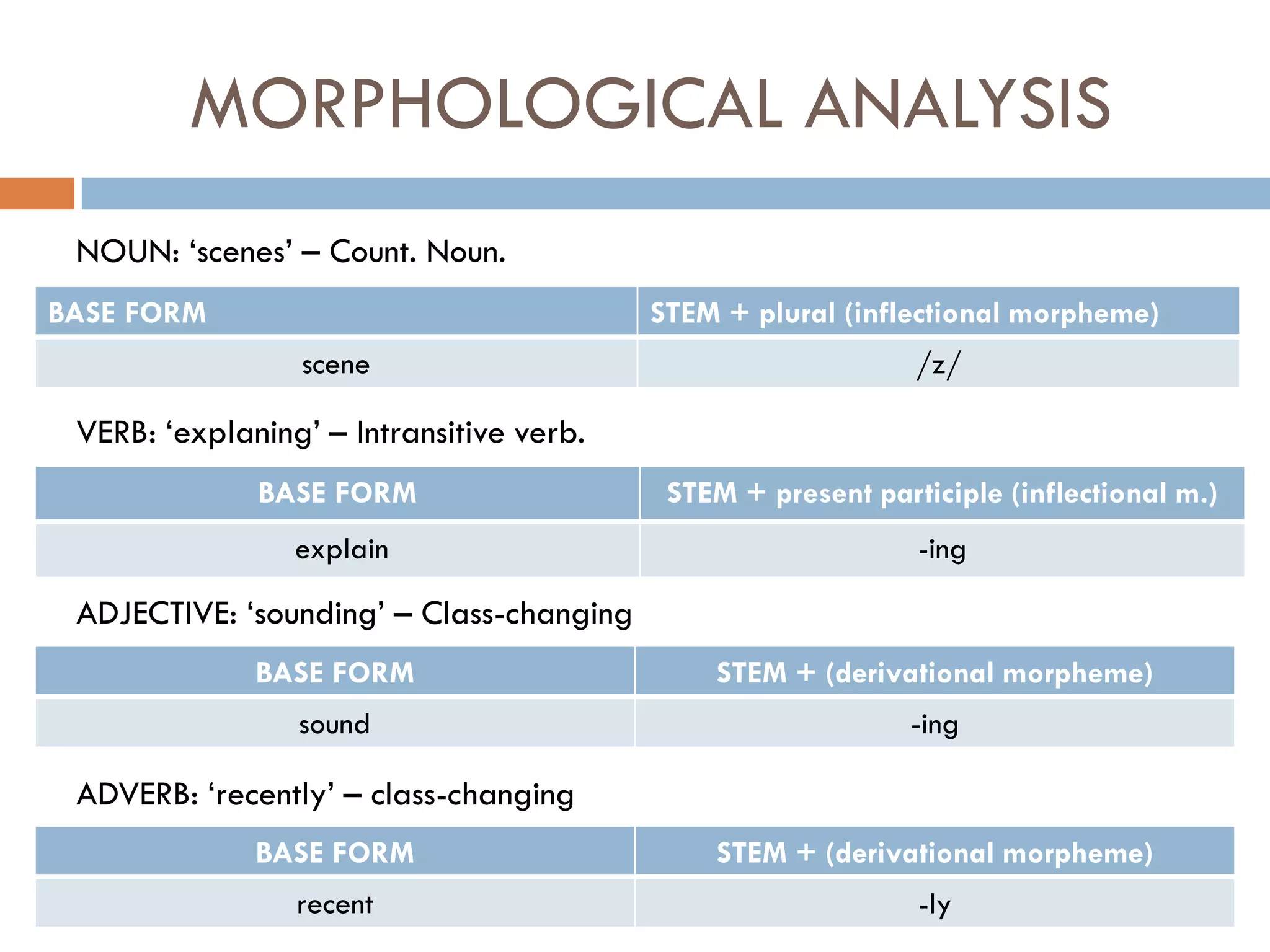
 NOUN: „scenes‟ – Count. Noun.
BASE FORM                                 STEM + plural (inflectional morpheme)
                 scene                                        /z/

 VERB: „explaning‟ – Intransitive verb.
              BASE FORM                    STEM + present participle (inflectional m.)
                 explain                                      -ing

 ADJECTIVE: „sounding‟ – Class-changing
              BASE FORM                       STEM + (derivational morpheme)
                 sound                                        -ing

 ADVERB: „recently‟ – class-changing
              BASE FORM                       STEM + (derivational morpheme)
                 recent                                       -ly
3.
ETYMOLOGY & DIACHRONIC CHANGE
ETYMOLOGY
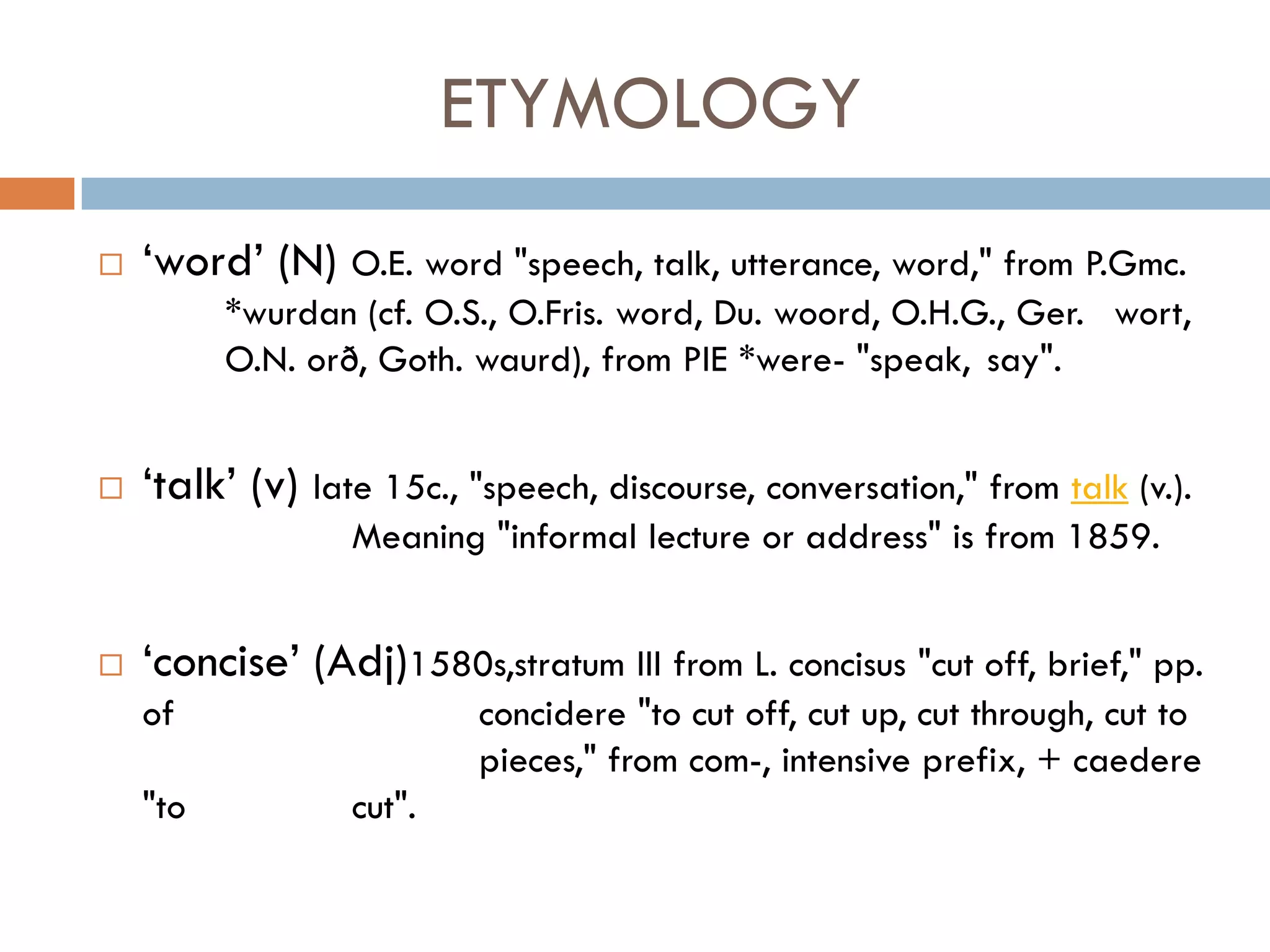
   „word‟ (N) O.E. word "speech, talk, utterance, word," from P.Gmc.
          *wurdan (cf. O.S., O.Fris. word, Du. woord, O.H.G., Ger. wort,
          O.N. orð, Goth. waurd), from PIE *were- "speak, say".


   „talk‟ (v) late 15c., "speech, discourse, conversation," from talk (v.).
                  Meaning "informal lecture or address" is from 1859.


   „concise‟ (Adj)1580s,stratum III from L. concisus "cut off, brief," pp.
    of                     concidere "to cut off, cut up, cut through, cut to
                           pieces," from com-, intensive prefix, + caedere
    "to           cut".
SEMANTIC DIACHRONIC CHANGE
   „challenge‟
[c.1200] O.Fr. Chalengier, from L. calumniari, from calumnia
[late 13c.] "calumny, slander"
[17c.] “a calling to fight”
[1985] “disabled”

 „try‟
BROADENING
[12 c.] “to pick out, cull”.
[c.1300] "examine judiciously, sit in judgment of"."
[early 14 c.] “attempt to do”
[mid-14 c.] "to test”
[1530s] "to subject to some strain" (of patience, endurance, etc.).
[1956]To try (something) on for size in the figurative sense.
4.
TYPES & SUBTYPES OF
LEXICAL UNITS
NOUNS

   Basic: scene, word, list, letter, dog, homework, time, story, love, insight, way, writing, emotion, holiday, son,
    teacher.
   Non-basic: exercise, challenge, picture, problem,
   Complex/derived (with affixation):
Preffixation:

„insight‟ -> [in(ADV) + „sight‟ (n) = „insight‟ (N)] (denominal noun: class-maintaining preffixation: an instance of

    apprehending the true nature of a thing, especially through intuitive understanding).


Suffixation:

„writing‟ -> [„write‟ (V) + ing = „writing‟ (N)] (deverbal noun: class-changing suffixation: the act of a person or

    thing that writes).

„teacher‟ -> [teach (V) + er = „teacher‟ (N)] (deverbal noun: Class-changing suffixation: a person who teaches

    in a school).
2
  Compounded:
   Endocentric:
„homework‟ [home (N) + work (N) = homework (N)] FRASE
„holiday‟ -> [holy (ADJ) + „day‟ (N) = „holiday‟ (N)]
Writing exercise n+n
„SIMPLE-SOUNDING‟ ADJ + ADJ
 Converted:

„writing‟ (V> N)
„challenge‟ (N>V)
VERBS
   Basic: write, use, sound, explain, think, have, paint, talk, give, pull, choose, do, eat, can, try, could, fine-tune,
    get, learn.
   Non- basic: challenge, describe, ramble.
   Converted:


„challenge‟[N > V]
„use‟ [V<N]
„sound‟ [N > V]
„thought‟ [N > V]
„paint‟ [N > V]
„ramble‟ [N > V]
„try‟ [N > V]
COMPOUND:
„ fine.tune‟[fine (Adj) + tune (v) = fine-tune (v) : make small adjustments to in order to achieve the best
      performance]
ADJECTIVES
   Basic: simple, sounding, short, hard, right.

   Non-basic: concise, precise, specific.

  Complex/derived:
Prefixation:
„sounding‟ [sound (N) + -ing = sounding (adj)] (denominal
   adjective: class-changing preffixation).

  Converted:
„sounding‟ (N > Adj)
5.
SEMANTIC ANALYSIS
PHRASAL VERBS

  Focus on
[Transitive] if you focus your attention on something, you look at it or think
   about it carefully and concentrate on it.
“To focus attention on…”
“Attention focused on John”

   Get to
[Intransitive] Have a very good and friendly relationship.
“Mother and I get on very well”
[Transitive] If you get a piece of clothing on, you put it on.
“She told them to put their scarves on”.
6.
       HOMONYMIC CLASHES

1.   HOMONYMS
2.   HOMOPHONES
3.   HOMOGRAPHS
1. HOMONYMS
SOUND /saʊnd/ PARTIAL

  Sound1 (n) [Middle English soun, from Anglo-Norman French
   soun (noun), suner (verb), from Latin sonus.] vibrations that
   travel through the air or another medium and can be heard
   when they reach a person„s or animal‟s ear.
light travels faster than sound

  Sound2 (adj) [Middle English from Old English gesund, of
   West Germanic origin] in good condition; not damaged,
   injured, or diseased.
they returned safe and sound
   LIST /lɪst/ PARTIAL

List1 (n) [late 16th century, from French liste, of Germanic origin]a number of connected
    items or names written or printed consecutively, typically one below the other
Consult the list of drugs on page 326

List2 (v) [arly 17th century](of a ship) lean over to one side, typically because of a leak or
    unbalanced cargo.
During the storm the boat listed badly.

List3 (v) [Old English lystan (verb), of Germanic origin]
want; like
let them think what they list
WELL /wɛl/ PARTIAL
       1
 Well (adv) [Old English wel(l), of Germanic origin] in
   a good or satisfactory way
the whole team played well

 Well2 (n) [Old English wella, of Germanic origin] a
  shaft sunk into the ground to obtain water, oil, or gas.
put the flour on a flat surface and make a well to hold the
  eggs
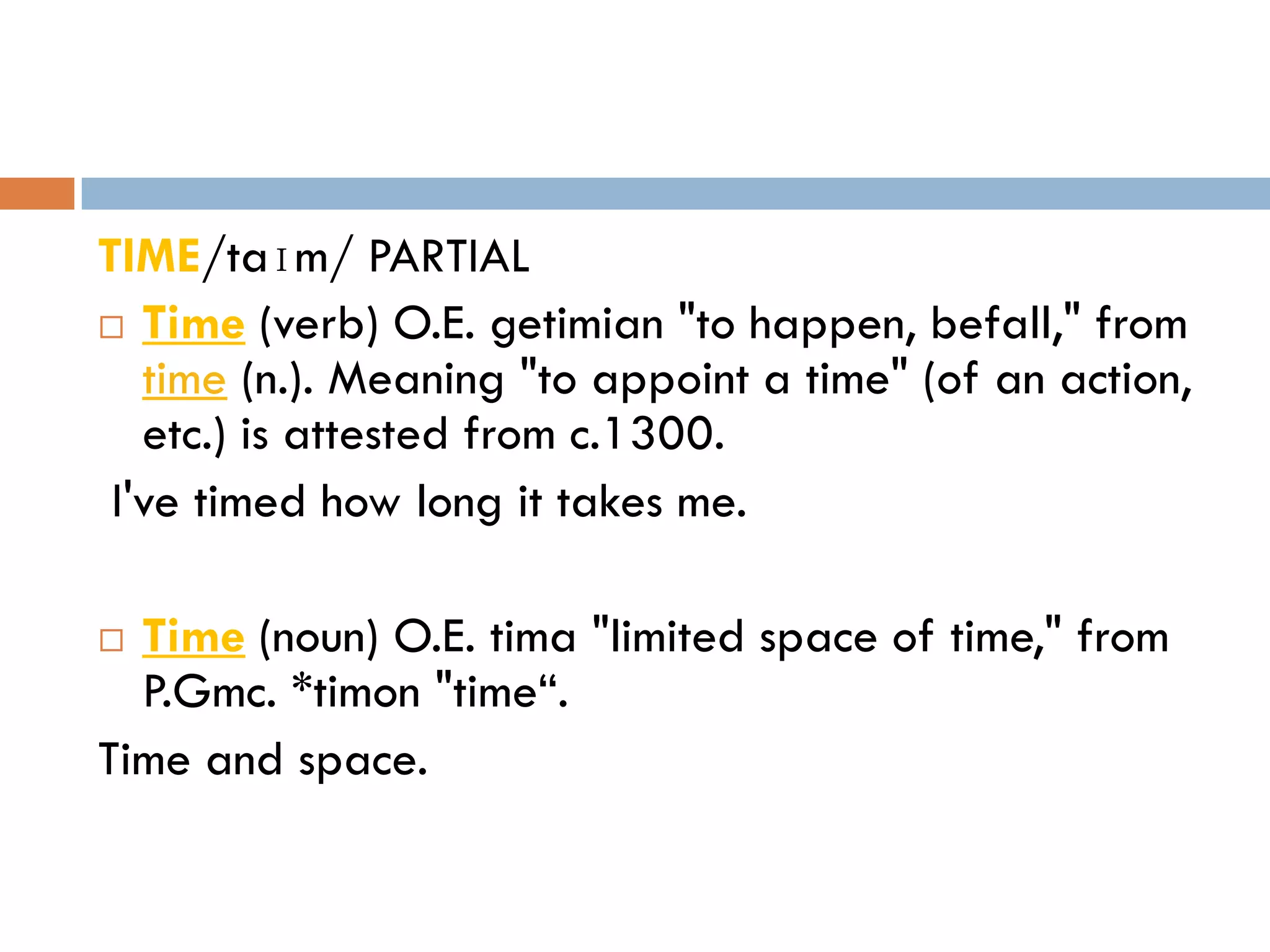
TIME/taɪm/ PARTIAL
 Time (verb) O.E. getimian "to happen, befall," from
   time (n.). Meaning "to appoint a time" (of an action,
   etc.) is attested from c.1300.
 I've timed how long it takes me.

 Time (noun) O.E. tima "limited space of time," from
  P.Gmc. *timon "time“.
Time and space.
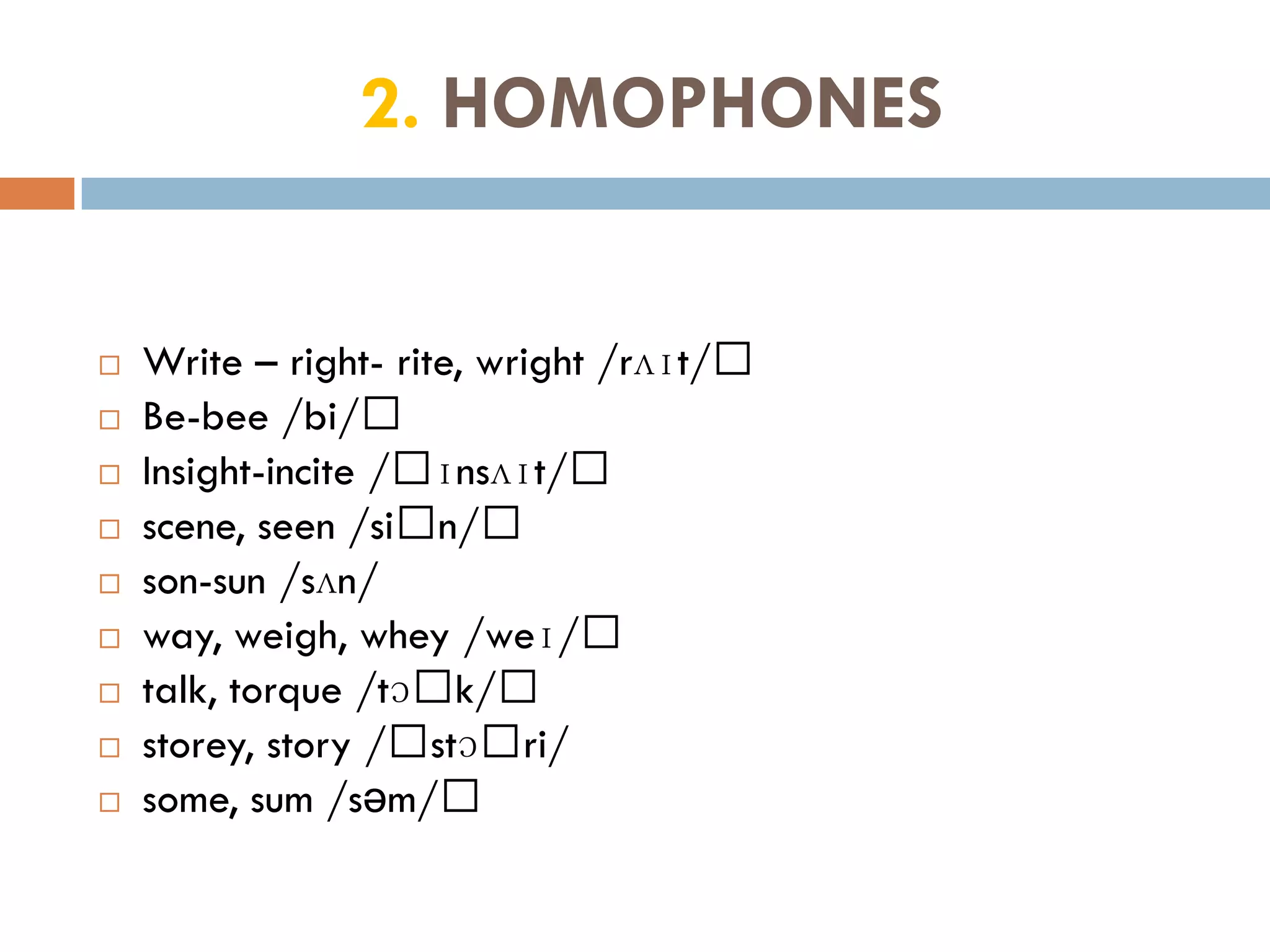
2. HOMOPHONES


   Write – right- rite, wright /rʌɪt/
   Be-bee /bi/
   Insight-incite /ɪnsʌɪt/
   scene, seen /sin/
   son-sun /sʌn/
   way, weigh, whey /weɪ/
   talk, torque /tɔk/
   storey, story /stɔri/
   some, sum /səm/
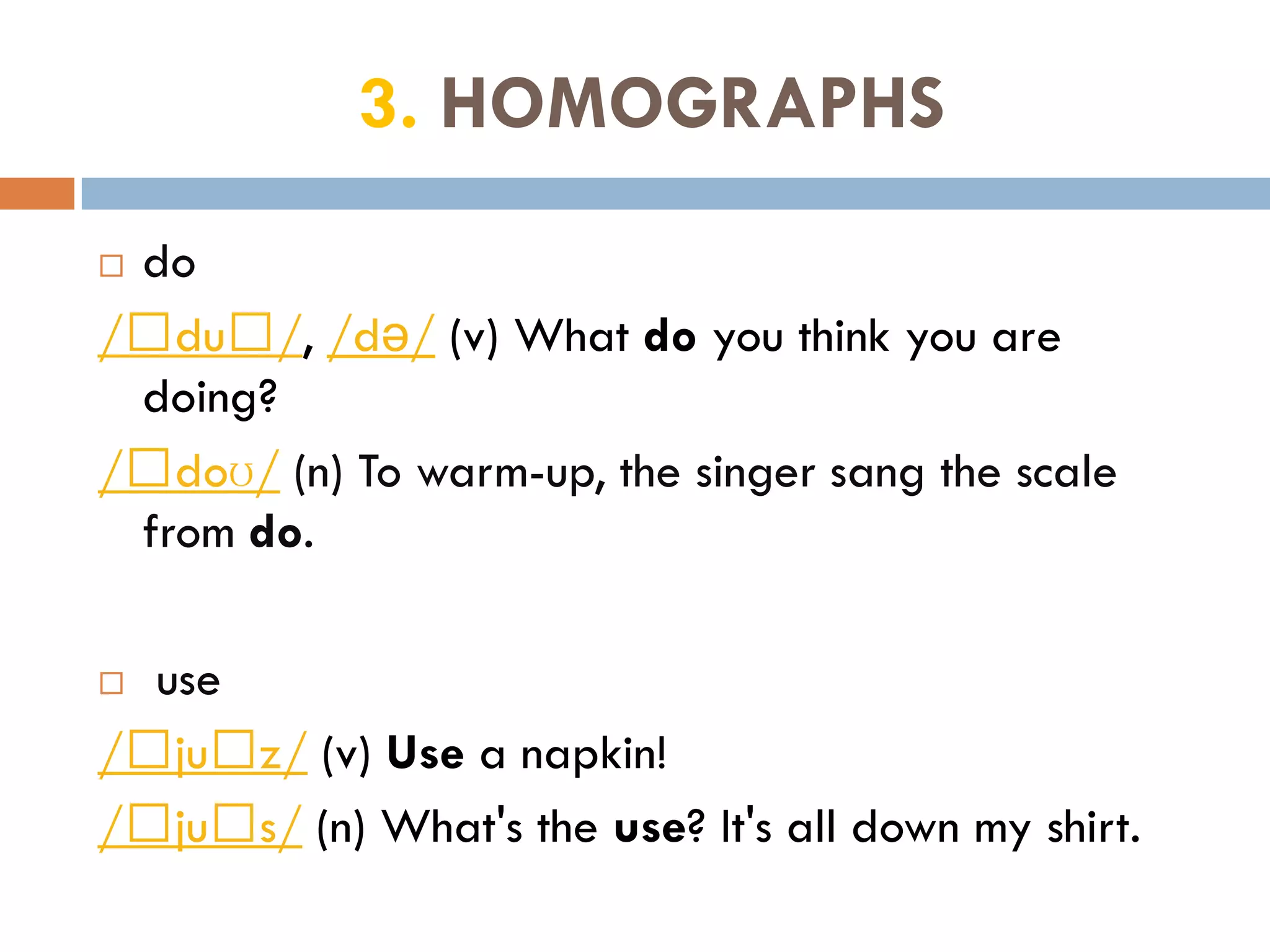
3. HOMOGRAPHS
do
/du/, /də/ (v) What do you think you are
 doing?
/doʊ/ (n) To warm-up, the singer sang the scale
 from do.

 use
/juz/ (v) Use a napkin!
/jus/ (n) What's the use? It's all down my shirt.
7. ANALYSIS OF POLYSEMYC STRUCTURES
NOUNS
1.   „way‟
2.   „word‟


VERBS
1.   „write‟
2.   „give‟


ADJECTIVES
1.   „simple‟
2.   „right‟
NOUN

1. „way‟
A) Deambiguating contexts

              1.There are two ways of approaching this problem
              2. Can you tell me the way to Leicester Square?
              3. the national vote split three ways
              4. the dinghy lost way and drifted towards the shore
              5. my grandchildren are way ahead of others their age
              (…)
B) Senses
    (a) a method, style, or manner of doing something; an optional or alternative form of action
    (b) a road, track , or path for travelling along
    (c) parts into which something divides or is divided
    (d) forward motion or momentum of a ship or boat through water
    (e)at or to a considerable distance or extent
    (…)
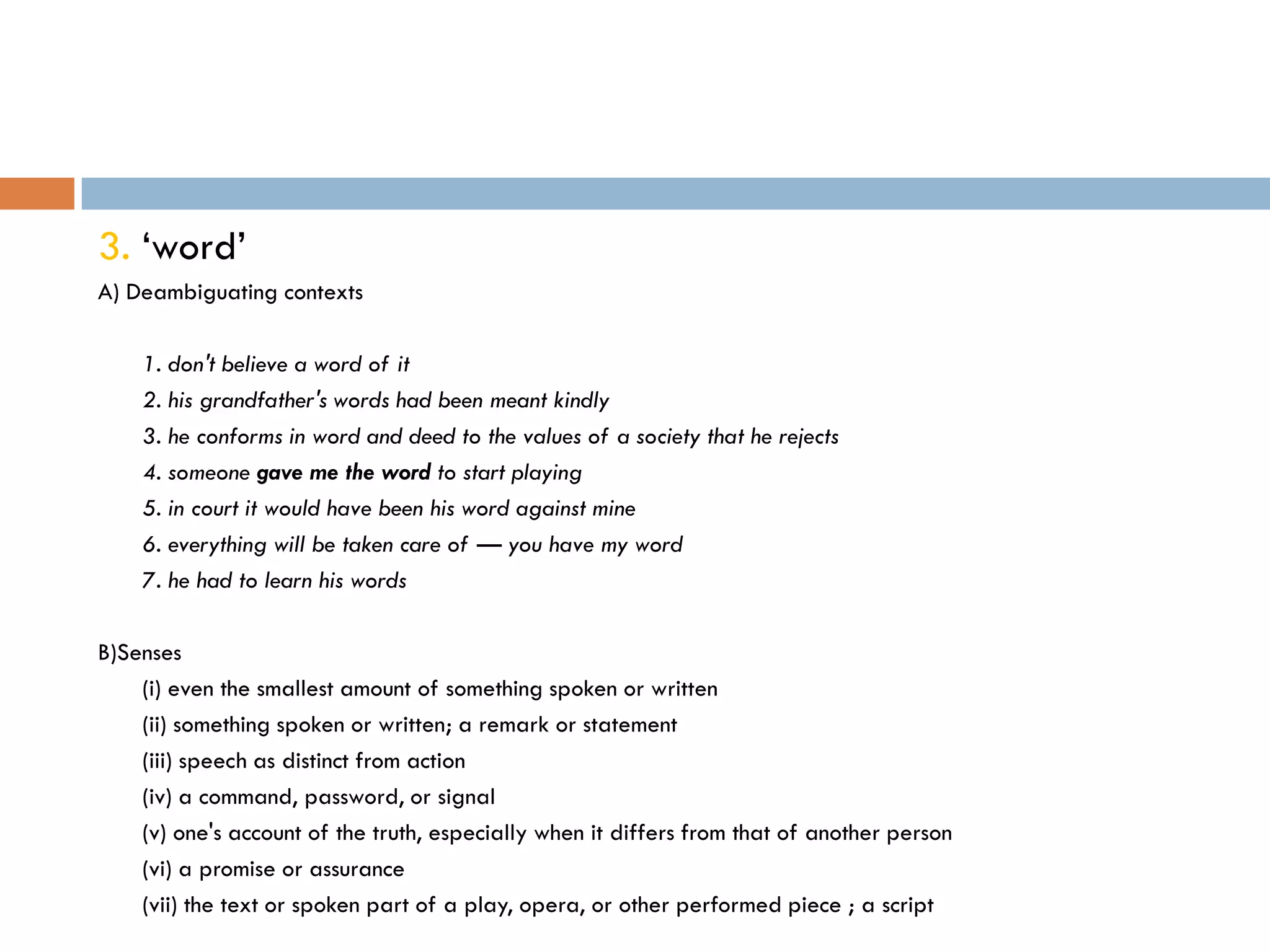
3. „word‟
A) Deambiguating contexts

    1. don't believe a word of it
    2. his grandfather's words had been meant kindly
    3. he conforms in word and deed to the values of a society that he rejects
    4. someone gave me the word to start playing
    5. in court it would have been his word against mine
    6. everything will be taken care of — you have my word
    7. he had to learn his words

B)Senses
    (i) even the smallest amount of something spoken or written
    (ii) something spoken or written; a remark or statement
    (iii) speech as distinct from action
    (iv) a command, password, or signal
    (v) one's account of the truth, especially when it differs from that of another person
    (vi) a promise or assurance
    (vii) the text or spoken part of a play, opera, or other performed piece ; a script
VERBS
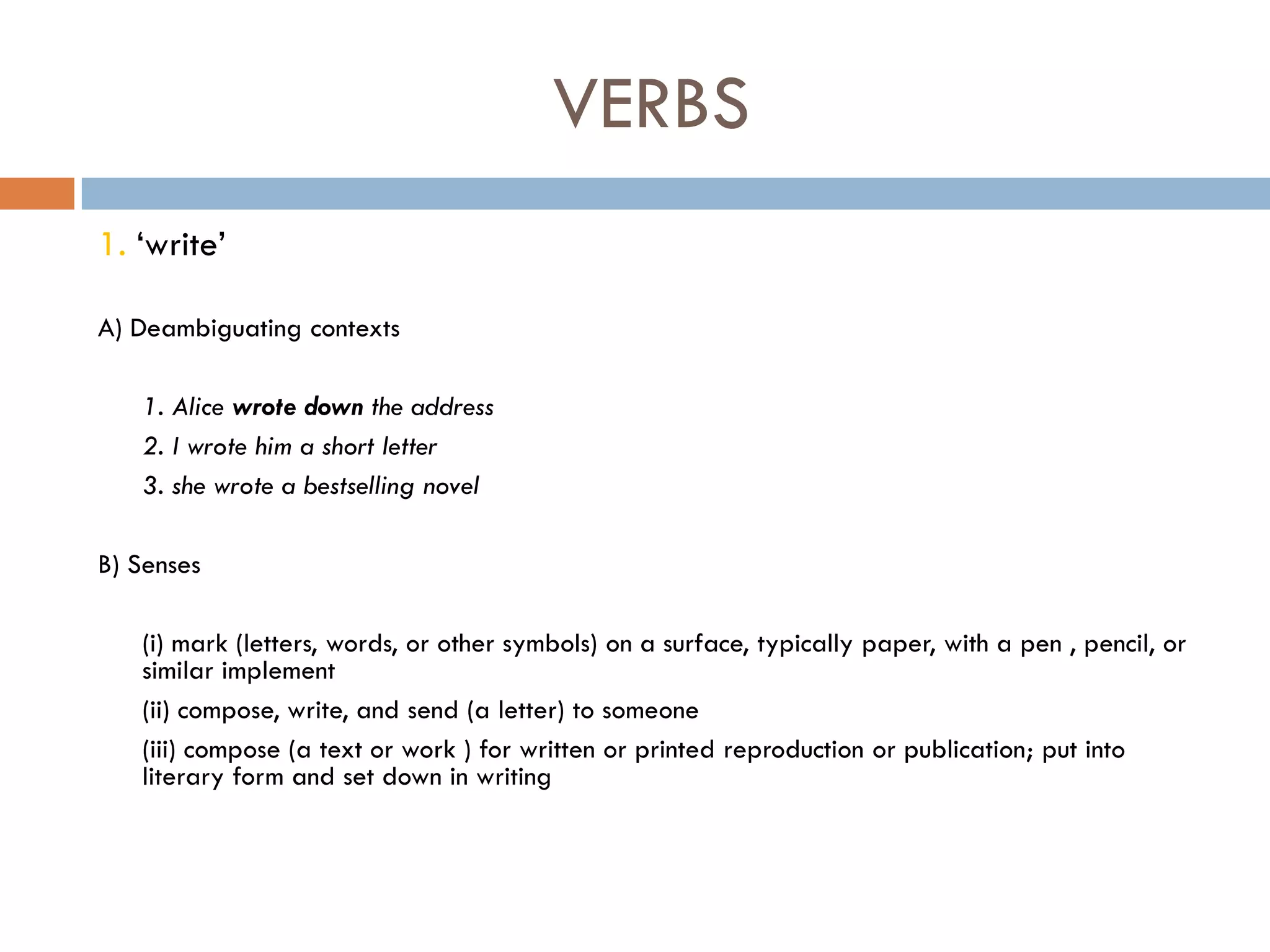
1. „write‟

A) Deambiguating contexts

   1. Alice wrote down the address
   2. I wrote him a short letter
   3. she wrote a bestselling novel

B) Senses

   (i) mark (letters, words, or other symbols) on a surface, typically paper, with a pen , pencil, or
   similar implement
   (ii) compose, write, and send (a letter) to someone
   (iii) compose (a text or work ) for written or printed reproduction or publication; put into
   literary form and set down in writing
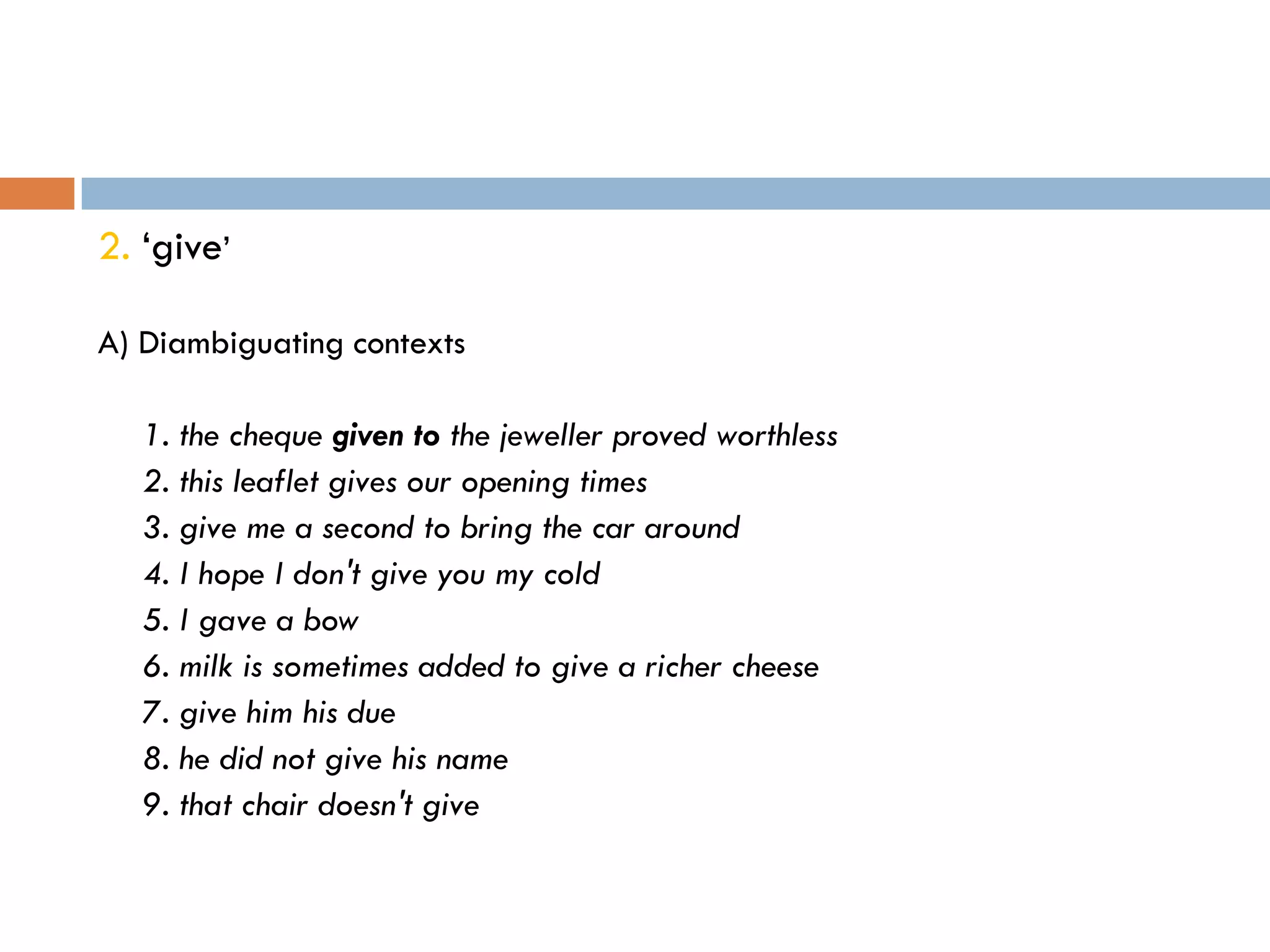
2. „give‟

A) Diambiguating contexts

   1. the cheque given to the jeweller proved worthless
   2. this leaflet gives our opening times
   3. give me a second to bring the car around
   4. I hope I don't give you my cold
   5. I gave a bow
   6. milk is sometimes added to give a richer cheese
   7. give him his due
   8. he did not give his name
   9. that chair doesn't give
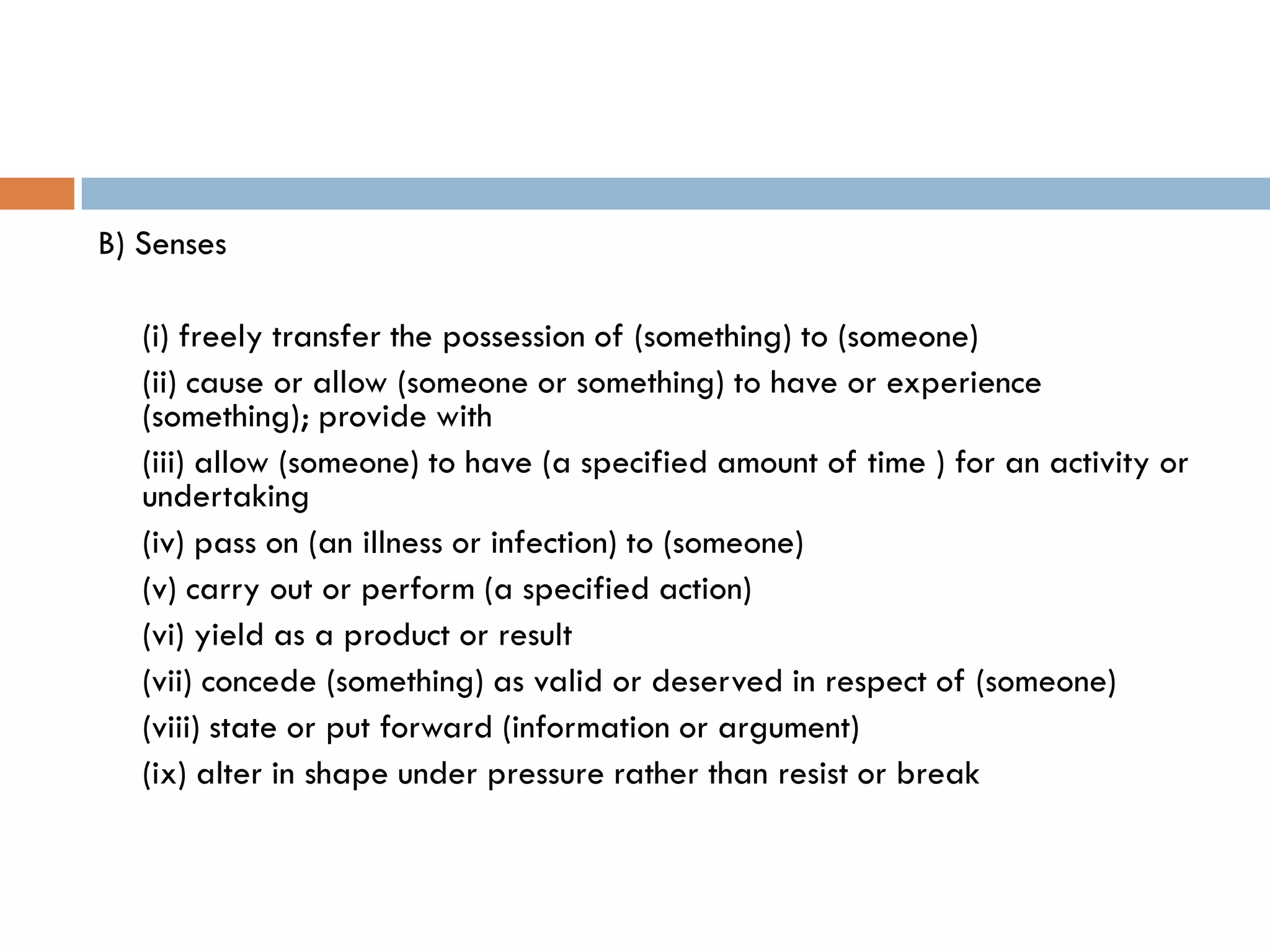
B) Senses

   (i) freely transfer the possession of (something) to (someone)
   (ii) cause or allow (someone or something) to have or experience
   (something); provide with
   (iii) allow (someone) to have (a specified amount of time ) for an activity or
   undertaking
   (iv) pass on (an illness or infection) to (someone)
   (v) carry out or perform (a specified action)
   (vi) yield as a product or result
   (vii) concede (something) as valid or deserved in respect of (someone)
   (viii) state or put forward (information or argument)
   (ix) alter in shape under pressure rather than resist or break
1. „simple‟

A) Diambiguating contexts

    1. camcorders are now so simple to operate
    2. the house is furnished in a simple country style
    3. consisting of a single lens or component
    4. She is very simple

B) Senses

(i) easily understood or done ; presenting no difficulty
(ii) plain, basic, or uncomplicated in form , nature, or design; without much decoration or ornamentation
(iii) composed of a single element; not compound
(iv) of very low intelligence
2. „right‟

A) Diambiguating contexts

    1. hope we're doing the right thing
    2.her theories were proved right
    3.that sausage doesn't smell right
    4. the right edge of the field
    5. I felt a right idiot
    6. are you politically right, left, or centre?

B) Senses

    (i) morally good, justified, or acceptable
    (ii) true or correct as a fact
    (iii) in a satisfactory, sound, or normal state or condition
    (iv) on , towards, or relating to the side of a human body or of a thing which is to the east when the person
    or thing is facing north
    (v) British informal complete; absolute (used for emphasis)
    (vi) relating to a person or group favouring conservative views
8. METHOD OF LEXICAL DESCOMPOSITION

‘dog’ (noun)
‘talk’(verb)
‘short’ (adjective)
„dog‟ (n)
a)
[+ concrete]
[+animate]
[- human]
[+ animal]

b)
[mammal]
[canine]
[+- male]
[+- adult]

c)
<barking voice, cute sense of smell, retractile claws >
<domesticated animal>
„talk‟ (v)
(a) SB/STH [+-Human]   (Agent/Force)
(b) To communicate     (Causation)
(c) SB/STH [+-Human]   (Patient)
(d) Communication      (Event)
(e) [+-Formal]
„short‟ (Adj)
(OF STH)
HAVING/SHOWING
SMALL LENGTH OR DURATION
(eg. THE BOOK WAS TOO SHORT)
9.
  MAJOR LEXICAL FIELDS
GROUPS & SUBGROUPS OF
       LEXEMES
NOUNS
a) CONCRETE ENTITIES

 [+CONCRETE, +ANIMATE]

ANIMAL ENTITY [+-LIVING]

ANIMAL [organism belonging to Kingdom Animalia]

    DOG [ DOMESTICAL CARNIVOROUS MAMMAL]


HUMAN ENTITY

   PERSON [INDIVIDUAL HUMAN BEING]

       TEACHER [ ONE WHO TEACHS ESPECIALLY ONE HIRED ]

       SON [A BOY OR MAN IN RELATION TO HIS PARENTS]

    [+CONCRETE, -ANIMATE]

             PICTURE [a painting, drawing, or photograpaph]

             LIST [STATIONARY: a number of connected items or names written consecutively].

             LETTER [STATIONARY: a character representing one or more of the sounds used in speech]

             HOMEWORK [--------: school work that a pupil is required to do at home].
b) ABSTRACT ENTITIES


       [-CONCRETE]

[WRITTEN PROCESS: DOING STH]

  EXERCISE [ACT OF WRITING STH: to accomplish sth].
  WORD [PART OF A WRITTEN TEXT]
  WRITING [PART OF A WRITTEN TEXT: to express sth].

[COMMUNICATION PROCESS: ACT OF EXCHANGING INFORMATION]

 CHALLENGE [ACT OF COMMUNICATING STH: to dare sb to do sth].
 STORY [ACT OF TELLING STH: in order to entertain].
 SCENE [ ACT OF REPRESENTING STH: acts, incidents, emotions].
[TEMPORALITY: DAY]


 TIME [PERIOD OF A DAY: specific point of time].


[UNWELCOME/HARMFUL MATTER]


 PROBLEM [sth difficult to achieve].


[QUANTITY: AMOUNT]


 LOT [set of things].


[EMOTIONAL PROCESS: TO EXPERIENCE FEELINGS]


 LOVE [deep romantic or sexual attachment to someone].


[UNDERSTANDING PROCESS: CAPACITY TO GAIN SHT]
    INSIGHT [ special perception of sth]
[SENSE PROCESS: ACT OF EXPERIENCING FELLINGS]
  EMOTION [ to feel joy, anger, or sadness].

[METHODOLOGICAL PROCESS: DOING STH]
  WAY [ACTING STYLE: to choose the specific mood in
  order to act].

[TEMPORALITY: CONCRETE MOMENT]
  HOLIDAY [ PERIOD OF TIME: [extended period of
   recreation away from home].
ADJECTIVES
[PHYSICAL PROPERTY]
   [DIMENSIONAL STATE]
        SIZE
           SHORT [length of sth].
        VOLUME
           SOUNDING [of sth: BEING AUDIBLE].

[NON-DIMENSIONAL]
    [SOMATIC STATE]
       HARD [of sth: BECOMING DIFFICULT TO ACHIEVE]
[EMOTIONAL/AFFECTIVE STATE]
    PRECISE [of sb: BEING OCCURATE].
    CONCISE [of sb: BEING CLEAR AND SHORT ].
    SPECIFIC [of sb: RELATING UNIQUELY]
[EVALUATION: AESTHETIC, MORAL, NOETIC]
    SIMPLE [of sth: SHOWING SIMPLICITY].
    RIGHT [of sth: CHOOSING THE SUITABLE THING].

VERBS:


[RELATIONAL STATE]


    [ATRIBUTIVE, DESCRIPTIVE, IDENTIFIER, CIRCUMSTANCIAL]
    BE (CONCISE)
    SOUND


[BEHAVIOURAL PROCESS]
    [ACTIVITY, ACT]
    WRITE [mark (letters, words, or other symbols) on a surface, with a pen, pencil, or similar implement.]
    GIVE [freely transfer the possession of; cause to receive or have]
    DO [perform or carry out (an action). ]
    USE [take, hold, or deploy as a means of achieving something. ]
    FINE-TUNE [make small adjustments to in order to achieve the best performance.]
    DESCRIBE [give a detailed account of (someone or something) in words. ]
    (LOCO)MOTION
    RAMBLE
FEEDING
    EAT (TO PUT FOOD INTO THE MOUTH AND CHEW AND SWALLOW IT)


    EFFECTIVE
    PAINT (TO APPLY PAINT TO)
    CHALLENGE (TO DISPUTE THE TRUTH OR VALIDITY OF STH)


[COGNITIVE PROCESS]
    MENTAL
    THINK (TO HAVE A PSRTICULAR OPINION OR IDEA ABOUT STH OR SB)
    CHOOSE (TO DECIDE ON A COURSE OF ACTION)
    LEARN (TO ACQUIERE KNOWLEDGE OF OR SKILL IN THROUGH STUDY OR   EXPERIENCE )


[COMMUNICTION PROCESS]
    VERBAL
    TALK (TO GIVE INFORMATION OR EXPRESS IDEAS OR FEELINGS)
    EXPLAIN (TO MAKE STH CLEAR BY PROVIDING MORE DETAILS)
[MATERIAL PROCESS]
   TRANSACTIONAL

[INCEPTIVE PROCESS]
    START, BEGIN TO
    TRY [make an attempt or effort to do something]

[INCHOATIVE PROCESS]
    BECOME

[CAUSATIVE PROCESS]
    CAUSE / MAKE

   HAVE [TO POSSES, OWN, OR HOLD]
   GET (TO COME TO HAVE OR HOLD; RECEVIE)

Lexical analysis

  • 1.
  • 2.
  • 3.
    WORD-FORMS  NOUNS: exercise, word/s, story/s, scene/s, picture, list, letter, dog, homework, love, insight, way, writing, emotions, sounds, teacher, list, holiday,challenge,homework  VERBS: to challenge, to write, to describe, to use, to sound, to explain, to think, to have, to paint, to taught, to ramble, to choose, to give, , to do, to eat, to be, to try, to start, to get to, to learn, to fine- tune,cutting away,focus on  ADJECTIVES: simple-sounding, short, hard, right, concise, precise, specific, hard.  ADVERBS: recently, really, enough, well, when, some.
  • 4.
  • 5.
    MORPHOLOGICAL ANALYSIS NOUN:„scenes‟ – Count. Noun. BASE FORM STEM + plural (inflectional morpheme) scene /z/ VERB: „explaning‟ – Intransitive verb. BASE FORM STEM + present participle (inflectional m.) explain -ing ADJECTIVE: „sounding‟ – Class-changing BASE FORM STEM + (derivational morpheme) sound -ing ADVERB: „recently‟ – class-changing BASE FORM STEM + (derivational morpheme) recent -ly
  • 6.
  • 7.
    ETYMOLOGY  „word‟ (N) O.E. word "speech, talk, utterance, word," from P.Gmc. *wurdan (cf. O.S., O.Fris. word, Du. woord, O.H.G., Ger. wort, O.N. orð, Goth. waurd), from PIE *were- "speak, say".  „talk‟ (v) late 15c., "speech, discourse, conversation," from talk (v.). Meaning "informal lecture or address" is from 1859.  „concise‟ (Adj)1580s,stratum III from L. concisus "cut off, brief," pp. of concidere "to cut off, cut up, cut through, cut to pieces," from com-, intensive prefix, + caedere "to cut".
  • 8.
    SEMANTIC DIACHRONIC CHANGE  „challenge‟ [c.1200] O.Fr. Chalengier, from L. calumniari, from calumnia [late 13c.] "calumny, slander" [17c.] “a calling to fight” [1985] “disabled”  „try‟ BROADENING [12 c.] “to pick out, cull”. [c.1300] "examine judiciously, sit in judgment of"." [early 14 c.] “attempt to do” [mid-14 c.] "to test” [1530s] "to subject to some strain" (of patience, endurance, etc.). [1956]To try (something) on for size in the figurative sense.
  • 9.
    4. TYPES & SUBTYPESOF LEXICAL UNITS
  • 10.
    NOUNS  Basic: scene, word, list, letter, dog, homework, time, story, love, insight, way, writing, emotion, holiday, son, teacher.  Non-basic: exercise, challenge, picture, problem,  Complex/derived (with affixation): Preffixation: „insight‟ -> [in(ADV) + „sight‟ (n) = „insight‟ (N)] (denominal noun: class-maintaining preffixation: an instance of apprehending the true nature of a thing, especially through intuitive understanding). Suffixation: „writing‟ -> [„write‟ (V) + ing = „writing‟ (N)] (deverbal noun: class-changing suffixation: the act of a person or thing that writes). „teacher‟ -> [teach (V) + er = „teacher‟ (N)] (deverbal noun: Class-changing suffixation: a person who teaches in a school).
  • 11.
    2  Compounded: Endocentric: „homework‟ [home (N) + work (N) = homework (N)] FRASE „holiday‟ -> [holy (ADJ) + „day‟ (N) = „holiday‟ (N)] Writing exercise n+n „SIMPLE-SOUNDING‟ ADJ + ADJ  Converted: „writing‟ (V> N) „challenge‟ (N>V)
  • 12.
    VERBS  Basic: write, use, sound, explain, think, have, paint, talk, give, pull, choose, do, eat, can, try, could, fine-tune, get, learn.  Non- basic: challenge, describe, ramble.  Converted: „challenge‟[N > V] „use‟ [V<N] „sound‟ [N > V] „thought‟ [N > V] „paint‟ [N > V] „ramble‟ [N > V] „try‟ [N > V] COMPOUND: „ fine.tune‟[fine (Adj) + tune (v) = fine-tune (v) : make small adjustments to in order to achieve the best performance]
  • 13.
    ADJECTIVES  Basic: simple, sounding, short, hard, right.  Non-basic: concise, precise, specific.  Complex/derived: Prefixation: „sounding‟ [sound (N) + -ing = sounding (adj)] (denominal adjective: class-changing preffixation).  Converted: „sounding‟ (N > Adj)
  • 14.
  • 15.
    PHRASAL VERBS  Focus on [Transitive] if you focus your attention on something, you look at it or think about it carefully and concentrate on it. “To focus attention on…” “Attention focused on John”  Get to [Intransitive] Have a very good and friendly relationship. “Mother and I get on very well” [Transitive] If you get a piece of clothing on, you put it on. “She told them to put their scarves on”.
  • 16.
    6. HOMONYMIC CLASHES 1. HOMONYMS 2. HOMOPHONES 3. HOMOGRAPHS
  • 17.
    1. HOMONYMS SOUND /saʊnd/PARTIAL  Sound1 (n) [Middle English soun, from Anglo-Norman French soun (noun), suner (verb), from Latin sonus.] vibrations that travel through the air or another medium and can be heard when they reach a person„s or animal‟s ear. light travels faster than sound  Sound2 (adj) [Middle English from Old English gesund, of West Germanic origin] in good condition; not damaged, injured, or diseased. they returned safe and sound
  • 18.
    LIST /lɪst/ PARTIAL List1 (n) [late 16th century, from French liste, of Germanic origin]a number of connected items or names written or printed consecutively, typically one below the other Consult the list of drugs on page 326 List2 (v) [arly 17th century](of a ship) lean over to one side, typically because of a leak or unbalanced cargo. During the storm the boat listed badly. List3 (v) [Old English lystan (verb), of Germanic origin] want; like let them think what they list
  • 19.
    WELL /wɛl/ PARTIAL 1  Well (adv) [Old English wel(l), of Germanic origin] in a good or satisfactory way the whole team played well  Well2 (n) [Old English wella, of Germanic origin] a shaft sunk into the ground to obtain water, oil, or gas. put the flour on a flat surface and make a well to hold the eggs
  • 20.
    TIME/taɪm/ PARTIAL  Time(verb) O.E. getimian "to happen, befall," from time (n.). Meaning "to appoint a time" (of an action, etc.) is attested from c.1300. I've timed how long it takes me.  Time (noun) O.E. tima "limited space of time," from P.Gmc. *timon "time“. Time and space.
  • 21.
    2. HOMOPHONES  Write – right- rite, wright /rʌɪt/  Be-bee /bi/  Insight-incite /ɪnsʌɪt/  scene, seen /sin/  son-sun /sʌn/  way, weigh, whey /weɪ/  talk, torque /tɔk/  storey, story /stɔri/  some, sum /səm/
  • 22.
    3. HOMOGRAPHS do /du/, /də/(v) What do you think you are doing? /doʊ/ (n) To warm-up, the singer sang the scale from do.  use /juz/ (v) Use a napkin! /jus/ (n) What's the use? It's all down my shirt.
  • 23.
    7. ANALYSIS OFPOLYSEMYC STRUCTURES NOUNS 1. „way‟ 2. „word‟ VERBS 1. „write‟ 2. „give‟ ADJECTIVES 1. „simple‟ 2. „right‟
  • 24.
    NOUN 1. „way‟ A) Deambiguatingcontexts 1.There are two ways of approaching this problem 2. Can you tell me the way to Leicester Square? 3. the national vote split three ways 4. the dinghy lost way and drifted towards the shore 5. my grandchildren are way ahead of others their age (…) B) Senses (a) a method, style, or manner of doing something; an optional or alternative form of action (b) a road, track , or path for travelling along (c) parts into which something divides or is divided (d) forward motion or momentum of a ship or boat through water (e)at or to a considerable distance or extent (…)
  • 25.
    3. „word‟ A) Deambiguatingcontexts 1. don't believe a word of it 2. his grandfather's words had been meant kindly 3. he conforms in word and deed to the values of a society that he rejects 4. someone gave me the word to start playing 5. in court it would have been his word against mine 6. everything will be taken care of — you have my word 7. he had to learn his words B)Senses (i) even the smallest amount of something spoken or written (ii) something spoken or written; a remark or statement (iii) speech as distinct from action (iv) a command, password, or signal (v) one's account of the truth, especially when it differs from that of another person (vi) a promise or assurance (vii) the text or spoken part of a play, opera, or other performed piece ; a script
  • 26.
    VERBS 1. „write‟ A) Deambiguatingcontexts 1. Alice wrote down the address 2. I wrote him a short letter 3. she wrote a bestselling novel B) Senses (i) mark (letters, words, or other symbols) on a surface, typically paper, with a pen , pencil, or similar implement (ii) compose, write, and send (a letter) to someone (iii) compose (a text or work ) for written or printed reproduction or publication; put into literary form and set down in writing
  • 27.
    2. „give‟ A) Diambiguatingcontexts 1. the cheque given to the jeweller proved worthless 2. this leaflet gives our opening times 3. give me a second to bring the car around 4. I hope I don't give you my cold 5. I gave a bow 6. milk is sometimes added to give a richer cheese 7. give him his due 8. he did not give his name 9. that chair doesn't give
  • 28.
    B) Senses (i) freely transfer the possession of (something) to (someone) (ii) cause or allow (someone or something) to have or experience (something); provide with (iii) allow (someone) to have (a specified amount of time ) for an activity or undertaking (iv) pass on (an illness or infection) to (someone) (v) carry out or perform (a specified action) (vi) yield as a product or result (vii) concede (something) as valid or deserved in respect of (someone) (viii) state or put forward (information or argument) (ix) alter in shape under pressure rather than resist or break
  • 29.
    1. „simple‟ A) Diambiguatingcontexts 1. camcorders are now so simple to operate 2. the house is furnished in a simple country style 3. consisting of a single lens or component 4. She is very simple B) Senses (i) easily understood or done ; presenting no difficulty (ii) plain, basic, or uncomplicated in form , nature, or design; without much decoration or ornamentation (iii) composed of a single element; not compound (iv) of very low intelligence
  • 30.
    2. „right‟ A) Diambiguatingcontexts 1. hope we're doing the right thing 2.her theories were proved right 3.that sausage doesn't smell right 4. the right edge of the field 5. I felt a right idiot 6. are you politically right, left, or centre? B) Senses (i) morally good, justified, or acceptable (ii) true or correct as a fact (iii) in a satisfactory, sound, or normal state or condition (iv) on , towards, or relating to the side of a human body or of a thing which is to the east when the person or thing is facing north (v) British informal complete; absolute (used for emphasis) (vi) relating to a person or group favouring conservative views
  • 31.
    8. METHOD OFLEXICAL DESCOMPOSITION ‘dog’ (noun) ‘talk’(verb) ‘short’ (adjective)
  • 32.
    „dog‟ (n) a) [+ concrete] [+animate] [-human] [+ animal] b) [mammal] [canine] [+- male] [+- adult] c) <barking voice, cute sense of smell, retractile claws > <domesticated animal>
  • 33.
    „talk‟ (v) (a) SB/STH[+-Human] (Agent/Force) (b) To communicate (Causation) (c) SB/STH [+-Human] (Patient) (d) Communication (Event) (e) [+-Formal]
  • 34.
    „short‟ (Adj) (OF STH) HAVING/SHOWING SMALLLENGTH OR DURATION (eg. THE BOOK WAS TOO SHORT)
  • 35.
    9. MAJORLEXICAL FIELDS GROUPS & SUBGROUPS OF LEXEMES
  • 36.
    NOUNS a) CONCRETE ENTITIES [+CONCRETE, +ANIMATE] ANIMAL ENTITY [+-LIVING] ANIMAL [organism belonging to Kingdom Animalia] DOG [ DOMESTICAL CARNIVOROUS MAMMAL] HUMAN ENTITY PERSON [INDIVIDUAL HUMAN BEING] TEACHER [ ONE WHO TEACHS ESPECIALLY ONE HIRED ] SON [A BOY OR MAN IN RELATION TO HIS PARENTS] [+CONCRETE, -ANIMATE] PICTURE [a painting, drawing, or photograpaph] LIST [STATIONARY: a number of connected items or names written consecutively]. LETTER [STATIONARY: a character representing one or more of the sounds used in speech] HOMEWORK [--------: school work that a pupil is required to do at home].
  • 37.
    b) ABSTRACT ENTITIES [-CONCRETE] [WRITTEN PROCESS: DOING STH] EXERCISE [ACT OF WRITING STH: to accomplish sth]. WORD [PART OF A WRITTEN TEXT] WRITING [PART OF A WRITTEN TEXT: to express sth]. [COMMUNICATION PROCESS: ACT OF EXCHANGING INFORMATION] CHALLENGE [ACT OF COMMUNICATING STH: to dare sb to do sth]. STORY [ACT OF TELLING STH: in order to entertain]. SCENE [ ACT OF REPRESENTING STH: acts, incidents, emotions].
  • 38.
    [TEMPORALITY: DAY] TIME[PERIOD OF A DAY: specific point of time]. [UNWELCOME/HARMFUL MATTER] PROBLEM [sth difficult to achieve]. [QUANTITY: AMOUNT] LOT [set of things]. [EMOTIONAL PROCESS: TO EXPERIENCE FEELINGS] LOVE [deep romantic or sexual attachment to someone]. [UNDERSTANDING PROCESS: CAPACITY TO GAIN SHT] INSIGHT [ special perception of sth]
  • 39.
    [SENSE PROCESS: ACTOF EXPERIENCING FELLINGS] EMOTION [ to feel joy, anger, or sadness]. [METHODOLOGICAL PROCESS: DOING STH] WAY [ACTING STYLE: to choose the specific mood in order to act]. [TEMPORALITY: CONCRETE MOMENT] HOLIDAY [ PERIOD OF TIME: [extended period of recreation away from home].
  • 40.
    ADJECTIVES [PHYSICAL PROPERTY] [DIMENSIONAL STATE] SIZE SHORT [length of sth]. VOLUME SOUNDING [of sth: BEING AUDIBLE]. [NON-DIMENSIONAL] [SOMATIC STATE] HARD [of sth: BECOMING DIFFICULT TO ACHIEVE] [EMOTIONAL/AFFECTIVE STATE] PRECISE [of sb: BEING OCCURATE]. CONCISE [of sb: BEING CLEAR AND SHORT ]. SPECIFIC [of sb: RELATING UNIQUELY] [EVALUATION: AESTHETIC, MORAL, NOETIC] SIMPLE [of sth: SHOWING SIMPLICITY]. RIGHT [of sth: CHOOSING THE SUITABLE THING]. 
  • 41.
    VERBS: [RELATIONAL STATE] [ATRIBUTIVE, DESCRIPTIVE, IDENTIFIER, CIRCUMSTANCIAL] BE (CONCISE) SOUND [BEHAVIOURAL PROCESS] [ACTIVITY, ACT] WRITE [mark (letters, words, or other symbols) on a surface, with a pen, pencil, or similar implement.] GIVE [freely transfer the possession of; cause to receive or have] DO [perform or carry out (an action). ] USE [take, hold, or deploy as a means of achieving something. ] FINE-TUNE [make small adjustments to in order to achieve the best performance.] DESCRIBE [give a detailed account of (someone or something) in words. ] (LOCO)MOTION RAMBLE
  • 42.
    FEEDING EAT (TO PUT FOOD INTO THE MOUTH AND CHEW AND SWALLOW IT) EFFECTIVE PAINT (TO APPLY PAINT TO) CHALLENGE (TO DISPUTE THE TRUTH OR VALIDITY OF STH) [COGNITIVE PROCESS] MENTAL THINK (TO HAVE A PSRTICULAR OPINION OR IDEA ABOUT STH OR SB) CHOOSE (TO DECIDE ON A COURSE OF ACTION) LEARN (TO ACQUIERE KNOWLEDGE OF OR SKILL IN THROUGH STUDY OR EXPERIENCE ) [COMMUNICTION PROCESS] VERBAL TALK (TO GIVE INFORMATION OR EXPRESS IDEAS OR FEELINGS) EXPLAIN (TO MAKE STH CLEAR BY PROVIDING MORE DETAILS)
  • 43.
    [MATERIAL PROCESS] TRANSACTIONAL [INCEPTIVE PROCESS] START, BEGIN TO TRY [make an attempt or effort to do something] [INCHOATIVE PROCESS] BECOME [CAUSATIVE PROCESS] CAUSE / MAKE HAVE [TO POSSES, OWN, OR HOLD] GET (TO COME TO HAVE OR HOLD; RECEVIE)