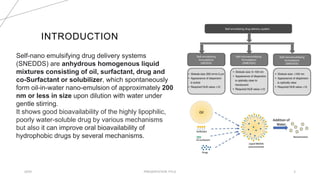
This document summarizes a presentation on self-nanoemulsifying drug delivery systems (SNEDDS). SNEDDS are mixtures that spontaneously form nanoemulsions of approximately 200 nm or less upon dilution with water. They consist of oil, surfactant, drug, and co-surfactant or solubilizer. SNEDDS can improve oral bioavailability of hydrophobic drugs by enhancing dissolution rate and permeability as well as reducing first-pass metabolism. Key factors in formulating SNEDDS include selecting oils, surfactants, and co-emulsifiers that enable nanoemulsification as well as considering the drug properties. SNEDDS provide benefits like increased bioavailability, reduced variability, and a potential for
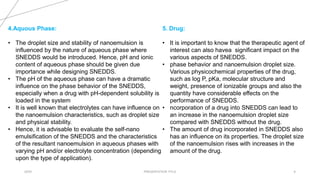
![20XX PRESENTATION TITLE 4
2. Surfactant:
• The concentration of the surfactant in the SNEDDS has considerable influence on the droplet size
of nano-emulsions.
• The acceptability of the selected surfactant for the desired route of administration and its regulatory
status (e.g., generally regarded as safe [GRAS] status) must also be considered during surfactant
selection.
• Cuine and coworkers have demonstrated that the surfactant structure and concentration can
influence the drug precipitation in the GI tract, which in turn influences the bioavailability of
the drug.
• Certain surfactants might cause irritation to the GI mucosa and skin at higher concentrations.
• The surfactants are not innocuous and they have favourable and/or unfavourable biological effects
depending upon the chemical nature and the concentration of the surfactant. The unfavourable
characteristics associated with the surfactant might diminish after association with the oily phase.
• Example of surfactant- Polysorbates(Tween 80, Tween20), Sorbitan esters (Span20, Span60,
Span80), POE-stearate](https://image.slidesharecdn.com/self-nanoemulsifyingdrugdeliverysystems-230202143247-1ab5c978/85/Self-nano-emulsifying-drug-delivery-systems-pptx-4-320.jpg)
![FACTORS LIMITING ORAL BIOAVAILABILITY OF
DRUGS & POTENTIAL OF SNEDDS IN ORAL DRUG
DELIVERY
20XX PRESENTATION TITLE 8
Dissolution rate-limited absorption- These therapeutic agents belong to BCS class II and IV
(e.g., cyclosporine, celecoxib and artemether, among others) the poor dissolution rate of these
compounds is responsible for the poor absorption from the GI tract.
• SNEDDS spontaneously present the drug in very fine nanodroplets offering very high surface
area for absorption. This helps with quick absorption of the drug and improves oral bioavailability.
Poor permeability-Poor permeability is also one of the major factors that limits oral bioavailability
of several drugs, such as atenolol and acyclovir (BCS class III).
several SNEDDS components have the ability to enhance the membrane permeation of the
therapeutic agents. For example, oily phases (e.g., oleic acid, monoglycerides of caprylic acid and
propylene glycol esters of caprylic acid [46]), surfactants (e.g., Labrasol®, vitamin E tocopheryl
polyethene glycol 1000 succinate [TPGS] and polysorbate 80 [75–77]) and cosurfactants (e.g.,
PEG 400, Transcutol and alcohol [78]) are known to have permeation enhancing properties](https://image.slidesharecdn.com/self-nanoemulsifyingdrugdeliverysystems-230202143247-1ab5c978/85/Self-nano-emulsifying-drug-delivery-systems-pptx-8-320.jpg)
![20XX PRESENTATION TITLE 9
High degree of presystemic & hepatic first-pass metabolism- SNEDDS components
including Gelucire 44/14 (lauroyl macrogol glycerides) and Labrasol (caprylocaproyl
macrogol glycerides) have the ability to modulate/inhibit the activity of cytochrome P450
and gut metabolizing enzymes], whereas long-chain tri- and mono-glycerides (glyceryl
monooleate) have demonstrated the ability to improve the intestinal lymphatic transport of
the hydrophobic drugs.Both these mechanisms are responsible for reducing/preventing the
first-pass or presystemic metabolism of the drug resulting in the improvement of oral
bioavailability;](https://image.slidesharecdn.com/self-nanoemulsifyingdrugdeliverysystems-230202143247-1ab5c978/85/Self-nano-emulsifying-drug-delivery-systems-pptx-9-320.jpg)



![SELF MICRO EMULSIFYING DRUG DELIVERY SYSTEM [SMEDDS]](https://cdn.slidesharecdn.com/ss_thumbnails/sagarsavalepaper-150914074813-lva1-app6891-thumbnail.jpg?width=640&height=640&fit=bounds)


