SNEDDS(Self-Nano-emulsifying Drug
Delivery Systems)
Sujeet Singh (NK20MSPM697)
M.S.(Pharm)-Pharmaceutics
Dr. Pallabh Datta
Niper Kolkata
Contents
• Drug of choice
• Physiochemical properties of Glibenclamide
• Introduction
• Need for SEDDS
• Advantage
• Disadvantage
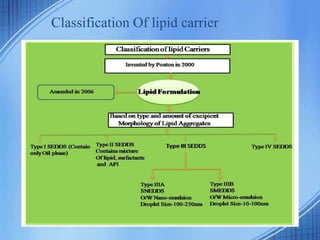
• Classification of lipid carrier
• Formulation Consideration
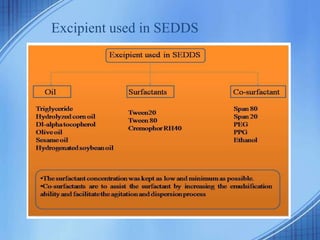
• Excipient used in SEDDS
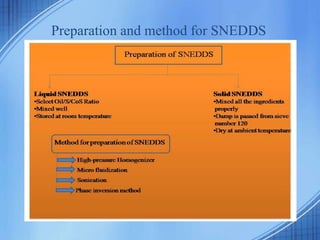
• Preparation and method for SNEDDS
• Evaluation of SNEDDS
• Application
• Conclusion
• Reference
Drug of Choice- Glibenclamide
• Also called Glyburide.
• Glyburide is an oral second-era sulfonylurea
drug employed in the treatment of type II diabetes.
• Being a biopharmaceutical classification system
(BCS) class II drugs, it's very low water solubility
leads to incomplete and variable bioavailability.
Physiochemical Properties of
Glibenclamide
• MW-494
• Hydrogen bond donor count-3
• Hydrogen bond acceptor count-5
• Rotatable bond count-8
• Solubility-2.06-3 g/l
Pharmacokinetic profile-
• Excretion-
50%- Urine
50%- feces
• Clearance- 2.47-4.11 L/h
• Half life- 4.0-13.4h
Needs for SEDDS
• 40% of new drug candidates show poor aqueous
solubility and so poor bioavailability.
• BCS class II drugs( dissolution is rate limiting step
for absorption).
• BCS class II and Class IV needs some
improvement in their solubility.
• Enhancement of bioavailability for oral
formulation.
Introduction
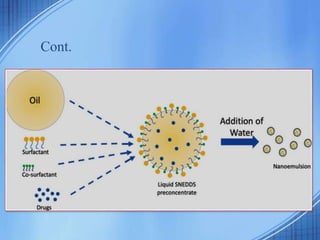
• SNEDDS is an emulsion based system.
• It consist of isotropic anhydrous homogenous
liquid mixtures.
• These mixtures contains oil, surfactants, co-
surfactants and API.
• It will produce O/W emulsion into aqueous media.
• A nanoparticles size ranges between less than or
equal to 200nm.
• SNEDDS contains high amounts of lipids increases
absorption and bioavailability of poorly water
soluble drugs.
Advantage
• Thermodynamically and kinetically stable
• SNEDDS improve the solubility of BCS class II
and Class IV drugs.
• Improving dissolution as well as absorption rate.
• Novel approach for enhancing gastrointestinal
absorption of poorly water soluble drugs.
• Transparent or translucent non ionized dispersion
of O/W and W/O Nano-emulsion.
• SNEDDS can dissolved large amount of lipophilic
drugs.
Disadvantage
• Stability
• Difficult to prepare
• expensive
• Gastrointestinal (GI) irritation upon oral
administration
• Undesirable toxicity
Classification Of lipid carrier
Formulation Consideration
• The nature of the oil/surfactant pair.
• The concentration of surfactant
• Oil/surfactant ratio
• the concentration and nature of co surfactant
• Surfactant and co-surfactant ratio
• Temperature at which self emulsification occurs
Excipient used in SEDDS
Preparation and method for SNEDDS
Cont.
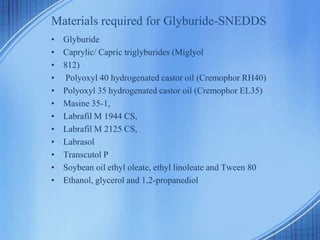
Materials required for Glyburide-SNEDDS
• Glyburide
• Caprylic/ Capric triglyburides (Miglyol
• 812)
• Polyoxyl 40 hydrogenated castor oil (Cremophor RH40)
• Polyoxyl 35 hydrogenated castor oil (Cremophor EL35)
• Masine 35-1,
• Labrafil M 1944 CS,
• Labrafil M 2125 CS,
• Labrasol
• Transcutol P
• Soybean oil ethyl oleate, ethyl linoleate and Tween 80
• Ethanol, glycerol and 1,2-propanediol
Screening of excipient
• The solubility of Glyburide was investigated in
oils, surfactants and co-surfactants.
• An excess amount drug was added in 2 g of
selected solvent in vials and mixed with the help of
shaker for 72 h at 37±1o
C.
• The resulting samples were centrifuged at 6000×g
for 15 min.
• The supernatant was diluted with methanol and
then quantified by a validated HPLC system.
• The size of oily droplets was determined
• immediately by dynamic light scattering (DLS).
Characterization
• Droplet size
• Zeta potential
• Polydispersity index
• Entrapment efficiency(%)
• Drug loading capacity
• FTIR
• Thermal characterization
DSC
TGA
• SEM and TEM
Evaluation of SNEDDS
• Some basic method are enlisted for evaluation of
SNEDDS-
1. Thermodynamic stability of emulsion
2. Centrifugation study( 5000rpm for 30 min)
3. Heating and cooling cycle
4. Freeze thaw cycle(4oc for 24h after that 40oc for
24h then centrifuged at 3000rpm for 5min then
monitored phase separation)
5. Droplet size(Photon correlation spectroscopy)
6. Viscosity(Brookfield Viscometer)
Application
• SNEDDS is formulated in a variety of formulation
such as-
1. Liquids
2. Sprays
3. Foams
4. Creams
5. Ointment
6. Gel
7. Nano-emulsion
Conclusion
• SNEDDS is a novel approach for the formulation of drug
molecule with poor water solubility.
• SNEDDS is an isotropic mixture of oils, surfctant.co
surfactant and co solvents.
• When introduced into aqueous phase it emulsifies
spontaneously to produce O/W Nano-emulsion under mild
agitation.
• SNEDDS provide a good alternate to those drugs which have
poor solubility.
• The oral delivery of lipophilic drug can be made possible by
SNEDDS.
• According to this approach it is possible to prolong the
release of drug via incorporation of polymer in composition.
• SNEDDS seems to be appear as unique and industrially
survival approach with futuristic development.
Reference
• file:///C:/Users/admin/Downloads/nanomaterials-
09-01028_210913_210918.pdf
• https://www.slideshare.net/sagarsavale1/self-
nanoemulsifying-drug-delivery-system-snedds
• https://pubmed.ncbi.nlm.nih.gov/31323842/
• https://pubchem.ncbi.nlm.nih.gov/compound/Glybu
ride.
• https://link.springer.com/chapter/10.1007/978-981-
33-4497-6_10
• https://pubmed.ncbi.nlm.nih.gov/24533514/
SNEDDS

SNEDDS

  • 1.
    SNEDDS(Self-Nano-emulsifying Drug Delivery Systems) SujeetSingh (NK20MSPM697) M.S.(Pharm)-Pharmaceutics Dr. Pallabh Datta Niper Kolkata
  • 2.
    Contents • Drug ofchoice • Physiochemical properties of Glibenclamide • Introduction • Need for SEDDS • Advantage • Disadvantage • Classification of lipid carrier • Formulation Consideration • Excipient used in SEDDS • Preparation and method for SNEDDS • Evaluation of SNEDDS • Application • Conclusion • Reference
  • 3.
    Drug of Choice-Glibenclamide • Also called Glyburide. • Glyburide is an oral second-era sulfonylurea drug employed in the treatment of type II diabetes. • Being a biopharmaceutical classification system (BCS) class II drugs, it's very low water solubility leads to incomplete and variable bioavailability.
  • 4.
    Physiochemical Properties of Glibenclamide •MW-494 • Hydrogen bond donor count-3 • Hydrogen bond acceptor count-5 • Rotatable bond count-8 • Solubility-2.06-3 g/l Pharmacokinetic profile- • Excretion- 50%- Urine 50%- feces • Clearance- 2.47-4.11 L/h • Half life- 4.0-13.4h
  • 5.
    Needs for SEDDS •40% of new drug candidates show poor aqueous solubility and so poor bioavailability. • BCS class II drugs( dissolution is rate limiting step for absorption). • BCS class II and Class IV needs some improvement in their solubility. • Enhancement of bioavailability for oral formulation.
  • 6.
    Introduction • SNEDDS isan emulsion based system. • It consist of isotropic anhydrous homogenous liquid mixtures. • These mixtures contains oil, surfactants, co- surfactants and API. • It will produce O/W emulsion into aqueous media. • A nanoparticles size ranges between less than or equal to 200nm. • SNEDDS contains high amounts of lipids increases absorption and bioavailability of poorly water soluble drugs.
  • 7.
    Advantage • Thermodynamically andkinetically stable • SNEDDS improve the solubility of BCS class II and Class IV drugs. • Improving dissolution as well as absorption rate. • Novel approach for enhancing gastrointestinal absorption of poorly water soluble drugs. • Transparent or translucent non ionized dispersion of O/W and W/O Nano-emulsion. • SNEDDS can dissolved large amount of lipophilic drugs.
  • 8.
    Disadvantage • Stability • Difficultto prepare • expensive • Gastrointestinal (GI) irritation upon oral administration • Undesirable toxicity
  • 9.
  • 10.
    Formulation Consideration • Thenature of the oil/surfactant pair. • The concentration of surfactant • Oil/surfactant ratio • the concentration and nature of co surfactant • Surfactant and co-surfactant ratio • Temperature at which self emulsification occurs
  • 11.
  • 12.
  • 13.
  • 14.
    Materials required forGlyburide-SNEDDS • Glyburide • Caprylic/ Capric triglyburides (Miglyol • 812) • Polyoxyl 40 hydrogenated castor oil (Cremophor RH40) • Polyoxyl 35 hydrogenated castor oil (Cremophor EL35) • Masine 35-1, • Labrafil M 1944 CS, • Labrafil M 2125 CS, • Labrasol • Transcutol P • Soybean oil ethyl oleate, ethyl linoleate and Tween 80 • Ethanol, glycerol and 1,2-propanediol
  • 15.
    Screening of excipient •The solubility of Glyburide was investigated in oils, surfactants and co-surfactants. • An excess amount drug was added in 2 g of selected solvent in vials and mixed with the help of shaker for 72 h at 37±1o C. • The resulting samples were centrifuged at 6000×g for 15 min. • The supernatant was diluted with methanol and then quantified by a validated HPLC system. • The size of oily droplets was determined • immediately by dynamic light scattering (DLS).
  • 16.
    Characterization • Droplet size •Zeta potential • Polydispersity index • Entrapment efficiency(%) • Drug loading capacity • FTIR • Thermal characterization DSC TGA • SEM and TEM
  • 17.
    Evaluation of SNEDDS •Some basic method are enlisted for evaluation of SNEDDS- 1. Thermodynamic stability of emulsion 2. Centrifugation study( 5000rpm for 30 min) 3. Heating and cooling cycle 4. Freeze thaw cycle(4oc for 24h after that 40oc for 24h then centrifuged at 3000rpm for 5min then monitored phase separation) 5. Droplet size(Photon correlation spectroscopy) 6. Viscosity(Brookfield Viscometer)
  • 18.
    Application • SNEDDS isformulated in a variety of formulation such as- 1. Liquids 2. Sprays 3. Foams 4. Creams 5. Ointment 6. Gel 7. Nano-emulsion
  • 19.
    Conclusion • SNEDDS isa novel approach for the formulation of drug molecule with poor water solubility. • SNEDDS is an isotropic mixture of oils, surfctant.co surfactant and co solvents. • When introduced into aqueous phase it emulsifies spontaneously to produce O/W Nano-emulsion under mild agitation. • SNEDDS provide a good alternate to those drugs which have poor solubility. • The oral delivery of lipophilic drug can be made possible by SNEDDS. • According to this approach it is possible to prolong the release of drug via incorporation of polymer in composition. • SNEDDS seems to be appear as unique and industrially survival approach with futuristic development.
  • 20.
    Reference • file:///C:/Users/admin/Downloads/nanomaterials- 09-01028_210913_210918.pdf • https://www.slideshare.net/sagarsavale1/self- nanoemulsifying-drug-delivery-system-snedds •https://pubmed.ncbi.nlm.nih.gov/31323842/ • https://pubchem.ncbi.nlm.nih.gov/compound/Glybu ride. • https://link.springer.com/chapter/10.1007/978-981- 33-4497-6_10 • https://pubmed.ncbi.nlm.nih.gov/24533514/