STEPS IN DSC CAMPAIGN
By: Zarmeen Durrani
CAMPAIGN
 A campaign can be defined as a short term
communication program, making use of
various mass media, aimed at a defined
target audience, focusing attention on a
particular problem and its solutions over a
period of time.
 The kind of campaign used in DSC is the
self help campaign. It is intended to provide
information and education which people can
use to improve their lives.
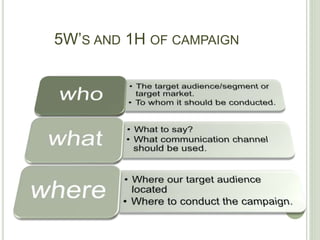
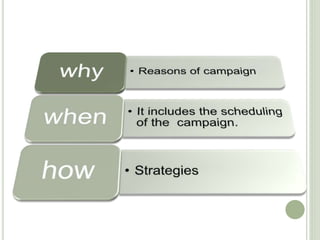
5W’S AND 1H OF CAMPAIGN
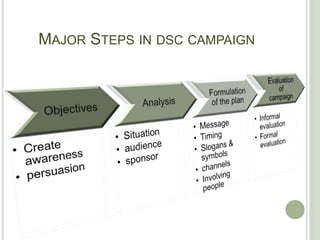
MAJOR STEPS IN DSC CAMPAIGN
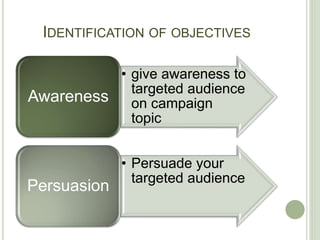
IDENTIFICATION OF OBJECTIVES
• give awareness to
targeted audience
on campaign
topic
Awareness
• Persuade your
targeted audience
Persuasion
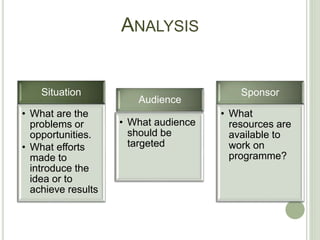
ANALYSIS
Situation
• What are the
problems or
opportunities.
• What efforts
made to
introduce the
idea or to
achieve results
Audience
• What audience
should be
targeted
Sponsor
• What
resources are
available to
work on
programme?
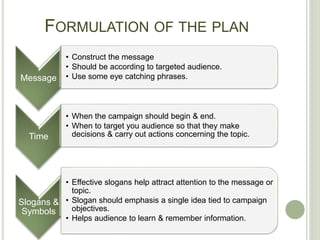
FORMULATION OF THE PLAN
Message
• Construct the message
• Should be according to targeted audience.
• Use some eye catching phrases.
Time
• When the campaign should begin & end.
• When to target you audience so that they make
decisions & carry out actions concerning the topic.
Slogans &
Symbols
• Effective slogans help attract attention to the message or
topic.
• Slogan should emphasis a single idea tied to campaign
objectives.
• Helps audience to learn & remember information.
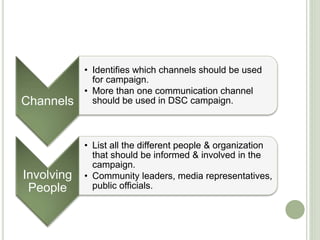
Channels
• Identifies which channels should be used
for campaign.
• More than one communication channel
should be used in DSC campaign.
Involving
People
• List all the different people & organization
that should be informed & involved in the
campaign.
• Community leaders, media representatives,
public officials.
EVALUATION OF CAMPAIGN
 Evaluation is the process directed to formulate
judgment about the overall operation of a
campaign.
 Evaluation in DSC is a continuous & systematic
process of assessing the value of the
developmental project.
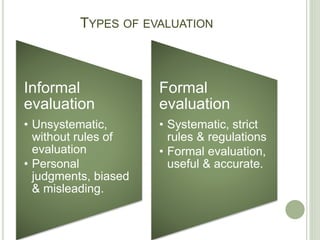
TYPES OF EVALUATION
Informal
evaluation
• Unsystematic,
without rules of
evaluation
• Personal
judgments, biased
& misleading.
Formal
evaluation
• Systematic, strict
rules & regulations
• Formal evaluation,
useful & accurate.
ThankYou

Steps in DSC campaign

  • 1.
    STEPS IN DSCCAMPAIGN By: Zarmeen Durrani
  • 2.
    CAMPAIGN  A campaigncan be defined as a short term communication program, making use of various mass media, aimed at a defined target audience, focusing attention on a particular problem and its solutions over a period of time.  The kind of campaign used in DSC is the self help campaign. It is intended to provide information and education which people can use to improve their lives.
  • 3.
    5W’S AND 1HOF CAMPAIGN
  • 5.
    MAJOR STEPS INDSC CAMPAIGN
  • 6.
    IDENTIFICATION OF OBJECTIVES •give awareness to targeted audience on campaign topic Awareness • Persuade your targeted audience Persuasion
  • 7.
    ANALYSIS Situation • What arethe problems or opportunities. • What efforts made to introduce the idea or to achieve results Audience • What audience should be targeted Sponsor • What resources are available to work on programme?
  • 8.
    FORMULATION OF THEPLAN Message • Construct the message • Should be according to targeted audience. • Use some eye catching phrases. Time • When the campaign should begin & end. • When to target you audience so that they make decisions & carry out actions concerning the topic. Slogans & Symbols • Effective slogans help attract attention to the message or topic. • Slogan should emphasis a single idea tied to campaign objectives. • Helps audience to learn & remember information.
  • 9.
    Channels • Identifies whichchannels should be used for campaign. • More than one communication channel should be used in DSC campaign. Involving People • List all the different people & organization that should be informed & involved in the campaign. • Community leaders, media representatives, public officials.
  • 10.
    EVALUATION OF CAMPAIGN Evaluation is the process directed to formulate judgment about the overall operation of a campaign.  Evaluation in DSC is a continuous & systematic process of assessing the value of the developmental project.
  • 11.
    TYPES OF EVALUATION Informal evaluation •Unsystematic, without rules of evaluation • Personal judgments, biased & misleading. Formal evaluation • Systematic, strict rules & regulations • Formal evaluation, useful & accurate.
  • 12.