Regulation
          Why…but Why Not?
Annenberg Oxford Global Media Policy Summer Institute
                    July 17, 2009
              The Non-Group, Group : )
Regulation – Why…but Why Not?


WHY REGULATE?

   Scarcity of resources
     – Administering the public goods

   Media pluralism
     – Promote Competition

   Influence of broadcasting
     – Content

   Principle audiatur et altera pars in act outside the courtroom
     – Decision-making
     – Possibility to appeal inside the regulatory institution
Regulation – Why…but Why Not?

WHAT WE HAVE TODAY IN BROADCAST

   Broadcasting is regulated by the authorities established by law
   Protection of freedom and diverse opinions
   Creation of basic standards
   Development of professional and sustainable commercial and public broadcasters
   Protecting braodcasters from political control and manipulation
   Protecting audience form harmful and offensive content and also deceptive
    advertising
   Preserving and encouraging independent media, promoting responsible reporting
    and supporting initiatives for self-regulation by which the media will themselves
    define professional and ethical standards.
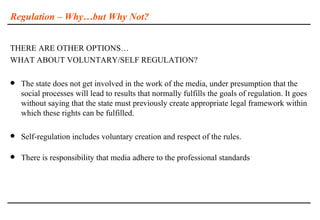
Regulation – Why…but Why Not?


THERE ARE OTHER OPTIONS…
WHAT ABOUT VOLUNTARY/SELF REGULATION?

   The state does not get involved in the work of the media, under presumption that the
    social processes will lead to results that normally fulfills the goals of regulation. It goes
    without saying that the state must previously create appropriate legal framework within
    which these rights can be fulfilled.

   Self-regulation includes voluntary creation and respect of the rules.

   There is responsibility that media adhere to the professional standards
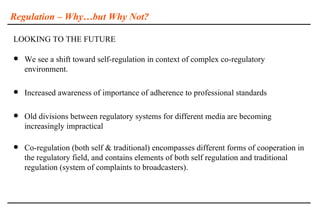
Regulation – Why…but Why Not?

LOOKING TO THE FUTURE

   We see a shift toward self-regulation in context of complex co-regulatory
    environment.

   Increased awareness of importance of adherence to professional standards

   Old divisions between regulatory systems for different media are becoming
    increasingly impractical

   Co-regulation (both self & traditional) encompasses different forms of cooperation in
    the regulatory field, and contains elements of both self regulation and traditional
    regulation (system of complaints to broadcasters).
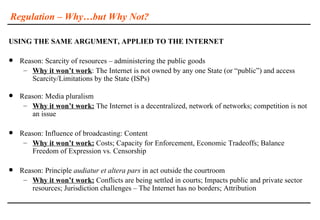
Regulation – Why…but Why Not?

USING THE SAME ARGUMENT, APPLIED TO THE INTERNET

   Reason: Scarcity of resources – administering the public goods
     – Why it won’t work: The Internet is not owned by any one State (or “public”) and access
       Scarcity/Limitations by the State (ISPs)

   Reason: Media pluralism
     – Why it won’t work: The Internet is a decentralized, network of networks; competition is not
       an issue

   Reason: Influence of broadcasting: Content
     – Why it won’t work: Costs; Capacity for Enforcement, Economic Tradeoffs; Balance
       Freedom of Expression vs. Censorship

   Reason: Principle audiatur et altera pars in act outside the courtroom
     – Why it won’t work: Conflicts are being settled in courts; Impacts public and private sector
       resources; Jurisdiction challenges – The Internet has no borders; Attribution
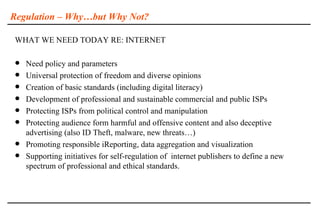
Regulation – Why…but Why Not?

WHAT WE NEED TODAY RE: INTERNET

   Need policy and parameters
   Universal protection of freedom and diverse opinions
   Creation of basic standards (including digital literacy)
   Development of professional and sustainable commercial and public ISPs
   Protecting ISPs from political control and manipulation
   Protecting audience form harmful and offensive content and also deceptive
    advertising (also ID Theft, malware, new threats…)
   Promoting responsible iReporting, data aggregation and visualization
   Supporting initiatives for self-regulation of internet publishers to define a new
    spectrum of professional and ethical standards.
Regulation – Why…but Why Not?

HOWEVER….

   All for your protection (?)
     – In cases of illegal content – is it easier to appeal to a regulator than a court
         • Costs less
         • Time efficient
     – Harmful Content: We can all agree child porn is illegal and should be prosecuted.
     – Pandora’s Box: What happens next?
         • The slippery slope of freedom of expression, right to information and censorship.


   When crisis happens: Is the internet -- is it a “right”? Is it a commodity? Utility?
    – Citizen access to information during a crisis
    – Private sector responsibility for consumer privacy and product reliability

Ann Ox09 Presentation

  • 1.
    Regulation Why…but Why Not? Annenberg Oxford Global Media Policy Summer Institute July 17, 2009 The Non-Group, Group : )
  • 2.
    Regulation – Why…butWhy Not? WHY REGULATE?  Scarcity of resources – Administering the public goods  Media pluralism – Promote Competition  Influence of broadcasting – Content  Principle audiatur et altera pars in act outside the courtroom – Decision-making – Possibility to appeal inside the regulatory institution
  • 3.
    Regulation – Why…butWhy Not? WHAT WE HAVE TODAY IN BROADCAST  Broadcasting is regulated by the authorities established by law  Protection of freedom and diverse opinions  Creation of basic standards  Development of professional and sustainable commercial and public broadcasters  Protecting braodcasters from political control and manipulation  Protecting audience form harmful and offensive content and also deceptive advertising  Preserving and encouraging independent media, promoting responsible reporting and supporting initiatives for self-regulation by which the media will themselves define professional and ethical standards.
  • 4.
    Regulation – Why…butWhy Not? THERE ARE OTHER OPTIONS… WHAT ABOUT VOLUNTARY/SELF REGULATION?  The state does not get involved in the work of the media, under presumption that the social processes will lead to results that normally fulfills the goals of regulation. It goes without saying that the state must previously create appropriate legal framework within which these rights can be fulfilled.  Self-regulation includes voluntary creation and respect of the rules.  There is responsibility that media adhere to the professional standards
  • 5.
    Regulation – Why…butWhy Not? LOOKING TO THE FUTURE  We see a shift toward self-regulation in context of complex co-regulatory environment.  Increased awareness of importance of adherence to professional standards  Old divisions between regulatory systems for different media are becoming increasingly impractical  Co-regulation (both self & traditional) encompasses different forms of cooperation in the regulatory field, and contains elements of both self regulation and traditional regulation (system of complaints to broadcasters).
  • 6.
    Regulation – Why…butWhy Not? USING THE SAME ARGUMENT, APPLIED TO THE INTERNET  Reason: Scarcity of resources – administering the public goods – Why it won’t work: The Internet is not owned by any one State (or “public”) and access Scarcity/Limitations by the State (ISPs)  Reason: Media pluralism – Why it won’t work: The Internet is a decentralized, network of networks; competition is not an issue  Reason: Influence of broadcasting: Content – Why it won’t work: Costs; Capacity for Enforcement, Economic Tradeoffs; Balance Freedom of Expression vs. Censorship  Reason: Principle audiatur et altera pars in act outside the courtroom – Why it won’t work: Conflicts are being settled in courts; Impacts public and private sector resources; Jurisdiction challenges – The Internet has no borders; Attribution
  • 7.
    Regulation – Why…butWhy Not? WHAT WE NEED TODAY RE: INTERNET  Need policy and parameters  Universal protection of freedom and diverse opinions  Creation of basic standards (including digital literacy)  Development of professional and sustainable commercial and public ISPs  Protecting ISPs from political control and manipulation  Protecting audience form harmful and offensive content and also deceptive advertising (also ID Theft, malware, new threats…)  Promoting responsible iReporting, data aggregation and visualization  Supporting initiatives for self-regulation of internet publishers to define a new spectrum of professional and ethical standards.
  • 8.
    Regulation – Why…butWhy Not? HOWEVER….  All for your protection (?) – In cases of illegal content – is it easier to appeal to a regulator than a court • Costs less • Time efficient – Harmful Content: We can all agree child porn is illegal and should be prosecuted. – Pandora’s Box: What happens next? • The slippery slope of freedom of expression, right to information and censorship.  When crisis happens: Is the internet -- is it a “right”? Is it a commodity? Utility? – Citizen access to information during a crisis – Private sector responsibility for consumer privacy and product reliability