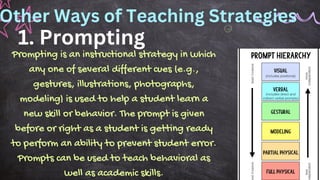
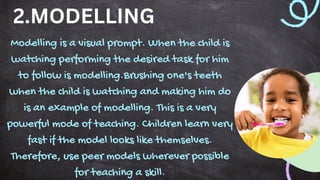
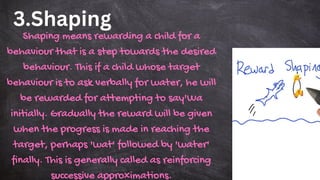
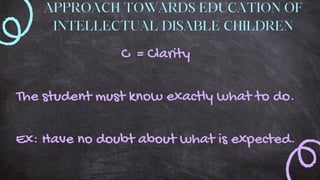
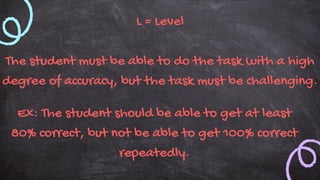
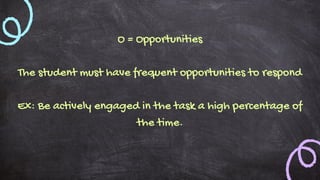
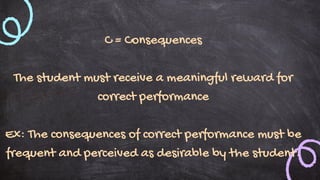
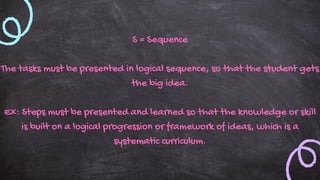
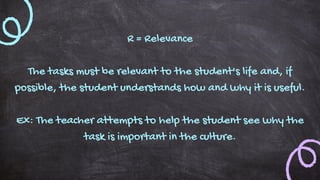
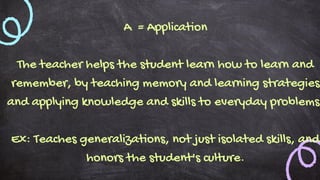
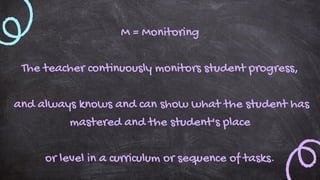
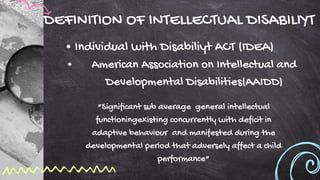
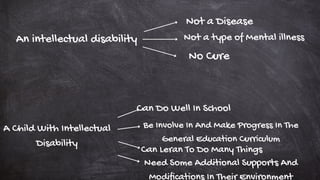
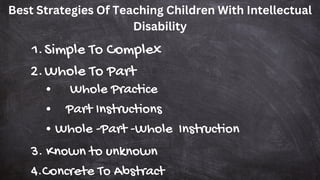
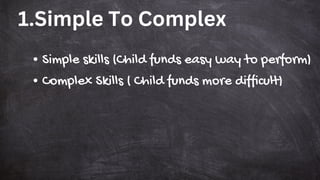
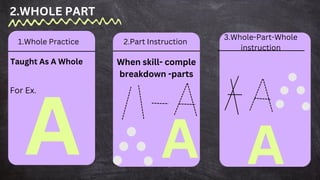
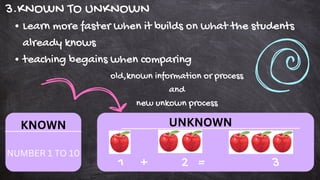
This document presents strategies for teaching children with intellectual disabilities. It defines intellectual disability and outlines common characteristics such as below average intellectual functioning and deficits in adaptive behaviors. It then discusses best teaching strategies like using simple to complex instruction, teaching whole tasks before parts, using concrete examples before abstract concepts, and prompting, modeling, shaping and fading techniques. The CLOCSR method of ensuring clarity, appropriate challenge level, opportunities to respond, consequences for responses, logical sequencing and monitoring of progress is also presented. Sources are provided.



![4.CONCRETE TO ABSTRACT
• Concrete -> Material & Specific
• Abstract -> Ideal & General
• Always start with Concrete and move to
the Abstract
• Use Concrete like a Tree, Dog, Fruit, etc.
• By Concrete, the Children can see, feel &
manipulate it with their hands
• By Concrete, the Children can use all five
senses
for ex:
1. An Actual Apple [Concrete]
2. A Picture Of An Apple [Less Concrete]
3. The Word Apple [Abstract]
APPLE](https://image.slidesharecdn.com/groupproject202402020730100000-240205140643-316b2a40/85/Education-plan-for-children-with-intellectual-disability-pdf-12-320.jpg)
![Introduce The Concrete Object [Apple]
Present Object [Apple] and its Picture
Make the Child keep the Concrete
Object [Apple] on the Picture
Picture Alone
Make the Child Say the Name APPLE](https://image.slidesharecdn.com/groupproject202402020730100000-240205140643-316b2a40/85/Education-plan-for-children-with-intellectual-disability-pdf-13-320.jpg)