PRESENTED BY :-
M U J T A B A N A Y Y E R ( 4 0 )
TA H I R S A B I R ( 4 4 )
AW WA B A M E E R ( 7 1 )
A H M A D I D R E E S ( 8 5 )
TA L H A I M R A N ( 8 9 )
SUPERVISED BY :-
P R O F. M U B A S H I R TA R I Q
Topic:
Robotics
Contents :
 Robots
 History of Robotics
 Types of robot
 Components of Robot
 Advantages
 Disadvantage Of Robots
 Laws Of Robots
 Problems with Robots
 Future Of Robot
 Conclusion
Robots:
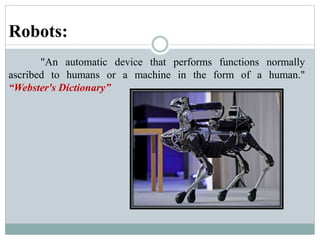
"An automatic device that performs functions normally
ascribed to humans or a machine in the form of a human."
“Webster's Dictionary”
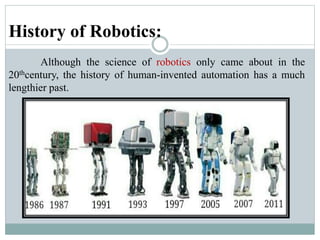
History of Robotics:
Although the science of robotics only came about in the
20thcentury, the history of human-invented automation has a much
lengthier past.
Types of robot:
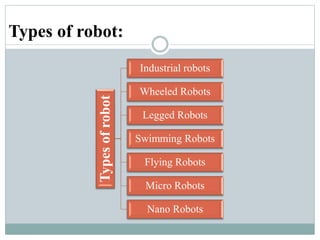
Typesofrobot
Industrial robots
Wheeled Robots
Legged Robots
Swimming Robots
Flying Robots
Micro Robots
Nano Robots
Cont…
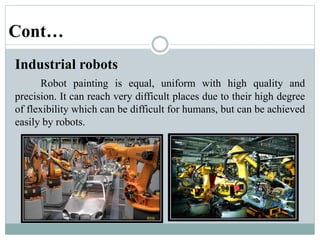
Industrial robots
Robot painting is equal, uniform with high quality and
precision. It can reach very difficult places due to their high degree
of flexibility which can be difficult for humans, but can be achieved
easily by robots.
Cont…
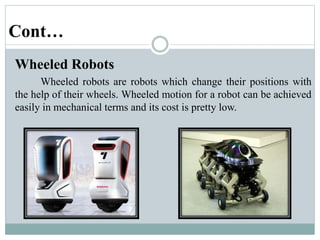
Wheeled Robots
Wheeled robots are robots which change their positions with
the help of their wheels. Wheeled motion for a robot can be achieved
easily in mechanical terms and its cost is pretty low.
Cont…
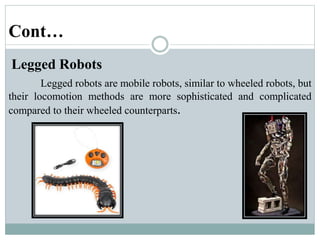
Legged Robots
Legged robots are mobile robots, similar to wheeled robots, but
their locomotion methods are more sophisticated and complicated
compared to their wheeled counterparts.
Cont…
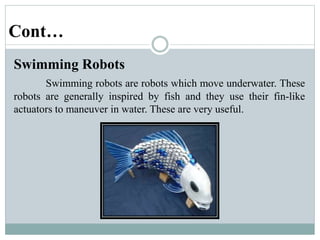
Swimming Robots
Swimming robots are robots which move underwater. These
robots are generally inspired by fish and they use their fin-like
actuators to maneuver in water. These are very useful.
Cont…
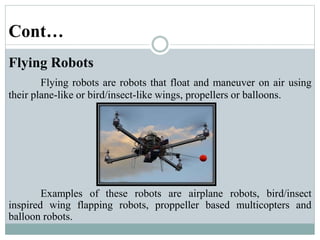
Flying Robots
Flying robots are robots that float and maneuver on air using
their plane-like or bird/insect-like wings, propellers or balloons.
Examples of these robots are airplane robots, bird/insect
inspired wing flapping robots, proppeller based multicopters and
balloon robots.
Cont…
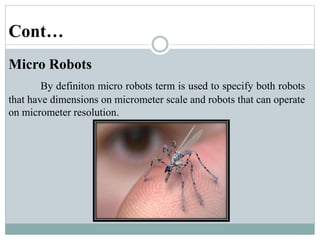
Micro Robots
By definiton micro robots term is used to specify both robots
that have dimensions on micrometer scale and robots that can operate
on micrometer resolution.
Cont…
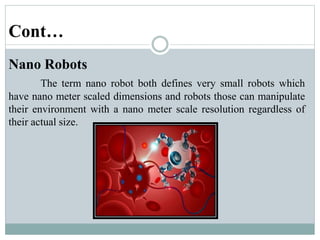
Nano Robots
The term nano robot both defines very small robots which
have nano meter scaled dimensions and robots those can manipulate
their environment with a nano meter scale resolution regardless of
their actual size.
Components of robot:
Power Supply
The working power to the robot is provided by batteries,
hydraulic, solar power, or pneumatic power sources.
Actuators
Actuators are the energy conversion device used inside a
robot. The major function of actuators is to convert energy into
movement.
Electric motors (DC/AC)
Motors are electromechanical component used for converting
electrical energy into its equivalent mechanical energy.
Cont…
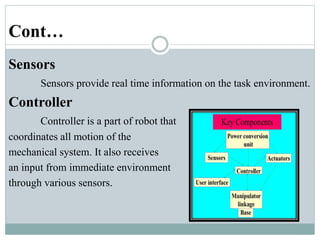
Sensors
Sensors provide real time information on the task environment.
Controller
Controller is a part of robot that
coordinates all motion of the
mechanical system. It also receives
an input from immediate environment
through various sensors.
Advantages of Robots:
Industrial Robotics
In Medical and Healthcare
In Households
Reduce Mundane Tasks
Increase Output
Cont…
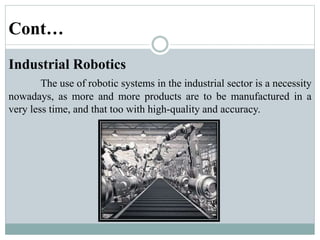
Industrial Robotics
The use of robotic systems in the industrial sector is a necessity
nowadays, as more and more products are to be manufactured in a
very less time, and that too with high-quality and accuracy.
Cont…
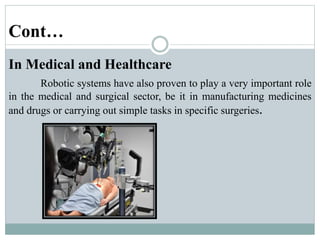
In Medical and Healthcare
Robotic systems have also proven to play a very important role
in the medical and surgical sector, be it in manufacturing medicines
and drugs or carrying out simple tasks in specific surgeries.
Cont…
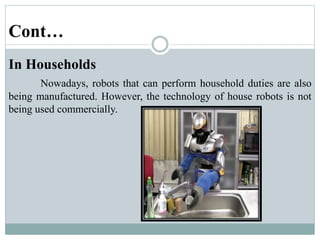
In Households
Nowadays, robots that can perform household duties are also
being manufactured. However, the technology of house robots is not
being used commercially.
Cont…
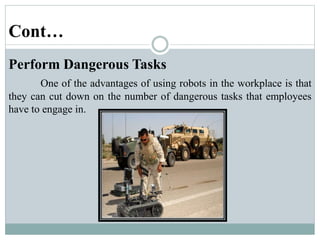
Perform Dangerous Tasks
One of the advantages of using robots in the workplace is that
they can cut down on the number of dangerous tasks that employees
have to engage in.
Cont…
Reduce Mundane Tasks
In many work environments, employees expend countless
hours doing mundane activities that could be better used elsewhere.
Increase Output
Robots are also frequently used in manufacturing settings as a
part of the process of assembling the product.
Disadvantage Of Robots:
 Today, most of the humans depends to the robots that it can do
make the things that human can do.
 The robots cannot detect faster in terms of emergency because
their memory chips of mind was artificial and they don’t have their
own emotions.
 Robots and its system replace certain workers causing economic
losses with possible resultant shortening of lifespans.
 Robots are more expensive and make lazy in our work.
 Robots and machines will take may jobs and people we loose their
jobs by contrast.
Laws Of Robots:
 A robot may not injure a human being or, through inaction, allow a
human being to come to harm.
 A robot must obey orders given it by human beings except where
such orders would conflict with the First Law.
 A robot must protect its own existence as long as such protection
does not conflict with the First or Second Law.
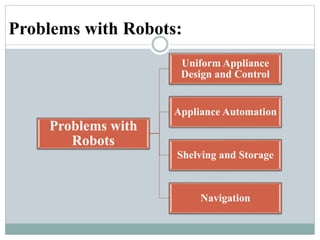
Problems with Robots:
Problems with
Robots
Uniform Appliance
Design and Control
Appliance Automation
Shelving and Storage
Navigation
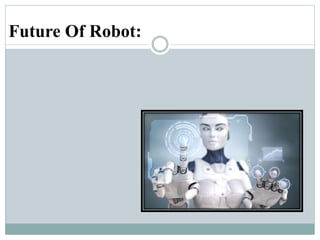
Future Of Robot:
Conclusion:
This contribution to the soft robotics toolkit aims at providing
a first numerical software for modeling and control of soft-robot.
This tool could be used by the community for design and control
assistance of soft robots. The approach seeks to be generic and could
be applied for various shape of soft robots and (for now) two types
of actuators: cables (tendons) and pneumatics.
Computer project
Computer project
Computer project

Computer project

  • 2.
    PRESENTED BY :- MU J T A B A N A Y Y E R ( 4 0 ) TA H I R S A B I R ( 4 4 ) AW WA B A M E E R ( 7 1 ) A H M A D I D R E E S ( 8 5 ) TA L H A I M R A N ( 8 9 ) SUPERVISED BY :- P R O F. M U B A S H I R TA R I Q Topic: Robotics
  • 3.
    Contents :  Robots History of Robotics  Types of robot  Components of Robot  Advantages  Disadvantage Of Robots  Laws Of Robots  Problems with Robots  Future Of Robot  Conclusion
  • 4.
    Robots: "An automatic devicethat performs functions normally ascribed to humans or a machine in the form of a human." “Webster's Dictionary”
  • 5.
    History of Robotics: Althoughthe science of robotics only came about in the 20thcentury, the history of human-invented automation has a much lengthier past.
  • 6.
    Types of robot: Typesofrobot Industrialrobots Wheeled Robots Legged Robots Swimming Robots Flying Robots Micro Robots Nano Robots
  • 7.
    Cont… Industrial robots Robot paintingis equal, uniform with high quality and precision. It can reach very difficult places due to their high degree of flexibility which can be difficult for humans, but can be achieved easily by robots.
  • 8.
    Cont… Wheeled Robots Wheeled robotsare robots which change their positions with the help of their wheels. Wheeled motion for a robot can be achieved easily in mechanical terms and its cost is pretty low.
  • 9.
    Cont… Legged Robots Legged robotsare mobile robots, similar to wheeled robots, but their locomotion methods are more sophisticated and complicated compared to their wheeled counterparts.
  • 10.
    Cont… Swimming Robots Swimming robotsare robots which move underwater. These robots are generally inspired by fish and they use their fin-like actuators to maneuver in water. These are very useful.
  • 11.
    Cont… Flying Robots Flying robotsare robots that float and maneuver on air using their plane-like or bird/insect-like wings, propellers or balloons. Examples of these robots are airplane robots, bird/insect inspired wing flapping robots, proppeller based multicopters and balloon robots.
  • 12.
    Cont… Micro Robots By definitonmicro robots term is used to specify both robots that have dimensions on micrometer scale and robots that can operate on micrometer resolution.
  • 13.
    Cont… Nano Robots The termnano robot both defines very small robots which have nano meter scaled dimensions and robots those can manipulate their environment with a nano meter scale resolution regardless of their actual size.
  • 14.
    Components of robot: PowerSupply The working power to the robot is provided by batteries, hydraulic, solar power, or pneumatic power sources. Actuators Actuators are the energy conversion device used inside a robot. The major function of actuators is to convert energy into movement. Electric motors (DC/AC) Motors are electromechanical component used for converting electrical energy into its equivalent mechanical energy.
  • 15.
    Cont… Sensors Sensors provide realtime information on the task environment. Controller Controller is a part of robot that coordinates all motion of the mechanical system. It also receives an input from immediate environment through various sensors.
  • 16.
    Advantages of Robots: IndustrialRobotics In Medical and Healthcare In Households Reduce Mundane Tasks Increase Output
  • 17.
    Cont… Industrial Robotics The useof robotic systems in the industrial sector is a necessity nowadays, as more and more products are to be manufactured in a very less time, and that too with high-quality and accuracy.
  • 18.
    Cont… In Medical andHealthcare Robotic systems have also proven to play a very important role in the medical and surgical sector, be it in manufacturing medicines and drugs or carrying out simple tasks in specific surgeries.
  • 19.
    Cont… In Households Nowadays, robotsthat can perform household duties are also being manufactured. However, the technology of house robots is not being used commercially.
  • 20.
    Cont… Perform Dangerous Tasks Oneof the advantages of using robots in the workplace is that they can cut down on the number of dangerous tasks that employees have to engage in.
  • 21.
    Cont… Reduce Mundane Tasks Inmany work environments, employees expend countless hours doing mundane activities that could be better used elsewhere. Increase Output Robots are also frequently used in manufacturing settings as a part of the process of assembling the product.
  • 22.
    Disadvantage Of Robots: Today, most of the humans depends to the robots that it can do make the things that human can do.  The robots cannot detect faster in terms of emergency because their memory chips of mind was artificial and they don’t have their own emotions.  Robots and its system replace certain workers causing economic losses with possible resultant shortening of lifespans.  Robots are more expensive and make lazy in our work.  Robots and machines will take may jobs and people we loose their jobs by contrast.
  • 23.
    Laws Of Robots: A robot may not injure a human being or, through inaction, allow a human being to come to harm.  A robot must obey orders given it by human beings except where such orders would conflict with the First Law.  A robot must protect its own existence as long as such protection does not conflict with the First or Second Law.
  • 24.
    Problems with Robots: Problemswith Robots Uniform Appliance Design and Control Appliance Automation Shelving and Storage Navigation
  • 25.
  • 26.
    Conclusion: This contribution tothe soft robotics toolkit aims at providing a first numerical software for modeling and control of soft-robot. This tool could be used by the community for design and control assistance of soft robots. The approach seeks to be generic and could be applied for various shape of soft robots and (for now) two types of actuators: cables (tendons) and pneumatics.