Presented by:
SM
Contents
■ Introduction
■ History
■ Composition
■ Simulation Environment and Configuration
■ Types of Humanoid Robots
■ Formation of Control System
■ PID Control
■ Fuzzy Control
■ Advantages & Disadvantages
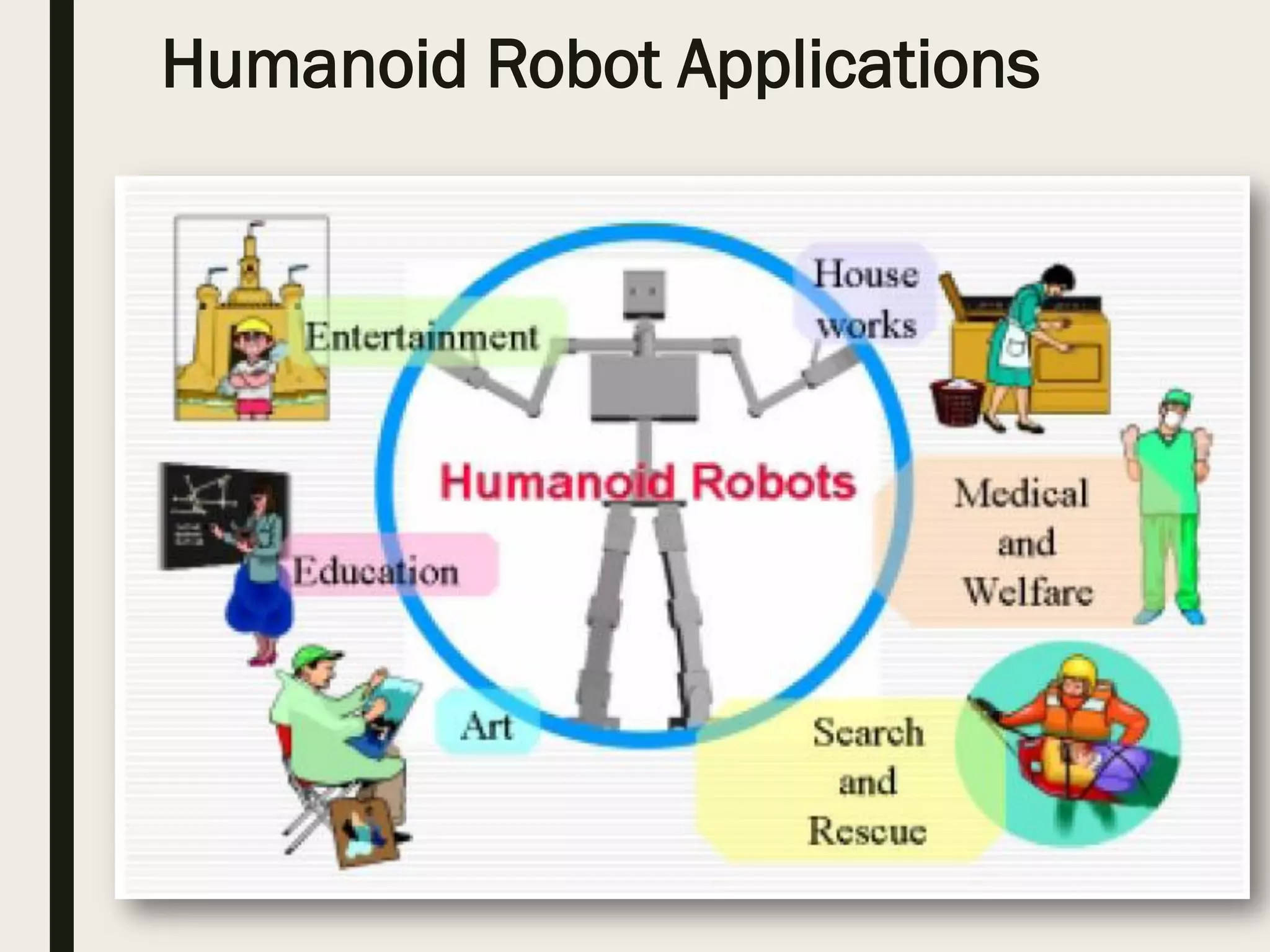
■ Applications
■ Conclusion
Introduction
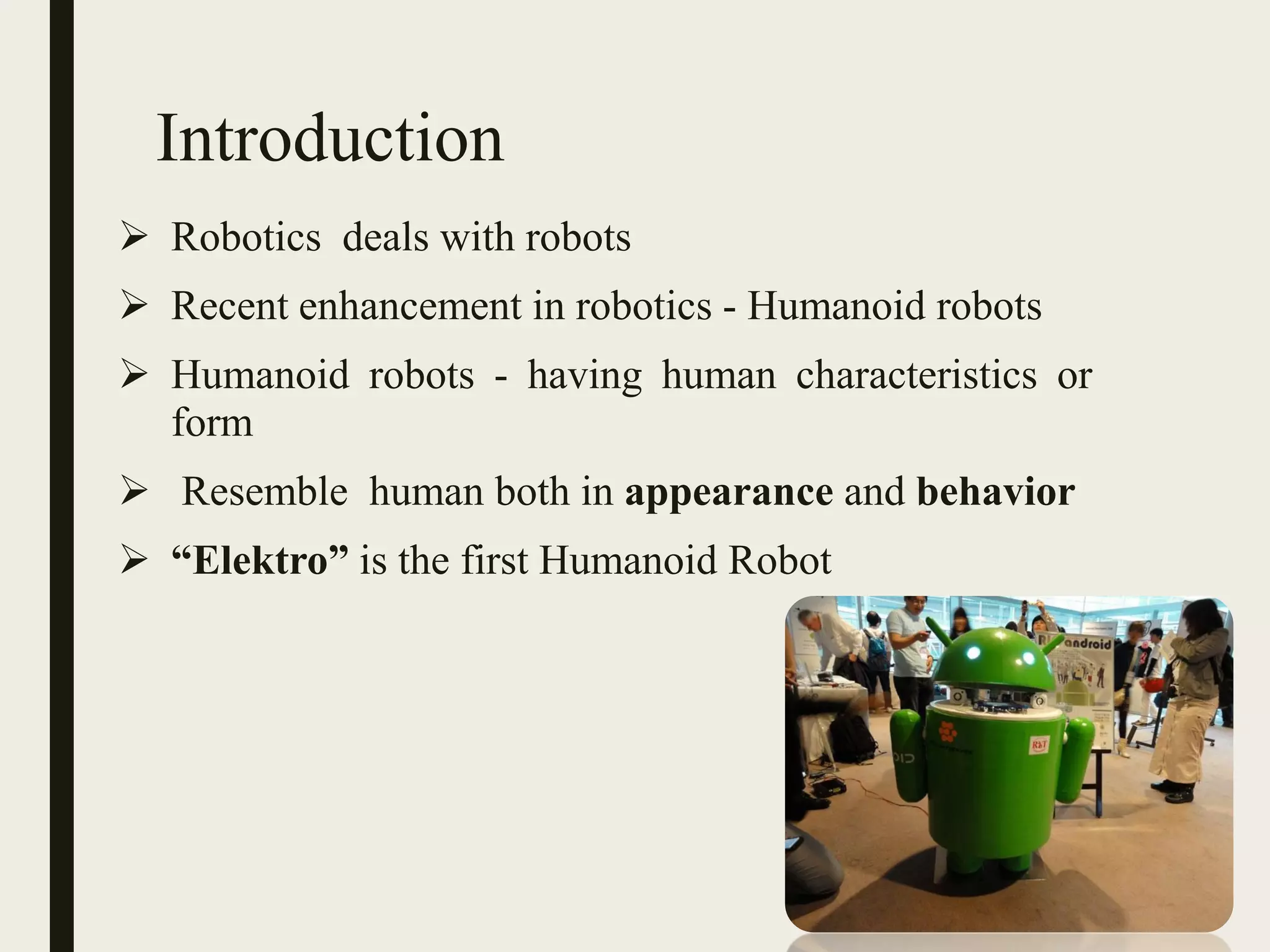
 Robotics deals with robots
 Recent enhancement in robotics - Humanoid robots
 Humanoid robots - having human characteristics or
form
 Resemble human both in appearance and behavior
 “Elektro” is the first Humanoid Robot
History
 Integration of scientific and engineering fields, has a social
dimension
 WASEDA University- leading research sites
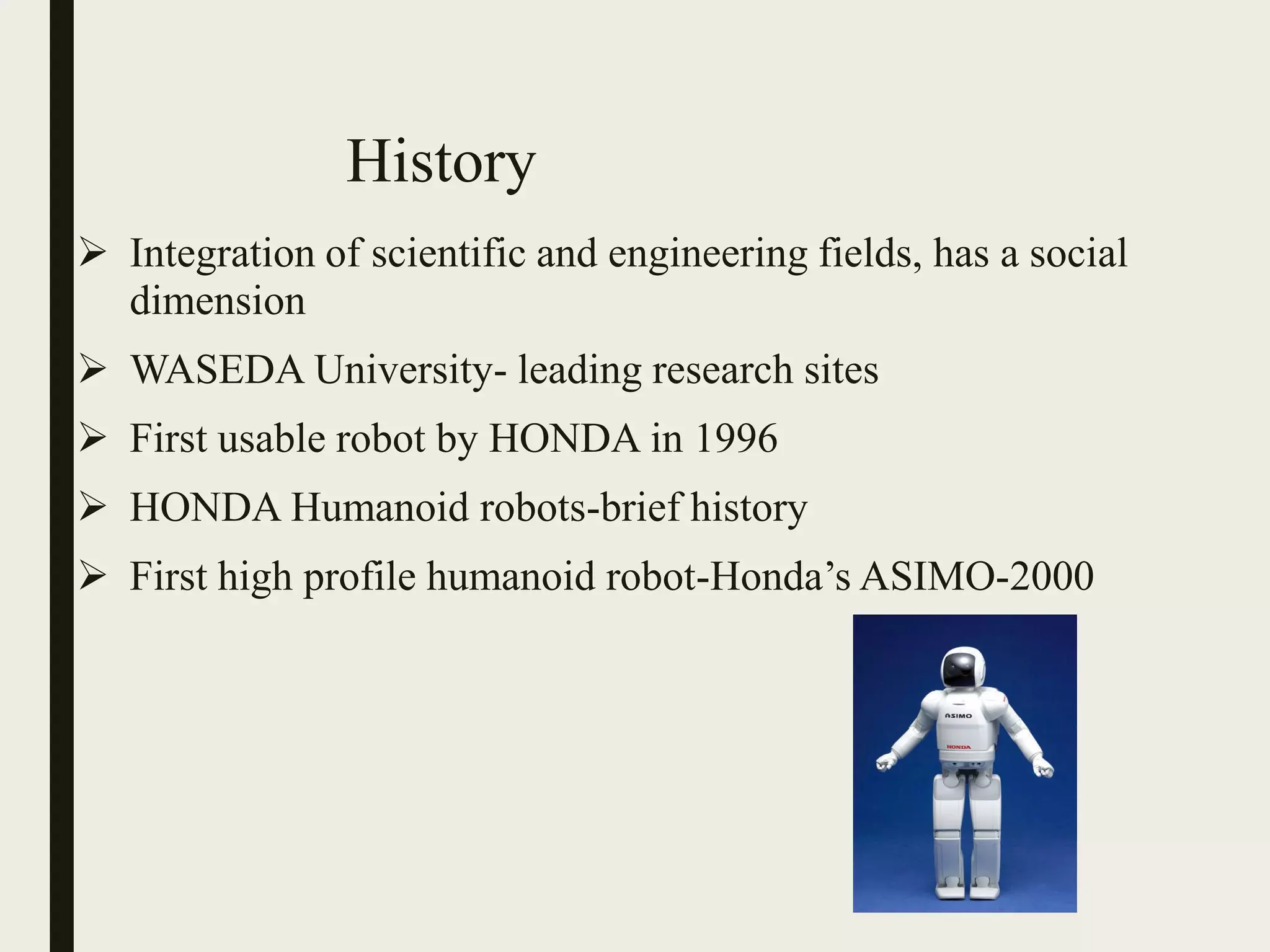
 First usable robot by HONDA in 1996
 HONDA Humanoid robots-brief history
 First high profile humanoid robot-Honda’s ASIMO-2000
Human Evolution vs. Humanoid Evolution
Why Develop Humanoids?
 More rational reasons
• Can work in human environment
• Environment and tools are adapted for us
• Easier for interaction
• Eases the work of humans
• Because it is a dream of generations
Composition
 Main components
Actuators – motion motors
Sensors – measure some attribute(sensing)
-proprioceptive
-exteroceptive
 Others
Manipulators
Power source
Simulation Tools
■ 3D CAD model of the humanoid robot created using Solid Works 2003
■ Robotics Software Development Environment, Robotics Lab TM v.1.5
■ Addition of characteristics (weights)
■ Connection of each part
■ Surface Contact conditioner to walk
Configuration
■ Degrees of Freedom
 6 for each leg
 4 for each arm
 1 for each hand
 2 for waist
 1 for neck
Total 25 degrees of freedom
Types of Humanoid Robots
 QRIO
--pronounced ”curio”-”quest for curiosity”
 HRP
 ASIMO- Advanced Step in Innovative Mobility
 AIBO-Artificial Intelligence Robot
 PARO
 PaPeRo
Few humanoid robots
Formation of Control System
 Simulation System Configuration
-Robotics lab
-9.8N gravitational force
-flat dry concrete floor
 PID controller
 Fuzzy control
PID Control
 Proportional-integral-derivative (PID) control
 Is control loop feedback mechanism
 Controller minimizes the error
 three-term control: P I D
 PID equation
Kp – Proportional Gain
Ki – Integral Gain
Kd- Derivative Gain
Block Diagram
Fuzzy Control
 Definition-Fuzzy logic
 Consists input stage, processing stage, output stage
 Input stage maps sensor or other inputs
 Processing stage generates & combines the results
 Output stage – conversion of results
Block diagram
Formation of control system
(contd…)
 Chest of the robot was basis
 Error and speed of object maintained by PID
 Reason for using PID
 Better efficiency than other controller
 Fuzzy controller -robot’s position parallel to object
 Why fuzzy control along with PID?
Advantages and disadvantages
ADVANTAGES
 Safe load carrying
 Good efficiency
 High accuracy
 Less time consuming
DISADVANTAGES
 High cost
 Requires specialized people for maintenance
Humanoid Robot Applications
Conclusion
 Safely move the objects co-operatively
 Corrects position and speed of two robots
 Smooth co-ordination
 Carry objects safely on various surfaces
Scope for improvement
 Design user friendly humanoids for Layman
 Cost effectiveness
Humanoid robotics

Humanoid robotics

  • 1.
  • 2.
    Contents ■ Introduction ■ History ■Composition ■ Simulation Environment and Configuration ■ Types of Humanoid Robots ■ Formation of Control System ■ PID Control ■ Fuzzy Control ■ Advantages & Disadvantages ■ Applications ■ Conclusion
  • 3.
    Introduction  Robotics dealswith robots  Recent enhancement in robotics - Humanoid robots  Humanoid robots - having human characteristics or form  Resemble human both in appearance and behavior  “Elektro” is the first Humanoid Robot
  • 4.
    History  Integration ofscientific and engineering fields, has a social dimension  WASEDA University- leading research sites  First usable robot by HONDA in 1996  HONDA Humanoid robots-brief history  First high profile humanoid robot-Honda’s ASIMO-2000
  • 5.
    Human Evolution vs.Humanoid Evolution
  • 6.
    Why Develop Humanoids? More rational reasons • Can work in human environment • Environment and tools are adapted for us • Easier for interaction • Eases the work of humans • Because it is a dream of generations
  • 7.
    Composition  Main components Actuators– motion motors Sensors – measure some attribute(sensing) -proprioceptive -exteroceptive  Others Manipulators Power source
  • 8.
    Simulation Tools ■ 3DCAD model of the humanoid robot created using Solid Works 2003 ■ Robotics Software Development Environment, Robotics Lab TM v.1.5 ■ Addition of characteristics (weights) ■ Connection of each part ■ Surface Contact conditioner to walk
  • 9.
    Configuration ■ Degrees ofFreedom  6 for each leg  4 for each arm  1 for each hand  2 for waist  1 for neck Total 25 degrees of freedom
  • 10.
    Types of HumanoidRobots  QRIO --pronounced ”curio”-”quest for curiosity”  HRP  ASIMO- Advanced Step in Innovative Mobility  AIBO-Artificial Intelligence Robot  PARO  PaPeRo
  • 11.
  • 12.
    Formation of ControlSystem  Simulation System Configuration -Robotics lab -9.8N gravitational force -flat dry concrete floor  PID controller  Fuzzy control
  • 13.
    PID Control  Proportional-integral-derivative(PID) control  Is control loop feedback mechanism  Controller minimizes the error  three-term control: P I D  PID equation Kp – Proportional Gain Ki – Integral Gain Kd- Derivative Gain
  • 14.
  • 15.
    Fuzzy Control  Definition-Fuzzylogic  Consists input stage, processing stage, output stage  Input stage maps sensor or other inputs  Processing stage generates & combines the results  Output stage – conversion of results
  • 16.
  • 17.
    Formation of controlsystem (contd…)  Chest of the robot was basis  Error and speed of object maintained by PID  Reason for using PID  Better efficiency than other controller  Fuzzy controller -robot’s position parallel to object  Why fuzzy control along with PID?
  • 19.
    Advantages and disadvantages ADVANTAGES Safe load carrying  Good efficiency  High accuracy  Less time consuming DISADVANTAGES  High cost  Requires specialized people for maintenance
  • 20.
  • 21.
    Conclusion  Safely movethe objects co-operatively  Corrects position and speed of two robots  Smooth co-ordination  Carry objects safely on various surfaces Scope for improvement  Design user friendly humanoids for Layman  Cost effectiveness