Self - Healing
Composites
Under the Guidance of
G Dilip Maruthi
Associate professor
VINODKUMAR
1BM21ME116
DEPT OF MECHANICAL
ENGINEERING
Internship based seminar
22ME6SRIN2
Department of Mechanical Engineering
BMS COLLEGE OF ENGINEERING
CONTENTS OF PRESENTATION:
● INTRODUCTION TO SELF HEALING COMPOSITES
● NEED OF SELF HEALING MATERIALS
● PRINCIPLE OF OPERATION
● MATERIAL USED
● ADVANTAGES OF SELF HEALING COMPOSITES
● CHALLENGES AND LIMITATION
● APPLICATION
Introduction:
Self-healing composites are a class of advanced materials designed to autonomously
repair damage or cracks that occur within their structure. These materials are inspired
by biological systems such as human skin, which have the ability to heal wounds.
Self-healing composites offer significant potential in various industries including
aerospace, automotive, construction, and
electronics, where structural integrity and
durability are crucial.
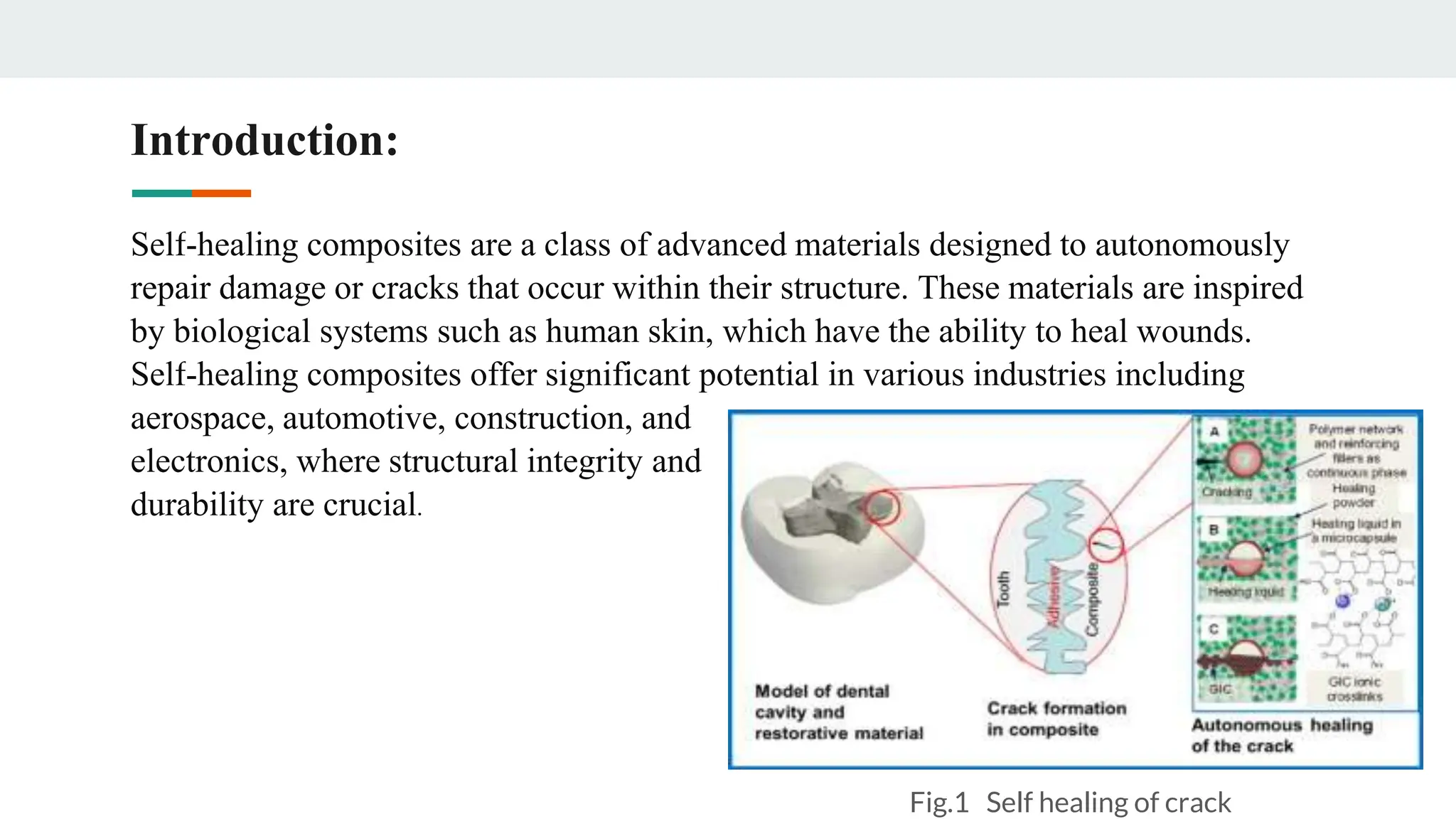
Fig.1 Self healing of crack
Why self healing?
Traditional repairs are expensive!
➔ To design
➔ To implement( removal from service or in - situ repair)
➔ To certify and monitor (additional inspection often required)throughout the remaining
operational life.
● Sense and respond to damage ,restore performance without affecting inherent properties
● No human intervention required.
● Provide early means of detection of damage
● It is like modeling and mimicking of human body and other living systems, which have
ability to self heal.
Principle of Operation:
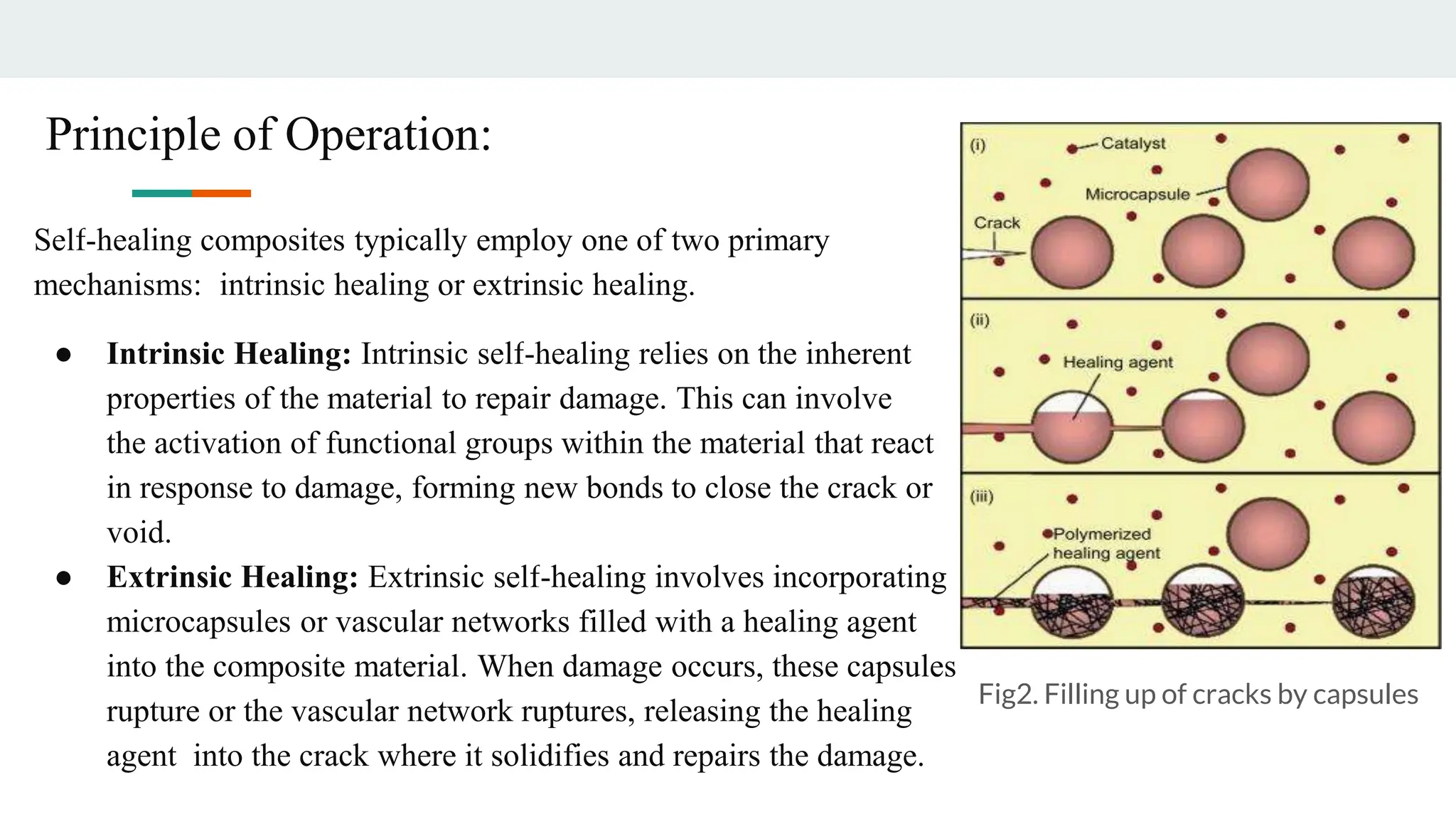
Self-healing composites typically employ one of two primary
mechanisms: intrinsic healing or extrinsic healing.
● Intrinsic Healing: Intrinsic self-healing relies on the inherent
properties of the material to repair damage. This can involve
the activation of functional groups within the material that react
in response to damage, forming new bonds to close the crack or
void.
● Extrinsic Healing: Extrinsic self-healing involves incorporating
microcapsules or vascular networks filled with a healing agent
into the composite material. When damage occurs, these capsules
rupture or the vascular network ruptures, releasing the healing
agent into the crack where it solidifies and repairs the damage.
Fig2. Filling up of cracks by capsules
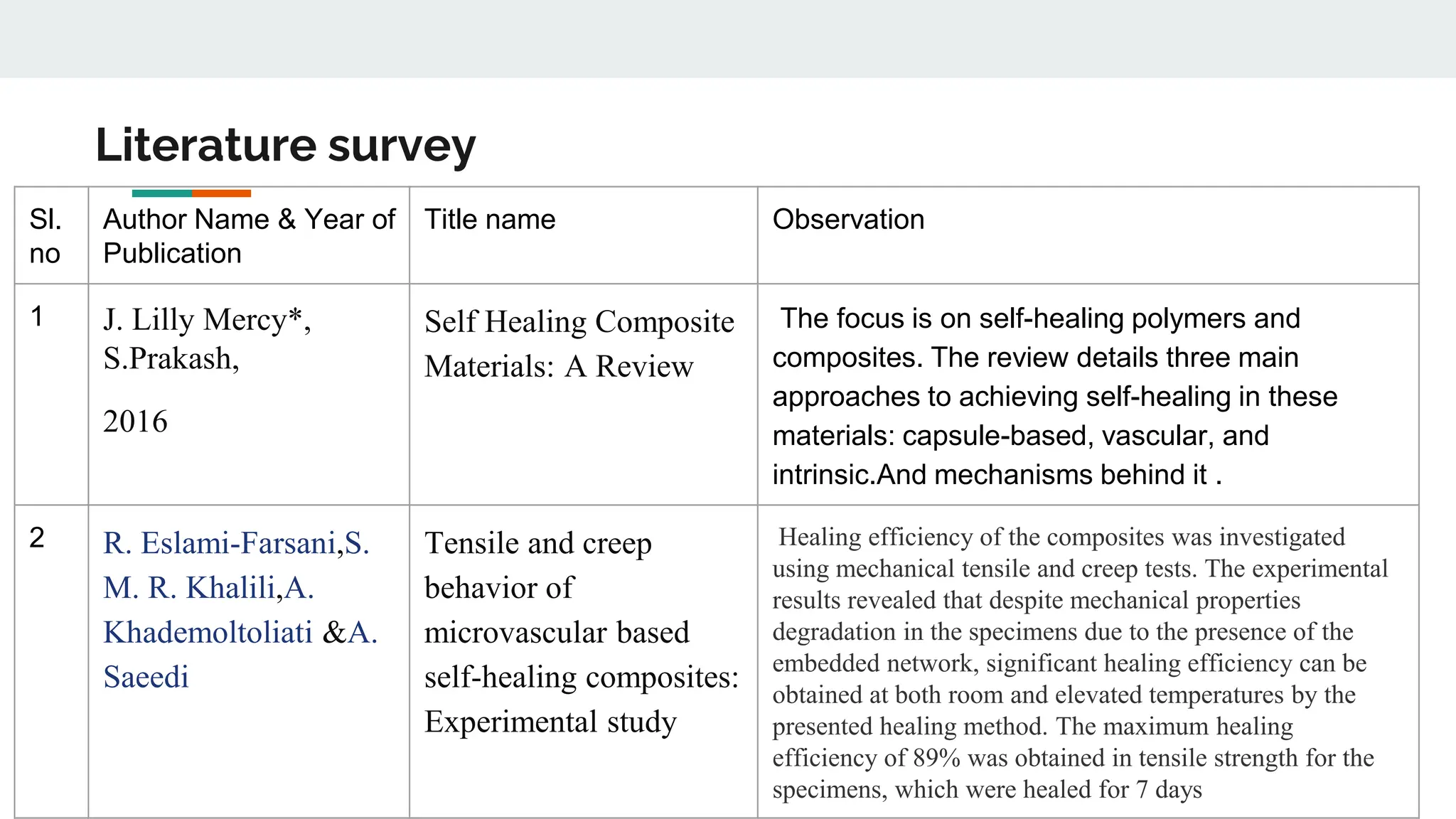
Literature survey
Sl.
no
Author Name & Year of
Publication
Title name Observation
1 J. Lilly Mercy*,
S.Prakash,
2016
Self Healing Composite
Materials: A Review
The focus is on self-healing polymers and
composites. The review details three main
approaches to achieving self-healing in these
materials: capsule-based, vascular, and
intrinsic.And mechanisms behind it .
2 R. Eslami-Farsani,S.
M. R. Khalili,A.
Khademoltoliati &A.
Saeedi
Tensile and creep
behavior of
microvascular based
self-healing composites:
Experimental study
Healing efficiency of the composites was investigated
using mechanical tensile and creep tests. The experimental
results revealed that despite mechanical properties
degradation in the specimens due to the presence of the
embedded network, significant healing efficiency can be
obtained at both room and elevated temperatures by the
presented healing method. The maximum healing
efficiency of 89% was obtained in tensile strength for the
specimens, which were healed for 7 days
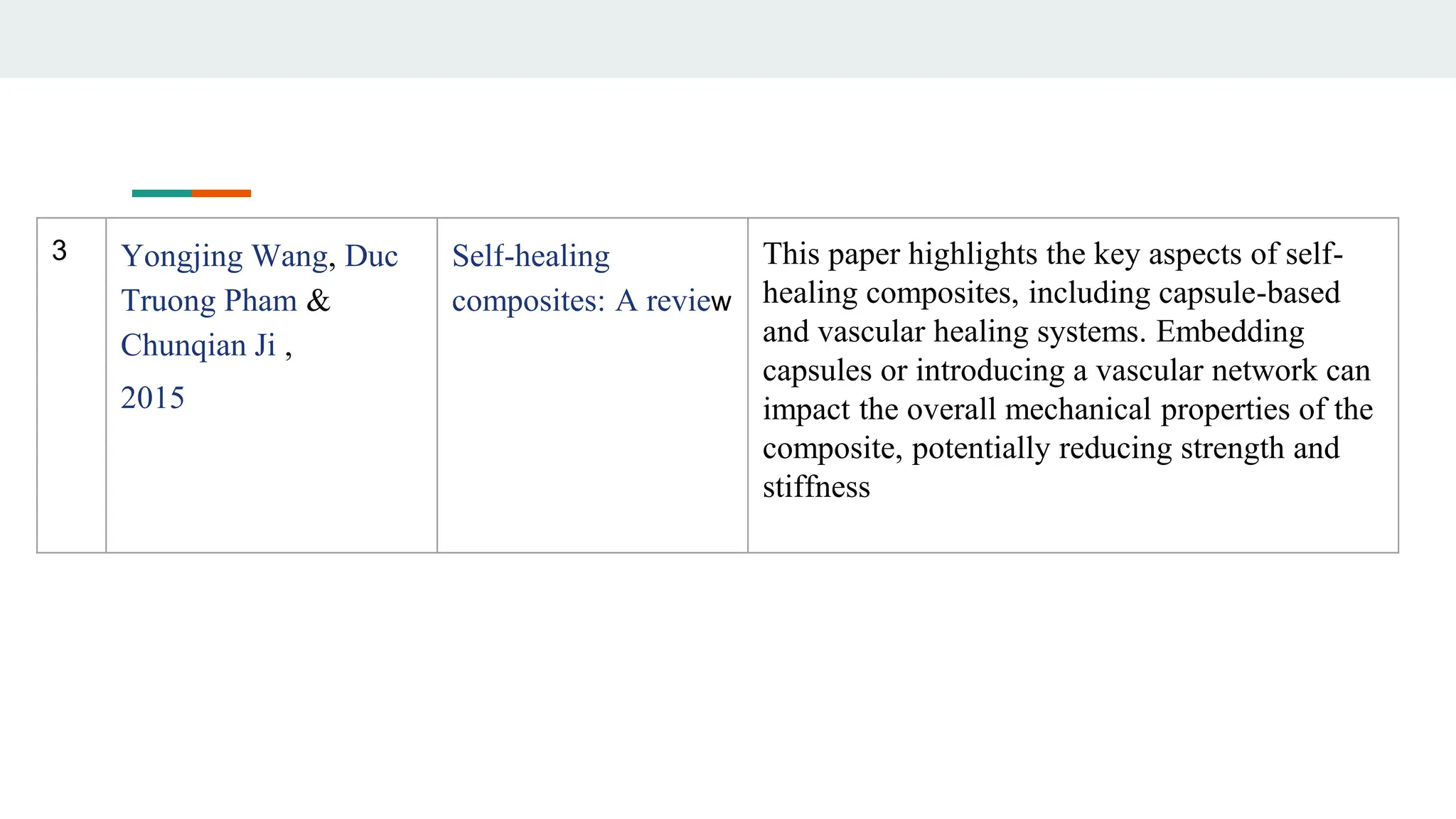
3 Yongjing Wang, Duc
Truong Pham &
Chunqian Ji ,
2015
Self-healing
composites: A review
This paper highlights the key aspects of self-
healing composites, including capsule-based
and vascular healing systems. Embedding
capsules or introducing a vascular network can
impact the overall mechanical properties of the
composite, potentially reducing strength and
stiffness
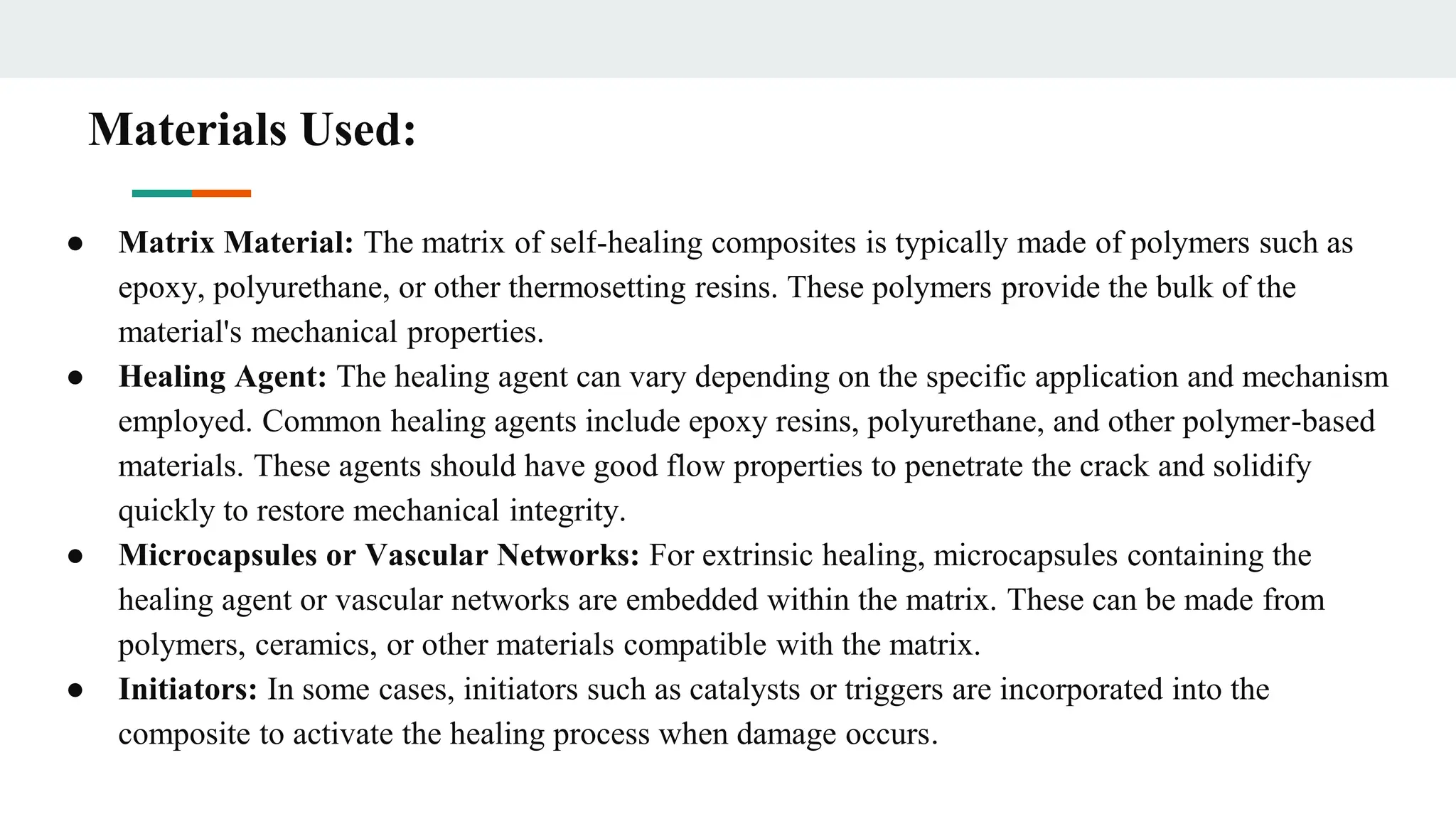
Materials Used:
● Matrix Material: The matrix of self-healing composites is typically made of polymers such as
epoxy, polyurethane, or other thermosetting resins. These polymers provide the bulk of the
material's mechanical properties.
● Healing Agent: The healing agent can vary depending on the specific application and mechanism
employed. Common healing agents include epoxy resins, polyurethane, and other polymer-based
materials. These agents should have good flow properties to penetrate the crack and solidify
quickly to restore mechanical integrity.
● Microcapsules or Vascular Networks: For extrinsic healing, microcapsules containing the
healing agent or vascular networks are embedded within the matrix. These can be made from
polymers, ceramics, or other materials compatible with the matrix.
● Initiators: In some cases, initiators such as catalysts or triggers are incorporated into the
composite to activate the healing process when damage occurs.
ADVANTAGES:
● Extended Lifespan: Self-healing composites can prolong the lifespan of structures by
repairing damage before it compromises structural integrity.
● Reduced Maintenance Costs: By autonomously repairing damage, self-healing composites
can reduce the need for costly maintenance and repair interventions.
● Enhanced Safety: Improved structural integrity reduces the risk of catastrophic failure,
enhancing safety in critical applications such as aerospace and automotive engineering.
CHALLENGES &LIMITATIONS:
● Complex Manufacturing: Incorporating healing mechanisms into composite materials can
increase complexity and cost during manufacturing.
● Limited Healing Capacity: Self-healing composites may have limited ability to repair
extensive damage or damage occurring in critical structural areas.
● Environmental Sensitivity: Some self-healing mechanisms may be sensitive to environmental
conditions such as temperature, humidity, or chemical exposure, affecting their effectiveness.
● Performance Trade-offs: The incorporation of healing mechanisms may alter the mechanical
properties of the composite material, leading to potential trade-offs between healing capability
and other desired properties such as strength and stiffness.
APPLICATION:
● Civil structures(Engineered cementitious composite)
● Tools
● Space applications
● Self healing coatings for steel structure.
● Composite materials for:
➔ Aerospace applications
➔ High quality sporting equipment
➔ Microelectronics
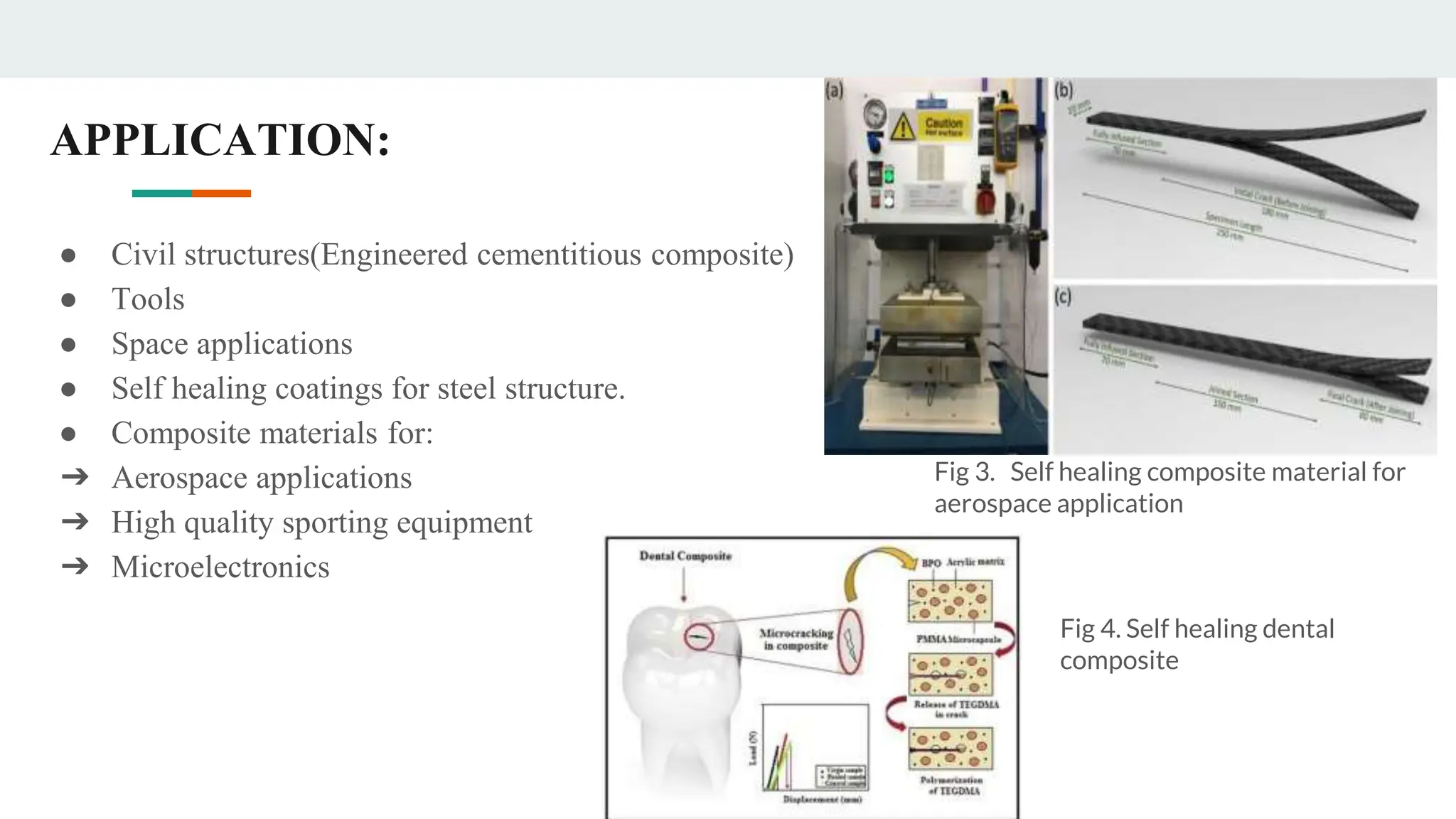
Fig 3. Self healing composite material for
aerospace application
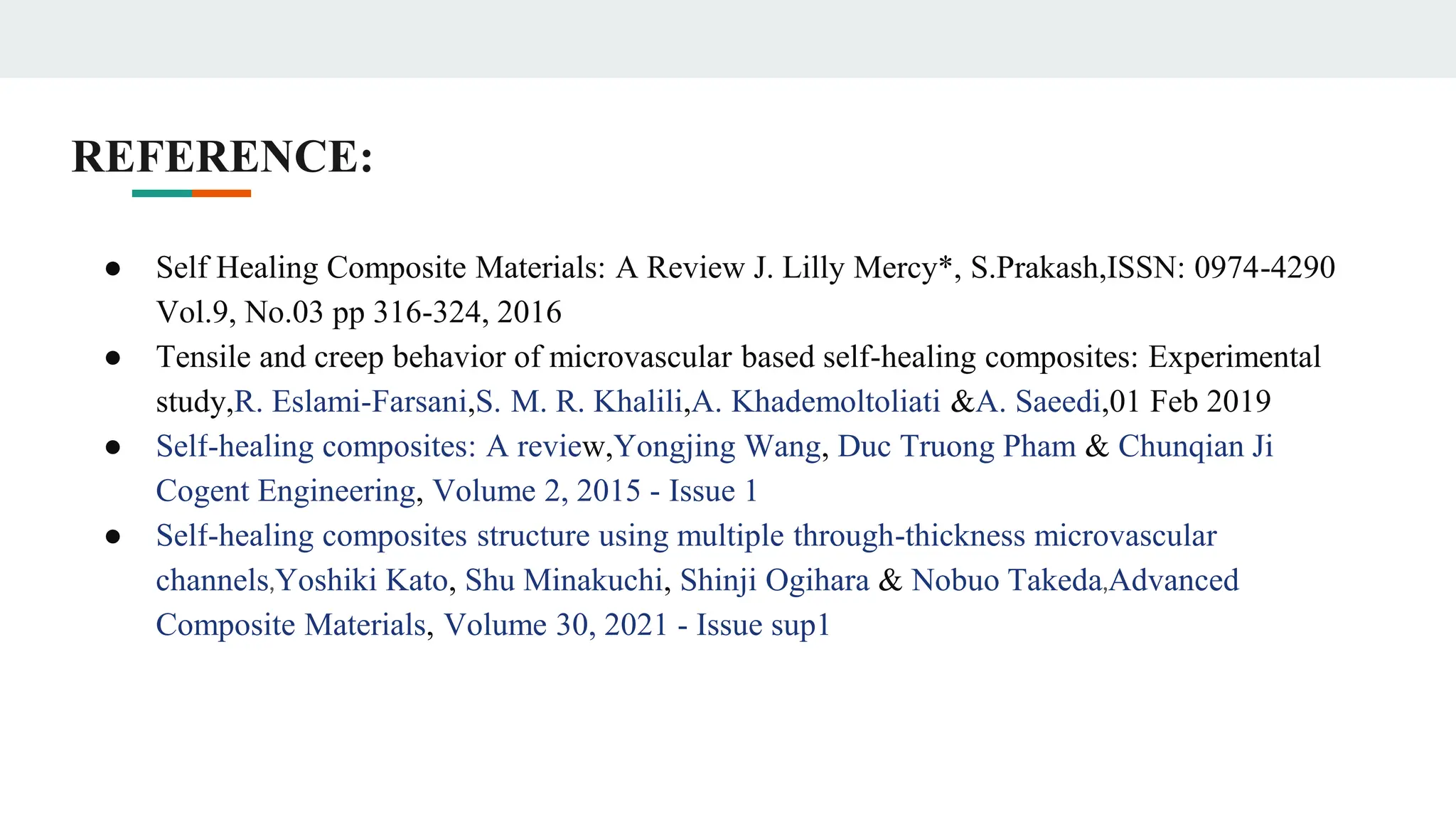
Fig 4. Self healing dental
composite
REFERENCE:
● Self Healing Composite Materials: A Review J. Lilly Mercy*, S.Prakash,ISSN: 0974-4290
Vol.9, No.03 pp 316-324, 2016
● Tensile and creep behavior of microvascular based self-healing composites: Experimental
study,R. Eslami-Farsani,S. M. R. Khalili,A. Khademoltoliati &A. Saeedi,01 Feb 2019
● Self-healing composites: A review,Yongjing Wang, Duc Truong Pham & Chunqian Ji
Cogent Engineering, Volume 2, 2015 - Issue 1
● Self-healing composites structure using multiple through-thickness microvascular
channels,Yoshiki Kato, Shu Minakuchi, Shinji Ogihara & Nobuo Takeda,Advanced
Composite Materials, Volume 30, 2021 - Issue sup1
THANK YOU

Self - Healing composites presentation including everything

  • 1.
    Self - Healing Composites Underthe Guidance of G Dilip Maruthi Associate professor VINODKUMAR 1BM21ME116 DEPT OF MECHANICAL ENGINEERING Internship based seminar 22ME6SRIN2 Department of Mechanical Engineering BMS COLLEGE OF ENGINEERING
  • 2.
    CONTENTS OF PRESENTATION: ●INTRODUCTION TO SELF HEALING COMPOSITES ● NEED OF SELF HEALING MATERIALS ● PRINCIPLE OF OPERATION ● MATERIAL USED ● ADVANTAGES OF SELF HEALING COMPOSITES ● CHALLENGES AND LIMITATION ● APPLICATION
  • 3.
    Introduction: Self-healing composites area class of advanced materials designed to autonomously repair damage or cracks that occur within their structure. These materials are inspired by biological systems such as human skin, which have the ability to heal wounds. Self-healing composites offer significant potential in various industries including aerospace, automotive, construction, and electronics, where structural integrity and durability are crucial. Fig.1 Self healing of crack
  • 4.
    Why self healing? Traditionalrepairs are expensive! ➔ To design ➔ To implement( removal from service or in - situ repair) ➔ To certify and monitor (additional inspection often required)throughout the remaining operational life. ● Sense and respond to damage ,restore performance without affecting inherent properties ● No human intervention required. ● Provide early means of detection of damage ● It is like modeling and mimicking of human body and other living systems, which have ability to self heal.
  • 5.
    Principle of Operation: Self-healingcomposites typically employ one of two primary mechanisms: intrinsic healing or extrinsic healing. ● Intrinsic Healing: Intrinsic self-healing relies on the inherent properties of the material to repair damage. This can involve the activation of functional groups within the material that react in response to damage, forming new bonds to close the crack or void. ● Extrinsic Healing: Extrinsic self-healing involves incorporating microcapsules or vascular networks filled with a healing agent into the composite material. When damage occurs, these capsules rupture or the vascular network ruptures, releasing the healing agent into the crack where it solidifies and repairs the damage. Fig2. Filling up of cracks by capsules
  • 6.
    Literature survey Sl. no Author Name& Year of Publication Title name Observation 1 J. Lilly Mercy*, S.Prakash, 2016 Self Healing Composite Materials: A Review The focus is on self-healing polymers and composites. The review details three main approaches to achieving self-healing in these materials: capsule-based, vascular, and intrinsic.And mechanisms behind it . 2 R. Eslami-Farsani,S. M. R. Khalili,A. Khademoltoliati &A. Saeedi Tensile and creep behavior of microvascular based self-healing composites: Experimental study Healing efficiency of the composites was investigated using mechanical tensile and creep tests. The experimental results revealed that despite mechanical properties degradation in the specimens due to the presence of the embedded network, significant healing efficiency can be obtained at both room and elevated temperatures by the presented healing method. The maximum healing efficiency of 89% was obtained in tensile strength for the specimens, which were healed for 7 days
  • 7.
    3 Yongjing Wang,Duc Truong Pham & Chunqian Ji , 2015 Self-healing composites: A review This paper highlights the key aspects of self- healing composites, including capsule-based and vascular healing systems. Embedding capsules or introducing a vascular network can impact the overall mechanical properties of the composite, potentially reducing strength and stiffness
  • 8.
    Materials Used: ● MatrixMaterial: The matrix of self-healing composites is typically made of polymers such as epoxy, polyurethane, or other thermosetting resins. These polymers provide the bulk of the material's mechanical properties. ● Healing Agent: The healing agent can vary depending on the specific application and mechanism employed. Common healing agents include epoxy resins, polyurethane, and other polymer-based materials. These agents should have good flow properties to penetrate the crack and solidify quickly to restore mechanical integrity. ● Microcapsules or Vascular Networks: For extrinsic healing, microcapsules containing the healing agent or vascular networks are embedded within the matrix. These can be made from polymers, ceramics, or other materials compatible with the matrix. ● Initiators: In some cases, initiators such as catalysts or triggers are incorporated into the composite to activate the healing process when damage occurs.
  • 9.
    ADVANTAGES: ● Extended Lifespan:Self-healing composites can prolong the lifespan of structures by repairing damage before it compromises structural integrity. ● Reduced Maintenance Costs: By autonomously repairing damage, self-healing composites can reduce the need for costly maintenance and repair interventions. ● Enhanced Safety: Improved structural integrity reduces the risk of catastrophic failure, enhancing safety in critical applications such as aerospace and automotive engineering.
  • 10.
    CHALLENGES &LIMITATIONS: ● ComplexManufacturing: Incorporating healing mechanisms into composite materials can increase complexity and cost during manufacturing. ● Limited Healing Capacity: Self-healing composites may have limited ability to repair extensive damage or damage occurring in critical structural areas. ● Environmental Sensitivity: Some self-healing mechanisms may be sensitive to environmental conditions such as temperature, humidity, or chemical exposure, affecting their effectiveness. ● Performance Trade-offs: The incorporation of healing mechanisms may alter the mechanical properties of the composite material, leading to potential trade-offs between healing capability and other desired properties such as strength and stiffness.
  • 11.
    APPLICATION: ● Civil structures(Engineeredcementitious composite) ● Tools ● Space applications ● Self healing coatings for steel structure. ● Composite materials for: ➔ Aerospace applications ➔ High quality sporting equipment ➔ Microelectronics Fig 3. Self healing composite material for aerospace application Fig 4. Self healing dental composite
  • 12.
    REFERENCE: ● Self HealingComposite Materials: A Review J. Lilly Mercy*, S.Prakash,ISSN: 0974-4290 Vol.9, No.03 pp 316-324, 2016 ● Tensile and creep behavior of microvascular based self-healing composites: Experimental study,R. Eslami-Farsani,S. M. R. Khalili,A. Khademoltoliati &A. Saeedi,01 Feb 2019 ● Self-healing composites: A review,Yongjing Wang, Duc Truong Pham & Chunqian Ji Cogent Engineering, Volume 2, 2015 - Issue 1 ● Self-healing composites structure using multiple through-thickness microvascular channels,Yoshiki Kato, Shu Minakuchi, Shinji Ogihara & Nobuo Takeda,Advanced Composite Materials, Volume 30, 2021 - Issue sup1
  • 13.