Self-Healing dental
Polymers
Spring 2018
Mohamed Mahmoud Abdul-Monem
Dental Biomaterials Assistant lecturer
Faculty of dentistry
Alexandria University
EGYPT
Introduction
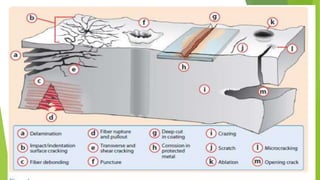
 Structural polymers are susceptible to damage in the form
of cracks, which form deep within the structure where
detection is difficult and repair is almost impossible.
 Self-healing polymers possess the ability to heal in
response to damage wherever and whenever it occurs in
the material.
 Self-healing can be :
(1)Autonomic without human intervention
(2)Require some external energy or pressure.
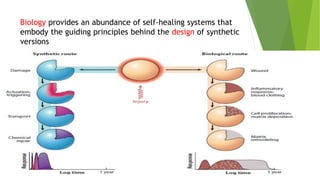
Biology provides an abundance of self-healing systems that
embody the guiding principles behind the design of synthetic
versions
Self-healing has been demonstrated by three
conceptual approaches:
 Capsule-based healing systems,
 Vascular healing systems,
 Intrinsic healing polymers.
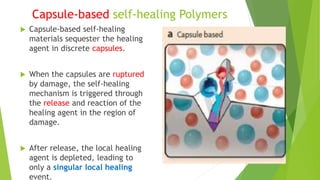
Capsule-based self-healing Polymers
 Capsule-based self-healing
materials sequester the healing
agent in discrete capsules.
 When the capsules are ruptured
by damage, the self-healing
mechanism is triggered through
the release and reaction of the
healing agent in the region of
damage.
 After release, the local healing
agent is depleted, leading to
only a singular local healing
event.
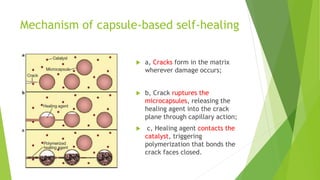
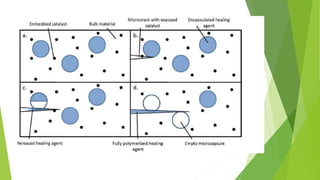
Mechanism of capsule-based self-healing
 a, Cracks form in the matrix
wherever damage occurs;
 b, Crack ruptures the
microcapsules, releasing the
healing agent into the crack
plane through capillary action;
 c, Healing agent contacts the
catalyst, triggering
polymerization that bonds the
crack faces closed.
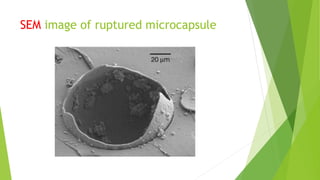
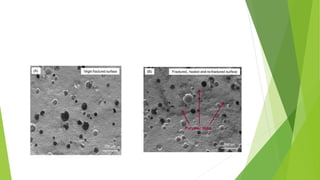
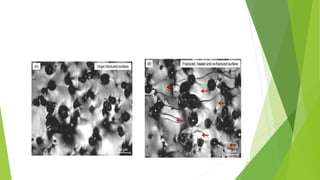
SEM image of ruptured microcapsule
Vascular self-healing Polymers
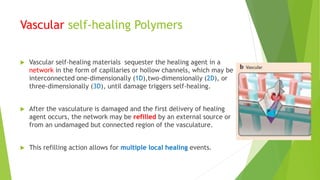
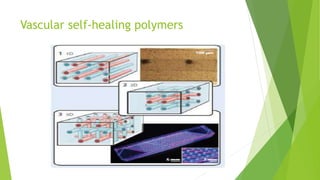
 Vascular self-healing materials sequester the healing agent in a
network in the form of capillaries or hollow channels, which may be
interconnected one-dimensionally (1D),two-dimensionally (2D), or
three-dimensionally (3D), until damage triggers self-healing.
 After the vasculature is damaged and the first delivery of healing
agent occurs, the network may be refilled by an external source or
from an undamaged but connected region of the vasculature.
 This refilling action allows for multiple local healing events.
Vascular self-healing polymers
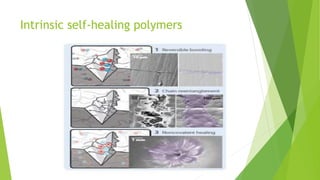
Intrinsic self-healing Polymers
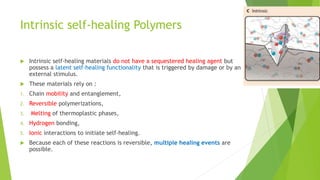
 Intrinsic self-healing materials do not have a sequestered healing agent but
possess a latent self-healing functionality that is triggered by damage or by an
external stimulus.
 These materials rely on :
1. Chain mobility and entanglement,
2. Reversible polymerizations,
3. Melting of thermoplastic phases,
4. Hydrogen bonding,
5. Ionic interactions to initiate self-healing.
 Because each of these reactions is reversible, multiple healing events are
possible.
Intrinsic self-healing polymers
Uses in dentistry
Self-healing Dental composites
Self-healing Resin cements
Self healing Hydrogels
Self-healing dental composites
Aim of the work
 The objective of this study was to develop a self-healing
composite to heal cracks, while containing
dimethylaminohexadecyl methacrylate (DMAHDM) for
antibacterial function and nanoparticles of amorphous
calcium phosphate (NACP) for remineralization.
Materials and methods
Materials:
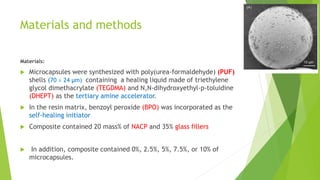
 Microcapsules were synthesized with poly(urea-formaldehyde) (PUF)
shells (70 ± 24 µm) containing a healing liquid made of triethylene
glycol dimethacrylate (TEGDMA) and N,N-dihydroxyethyl-p-toluidine
(DHEPT) as the tertiary amine accelerator.
 In the resin matrix, benzoyl peroxide (BPO) was incorporated as the
self-healing initiator
 Composite contained 20 mass% of NACP and 35% glass fillers
 In addition, composite contained 0%, 2.5%, 5%, 7.5%, or 10% of
microcapsules.
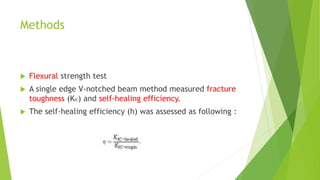
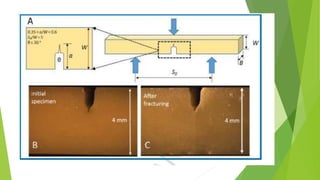
Methods
 Flexural strength test
 A single edge V-notched beam method measured fracture
toughness (KIC) and self-healing efficiency.
 The self-healing efficiency (h) was assessed as following :
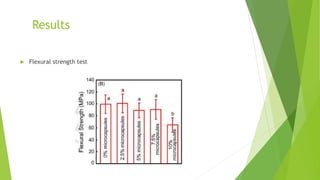
Results
 Flexural strength test
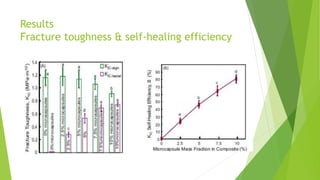
Results
Fracture toughness & self-healing efficiency
Conclusion
 A novel dental composite was developed with triple
benefits of self-healing, antibacterial and
remineralization capabilities.
 The original properties of the composite including flexural
strength, elastic modulus and fracture toughness were not
adversely affected when microcapsules were added up to
7.5%.
 Self-healing was achieved with 65–81% recovery in the
virgin fracture toughness, thereby recovering the load-
bearing capability of a cracked dental composite.
Self-healing resin cements
Aim of the work
 The objectives of this study were to develop the first self-
healing luting cement, and investigate dentin bond
strength, mechanical properties, crack-healing, and self-
healing durability in water-aging for 6 months.
Materials
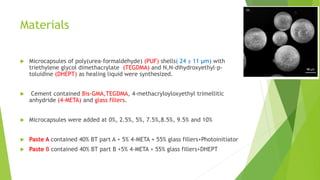
 Microcapsules of poly(urea-formaldehyde) (PUF) shells( 24 ± 11 μm) with
triethylene glycol dimethacrylate (TEGDMA) and N,N-dihydroxyethyl-p-
toluidine (DHEPT) as healing liquid were synthesized.
 Cement contained Bis-GMA,TEGDMA, 4-methacryloyloxyethyl trimellitic
anhydride (4-META) and glass fillers.
 Microcapsules were added at 0%, 2.5%, 5%, 7.5%,8.5%, 9.5% and 10%
 Paste A contained 40% BT part A + 5% 4-META + 55% glass fillers+Photoinitiator
 Paste B contained 40% BT part B +5% 4-META + 55% glass fillers+DHEPT
Methods
 Dentin shear bond strength was measured using extracted
human teeth.
 Flexural strength and elastic modulus were measured.
 Single edge V-notched beams were used to measure
fracture toughness (KIC)and self-healing efficiency.
Results
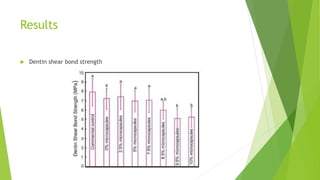
 Dentin shear bond strength
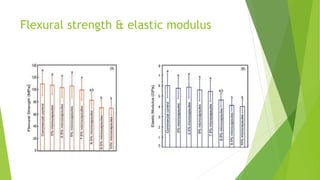
Flexural strength & elastic modulus
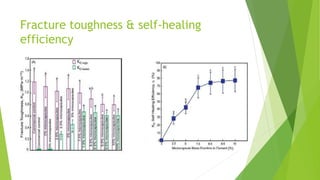
Fracture toughness & self-healing
efficiency
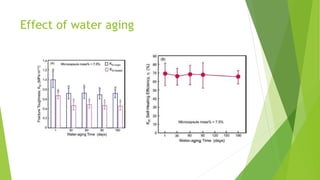
Effect of water aging
Conclusion
 Incorporating up to 7.5% microcapsules by mass into the
cement did not compromise the dentin bond strength and
the cement’s mechanical properties.
 A relatively high self-healing efficiency of 68% in the
recovery of KIC-virgin was obtained when the microcapsule
mass fraction was 7.5%.
 This new cement had a promising self-healing retention
without a significant decrease in 6 months of water-aging
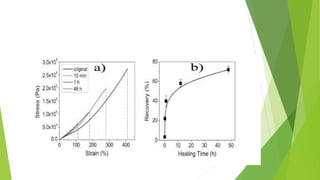
Self-healing Hydrogels
Introduction
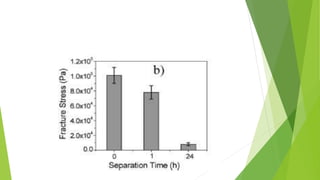
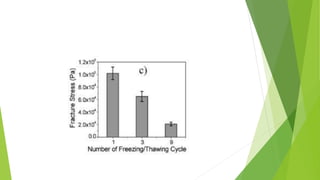
 It is discovered that poly(vinyl alcohol) (PVA) hydrogel prepared using the
freezing/thawing method can self-heal at room temperature without the
need for any stimulus or healing agent.
 Investigation on the effect of the hydrogel preparation conditions points out
that hydrogen bonding between PVA chains across the interface of the cut
surfaces is at the origin of the phenomenon.
 The key for an effective selfhealing is to have an (1) appropriate balance
between high concentration of free hydroxyl groups on PVA chains on the cut
surfaces prior to contact and (2)sufficient PVA chain mobility in the hydrogel.
Materials & Methods
 Physically cross-linked PVA hydrogel using the well-known
freezing/thawing method.
 PVA was dissolved in distilled water at 95°C under
vigorous stirring.
 The homogeneous solution was then cast into a mold of
desired dimension and cooled at −15 °C for 1 h, which was
followed by thawing at room temperature for 12h.
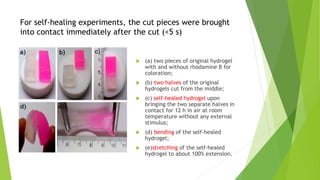
For self-healing experiments, the cut pieces were brought
into contact immediately after the cut (<5 s)
 (a) two pieces of original hydrogel
with and without rhodamine B for
coloration;
 (b) two halves of the original
hydrogels cut from the middle;
 (c) self-healed hydrogel upon
bringing the two separate halves in
contact for 12 h in air at room
temperature without any external
stimulus;
 (d) bending of the self-healed
hydrogel;
 (e)stretching of the self-healed
hydrogel to about 100% extension.
Conclusion
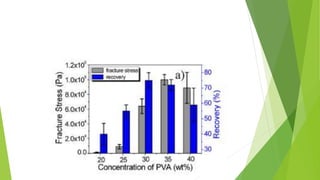
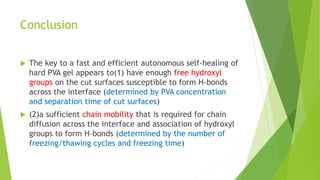
 The key to a fast and efficient autonomous self-healing of
hard PVA gel appears to(1) have enough free hydroxyl
groups on the cut surfaces susceptible to form H-bonds
across the interface (determined by PVA concentration
and separation time of cut surfaces)
 (2)a sufficient chain mobility that is required for chain
diffusion across the interface and association of hydroxyl
groups to form H-bonds (determined by the number of
freezing/thawing cycles and freezing time)
References
1. Blaiszik BJ et al. Self-Healing Polymers and Composites. Annu. Rev. Mater.
Res. 2010;40:179–211
2. White SR et al. Autonomic healing of polymer
composites.Nature.2001;409:794-98
3. Junling Wu et al. Development of novel self-healing and antibacterial dental
composite containing calcium phosphate nanoparticles .Journal of
Dentistry.2015;1-10
4. Junling Wu et al. Novel self-healing dental luting cements with microcapsules
for indirect restorations. Journal of dentistry.2017;1-7
5. Hongji Z et al. Poly(vinyl alcohol) Hydrogel Can Autonomously Self-Heal.ACS
Macro Lett. 2012;1:1233−36.
Thank you

Self healing dental polymers

  • 1.
    Self-Healing dental Polymers Spring 2018 MohamedMahmoud Abdul-Monem Dental Biomaterials Assistant lecturer Faculty of dentistry Alexandria University EGYPT
  • 2.
    Introduction  Structural polymersare susceptible to damage in the form of cracks, which form deep within the structure where detection is difficult and repair is almost impossible.  Self-healing polymers possess the ability to heal in response to damage wherever and whenever it occurs in the material.  Self-healing can be : (1)Autonomic without human intervention (2)Require some external energy or pressure.
  • 4.
    Biology provides anabundance of self-healing systems that embody the guiding principles behind the design of synthetic versions
  • 5.
    Self-healing has beendemonstrated by three conceptual approaches:  Capsule-based healing systems,  Vascular healing systems,  Intrinsic healing polymers.
  • 6.
    Capsule-based self-healing Polymers Capsule-based self-healing materials sequester the healing agent in discrete capsules.  When the capsules are ruptured by damage, the self-healing mechanism is triggered through the release and reaction of the healing agent in the region of damage.  After release, the local healing agent is depleted, leading to only a singular local healing event.
  • 7.
    Mechanism of capsule-basedself-healing  a, Cracks form in the matrix wherever damage occurs;  b, Crack ruptures the microcapsules, releasing the healing agent into the crack plane through capillary action;  c, Healing agent contacts the catalyst, triggering polymerization that bonds the crack faces closed.
  • 9.
    SEM image ofruptured microcapsule
  • 10.
    Vascular self-healing Polymers Vascular self-healing materials sequester the healing agent in a network in the form of capillaries or hollow channels, which may be interconnected one-dimensionally (1D),two-dimensionally (2D), or three-dimensionally (3D), until damage triggers self-healing.  After the vasculature is damaged and the first delivery of healing agent occurs, the network may be refilled by an external source or from an undamaged but connected region of the vasculature.  This refilling action allows for multiple local healing events.
  • 11.
  • 12.
    Intrinsic self-healing Polymers Intrinsic self-healing materials do not have a sequestered healing agent but possess a latent self-healing functionality that is triggered by damage or by an external stimulus.  These materials rely on : 1. Chain mobility and entanglement, 2. Reversible polymerizations, 3. Melting of thermoplastic phases, 4. Hydrogen bonding, 5. Ionic interactions to initiate self-healing.  Because each of these reactions is reversible, multiple healing events are possible.
  • 13.
  • 14.
    Uses in dentistry Self-healingDental composites Self-healing Resin cements Self healing Hydrogels
  • 15.
  • 16.
    Aim of thework  The objective of this study was to develop a self-healing composite to heal cracks, while containing dimethylaminohexadecyl methacrylate (DMAHDM) for antibacterial function and nanoparticles of amorphous calcium phosphate (NACP) for remineralization.
  • 17.
    Materials and methods Materials: Microcapsules were synthesized with poly(urea-formaldehyde) (PUF) shells (70 ± 24 µm) containing a healing liquid made of triethylene glycol dimethacrylate (TEGDMA) and N,N-dihydroxyethyl-p-toluidine (DHEPT) as the tertiary amine accelerator.  In the resin matrix, benzoyl peroxide (BPO) was incorporated as the self-healing initiator  Composite contained 20 mass% of NACP and 35% glass fillers  In addition, composite contained 0%, 2.5%, 5%, 7.5%, or 10% of microcapsules.
  • 18.
    Methods  Flexural strengthtest  A single edge V-notched beam method measured fracture toughness (KIC) and self-healing efficiency.  The self-healing efficiency (h) was assessed as following :
  • 20.
  • 21.
    Results Fracture toughness &self-healing efficiency
  • 23.
    Conclusion  A noveldental composite was developed with triple benefits of self-healing, antibacterial and remineralization capabilities.  The original properties of the composite including flexural strength, elastic modulus and fracture toughness were not adversely affected when microcapsules were added up to 7.5%.  Self-healing was achieved with 65–81% recovery in the virgin fracture toughness, thereby recovering the load- bearing capability of a cracked dental composite.
  • 24.
  • 25.
    Aim of thework  The objectives of this study were to develop the first self- healing luting cement, and investigate dentin bond strength, mechanical properties, crack-healing, and self- healing durability in water-aging for 6 months.
  • 26.
    Materials  Microcapsules ofpoly(urea-formaldehyde) (PUF) shells( 24 ± 11 μm) with triethylene glycol dimethacrylate (TEGDMA) and N,N-dihydroxyethyl-p- toluidine (DHEPT) as healing liquid were synthesized.  Cement contained Bis-GMA,TEGDMA, 4-methacryloyloxyethyl trimellitic anhydride (4-META) and glass fillers.  Microcapsules were added at 0%, 2.5%, 5%, 7.5%,8.5%, 9.5% and 10%  Paste A contained 40% BT part A + 5% 4-META + 55% glass fillers+Photoinitiator  Paste B contained 40% BT part B +5% 4-META + 55% glass fillers+DHEPT
  • 27.
    Methods  Dentin shearbond strength was measured using extracted human teeth.  Flexural strength and elastic modulus were measured.  Single edge V-notched beams were used to measure fracture toughness (KIC)and self-healing efficiency.
  • 28.
  • 29.
    Flexural strength &elastic modulus
  • 30.
    Fracture toughness &self-healing efficiency
  • 31.
  • 33.
    Conclusion  Incorporating upto 7.5% microcapsules by mass into the cement did not compromise the dentin bond strength and the cement’s mechanical properties.  A relatively high self-healing efficiency of 68% in the recovery of KIC-virgin was obtained when the microcapsule mass fraction was 7.5%.  This new cement had a promising self-healing retention without a significant decrease in 6 months of water-aging
  • 34.
  • 35.
    Introduction  It isdiscovered that poly(vinyl alcohol) (PVA) hydrogel prepared using the freezing/thawing method can self-heal at room temperature without the need for any stimulus or healing agent.  Investigation on the effect of the hydrogel preparation conditions points out that hydrogen bonding between PVA chains across the interface of the cut surfaces is at the origin of the phenomenon.  The key for an effective selfhealing is to have an (1) appropriate balance between high concentration of free hydroxyl groups on PVA chains on the cut surfaces prior to contact and (2)sufficient PVA chain mobility in the hydrogel.
  • 36.
    Materials & Methods Physically cross-linked PVA hydrogel using the well-known freezing/thawing method.  PVA was dissolved in distilled water at 95°C under vigorous stirring.  The homogeneous solution was then cast into a mold of desired dimension and cooled at −15 °C for 1 h, which was followed by thawing at room temperature for 12h.
  • 37.
    For self-healing experiments,the cut pieces were brought into contact immediately after the cut (<5 s)  (a) two pieces of original hydrogel with and without rhodamine B for coloration;  (b) two halves of the original hydrogels cut from the middle;  (c) self-healed hydrogel upon bringing the two separate halves in contact for 12 h in air at room temperature without any external stimulus;  (d) bending of the self-healed hydrogel;  (e)stretching of the self-healed hydrogel to about 100% extension.
  • 42.
    Conclusion  The keyto a fast and efficient autonomous self-healing of hard PVA gel appears to(1) have enough free hydroxyl groups on the cut surfaces susceptible to form H-bonds across the interface (determined by PVA concentration and separation time of cut surfaces)  (2)a sufficient chain mobility that is required for chain diffusion across the interface and association of hydroxyl groups to form H-bonds (determined by the number of freezing/thawing cycles and freezing time)
  • 43.
    References 1. Blaiszik BJet al. Self-Healing Polymers and Composites. Annu. Rev. Mater. Res. 2010;40:179–211 2. White SR et al. Autonomic healing of polymer composites.Nature.2001;409:794-98 3. Junling Wu et al. Development of novel self-healing and antibacterial dental composite containing calcium phosphate nanoparticles .Journal of Dentistry.2015;1-10 4. Junling Wu et al. Novel self-healing dental luting cements with microcapsules for indirect restorations. Journal of dentistry.2017;1-7 5. Hongji Z et al. Poly(vinyl alcohol) Hydrogel Can Autonomously Self-Heal.ACS Macro Lett. 2012;1:1233−36.
  • 44.