Helping patients with Long Term Conditions maintain 
independence.
This session is a key session therefore it is something that you MUST know in 
order to address the Module Learning Outcomes Three and Four
More than 15 million people in England live with at least one 
long-term condition 
 They represent 55% of GP appointments; 68% of outpatient, 
accident and emergency attendances and 77% of inpatient 
bed days 
 They account for around 70% of NHS spending 
By 2018 nearly three million people will have three or more 
long-term conditions [Source: Department of Health]
Do it yourself care!! 
What do you think? 
Using your own words define Self Care
 Self Care is an integral part of daily life and is all about individuals taking responsibility 
for their own health and wellbeing, with support from their health and social care 
professionals. 
 It includes the actions people take every day in order to stay fit and maintain good 
physical and mental health, meet their social and psychological needs, prevents 
illness or accidents, and care more effectively for minor ailments and long term 
conditions.
 “Self care is about individuals, families and communities taking responsibility for their 
own health and wellbeing. It includes actions people take in order to stay fit and 
maintain good physical and mental health, meet their social and psychological needs, 
prevent illness or accidents and care more effectively for minor ailments and long term 
conditions.”
 “People living with a long term condition, disability or a minor illness, as well as 
carers, can benefit enormously from being supported to self care. They can live 
longer, suffer less pain, anxiety, depression and fatigue, have a better quality of life, 
and be more active and independent.”
 “is defined as a naturalistic decision-making process that 
patients use in the choice of behaviours that maintains 
physiological stability (symptom monitoring and treatment 
adherence) and the response to symptoms when they occur. 
Making decisions based on the situation let the content 
influence the decision making process and based on 
practical decisions on the information available in that 
moment.” (Riegel et al 2006)
 Self care was highlighted in the NHS Plan as one of the key building blocks for a 
patient-centred health service. More recently self care featured as a key component of 
the model for Supporting People with Long Term Conditions. Research shows that 
supporting self care can improve health outcomes, increase patient satisfaction and 
help in deploying the biggest collaborative resource available to the NHS and social 
care - patients and the public. Helping people self care represents an exciting 
opportunity and challenge for the NHS and social care services to empower patients 
to take more control over their lives.
 “Self management means different things to different people for most people it means 
developing an understanding of how their condition affects their lives and how to cope 
with their symptoms” 
 http://www.kingsfund.org.uk/time-to-think-differently/trends/disease-and-disability/long-term- 
conditions-multi-morbidity
 The proactive management of people with long-term conditions, including the 
promotion of self-care by patients, is a key priority for the NHS. 
 General practice has a central role in delivering more integrated and personalised 
care, and in implementing policies that target 'at-risk' individuals with appropriate 
interventions. 
 http://www.kingsfund.org.uk/sites/files/kf/field/field_publication_file/self-management-long- 
term-conditions-patients-perspectives-sara-corben-rebecca-rosen-kings-fund-26- 
july-2005.pdf
 People with long-term conditions spend an average of just three hours per year with 
their healthcare team. 
 The rest of the time, they are effectively self-managing. 
 Self management support enables and encourages patients with long-term conditions 
to take a more proactive role in managing their health and wellbeing 
 “Self management is about giving people living with long-term 
conditions the tools, skills and support they need to 
improve their own wellbeing.” 
 http://selfmanagementuk.org/
 Self management programmes are delivered by trained peer facilitators who are 
experienced at managing their own long-term condition. 
 Peer-led programmes provide the optimal environment for patient engagement and 
education. 
 Patients are more responsive to learning from people who have first-hand knowledge 
of the challenges they face. 
 https://www.youtube.com/watch?v=ac13iuGByRQ
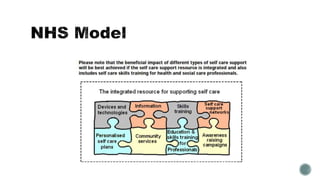
 Self care information on health and human body systems, lifestyle and healthy eating. 
 Support to capture, manage, interpret, and report observations of daily living the tracking 
of trends, and the use of the resulting information as clues for self care action and decision 
making. 
 Information prescription providing personalised information and instructions to enable an 
individual to self care and take control of their health 
 Self care and self monitoring devices and assistive technology 
 Self care skills and life skills training programmes and courses for people 
 Aid from spiritual care givers 
 Advice from licensed counselors, clinical social workers, psychotherapists, pharmacists, 
physiotherapists and complementary therapists 
 Self care support networks which can be face to face or virtual, and made up of peers or 
people who want to provide support to others or receive support and information from 
others.
Self care is a decision making process that demands that patients: 
 Recognise change in their condition 
 Evaluate the change 
 Decide to take action 
 Implement the treatment 
 Evaluate the response 
 Self care is not synonymous with treatment adherence or compliance but instead 
subsumes treatment adherence as one component of self care 
 https://www.youtube.com/watch?v=aM9sMhuOQ18
 https://www.youtube.com/watch?v=NYevwIEyDxY 
 https://www.youtube.com/watch?v=-b1YFzeQtFs 
 Learning from our patients
Taking medications 
Monitoring and interpreting symptoms 
Keeping appointments 
When and how to contact health care
It encourages people with LTC’s to: 
 find out more about their condition 
 learn new skills and tools to help them manage their health 
work better, and in partnership, with healthcare professionals 
 take charge of their healthcare
 Supported self management enhances: 
 Patient engagement and activation 
 Shared decision making 
 Personal care planning 
 Appropriate information and education 
 Personalised health goals for patients 
 Outcomes focused approach 
 Partnership between patients and their health, social care and careers professionals 
to improve health outcomes
Three key areas for service development are: 
 improving health professionals' skills to help patients manage their own conditions 
 improving the provision of information about long-term conditions and the local 
services available 
 increasing the flexibility of services to fit in with patients' other commitments. 
 http://www.kingsfund.org.uk/publications/delivering-better-services-people-long-term-conditions
 Adopt the self care philosophy therefore use self care strategies to promote 
independence 
 Reflect upon your chosen Gallagher 
 Identify 
 What is available to enable the patient self care 
 What skills are needed to enable the patient adopt this strategy 
 How would this promote independence?
 Conflicting instructions 
 Impaired cognition 
 Anxiety and depression 
 Comorbidities ( makes interpreting symptoms difficult) 
 Taking medication 
 Monitoring and interpreting symptoms 
 Keeping appointments 
 Managing new routines 
 How would you determine self care is effective?
 http://www.kingsfund.org.uk/time-to-think-differently/trends/disease-and-disability/long-term- 
conditions-multi-morbidity 
 http://www.kingsfund.org.uk/publications/delivering-better-services-people-long-term-conditions 
 http://www.skillsforcare.org.uk/Skills/Self-care/Self-care.aspx 
 http://www.nhs.uk/Planners/Yourhealth/Pages/Whatisselfcare.aspx 
 http://selfmanagementuk.org/ 
 Department of Health (2008) Long Term Conditions Compendium of Information 
(Gateway reference 8734)

Self Care

  • 1.
    Helping patients withLong Term Conditions maintain independence.
  • 2.
    This session isa key session therefore it is something that you MUST know in order to address the Module Learning Outcomes Three and Four
  • 3.
    More than 15million people in England live with at least one long-term condition  They represent 55% of GP appointments; 68% of outpatient, accident and emergency attendances and 77% of inpatient bed days  They account for around 70% of NHS spending By 2018 nearly three million people will have three or more long-term conditions [Source: Department of Health]
  • 4.
    Do it yourselfcare!! What do you think? Using your own words define Self Care
  • 6.
     Self Careis an integral part of daily life and is all about individuals taking responsibility for their own health and wellbeing, with support from their health and social care professionals.  It includes the actions people take every day in order to stay fit and maintain good physical and mental health, meet their social and psychological needs, prevents illness or accidents, and care more effectively for minor ailments and long term conditions.
  • 7.
     “Self careis about individuals, families and communities taking responsibility for their own health and wellbeing. It includes actions people take in order to stay fit and maintain good physical and mental health, meet their social and psychological needs, prevent illness or accidents and care more effectively for minor ailments and long term conditions.”
  • 8.
     “People livingwith a long term condition, disability or a minor illness, as well as carers, can benefit enormously from being supported to self care. They can live longer, suffer less pain, anxiety, depression and fatigue, have a better quality of life, and be more active and independent.”
  • 9.
     “is definedas a naturalistic decision-making process that patients use in the choice of behaviours that maintains physiological stability (symptom monitoring and treatment adherence) and the response to symptoms when they occur. Making decisions based on the situation let the content influence the decision making process and based on practical decisions on the information available in that moment.” (Riegel et al 2006)
  • 10.
     Self carewas highlighted in the NHS Plan as one of the key building blocks for a patient-centred health service. More recently self care featured as a key component of the model for Supporting People with Long Term Conditions. Research shows that supporting self care can improve health outcomes, increase patient satisfaction and help in deploying the biggest collaborative resource available to the NHS and social care - patients and the public. Helping people self care represents an exciting opportunity and challenge for the NHS and social care services to empower patients to take more control over their lives.
  • 11.
     “Self managementmeans different things to different people for most people it means developing an understanding of how their condition affects their lives and how to cope with their symptoms”  http://www.kingsfund.org.uk/time-to-think-differently/trends/disease-and-disability/long-term- conditions-multi-morbidity
  • 12.
     The proactivemanagement of people with long-term conditions, including the promotion of self-care by patients, is a key priority for the NHS.  General practice has a central role in delivering more integrated and personalised care, and in implementing policies that target 'at-risk' individuals with appropriate interventions.  http://www.kingsfund.org.uk/sites/files/kf/field/field_publication_file/self-management-long- term-conditions-patients-perspectives-sara-corben-rebecca-rosen-kings-fund-26- july-2005.pdf
  • 13.
     People withlong-term conditions spend an average of just three hours per year with their healthcare team.  The rest of the time, they are effectively self-managing.  Self management support enables and encourages patients with long-term conditions to take a more proactive role in managing their health and wellbeing  “Self management is about giving people living with long-term conditions the tools, skills and support they need to improve their own wellbeing.”  http://selfmanagementuk.org/
  • 14.
     Self managementprogrammes are delivered by trained peer facilitators who are experienced at managing their own long-term condition.  Peer-led programmes provide the optimal environment for patient engagement and education.  Patients are more responsive to learning from people who have first-hand knowledge of the challenges they face.  https://www.youtube.com/watch?v=ac13iuGByRQ
  • 16.
     Self careinformation on health and human body systems, lifestyle and healthy eating.  Support to capture, manage, interpret, and report observations of daily living the tracking of trends, and the use of the resulting information as clues for self care action and decision making.  Information prescription providing personalised information and instructions to enable an individual to self care and take control of their health  Self care and self monitoring devices and assistive technology  Self care skills and life skills training programmes and courses for people  Aid from spiritual care givers  Advice from licensed counselors, clinical social workers, psychotherapists, pharmacists, physiotherapists and complementary therapists  Self care support networks which can be face to face or virtual, and made up of peers or people who want to provide support to others or receive support and information from others.
  • 17.
    Self care isa decision making process that demands that patients:  Recognise change in their condition  Evaluate the change  Decide to take action  Implement the treatment  Evaluate the response  Self care is not synonymous with treatment adherence or compliance but instead subsumes treatment adherence as one component of self care  https://www.youtube.com/watch?v=aM9sMhuOQ18
  • 18.
     https://www.youtube.com/watch?v=NYevwIEyDxY https://www.youtube.com/watch?v=-b1YFzeQtFs  Learning from our patients
  • 19.
    Taking medications Monitoringand interpreting symptoms Keeping appointments When and how to contact health care
  • 20.
    It encourages peoplewith LTC’s to:  find out more about their condition  learn new skills and tools to help them manage their health work better, and in partnership, with healthcare professionals  take charge of their healthcare
  • 21.
     Supported selfmanagement enhances:  Patient engagement and activation  Shared decision making  Personal care planning  Appropriate information and education  Personalised health goals for patients  Outcomes focused approach  Partnership between patients and their health, social care and careers professionals to improve health outcomes
  • 22.
    Three key areasfor service development are:  improving health professionals' skills to help patients manage their own conditions  improving the provision of information about long-term conditions and the local services available  increasing the flexibility of services to fit in with patients' other commitments.  http://www.kingsfund.org.uk/publications/delivering-better-services-people-long-term-conditions
  • 23.
     Adopt theself care philosophy therefore use self care strategies to promote independence  Reflect upon your chosen Gallagher  Identify  What is available to enable the patient self care  What skills are needed to enable the patient adopt this strategy  How would this promote independence?
  • 24.
     Conflicting instructions  Impaired cognition  Anxiety and depression  Comorbidities ( makes interpreting symptoms difficult)  Taking medication  Monitoring and interpreting symptoms  Keeping appointments  Managing new routines  How would you determine self care is effective?
  • 25.
     http://www.kingsfund.org.uk/time-to-think-differently/trends/disease-and-disability/long-term- conditions-multi-morbidity  http://www.kingsfund.org.uk/publications/delivering-better-services-people-long-term-conditions  http://www.skillsforcare.org.uk/Skills/Self-care/Self-care.aspx  http://www.nhs.uk/Planners/Yourhealth/Pages/Whatisselfcare.aspx  http://selfmanagementuk.org/  Department of Health (2008) Long Term Conditions Compendium of Information (Gateway reference 8734)