Grief, Bereavement, Dying and
Death
Prepared and presented by:
Shamsher Moloo
Muhammad Hasnain Shaikh
1/25/2017 Grief, bereavement, dying and death 1
Objectives
By the end of this presentation learners will be
able to:
Define loss, grief, bereavement and mourning.
Identify the common signs and symptoms of
grief.
Ellaborate stages of grief.
Define death and signs of approaching death.
1/25/2017 Grief, bereavement, dying and death 2
Cont..
Explain nursing care of dying patient.
Enlist signs of clinical death.
Describe care of body after death.
1/25/2017 Grief, bereavement, dying and death 3
Loss
Loss is defined as the experience of parting
(seperating) with an object, person, or
relationship that one values.
(Craven & Hirnle, 2009)
1/25/2017 Grief, bereavement, dying and death 4
Grief
Grief is psychological and physiologic responses
a person experiences after the loss of a
significant person, object, or relationship.
(Craven & Hirnle, 2009)
1/25/2017 Grief, bereavement, dying and death 5
Bereavement
Bereavement is a state of desolation
(unhappiness) that occurs as the result of a
loss.
Bereavement is the subjective response.
(Craven & Hirnle, 2009)
1/25/2017 Grief, bereavement, dying and death 6
Mourning
Mourning encompasses the socially prescribed
behaviors after the death of a significant other.
Mourning behaviors are socially conventional
(based on) bereavement behaviors.
(Craven & Hirnle, 2009)
1/25/2017 Grief, bereavement, dying and death 7
Stages of Grief
1/25/2017 Grief, bereavement, dying and death 8
Stages of grief
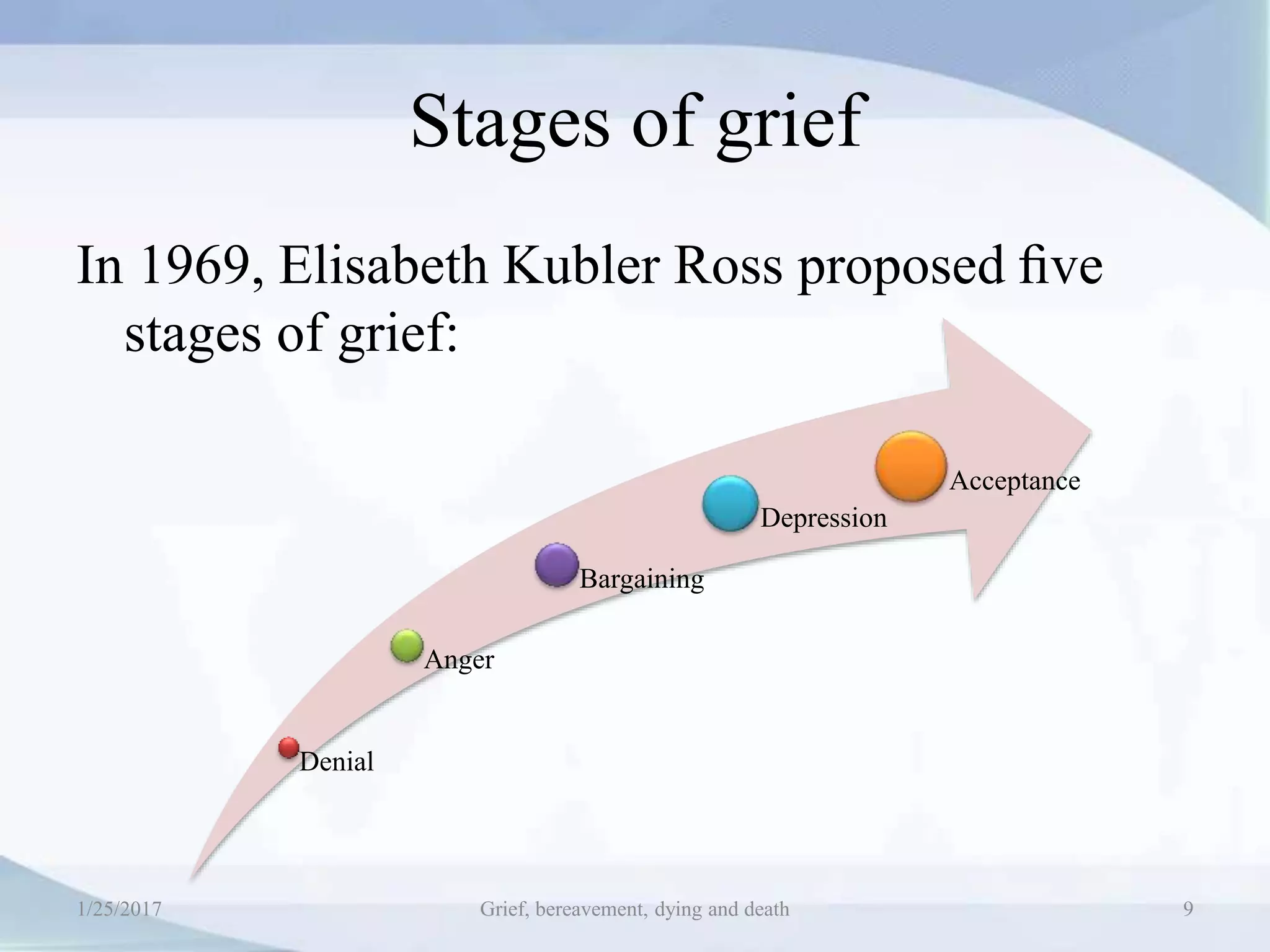
In 1969, Elisabeth Kubler Ross proposed five
stages of grief:
1/25/2017 Grief, bereavement, dying and death 9
Denial
Anger
Bargaining
Depression
Acceptance
1/25/2017 Grief, bereavement, dying and death 10
Denial
It is first stage which is also known as shock
phase. In this stage, the world becomes
meaningless and hide from the facts.
(Craven & Hirnle, 2009)
1/25/2017 Grief, bereavement, dying and death 11
Anger
In the second stage, anger may be directed
toward fate (destiny), God, family members,
healthcare providers.
(Craven & Hirnle, 2009)
1/25/2017 Grief, bereavement, dying and death 12
Bargaining
In third stage, bargaining occurs as the client
seeks to delay the dreaded event; the client
bargains with God for more time and, in
return, promises to do something to repay God
for this favor.
(Craven & Hirnle, 2009)
1/25/2017 Grief, bereavement, dying and death 13
Depression
In the fourth stage, depression occurs when the
client acknowledges the reality and
inevitability (unable to avoid) of the
impending death.
(Craven & Hirnle, 2009)
1/25/2017 Grief, bereavement, dying and death 14
Acceptance
In the final stage, person is able to make peace
with loss, and start interest in worldly
activities.
(Craven & Hirnle, 2009)
1/25/2017 Grief, bereavement, dying and death 15
Dying
1/25/2017 Grief, bereavement, dying and death 16
Dying
Dying is ceasing to live; approaching death.
(The American Heritage, 2015).
1/25/2017 Grief, bereavement, dying and death 17
Signs of approaching death
Respiratory system.
Circulatory system.
Central nervous system.
Gastro intestinal system.
Genito urinary system.
(Slideshare.net)
1/25/2017 Grief, bereavement, dying and death 18
Respiratory System
Respiration becomes irregular, rapid and shallow
breath.
(Slideshare.net)
1/25/2017 Grief, bereavement, dying and death 19
Circulatory System
Radial pulse gradually fails. Once it stops, the
apical pulse may continue for some time.
Usually the pulsations are seen even after the
patient has stopped breathing.
(Slideshare.net)
1/25/2017 Grief, bereavement, dying and death 20
Central Nervous System
Reflexes and pain are gradually lost.
Patient may be restless due to lack of oxygen.
(Slideshare.net)
1/25/2017 Grief, bereavement, dying and death 21
Genito Urinary System
Retention of urine.
Distention of the bladder.
Incontinence of urine.
(Slideshare.net)
1/25/2017 Grief, bereavement, dying and death 22
Gastro Intestinal System
The patient feels the inability to swallow.
Incontinence of stool.
(Slideshare.net)
1/25/2017 Grief, bereavement, dying and death 23
Care of the Critical Ill Patient
Nursing care related to breathing
Nursing care related to eating and drinking
Nursing care related to elimination
Nursing care related to immobility
Nursing care related to cleanliness and
grooming
(Slideshare.Net)
1/25/2017 Grief, bereavement, dying and death 24
Nursing Care Related to Breathing
Oxygen inhalation to remove his discomfort.
 Elevation of the patient’s head and shoulders
may make breathing easier.
Keep the room well ventilated and keep
crowed away.
Periodic suctioning is necessary.
(Slideshare.net)
1/25/2017 Grief, bereavement, dying and death 25
Nursing Care Related to Eating
The patient is unable to swallow even the sips
of water.
Most of them may require I.V fluids.
If they can tolerate the oral fluids, sips of water
is given with teaspoon. That will help the
patient to keep the mouth moist.
Give frequent oral hygiene.
(Slideshare.net)
1/25/2017 Grief, bereavement, dying and death 26
Nursing Care Related to
Elimination
Constipation, retention of urine and
incontinence of urine and stool are some of
problem faced by the patient.
Catheterization has to be done.
Perineal care is to be given, to keep the patient
clean and to prevent skin breakdown.
(Slideshare.net)
1/25/2017 Grief, bereavement, dying and death 27
Nursing Care Related to
Immobility
Frequent skin care should be given with
particular attention to the pressure point.
Patient should be comfortably placed and their
position frequently changed in the bed.
(Slideshare.net)
1/25/2017 Grief, bereavement, dying and death 28
Nursing Care Related to
Cleanliness and Grooming
Cleanliness and appearance are important until
the end.
Cleanliness of the skin, hair, mouth, and cloth
has to be maintained.
(Slideshare.net)
1/25/2017 Grief, bereavement, dying and death 29
Death
A permanent cessation of all vital functions.
(Merriam-webster)
1/25/2017 Grief, bereavement, dying and death 30
Signs of Clinical Death
• No palpable pulses.
• No heart sounds on auscultation (or asystole
on ECG).
• No observed respiratory effort.
• No breath sounds on auscultation.
• Pupils dilated and not reactive to light.
(Patient.info)
1/25/2017 Grief, bereavement, dying and death 31
Other signs include:
• No response to painful stimuli.
• Absence of corneal reflexes.
• Cloudiness of the cornea.
• Rigor mortis (begins approximately three
hours after death).
• Decreased temperature.
(Patient.info)
1/25/2017 Grief, bereavement, dying and death 32
Cont..
1/25/2017 Grief, bereavement, dying and death 33
Care of Body After Death
1/25/2017 Grief, bereavement, dying and death 34
Actions of Nurse After Death
After the physician has pronounced death
legally documented the death in the medical
record.
If the patient had any valuables, they are
handed over to the relatives.
(Slideshare.net)
1/25/2017 Grief, bereavement, dying and death 35
Articles Required
Bandages and cotton swabs
Perineal pads
Sheets
Restraints for jaw, hands and legs.
Pair of gloves
Thumb forceps
Patients own set of clothes.
(Slideshare.net)
1/25/2017 Grief, bereavement, dying and death 36
Procedure
Wash hands and put on gloves
Soon the death is pronounced, removed extra
pillows.
Gently put the patient in a supine position.
Positioning is important after death, because of
rigor mortis.
Gently close the patients eyes and mouth.
(Slideshare.net)
1/25/2017 Grief, bereavement, dying and death 37
Cont..
Remove all tubes and other devices from the
patients body.
Replace soiled dressing with cleaned ones.
Apply perineal pads and plug the rectum with
cotton balls.
Close the body from side to side and head to
foot with the sheet.
(Slideshare.net)
1/25/2017 Grief, bereavement, dying and death 38
Cont..
Body should be labeled for identification label.
It is attached to one wrist.
If relatives are present, the body should be
handed over to them.
One copy of the death certificate should be
with hospital.
(Slideshare.net)
1/25/2017 Grief, bereavement, dying and death 39
Identification Tag Should Contain
 Patient name
 Age
 Registration number
 Relatives name (specify)
 Address
 Ward number
 Bed number
 Date and time of death
 Cause of death
(Slideshare.net)
1/25/2017 Grief, bereavement, dying and death 40
Summarization
Lost is defined as parting from valuable things.
Grief is a total response after loss.
1/25/2017 Grief, bereavement, dying and death 41
Time for Question
1/25/2017 Grief, bereavement, dying and death 42
Reference
Craven, R., & Hirnle, C. (2009). Human heath
and function. London: Wolters Kluwer.
https://www.merriam-
webster.com/dictionary/death
http://www.slideshare.net/IrannaKajagar/final-
ppt-26970537
http://patient.info/doctor/death-recognition-
and-certification
1/25/2017 Grief, bereavement, dying and death 43

Grief, bereavement, death and dying

  • 1.
    Grief, Bereavement, Dyingand Death Prepared and presented by: Shamsher Moloo Muhammad Hasnain Shaikh 1/25/2017 Grief, bereavement, dying and death 1
  • 2.
    Objectives By the endof this presentation learners will be able to: Define loss, grief, bereavement and mourning. Identify the common signs and symptoms of grief. Ellaborate stages of grief. Define death and signs of approaching death. 1/25/2017 Grief, bereavement, dying and death 2
  • 3.
    Cont.. Explain nursing careof dying patient. Enlist signs of clinical death. Describe care of body after death. 1/25/2017 Grief, bereavement, dying and death 3
  • 4.
    Loss Loss is definedas the experience of parting (seperating) with an object, person, or relationship that one values. (Craven & Hirnle, 2009) 1/25/2017 Grief, bereavement, dying and death 4
  • 5.
    Grief Grief is psychologicaland physiologic responses a person experiences after the loss of a significant person, object, or relationship. (Craven & Hirnle, 2009) 1/25/2017 Grief, bereavement, dying and death 5
  • 6.
    Bereavement Bereavement is astate of desolation (unhappiness) that occurs as the result of a loss. Bereavement is the subjective response. (Craven & Hirnle, 2009) 1/25/2017 Grief, bereavement, dying and death 6
  • 7.
    Mourning Mourning encompasses thesocially prescribed behaviors after the death of a significant other. Mourning behaviors are socially conventional (based on) bereavement behaviors. (Craven & Hirnle, 2009) 1/25/2017 Grief, bereavement, dying and death 7
  • 8.
    Stages of Grief 1/25/2017Grief, bereavement, dying and death 8
  • 9.
    Stages of grief In1969, Elisabeth Kubler Ross proposed five stages of grief: 1/25/2017 Grief, bereavement, dying and death 9 Denial Anger Bargaining Depression Acceptance
  • 10.
  • 11.
    Denial It is firststage which is also known as shock phase. In this stage, the world becomes meaningless and hide from the facts. (Craven & Hirnle, 2009) 1/25/2017 Grief, bereavement, dying and death 11
  • 12.
    Anger In the secondstage, anger may be directed toward fate (destiny), God, family members, healthcare providers. (Craven & Hirnle, 2009) 1/25/2017 Grief, bereavement, dying and death 12
  • 13.
    Bargaining In third stage,bargaining occurs as the client seeks to delay the dreaded event; the client bargains with God for more time and, in return, promises to do something to repay God for this favor. (Craven & Hirnle, 2009) 1/25/2017 Grief, bereavement, dying and death 13
  • 14.
    Depression In the fourthstage, depression occurs when the client acknowledges the reality and inevitability (unable to avoid) of the impending death. (Craven & Hirnle, 2009) 1/25/2017 Grief, bereavement, dying and death 14
  • 15.
    Acceptance In the finalstage, person is able to make peace with loss, and start interest in worldly activities. (Craven & Hirnle, 2009) 1/25/2017 Grief, bereavement, dying and death 15
  • 16.
  • 17.
    Dying Dying is ceasingto live; approaching death. (The American Heritage, 2015). 1/25/2017 Grief, bereavement, dying and death 17
  • 18.
    Signs of approachingdeath Respiratory system. Circulatory system. Central nervous system. Gastro intestinal system. Genito urinary system. (Slideshare.net) 1/25/2017 Grief, bereavement, dying and death 18
  • 19.
    Respiratory System Respiration becomesirregular, rapid and shallow breath. (Slideshare.net) 1/25/2017 Grief, bereavement, dying and death 19
  • 20.
    Circulatory System Radial pulsegradually fails. Once it stops, the apical pulse may continue for some time. Usually the pulsations are seen even after the patient has stopped breathing. (Slideshare.net) 1/25/2017 Grief, bereavement, dying and death 20
  • 21.
    Central Nervous System Reflexesand pain are gradually lost. Patient may be restless due to lack of oxygen. (Slideshare.net) 1/25/2017 Grief, bereavement, dying and death 21
  • 22.
    Genito Urinary System Retentionof urine. Distention of the bladder. Incontinence of urine. (Slideshare.net) 1/25/2017 Grief, bereavement, dying and death 22
  • 23.
    Gastro Intestinal System Thepatient feels the inability to swallow. Incontinence of stool. (Slideshare.net) 1/25/2017 Grief, bereavement, dying and death 23
  • 24.
    Care of theCritical Ill Patient Nursing care related to breathing Nursing care related to eating and drinking Nursing care related to elimination Nursing care related to immobility Nursing care related to cleanliness and grooming (Slideshare.Net) 1/25/2017 Grief, bereavement, dying and death 24
  • 25.
    Nursing Care Relatedto Breathing Oxygen inhalation to remove his discomfort.  Elevation of the patient’s head and shoulders may make breathing easier. Keep the room well ventilated and keep crowed away. Periodic suctioning is necessary. (Slideshare.net) 1/25/2017 Grief, bereavement, dying and death 25
  • 26.
    Nursing Care Relatedto Eating The patient is unable to swallow even the sips of water. Most of them may require I.V fluids. If they can tolerate the oral fluids, sips of water is given with teaspoon. That will help the patient to keep the mouth moist. Give frequent oral hygiene. (Slideshare.net) 1/25/2017 Grief, bereavement, dying and death 26
  • 27.
    Nursing Care Relatedto Elimination Constipation, retention of urine and incontinence of urine and stool are some of problem faced by the patient. Catheterization has to be done. Perineal care is to be given, to keep the patient clean and to prevent skin breakdown. (Slideshare.net) 1/25/2017 Grief, bereavement, dying and death 27
  • 28.
    Nursing Care Relatedto Immobility Frequent skin care should be given with particular attention to the pressure point. Patient should be comfortably placed and their position frequently changed in the bed. (Slideshare.net) 1/25/2017 Grief, bereavement, dying and death 28
  • 29.
    Nursing Care Relatedto Cleanliness and Grooming Cleanliness and appearance are important until the end. Cleanliness of the skin, hair, mouth, and cloth has to be maintained. (Slideshare.net) 1/25/2017 Grief, bereavement, dying and death 29
  • 30.
    Death A permanent cessationof all vital functions. (Merriam-webster) 1/25/2017 Grief, bereavement, dying and death 30
  • 31.
    Signs of ClinicalDeath • No palpable pulses. • No heart sounds on auscultation (or asystole on ECG). • No observed respiratory effort. • No breath sounds on auscultation. • Pupils dilated and not reactive to light. (Patient.info) 1/25/2017 Grief, bereavement, dying and death 31
  • 32.
    Other signs include: •No response to painful stimuli. • Absence of corneal reflexes. • Cloudiness of the cornea. • Rigor mortis (begins approximately three hours after death). • Decreased temperature. (Patient.info) 1/25/2017 Grief, bereavement, dying and death 32
  • 33.
  • 34.
    Care of BodyAfter Death 1/25/2017 Grief, bereavement, dying and death 34
  • 35.
    Actions of NurseAfter Death After the physician has pronounced death legally documented the death in the medical record. If the patient had any valuables, they are handed over to the relatives. (Slideshare.net) 1/25/2017 Grief, bereavement, dying and death 35
  • 36.
    Articles Required Bandages andcotton swabs Perineal pads Sheets Restraints for jaw, hands and legs. Pair of gloves Thumb forceps Patients own set of clothes. (Slideshare.net) 1/25/2017 Grief, bereavement, dying and death 36
  • 37.
    Procedure Wash hands andput on gloves Soon the death is pronounced, removed extra pillows. Gently put the patient in a supine position. Positioning is important after death, because of rigor mortis. Gently close the patients eyes and mouth. (Slideshare.net) 1/25/2017 Grief, bereavement, dying and death 37
  • 38.
    Cont.. Remove all tubesand other devices from the patients body. Replace soiled dressing with cleaned ones. Apply perineal pads and plug the rectum with cotton balls. Close the body from side to side and head to foot with the sheet. (Slideshare.net) 1/25/2017 Grief, bereavement, dying and death 38
  • 39.
    Cont.. Body should belabeled for identification label. It is attached to one wrist. If relatives are present, the body should be handed over to them. One copy of the death certificate should be with hospital. (Slideshare.net) 1/25/2017 Grief, bereavement, dying and death 39
  • 40.
    Identification Tag ShouldContain  Patient name  Age  Registration number  Relatives name (specify)  Address  Ward number  Bed number  Date and time of death  Cause of death (Slideshare.net) 1/25/2017 Grief, bereavement, dying and death 40
  • 41.
    Summarization Lost is definedas parting from valuable things. Grief is a total response after loss. 1/25/2017 Grief, bereavement, dying and death 41
  • 42.
    Time for Question 1/25/2017Grief, bereavement, dying and death 42
  • 43.
    Reference Craven, R., &Hirnle, C. (2009). Human heath and function. London: Wolters Kluwer. https://www.merriam- webster.com/dictionary/death http://www.slideshare.net/IrannaKajagar/final- ppt-26970537 http://patient.info/doctor/death-recognition- and-certification 1/25/2017 Grief, bereavement, dying and death 43

Editor's Notes

  • #32 Rigor mortis: stiffing of the body after death. The arms & legs cannot be bent or straightened while rigor mortis is present unless the tendons are torn. Postmortem hypostasis: It is a dark red or bluish discoloration due to the settling of the blood.