biosecurity built on science
Fruit Fly Research - A National
Approach
Darryl Barbour
National Manager – Fruit Fly Council, PHA
Plant Biosecurity Cooperative Research Centre
The National Fruit Fly Research
Development and Extension Plan
biosecurity built on science
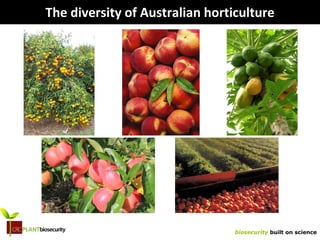
The diversity of Australian horticulture
biosecurity built on science
What is the problem?
Approximately 75% of Australian
horticulture exports are susceptible to
fruit fly.
Exports valued at over $640m.
Domestic trade over $1b.
In-field baiting and sprays $270/ha.
Post harvest treatments $62/t.
Impacts are across industry and
government “boundaries”.
biosecurity built on science
What is the problem?
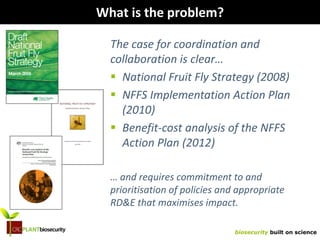
The case for coordination and
collaboration is clear…
 National Fruit Fly Strategy (2008)
 NFFS Implementation Action Plan
(2010)
 Benefit-cost analysis of the NFFS
Action Plan (2012)
… and requires commitment to and
prioritisation of policies and appropriate
RD&E that maximises impact.
biosecurity built on science
What are we doing about it?
NFFS Advisory Committee – May 2014.
PBCRC – role in coordinating a national
approach to fruit fly research and
enhancing capacity.
Formation of a writing Group to
develop the RD&E Plan.
Intent to capture all potential research
areas and highlight specific projects.
A basis for prioritisation and action.
biosecurity built on science
How will this work be delivered?
RD&E Plan released June 2015.
Regional workshops July-August 2015.
Working to understand the pressures
and key priorities.
Key documents for the National Fruit
Fly Council.
List of priorities by research type,
owner and beneficiary being
developed. Will also cover key policy
developments.
biosecurity built on science
Who will benefit from this research?
End-users
 National Fruit Fly Council
 Industries and peak industry bodies
 Researchers and research funders
 Commercial pest controllers, advisors and suppliers
Beneficiaries
 All fruit fly affected industries
 Researchers and research funders
 Members of the community – backyard horticulture
 Export chain
 Horticultural consumers
 Trade negotiators
biosecurity built on science
Benefit for our horticultural industries
The goal of the RD&E Plan aligns with that of the NFFS:
A 20-year RD&E Plan that supports a viable, cost-effective and
sustainable national approach to managing fruit flies – including
endemic, established and exotic species.
By… ensuring the short term delivery of priority research
 Control “post” dimethoate and fenthion
 Area wide management approaches
 New lures, SIT, disinfestation
And… building the case and support strategic research,
capacity and “core science”
 Fruit fly phenology, behavior and modelling
biosecurity built on science
Benefit for our horticultural industries
Reducing the cost of treatments.
Developing the confidence and evidence base for fruit fly
control programs.
Increased marketability of fruit and improving access to
domestic and international markets.
Even modest improvements in fruit fly control could have
big financial benefits.
 $50+m in field control costs
 $25+m in post harvest treatments
biosecurity built on science
End-User Advocate’s Perspective
Regional consultation and endorsement of the plan
 June - August 2015 regional workshops/consultations held across
eight different jurisdictions: SA, WA, Qld., NT, NSW, Vic., Tas.,
National (Department of Agriculture and Water Resources).
 81 people consulted from horticultural industries, government and
research.
 Identified and collated regional strategic priorities across five RD&E
areas in the Plan: Coordination; Extension, community and capacity;
Controlling fruit flies; Trade and market access; Future issues.
biosecurity built on science
Future
Seeking to influence the research agenda
and engage the experts in prioritisation.
Review of current research and delivery.
Identifying the benefits of investments.
Maintaining capacity, expertise and
funding.
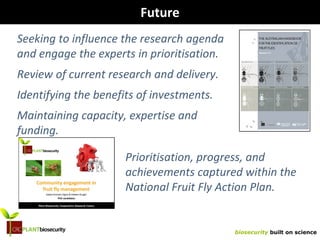
Prioritisation, progress, and
achievements captured within the
National Fruit Fly Action Plan.
biosecurity built on science
Thank you
 For more information, please email
dbarbour@phau.com.au
Prof. Anthony Clarke – Queensland University of Technology /
PBCRC
Pat Barkley – Citrus expert
Kim James – Ashmere Consulting
Dr. Jo Luck – PBCRC
Dr. Michael Robinson – PBCRC
Prof. Phil Taylor – Macquarie University
PBCRC is established and supported under
the Australian Government Cooperative
Research Centres Programme

Fruit fly research - a national approach

  • 1.
    biosecurity built onscience Fruit Fly Research - A National Approach Darryl Barbour National Manager – Fruit Fly Council, PHA Plant Biosecurity Cooperative Research Centre The National Fruit Fly Research Development and Extension Plan
  • 2.
    biosecurity built onscience The diversity of Australian horticulture
  • 3.
    biosecurity built onscience What is the problem? Approximately 75% of Australian horticulture exports are susceptible to fruit fly. Exports valued at over $640m. Domestic trade over $1b. In-field baiting and sprays $270/ha. Post harvest treatments $62/t. Impacts are across industry and government “boundaries”.
  • 4.
    biosecurity built onscience What is the problem? The case for coordination and collaboration is clear…  National Fruit Fly Strategy (2008)  NFFS Implementation Action Plan (2010)  Benefit-cost analysis of the NFFS Action Plan (2012) … and requires commitment to and prioritisation of policies and appropriate RD&E that maximises impact.
  • 5.
    biosecurity built onscience What are we doing about it? NFFS Advisory Committee – May 2014. PBCRC – role in coordinating a national approach to fruit fly research and enhancing capacity. Formation of a writing Group to develop the RD&E Plan. Intent to capture all potential research areas and highlight specific projects. A basis for prioritisation and action.
  • 6.
    biosecurity built onscience How will this work be delivered? RD&E Plan released June 2015. Regional workshops July-August 2015. Working to understand the pressures and key priorities. Key documents for the National Fruit Fly Council. List of priorities by research type, owner and beneficiary being developed. Will also cover key policy developments.
  • 7.
    biosecurity built onscience Who will benefit from this research? End-users  National Fruit Fly Council  Industries and peak industry bodies  Researchers and research funders  Commercial pest controllers, advisors and suppliers Beneficiaries  All fruit fly affected industries  Researchers and research funders  Members of the community – backyard horticulture  Export chain  Horticultural consumers  Trade negotiators
  • 8.
    biosecurity built onscience Benefit for our horticultural industries The goal of the RD&E Plan aligns with that of the NFFS: A 20-year RD&E Plan that supports a viable, cost-effective and sustainable national approach to managing fruit flies – including endemic, established and exotic species. By… ensuring the short term delivery of priority research  Control “post” dimethoate and fenthion  Area wide management approaches  New lures, SIT, disinfestation And… building the case and support strategic research, capacity and “core science”  Fruit fly phenology, behavior and modelling
  • 9.
    biosecurity built onscience Benefit for our horticultural industries Reducing the cost of treatments. Developing the confidence and evidence base for fruit fly control programs. Increased marketability of fruit and improving access to domestic and international markets. Even modest improvements in fruit fly control could have big financial benefits.  $50+m in field control costs  $25+m in post harvest treatments
  • 10.
    biosecurity built onscience End-User Advocate’s Perspective Regional consultation and endorsement of the plan  June - August 2015 regional workshops/consultations held across eight different jurisdictions: SA, WA, Qld., NT, NSW, Vic., Tas., National (Department of Agriculture and Water Resources).  81 people consulted from horticultural industries, government and research.  Identified and collated regional strategic priorities across five RD&E areas in the Plan: Coordination; Extension, community and capacity; Controlling fruit flies; Trade and market access; Future issues.
  • 11.
    biosecurity built onscience Future Seeking to influence the research agenda and engage the experts in prioritisation. Review of current research and delivery. Identifying the benefits of investments. Maintaining capacity, expertise and funding. Prioritisation, progress, and achievements captured within the National Fruit Fly Action Plan.
  • 12.
    biosecurity built onscience Thank you  For more information, please email dbarbour@phau.com.au Prof. Anthony Clarke – Queensland University of Technology / PBCRC Pat Barkley – Citrus expert Kim James – Ashmere Consulting Dr. Jo Luck – PBCRC Dr. Michael Robinson – PBCRC Prof. Phil Taylor – Macquarie University PBCRC is established and supported under the Australian Government Cooperative Research Centres Programme