eWorld Forum 2011   United Nations Program in E-government:  Assessing  national e-readiness  SEEMA HAFEEZ Senior Economic Affairs Officer Division for Public Administration and Development Management UN Department of Economic and Social Affairs New Delhi, India 2August 2011
What this presentation will outline Issues in  global e-government  Overview of some results from the UN E-government  Survey in light of  the framework of eWorld Forum discussions
Why e-government  ? Governments today are looking to reform processes to: Implement more transparency and accountability, so that citizens can understand  how  the public sector operates,  who  is making the decisions,  how  input can be provided, and  whether or not  this input is being used.  Improves access to basic services and ensures equal access to the population.  Provide faster response times and improve the quality of service. Allow greater participation and suggestions from more people, at all stages of the policy process.
E-government  can: 1. Provide better information and services from : government to citizen (as policy maker and  implementer )  government  to citizen (as provider of services)  citizen to government (by participating in public policy  decision making) 2.  E-government can improve transparency, integrity and productivity (efficiency per unit of  time) Measurements of e-government therefore provide some insights on the performance of the governments
The UN E-government Survey presents a comparative ranking of the 193 UN Member States according to  their  state of e-government  readiness UN DESA Research work : the e -government Survey
UN has published 5 surveys since 2003; these  are considered a global bedrock for e-government readiness assessment Several countries use the UN Methodology to conduct their own e-government readiness  European Union and the World Economic Forum use the UN e-government Index as their key indicator for global  e-government assessment Google has around a million links  to the Survey It is referenced in over 700 journals, academic papers  Translated into several languages
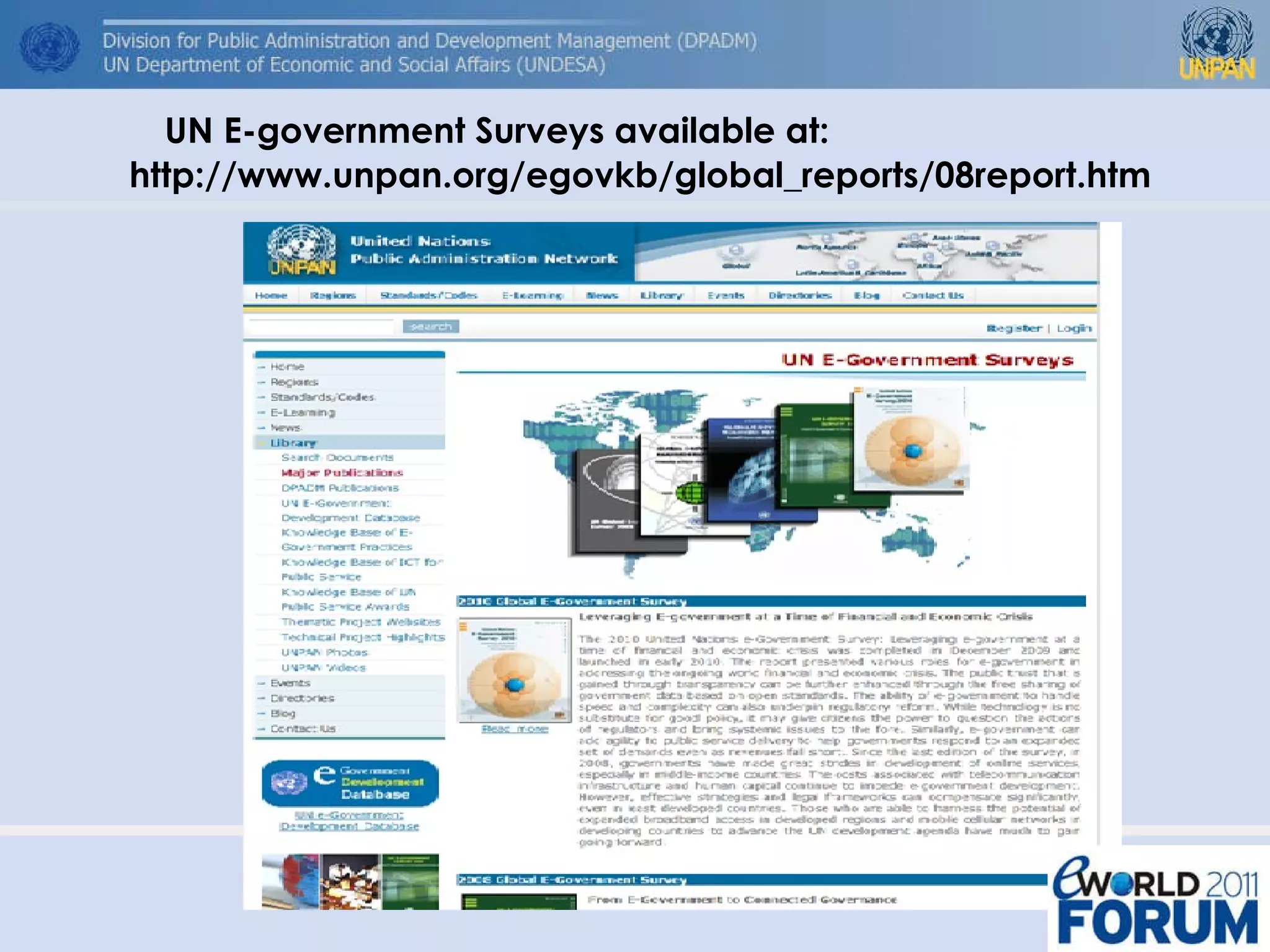
UN E-government Surveys available at: http://www.unpan.org/egovkb/global_reports/08report.htm
The objective of the UN E-government  Development Surveys  is to provide a: comparative assessment of the  193  countries in the use of e-government and ICTs for delivery of public services;  benchmarking tool for monitoring the progress of countries  as they progress towards higher levels of e-government and e-participation service delivery.
What is the UN E-government  Development Index It is a benchmarking tool for monitoring the progress of countries towards higher levels of e-government and e-participation service delivery.
E-government is defined as the use of ICT and its application by the government for the provision of information and public services to the people.   The E-government Readiness Index is a composite index comprising the Online service index, the Telecommunication Infrastructure index and the Human Capital index.  Methodological  Framework  http://www.UNPAN.org/DPADM/
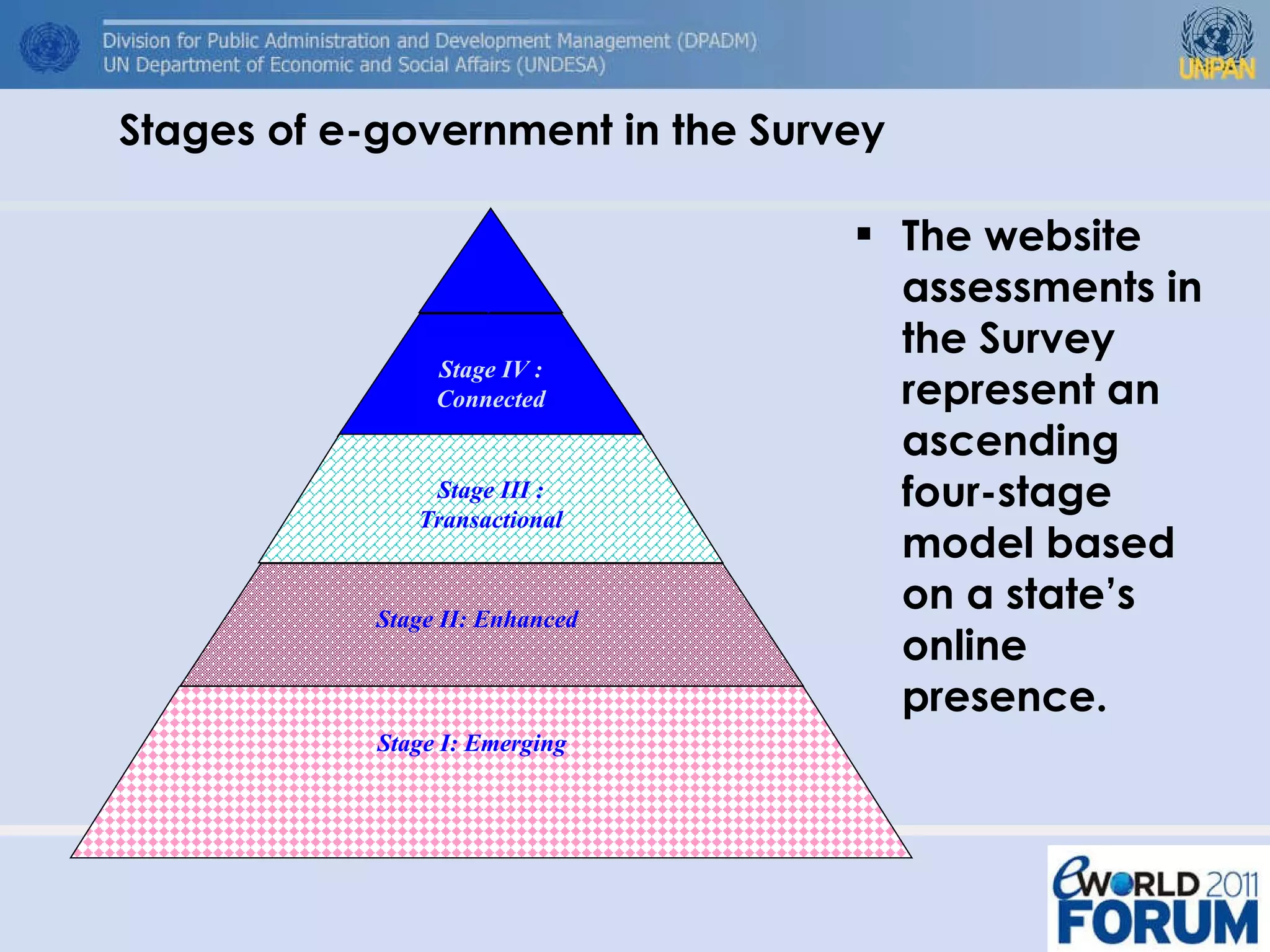
Stages of e-government in the Survey   The website assessments in the Survey  represent an ascending  four-stage model based on a state’s online presence.  Stage V Stage IV : Connected Stage III : Transactional Stage II: Enhanced Stage I: Emerging
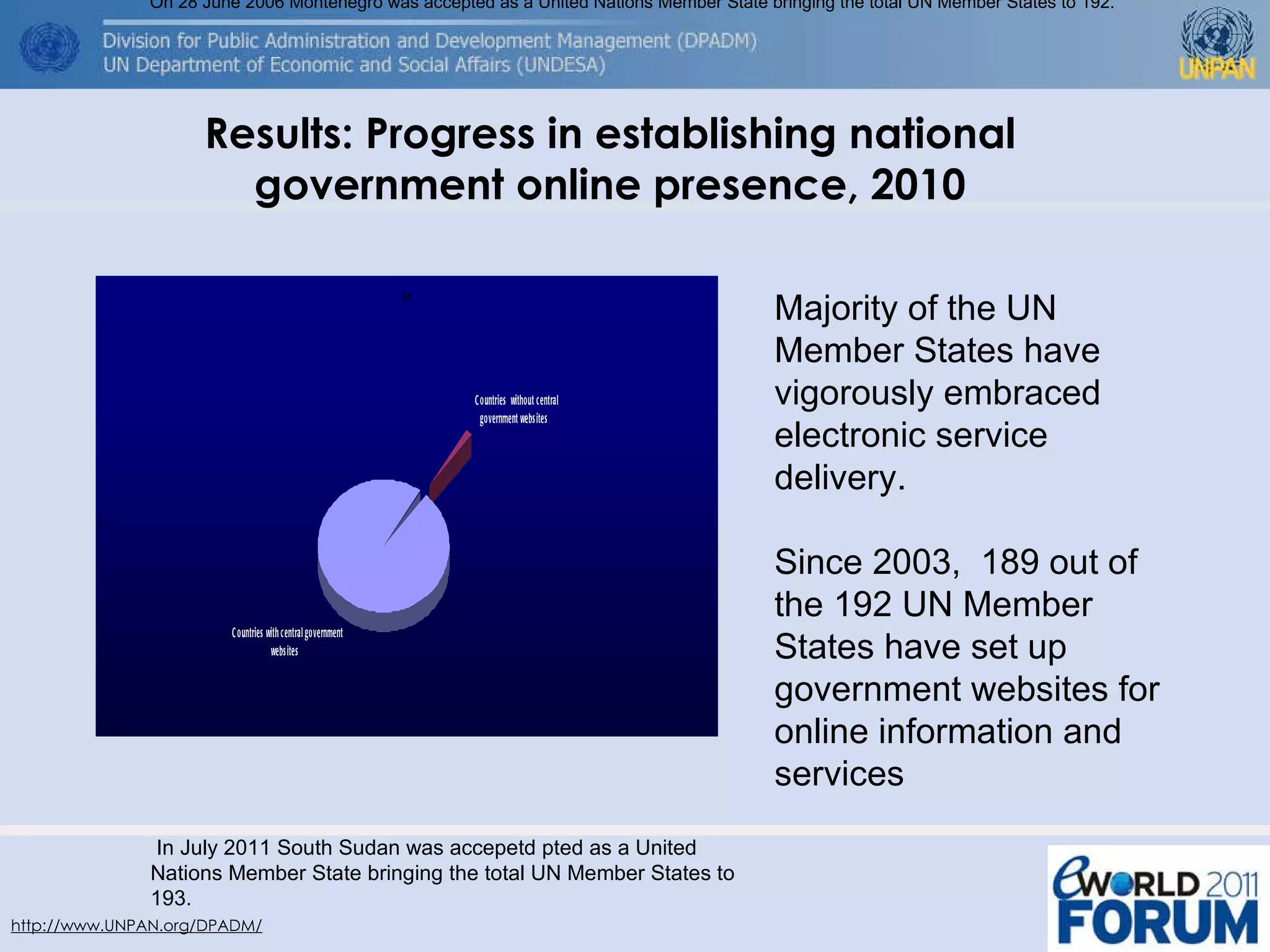
Results: Progress in establishing national government online presence, 2010 http://www.UNPAN.org/DPADM/ Majority of the UN Member States have vigorously embraced electronic service delivery.  Since 2003,  189 out of the 192 UN Member States have set up government websites for online information and services On 28 June 2006 Montenegro was accepted as a United Nations Member State bringing the total UN Member States to 192.   In July 2011 South Sudan was accepetd pted as a United Nations Member State bringing the total UN Member States to 193.
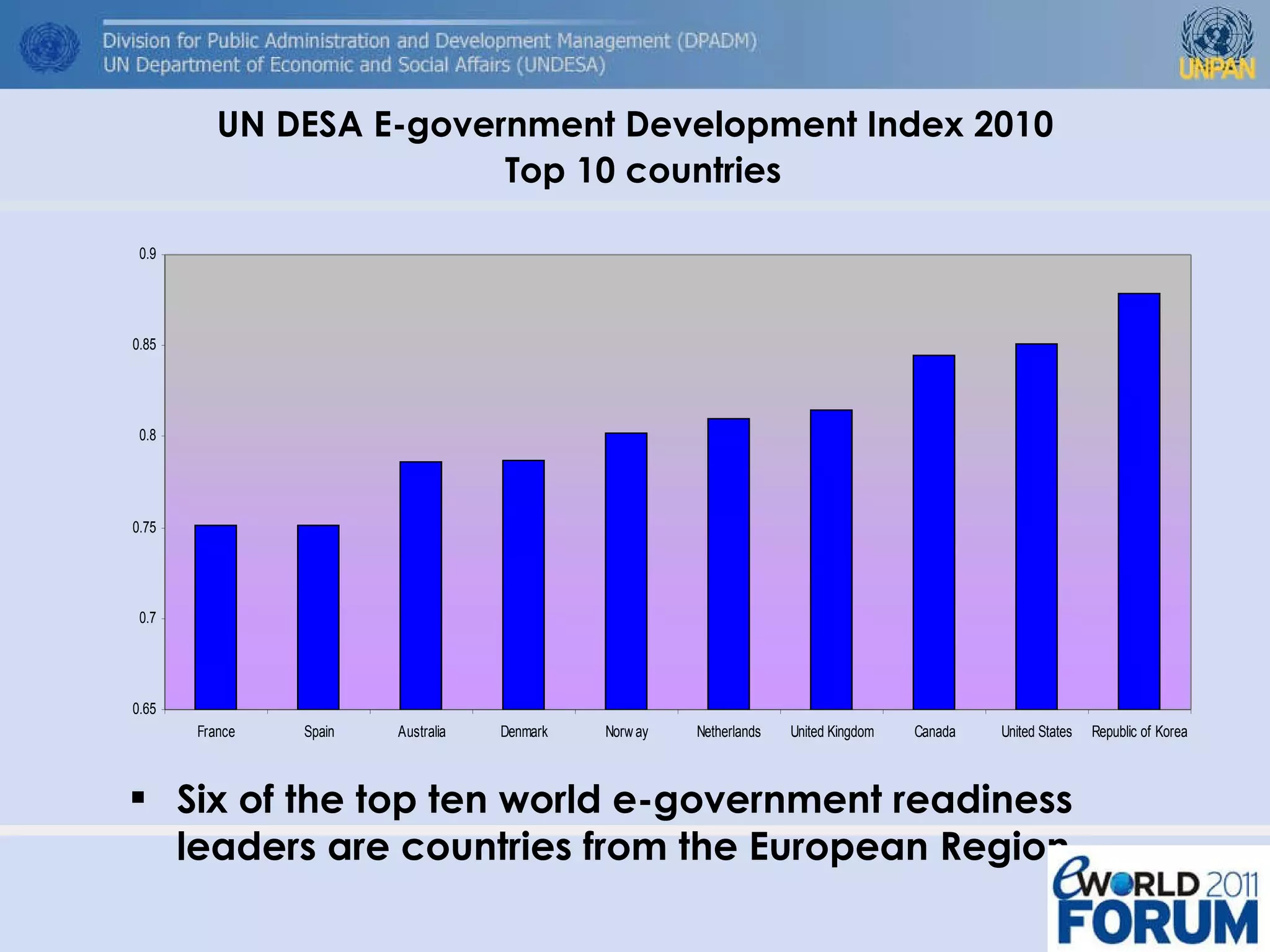
UN DESA E-government Development Index 2010    Top 10 countries Six of the top ten world e-government readiness leaders are countries from the European Region
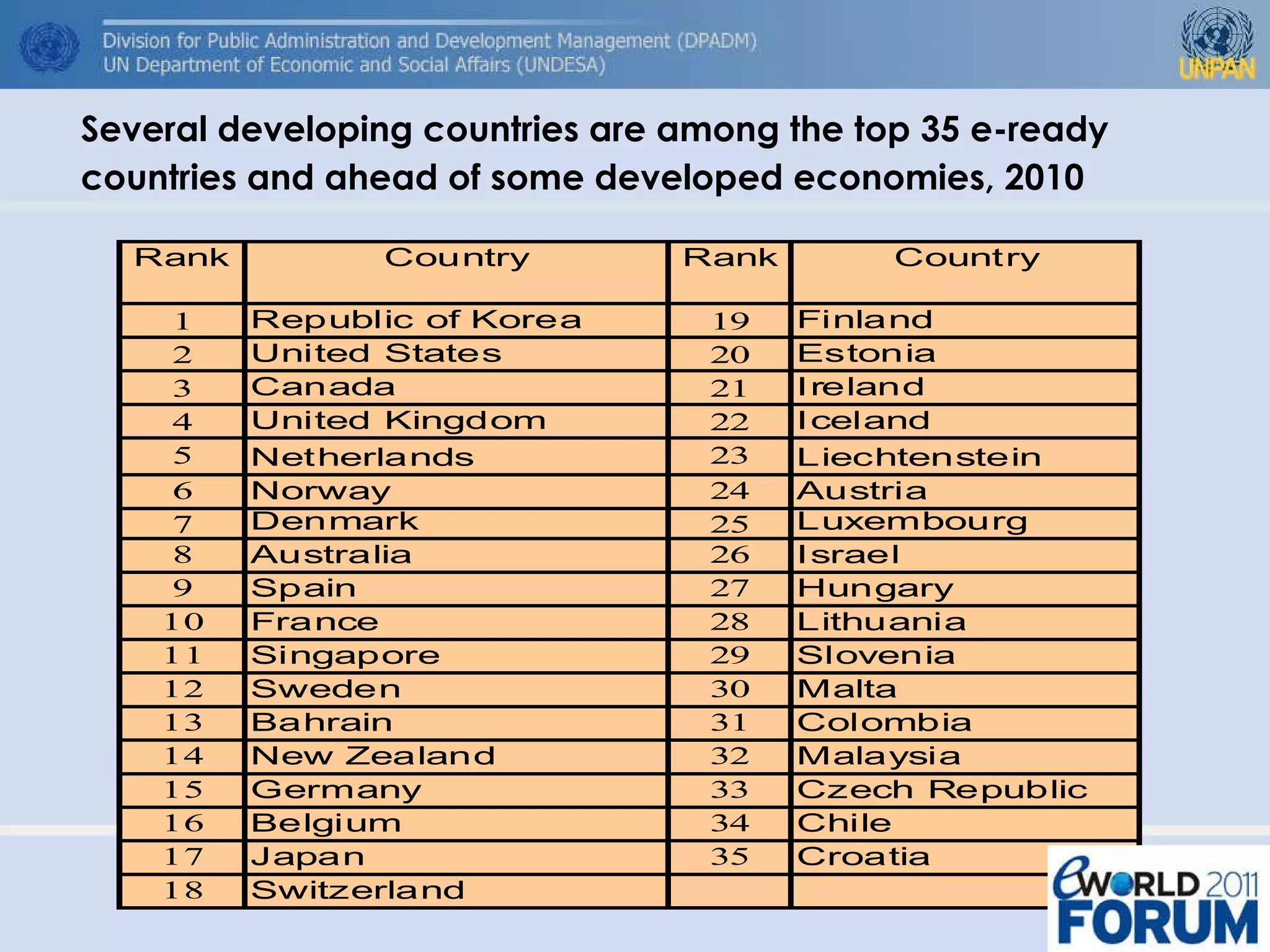
Several developing countries are among the top 35 e-ready countries and ahead of some developed economies, 2010
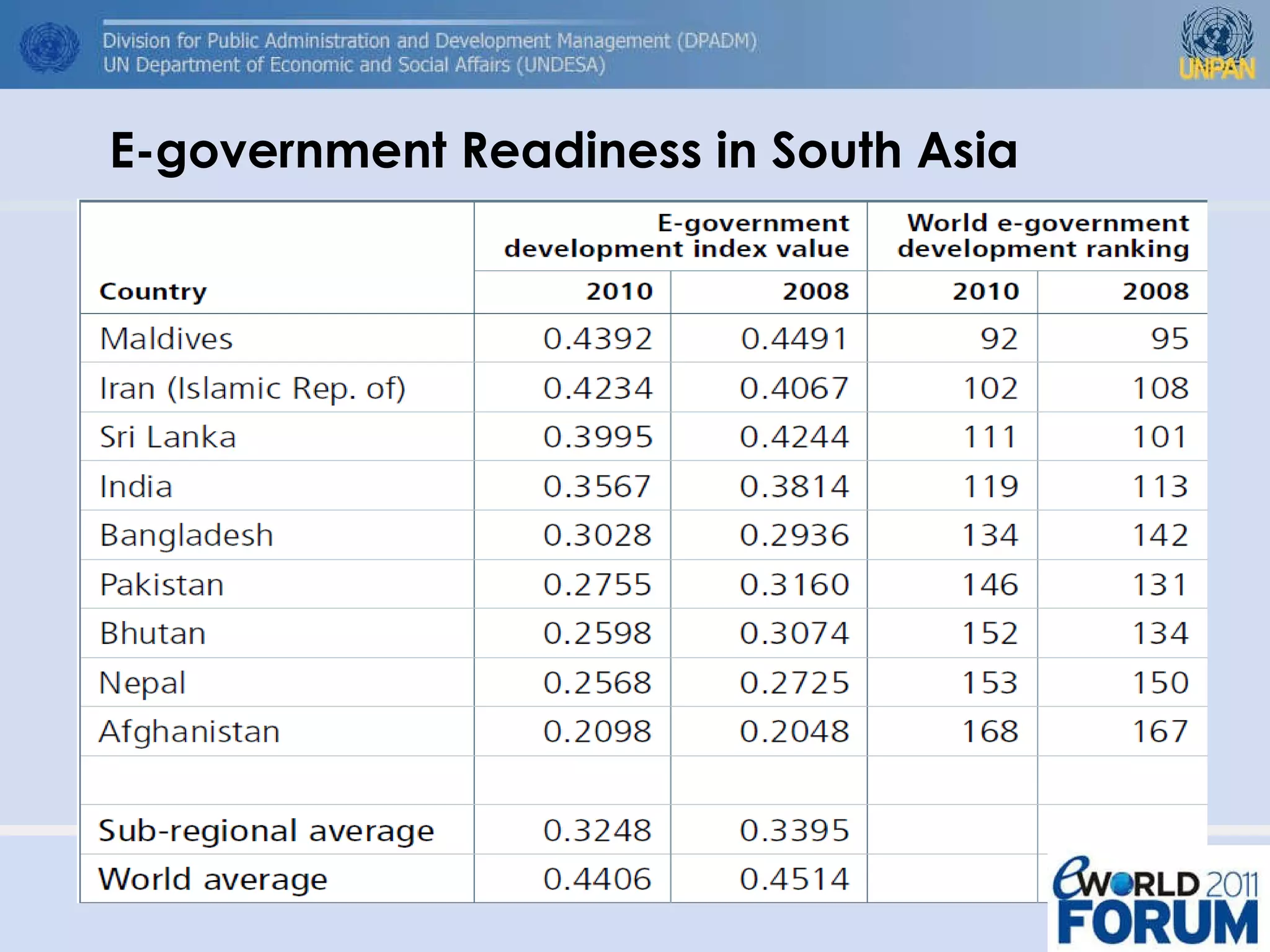
E-government Readiness in South Asia
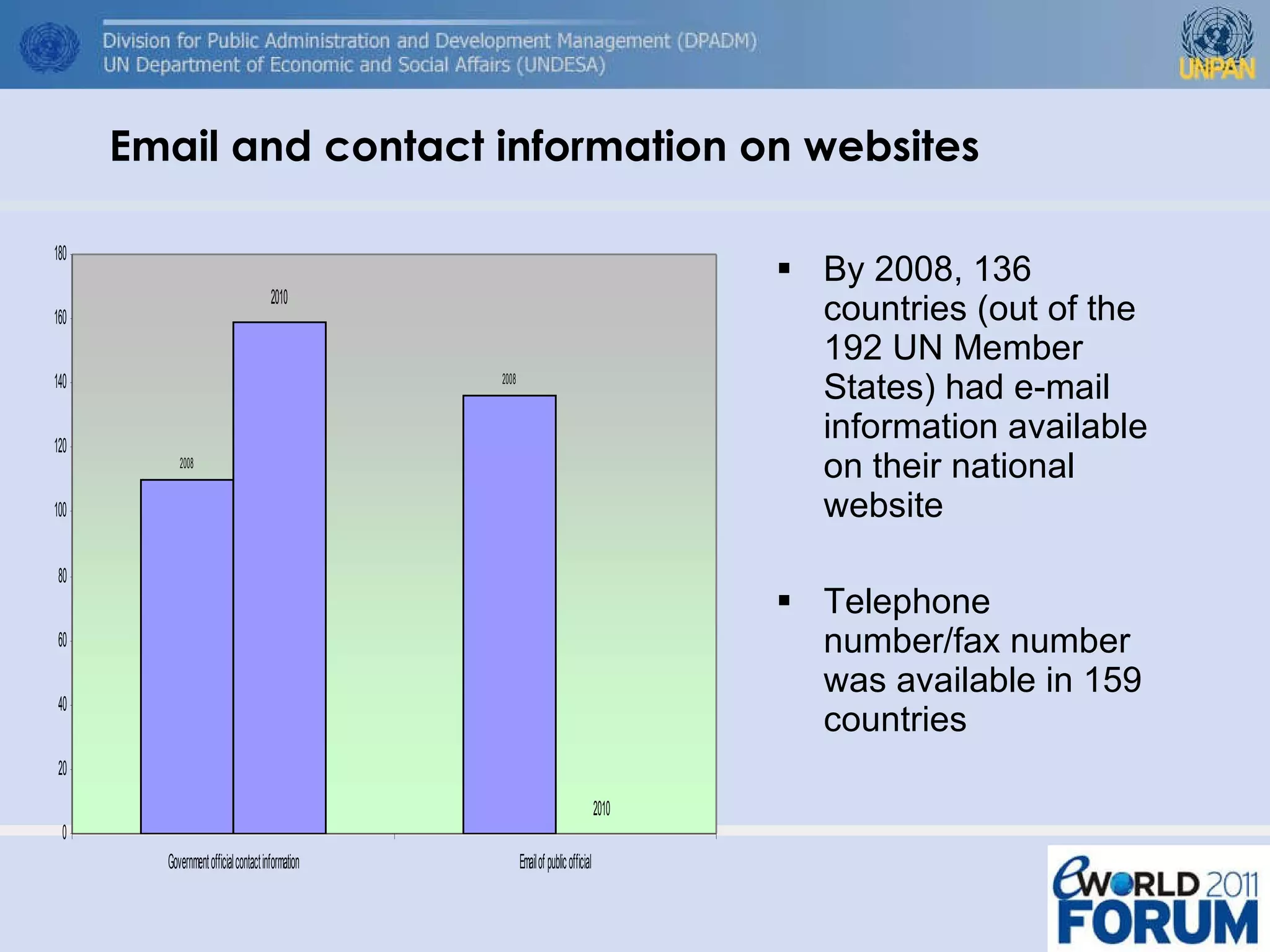
Email and contact information on websites By 2008, 136 countries (out of the 192 UN Member States) had e-mail information available on their national website Telephone number/fax number was available in 159 countries
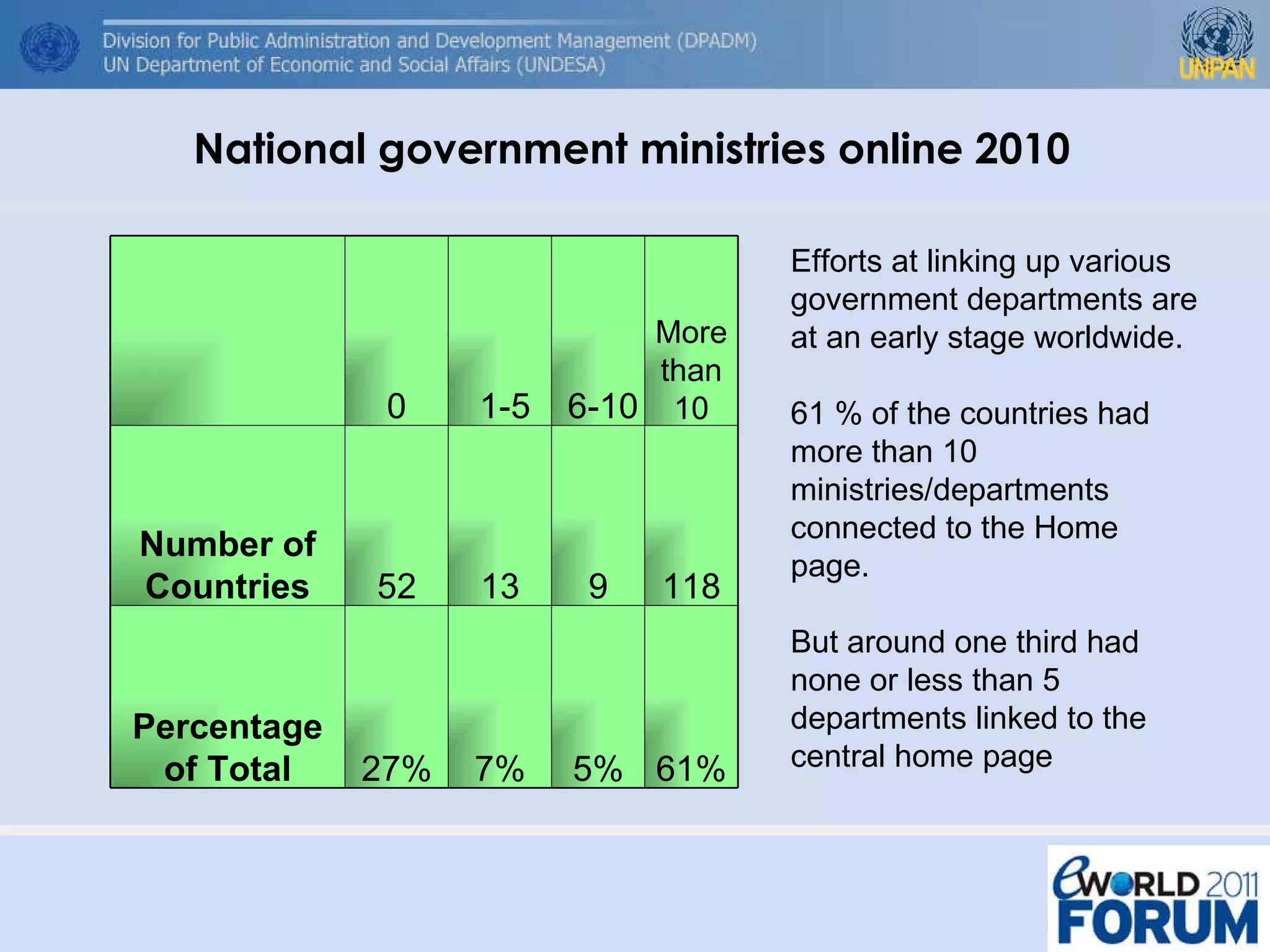
National government ministries online 2010 Efforts at linking up various government departments are at an early stage worldwide. 61 % of the countries had more than 10 ministries/departments connected to the Home page.  But around one third had none or less than 5 departments linked to the central home page 0 1-5 6-10 More than 10 Number of Countries 52 13 9 118 Percentage of Total 27% 7% 5% 61%
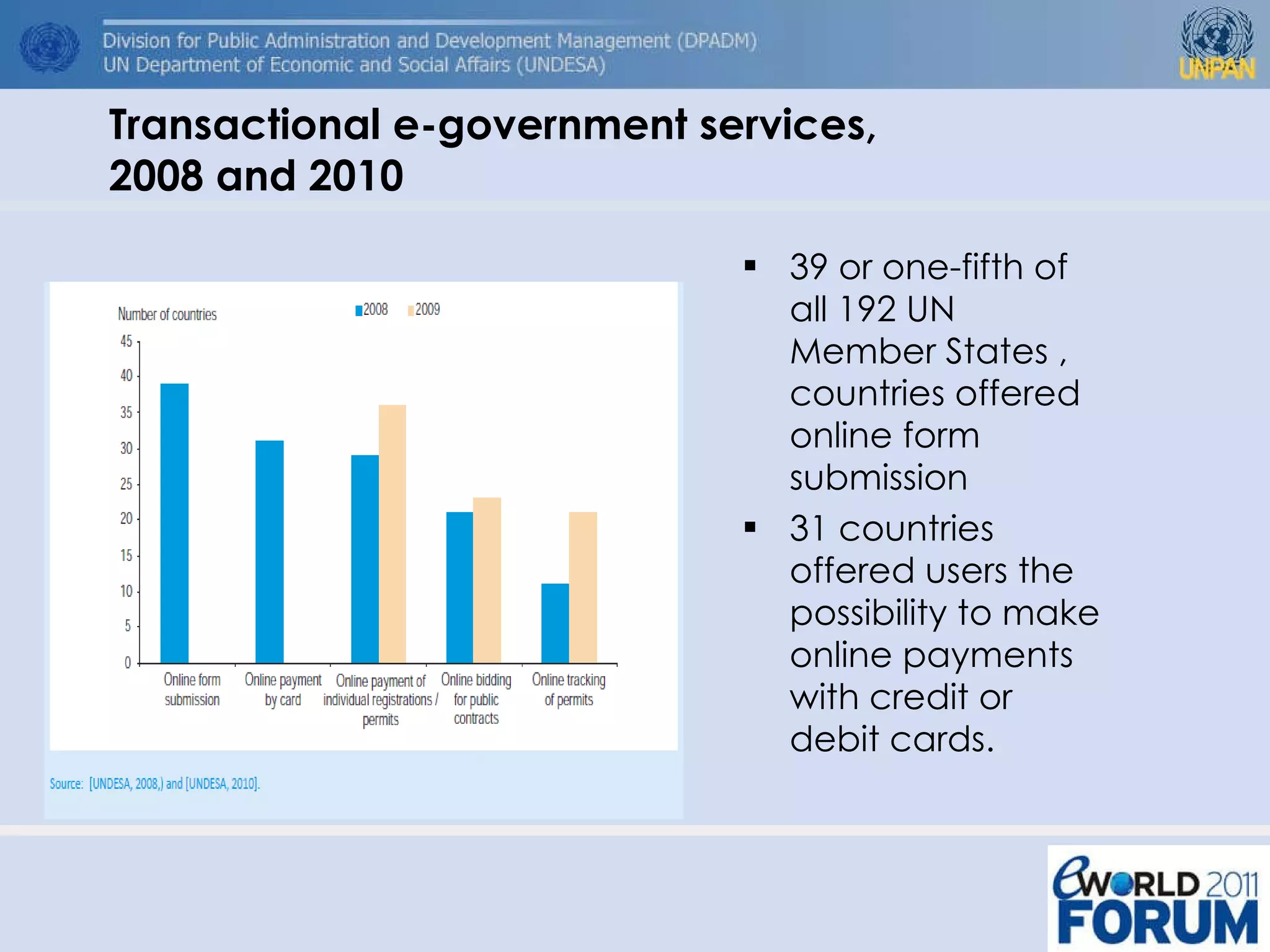
Transactional e-government services,  2008 and 2010 39 or one-fifth of all 192 UN Member States , countries offered online form submission  31 countries offered users the possibility to make online payments with credit or debit cards.
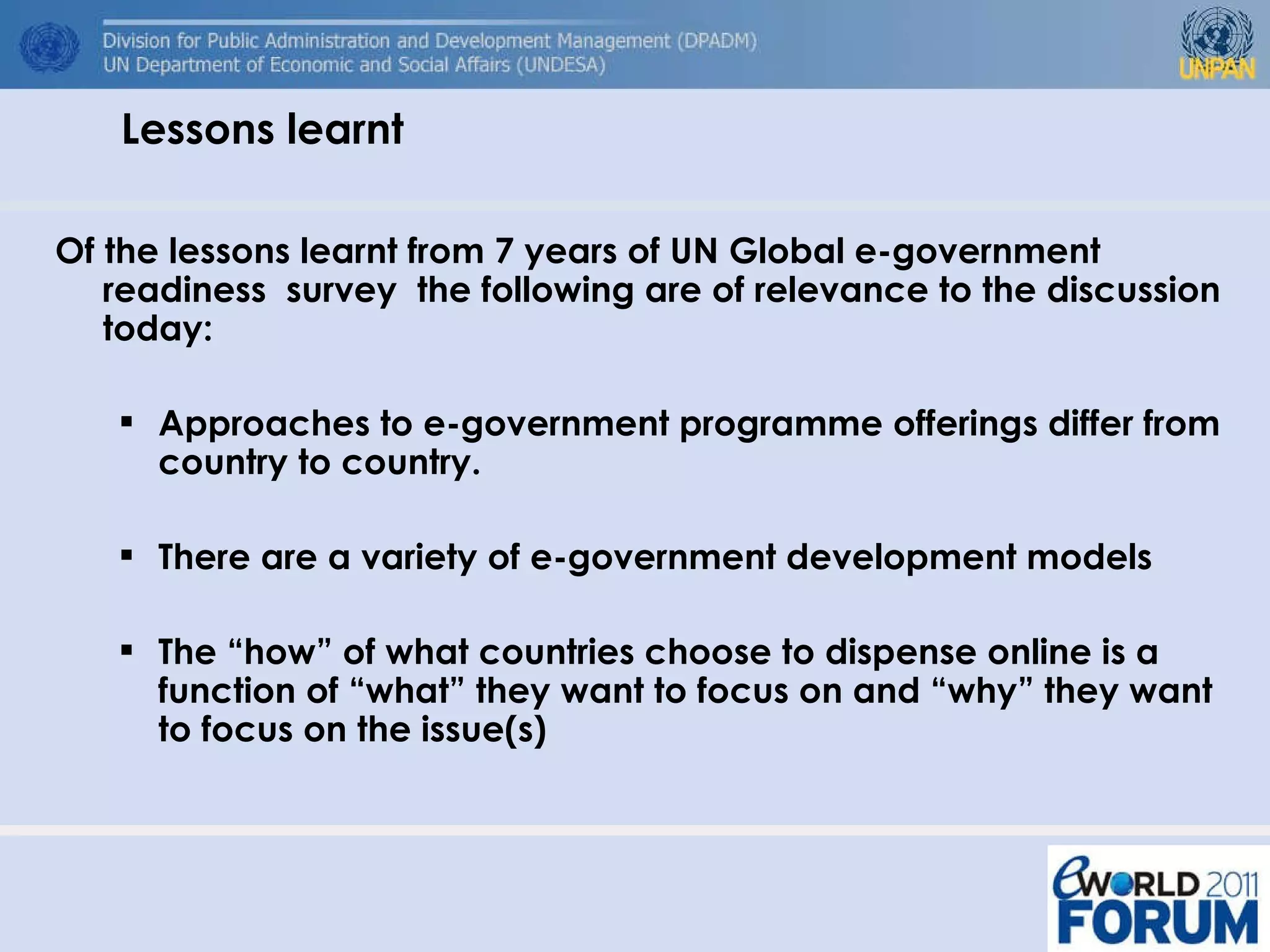
Of the lessons learnt from 7 years of UN Global e-government readiness  survey  the following are of relevance to the discussion today: Approaches to e-government programme offerings differ from country to country. There are a variety of e-government development models  The “how” of what countries choose to dispense online is a function of “what” they want to focus on and “why” they want to focus on the issue(s)  Lessons learnt
Following on the basic framework of the UN e-government  development survey, one set of  issues  for national governments to explore could be the following:  http://www.UNPAN.org/DPADM/ Th discussions at the eWorld Forum  revolve around what governments  can do in ensuring effective e-government
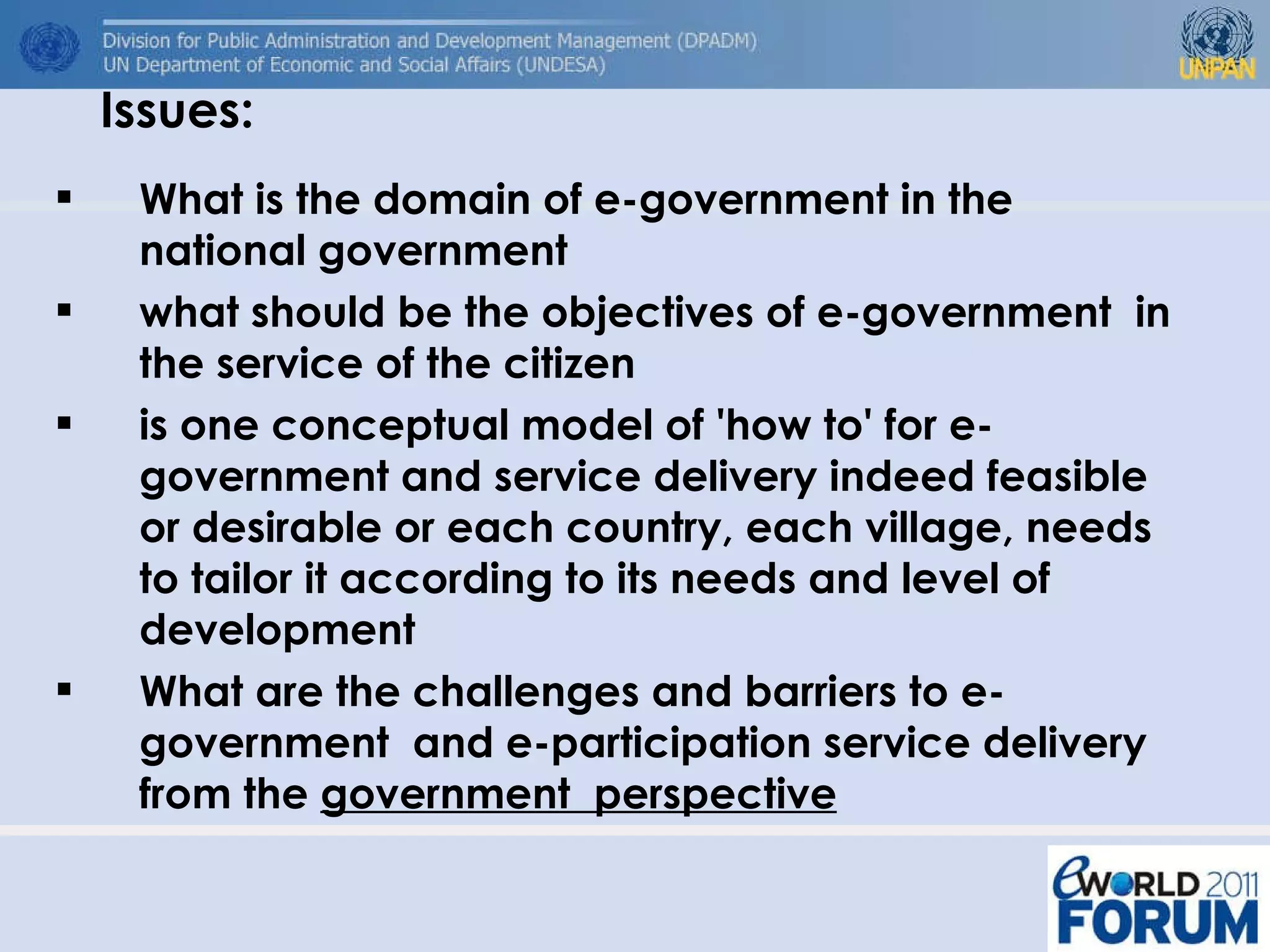
Issues: What is the domain of e-government in the national government  what should be the objectives of e-government  in the service of the citizen is one conceptual model of 'how to' for e-government and service delivery indeed feasible or desirable or each country, each village, needs to tailor it according to its needs and level of development What are the challenges and barriers to e-government  and e-participation service delivery from the  government  perspective
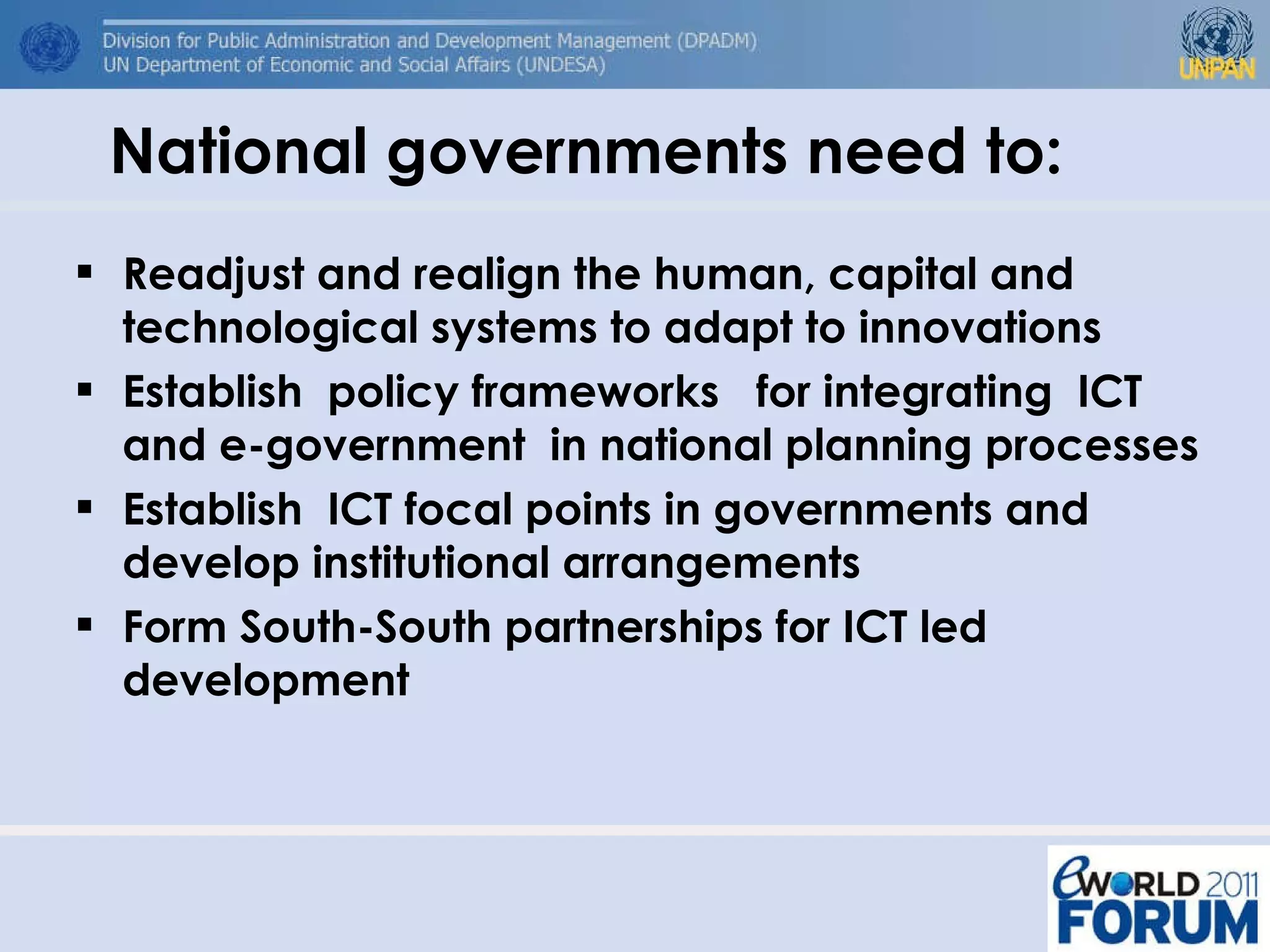
National governments need to: Readjust and realign the human, capital and technological systems to adapt to innovations Establish  policy frameworks  for integrating  ICT and e-government  in national planning processes Establish  ICT focal points in governments and develop institutional arrangements Form South-South partnerships for ICT led development
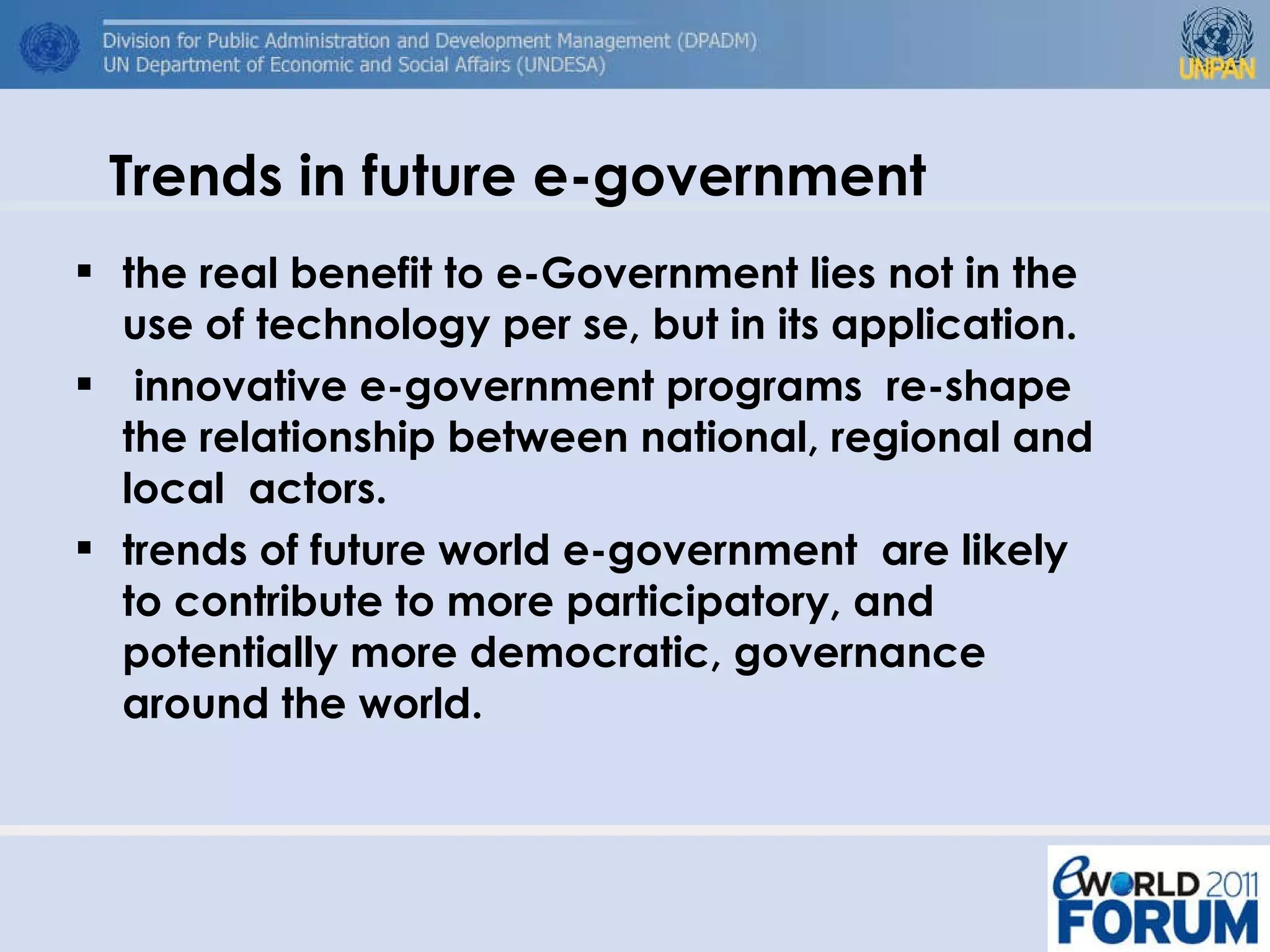
Trends in future e-government the real benefit to e-Government lies not in the use of technology per se, but in its application.  innovative e-government programs  re-shape the relationship between national, regional and local  actors.  trends of future world e-government  are likely to contribute to more participatory, and potentially more democratic, governance around the world.
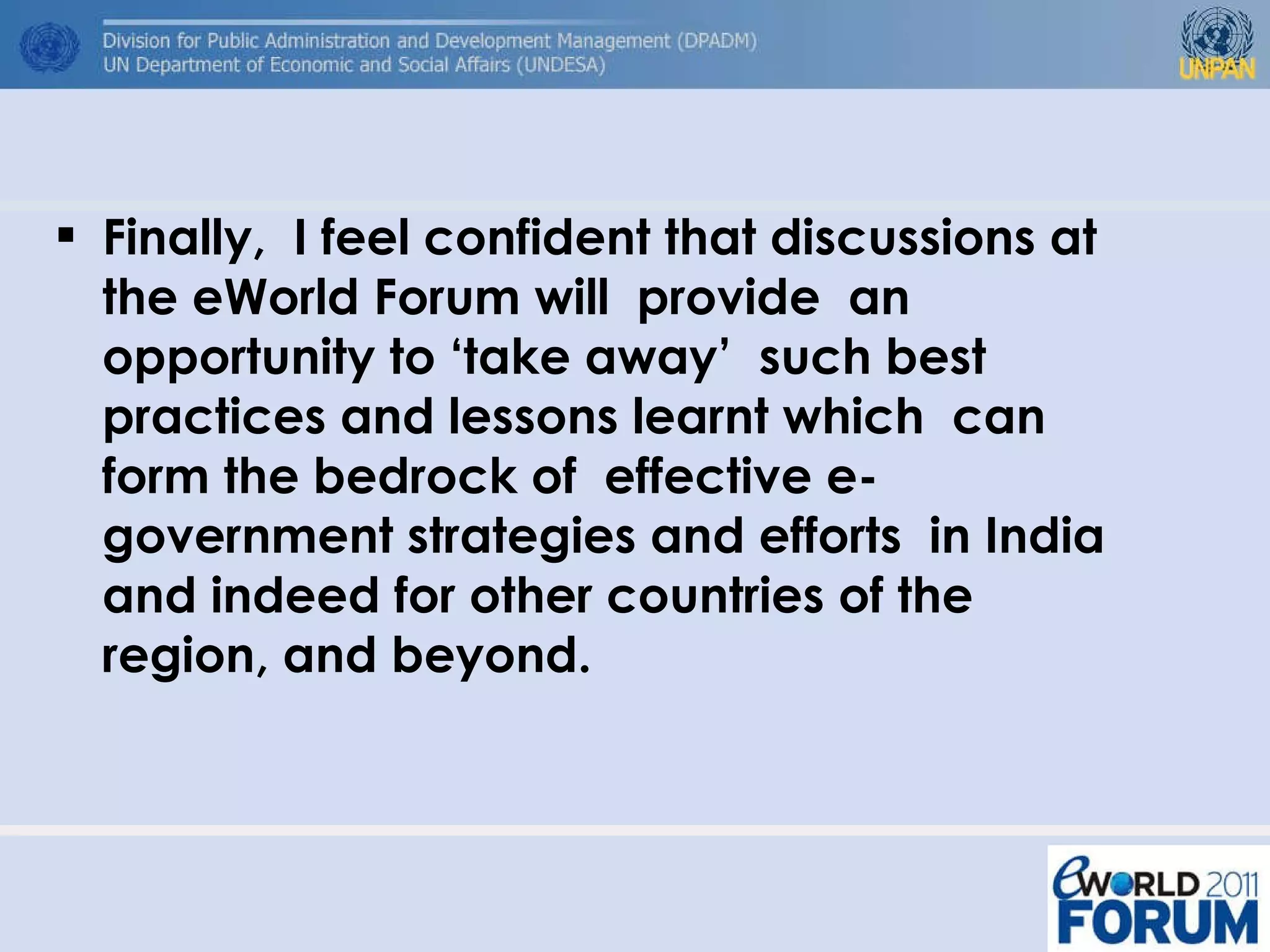
Finally,  I feel confident that discussions at the eWorld Forum will  provide  an opportunity to ‘take away’  such best practices and lessons learnt which  can form the bedrock of  effective e-government strategies and efforts  in India and indeed for other countries of the region, and beyond.
Thank You

Seema Hafeez

  • 1.
    eWorld Forum 2011 United Nations Program in E-government: Assessing national e-readiness SEEMA HAFEEZ Senior Economic Affairs Officer Division for Public Administration and Development Management UN Department of Economic and Social Affairs New Delhi, India 2August 2011
  • 2.
    What this presentationwill outline Issues in global e-government Overview of some results from the UN E-government Survey in light of the framework of eWorld Forum discussions
  • 3.
    Why e-government ? Governments today are looking to reform processes to: Implement more transparency and accountability, so that citizens can understand how the public sector operates, who is making the decisions, how input can be provided, and whether or not this input is being used. Improves access to basic services and ensures equal access to the population. Provide faster response times and improve the quality of service. Allow greater participation and suggestions from more people, at all stages of the policy process.
  • 4.
    E-government can:1. Provide better information and services from : government to citizen (as policy maker and implementer ) government to citizen (as provider of services) citizen to government (by participating in public policy decision making) 2. E-government can improve transparency, integrity and productivity (efficiency per unit of time) Measurements of e-government therefore provide some insights on the performance of the governments
  • 5.
    The UN E-governmentSurvey presents a comparative ranking of the 193 UN Member States according to their state of e-government readiness UN DESA Research work : the e -government Survey
  • 6.
    UN has published5 surveys since 2003; these are considered a global bedrock for e-government readiness assessment Several countries use the UN Methodology to conduct their own e-government readiness European Union and the World Economic Forum use the UN e-government Index as their key indicator for global e-government assessment Google has around a million links to the Survey It is referenced in over 700 journals, academic papers Translated into several languages
  • 7.
    UN E-government Surveysavailable at: http://www.unpan.org/egovkb/global_reports/08report.htm
  • 8.
    The objective ofthe UN E-government Development Surveys is to provide a: comparative assessment of the 193 countries in the use of e-government and ICTs for delivery of public services; benchmarking tool for monitoring the progress of countries as they progress towards higher levels of e-government and e-participation service delivery.
  • 9.
    What is theUN E-government Development Index It is a benchmarking tool for monitoring the progress of countries towards higher levels of e-government and e-participation service delivery.
  • 10.
    E-government is definedas the use of ICT and its application by the government for the provision of information and public services to the people. The E-government Readiness Index is a composite index comprising the Online service index, the Telecommunication Infrastructure index and the Human Capital index. Methodological Framework http://www.UNPAN.org/DPADM/
  • 11.
    Stages of e-governmentin the Survey The website assessments in the Survey represent an ascending four-stage model based on a state’s online presence. Stage V Stage IV : Connected Stage III : Transactional Stage II: Enhanced Stage I: Emerging
  • 12.
    Results: Progress inestablishing national government online presence, 2010 http://www.UNPAN.org/DPADM/ Majority of the UN Member States have vigorously embraced electronic service delivery. Since 2003, 189 out of the 192 UN Member States have set up government websites for online information and services On 28 June 2006 Montenegro was accepted as a United Nations Member State bringing the total UN Member States to 192. In July 2011 South Sudan was accepetd pted as a United Nations Member State bringing the total UN Member States to 193.
  • 13.
    UN DESA E-governmentDevelopment Index 2010 Top 10 countries Six of the top ten world e-government readiness leaders are countries from the European Region
  • 14.
    Several developing countriesare among the top 35 e-ready countries and ahead of some developed economies, 2010
  • 15.
  • 16.
    Email and contactinformation on websites By 2008, 136 countries (out of the 192 UN Member States) had e-mail information available on their national website Telephone number/fax number was available in 159 countries
  • 17.
    National government ministriesonline 2010 Efforts at linking up various government departments are at an early stage worldwide. 61 % of the countries had more than 10 ministries/departments connected to the Home page. But around one third had none or less than 5 departments linked to the central home page 0 1-5 6-10 More than 10 Number of Countries 52 13 9 118 Percentage of Total 27% 7% 5% 61%
  • 18.
    Transactional e-government services, 2008 and 2010 39 or one-fifth of all 192 UN Member States , countries offered online form submission 31 countries offered users the possibility to make online payments with credit or debit cards.
  • 19.
    Of the lessonslearnt from 7 years of UN Global e-government readiness survey the following are of relevance to the discussion today: Approaches to e-government programme offerings differ from country to country. There are a variety of e-government development models The “how” of what countries choose to dispense online is a function of “what” they want to focus on and “why” they want to focus on the issue(s) Lessons learnt
  • 20.
    Following on thebasic framework of the UN e-government development survey, one set of issues for national governments to explore could be the following: http://www.UNPAN.org/DPADM/ Th discussions at the eWorld Forum revolve around what governments can do in ensuring effective e-government
  • 21.
    Issues: What isthe domain of e-government in the national government what should be the objectives of e-government in the service of the citizen is one conceptual model of 'how to' for e-government and service delivery indeed feasible or desirable or each country, each village, needs to tailor it according to its needs and level of development What are the challenges and barriers to e-government and e-participation service delivery from the government perspective
  • 22.
    National governments needto: Readjust and realign the human, capital and technological systems to adapt to innovations Establish policy frameworks for integrating ICT and e-government in national planning processes Establish ICT focal points in governments and develop institutional arrangements Form South-South partnerships for ICT led development
  • 23.
    Trends in futuree-government the real benefit to e-Government lies not in the use of technology per se, but in its application. innovative e-government programs re-shape the relationship between national, regional and local actors. trends of future world e-government are likely to contribute to more participatory, and potentially more democratic, governance around the world.
  • 24.
    Finally, Ifeel confident that discussions at the eWorld Forum will provide an opportunity to ‘take away’ such best practices and lessons learnt which can form the bedrock of effective e-government strategies and efforts in India and indeed for other countries of the region, and beyond.
  • 25.

Editor's Notes

  • #2 http://www.UNPAN.org/DPADM/ Division for Public Administration and Development Management
  • #3 http://www.UNPAN.org/DPADM/ Division for Public Administration and Development Management
  • #6 http://www.UNPAN.org/DPADM/ Division for Public Administration and Development Management
  • #7 http://www.UNPAN.org/DPADM/ Division for Public Administration and Development Management
  • #8 http://www.UNPAN.org/DPADM/ Division for Public Administration and Development Management
  • #11 http://www.UNPAN.org/DPADM/ Division for Public Administration and Development Management
  • #12 http://www.UNPAN.org/DPADM/ Division for Public Administration and Development Management
  • #14 http://www.UNPAN.org/DPADM/ Division for Public Administration and Development Management
  • #15 http://www.UNPAN.org/DPADM/ Division for Public Administration and Development Management
  • #21 http://www.UNPAN.org/DPADM/ Division for Public Administration and Development Management
  • #25 http://www.UNPAN.org/DPADM/ Division for Public Administration and Development Management