Shubham Thapa
Department of Seed Science and
Technology
Seed Processing and Storage (AST-605)
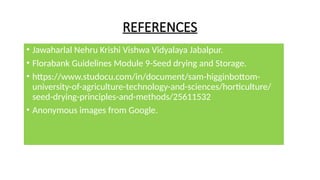
Seed Drying
VCSG Uttarakhand University of Horticulture and Forestry, Bharsar
What is Seed drying?
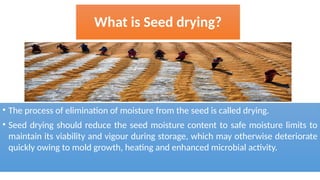
• The process of elimination of moisture from the seed is called drying.
• Seed drying should reduce the seed moisture content to safe moisture limits to
maintain its viability and vigour during storage, which may otherwise deteriorate
quickly owing to mold growth, heating and enhanced microbial activity.
Continued…
• The drying and storage of seeds are often essential steps in the
production and maintenance of high quality seed.
• In the drying process, excess water is removed, either in the field by
natural means (i.e., sun and wind) or in a bin or dryer with the aid of a
fan and heater.
• In storage, an atmosphere is maintained in which the temperature
and moisture content of the seed remain constant, regardless of the
length of the storage period.
• Seed drying also permits early harvesting.
• Long term storage of seeds.
• Production of high quality seed.
Depending upon the climate and method of harvesting adopted the
threshed seed may or may not be dry enough for safe storage.
 Under less favorable conditions, threshed seed needs further drying.
Importance of seed drying
Objectives of Seed drying
• Drying is needed for the future storage of crops.
• Drying makes crops favorable for processing.
• Drying is important to insure market price.
• Drying saves crops from different types of insects or pests that cause
crops damage.
• Drying is essential to improve seed quality.
• To improve nutritive value, drying is needed.
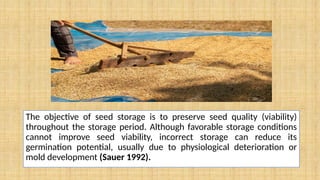
The objective of seed storage is to preserve seed quality (viability)
throughout the storage period. Although favorable storage conditions
cannot improve seed viability, incorrect storage can reduce its
germination potential, usually due to physiological deterioration or
mold development (Sauer 1992).
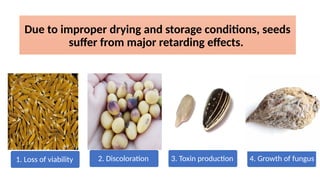
1. Loss of viability 2. Discoloration 3. Toxin production 4. Growth of fungus
Due to improper drying and storage conditions, seeds
suffer from major retarding effects.
The rate of drying depends on
• Initial seed moisture content
• Size of the bin and capacity
• Depth / spread of seed
• The rate of air blow
• Atmosphere air temperature
• Relative humidity
• Static pressure
• Drying temperature.
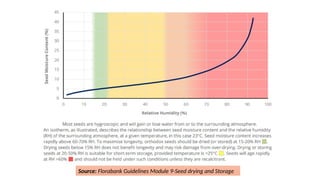
Source: Florabank Guidelines Module 9-Seed drying and Storage
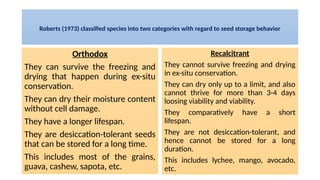
Roberts (1973) classified species into two categories with regard to seed storage behavior
Orthodox
They can survive the freezing and
drying that happen during ex-situ
conservation.
They can dry their moisture content
without cell damage.
They have a longer lifespan.
They are desiccation-tolerant seeds
that can be stored for a long time.
This includes most of the grains,
guava, cashew, sapota, etc.
Recalcitrant
They cannot survive freezing and drying
in ex-situ conservation.
They can dry only up to a limit, and also
cannot thrive for more than 3-4 days
loosing viability and viability.
They comparatively have a short
lifespan.
They are not desiccation-tolerant, and
hence cannot be stored for a long
duration.
This includes lychee, mango, avocado,
etc.
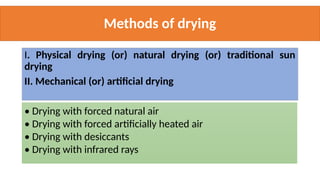
Methods of drying
I. Physical drying (or) natural drying (or) traditional sun
drying
II. Mechanical (or) artificial drying
• Drying with forced natural air
• Drying with forced artificially heated air
• Drying with desiccants
• Drying with infrared rays
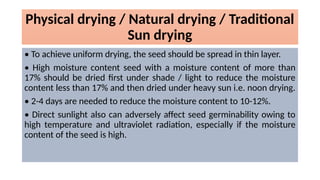
Physical drying / Natural drying / Traditional
Sun drying
• To achieve uniform drying, the seed should be spread in thin layer.
• High moisture content seed with a moisture content of more than
17% should be dried first under shade / light to reduce the moisture
content less than 17% and then dried under heavy sun i.e. noon drying.
• 2-4 days are needed to reduce the moisture content to 10-12%.
• Direct sunlight also can adversely affect seed germinability owing to
high temperature and ultraviolet radiation, especially if the moisture
content of the seed is high.
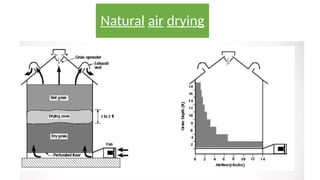
Natural air drying
Advantages
• Easy and cheap
• Does not require any expenditure or fuel.
• Does not require special machine or
equipment's.
• Performing this method from long time.
Disadvantages
• The rate of drying is slow
• Loss due to attack by insects, birds and animals
• Large floor area is required
• Involves extra labour for collecting and exposing
during the day
• Sun drying cause sun checks or hot spots due to
variation in temperature from time to time. This
checks or spots induce high amount of breakage
while processing
• Mechanical admixtures are possible
• Dust, dirt and other foreign materials get
admixed
• High weather risks and damage by heavy wind
and rains
II. Mechanical drying or artificial drying
Forced air drying
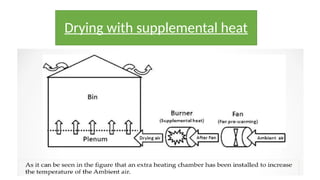
In forced air drying, natural air or air supplemented with heat is blown
through a layer of seed until drying is completed.
• Ordinary seed godowns are provided with two types of ventilators for
free movement of air circulation.
• Modern godowns, provisions are to be made for forcible circulation of
air with the help of an electronic blower.
• Outside air which is comparatively dry is circulated in the godown and
thereby the seed get dried up in this process. This is possible only in dry
months.
Advantages
• . Quick method
• Perfect drying is possible even under
unfavorable weather condition.
• Seed loss is minimized.
Disadvantages
• Requires specialized equipment and machine,
which is costly.
• Care should be taken while drying the seed
using hot air, as it causes damage to
• the seed.
• Tempering is to be followed while drying the
seed in this method
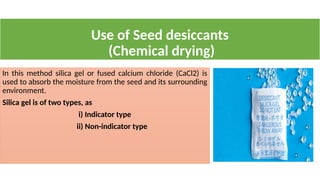
Use of Seed desiccants
(Chemical drying)
In this method silica gel or fused calcium chloride (CaCl2) is
used to absorb the moisture from the seed and its surrounding
environment.
Silica gel is of two types, as
i) Indicator type
ii) Non-indicator type
Continued…
• Active ingredient in Silica gel is Lithium chloride, which is responsible for drying
process. Silica gel can absorb moisture upto 15 per cent of its weight. So to get
very low moisture content we can use this, which is not possible in mechanical
driers.
• Indicator type will be blue in colour and on absorbing moisture, this turns to pink
colour. So we can remove this and reuse after dehydration. Non – indicator type
will be white in colour and remains same (white) even after absorption of
moisture content. So there is no indication in this type. But this can also be reused
after dehydration.
• Calcium chloride is used for most of the vegetable and flower seeds of breeding
material. Here the quantity needed is more. It can absorb 10 per cent of its
weight.
• The method is suitable for drying small quantities of seeds only. It is a
sophisticated and costlier method.
Drying with supplemental heat
• Seed can be dried in various ways, including sun drying, bin drying,
portable batch drying, wagon bed drying,
continuous-flow/crossflow drying, and rotary drying. In addition,
seed com is dried in specially designed ear-corn dryers. (Brooker et
al. 1992; Loewer et al. 1994).
DIFFERENT TYPES OF DRIERS
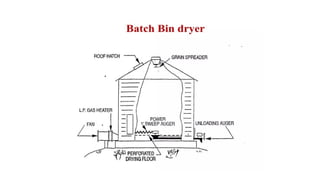
a) Batch bin dryers (or) Metal bin dryers
i) Rectangular metal bin dryers
ii) Circular metal bin dryers
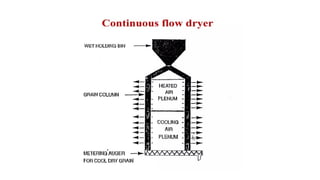
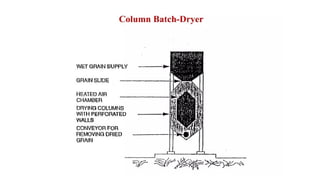
b) Continuous flow dryers
i) L.S.U. dryers (Louisiana State University)
ii) Non mixing column dryers
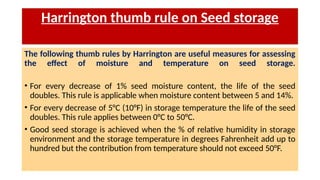
Harrington thumb rule on Seed storage
The following thumb rules by Harrington are useful measures for assessing
the effect of moisture and temperature on seed storage.
• For every decrease of 1% seed moisture content, the life of the seed
doubles. This rule is applicable when moisture content between 5 and 14%.
• For every decrease of 5°C (10°F) in storage temperature the life of the seed
doubles. This rule applies between 0°C to 50°C.
• Good seed storage is achieved when the % of relative humidity in storage
environment and the storage temperature in degrees Fahrenheit add up to
hundred but the contribution from temperature should not exceed 50°F.
REFERENCES
• Jawaharlal Nehru Krishi Vishwa Vidyalaya Jabalpur.
• Florabank Guidelines Module 9-Seed drying and Storage.
• https://www.studocu.com/in/document/sam-higginbottom-
university-of-agriculture-technology-and-sciences/horticulture/
seed-drying-principles-and-methods/25611532
• Anonymous images from Google.

Seed Processing and Storage- Seed Drying

  • 1.
    Shubham Thapa Department ofSeed Science and Technology Seed Processing and Storage (AST-605) Seed Drying VCSG Uttarakhand University of Horticulture and Forestry, Bharsar
  • 2.
    What is Seeddrying? • The process of elimination of moisture from the seed is called drying. • Seed drying should reduce the seed moisture content to safe moisture limits to maintain its viability and vigour during storage, which may otherwise deteriorate quickly owing to mold growth, heating and enhanced microbial activity.
  • 3.
    Continued… • The dryingand storage of seeds are often essential steps in the production and maintenance of high quality seed. • In the drying process, excess water is removed, either in the field by natural means (i.e., sun and wind) or in a bin or dryer with the aid of a fan and heater. • In storage, an atmosphere is maintained in which the temperature and moisture content of the seed remain constant, regardless of the length of the storage period.
  • 4.
    • Seed dryingalso permits early harvesting. • Long term storage of seeds. • Production of high quality seed. Depending upon the climate and method of harvesting adopted the threshed seed may or may not be dry enough for safe storage.  Under less favorable conditions, threshed seed needs further drying. Importance of seed drying
  • 5.
    Objectives of Seeddrying • Drying is needed for the future storage of crops. • Drying makes crops favorable for processing. • Drying is important to insure market price. • Drying saves crops from different types of insects or pests that cause crops damage. • Drying is essential to improve seed quality. • To improve nutritive value, drying is needed.
  • 6.
    The objective ofseed storage is to preserve seed quality (viability) throughout the storage period. Although favorable storage conditions cannot improve seed viability, incorrect storage can reduce its germination potential, usually due to physiological deterioration or mold development (Sauer 1992).
  • 7.
    1. Loss ofviability 2. Discoloration 3. Toxin production 4. Growth of fungus Due to improper drying and storage conditions, seeds suffer from major retarding effects.
  • 8.
    The rate ofdrying depends on • Initial seed moisture content • Size of the bin and capacity • Depth / spread of seed • The rate of air blow • Atmosphere air temperature • Relative humidity • Static pressure • Drying temperature.
  • 9.
    Source: Florabank GuidelinesModule 9-Seed drying and Storage
  • 10.
    Roberts (1973) classifiedspecies into two categories with regard to seed storage behavior Orthodox They can survive the freezing and drying that happen during ex-situ conservation. They can dry their moisture content without cell damage. They have a longer lifespan. They are desiccation-tolerant seeds that can be stored for a long time. This includes most of the grains, guava, cashew, sapota, etc. Recalcitrant They cannot survive freezing and drying in ex-situ conservation. They can dry only up to a limit, and also cannot thrive for more than 3-4 days loosing viability and viability. They comparatively have a short lifespan. They are not desiccation-tolerant, and hence cannot be stored for a long duration. This includes lychee, mango, avocado, etc.
  • 11.
    Methods of drying I.Physical drying (or) natural drying (or) traditional sun drying II. Mechanical (or) artificial drying • Drying with forced natural air • Drying with forced artificially heated air • Drying with desiccants • Drying with infrared rays
  • 12.
    Physical drying /Natural drying / Traditional Sun drying • To achieve uniform drying, the seed should be spread in thin layer. • High moisture content seed with a moisture content of more than 17% should be dried first under shade / light to reduce the moisture content less than 17% and then dried under heavy sun i.e. noon drying. • 2-4 days are needed to reduce the moisture content to 10-12%. • Direct sunlight also can adversely affect seed germinability owing to high temperature and ultraviolet radiation, especially if the moisture content of the seed is high.
  • 13.
  • 14.
    Advantages • Easy andcheap • Does not require any expenditure or fuel. • Does not require special machine or equipment's. • Performing this method from long time. Disadvantages • The rate of drying is slow • Loss due to attack by insects, birds and animals • Large floor area is required • Involves extra labour for collecting and exposing during the day • Sun drying cause sun checks or hot spots due to variation in temperature from time to time. This checks or spots induce high amount of breakage while processing • Mechanical admixtures are possible • Dust, dirt and other foreign materials get admixed • High weather risks and damage by heavy wind and rains
  • 15.
    II. Mechanical dryingor artificial drying Forced air drying In forced air drying, natural air or air supplemented with heat is blown through a layer of seed until drying is completed. • Ordinary seed godowns are provided with two types of ventilators for free movement of air circulation. • Modern godowns, provisions are to be made for forcible circulation of air with the help of an electronic blower. • Outside air which is comparatively dry is circulated in the godown and thereby the seed get dried up in this process. This is possible only in dry months.
  • 16.
    Advantages • . Quickmethod • Perfect drying is possible even under unfavorable weather condition. • Seed loss is minimized. Disadvantages • Requires specialized equipment and machine, which is costly. • Care should be taken while drying the seed using hot air, as it causes damage to • the seed. • Tempering is to be followed while drying the seed in this method
  • 17.
    Use of Seeddesiccants (Chemical drying) In this method silica gel or fused calcium chloride (CaCl2) is used to absorb the moisture from the seed and its surrounding environment. Silica gel is of two types, as i) Indicator type ii) Non-indicator type
  • 18.
    Continued… • Active ingredientin Silica gel is Lithium chloride, which is responsible for drying process. Silica gel can absorb moisture upto 15 per cent of its weight. So to get very low moisture content we can use this, which is not possible in mechanical driers. • Indicator type will be blue in colour and on absorbing moisture, this turns to pink colour. So we can remove this and reuse after dehydration. Non – indicator type will be white in colour and remains same (white) even after absorption of moisture content. So there is no indication in this type. But this can also be reused after dehydration. • Calcium chloride is used for most of the vegetable and flower seeds of breeding material. Here the quantity needed is more. It can absorb 10 per cent of its weight. • The method is suitable for drying small quantities of seeds only. It is a sophisticated and costlier method.
  • 19.
  • 20.
    • Seed canbe dried in various ways, including sun drying, bin drying, portable batch drying, wagon bed drying, continuous-flow/crossflow drying, and rotary drying. In addition, seed com is dried in specially designed ear-corn dryers. (Brooker et al. 1992; Loewer et al. 1994).
  • 21.
    DIFFERENT TYPES OFDRIERS a) Batch bin dryers (or) Metal bin dryers i) Rectangular metal bin dryers ii) Circular metal bin dryers b) Continuous flow dryers i) L.S.U. dryers (Louisiana State University) ii) Non mixing column dryers
  • 25.
    Harrington thumb ruleon Seed storage The following thumb rules by Harrington are useful measures for assessing the effect of moisture and temperature on seed storage. • For every decrease of 1% seed moisture content, the life of the seed doubles. This rule is applicable when moisture content between 5 and 14%. • For every decrease of 5°C (10°F) in storage temperature the life of the seed doubles. This rule applies between 0°C to 50°C. • Good seed storage is achieved when the % of relative humidity in storage environment and the storage temperature in degrees Fahrenheit add up to hundred but the contribution from temperature should not exceed 50°F.
  • 27.
    REFERENCES • Jawaharlal NehruKrishi Vishwa Vidyalaya Jabalpur. • Florabank Guidelines Module 9-Seed drying and Storage. • https://www.studocu.com/in/document/sam-higginbottom- university-of-agriculture-technology-and-sciences/horticulture/ seed-drying-principles-and-methods/25611532 • Anonymous images from Google.