Pollination and pollinizer problems in fruit crops and their control
Parmar VijayKumar K.
Ph.D (5th semester)
Department of Vegetable Science
College of Horticulture
Jagudan- 382710
Major Guide
Dr. Piyush Verma
Associate professor & Head
Dept. of Horticulture
C. P. College of Agriculture,
S.D.A.U.
Minor Guide
Dr. R. K. Jat
Assistant professor & Head
Dept. of Fruit Science
College of Horticulture,
Jagudan.
Course: VSC 692
2
Contents
Factors affecting pollination
What is pollination
Introduction
Future thrust
Conclusion
Temporary aids to pollination
Review of research work
3
Introduction
 India being the second largest producer of fruits in the world and its
productivity per unit area compared with developed countries is
quite low
 There are many factors responsible for lowering the fruit crop
production viz. unfruitfulness, alternate bearing, fruit drop, biotic
and abiotic stresses, specific chronic problems, etc. in which
pollination and pollinizers problems is also of great concern
 Pollination is one of the most critical, complex and less understood
subject in fruit production
 Adequate pollination is mandatory for most of fruit crops except in
mangosteen, pineapple and banana
4
What is pollination……?
 “Process of transfer of pollen grain from an anther to the
stigma of the same or different flower”
 It includes all events starting from maturation of anthers
to the division of zygote
 Camerarius (1694) was the first to establish that
pollination is essential for the production of seeds, which
proved the existence of sexuality in plants
5
ways of pollination
Two ways:
1) Self-pollination
i. Autogamy
ii.Geitonogamy
2) Cross-pollination
6
Mechanisms of Self-pollination
I. Cleistogamy e.g. grapes and guava
II. Homogamy e.g. Some spp. of citrus, peach
and apricot
Mechanisms of Cross-pollination
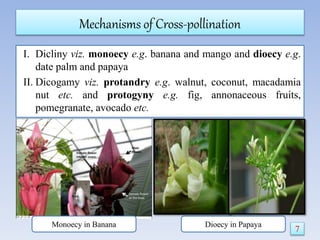
I. Dicliny viz. monoecy e.g. banana and mango and dioecy e.g.
date palm and papaya
II. Dicogamy viz. protandry e.g. walnut, coconut, macadamia
nut etc. and protogyny e.g. fig, annonaceous fruits,
pomegranate, avocado etc.
Monoecy in Banana Dioecy in Papaya
7
III. Heterostyly e.g. litchi, carambola, almond, pomegranate and
sapota
IV. Incompatibiltiy viz. self-incompatibility e.g. avocado, fig,
mango, citrus, olive, aonla etc. and cross-incompatibility
e.g. Loquat, plums etc.
V. Pollen sterility e.g. triploid apple varieties like Bramley’s
Seedling, Blenheim Orange, etc. and pear variety Beurre-
De-Amanlis
8
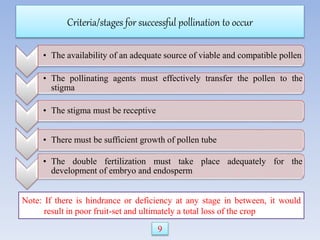
Criteria/stages for successful pollination to occur
• The availability of an adequate source of viable and compatible pollen
• The pollinating agents must effectively transfer the pollen to the
stigma
• The stigma must be receptive
• There must be sufficient growth of pollen tube
• The double fertilization must take place adequately for the
development of embryo and endosperm
Note: If there is hindrance or deficiency at any stage in between, it would
result in poor fruit-set and ultimately a total loss of the crop
9
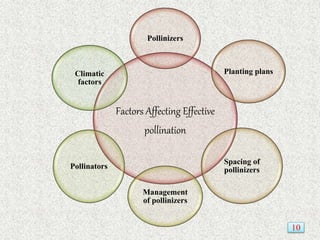
Factors Affecting Effective
pollination
Pollinizers
Planting plans
Spacing of
pollinizers
Management
of pollinizers
Pollinators
Climatic
factors
10
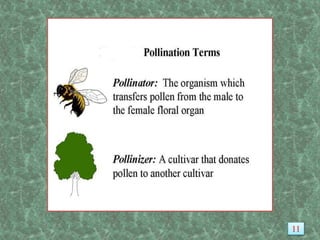
11
I. Pollinizers
 It is particularly important in fruit crops. That show the
mechanism of self incompatibility, self-sterility or cross-
incompatibility. Such phenomena are quite prevalent in
some fruit plants like ber, aonla, loquat, mango and lemons
 In mango and citrus, there is false set due to improper
pollination, which drops off in the later stages
 In date palm, at least 4 to 5 male plants are required for
pollination of 100 female plants
12
Characteristics required for an ideal pollinizer
• Plenty of viable pollens
• Compatible pollen with the main cultivar
• Synchronization of flowering with main cultivar
• Regular and prolific bearer
• Bearing at the same age as that of the main variety
• Free from major insect-pests and diseases
• Adaptable to the agro climatic region, where main cultivars
grow well
13
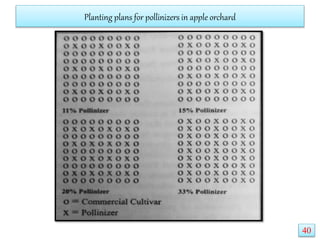
II. PLANTING PLANS: The pollinizer trees should be well distributed in
the orchard. Several planting plans are being adopted. The important
ones provide 11, 15, 25 and 33 per cent pollinizers. The proportion of
pollinizer in an orchard depends upon the activity of bees (No. of
hives/ha), type of main cultivar (early, mid or late) and type of the
pollinizer
III. SPACING POLLINIZERS : In close planting, every tenth tree should
be a pollinizer. In wider plantations of apple atleast every fourth tree
should be a pollinizer. For better, results multiple source of pollens is
better than single source
IV. MANAGEMENT OF POLLINIZERS: In standard wide spaced
plantings, the pollinizers should be managed in central leader system of
training. Pole type pollinizers can be most advantageous in high density
or close plantings
14
V. pollinators
o In self-pollination, no pollinators are required for the transfer of pollen
grains from anther to stigma. However, effective pollinators are required
for this purpose in cross-pollinated fruit crops
o The mature pollen grains are disseminated by various pollinators like
insects, winds, birds and water
o However, it is not always true that one pollinator is fully responsible for
pollen transfer in a particular fruit species. It is likely that two or more
pollinators may work togather at one time
o Pollinators such as bees, birds and bats contribute to 35 per cent of the
world’s crop production, increasing outputs of 87 % of the the leading food
crops worldwide (FAO, 2009)
15
Climatic Factors
• Temperature effects the pollination period and bee
activity
• High temperature reduces flowering periods while low
temperature during anthesis prolongs flowering
• Percentage of hermaphrodite flowers found to decrease
due to low temperature and humidity (60-70%)
• Rainfall reduces bee flight, washes of stigmatic
secreations and in turn affect pollination
VI
16
1) Entomophilous
 “The pollination by insects”
 It involves many species of honey bees viz. A. cerana indica (Indian/Asian bee),
A. florea (dwarf or red dwarf bees), A. dorsata (giant bees), A. andreniforms
(black dwarf bees), A. laboriosa (himalayan bees) and an introduced one A.
mellifera (western bees)
 In addition, several other pollinators including stingless bees, carpenter bees,
bumble bees, megachilids, andrenids, syrphids etc in several agroecosystems
 The fruit crops pollinated entomophilously are apple, pear, peach, plum, almond,
apricot, cherries, ber, litchi, citrus, mango, annonaceous fruit crops
17
Pollinators of fruit crops
2) Anemophilous
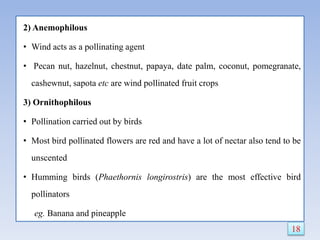
• Wind acts as a pollinating agent
• Pecan nut, hazelnut, chestnut, papaya, date palm, coconut, pomegranate,
cashewnut, sapota etc are wind pollinated fruit crops
3) Ornithophilous
• Pollination carried out by birds
• Most bird pollinated flowers are red and have a lot of nectar also tend to be
unscented
• Humming birds (Phaethornis longirostris) are the most effective bird
pollinators
eg. Banana and pineapple
18
4) Hydrophilous
• Pollination where by pollen is distributed by the flow of waters,
particularly in rivers and streams
eg. water chestnut
5) Man-pollination
• The pollination carried out manually by hand pollination
eg. Date palm
6) Chiropterophily
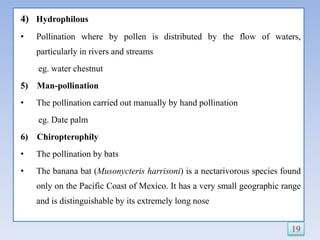
• The pollination by bats
• The banana bat (Musonycteris harrisoni) is a nectarivorous species found
only on the Pacific Coast of Mexico. It has a very small geographic range
and is distinguishable by its extremely long nose
19
Role of pollinators and pollinizers
• Pollinators and pollinizers play important role in pollination of
fruit crop species for sustaining the crop diversity and production
systems.
• Many fruit crops such as ber, aonla, pomegranate, fig, citrus, beal,
jamun etc. require insect pollinators for efficient pollination to
gain the higher yield.
• The pollinators and pollinizers increase quantitative and
qualitative traits of fruit crop production.
20
20
Honeybee: a most effective pollinator
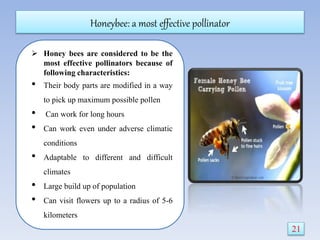
 Honey bees are considered to be the
most effective pollinators because of
following characteristics:
• Their body parts are modified in a way
to pick up maximum possible pollen
• Can work for long hours
• Can work even under adverse climatic
conditions
• Adaptable to different and difficult
climates
• Large build up of population
• Can visit flowers up to a radius of 5-6
kilometers
21
• The number of colonies to be required for effective
pollination in an orchard depends on planting density,
duration of flowering, strength of bee colonies and
availability of flowers per unit area
• In general, two colonies of A. mellifera and three colonies
of A. cerana indica per hactare of crop in flowering
season are recommended for effective pollination
• Along with honeybees, butterflies, houseflies, some
species of wasp, bumble bees, syrphid flies etc. are also
known to help in pollination
22
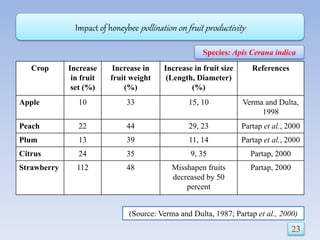
Crop Increase
in fruit
set (%)
Increase in
fruit weight
(%)
Increase in fruit size
(Length, Diameter)
(%)
References
Apple 10 33 15, 10 Verma and Dulta,
1998
Peach 22 44 29, 23 Partap et al., 2000
Plum 13 39 11, 14 Partap et al., 2000
Citrus 24 35 9, 35 Partap, 2000
Strawberry 112 48 Misshapen fruits
decreased by 50
percent
Partap, 2000
(Source: Verma and Dulta, 1987; Partap et al., 2000)
Impact of honeybee pollination on fruit productivity
23
Species: Apis Cerana indica
Mango
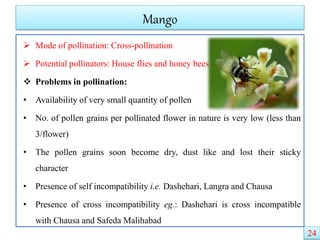
 Mode of pollination: Cross-pollination
 Potential pollinators: House flies and honey bees
 Problems in pollination:
• Availability of very small quantity of pollen
• No. of pollen grains per pollinated flower in nature is very low (less than
3/flower)
• The pollen grains soon become dry, dust like and lost their sticky
character
• Presence of self incompatibility i.e. Dashehari, Langra and Chausa
• Presence of cross incompatibility eg.: Dashehari is cross incompatible
with Chausa and Safeda Malihabad
24
• Presence of higher sex ratio
• Late flushes produce plenty of pollen than early flushes
 Suggestion for successful pollination:
• Placement of bee colonies in mango plantations
• Planting of suitable pollinizers
• Recommended pollinizers are
 Bombay Green for Dashehari
 Dashehari for Chausa and Langra
25
papaya
 Mode of pollination: Cross-pollination
 Potential pollinators: Wind and small insect
 Problems in pollination:
• Dioecious in nature
• Unattracted flowers
• Long narrow corolla tube of the male flower
• The appearance of sex reversion
• The rare appearance of self-incompatibility
• Lack of basic knowledge of various types of changes in flower
• Lack of morphological markers to identify the sex at nursery stage
26
 Suggestion for successful pollination:
• The problem of self-incompatibilty due to heterostyly may be alleviated
by pollinating the flowers with pollen from the male flowers that are
produced on andromonoecious trees
• Honeybees, thrips, hawk moths and apparently also mosquitoes have been
reported as pollinators of papaya
• In dioecious varieties, 10-12% male plants in the orchard population are
required for proper pollination
• Wind pollination is also important
27
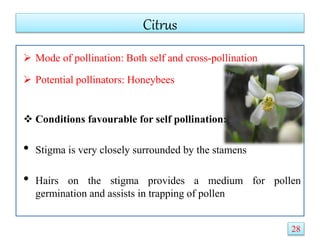
Citrus
 Mode of pollination: Both self and cross-pollination
 Potential pollinators: Honeybees
 Conditions favourable for self pollination:
• Stigma is very closely surrounded by the stamens
• Hairs on the stigma provides a medium for pollen
germination and assists in trapping of pollen
28
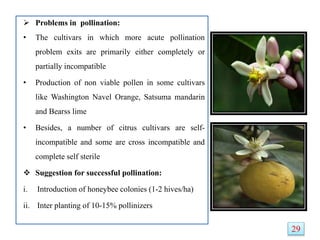
 Problems in pollination:
• The cultivars in which more acute pollination
problem exits are primarily either completely or
partially incompatible
• Production of non viable pollen in some cultivars
like Washington Navel Orange, Satsuma mandarin
and Bearss lime
• Besides, a number of citrus cultivars are self-
incompatible and some are cross incompatible and
complete self sterile
 Suggestion for successful pollination:
i. Introduction of honeybee colonies (1-2 hives/ha)
ii. Inter planting of 10-15% pollinizers
29
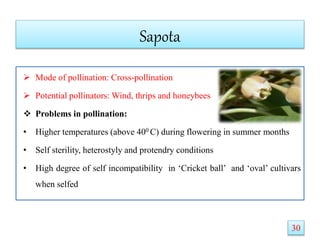
Sapota
 Mode of pollination: Cross-pollination
 Potential pollinators: Wind, thrips and honeybees
 Problems in pollination:
• Higher temperatures (above 400 C) during flowering in summer months
• Self sterility, heterostyly and protendry conditions
• High degree of self incompatibility in ‘Cricket ball’ and ‘oval’ cultivars
when selfed
30
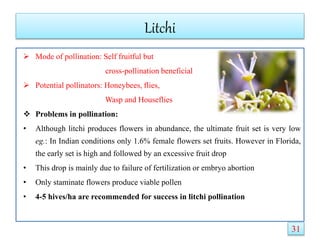
Litchi
 Mode of pollination: Self fruitful but
cross-pollination beneficial
 Potential pollinators: Honeybees, flies,
Wasp and Houseflies
 Problems in pollination:
• Although litchi produces flowers in abundance, the ultimate fruit set is very low
eg.: In Indian conditions only 1.6% female flowers set fruits. However in Florida,
the early set is high and followed by an excessive fruit drop
• This drop is mainly due to failure of fertilization or embryo abortion
• Only staminate flowers produce viable pollen
• 4-5 hives/ha are recommended for success in litchi pollination
31
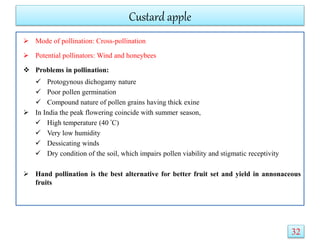
Custard apple
 Mode of pollination: Cross-pollination
 Potential pollinators: Wind and honeybees
 Problems in pollination:
 Protogynous dichogamy nature
 Poor pollen germination
 Compound nature of pollen grains having thick exine
 In India the peak flowering coincide with summer season,
 High temperature (40 ºC)
 Very low humidity
 Dessicating winds
 Dry condition of the soil, which impairs pollen viability and stigmatic receptivity
 Hand pollination is the best alternative for better fruit set and yield in annonaceous
fruits
32
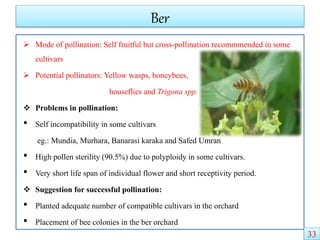
Ber
 Mode of pollination: Self fruitful but cross-pollination recommmended in some
cultivars
 Potential pollinators: Yellow wasps, honeybees,
houseflies and Trigona spp.
 Problems in pollination:
• Self incompatibility in some cultivars
eg.: Mundia, Murhara, Banarasi karaka and Safed Umran
• High pollen sterility (90.5%) due to polyploidy in some cultivars.
• Very short life span of individual flower and short receptivity period.
 Suggestion for successful pollination:
• Planted adequate number of compatible cultivars in the orchard
• Placement of bee colonies in the ber orchard
33
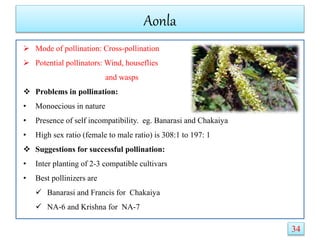
Aonla
 Mode of pollination: Cross-pollination
 Potential pollinators: Wind, houseflies
and wasps
 Problems in pollination:
• Monoecious in nature
• Presence of self incompatibility. eg. Banarasi and Chakaiya
• High sex ratio (female to male ratio) is 308:1 to 197: 1
 Suggestions for successful pollination:
• Inter planting of 2-3 compatible cultivars
• Best pollinizers are
 Banarasi and Francis for Chakaiya
 NA-6 and Krishna for NA-7
34
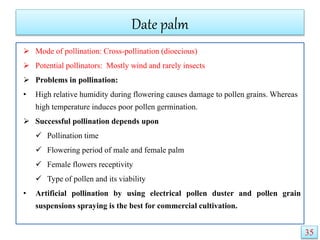
Date palm
 Mode of pollination: Cross-pollination (dioecious)
 Potential pollinators: Mostly wind and rarely insects
 Problems in pollination:
• High relative humidity during flowering causes damage to pollen grains. Whereas
high temperature induces poor pollen germination.
 Successful pollination depends upon
 Pollination time
 Flowering period of male and female palm
 Female flowers receptivity
 Type of pollen and its viability
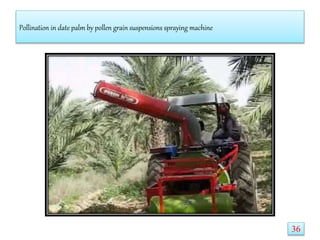
• Artificial pollination by using electrical pollen duster and pollen grain
suspensions spraying is the best for commercial cultivation.
35
Pollination in date palm by pollen grain suspensions spraying machine
36
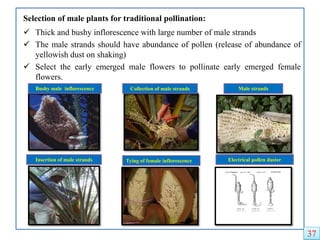
Selection of male plants for traditional pollination:
 Thick and bushy inflorescence with large number of male strands
 The male strands should have abundance of pollen (release of abundance of
yellowish dust on shaking)
 Select the early emerged male flowers to pollinate early emerged female
flowers.
Bushy male inflorescence Collection of male strands Male strands
Insertion of male strands Tying of female inflorescence Electrical pollen duster
37
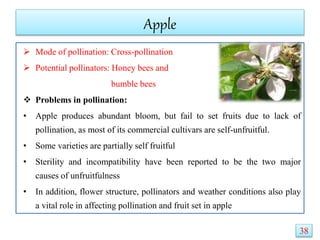
Apple
 Mode of pollination: Cross-pollination
 Potential pollinators: Honey bees and
bumble bees
 Problems in pollination:
• Apple produces abundant bloom, but fail to set fruits due to lack of
pollination, as most of its commercial cultivars are self-unfruitful.
• Some varieties are partially self fruitful
• Sterility and incompatibility have been reported to be the two major
causes of unfruitfulness
• In addition, flower structure, pollinators and weather conditions also play
a vital role in affecting pollination and fruit set in apple
38
 For successful pollination in apples
• Planted adequate proportion of pollinizers (33%)
• In general, 2-3 pollinizing varieties placed in an orchard
• Placement of bee colonies (2-3 bee hives/ha)
• The population of bees should be high during effective pollination
period 2 to 10 days depending on the cultivars and temperature.
39
Planting plans for pollinizers in apple orchard
40
Review of Research work
41
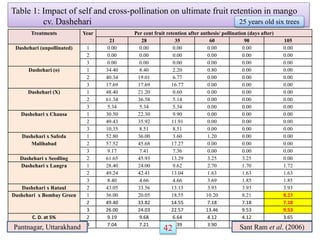
Table 1: Impact of self and cross-pollination on ultimate fruit retention in mango
cv. Dashehari
Treatments Year Per cent fruit retention after anthesis/ pollination (days after)
21 28 35 60 90 105
Dashehari (unpollinated) 1 0.00 0.00 0.00 0.00 0.00 0.00
2 0.00 0.00 0.00 0.00 0.00 0.00
3 0.00 0.00 0.00 0.00 0.00 0.00
Dashehari (ɵ) 1 34.40 8.40 2.20 0.80 0.00 0.00
2 40.34 19.01 6.77 0.00 0.00 0.00
3 17.69 17.69 16.77 0.00 0.00 0.00
Dashehari (X) 1 48.40 21.20 0.60 0.00 0.00 0.00
2 61.34 36.58 5.14 0.00 0.00 0.00
3 5.34 5.34 5.34 0.00 0.00 0.00
Dashehari x Chausa 1 30.50 22.30 9.90 0.00 0.00 0.00
2 49.43 35.92 11.91 0.00 0.00 0.00
3 10.35 8.51 8.51 0.00 0.00 0.00
Dashehari x Safeda
Malihabad
1 52.80 36.00 3.60 1.20 0.00 0.00
2 57.52 45.68 17.27 0.00 0.00 0.00
3 9.17 7.41 7.36 0.00 0.00 0.00
Dashehari x Seedling 2 61.65 45.93 13.29 3.25 3.25 0.00
Dashehari x Langra 1 28.40 24.00 9.62 2.70 1.70 1.72
2 49.24 42.41 13.04 1.63 1.63 1.63
3 8.40 4.66 4.66 3.69 1.85 1.85
Dashehari x Rataul 2 43.05 33.56 13.13 3.93 3.93 3.93
Dashehari x Bombay Green 1 36.00 20.05 18.55 10.20 8.21 8.23
2 49.40 33.82 14.55 7.18 7.18 7.18
3 26.00 24.03 22.57 13.46 9.53 9.53
C. D. at 5% 2 9.19 9.68 6.64 4.12 4.12 3.65
3 7.04 7.21 7.39 3.90 3.90 4.00
Pantnagar, Uttarakhand Sant Ram et al. (2006)
25 years old six trees
42
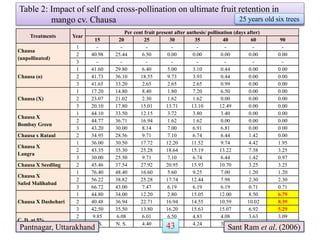
Table 2: Impact of self and cross-pollination on ultimate fruit retention in
mango cv. Chausa
Treatments Year
Per cent fruit present after anthesis/ pollination (days after)
15 20 25 30 35 40 60 90
Chausa
(unpollinated)
1 - - - - - - - -
2 40.98 25.44 6.50 0.00 0.00 0.00 0.00 0.00
3 - - - - - - - -
Chausa (ɵ)
1 41.60 29.80 6.40 5.00 3.10 0.44 0.00 0.00
2 41.73 36.10 18.55 9.73 3.93 0.44 0.00 0.00
3 41.65 33.20 2.65 2.65 2.65 0.99 0.00 0.00
Chausa (X)
1 17.20 14.80 8.40 1.80 7.20 6.50 0.00 0.00
2 23.07 21.02 2.30 1.62 1.62 0.00 0.00 0.00
3 20.10 17.80 15.01 13.71 13.10 12.49 0.00 0.00
Chausa X
Bombay Green
1 44.10 33.50 12.15 3.72 3.80 3.40 0.00 0.00
2 44.77 36.71 16.94 1.62 1.62 0.00 0.00 0.00
3 43.20 30.00 8.14 7.00 6.91 6.81 0.00 0.00
Chausa x Rataul 2 34.95 28.56 9.71 7.10 6.74 6.44 1.42 0.00
Chausa X
Langra
1 36.00 30.50 17.72 12.20 11.52 9.74 4.42 1.95
2 43.35 35.30 25.28 18.64 15.19 13.22 7.38 3.25
3 30.00 25.50 9.71 7.10 6.74 6.44 1.42 0.97
Chausa X Seedling 2 45.46 37.54 27.92 20.95 15.93 10.70 3.25 3.25
Chausa X
Safed Malihabad
1 76.40 48.40 16.60 5.60 9.25 7.00 1.20 1.20
2 56.22 38.82 25.28 17.74 12.44 7.98 2.30 2.30
3 66.72 43.00 7.47 6.19 6.19 6.19 0.71 0.71
Chausa X Dashehari
1 44.80 34.00 12.20 2.80 15.05 12.00 8.50 6.79
2 40.48 36.94 22.71 16.94 14.55 10.59 10.02 8.39
3 42.50 35.50 13.80 16.20 15.63 15.07 6.92 5.29
C. D. at 5%
2 9.85 6.08 6.01 6.50 4.83 4.08 3.63 3.09
3 N. S. N. S. 4.40 4.34 4.24 3.99 3.25 2.91
Pantnagar, Uttarakhand Sant Ram et al. (2006)
25 years old six trees
43
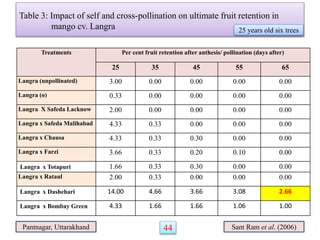
Table 3: Impact of self and cross-pollination on ultimate fruit retention in
mango cv. Langra
Treatments Per cent fruit retention after anthesis/ pollination (days after)
25 35 45 55 65
Langra (unpollinated) 3.00 0.00 0.00 0.00 0.00
Langra (ɵ) 0.33 0.00 0.00 0.00 0.00
Langra X Safeda Lacknow 2.00 0.00 0.00 0.00 0.00
Langra x Safeda Malihabad 4.33 0.33 0.00 0.00 0.00
Langra x Chausa 4.33 0.33 0.30 0.00 0.00
Langra x Farzi 3.66 0.33 0.20 0.10 0.00
Langra x Totapuri 1.66 0.33 0.30 0.00 0.00
Langra x Rataul 2.00 0.33 0.00 0.00 0.00
Langra x Dashehari 14.00 4.66 3.66 3.08 2.66
Langra x Bombay Green 4.33 1.66 1.66 1.06 1.00
Pantnagar, Uttarakhand Sant Ram et al. (2006)
25 years old six trees
44
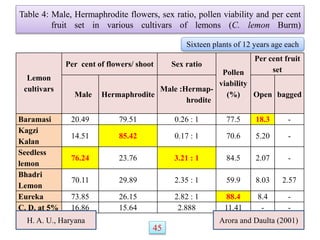
Table 4: Male, Hermaphrodite flowers, sex ratio, pollen viability and per cent
fruit set in various cultivars of lemons (C. lemon Burm)
Lemon
cultivars
Per cent of flowers/ shoot Sex ratio
Pollen
viability
(%)
Per cent fruit
set
Male Hermaphrodite
Male :Hermap-
hrodite
Open bagged
Baramasi 20.49 79.51 0.26 : 1 77.5 18.3 -
Kagzi
Kalan
14.51 85.42 0.17 : 1 70.6 5.20 -
Seedless
lemon
76.24 23.76 3.21 : 1 84.5 2.07 -
Bhadri
Lemon
70.11 29.89 2.35 : 1 59.9 8.03 2.57
Eureka 73.85 26.15 2.82 : 1 88.4 8.4 -
C. D. at 5% 16.86 15.64 2.888 11.41 - -
H. A. U., Haryana Arora and Daulta (2001)
Sixteen plants of 12 years age each
45
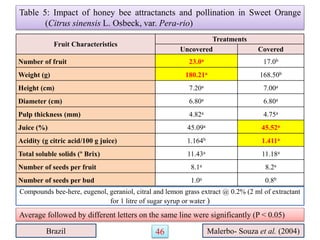
Fruit Characteristics
Treatments
Uncovered Covered
Number of fruit 23.0a 17.0b
Weight (g) 180.21a 168.50b
Height (cm) 7.20a 7.00a
Diameter (cm) 6.80a 6.80a
Pulp thickness (mm) 4.82a 4.75a
Juice (%) 45.09a 45.52a
Acidity (g citric acid/100 g juice) 1.164b 1.411a
Total soluble solids (º Brix) 11.43a 11.18a
Number of seeds per fruit 8.1a 8.2a
Number of seeds per bud 1.0a 0.8b
Table 5: Impact of honey bee attractancts and pollination in Sweet Orange
(Citrus sinensis L. Osbeck, var. Pera-rio)
Brazil Malerbo- Souza et al. (2004)
Average followed by different letters on the same line were significantly (P < 0.05)
46
Compounds bee-here, eugenol, geraniol, citral and lemon grass extract @ 0.2% (2 ml of extractant
for 1 litre of sugar syrup or water )
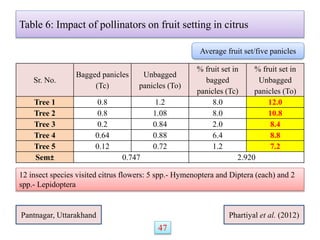
Table 6: Impact of pollinators on fruit setting in citrus
Sr. No.
Bagged panicles
(Tc)
Unbagged
panicles (To)
% fruit set in
bagged
panicles (Tc)
% fruit set in
Unbagged
panicles (To)
Tree 1 0.8 1.2 8.0 12.0
Tree 2 0.8 1.08 8.0 10.8
Tree 3 0.2 0.84 2.0 8.4
Tree 4 0.64 0.88 6.4 8.8
Tree 5 0.12 0.72 1.2 7.2
Sem± 0.747 2.920
Pantnagar, Uttarakhand Phartiyal et al. (2012)
Average fruit set/five panicles
12 insect species visited citrus flowers: 5 spp.- Hymenoptera and Diptera (each) and 2
spp.- Lepidoptera
47
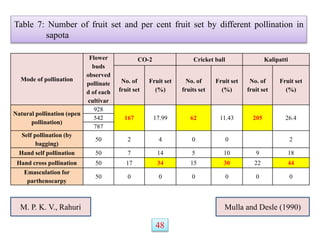
Table 7: Number of fruit set and per cent fruit set by different pollination in
sapota
Mode of pollination
Flower
buds
observed
pollinate
d of each
cultivar
CO-2 Cricket ball Kalipatti
No. of
fruit set
Fruit set
(%)
No. of
fruits set
Fruit set
(%)
No. of
fruit set
Fruit set
(%)
Natural pollination (open
pollination)
928
167 17.99 62 11.43 205 26.4
542
787
Self pollination (by
bagging)
50 2 4 0 0 2
Hand self pollination 50 7 14 5 10 9 18
Hand cross pollination 50 17 34 15 30 22 44
Emasculation for
parthenocarpy
50 0 0 0 0 0 0
48
Mulla and Desle (1990)
M. P. K. V., Rahuri
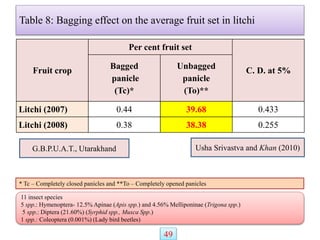
Table 8: Bagging effect on the average fruit set in litchi
Fruit crop
Per cent fruit set
C. D. at 5%
Bagged
panicle
(Tc)*
Unbagged
panicle
(To)**
Litchi (2007) 0.44 39.68 0.433
Litchi (2008) 0.38 38.38 0.255
G.B.P.U.A.T., Utarakhand Usha Srivastva and Khan (2010)
49
11 insect species
5 spp.: Hymenoptera- 12.5% Apinae (Apis spp.) and 4.56% Melliponinae (Trigona spp.)
5 spp.: Diptera (21.60%) (Syrphid spp., Musca Spp.)
1 spp.: Coleoptera (0.001%) (Lady bird beetles)
* Tc – Completely closed panicles and **To – Completely opened panicles
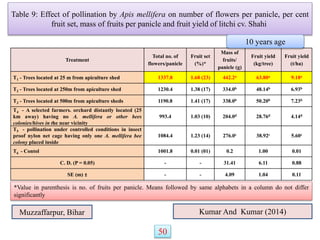
Table 9: Effect of pollination by Apis mellifera on number of flowers per panicle, per cent
fruit set, mass of fruits per panicle and fruit yield of litchi cv. Shahi
Treatment
Total no. of
flowers/panicle
Fruit set
(%)*
Mass of
fruits/
panicle (g)
Fruit yield
(kg/tree)
Fruit yield
(t/ha)
T1 - Trees located at 25 m from apiculture shed 1337.8 1.68 (23) 442.2a 63.80a 9.18a
T2 - Trees located at 250m from apiculture shed 1230.4 1.38 (17) 334.0b 48.14b 6.93b
T3 - Trees located at 500m from apiculture sheds 1190.8 1.41 (17) 338.0b 50.20b 7.23b
T4 - A selected farmers. orchard distantly located (25
km away) having no A. mellifera or other bees
colonies/hives in the near vicinity
993.4 1.03 (10) 204.0d 28.76d 4.14d
T5 - pollination under controlled conditions in insect
proof nylon net cage having only one A. mellifera bee
colony placed inside
1084.4 1.23 (14) 276.0c 38.92c 5.60c
T6 - Contol 1001.8 0.01 (01) 0.2 1.00 0.01
C. D. (P = 0.05) - - 31.41 6.11 0.88
SE (m) ± - - 4.09 1.04 0.11
50
Kumar And Kumar (2014)
Muzzaffarpur, Bihar
*Value in parenthesis is no. of fruits per panicle. Means followed by same alphabets in a column do not differ
significantly
10 years age
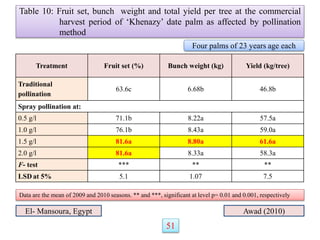
Treatment Fruit set (%) Bunch weight (kg) Yield (kg/tree)
Traditional
pollination
63.6c 6.68b 46.8b
Spray pollination at:
0.5 g/l 71.1b 8.22a 57.5a
1.0 g/l 76.1b 8.43a 59.0a
1.5 g/l 81.6a 8.80a 61.6a
2.0 g/l 81.6a 8.33a 58.3a
F- test *** ** **
LSD at 5% 5.1 1.07 7.5
Table 10: Fruit set, bunch weight and total yield per tree at the commercial
harvest period of ‘Khenazy’ date palm as affected by pollination
method
Awad (2010)
El- Mansoura, Egypt
Four palms of 23 years age each
Data are the mean of 2009 and 2010 seasons. ** and ***, significant at level p= 0.01 and 0.001, respectively
51
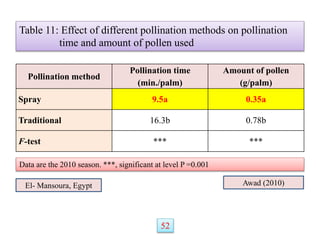
Table 11: Effect of different pollination methods on pollination
time and amount of pollen used
Awad (2010)
El- Mansoura, Egypt
Data are the 2010 season. ***, significant at level P =0.001
52
Pollination method
Pollination time
(min./palm)
Amount of pollen
(g/palm)
Spray 9.5a 0.35a
Traditional 16.3b 0.78b
F-test *** ***
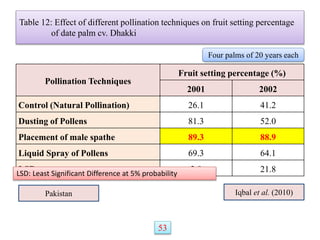
Table 12: Effect of different pollination techniques on fruit setting percentage
of date palm cv. Dhakki
Pollination Techniques
Fruit setting percentage (%)
2001 2002
Control (Natural Pollination) 26.1 41.2
Dusting of Pollens 81.3 52.0
Placement of male spathe 89.3 88.9
Liquid Spray of Pollens 69.3 64.1
LSD 2.8 21.8
LSD: Least Significant Difference at 5% probability
Iqbal et al. (2010)
Pakistan
Four palms of 20 years each
53
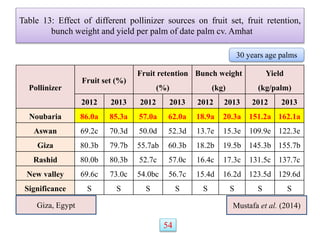
Pollinizer
Fruit set (%)
Fruit retention
(%)
Bunch weight
(kg)
Yield
(kg/palm)
2012 2013 2012 2013 2012 2013 2012 2013
Noubaria 86.0a 85.3a 57.0a 62.0a 18.9a 20.3a 151.2a 162.1a
Aswan 69.2c 70.3d 50.0d 52.3d 13.7e 15.3e 109.9e 122.3e
Giza 80.3b 79.7b 55.7ab 60.3b 18.2b 19.5b 145.3b 155.7b
Rashid 80.0b 80.3b 52.7c 57.0c 16.4c 17.3c 131.5c 137.7c
New valley 69.6c 73.0c 54.0bc 56.7c 15.4d 16.2d 123.5d 129.6d
Significance S S S S S S S S
Table 13: Effect of different pollinizer sources on fruit set, fruit retention,
bunch weight and yield per palm of date palm cv. Amhat
Giza, Egypt Mustafa et al. (2014)
30 years age palms
54
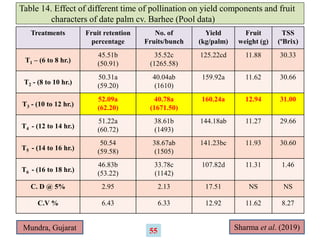
Table 14. Effect of different time of pollination on yield components and fruit
characters of date palm cv. Barhee (Pool data)
Treatments Fruit retention
percentage
No. of
Fruits/bunch
Yield
(kg/palm)
Fruit
weight (g)
TSS
(ºBrix)
T1 – (6 to 8 hr.)
45.51b
(50.91)
35.52c
(1265.58)
125.22cd 11.88 30.33
T2 - (8 to 10 hr.)
50.31a
(59.20)
40.04ab
(1610)
159.92a 11.62 30.66
T3 - (10 to 12 hr.)
52.09a
(62.20)
40.78a
(1671.50)
160.24a 12.94 31.00
T4 - (12 to 14 hr.)
51.22a
(60.72)
38.61b
(1493)
144.18ab 11.27 29.66
T5 - (14 to 16 hr.)
50.54
(59.58)
38.67ab
(1505)
141.23bc 11.93 30.60
T6 - (16 to 18 hr.)
46.83b
(53.22)
33.78c
(1142)
107.82d 11.31 1.46
C. D @ 5% 2.95 2.13 17.51 NS NS
C.V % 6.43 6.33 12.92 11.62 8.27
Sharma et al. (2019)
Mundra, Gujarat 55
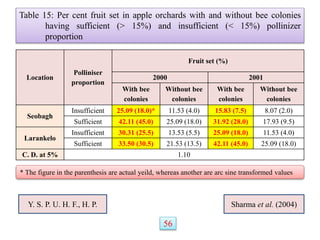
Table 15: Per cent fruit set in apple orchards with and without bee colonies
having sufficient (> 15%) and insufficient (< 15%) pollinizer
proportion
Location
Polliniser
proportion
Fruit set (%)
2000 2001
With bee
colonies
Without bee
colonies
With bee
colonies
Without bee
colonies
Seobagh
Insufficient 25.09 (18.0)* 11.53 (4.0) 15.83 (7.5) 8.07 (2.0)
Sufficient 42.11 (45.0) 25.09 (18.0) 31.92 (28.0) 17.93 (9.5)
Larankelo
Insufficient 30.31 (25.5) 13.53 (5.5) 25.09 (18.0) 11.53 (4.0)
Sufficient 33.50 (30.5) 21.53 (13.5) 42.11 (45.0) 25.09 (18.0)
C. D. at 5% 1.10
56
* The figure in the parenthesis are actual yeild, whereas another are arc sine transformed values
Sharma et al. (2004)
Y. S. P. U. H. F., H. P.
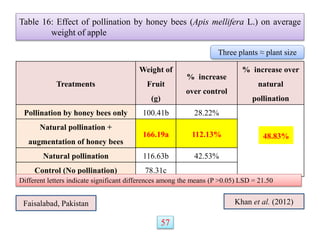
Treatments
Weight of
Fruit
(g)
% increase
over control
% increase over
natural
pollination
Pollination by honey bees only 100.41b 28.22%
Natural pollination +
augmentation of honey bees
166.19a 112.13%
Natural pollination 116.63b 42.53%
Control (No pollination) 78.31c
Table 16: Effect of pollination by honey bees (Apis mellifera L.) on average
weight of apple
Different letters indicate significant differences among the means (P >0.05) LSD = 21.50
Khan et al. (2012)
Faisalabad, Pakistan
Three plants ≈ plant size
57
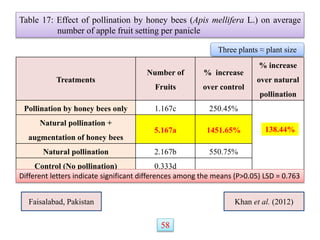
48.83%
Table 17: Effect of pollination by honey bees (Apis mellifera L.) on average
number of apple fruit setting per panicle
Treatments
Number of
Fruits
% increase
over control
% increase
over natural
pollination
Pollination by honey bees only 1.167c 250.45%
Natural pollination +
augmentation of honey bees
5.167a 1451.65%
Natural pollination 2.167b 550.75%
Control (No pollination) 0.333d
Different letters indicate significant differences among the means (P>0.05) LSD = 0.763
Three plants ≈ plant size
Faisalabad, Pakistan Khan et al. (2012)
58
138.44%
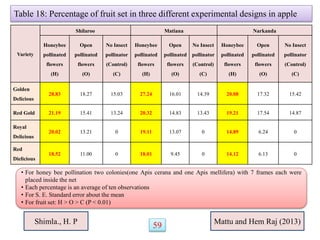
Variety
Shilaroo Matiana Narkanda
Honeybee
pollinated
flowers
(H)
Open
pollinated
flowers
(O)
No Insect
pollinator
(Control)
(C)
Honeybee
pollinated
flowers
(H)
Open
pollinated
flowers
(O)
No Insect
pollinator
(Control)
(C)
Honeybee
pollinated
flowers
(H)
Open
pollinated
flowers
(O)
No Insect
pollinator
(Control)
(C)
Golden
Delicious
28.83 18.27 15.03 27.24 16.01 14.39 20.08 17.32 15.42
Red Gold 21.19 15.41 13.24 20.32 14.83 13.43 19.21 17.54 14.87
Royal
Delicious
20.02 13.21 0 19.11 13.07 0 14.89 6.24 0
Red
Dielicious
18.52 11.00 0 18.01 9.45 0 14.12 6.13 0
Table 18: Percentage of fruit set in three different experimental designs in apple
• For honey bee pollination two colonies(one Apis cerana and one Apis mellifera) with 7 frames each were
placed inside the net
• Each percentage is an average of ten observations
• For S. E. Standard error about the mean
• For fruit set: H > O > C (P < 0.01)
Mattu and Hem Raj (2013)
Shimla., H. P
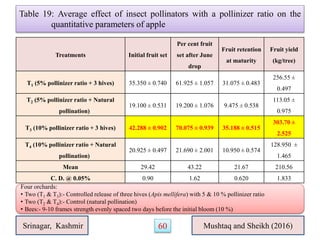
59
Treatments Initial fruit set
Per cent fruit
set after June
drop
Fruit retention
at maturity
Fruit yield
(kg/tree)
T1 (5% pollinizer ratio + 3 hives) 35.350 ± 0.740 61.925 ± 1.057 31.075 ± 0.483
256.55 ±
0.497
T2 (5% pollinizer ratio + Natural
pollination)
19.100 ± 0.531 19.200 ± 1.076 9.475 ± 0.538
113.05 ±
0.975
T3 (10% pollinizer ratio + 3 hives) 42.288 ± 0.902 70.075 ± 0.939 35.188 ± 0.515
303.70 ±
2.525
T4 (10% pollinizer ratio + Natural
pollination)
20.925 ± 0.497 21.690 ± 2.001 10.950 ± 0.574
128.950 ±
1.465
Mean 29.42 43.22 21.67 210.56
C. D. @ 0.05% 0.90 1.62 0.620 1.833
Table 19: Average effect of insect pollinators with a pollinizer ratio on the
quantitative parameters of apple
Mushtaq and Sheikh (2016)
Srinagar, Kashmir
Four orchards:
• Two (T1 & T3):- Controlled release of three hives (Apis mellifera) with 5 & 10 % pollinizer ratio
• Two (T2 & T4):- Control (natural pollination)
• Bees:- 9-10 frames strength evenly spaced two days before the initial bloom (10 %)
60
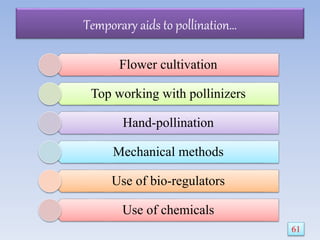
Temporary aids to pollination…
Flower cultivation
Top working with pollinizers
Hand-pollination
Mechanical methods
Use of bio-regulators
Use of chemicals
61
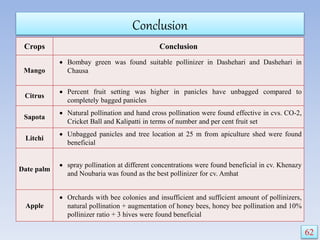
Conclusion
62
Crops Conclusion
Mango
 Bombay green was found suitable pollinizer in Dashehari and Dashehari in
Chausa
Citrus
 Percent fruit setting was higher in panicles have unbagged compared to
completely bagged panicles
Sapota
 Natural pollination and hand cross pollination were found effective in cvs. CO-2,
Cricket Ball and Kalipatti in terms of number and per cent fruit set
Litchi
 Unbagged panicles and tree location at 25 m from apiculture shed were found
beneficial
Date palm
 spray pollination at different concentrations were found beneficial in cv. Khenazy
and Noubaria was found as the best pollinizer for cv. Amhat
Apple
 Orchards with bee colonies and insufficient and sufficient amount of pollinizers,
natural pollination + augmentation of honey bees, honey bee pollination and 10%
pollinizer ratio + 3 hives were found beneficial
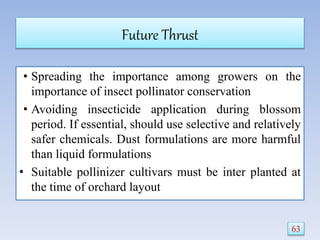
Future Thrust
• Spreading the importance among growers on the
importance of insect pollinator conservation
• Avoiding insecticide application during blossom
period. If essential, should use selective and relatively
safer chemicals. Dust formulations are more harmful
than liquid formulations
• Suitable pollinizer cultivars must be inter planted at
the time of orchard layout
63
Pollination and pollinizer effects on fruit crops

Pollination and pollinizer effects on fruit crops

  • 2.
    Pollination and pollinizerproblems in fruit crops and their control Parmar VijayKumar K. Ph.D (5th semester) Department of Vegetable Science College of Horticulture Jagudan- 382710 Major Guide Dr. Piyush Verma Associate professor & Head Dept. of Horticulture C. P. College of Agriculture, S.D.A.U. Minor Guide Dr. R. K. Jat Assistant professor & Head Dept. of Fruit Science College of Horticulture, Jagudan. Course: VSC 692 2
  • 3.
    Contents Factors affecting pollination Whatis pollination Introduction Future thrust Conclusion Temporary aids to pollination Review of research work 3
  • 4.
    Introduction  India beingthe second largest producer of fruits in the world and its productivity per unit area compared with developed countries is quite low  There are many factors responsible for lowering the fruit crop production viz. unfruitfulness, alternate bearing, fruit drop, biotic and abiotic stresses, specific chronic problems, etc. in which pollination and pollinizers problems is also of great concern  Pollination is one of the most critical, complex and less understood subject in fruit production  Adequate pollination is mandatory for most of fruit crops except in mangosteen, pineapple and banana 4
  • 5.
    What is pollination……? “Process of transfer of pollen grain from an anther to the stigma of the same or different flower”  It includes all events starting from maturation of anthers to the division of zygote  Camerarius (1694) was the first to establish that pollination is essential for the production of seeds, which proved the existence of sexuality in plants 5
  • 6.
    ways of pollination Twoways: 1) Self-pollination i. Autogamy ii.Geitonogamy 2) Cross-pollination 6 Mechanisms of Self-pollination I. Cleistogamy e.g. grapes and guava II. Homogamy e.g. Some spp. of citrus, peach and apricot
  • 7.
    Mechanisms of Cross-pollination I.Dicliny viz. monoecy e.g. banana and mango and dioecy e.g. date palm and papaya II. Dicogamy viz. protandry e.g. walnut, coconut, macadamia nut etc. and protogyny e.g. fig, annonaceous fruits, pomegranate, avocado etc. Monoecy in Banana Dioecy in Papaya 7
  • 8.
    III. Heterostyly e.g.litchi, carambola, almond, pomegranate and sapota IV. Incompatibiltiy viz. self-incompatibility e.g. avocado, fig, mango, citrus, olive, aonla etc. and cross-incompatibility e.g. Loquat, plums etc. V. Pollen sterility e.g. triploid apple varieties like Bramley’s Seedling, Blenheim Orange, etc. and pear variety Beurre- De-Amanlis 8
  • 9.
    Criteria/stages for successfulpollination to occur • The availability of an adequate source of viable and compatible pollen • The pollinating agents must effectively transfer the pollen to the stigma • The stigma must be receptive • There must be sufficient growth of pollen tube • The double fertilization must take place adequately for the development of embryo and endosperm Note: If there is hindrance or deficiency at any stage in between, it would result in poor fruit-set and ultimately a total loss of the crop 9
  • 10.
    Factors Affecting Effective pollination Pollinizers Plantingplans Spacing of pollinizers Management of pollinizers Pollinators Climatic factors 10
  • 11.
  • 12.
    I. Pollinizers  Itis particularly important in fruit crops. That show the mechanism of self incompatibility, self-sterility or cross- incompatibility. Such phenomena are quite prevalent in some fruit plants like ber, aonla, loquat, mango and lemons  In mango and citrus, there is false set due to improper pollination, which drops off in the later stages  In date palm, at least 4 to 5 male plants are required for pollination of 100 female plants 12
  • 13.
    Characteristics required foran ideal pollinizer • Plenty of viable pollens • Compatible pollen with the main cultivar • Synchronization of flowering with main cultivar • Regular and prolific bearer • Bearing at the same age as that of the main variety • Free from major insect-pests and diseases • Adaptable to the agro climatic region, where main cultivars grow well 13
  • 14.
    II. PLANTING PLANS:The pollinizer trees should be well distributed in the orchard. Several planting plans are being adopted. The important ones provide 11, 15, 25 and 33 per cent pollinizers. The proportion of pollinizer in an orchard depends upon the activity of bees (No. of hives/ha), type of main cultivar (early, mid or late) and type of the pollinizer III. SPACING POLLINIZERS : In close planting, every tenth tree should be a pollinizer. In wider plantations of apple atleast every fourth tree should be a pollinizer. For better, results multiple source of pollens is better than single source IV. MANAGEMENT OF POLLINIZERS: In standard wide spaced plantings, the pollinizers should be managed in central leader system of training. Pole type pollinizers can be most advantageous in high density or close plantings 14
  • 15.
    V. pollinators o Inself-pollination, no pollinators are required for the transfer of pollen grains from anther to stigma. However, effective pollinators are required for this purpose in cross-pollinated fruit crops o The mature pollen grains are disseminated by various pollinators like insects, winds, birds and water o However, it is not always true that one pollinator is fully responsible for pollen transfer in a particular fruit species. It is likely that two or more pollinators may work togather at one time o Pollinators such as bees, birds and bats contribute to 35 per cent of the world’s crop production, increasing outputs of 87 % of the the leading food crops worldwide (FAO, 2009) 15
  • 16.
    Climatic Factors • Temperatureeffects the pollination period and bee activity • High temperature reduces flowering periods while low temperature during anthesis prolongs flowering • Percentage of hermaphrodite flowers found to decrease due to low temperature and humidity (60-70%) • Rainfall reduces bee flight, washes of stigmatic secreations and in turn affect pollination VI 16
  • 17.
    1) Entomophilous  “Thepollination by insects”  It involves many species of honey bees viz. A. cerana indica (Indian/Asian bee), A. florea (dwarf or red dwarf bees), A. dorsata (giant bees), A. andreniforms (black dwarf bees), A. laboriosa (himalayan bees) and an introduced one A. mellifera (western bees)  In addition, several other pollinators including stingless bees, carpenter bees, bumble bees, megachilids, andrenids, syrphids etc in several agroecosystems  The fruit crops pollinated entomophilously are apple, pear, peach, plum, almond, apricot, cherries, ber, litchi, citrus, mango, annonaceous fruit crops 17 Pollinators of fruit crops
  • 18.
    2) Anemophilous • Windacts as a pollinating agent • Pecan nut, hazelnut, chestnut, papaya, date palm, coconut, pomegranate, cashewnut, sapota etc are wind pollinated fruit crops 3) Ornithophilous • Pollination carried out by birds • Most bird pollinated flowers are red and have a lot of nectar also tend to be unscented • Humming birds (Phaethornis longirostris) are the most effective bird pollinators eg. Banana and pineapple 18
  • 19.
    4) Hydrophilous • Pollinationwhere by pollen is distributed by the flow of waters, particularly in rivers and streams eg. water chestnut 5) Man-pollination • The pollination carried out manually by hand pollination eg. Date palm 6) Chiropterophily • The pollination by bats • The banana bat (Musonycteris harrisoni) is a nectarivorous species found only on the Pacific Coast of Mexico. It has a very small geographic range and is distinguishable by its extremely long nose 19
  • 20.
    Role of pollinatorsand pollinizers • Pollinators and pollinizers play important role in pollination of fruit crop species for sustaining the crop diversity and production systems. • Many fruit crops such as ber, aonla, pomegranate, fig, citrus, beal, jamun etc. require insect pollinators for efficient pollination to gain the higher yield. • The pollinators and pollinizers increase quantitative and qualitative traits of fruit crop production. 20 20
  • 21.
    Honeybee: a mosteffective pollinator  Honey bees are considered to be the most effective pollinators because of following characteristics: • Their body parts are modified in a way to pick up maximum possible pollen • Can work for long hours • Can work even under adverse climatic conditions • Adaptable to different and difficult climates • Large build up of population • Can visit flowers up to a radius of 5-6 kilometers 21
  • 22.
    • The numberof colonies to be required for effective pollination in an orchard depends on planting density, duration of flowering, strength of bee colonies and availability of flowers per unit area • In general, two colonies of A. mellifera and three colonies of A. cerana indica per hactare of crop in flowering season are recommended for effective pollination • Along with honeybees, butterflies, houseflies, some species of wasp, bumble bees, syrphid flies etc. are also known to help in pollination 22
  • 23.
    Crop Increase in fruit set(%) Increase in fruit weight (%) Increase in fruit size (Length, Diameter) (%) References Apple 10 33 15, 10 Verma and Dulta, 1998 Peach 22 44 29, 23 Partap et al., 2000 Plum 13 39 11, 14 Partap et al., 2000 Citrus 24 35 9, 35 Partap, 2000 Strawberry 112 48 Misshapen fruits decreased by 50 percent Partap, 2000 (Source: Verma and Dulta, 1987; Partap et al., 2000) Impact of honeybee pollination on fruit productivity 23 Species: Apis Cerana indica
  • 24.
    Mango  Mode ofpollination: Cross-pollination  Potential pollinators: House flies and honey bees  Problems in pollination: • Availability of very small quantity of pollen • No. of pollen grains per pollinated flower in nature is very low (less than 3/flower) • The pollen grains soon become dry, dust like and lost their sticky character • Presence of self incompatibility i.e. Dashehari, Langra and Chausa • Presence of cross incompatibility eg.: Dashehari is cross incompatible with Chausa and Safeda Malihabad 24
  • 25.
    • Presence ofhigher sex ratio • Late flushes produce plenty of pollen than early flushes  Suggestion for successful pollination: • Placement of bee colonies in mango plantations • Planting of suitable pollinizers • Recommended pollinizers are  Bombay Green for Dashehari  Dashehari for Chausa and Langra 25
  • 26.
    papaya  Mode ofpollination: Cross-pollination  Potential pollinators: Wind and small insect  Problems in pollination: • Dioecious in nature • Unattracted flowers • Long narrow corolla tube of the male flower • The appearance of sex reversion • The rare appearance of self-incompatibility • Lack of basic knowledge of various types of changes in flower • Lack of morphological markers to identify the sex at nursery stage 26
  • 27.
     Suggestion forsuccessful pollination: • The problem of self-incompatibilty due to heterostyly may be alleviated by pollinating the flowers with pollen from the male flowers that are produced on andromonoecious trees • Honeybees, thrips, hawk moths and apparently also mosquitoes have been reported as pollinators of papaya • In dioecious varieties, 10-12% male plants in the orchard population are required for proper pollination • Wind pollination is also important 27
  • 28.
    Citrus  Mode ofpollination: Both self and cross-pollination  Potential pollinators: Honeybees  Conditions favourable for self pollination: • Stigma is very closely surrounded by the stamens • Hairs on the stigma provides a medium for pollen germination and assists in trapping of pollen 28
  • 29.
     Problems inpollination: • The cultivars in which more acute pollination problem exits are primarily either completely or partially incompatible • Production of non viable pollen in some cultivars like Washington Navel Orange, Satsuma mandarin and Bearss lime • Besides, a number of citrus cultivars are self- incompatible and some are cross incompatible and complete self sterile  Suggestion for successful pollination: i. Introduction of honeybee colonies (1-2 hives/ha) ii. Inter planting of 10-15% pollinizers 29
  • 30.
    Sapota  Mode ofpollination: Cross-pollination  Potential pollinators: Wind, thrips and honeybees  Problems in pollination: • Higher temperatures (above 400 C) during flowering in summer months • Self sterility, heterostyly and protendry conditions • High degree of self incompatibility in ‘Cricket ball’ and ‘oval’ cultivars when selfed 30
  • 31.
    Litchi  Mode ofpollination: Self fruitful but cross-pollination beneficial  Potential pollinators: Honeybees, flies, Wasp and Houseflies  Problems in pollination: • Although litchi produces flowers in abundance, the ultimate fruit set is very low eg.: In Indian conditions only 1.6% female flowers set fruits. However in Florida, the early set is high and followed by an excessive fruit drop • This drop is mainly due to failure of fertilization or embryo abortion • Only staminate flowers produce viable pollen • 4-5 hives/ha are recommended for success in litchi pollination 31
  • 32.
    Custard apple  Modeof pollination: Cross-pollination  Potential pollinators: Wind and honeybees  Problems in pollination:  Protogynous dichogamy nature  Poor pollen germination  Compound nature of pollen grains having thick exine  In India the peak flowering coincide with summer season,  High temperature (40 ºC)  Very low humidity  Dessicating winds  Dry condition of the soil, which impairs pollen viability and stigmatic receptivity  Hand pollination is the best alternative for better fruit set and yield in annonaceous fruits 32
  • 33.
    Ber  Mode ofpollination: Self fruitful but cross-pollination recommmended in some cultivars  Potential pollinators: Yellow wasps, honeybees, houseflies and Trigona spp.  Problems in pollination: • Self incompatibility in some cultivars eg.: Mundia, Murhara, Banarasi karaka and Safed Umran • High pollen sterility (90.5%) due to polyploidy in some cultivars. • Very short life span of individual flower and short receptivity period.  Suggestion for successful pollination: • Planted adequate number of compatible cultivars in the orchard • Placement of bee colonies in the ber orchard 33
  • 34.
    Aonla  Mode ofpollination: Cross-pollination  Potential pollinators: Wind, houseflies and wasps  Problems in pollination: • Monoecious in nature • Presence of self incompatibility. eg. Banarasi and Chakaiya • High sex ratio (female to male ratio) is 308:1 to 197: 1  Suggestions for successful pollination: • Inter planting of 2-3 compatible cultivars • Best pollinizers are  Banarasi and Francis for Chakaiya  NA-6 and Krishna for NA-7 34
  • 35.
    Date palm  Modeof pollination: Cross-pollination (dioecious)  Potential pollinators: Mostly wind and rarely insects  Problems in pollination: • High relative humidity during flowering causes damage to pollen grains. Whereas high temperature induces poor pollen germination.  Successful pollination depends upon  Pollination time  Flowering period of male and female palm  Female flowers receptivity  Type of pollen and its viability • Artificial pollination by using electrical pollen duster and pollen grain suspensions spraying is the best for commercial cultivation. 35
  • 36.
    Pollination in datepalm by pollen grain suspensions spraying machine 36
  • 37.
    Selection of maleplants for traditional pollination:  Thick and bushy inflorescence with large number of male strands  The male strands should have abundance of pollen (release of abundance of yellowish dust on shaking)  Select the early emerged male flowers to pollinate early emerged female flowers. Bushy male inflorescence Collection of male strands Male strands Insertion of male strands Tying of female inflorescence Electrical pollen duster 37
  • 38.
    Apple  Mode ofpollination: Cross-pollination  Potential pollinators: Honey bees and bumble bees  Problems in pollination: • Apple produces abundant bloom, but fail to set fruits due to lack of pollination, as most of its commercial cultivars are self-unfruitful. • Some varieties are partially self fruitful • Sterility and incompatibility have been reported to be the two major causes of unfruitfulness • In addition, flower structure, pollinators and weather conditions also play a vital role in affecting pollination and fruit set in apple 38
  • 39.
     For successfulpollination in apples • Planted adequate proportion of pollinizers (33%) • In general, 2-3 pollinizing varieties placed in an orchard • Placement of bee colonies (2-3 bee hives/ha) • The population of bees should be high during effective pollination period 2 to 10 days depending on the cultivars and temperature. 39
  • 40.
    Planting plans forpollinizers in apple orchard 40
  • 41.
  • 42.
    Table 1: Impactof self and cross-pollination on ultimate fruit retention in mango cv. Dashehari Treatments Year Per cent fruit retention after anthesis/ pollination (days after) 21 28 35 60 90 105 Dashehari (unpollinated) 1 0.00 0.00 0.00 0.00 0.00 0.00 2 0.00 0.00 0.00 0.00 0.00 0.00 3 0.00 0.00 0.00 0.00 0.00 0.00 Dashehari (ɵ) 1 34.40 8.40 2.20 0.80 0.00 0.00 2 40.34 19.01 6.77 0.00 0.00 0.00 3 17.69 17.69 16.77 0.00 0.00 0.00 Dashehari (X) 1 48.40 21.20 0.60 0.00 0.00 0.00 2 61.34 36.58 5.14 0.00 0.00 0.00 3 5.34 5.34 5.34 0.00 0.00 0.00 Dashehari x Chausa 1 30.50 22.30 9.90 0.00 0.00 0.00 2 49.43 35.92 11.91 0.00 0.00 0.00 3 10.35 8.51 8.51 0.00 0.00 0.00 Dashehari x Safeda Malihabad 1 52.80 36.00 3.60 1.20 0.00 0.00 2 57.52 45.68 17.27 0.00 0.00 0.00 3 9.17 7.41 7.36 0.00 0.00 0.00 Dashehari x Seedling 2 61.65 45.93 13.29 3.25 3.25 0.00 Dashehari x Langra 1 28.40 24.00 9.62 2.70 1.70 1.72 2 49.24 42.41 13.04 1.63 1.63 1.63 3 8.40 4.66 4.66 3.69 1.85 1.85 Dashehari x Rataul 2 43.05 33.56 13.13 3.93 3.93 3.93 Dashehari x Bombay Green 1 36.00 20.05 18.55 10.20 8.21 8.23 2 49.40 33.82 14.55 7.18 7.18 7.18 3 26.00 24.03 22.57 13.46 9.53 9.53 C. D. at 5% 2 9.19 9.68 6.64 4.12 4.12 3.65 3 7.04 7.21 7.39 3.90 3.90 4.00 Pantnagar, Uttarakhand Sant Ram et al. (2006) 25 years old six trees 42
  • 43.
    Table 2: Impactof self and cross-pollination on ultimate fruit retention in mango cv. Chausa Treatments Year Per cent fruit present after anthesis/ pollination (days after) 15 20 25 30 35 40 60 90 Chausa (unpollinated) 1 - - - - - - - - 2 40.98 25.44 6.50 0.00 0.00 0.00 0.00 0.00 3 - - - - - - - - Chausa (ɵ) 1 41.60 29.80 6.40 5.00 3.10 0.44 0.00 0.00 2 41.73 36.10 18.55 9.73 3.93 0.44 0.00 0.00 3 41.65 33.20 2.65 2.65 2.65 0.99 0.00 0.00 Chausa (X) 1 17.20 14.80 8.40 1.80 7.20 6.50 0.00 0.00 2 23.07 21.02 2.30 1.62 1.62 0.00 0.00 0.00 3 20.10 17.80 15.01 13.71 13.10 12.49 0.00 0.00 Chausa X Bombay Green 1 44.10 33.50 12.15 3.72 3.80 3.40 0.00 0.00 2 44.77 36.71 16.94 1.62 1.62 0.00 0.00 0.00 3 43.20 30.00 8.14 7.00 6.91 6.81 0.00 0.00 Chausa x Rataul 2 34.95 28.56 9.71 7.10 6.74 6.44 1.42 0.00 Chausa X Langra 1 36.00 30.50 17.72 12.20 11.52 9.74 4.42 1.95 2 43.35 35.30 25.28 18.64 15.19 13.22 7.38 3.25 3 30.00 25.50 9.71 7.10 6.74 6.44 1.42 0.97 Chausa X Seedling 2 45.46 37.54 27.92 20.95 15.93 10.70 3.25 3.25 Chausa X Safed Malihabad 1 76.40 48.40 16.60 5.60 9.25 7.00 1.20 1.20 2 56.22 38.82 25.28 17.74 12.44 7.98 2.30 2.30 3 66.72 43.00 7.47 6.19 6.19 6.19 0.71 0.71 Chausa X Dashehari 1 44.80 34.00 12.20 2.80 15.05 12.00 8.50 6.79 2 40.48 36.94 22.71 16.94 14.55 10.59 10.02 8.39 3 42.50 35.50 13.80 16.20 15.63 15.07 6.92 5.29 C. D. at 5% 2 9.85 6.08 6.01 6.50 4.83 4.08 3.63 3.09 3 N. S. N. S. 4.40 4.34 4.24 3.99 3.25 2.91 Pantnagar, Uttarakhand Sant Ram et al. (2006) 25 years old six trees 43
  • 44.
    Table 3: Impactof self and cross-pollination on ultimate fruit retention in mango cv. Langra Treatments Per cent fruit retention after anthesis/ pollination (days after) 25 35 45 55 65 Langra (unpollinated) 3.00 0.00 0.00 0.00 0.00 Langra (ɵ) 0.33 0.00 0.00 0.00 0.00 Langra X Safeda Lacknow 2.00 0.00 0.00 0.00 0.00 Langra x Safeda Malihabad 4.33 0.33 0.00 0.00 0.00 Langra x Chausa 4.33 0.33 0.30 0.00 0.00 Langra x Farzi 3.66 0.33 0.20 0.10 0.00 Langra x Totapuri 1.66 0.33 0.30 0.00 0.00 Langra x Rataul 2.00 0.33 0.00 0.00 0.00 Langra x Dashehari 14.00 4.66 3.66 3.08 2.66 Langra x Bombay Green 4.33 1.66 1.66 1.06 1.00 Pantnagar, Uttarakhand Sant Ram et al. (2006) 25 years old six trees 44
  • 45.
    Table 4: Male,Hermaphrodite flowers, sex ratio, pollen viability and per cent fruit set in various cultivars of lemons (C. lemon Burm) Lemon cultivars Per cent of flowers/ shoot Sex ratio Pollen viability (%) Per cent fruit set Male Hermaphrodite Male :Hermap- hrodite Open bagged Baramasi 20.49 79.51 0.26 : 1 77.5 18.3 - Kagzi Kalan 14.51 85.42 0.17 : 1 70.6 5.20 - Seedless lemon 76.24 23.76 3.21 : 1 84.5 2.07 - Bhadri Lemon 70.11 29.89 2.35 : 1 59.9 8.03 2.57 Eureka 73.85 26.15 2.82 : 1 88.4 8.4 - C. D. at 5% 16.86 15.64 2.888 11.41 - - H. A. U., Haryana Arora and Daulta (2001) Sixteen plants of 12 years age each 45
  • 46.
    Fruit Characteristics Treatments Uncovered Covered Numberof fruit 23.0a 17.0b Weight (g) 180.21a 168.50b Height (cm) 7.20a 7.00a Diameter (cm) 6.80a 6.80a Pulp thickness (mm) 4.82a 4.75a Juice (%) 45.09a 45.52a Acidity (g citric acid/100 g juice) 1.164b 1.411a Total soluble solids (º Brix) 11.43a 11.18a Number of seeds per fruit 8.1a 8.2a Number of seeds per bud 1.0a 0.8b Table 5: Impact of honey bee attractancts and pollination in Sweet Orange (Citrus sinensis L. Osbeck, var. Pera-rio) Brazil Malerbo- Souza et al. (2004) Average followed by different letters on the same line were significantly (P < 0.05) 46 Compounds bee-here, eugenol, geraniol, citral and lemon grass extract @ 0.2% (2 ml of extractant for 1 litre of sugar syrup or water )
  • 47.
    Table 6: Impactof pollinators on fruit setting in citrus Sr. No. Bagged panicles (Tc) Unbagged panicles (To) % fruit set in bagged panicles (Tc) % fruit set in Unbagged panicles (To) Tree 1 0.8 1.2 8.0 12.0 Tree 2 0.8 1.08 8.0 10.8 Tree 3 0.2 0.84 2.0 8.4 Tree 4 0.64 0.88 6.4 8.8 Tree 5 0.12 0.72 1.2 7.2 Sem± 0.747 2.920 Pantnagar, Uttarakhand Phartiyal et al. (2012) Average fruit set/five panicles 12 insect species visited citrus flowers: 5 spp.- Hymenoptera and Diptera (each) and 2 spp.- Lepidoptera 47
  • 48.
    Table 7: Numberof fruit set and per cent fruit set by different pollination in sapota Mode of pollination Flower buds observed pollinate d of each cultivar CO-2 Cricket ball Kalipatti No. of fruit set Fruit set (%) No. of fruits set Fruit set (%) No. of fruit set Fruit set (%) Natural pollination (open pollination) 928 167 17.99 62 11.43 205 26.4 542 787 Self pollination (by bagging) 50 2 4 0 0 2 Hand self pollination 50 7 14 5 10 9 18 Hand cross pollination 50 17 34 15 30 22 44 Emasculation for parthenocarpy 50 0 0 0 0 0 0 48 Mulla and Desle (1990) M. P. K. V., Rahuri
  • 49.
    Table 8: Baggingeffect on the average fruit set in litchi Fruit crop Per cent fruit set C. D. at 5% Bagged panicle (Tc)* Unbagged panicle (To)** Litchi (2007) 0.44 39.68 0.433 Litchi (2008) 0.38 38.38 0.255 G.B.P.U.A.T., Utarakhand Usha Srivastva and Khan (2010) 49 11 insect species 5 spp.: Hymenoptera- 12.5% Apinae (Apis spp.) and 4.56% Melliponinae (Trigona spp.) 5 spp.: Diptera (21.60%) (Syrphid spp., Musca Spp.) 1 spp.: Coleoptera (0.001%) (Lady bird beetles) * Tc – Completely closed panicles and **To – Completely opened panicles
  • 50.
    Table 9: Effectof pollination by Apis mellifera on number of flowers per panicle, per cent fruit set, mass of fruits per panicle and fruit yield of litchi cv. Shahi Treatment Total no. of flowers/panicle Fruit set (%)* Mass of fruits/ panicle (g) Fruit yield (kg/tree) Fruit yield (t/ha) T1 - Trees located at 25 m from apiculture shed 1337.8 1.68 (23) 442.2a 63.80a 9.18a T2 - Trees located at 250m from apiculture shed 1230.4 1.38 (17) 334.0b 48.14b 6.93b T3 - Trees located at 500m from apiculture sheds 1190.8 1.41 (17) 338.0b 50.20b 7.23b T4 - A selected farmers. orchard distantly located (25 km away) having no A. mellifera or other bees colonies/hives in the near vicinity 993.4 1.03 (10) 204.0d 28.76d 4.14d T5 - pollination under controlled conditions in insect proof nylon net cage having only one A. mellifera bee colony placed inside 1084.4 1.23 (14) 276.0c 38.92c 5.60c T6 - Contol 1001.8 0.01 (01) 0.2 1.00 0.01 C. D. (P = 0.05) - - 31.41 6.11 0.88 SE (m) ± - - 4.09 1.04 0.11 50 Kumar And Kumar (2014) Muzzaffarpur, Bihar *Value in parenthesis is no. of fruits per panicle. Means followed by same alphabets in a column do not differ significantly 10 years age
  • 51.
    Treatment Fruit set(%) Bunch weight (kg) Yield (kg/tree) Traditional pollination 63.6c 6.68b 46.8b Spray pollination at: 0.5 g/l 71.1b 8.22a 57.5a 1.0 g/l 76.1b 8.43a 59.0a 1.5 g/l 81.6a 8.80a 61.6a 2.0 g/l 81.6a 8.33a 58.3a F- test *** ** ** LSD at 5% 5.1 1.07 7.5 Table 10: Fruit set, bunch weight and total yield per tree at the commercial harvest period of ‘Khenazy’ date palm as affected by pollination method Awad (2010) El- Mansoura, Egypt Four palms of 23 years age each Data are the mean of 2009 and 2010 seasons. ** and ***, significant at level p= 0.01 and 0.001, respectively 51
  • 52.
    Table 11: Effectof different pollination methods on pollination time and amount of pollen used Awad (2010) El- Mansoura, Egypt Data are the 2010 season. ***, significant at level P =0.001 52 Pollination method Pollination time (min./palm) Amount of pollen (g/palm) Spray 9.5a 0.35a Traditional 16.3b 0.78b F-test *** ***
  • 53.
    Table 12: Effectof different pollination techniques on fruit setting percentage of date palm cv. Dhakki Pollination Techniques Fruit setting percentage (%) 2001 2002 Control (Natural Pollination) 26.1 41.2 Dusting of Pollens 81.3 52.0 Placement of male spathe 89.3 88.9 Liquid Spray of Pollens 69.3 64.1 LSD 2.8 21.8 LSD: Least Significant Difference at 5% probability Iqbal et al. (2010) Pakistan Four palms of 20 years each 53
  • 54.
    Pollinizer Fruit set (%) Fruitretention (%) Bunch weight (kg) Yield (kg/palm) 2012 2013 2012 2013 2012 2013 2012 2013 Noubaria 86.0a 85.3a 57.0a 62.0a 18.9a 20.3a 151.2a 162.1a Aswan 69.2c 70.3d 50.0d 52.3d 13.7e 15.3e 109.9e 122.3e Giza 80.3b 79.7b 55.7ab 60.3b 18.2b 19.5b 145.3b 155.7b Rashid 80.0b 80.3b 52.7c 57.0c 16.4c 17.3c 131.5c 137.7c New valley 69.6c 73.0c 54.0bc 56.7c 15.4d 16.2d 123.5d 129.6d Significance S S S S S S S S Table 13: Effect of different pollinizer sources on fruit set, fruit retention, bunch weight and yield per palm of date palm cv. Amhat Giza, Egypt Mustafa et al. (2014) 30 years age palms 54
  • 55.
    Table 14. Effectof different time of pollination on yield components and fruit characters of date palm cv. Barhee (Pool data) Treatments Fruit retention percentage No. of Fruits/bunch Yield (kg/palm) Fruit weight (g) TSS (ºBrix) T1 – (6 to 8 hr.) 45.51b (50.91) 35.52c (1265.58) 125.22cd 11.88 30.33 T2 - (8 to 10 hr.) 50.31a (59.20) 40.04ab (1610) 159.92a 11.62 30.66 T3 - (10 to 12 hr.) 52.09a (62.20) 40.78a (1671.50) 160.24a 12.94 31.00 T4 - (12 to 14 hr.) 51.22a (60.72) 38.61b (1493) 144.18ab 11.27 29.66 T5 - (14 to 16 hr.) 50.54 (59.58) 38.67ab (1505) 141.23bc 11.93 30.60 T6 - (16 to 18 hr.) 46.83b (53.22) 33.78c (1142) 107.82d 11.31 1.46 C. D @ 5% 2.95 2.13 17.51 NS NS C.V % 6.43 6.33 12.92 11.62 8.27 Sharma et al. (2019) Mundra, Gujarat 55
  • 56.
    Table 15: Percent fruit set in apple orchards with and without bee colonies having sufficient (> 15%) and insufficient (< 15%) pollinizer proportion Location Polliniser proportion Fruit set (%) 2000 2001 With bee colonies Without bee colonies With bee colonies Without bee colonies Seobagh Insufficient 25.09 (18.0)* 11.53 (4.0) 15.83 (7.5) 8.07 (2.0) Sufficient 42.11 (45.0) 25.09 (18.0) 31.92 (28.0) 17.93 (9.5) Larankelo Insufficient 30.31 (25.5) 13.53 (5.5) 25.09 (18.0) 11.53 (4.0) Sufficient 33.50 (30.5) 21.53 (13.5) 42.11 (45.0) 25.09 (18.0) C. D. at 5% 1.10 56 * The figure in the parenthesis are actual yeild, whereas another are arc sine transformed values Sharma et al. (2004) Y. S. P. U. H. F., H. P.
  • 57.
    Treatments Weight of Fruit (g) % increase overcontrol % increase over natural pollination Pollination by honey bees only 100.41b 28.22% Natural pollination + augmentation of honey bees 166.19a 112.13% Natural pollination 116.63b 42.53% Control (No pollination) 78.31c Table 16: Effect of pollination by honey bees (Apis mellifera L.) on average weight of apple Different letters indicate significant differences among the means (P >0.05) LSD = 21.50 Khan et al. (2012) Faisalabad, Pakistan Three plants ≈ plant size 57 48.83%
  • 58.
    Table 17: Effectof pollination by honey bees (Apis mellifera L.) on average number of apple fruit setting per panicle Treatments Number of Fruits % increase over control % increase over natural pollination Pollination by honey bees only 1.167c 250.45% Natural pollination + augmentation of honey bees 5.167a 1451.65% Natural pollination 2.167b 550.75% Control (No pollination) 0.333d Different letters indicate significant differences among the means (P>0.05) LSD = 0.763 Three plants ≈ plant size Faisalabad, Pakistan Khan et al. (2012) 58 138.44%
  • 59.
    Variety Shilaroo Matiana Narkanda Honeybee pollinated flowers (H) Open pollinated flowers (O) NoInsect pollinator (Control) (C) Honeybee pollinated flowers (H) Open pollinated flowers (O) No Insect pollinator (Control) (C) Honeybee pollinated flowers (H) Open pollinated flowers (O) No Insect pollinator (Control) (C) Golden Delicious 28.83 18.27 15.03 27.24 16.01 14.39 20.08 17.32 15.42 Red Gold 21.19 15.41 13.24 20.32 14.83 13.43 19.21 17.54 14.87 Royal Delicious 20.02 13.21 0 19.11 13.07 0 14.89 6.24 0 Red Dielicious 18.52 11.00 0 18.01 9.45 0 14.12 6.13 0 Table 18: Percentage of fruit set in three different experimental designs in apple • For honey bee pollination two colonies(one Apis cerana and one Apis mellifera) with 7 frames each were placed inside the net • Each percentage is an average of ten observations • For S. E. Standard error about the mean • For fruit set: H > O > C (P < 0.01) Mattu and Hem Raj (2013) Shimla., H. P 59
  • 60.
    Treatments Initial fruitset Per cent fruit set after June drop Fruit retention at maturity Fruit yield (kg/tree) T1 (5% pollinizer ratio + 3 hives) 35.350 ± 0.740 61.925 ± 1.057 31.075 ± 0.483 256.55 ± 0.497 T2 (5% pollinizer ratio + Natural pollination) 19.100 ± 0.531 19.200 ± 1.076 9.475 ± 0.538 113.05 ± 0.975 T3 (10% pollinizer ratio + 3 hives) 42.288 ± 0.902 70.075 ± 0.939 35.188 ± 0.515 303.70 ± 2.525 T4 (10% pollinizer ratio + Natural pollination) 20.925 ± 0.497 21.690 ± 2.001 10.950 ± 0.574 128.950 ± 1.465 Mean 29.42 43.22 21.67 210.56 C. D. @ 0.05% 0.90 1.62 0.620 1.833 Table 19: Average effect of insect pollinators with a pollinizer ratio on the quantitative parameters of apple Mushtaq and Sheikh (2016) Srinagar, Kashmir Four orchards: • Two (T1 & T3):- Controlled release of three hives (Apis mellifera) with 5 & 10 % pollinizer ratio • Two (T2 & T4):- Control (natural pollination) • Bees:- 9-10 frames strength evenly spaced two days before the initial bloom (10 %) 60
  • 61.
    Temporary aids topollination… Flower cultivation Top working with pollinizers Hand-pollination Mechanical methods Use of bio-regulators Use of chemicals 61
  • 62.
    Conclusion 62 Crops Conclusion Mango  Bombaygreen was found suitable pollinizer in Dashehari and Dashehari in Chausa Citrus  Percent fruit setting was higher in panicles have unbagged compared to completely bagged panicles Sapota  Natural pollination and hand cross pollination were found effective in cvs. CO-2, Cricket Ball and Kalipatti in terms of number and per cent fruit set Litchi  Unbagged panicles and tree location at 25 m from apiculture shed were found beneficial Date palm  spray pollination at different concentrations were found beneficial in cv. Khenazy and Noubaria was found as the best pollinizer for cv. Amhat Apple  Orchards with bee colonies and insufficient and sufficient amount of pollinizers, natural pollination + augmentation of honey bees, honey bee pollination and 10% pollinizer ratio + 3 hives were found beneficial
  • 63.
    Future Thrust • Spreadingthe importance among growers on the importance of insect pollinator conservation • Avoiding insecticide application during blossom period. If essential, should use selective and relatively safer chemicals. Dust formulations are more harmful than liquid formulations • Suitable pollinizer cultivars must be inter planted at the time of orchard layout 63