Immature or mixed collections 
Immature seeds (eRH typically 85- 
100%) will not yet have acquired 
maximum storage potential. With 
careful handling, they can be 
ripened until they reach maximum 
longevity. 
Mixed collections need to be 
handled in a way that allows 
immature seeds to continue 
ripening but minimises undue 
ageing of mature seeds. 
Ideally, and if time permits, divide 
mixed collections and handle 
the ripe and immature portions 
separately. 
If fruits look close to natural 
dispersal – changes in colour, fruits 
dehiscing, etc. – it is probably 
safe to dry them using one of the 
methods described above. 
When seeds don’t appear to be 
close to natural dispersal, it is safer 
to dry them slowly for 1-2 weeks, 
under natural conditions. Don’t 
remove seeds from fruits, or fruits 
from branches or stems. If ambient 
conditions are particularly dry or 
hot, you may need to slow the 
drying rate down, for example by 
enclosing the fruits in a permeable 
bag or ventilated container. 
Very immature seeds (eRH around 
100%) are not fully desiccation 
tolerant and need particular 
care as rapid drying and/or high 
temperatures may kill them. It is 
imperative that these seeds are 
given the opportunity to continue 
maturation and ripening. 
Once seeds have reached full 
ripeness treat them as other 
collections and dry them fully, as 
soon as possible. It is especially 
important to process fleshy fruits as 
soon as they are ripe as seeds left 
within ripe fleshy fruits may begin 
to age. 
Millennium Seed Bank Project, Wakehurst Place 
Ardingly, West Sussex RH17 6TN, UK 
© Copyright 2008, Board of Trustees, RBG Kew 
www.kew.org/msbp 
Post-harvest handling 
of seed collections 
Technical Information Sheet_04 Kate Gold, Seed Conservation Department 
The effort put into collecting high 
quality seeds may be wasted if you 
don’t handle collections carefully 
afterwards. By following these 
practical guidelines you will be 
able to avoid unacceptable loss of 
viability during collecting trips and 
ensure that seeds arrive at the seed 
bank in good condition. 
Are all the seeds fully ripe? 
Seed collectors should assess seed 
maturity prior to collection (see 
Technical Information Sheet_ 
02) and ideally, avoid collecting 
immature seeds. In practice, 
however, collections often contain 
a range of seed maturities, from 
seeds that have only just reached 
maximum dry weight through to 
those at natural dispersal. 
If your collection contains more than 
10% immature seeds, follow the 
guidelines overleaf for immature or 
mixed collections. 
How dry are the seeds? 
Even when seeds are fully ripe, 
their moisture status at the time of 
collection may be high enough to 
place them at risk of deterioration 
through ageing or mould. 
Technical Information Sheet_04 
Equipment specifications 
Further reading 
Probert, R.J. (2003). Seed viability 
under ambient conditions and the 
importance of drying, pp. 337-365. In: 
R.D. Smith, J.D. Dickie, S.H. Linington, 
H.W. Pritchard and R.J. Probert (eds), 
Seed Conservation: turning science into 
practice. Royal Botanic Gardens, Kew, 
UK. 
Smith, R.D. (1995). Collecting and 
handling seeds in the field, pp. 419- 
456. In: L. Guarino, R.V. Rao and R. Reid 
(eds), Collecting Plant Genetic Diversity: 
technical guidelines. Commonwealth 
Agricultural Bureaux International, 
Wallingford, UK. 
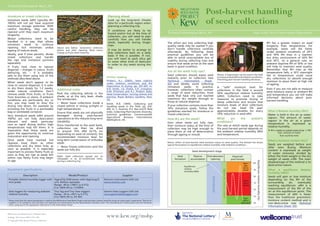
Below: Effect of post-harvest seed moisture status on seed quality. The dotted line shows 
typical fluctuations in equilibrium relative humidity with ambient conditions. 
What is Relative Humidity (RH)? 
Water is held in the air as water 
vapour. The amount of water 
vapour in the air at a given 
temperature is expressed as 
relative humidity. 
% RH = water in a given mass of air x 100 
max. amount of water 
that could be held 
What is moisture content (mc)? 
Seeds are weighed before and 
after oven drying. Moisture 
content is expressed as weight 
of water removed, divided by 
either the fresh weight or the dry 
weight of seeds x100. The main 
disadvantage of this method is its 
destructive nature. 
What is equilibrium Relative 
Humidity (eRH)? 
Seeds will gain or lose moisture 
depending on the RH of the 
surrounding air, eventually 
reaching equilibrium. eRH is a 
measurement of the RH of the 
air at this equilibrium point. The 
measurement of eRH is faster 
than the traditional gravimetric 
moisture content method and is 
non-destructive (see Technical 
Information Sheet_05). 
Planning ahead 
Look up the long-term climate 
data for a particular region when 
planning a collecting trip. 
If conditions are likely to be 
humid and/or hot at the time of 
collection, you will need to plan 
carefully how you will handle 
seeds, especially during longer 
trips. 
It may be better to arrange to 
ship collections back on a daily 
basis if this is possible. If not, 
you will need to pack silica gel 
or some other kind of desiccant 
in order to dry seeds during the 
trip. 
Additional notes 
Park the collecting vehicle in the 
shade, or at the very least, shade 
the windscreen. 
• Never leave collections inside a 
closed vehicle in strong sunlight or 
high temperatures. 
Ensure that seeds are not physically 
damaged during post-harvest 
operations as this reduces long-term 
storability. 
Once transferred to the seed bank, 
collections can then be dried 
to around 15% eRH (4-7% mc 
depending on seed oil content), the 
recommended moisture level for 
long-term conservation of orthodox 
seeds. 
• Never freeze collections until the 
seeds are fully dry. 
Description Model/Product Supplier 
Portable relative humidity logger with 
mini probe 
HygroClip SC04 sensor with HygroLog-D 
unit. Battery operated. 
Range: -40 to +100°C (± 0.3°C); 
0 to 100% RH (± 1.5%RH). 
Rotronic Instruments (UK) Ltd. 
www.rotronic.com 
Data loggers for measuring ambient 
relative humidity 
Tiny Tag and Tiny View loggers. 
Range: -30 to +50°C (± 0.2°C); 
0 to 100% RH (± 3% RH). 
Gemini Data Loggers (UK) Ltd. 
www.geminidataloggers.com 
Please note that the above equipment is used by the Millennium Seed Bank Project and has been chosen carefully using our many years’ experience. The list of 
suppliers is for guidance only and does not represent an endorsement by the Royal Botanic Gardens, Kew. The manufacturer’s instructions must be followed 
when using any of the equipment referred to in this Information Sheet. 
A “safe” moisture level for 
collections in the field is around 
50% equilibrium relative humidity 
(eRH). Collectors need to take 
measures to promote drying of 
damp collections and ensure that 
moisture levels of drier collections 
do not rise. Seed life span 
approximately doubles for every 
10% reduction in seed eRH. 
What are the ambient 
conditions? 
The rate at which seeds age during 
the post-harvest period depends on 
the ambient relative humidity (RH) 
and temperature. 
RH has a greater impact on seed 
longevity than temperature. For 
example, seeds will die faster 
under ambient conditions of 24°C 
and 70% RH than in a warmer, 
but drier, environment of 50% RH 
and 30°C. As a general rule, an 
ambient daytime RH of 50% or less 
will help to maintain seed quality. 
Remember that RH rises as the 
temperature falls; a 10°C overnight 
fall in temperature could cause 
dry collections to absorb enough 
moisture to place them at high risk 
of ageing. 
Even if you are not able to measure 
seed moisture status or ambient RH 
and temperature you can still make 
informed decisions about post-harvest 
handling. 
Above: A hygrometer can be used in the field 
to measure seed eRH and ambient conditions, 
informing post-harvest handling decisions. 
Above and below: Sansevieria collection 
before and after ripening. Note colour 
change as fruits reach maturity. 
Right: Seed collections spread out on 
newspaper in an air-conditioned room, 
during a collecting trip. 
Seed development stage 
Equilibrium relative humidity (%) 
100 
Seed 
formation 
Reserve 
accumulation 
Dispersal/ 
post-harvest 
Post-abscission 
ripening 
“Wet”: 
high 
risk of 
mould 
“Wet”: 
risk of 
ageing 
“Dry”: 
safe in 
short term 
Equilibrium 
relative 
humidity (eRH) 
Immature 
Optimum time to collect 
90 
80 
70 
60 
50 
40
Fleshy fruits 
Fleshy fruits are best kept in 
aerated plastic bags until they 
can be processed. Open the bags 
daily to avoid mould and possible 
fermentation. 
Over-ripe fleshy fruits, or those 
that have been damaged or 
crushed during collecting may 
require partial or full cleaning. 
Remove as much flesh as possible 
from the fruits, using a sieve and 
cool running water. 
Leave the seeds to air-dry on 
a fine wire mesh or thick filter 
paper before packing them into 
cloth bags. 
Allow the seeds to dry slowly 
under ambient conditions for 1-2 
weeks before transferring to seed 
bank dry-room conditions (15ºC, 
15% RH). 
Drying with desiccants 
Any hygroscopic substance (silica 
gel, dried seeds such as rice or 
maize, charcoal, etc.) can be used 
to remove moisture from seeds, 
providing that the eRH of the 
desiccant is lower than the eRH 
of the seeds. If seeds are very 
wet it is better to dry them for 2- 
3 days under ambient conditions 
before using the desiccant. This 
can be done even if the daytime 
ambient RH is relatively high (70- 
80%). 
Once the bulk water has been 
removed, transfer the seeds 
to a sealed container with the 
desiccant, allowing seed moisture 
to be reduced to a safe level 
(~30% eRH). Use a silica gel:seed 
weight ratio of 1:1 To dry seeds 
to the same level using charcoal, 
use a weight ratio of 1:3. 
Change the drying agent 
regularly to speed up drying 
time. Regenerate desiccants in 
the sun during the day and then 
use them to maintain seed drying 
at night, in sealed containers. 
Seed Maturity Stage Seed Moisture Status 
Ambient Conditions 
(daytime RH < 50%) 
“Dry” 
(daytime RH > 50%) 
“Humid” 
Immature 85 - 100% eRH Hold intact fruits under shaded, 
ambient conditions for 1-2 weeks* 
Natural dispersal 
< 50% eRH 
“Dry” 
Hold in loosely packed 
bags in a well ventilated, 
shady location. Minimise 
moisture absorption at 
night. 
Transfer to seed bank as 
soon as possible 
OR 
Dry with desiccant 
“Wet” room 
> 50% eRH 
Dry in thin layer, in well 
ventilated location. 
OR 
Place in air-conditioned 
Minimise moisture 
absorption at night. 
* Remove seeds from fleshy fruits as soon as morphological signs (e.g. fruit colour) indicate that they are 
fully ripe. Allow to dry slowly under ambient conditions before transferring to a cool dry-room. 
• Take note of the prevailing 
weather conditions - if it has 
recently rained, seeds may be 
wetter than expected. 
• Observe seed and fruit 
morphology - seeds enclosed within 
indehiscent fruits may be at a high 
moisture level. 
• Seeds which have only just 
reached the point of natural 
dispersal may be at a high moisture 
level, even if ambient conditions are 
dry and warm. 
Depending on seed moisture 
status, ambient conditions and 
seed maturity, handle collections as 
follows: 
“Dry” (<50% eRH), fully mature 
seeds 
Seeds within dehiscent fruits, 
collected in dry climatic conditions, 
may have already dried down to a 
safe level. 
If ambient conditions are 
favourable: 
• Loosely pack dry seeds in 
labelled bags and keep in a cool, 
well ventilated place. 
• Spread bags out so that air 
circulates freely and place them in 
the shade - under the vehicle may 
be a good place – until all other 
fieldwork is complete. 
• Dry seeds may need to be packed 
away at night to mimimise moisture 
absorption. 
• Similarly, if weather conditions 
change (e.g. rainfall) and ambient 
RH rises, protect collections from 
absorbing moisture. 
“Wet” (50-100% eRH), fully 
mature seeds 
Seeds which have only recently 
reached natural dispersal (especially 
if they are tightly enclosed within 
indehiscent fruits) or seeds collected 
during the rainy season will be 
within this moisture range. 
Wet seeds need to be dried as soon 
as possible. If ambient conditions 
are suitable (RH < 50%): 
• Spread seeds out in a thin layer 
on newspaper in partial shade. 
• Raise seeds off the ground if 
possible to allow air circulation. 
• Re-pack seeds at night and place 
them within the vehicle to minimise 
moisture absorption as ambient RH 
rises. 
• Make sure that the correct label 
remains with the collection during 
drying and re-packing. 
If ambient conditions are not 
suitable for drying, use a desiccant 
such as silica gel (see box). 
Alternatively, spread collections in 
a thin layer in an air-conditioned 
room. 
If none of these options is feasible, 
get the seeds back to the seed bank 
as soon as possible, where they can 
be dried to safe moisture levels. 
Right: Using dried maize to dry a seed 
collection in a sealable bucket. Some low-technology 
relative humidity indicators have 
been added to monitor the moisture level 
inside the bucket. 
Summary of recommendations for effective post-harvest handling of seeds 
Above: Fleshy Solanum fruits collected at full 
maturity. 
Below: Solanum fruits being cleaned in the 
field. The fruits are squashed in a nylon mesh 
bag to remove juice and pulp. The seeds will 
be further cleaned when they begin to dry.

Post-Harvest Handling of Seed Collections

  • 1.
    Immature or mixedcollections Immature seeds (eRH typically 85- 100%) will not yet have acquired maximum storage potential. With careful handling, they can be ripened until they reach maximum longevity. Mixed collections need to be handled in a way that allows immature seeds to continue ripening but minimises undue ageing of mature seeds. Ideally, and if time permits, divide mixed collections and handle the ripe and immature portions separately. If fruits look close to natural dispersal – changes in colour, fruits dehiscing, etc. – it is probably safe to dry them using one of the methods described above. When seeds don’t appear to be close to natural dispersal, it is safer to dry them slowly for 1-2 weeks, under natural conditions. Don’t remove seeds from fruits, or fruits from branches or stems. If ambient conditions are particularly dry or hot, you may need to slow the drying rate down, for example by enclosing the fruits in a permeable bag or ventilated container. Very immature seeds (eRH around 100%) are not fully desiccation tolerant and need particular care as rapid drying and/or high temperatures may kill them. It is imperative that these seeds are given the opportunity to continue maturation and ripening. Once seeds have reached full ripeness treat them as other collections and dry them fully, as soon as possible. It is especially important to process fleshy fruits as soon as they are ripe as seeds left within ripe fleshy fruits may begin to age. Millennium Seed Bank Project, Wakehurst Place Ardingly, West Sussex RH17 6TN, UK © Copyright 2008, Board of Trustees, RBG Kew www.kew.org/msbp Post-harvest handling of seed collections Technical Information Sheet_04 Kate Gold, Seed Conservation Department The effort put into collecting high quality seeds may be wasted if you don’t handle collections carefully afterwards. By following these practical guidelines you will be able to avoid unacceptable loss of viability during collecting trips and ensure that seeds arrive at the seed bank in good condition. Are all the seeds fully ripe? Seed collectors should assess seed maturity prior to collection (see Technical Information Sheet_ 02) and ideally, avoid collecting immature seeds. In practice, however, collections often contain a range of seed maturities, from seeds that have only just reached maximum dry weight through to those at natural dispersal. If your collection contains more than 10% immature seeds, follow the guidelines overleaf for immature or mixed collections. How dry are the seeds? Even when seeds are fully ripe, their moisture status at the time of collection may be high enough to place them at risk of deterioration through ageing or mould. Technical Information Sheet_04 Equipment specifications Further reading Probert, R.J. (2003). Seed viability under ambient conditions and the importance of drying, pp. 337-365. In: R.D. Smith, J.D. Dickie, S.H. Linington, H.W. Pritchard and R.J. Probert (eds), Seed Conservation: turning science into practice. Royal Botanic Gardens, Kew, UK. Smith, R.D. (1995). Collecting and handling seeds in the field, pp. 419- 456. In: L. Guarino, R.V. Rao and R. Reid (eds), Collecting Plant Genetic Diversity: technical guidelines. Commonwealth Agricultural Bureaux International, Wallingford, UK. Below: Effect of post-harvest seed moisture status on seed quality. The dotted line shows typical fluctuations in equilibrium relative humidity with ambient conditions. What is Relative Humidity (RH)? Water is held in the air as water vapour. The amount of water vapour in the air at a given temperature is expressed as relative humidity. % RH = water in a given mass of air x 100 max. amount of water that could be held What is moisture content (mc)? Seeds are weighed before and after oven drying. Moisture content is expressed as weight of water removed, divided by either the fresh weight or the dry weight of seeds x100. The main disadvantage of this method is its destructive nature. What is equilibrium Relative Humidity (eRH)? Seeds will gain or lose moisture depending on the RH of the surrounding air, eventually reaching equilibrium. eRH is a measurement of the RH of the air at this equilibrium point. The measurement of eRH is faster than the traditional gravimetric moisture content method and is non-destructive (see Technical Information Sheet_05). Planning ahead Look up the long-term climate data for a particular region when planning a collecting trip. If conditions are likely to be humid and/or hot at the time of collection, you will need to plan carefully how you will handle seeds, especially during longer trips. It may be better to arrange to ship collections back on a daily basis if this is possible. If not, you will need to pack silica gel or some other kind of desiccant in order to dry seeds during the trip. Additional notes Park the collecting vehicle in the shade, or at the very least, shade the windscreen. • Never leave collections inside a closed vehicle in strong sunlight or high temperatures. Ensure that seeds are not physically damaged during post-harvest operations as this reduces long-term storability. Once transferred to the seed bank, collections can then be dried to around 15% eRH (4-7% mc depending on seed oil content), the recommended moisture level for long-term conservation of orthodox seeds. • Never freeze collections until the seeds are fully dry. Description Model/Product Supplier Portable relative humidity logger with mini probe HygroClip SC04 sensor with HygroLog-D unit. Battery operated. Range: -40 to +100°C (± 0.3°C); 0 to 100% RH (± 1.5%RH). Rotronic Instruments (UK) Ltd. www.rotronic.com Data loggers for measuring ambient relative humidity Tiny Tag and Tiny View loggers. Range: -30 to +50°C (± 0.2°C); 0 to 100% RH (± 3% RH). Gemini Data Loggers (UK) Ltd. www.geminidataloggers.com Please note that the above equipment is used by the Millennium Seed Bank Project and has been chosen carefully using our many years’ experience. The list of suppliers is for guidance only and does not represent an endorsement by the Royal Botanic Gardens, Kew. The manufacturer’s instructions must be followed when using any of the equipment referred to in this Information Sheet. A “safe” moisture level for collections in the field is around 50% equilibrium relative humidity (eRH). Collectors need to take measures to promote drying of damp collections and ensure that moisture levels of drier collections do not rise. Seed life span approximately doubles for every 10% reduction in seed eRH. What are the ambient conditions? The rate at which seeds age during the post-harvest period depends on the ambient relative humidity (RH) and temperature. RH has a greater impact on seed longevity than temperature. For example, seeds will die faster under ambient conditions of 24°C and 70% RH than in a warmer, but drier, environment of 50% RH and 30°C. As a general rule, an ambient daytime RH of 50% or less will help to maintain seed quality. Remember that RH rises as the temperature falls; a 10°C overnight fall in temperature could cause dry collections to absorb enough moisture to place them at high risk of ageing. Even if you are not able to measure seed moisture status or ambient RH and temperature you can still make informed decisions about post-harvest handling. Above: A hygrometer can be used in the field to measure seed eRH and ambient conditions, informing post-harvest handling decisions. Above and below: Sansevieria collection before and after ripening. Note colour change as fruits reach maturity. Right: Seed collections spread out on newspaper in an air-conditioned room, during a collecting trip. Seed development stage Equilibrium relative humidity (%) 100 Seed formation Reserve accumulation Dispersal/ post-harvest Post-abscission ripening “Wet”: high risk of mould “Wet”: risk of ageing “Dry”: safe in short term Equilibrium relative humidity (eRH) Immature Optimum time to collect 90 80 70 60 50 40
  • 2.
    Fleshy fruits Fleshyfruits are best kept in aerated plastic bags until they can be processed. Open the bags daily to avoid mould and possible fermentation. Over-ripe fleshy fruits, or those that have been damaged or crushed during collecting may require partial or full cleaning. Remove as much flesh as possible from the fruits, using a sieve and cool running water. Leave the seeds to air-dry on a fine wire mesh or thick filter paper before packing them into cloth bags. Allow the seeds to dry slowly under ambient conditions for 1-2 weeks before transferring to seed bank dry-room conditions (15ºC, 15% RH). Drying with desiccants Any hygroscopic substance (silica gel, dried seeds such as rice or maize, charcoal, etc.) can be used to remove moisture from seeds, providing that the eRH of the desiccant is lower than the eRH of the seeds. If seeds are very wet it is better to dry them for 2- 3 days under ambient conditions before using the desiccant. This can be done even if the daytime ambient RH is relatively high (70- 80%). Once the bulk water has been removed, transfer the seeds to a sealed container with the desiccant, allowing seed moisture to be reduced to a safe level (~30% eRH). Use a silica gel:seed weight ratio of 1:1 To dry seeds to the same level using charcoal, use a weight ratio of 1:3. Change the drying agent regularly to speed up drying time. Regenerate desiccants in the sun during the day and then use them to maintain seed drying at night, in sealed containers. Seed Maturity Stage Seed Moisture Status Ambient Conditions (daytime RH < 50%) “Dry” (daytime RH > 50%) “Humid” Immature 85 - 100% eRH Hold intact fruits under shaded, ambient conditions for 1-2 weeks* Natural dispersal < 50% eRH “Dry” Hold in loosely packed bags in a well ventilated, shady location. Minimise moisture absorption at night. Transfer to seed bank as soon as possible OR Dry with desiccant “Wet” room > 50% eRH Dry in thin layer, in well ventilated location. OR Place in air-conditioned Minimise moisture absorption at night. * Remove seeds from fleshy fruits as soon as morphological signs (e.g. fruit colour) indicate that they are fully ripe. Allow to dry slowly under ambient conditions before transferring to a cool dry-room. • Take note of the prevailing weather conditions - if it has recently rained, seeds may be wetter than expected. • Observe seed and fruit morphology - seeds enclosed within indehiscent fruits may be at a high moisture level. • Seeds which have only just reached the point of natural dispersal may be at a high moisture level, even if ambient conditions are dry and warm. Depending on seed moisture status, ambient conditions and seed maturity, handle collections as follows: “Dry” (<50% eRH), fully mature seeds Seeds within dehiscent fruits, collected in dry climatic conditions, may have already dried down to a safe level. If ambient conditions are favourable: • Loosely pack dry seeds in labelled bags and keep in a cool, well ventilated place. • Spread bags out so that air circulates freely and place them in the shade - under the vehicle may be a good place – until all other fieldwork is complete. • Dry seeds may need to be packed away at night to mimimise moisture absorption. • Similarly, if weather conditions change (e.g. rainfall) and ambient RH rises, protect collections from absorbing moisture. “Wet” (50-100% eRH), fully mature seeds Seeds which have only recently reached natural dispersal (especially if they are tightly enclosed within indehiscent fruits) or seeds collected during the rainy season will be within this moisture range. Wet seeds need to be dried as soon as possible. If ambient conditions are suitable (RH < 50%): • Spread seeds out in a thin layer on newspaper in partial shade. • Raise seeds off the ground if possible to allow air circulation. • Re-pack seeds at night and place them within the vehicle to minimise moisture absorption as ambient RH rises. • Make sure that the correct label remains with the collection during drying and re-packing. If ambient conditions are not suitable for drying, use a desiccant such as silica gel (see box). Alternatively, spread collections in a thin layer in an air-conditioned room. If none of these options is feasible, get the seeds back to the seed bank as soon as possible, where they can be dried to safe moisture levels. Right: Using dried maize to dry a seed collection in a sealable bucket. Some low-technology relative humidity indicators have been added to monitor the moisture level inside the bucket. Summary of recommendations for effective post-harvest handling of seeds Above: Fleshy Solanum fruits collected at full maturity. Below: Solanum fruits being cleaned in the field. The fruits are squashed in a nylon mesh bag to remove juice and pulp. The seeds will be further cleaned when they begin to dry.