Seed Production Technology
in Sorghum
Shubham Thapa Ph.D. Scholar
Department of Seed Science and
Technology
Introduction
• Sorghum: Sorghum bicolor L.
• Chromosome number: 2n=20
• Family: Poaceae
• Origin: Ethopia (Africa)
• It reserves as an important source of
cattle,feed and fodder.
• It is among the most efficient crops in
conversion of solar energy and use of water.
• It is one of the most widely grown dryland
foodgrains in India.
• It does well even in a low rainfed areas.
• Area:
• It is mostly grown in continents like Africa, Asia
and Central America.
• It is the worlds fifth largest grain crop
and Africas second most important.
• India is first in area and second rank in
production.
• USA is a largest producer.
• Nutritional value:
• Protein: 10-12%
• Carbohydrates: 70%
• Fat: 3%
Climatic requirement:
1. It tolerates drought condition.
2. Tolerate water logging condition as
well.
3. It needs annual rainfall uptp 60-100cm.
4. It is grown in kharif season in North.
5. And grown in rabi season in South.
6. Minimum temperature for
germination: 7-10°c
7. Optimum temperature for growth: 26-
30°c
8. It is a short-day plant
Botanical description:
• Root system- It has well developed root system
and it is more fibrous than maize.
• Proper root may develop from the axillary buds
on the lowest nodes of the stem above the
ground level.
• It helps to support the plant.
• Stem- Certain fodder variety have more juice
and sweater than common grain varieties.
• Leaves- they have 7-24 in number.
• Stomata occurs in both side of leaves. There are
also line of motor cells which cause the
leaves to roll inwards under drought condition.
Sl. No State Name Season varieties Released(Recommended during last 15 years) Hybrids varieties Popular varieties Popular Hybrids varieties
1 HARYANA Kharif CSV-15, SSV-84, CSV-23 , CSH-16 CSH-16
2 HARYANA Fodder Hara Sona, Haryana Chari-308, Pusa Chari Hybrid-106,
Pantchari-5, CSH-20-MF, Haryana Jowar-513, CSH-24
Hara Sona, Haryana Chari-308, Pusa
Chari Hybrid-106, Pantchari-5, CSH-
20-MF, Haryana Jowar-513, CSH-24
3 RAJASTHAN Kharif
CSV-15, Partap jowar-1430, CSV-23, CSV-17 , CSH-13,
CSH-16, CSH-17, CSH-18, MLSH-296, ICI-501, SPH-837,
CSH-23
CSH-13, CSH-16, CSH-17, CSH-18,
MLSH-296, ICI-501, SPH-837, CSH-23
CSH-16, CSH-17, CSH-6,
CSV-15, CSH-9, Partap
Jowar-1430, SPH-837, SPV-
245
CSH-16, CSH-17, CSH-6,
CSV-15, CSH-9, Partap
Jowar-1430, SPH-837, SPV-
245
4 RAJASTHAN Sweet
sorghum
CSH-22 SS
CSH-16, CSH-17, CSH-6,
CSV-15, CSH-9, Partap
Jowar-1430, SPH-837, SPV-
245
CSH-16, CSH-17, CSH-6,
CSV-15, CSH-9, Partap
Jowar-1430, SPH-837, SPV-
245
5 RAJASTHAN Fodder Hara sona, Haryana chari-308, Pant chari-5, CSH-20-MF
CSH-16, CSH-17, CSH-6,
CSV-15, CSH-9, Partap
Jowar-1430, SPH-837, SPV-
245
CSH-16, CSH-17, CSH-6,
CSV-15, CSH-9, Partap
Jowar-1430, SPH-837, SPV-
245
6 UTTAR PRADESH Kharif CSV-15, Bundela, CSV-23, CSV-17, CSV-20 , CSH-13, CSH-
16, CSH-18, CSH-23
CSH-13, CSH- 16, CSH-18, CSH-23
7 UTTAR PRADESH
Sweet
sorghum
CSH-22 SS
8 UTTAR PRADESH Fodder Hara sona, Haryana chari-308, Pant chari-4, Pant chari-
5, Pusa chari-106
9 BIHAR Kharif CSV-15, CSH-16, CSH-1, CSH-2, CSH-3, CSH-5, Swarna
hybrid-, BR-1, BR-2
CSH-16
MP Chari, Pusa Chari-1,
CSH-1, CSH-2, CSH-3, CSH-
5, Swarna hybrid-, BR-1,
BR-2
CSH-1, CSH-2, CSH-3, CSH-
5, Swarna hybrid-, BR-1,
BR-2
10 BIHAR Fodder CSH-20-MF, MP Chari, Pusa Chari-1
MP Chari, Pusa Chari-1,
CSH-1, CSH-2, CSH-3, CSH-
5, Swarna hybrid-, BR-1,
BR-2
CSH-1, CSH-2, CSH-3, CSH-
5, Swarna hybrid-, BR-1,
BR-2
Flower
structure
• Inflorescence of the sorghum is panicle.
• Panicle consists of central axis.
• Central axis consists of primary and
secondary branches.
• In secondary branches spikelets are present in
pair.
• A spikelet consists of:
• It is always present in pair.
• One is pedicellate spikelet (sterile)
• Another one is sessile spikelet (fertile) and
flowers is also present.
Sessile spikelet:
• It consists of two flowers-
• *upper flower: complete flower
• *lower flower: incomplete flower
• A single spikelet consist of:
• Lower glumea and upper glumea
• 2 lemma (by this 2 flowers are formed)
• One is bisexual flower and another one is
staminate flower)
• Upper complete flower consists of lemma and
covered by palea.
• 3 stamen,1 carpel and one lodicules is present.
• In lower flower carpel is absent.
Referene: via google
Floral
Biology
• Sorghum inflorescence
blooms in early morning.
• The anther and stigma
push out as the glumes open.
• Stigma are receptive from 1-2
days before blooming to 8-16
days
after blooming depending on
the variety and the climatic
condition.
• Stigma before the
anther dehiscence are
subjected cross pollination
(<5 to 50%)
• Fertilization takes 1 to
2 hours after pollination.
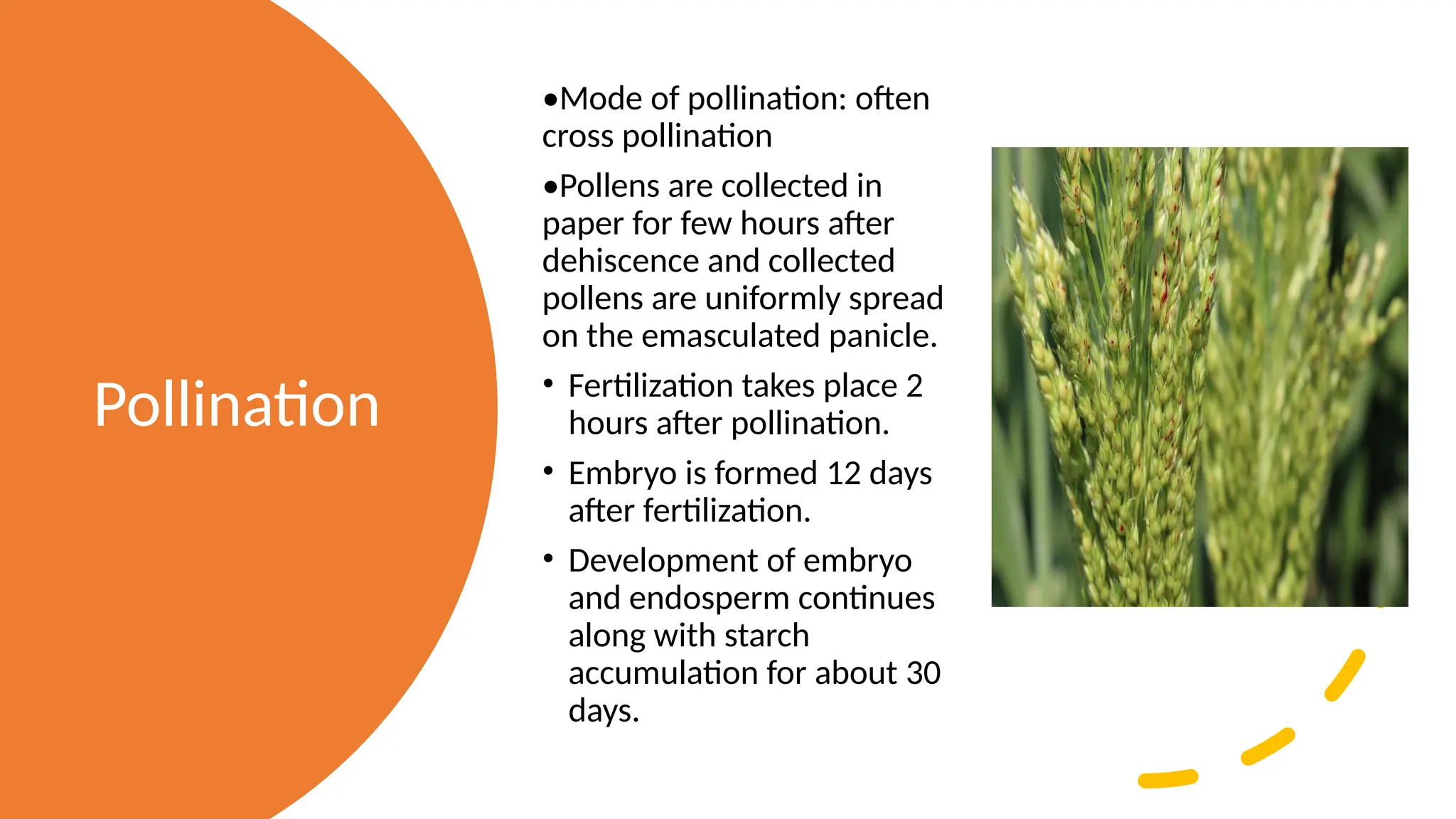
Pollination
•Mode of pollination: often
cross pollination
•Pollens are collected in
paper for few hours after
dehiscence and collected
pollens are uniformly spread
on the emasculated panicle.
• Fertilization takes place 2
hours after pollination.
• Embryo is formed 12 days
after fertilization.
• Development of embryo
and endosperm continues
along with starch
accumulation for about 30
days.
Diseases:
• Seed decay and seedling
blight: treat with Thiram or
vitavax @ 2.5g/kg of seeds.
• Downy mildew: Thiram and
vitavax @ 2.5g/kg and grow
resistant variety.
• Leaf blight:
(Helminthosporium tracium)
• Thiram and vitavax @ 2.5g/kg
of seed.
Seedling blight Downy mildew
Leaf blight
Hybrid Seed
Production
of sorghum
•In sorghum hybrid seed is produced by utilizing
cytoplasmic genetic male sterlity.
• Seeds produced in different stages:
Nucleus seed stage : Maintenance of basic source by
seed to row progenies.
Breeder stage : A(A×B),B and R Line are
multiplied
Foundation stage : A(A×B) and R line are
multiplied
Breeder and foundation seed stage: Multiplication of
male sterile line or maintenance of A and B line
Certified seed stage : A×R-F1 hybrid produced
The details of production of R-line, B-line, and A-
lines are given below:
• R-line- The sorghum restorer (R) line has self-fertile bisexual florets and is a pure line.
Therefore, it can be multiplied with ease in a manner similar to that of pure line varieties.
• The pearl millet R-line could be either an inbred line or open pollinated variety.
• However, in the seed multiplication of an inbred line, at the final inspection, genetic off-
type should not be permitted more than 0.05%.
• Any plant in the R-line plot appearing different from the true R-type in any way (major or
minor) should be uprooted, or rogued, before anthesis. Although the process of roguing
starts soon after the seedling stage, the boot leaf and panicle emergence stages are
critical, as detection of off-types is easier during these stages.
• Off-types that escape detection during the flowering stage should be removed before
harvest to minimize contamination. It is recommended that plants of doubtful status
should also be removed. Purity of the parental seed is very important because it affects
the quality of hybrid seed that is generated.
Reference: via google
scholar
• B-line- The maintainer or B-line is self-fertile and can be multiplied in an isolated
plot in the same manner described for the R-line. However, it can also be
harvested from the Aline/B-line seed production plots.
• A-lines- Large scale production of male sterile (A) lines is carried out by growing the A-line
and its corresponding maintainer, B-line together in an isolated plot.
• The isolation distance required for A x B production fields is at least 1 km .
• The male-sterile line (A) and its maintainer (B) flower at about the same time and thus there
are no problems of asynchronous flowering.
• Pollen produced by the B-line fertilizes the male-sterile plants (A) and the seed produced thus,
gives rise to the A-line again.
• Roguing in A-line seed production plots should be more stringent because A and B plants
cannot be easily distinguished after flowering. The pollen shedders in the A-line rows must be
identified and uprooted each morning during the flowering period. Utmost caution must be
exercised in labeling and harvesting A-line and B-line rows and the B-line rows are harvested
first, followed by t h e A-line rows.
• Purity of the A-line is very important and any lapses can lead to huge losses of both time and
money spent in roguing the hybrid seed (A x R) production plots in the next generation.
Normally, not more than 0.05% genetic off type are permitted at final inspection in foundation
seed.
• Since both A-lines and B-lines exhibit synchronous flowering, seed yields on the A-line in A / B
seed production plots are relative better than in the A and R (hybrid) production plots. Seed of
the B-line harvested from the A/B production plots might be reused for the next generation,
depending on t h e seed laws of the country.
• Stages of seed multiplication: Breeder seed-
foundation seed-certified seed.
• Foundation seed production: A and B Line
are raised in 4:2 ratio with 4 rows of B line as
border row and allowed for cross pollination.
The seeds from A line will be collected as A
line seeds (multiplied).
• Certified seed production: Hybrid seed
production.
FOUNDATION SEED CERTIFIED SEED
NORMAL 200 100
ON PRESENCE OF JOHNSON GRASS 400 400
ON PRESENCE OF FORAGE
SORGHUM
400 200
HYBRIDS 300 200
ISOLATION DISTANCE
• Seeds and sowing:
• Seed rate: A line: 8kg hac-1 R line : 4kg ha-1
• Spacing: A line: 45×30 cm R line:45×solid row spacing.
• Planting ratio: Foundation seed stage: 4:2(A:B)
Certified seed stage:5:2 (A:R)
• Border rows: 4 rows of male to supply adequate
pollen.
Manures and fertilizers:
Compost: 12.5t/ha
NPK: 100:50:50 kg/ha
Basal: 50:50:50kg/ha
Top dressing: 25kg N after last ploughing 25kg N after
boot leaf stage (45 days)
• Staggered sowing: Sowing of male parent and female parents are adjusted in
such a way that both parents come to flowering at same time.
•Roguing: Do it in both parents.
•In female line remove: off types, wild types,pollenshedders,rogues,diseased
plants.
•In male line remove: rogues, diseased plant, wild types..
Method of harvesting:
1. Male and female lines should be harvested separately.
2. The male rows are harvested first and transported to separate threshing floor.
3. Like that female rows are harvested and threshed separately.
Threshing:
• At the time of threshing the seed moisture
content should be reduced around 15-
18%.Threshing can be done by beating the
earheads with bamboo sticks.
• While using the mechanical threshers, care
should be taken to avoid mechanical damage.
Drying:
• Seed should be dried to 12% for short term
storage and 8% for long term storage.
Seed treatment and storage:
• The seeds are treated with
captan or thiram @2g/kg of
seed and pack it in cloth bag at
12%moisture content.
• The treated seeds can be
stored upto 12 months under
open storage and upto 18
months in moisture vapour
proof containers, provided it is
not infested by the storage
insects.
Seed yield:
• 3000 kg/ha
• Popular hybrids of their parents:
The first bhybrid CSH-1 was
released in 1964.
• In 1969,the coordinated sorghum
improvement project was
established.
• Now there are more than 30
hybrids. Some popular are:
CSH-1 CK 60 A × IS 84
CSH-5 2077A × CS3541
CSH-9 MS 296 A × CS 3541
COH-2 2219A × IS3541
COH-3 2077A × CO21
COH-4 296A × TNS30
CSH-16 27 A × C 43
CSH-17 AKMS 14A × RS 673
Reference: Agri4profitsite (online)
Thank You!!

Seed Production Technology in Sorghum.pptx

  • 1.
    Seed Production Technology inSorghum Shubham Thapa Ph.D. Scholar Department of Seed Science and Technology
  • 2.
    Introduction • Sorghum: Sorghumbicolor L. • Chromosome number: 2n=20 • Family: Poaceae • Origin: Ethopia (Africa) • It reserves as an important source of cattle,feed and fodder. • It is among the most efficient crops in conversion of solar energy and use of water. • It is one of the most widely grown dryland foodgrains in India. • It does well even in a low rainfed areas.
  • 3.
    • Area: • Itis mostly grown in continents like Africa, Asia and Central America. • It is the worlds fifth largest grain crop and Africas second most important. • India is first in area and second rank in production. • USA is a largest producer. • Nutritional value: • Protein: 10-12% • Carbohydrates: 70% • Fat: 3%
  • 4.
    Climatic requirement: 1. Ittolerates drought condition. 2. Tolerate water logging condition as well. 3. It needs annual rainfall uptp 60-100cm. 4. It is grown in kharif season in North. 5. And grown in rabi season in South. 6. Minimum temperature for germination: 7-10°c 7. Optimum temperature for growth: 26- 30°c 8. It is a short-day plant
  • 5.
    Botanical description: • Rootsystem- It has well developed root system and it is more fibrous than maize. • Proper root may develop from the axillary buds on the lowest nodes of the stem above the ground level. • It helps to support the plant. • Stem- Certain fodder variety have more juice and sweater than common grain varieties. • Leaves- they have 7-24 in number. • Stomata occurs in both side of leaves. There are also line of motor cells which cause the leaves to roll inwards under drought condition.
  • 6.
    Sl. No StateName Season varieties Released(Recommended during last 15 years) Hybrids varieties Popular varieties Popular Hybrids varieties 1 HARYANA Kharif CSV-15, SSV-84, CSV-23 , CSH-16 CSH-16 2 HARYANA Fodder Hara Sona, Haryana Chari-308, Pusa Chari Hybrid-106, Pantchari-5, CSH-20-MF, Haryana Jowar-513, CSH-24 Hara Sona, Haryana Chari-308, Pusa Chari Hybrid-106, Pantchari-5, CSH- 20-MF, Haryana Jowar-513, CSH-24 3 RAJASTHAN Kharif CSV-15, Partap jowar-1430, CSV-23, CSV-17 , CSH-13, CSH-16, CSH-17, CSH-18, MLSH-296, ICI-501, SPH-837, CSH-23 CSH-13, CSH-16, CSH-17, CSH-18, MLSH-296, ICI-501, SPH-837, CSH-23 CSH-16, CSH-17, CSH-6, CSV-15, CSH-9, Partap Jowar-1430, SPH-837, SPV- 245 CSH-16, CSH-17, CSH-6, CSV-15, CSH-9, Partap Jowar-1430, SPH-837, SPV- 245 4 RAJASTHAN Sweet sorghum CSH-22 SS CSH-16, CSH-17, CSH-6, CSV-15, CSH-9, Partap Jowar-1430, SPH-837, SPV- 245 CSH-16, CSH-17, CSH-6, CSV-15, CSH-9, Partap Jowar-1430, SPH-837, SPV- 245 5 RAJASTHAN Fodder Hara sona, Haryana chari-308, Pant chari-5, CSH-20-MF CSH-16, CSH-17, CSH-6, CSV-15, CSH-9, Partap Jowar-1430, SPH-837, SPV- 245 CSH-16, CSH-17, CSH-6, CSV-15, CSH-9, Partap Jowar-1430, SPH-837, SPV- 245 6 UTTAR PRADESH Kharif CSV-15, Bundela, CSV-23, CSV-17, CSV-20 , CSH-13, CSH- 16, CSH-18, CSH-23 CSH-13, CSH- 16, CSH-18, CSH-23 7 UTTAR PRADESH Sweet sorghum CSH-22 SS 8 UTTAR PRADESH Fodder Hara sona, Haryana chari-308, Pant chari-4, Pant chari- 5, Pusa chari-106 9 BIHAR Kharif CSV-15, CSH-16, CSH-1, CSH-2, CSH-3, CSH-5, Swarna hybrid-, BR-1, BR-2 CSH-16 MP Chari, Pusa Chari-1, CSH-1, CSH-2, CSH-3, CSH- 5, Swarna hybrid-, BR-1, BR-2 CSH-1, CSH-2, CSH-3, CSH- 5, Swarna hybrid-, BR-1, BR-2 10 BIHAR Fodder CSH-20-MF, MP Chari, Pusa Chari-1 MP Chari, Pusa Chari-1, CSH-1, CSH-2, CSH-3, CSH- 5, Swarna hybrid-, BR-1, BR-2 CSH-1, CSH-2, CSH-3, CSH- 5, Swarna hybrid-, BR-1, BR-2
  • 7.
    Flower structure • Inflorescence ofthe sorghum is panicle. • Panicle consists of central axis. • Central axis consists of primary and secondary branches. • In secondary branches spikelets are present in pair. • A spikelet consists of: • It is always present in pair. • One is pedicellate spikelet (sterile) • Another one is sessile spikelet (fertile) and flowers is also present.
  • 8.
    Sessile spikelet: • Itconsists of two flowers- • *upper flower: complete flower • *lower flower: incomplete flower • A single spikelet consist of: • Lower glumea and upper glumea • 2 lemma (by this 2 flowers are formed) • One is bisexual flower and another one is staminate flower) • Upper complete flower consists of lemma and covered by palea. • 3 stamen,1 carpel and one lodicules is present. • In lower flower carpel is absent.
  • 9.
  • 10.
    Floral Biology • Sorghum inflorescence bloomsin early morning. • The anther and stigma push out as the glumes open. • Stigma are receptive from 1-2 days before blooming to 8-16 days after blooming depending on the variety and the climatic condition. • Stigma before the anther dehiscence are subjected cross pollination (<5 to 50%) • Fertilization takes 1 to 2 hours after pollination.
  • 11.
    Pollination •Mode of pollination:often cross pollination •Pollens are collected in paper for few hours after dehiscence and collected pollens are uniformly spread on the emasculated panicle. • Fertilization takes place 2 hours after pollination. • Embryo is formed 12 days after fertilization. • Development of embryo and endosperm continues along with starch accumulation for about 30 days.
  • 12.
    Diseases: • Seed decayand seedling blight: treat with Thiram or vitavax @ 2.5g/kg of seeds. • Downy mildew: Thiram and vitavax @ 2.5g/kg and grow resistant variety. • Leaf blight: (Helminthosporium tracium) • Thiram and vitavax @ 2.5g/kg of seed. Seedling blight Downy mildew Leaf blight
  • 13.
    Hybrid Seed Production of sorghum •Insorghum hybrid seed is produced by utilizing cytoplasmic genetic male sterlity. • Seeds produced in different stages: Nucleus seed stage : Maintenance of basic source by seed to row progenies. Breeder stage : A(A×B),B and R Line are multiplied Foundation stage : A(A×B) and R line are multiplied Breeder and foundation seed stage: Multiplication of male sterile line or maintenance of A and B line Certified seed stage : A×R-F1 hybrid produced
  • 15.
    The details ofproduction of R-line, B-line, and A- lines are given below: • R-line- The sorghum restorer (R) line has self-fertile bisexual florets and is a pure line. Therefore, it can be multiplied with ease in a manner similar to that of pure line varieties. • The pearl millet R-line could be either an inbred line or open pollinated variety. • However, in the seed multiplication of an inbred line, at the final inspection, genetic off- type should not be permitted more than 0.05%. • Any plant in the R-line plot appearing different from the true R-type in any way (major or minor) should be uprooted, or rogued, before anthesis. Although the process of roguing starts soon after the seedling stage, the boot leaf and panicle emergence stages are critical, as detection of off-types is easier during these stages. • Off-types that escape detection during the flowering stage should be removed before harvest to minimize contamination. It is recommended that plants of doubtful status should also be removed. Purity of the parental seed is very important because it affects the quality of hybrid seed that is generated. Reference: via google scholar
  • 16.
    • B-line- Themaintainer or B-line is self-fertile and can be multiplied in an isolated plot in the same manner described for the R-line. However, it can also be harvested from the Aline/B-line seed production plots.
  • 17.
    • A-lines- Largescale production of male sterile (A) lines is carried out by growing the A-line and its corresponding maintainer, B-line together in an isolated plot. • The isolation distance required for A x B production fields is at least 1 km . • The male-sterile line (A) and its maintainer (B) flower at about the same time and thus there are no problems of asynchronous flowering. • Pollen produced by the B-line fertilizes the male-sterile plants (A) and the seed produced thus, gives rise to the A-line again. • Roguing in A-line seed production plots should be more stringent because A and B plants cannot be easily distinguished after flowering. The pollen shedders in the A-line rows must be identified and uprooted each morning during the flowering period. Utmost caution must be exercised in labeling and harvesting A-line and B-line rows and the B-line rows are harvested first, followed by t h e A-line rows. • Purity of the A-line is very important and any lapses can lead to huge losses of both time and money spent in roguing the hybrid seed (A x R) production plots in the next generation. Normally, not more than 0.05% genetic off type are permitted at final inspection in foundation seed. • Since both A-lines and B-lines exhibit synchronous flowering, seed yields on the A-line in A / B seed production plots are relative better than in the A and R (hybrid) production plots. Seed of the B-line harvested from the A/B production plots might be reused for the next generation, depending on t h e seed laws of the country.
  • 18.
    • Stages ofseed multiplication: Breeder seed- foundation seed-certified seed. • Foundation seed production: A and B Line are raised in 4:2 ratio with 4 rows of B line as border row and allowed for cross pollination. The seeds from A line will be collected as A line seeds (multiplied). • Certified seed production: Hybrid seed production.
  • 19.
    FOUNDATION SEED CERTIFIEDSEED NORMAL 200 100 ON PRESENCE OF JOHNSON GRASS 400 400 ON PRESENCE OF FORAGE SORGHUM 400 200 HYBRIDS 300 200 ISOLATION DISTANCE
  • 20.
    • Seeds andsowing: • Seed rate: A line: 8kg hac-1 R line : 4kg ha-1 • Spacing: A line: 45×30 cm R line:45×solid row spacing. • Planting ratio: Foundation seed stage: 4:2(A:B) Certified seed stage:5:2 (A:R) • Border rows: 4 rows of male to supply adequate pollen. Manures and fertilizers: Compost: 12.5t/ha NPK: 100:50:50 kg/ha Basal: 50:50:50kg/ha Top dressing: 25kg N after last ploughing 25kg N after boot leaf stage (45 days)
  • 21.
    • Staggered sowing:Sowing of male parent and female parents are adjusted in such a way that both parents come to flowering at same time. •Roguing: Do it in both parents. •In female line remove: off types, wild types,pollenshedders,rogues,diseased plants. •In male line remove: rogues, diseased plant, wild types.. Method of harvesting: 1. Male and female lines should be harvested separately. 2. The male rows are harvested first and transported to separate threshing floor. 3. Like that female rows are harvested and threshed separately.
  • 22.
    Threshing: • At thetime of threshing the seed moisture content should be reduced around 15- 18%.Threshing can be done by beating the earheads with bamboo sticks. • While using the mechanical threshers, care should be taken to avoid mechanical damage. Drying: • Seed should be dried to 12% for short term storage and 8% for long term storage.
  • 23.
    Seed treatment andstorage: • The seeds are treated with captan or thiram @2g/kg of seed and pack it in cloth bag at 12%moisture content. • The treated seeds can be stored upto 12 months under open storage and upto 18 months in moisture vapour proof containers, provided it is not infested by the storage insects. Seed yield: • 3000 kg/ha
  • 24.
    • Popular hybridsof their parents: The first bhybrid CSH-1 was released in 1964. • In 1969,the coordinated sorghum improvement project was established. • Now there are more than 30 hybrids. Some popular are: CSH-1 CK 60 A × IS 84 CSH-5 2077A × CS3541 CSH-9 MS 296 A × CS 3541 COH-2 2219A × IS3541 COH-3 2077A × CO21 COH-4 296A × TNS30 CSH-16 27 A × C 43 CSH-17 AKMS 14A × RS 673
  • 25.
  • 26.