Raushan Kumar
M.Sc Horticulture (Fruit Science)
Department of Horticulture
Jawaharlal Nehru Krishi Vishwa Vidyalaya, Jabalpur
(M.P.)
PROBLEM OF FRUIT DROP IN FRUIT CROPS
2022-23
Deepak Singh
Ph.D Scholar (Fruit Science)
1. • Introduction
2. • What is fruit Drop
3. • Types of fruit Drop
4.
• Causes of fruit Drops
5.
• Remedies of fruit Drops
6.
• Case study
7.
• Conclusion
8
• Physiology of Abscission
SEMINAR OUTLINE
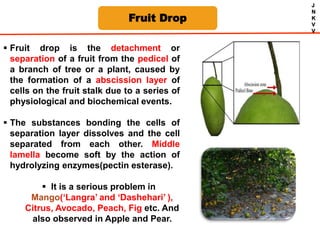
 Fruit drop is the detachment or
separation of a fruit from the pedicel of
a branch of tree or a plant, caused by
the formation of a abscission layer of
cells on the fruit stalk due to a series of
physiological and biochemical events.
 The substances bonding the cells of
separation layer dissolves and the cell
separated from each other. Middle
lamella become soft by the action of
hydrolyzing enzymes(pectin esterase).
 It is a serious problem in
Mango(‘Langra’ and ‘Dashehari’ ),
Citrus, Avocado, Peach, Fig etc. And
also observed in Apple and Pear.
Fruit Drop
J
N
K
V
V
Abscission Process
J
N
K
V
V
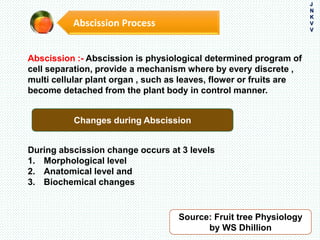
Abscission :- Abscission is physiological determined program of
cell separation, provide a mechanism where by every discrete ,
multi cellular plant organ , such as leaves, flower or fruits are
become detached from the plant body in control manner.
During abscission change occurs at 3 levels
1. Morphological level
2. Anatomical level and
3. Biochemical changes
Changes during Abscission
Source: Fruit tree Physiology
by WS Dhillion
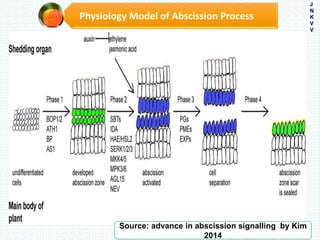
Physiology Model of Abscission Process
J
N
K
V
V
Source: advance in abscission signalling by Kim
2014
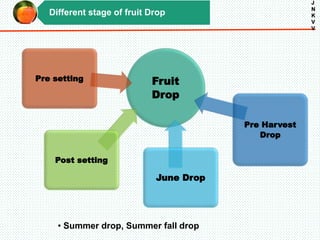
Different stage of fruit Drop
J
N
K
V
V
Fruit
Drop
Post setting
June Drop
Pre Harvest
Drop
Pre setting
• Summer drop, Summer fall drop
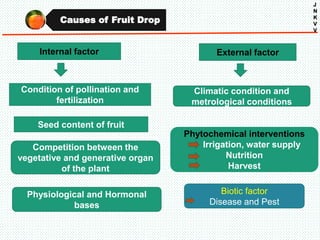
Causes of Fruit Drop
J
N
K
V
V
Internal factor External factor
Condition of pollination and
fertilization
Seed content of fruit
Competition between the
vegetative and generative organ
of the plant
Physiological and Hormonal
bases
Climatic condition and
metrological conditions
Phytochemical interventions
Irrigation, water supply
Nutrition
Harvest
Biotic factor
Disease and Pest
Pollination and Fertilization
J
N
K
V
V
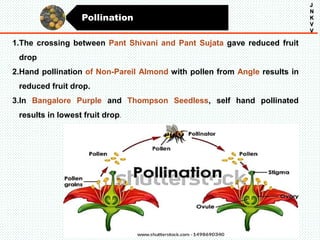
Pollination and Fertilization
J
N
K
V
V
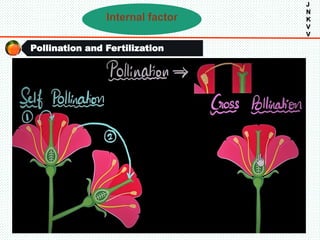
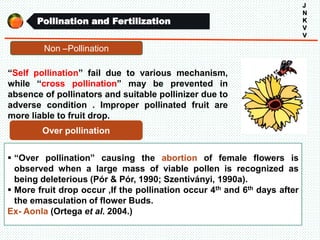
“Self pollination” fail due to various mechanism,
while “cross pollination” may be prevented in
absence of pollinators and suitable pollinizer due to
adverse condition . Improper pollinated fruit are
more liable to fruit drop.
Non –Pollination
Over pollination
 “Over pollination” causing the abortion of female flowers is
observed when a large mass of viable pollen is recognized as
being deleterious (Pór & Pór, 1990; Szentiványi, 1990a).
 More fruit drop occur ,If the pollination occur 4th and 6th days after
the emasculation of flower Buds.
Ex- Aonla (Ortega et al. 2004.)
Pollination and Fertilization
J
N
K
V
V
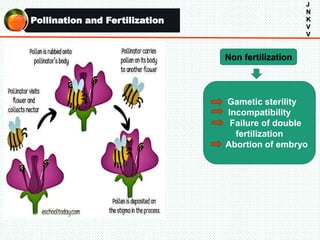
Non fertilization
Gametic sterility
Incompatibility
Failure of double
fertilization
Abortion of embryo
Seed content of Fruit :
J
N
K
V
V
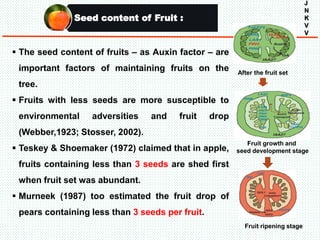
 The seed content of fruits – as Auxin factor – are
important factors of maintaining fruits on the
tree.
 Fruits with less seeds are more susceptible to
environmental adversities and fruit drop
(Webber,1923; Stosser, 2002).
 Teskey & Shoemaker (1972) claimed that in apple,
fruits containing less than 3 seeds are shed first
when fruit set was abundant.
 Murneek (1987) too estimated the fruit drop of
pears containing less than 3 seeds per fruit.
After the fruit set
Fruit growth and
seed development stage
Fruit ripening stage
J
N
K
V
V
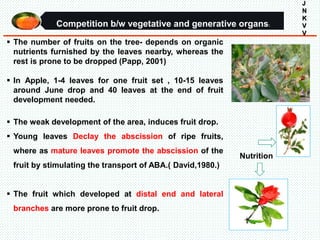
 The number of fruits on the tree- depends on organic
nutrients furnished by the leaves nearby, whereas the
rest is prone to be dropped (Papp, 2001)
 In Apple, 1-4 leaves for one fruit set , 10-15 leaves
around June drop and 40 leaves at the end of fruit
development needed.
 The weak development of the area, induces fruit drop.
 Young leaves Declay the abscission of ripe fruits,
where as mature leaves promote the abscission of the
fruit by stimulating the transport of ABA.( David,1980.)
 The fruit which developed at distal end and lateral
branches are more prone to fruit drop.
Competition b/w vegetative and generative organs:
Nutrition
Physiological and Hormonal Bases :
J
N
K
V
V
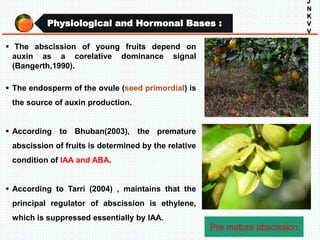
 The abscission of young fruits depend on
auxin as a corelative dominance signal
(Bangerth,1990).
 The endosperm of the ovule (seed primordial) is
the source of auxin production.
 According to Bhuban(2003), the premature
abscission of fruits is determined by the relative
condition of IAA and ABA.
 According to Tarri (2004) , maintains that the
principal regulator of abscission is ethylene,
which is suppressed essentially by IAA.
Pre mature abscission
Climatic condition :
J
N
K
V
V
 Premature fruit drop is caused by high probability adverse environmental
condition(Solester,1997).
 The temperature more than 280C as an important factor responsible for June-
drop of apple.
 High temperature (19-420C ) during stage of fruit set development causes fruit
drop . Ex- Cashew Nut.
 More Fruit Drop in dry season.
 Poor light condition(shading) increases the incidence of fruit drop in sweet
cherries.
 Freezing Temperatures : Duration and the number of degrees below freezing
are important factors in the amount of flower damage.
 In hot growing seasons the period between bloom and fruit ripening is
shorter than in cool growing seasons.
External Factor
Irrigation
J
N
K
V
V
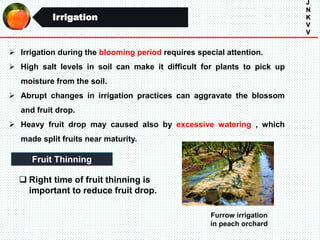
 Irrigation during the blooming period requires special attention.
 High salt levels in soil can make it difficult for plants to pick up
moisture from the soil.
 Abrupt changes in irrigation practices can aggravate the blossom
and fruit drop.
 Heavy fruit drop may caused also by excessive watering , which
made split fruits near maturity.
Furrow irrigation
in peach orchard
Fruit Thinning
 Right time of fruit thinning is
important to reduce fruit drop.
Nutrition :
J
N
K
V
V
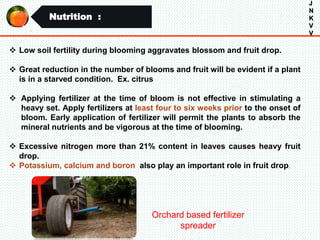
 Low soil fertility during blooming aggravates blossom and fruit drop.
 Great reduction in the number of blooms and fruit will be evident if a plant
is in a starved condition. Ex. citrus
 Applying fertilizer at the time of bloom is not effective in stimulating a
heavy set. Apply fertilizers at least four to six weeks prior to the onset of
bloom. Early application of fertilizer will permit the plants to absorb the
mineral nutrients and be vigorous at the time of blooming.
 Excessive nitrogen more than 21% content in leaves causes heavy fruit
drop.
 Potassium, calcium and boron also play an important role in fruit drop.
Orchard based fertilizer
spreader
Biotic Factor :
J
N
K
V
V
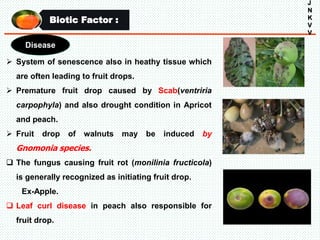
 System of senescence also in heathy tissue which
are often leading to fruit drops.
 Premature fruit drop caused by Scab(ventriria
carpophyla) and also drought condition in Apricot
and peach.
 Fruit drop of walnuts may be induced by
Gnomonia species.
 The fungus causing fruit rot (monilinia fructicola)
is generally recognized as initiating fruit drop.
Ex-Apple.
 Leaf curl disease in peach also responsible for
fruit drop.
Disease
J
N
K
V
V
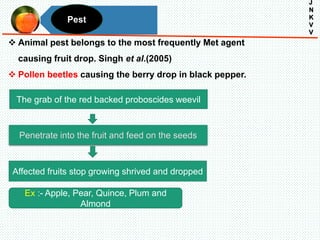
 Animal pest belongs to the most frequently Met agent
causing fruit drop. Singh et al.(2005)
 Pollen beetles causing the berry drop in black pepper.
Pest
The grab of the red backed proboscides weevil
Affected fruits stop growing shrived and dropped
Ex :- Apple, Pear, Quince, Plum and
Almond
Fruit Drop in Various Fruit Crops
J
N
K
V
V
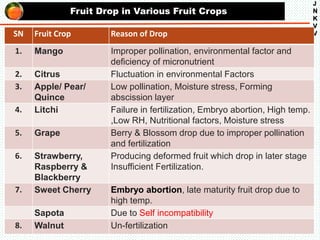
SN Fruit Crop Reason of Drop
1. Mango Improper pollination, environmental factor and
deficiency of micronutrient
2. Citrus Fluctuation in environmental Factors
3. Apple/ Pear/
Quince
Low pollination, Moisture stress, Forming
abscission layer
4. Litchi Failure in fertilization, Embryo abortion, High temp.
,Low RH, Nutritional factors, Moisture stress
5. Grape Berry & Blossom drop due to improper pollination
and fertilization
6. Strawberry,
Raspberry &
Blackberry
Producing deformed fruit which drop in later stage
Insufficient Fertilization.
7. Sweet Cherry Embryo abortion, late maturity fruit drop due to
high temp.
Sapota Due to Self incompatibility
8. Walnut Un-fertilization
Remedies of fruit Drop
J
N
K
V
V
1.Timely treatment of cultural practices plant.
2.Ensure the population of Pollinators
3.Treatment with growth regulators like NAA, GA are
effective in minimizing fruit drop.
4.Using the integrated nutrient approach.
5.Pruning of plant after harvest to minimize pest and
disease.
6.Improved drainage.
7.Provision of wind breaks
Pollination
J
N
K
V
V
1.The crossing between Pant Shivani and Pant Sujata gave reduced fruit
drop
2.Hand pollination of Non-Pareil Almond with pollen from Angle results in
reduced fruit drop.
3.In Bangalore Purple and Thompson Seedless, self hand pollinated
results in lowest fruit drop.
Mineral Nutrients (INM)
J
N
K
V
V
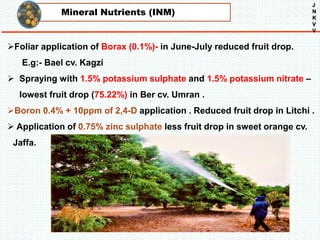
Foliar application of Borax (0.1%)- in June-July reduced fruit drop.
E.g:- Bael cv. Kagzi
 Spraying with 1.5% potassium sulphate and 1.5% potassium nitrate –
lowest fruit drop (75.22%) in Ber cv. Umran .
Boron 0.4% + 10ppm of 2,4-D application . Reduced fruit drop in Litchi .
 Application of 0.75% zinc sulphate less fruit drop in sweet orange cv.
Jaffa.
Mineral Nutrients (INM)
J
N
K
V
V
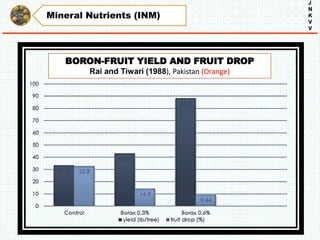
BORON-FRUIT YIELD AND FRUIT DROP
Rai and Tiwari (1988), Pakistan (Orange)
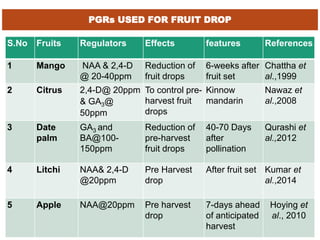
PGRs USED FOR FRUIT DROP
S.No Fruits Regulators Effects features References
1 Mango NAA & 2,4-D
@ 20-40ppm
Reduction of
fruit drops
6-weeks after
fruit set
Chattha et
al.,1999
2 Citrus 2,4-D@ 20ppm
& GA3@
50ppm
To control pre-
harvest fruit
drops
Kinnow
mandarin
Nawaz et
al.,2008
3 Date
palm
GA3 and
BA@100-
150ppm
Reduction of
pre-harvest
fruit drops
40-70 Days
after
pollination
Qurashi et
al.,2012
4 Litchi NAA& 2,4-D
@20ppm
Pre Harvest
drop
After fruit set Kumar et
al.,2014
5 Apple NAA@20ppm Pre harvest
drop
7-days ahead
of anticipated
harvest
Hoying et
al., 2010
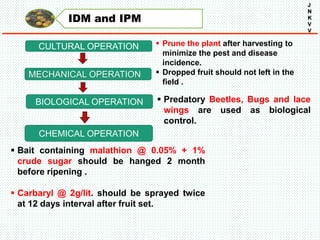
IDM and IPM
J
N
K
V
V
CULTURAL OPERATION
MECHANICAL OPERATION
BIOLOGICAL OPERATION
CHEMICAL OPERATION
 Predatory Beetles, Bugs and lace
wings are used as biological
control.
 Bait containing malathion @ 0.05% + 1%
crude sugar should be hanged 2 month
before ripening .
 Carbaryl @ 2g/lit. should be sprayed twice
at 12 days interval after fruit set.
 Prune the plant after harvesting to
minimize the pest and disease
incidence.
 Dropped fruit should not left in the
field .
Case Study -1
J
N
K
V
V
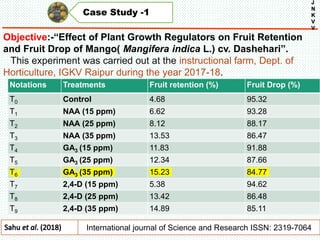
Objective:-“Effect of Plant Growth Regulators on Fruit Retention
and Fruit Drop of Mango( Mangifera indica L.) cv. Dashehari”.
This experiment was carried out at the instructional farm, Dept. of
Horticulture, IGKV Raipur during the year 2017-18.
Kaur Sukhjit (2017)
Notations Treatments Fruit retention (%) Fruit Drop (%)
T0 Control 4.68 95.32
T1 NAA (15 ppm) 6.62 93.28
T2 NAA (25 ppm) 8.12 88.17
T3 NAA (35 ppm) 13.53 86.47
T4 GA3 (15 ppm) 11.83 91.88
T5 GA3 (25 ppm) 12.34 87.66
T6 GA3 (35 ppm) 15.23 84.77
T7 2,4-D (15 ppm) 5.38 94.62
T8 2,4-D (25 ppm) 13.42 86.48
T9 2,4-D (35 ppm) 14.89 85.11
International journal of Science and Research ISSN: 2319-7064
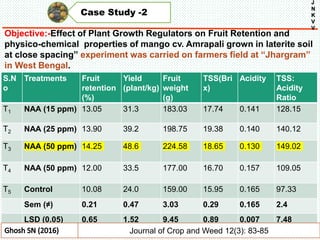
Case Study -2
J
N
K
V
V
Objective:-Effect of Plant Growth Regulators on Fruit Retention and
physico-chemical properties of mango cv. Amrapali grown in laterite soil
at close spacing” experiment was carried on farmers field at “Jhargram”
in West Bengal.
Kaur Sukhjit (2017)
S.N
o
Treatments Fruit
retention
(%)
Yield
(plant/kg)
Fruit
weight
(g)
TSS(Bri
x)
Acidity TSS:
Acidity
Ratio
T1 NAA (15 ppm) 13.05 31.3 183.03 17.74 0.141 128.15
T2 NAA (25 ppm) 13.90 39.2 198.75 19.38 0.140 140.12
T3 NAA (50 ppm) 14.25 48.6 224.58 18.65 0.130 149.02
T4 NAA (50 ppm) 12.00 33.5 177.00 16.70 0.157 109.05
T5 Control 10.08 24.0 159.00 15.95 0.165 97.33
Sem (≠) 0.21 0.47 3.03 0.29 0.165 2.4
LSD (0.05) 0.65 1.52 9.45 0.89 0.007 7.48
Journal of Crop and Weed 12(3): 83-85
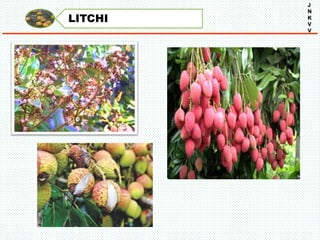
LITCHI
J
N
K
V
V
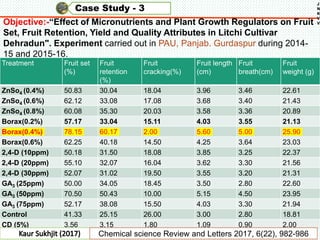
Case Study - 3
J
N
K
V
V
Objective:-“Effect of Micronutrients and Plant Growth Regulators on Fruit
Set, Fruit Retention, Yield and Quality Attributes in Litchi Cultivar
Dehradun". Experiment carried out in PAU, Panjab. Gurdaspur during 2014-
15 and 2015-16.
Kaur Sukhjit (2017)
Treatment Fruit set
(%)
Fruit
retention
(%)
Fruit
cracking(%)
Fruit length
(cm)
Fruit
breath(cm)
Fruit
weight (g)
ZnSo4 (0.4%) 50.83 30.04 18.04 3.96 3.46 22.61
ZnSo4 (0.6%) 62.12 33.08 17.08 3.68 3.40 21.43
ZnSo4 (0.8%) 60.08 35.30 20.03 3.58 3.36 20.89
Borax(0.2%) 57.17 33.04 15.11 4.03 3.55 21.13
Borax(0.4%) 78.15 60.17 2.00 5.60 5.00 25.90
Borax(0.6%) 62.25 40.18 14.50 4.25 3.64 23.03
2,4-D (10ppm) 50.18 31.50 18.08 3.85 3.25 22.37
2,4-D (20ppm) 55.10 32.07 16.04 3.62 3.30 21.56
2,4-D (30ppm) 52.07 31.02 19.50 3.55 3.20 21.31
GA3 (25ppm) 50.00 34.05 18.45 3.50 2.80 22.60
GA3 (50ppm) 70.50 50.43 10.00 5.15 4.50 23.95
GA3 (75ppm) 52.17 38.08 15.50 4.03 3.30 21.94
Control 41.33 25.15 26.00 3.00 2.80 18.81
CD (5%) 3.56 3.15 1.80 1.09 0.90 2.00
Chemical science Review and Letters 2017, 6(22), 982-986
J
N
K
V
V
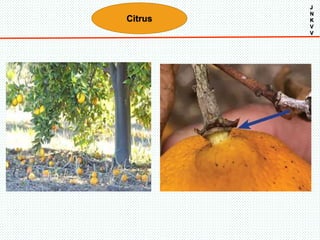
Citrus
Case Study -4
J
N
K
V
V
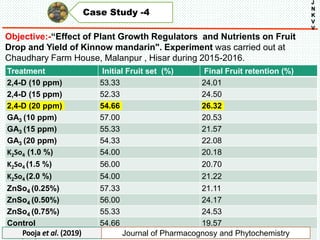
Objective:-“Effect of Plant Growth Regulators and Nutrients on Fruit
Drop and Yield of Kinnow mandarin". Experiment was carried out at
Chaudhary Farm House, Malanpur , Hisar during 2015-2016.
Kaur Sukhjit (2017)
Treatment Initial Fruit set (%) Final Fruit retention (%)
2,4-D (10 ppm) 53.33 24.01
2,4-D (15 ppm) 52.33 24.50
2,4-D (20 ppm) 54.66 26.32
GA3 (10 ppm) 57.00 20.53
GA3 (15 ppm) 55.33 21.57
GA3 (20 ppm) 54.33 22.08
K2So4 (1.0 %) 54.00 20.18
K2So4 (1.5 %) 56.00 20.70
K2So4 (2.0 %) 54.00 21.22
ZnSo4 (0.25%) 57.33 21.11
ZnSo4 (0.50%) 56.00 24.17
ZnSo4 (0.75%) 55.33 24.53
Control 54.66 19.57
CD (5%) N/S 1.74
Journal of Pharmacognosy and Phytochemistry
Case Study -5
J
N
K
V
V
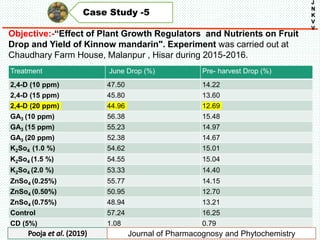
Objective:-“Effect of Plant Growth Regulators and Nutrients on Fruit
Drop and Yield of Kinnow mandarin". Experiment was carried out at
Chaudhary Farm House, Malanpur , Hisar during 2015-2016.
Kaur Sukhjit (2017)
Treatment June Drop (%) Pre- harvest Drop (%)
2,4-D (10 ppm) 47.50 14.22
2,4-D (15 ppm) 45.80 13.60
2,4-D (20 ppm) 44.96 12.69
GA3 (10 ppm) 56.38 15.48
GA3 (15 ppm) 55.23 14.97
GA3 (20 ppm) 52.38 14.67
K2So4 (1.0 %) 54.62 15.01
K2So4 (1.5 %) 54.55 15.04
K2So4 (2.0 %) 53.33 14.40
ZnSo4 (0.25%) 55.77 14.15
ZnSo4 (0.50%) 50.95 12.70
ZnSo4 (0.75%) 48.94 13.21
Control 57.24 16.25
CD (5%) 1.08 0.79
Journal of Pharmacognosy and Phytochemistry
Case Study - 6
J
N
K
V
V
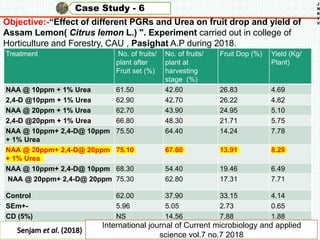
Objective:-“Effect of different PGRs and Urea on fruit drop and yield of
Assam Lemon( Citrus lemon L.) ". Experiment carried out in college of
Horticulture and Forestry, CAU , Pasighat A.P during 2018.
Kaur Sukhjit (2017)
Treatment No. of fruits/
plant after
Fruit set (%)
No. of fruits/
plant at
harvesting
stage (%)
Fruit Dop (%) Yield (Kg/
Plant)
NAA @ 10ppm + 1% Urea 61.50 42.60 26.83 4.69
2,4-D @10ppm + 1% Urea 62.90 42.70 26.22 4.82
NAA @ 20ppm + 1% Urea 62.70 43.90 24.95 5.10
2,4-D @20ppm + 1% Urea 66.80 48.30 21.71 5.75
NAA @ 10ppm+ 2,4-D@ 10ppm
+ 1% Urea
75.50 64.40 14.24 7.78
NAA @ 20ppm+ 2,4-D@ 20ppm
+ 1% Urea
75.10 67.60 13.91 8.29
NAA @ 10ppm+ 2,4-D@ 10ppm 68.30 54.40 19.46 6.49
NAA @ 20ppm+ 2,4-D@ 20ppm 75.30 62.80 17.31 7.71
Control 62.00 37.90 33.15 4.14
SEm+- 5.96 5.05 2.73 0.65
CD (5%) NS 14.56 7.88 1.88
International journal of Current microbiology and applied
science vol.7 no.7 2018
Conclusion
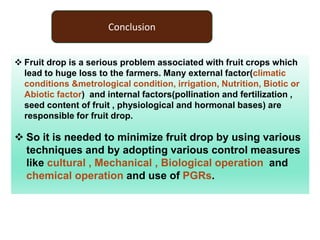
 Fruit drop is a serious problem associated with fruit crops which
lead to huge loss to the farmers. Many external factor(climatic
conditions &metrological condition, irrigation, Nutrition, Biotic or
Abiotic factor) and internal factors(pollination and fertilization ,
seed content of fruit , physiological and hormonal bases) are
responsible for fruit drop.
 So it is needed to minimize fruit drop by using various
techniques and by adopting various control measures
like cultural , Mechanical , Biological operation and
chemical operation and use of PGRs.
Fruit Drop in Horticulture Crops.pptx

Fruit Drop in Horticulture Crops.pptx

  • 1.
    Raushan Kumar M.Sc Horticulture(Fruit Science) Department of Horticulture Jawaharlal Nehru Krishi Vishwa Vidyalaya, Jabalpur (M.P.) PROBLEM OF FRUIT DROP IN FRUIT CROPS 2022-23 Deepak Singh Ph.D Scholar (Fruit Science)
  • 2.
    1. • Introduction 2.• What is fruit Drop 3. • Types of fruit Drop 4. • Causes of fruit Drops 5. • Remedies of fruit Drops 6. • Case study 7. • Conclusion 8 • Physiology of Abscission SEMINAR OUTLINE
  • 3.
     Fruit dropis the detachment or separation of a fruit from the pedicel of a branch of tree or a plant, caused by the formation of a abscission layer of cells on the fruit stalk due to a series of physiological and biochemical events.  The substances bonding the cells of separation layer dissolves and the cell separated from each other. Middle lamella become soft by the action of hydrolyzing enzymes(pectin esterase).  It is a serious problem in Mango(‘Langra’ and ‘Dashehari’ ), Citrus, Avocado, Peach, Fig etc. And also observed in Apple and Pear. Fruit Drop J N K V V
  • 4.
    Abscission Process J N K V V Abscission :-Abscission is physiological determined program of cell separation, provide a mechanism where by every discrete , multi cellular plant organ , such as leaves, flower or fruits are become detached from the plant body in control manner. During abscission change occurs at 3 levels 1. Morphological level 2. Anatomical level and 3. Biochemical changes Changes during Abscission Source: Fruit tree Physiology by WS Dhillion
  • 5.
    Physiology Model ofAbscission Process J N K V V Source: advance in abscission signalling by Kim 2014
  • 6.
    Different stage offruit Drop J N K V V Fruit Drop Post setting June Drop Pre Harvest Drop Pre setting • Summer drop, Summer fall drop
  • 7.
    Causes of FruitDrop J N K V V Internal factor External factor Condition of pollination and fertilization Seed content of fruit Competition between the vegetative and generative organ of the plant Physiological and Hormonal bases Climatic condition and metrological conditions Phytochemical interventions Irrigation, water supply Nutrition Harvest Biotic factor Disease and Pest
  • 8.
  • 9.
    Pollination and Fertilization J N K V V “Selfpollination” fail due to various mechanism, while “cross pollination” may be prevented in absence of pollinators and suitable pollinizer due to adverse condition . Improper pollinated fruit are more liable to fruit drop. Non –Pollination Over pollination  “Over pollination” causing the abortion of female flowers is observed when a large mass of viable pollen is recognized as being deleterious (Pór & Pór, 1990; Szentiványi, 1990a).  More fruit drop occur ,If the pollination occur 4th and 6th days after the emasculation of flower Buds. Ex- Aonla (Ortega et al. 2004.)
  • 10.
    Pollination and Fertilization J N K V V Nonfertilization Gametic sterility Incompatibility Failure of double fertilization Abortion of embryo
  • 11.
    Seed content ofFruit : J N K V V  The seed content of fruits – as Auxin factor – are important factors of maintaining fruits on the tree.  Fruits with less seeds are more susceptible to environmental adversities and fruit drop (Webber,1923; Stosser, 2002).  Teskey & Shoemaker (1972) claimed that in apple, fruits containing less than 3 seeds are shed first when fruit set was abundant.  Murneek (1987) too estimated the fruit drop of pears containing less than 3 seeds per fruit. After the fruit set Fruit growth and seed development stage Fruit ripening stage
  • 12.
    J N K V V  The numberof fruits on the tree- depends on organic nutrients furnished by the leaves nearby, whereas the rest is prone to be dropped (Papp, 2001)  In Apple, 1-4 leaves for one fruit set , 10-15 leaves around June drop and 40 leaves at the end of fruit development needed.  The weak development of the area, induces fruit drop.  Young leaves Declay the abscission of ripe fruits, where as mature leaves promote the abscission of the fruit by stimulating the transport of ABA.( David,1980.)  The fruit which developed at distal end and lateral branches are more prone to fruit drop. Competition b/w vegetative and generative organs: Nutrition
  • 13.
    Physiological and HormonalBases : J N K V V  The abscission of young fruits depend on auxin as a corelative dominance signal (Bangerth,1990).  The endosperm of the ovule (seed primordial) is the source of auxin production.  According to Bhuban(2003), the premature abscission of fruits is determined by the relative condition of IAA and ABA.  According to Tarri (2004) , maintains that the principal regulator of abscission is ethylene, which is suppressed essentially by IAA. Pre mature abscission
  • 14.
    Climatic condition : J N K V V Premature fruit drop is caused by high probability adverse environmental condition(Solester,1997).  The temperature more than 280C as an important factor responsible for June- drop of apple.  High temperature (19-420C ) during stage of fruit set development causes fruit drop . Ex- Cashew Nut.  More Fruit Drop in dry season.  Poor light condition(shading) increases the incidence of fruit drop in sweet cherries.  Freezing Temperatures : Duration and the number of degrees below freezing are important factors in the amount of flower damage.  In hot growing seasons the period between bloom and fruit ripening is shorter than in cool growing seasons. External Factor
  • 15.
    Irrigation J N K V V  Irrigation duringthe blooming period requires special attention.  High salt levels in soil can make it difficult for plants to pick up moisture from the soil.  Abrupt changes in irrigation practices can aggravate the blossom and fruit drop.  Heavy fruit drop may caused also by excessive watering , which made split fruits near maturity. Furrow irrigation in peach orchard Fruit Thinning  Right time of fruit thinning is important to reduce fruit drop.
  • 16.
    Nutrition : J N K V V  Lowsoil fertility during blooming aggravates blossom and fruit drop.  Great reduction in the number of blooms and fruit will be evident if a plant is in a starved condition. Ex. citrus  Applying fertilizer at the time of bloom is not effective in stimulating a heavy set. Apply fertilizers at least four to six weeks prior to the onset of bloom. Early application of fertilizer will permit the plants to absorb the mineral nutrients and be vigorous at the time of blooming.  Excessive nitrogen more than 21% content in leaves causes heavy fruit drop.  Potassium, calcium and boron also play an important role in fruit drop. Orchard based fertilizer spreader
  • 17.
    Biotic Factor : J N K V V System of senescence also in heathy tissue which are often leading to fruit drops.  Premature fruit drop caused by Scab(ventriria carpophyla) and also drought condition in Apricot and peach.  Fruit drop of walnuts may be induced by Gnomonia species.  The fungus causing fruit rot (monilinia fructicola) is generally recognized as initiating fruit drop. Ex-Apple.  Leaf curl disease in peach also responsible for fruit drop. Disease
  • 18.
    J N K V V  Animal pestbelongs to the most frequently Met agent causing fruit drop. Singh et al.(2005)  Pollen beetles causing the berry drop in black pepper. Pest The grab of the red backed proboscides weevil Affected fruits stop growing shrived and dropped Ex :- Apple, Pear, Quince, Plum and Almond
  • 19.
    Fruit Drop inVarious Fruit Crops J N K V V SN Fruit Crop Reason of Drop 1. Mango Improper pollination, environmental factor and deficiency of micronutrient 2. Citrus Fluctuation in environmental Factors 3. Apple/ Pear/ Quince Low pollination, Moisture stress, Forming abscission layer 4. Litchi Failure in fertilization, Embryo abortion, High temp. ,Low RH, Nutritional factors, Moisture stress 5. Grape Berry & Blossom drop due to improper pollination and fertilization 6. Strawberry, Raspberry & Blackberry Producing deformed fruit which drop in later stage Insufficient Fertilization. 7. Sweet Cherry Embryo abortion, late maturity fruit drop due to high temp. Sapota Due to Self incompatibility 8. Walnut Un-fertilization
  • 20.
    Remedies of fruitDrop J N K V V 1.Timely treatment of cultural practices plant. 2.Ensure the population of Pollinators 3.Treatment with growth regulators like NAA, GA are effective in minimizing fruit drop. 4.Using the integrated nutrient approach. 5.Pruning of plant after harvest to minimize pest and disease. 6.Improved drainage. 7.Provision of wind breaks
  • 21.
    Pollination J N K V V 1.The crossing betweenPant Shivani and Pant Sujata gave reduced fruit drop 2.Hand pollination of Non-Pareil Almond with pollen from Angle results in reduced fruit drop. 3.In Bangalore Purple and Thompson Seedless, self hand pollinated results in lowest fruit drop.
  • 22.
    Mineral Nutrients (INM) J N K V V Foliarapplication of Borax (0.1%)- in June-July reduced fruit drop. E.g:- Bael cv. Kagzi  Spraying with 1.5% potassium sulphate and 1.5% potassium nitrate – lowest fruit drop (75.22%) in Ber cv. Umran . Boron 0.4% + 10ppm of 2,4-D application . Reduced fruit drop in Litchi .  Application of 0.75% zinc sulphate less fruit drop in sweet orange cv. Jaffa.
  • 23.
    Mineral Nutrients (INM) J N K V V BORON-FRUITYIELD AND FRUIT DROP Rai and Tiwari (1988), Pakistan (Orange)
  • 24.
    PGRs USED FORFRUIT DROP S.No Fruits Regulators Effects features References 1 Mango NAA & 2,4-D @ 20-40ppm Reduction of fruit drops 6-weeks after fruit set Chattha et al.,1999 2 Citrus 2,4-D@ 20ppm & GA3@ 50ppm To control pre- harvest fruit drops Kinnow mandarin Nawaz et al.,2008 3 Date palm GA3 and BA@100- 150ppm Reduction of pre-harvest fruit drops 40-70 Days after pollination Qurashi et al.,2012 4 Litchi NAA& 2,4-D @20ppm Pre Harvest drop After fruit set Kumar et al.,2014 5 Apple NAA@20ppm Pre harvest drop 7-days ahead of anticipated harvest Hoying et al., 2010
  • 25.
    IDM and IPM J N K V V CULTURALOPERATION MECHANICAL OPERATION BIOLOGICAL OPERATION CHEMICAL OPERATION  Predatory Beetles, Bugs and lace wings are used as biological control.  Bait containing malathion @ 0.05% + 1% crude sugar should be hanged 2 month before ripening .  Carbaryl @ 2g/lit. should be sprayed twice at 12 days interval after fruit set.  Prune the plant after harvesting to minimize the pest and disease incidence.  Dropped fruit should not left in the field .
  • 27.
    Case Study -1 J N K V V Objective:-“Effectof Plant Growth Regulators on Fruit Retention and Fruit Drop of Mango( Mangifera indica L.) cv. Dashehari”. This experiment was carried out at the instructional farm, Dept. of Horticulture, IGKV Raipur during the year 2017-18. Kaur Sukhjit (2017) Notations Treatments Fruit retention (%) Fruit Drop (%) T0 Control 4.68 95.32 T1 NAA (15 ppm) 6.62 93.28 T2 NAA (25 ppm) 8.12 88.17 T3 NAA (35 ppm) 13.53 86.47 T4 GA3 (15 ppm) 11.83 91.88 T5 GA3 (25 ppm) 12.34 87.66 T6 GA3 (35 ppm) 15.23 84.77 T7 2,4-D (15 ppm) 5.38 94.62 T8 2,4-D (25 ppm) 13.42 86.48 T9 2,4-D (35 ppm) 14.89 85.11 International journal of Science and Research ISSN: 2319-7064
  • 28.
    Case Study -2 J N K V V Objective:-Effectof Plant Growth Regulators on Fruit Retention and physico-chemical properties of mango cv. Amrapali grown in laterite soil at close spacing” experiment was carried on farmers field at “Jhargram” in West Bengal. Kaur Sukhjit (2017) S.N o Treatments Fruit retention (%) Yield (plant/kg) Fruit weight (g) TSS(Bri x) Acidity TSS: Acidity Ratio T1 NAA (15 ppm) 13.05 31.3 183.03 17.74 0.141 128.15 T2 NAA (25 ppm) 13.90 39.2 198.75 19.38 0.140 140.12 T3 NAA (50 ppm) 14.25 48.6 224.58 18.65 0.130 149.02 T4 NAA (50 ppm) 12.00 33.5 177.00 16.70 0.157 109.05 T5 Control 10.08 24.0 159.00 15.95 0.165 97.33 Sem (≠) 0.21 0.47 3.03 0.29 0.165 2.4 LSD (0.05) 0.65 1.52 9.45 0.89 0.007 7.48 Journal of Crop and Weed 12(3): 83-85
  • 29.
  • 30.
    Case Study -3 J N K V V Objective:-“Effect of Micronutrients and Plant Growth Regulators on Fruit Set, Fruit Retention, Yield and Quality Attributes in Litchi Cultivar Dehradun". Experiment carried out in PAU, Panjab. Gurdaspur during 2014- 15 and 2015-16. Kaur Sukhjit (2017) Treatment Fruit set (%) Fruit retention (%) Fruit cracking(%) Fruit length (cm) Fruit breath(cm) Fruit weight (g) ZnSo4 (0.4%) 50.83 30.04 18.04 3.96 3.46 22.61 ZnSo4 (0.6%) 62.12 33.08 17.08 3.68 3.40 21.43 ZnSo4 (0.8%) 60.08 35.30 20.03 3.58 3.36 20.89 Borax(0.2%) 57.17 33.04 15.11 4.03 3.55 21.13 Borax(0.4%) 78.15 60.17 2.00 5.60 5.00 25.90 Borax(0.6%) 62.25 40.18 14.50 4.25 3.64 23.03 2,4-D (10ppm) 50.18 31.50 18.08 3.85 3.25 22.37 2,4-D (20ppm) 55.10 32.07 16.04 3.62 3.30 21.56 2,4-D (30ppm) 52.07 31.02 19.50 3.55 3.20 21.31 GA3 (25ppm) 50.00 34.05 18.45 3.50 2.80 22.60 GA3 (50ppm) 70.50 50.43 10.00 5.15 4.50 23.95 GA3 (75ppm) 52.17 38.08 15.50 4.03 3.30 21.94 Control 41.33 25.15 26.00 3.00 2.80 18.81 CD (5%) 3.56 3.15 1.80 1.09 0.90 2.00 Chemical science Review and Letters 2017, 6(22), 982-986
  • 31.
  • 32.
    Case Study -4 J N K V V Objective:-“Effectof Plant Growth Regulators and Nutrients on Fruit Drop and Yield of Kinnow mandarin". Experiment was carried out at Chaudhary Farm House, Malanpur , Hisar during 2015-2016. Kaur Sukhjit (2017) Treatment Initial Fruit set (%) Final Fruit retention (%) 2,4-D (10 ppm) 53.33 24.01 2,4-D (15 ppm) 52.33 24.50 2,4-D (20 ppm) 54.66 26.32 GA3 (10 ppm) 57.00 20.53 GA3 (15 ppm) 55.33 21.57 GA3 (20 ppm) 54.33 22.08 K2So4 (1.0 %) 54.00 20.18 K2So4 (1.5 %) 56.00 20.70 K2So4 (2.0 %) 54.00 21.22 ZnSo4 (0.25%) 57.33 21.11 ZnSo4 (0.50%) 56.00 24.17 ZnSo4 (0.75%) 55.33 24.53 Control 54.66 19.57 CD (5%) N/S 1.74 Journal of Pharmacognosy and Phytochemistry
  • 33.
    Case Study -5 J N K V V Objective:-“Effectof Plant Growth Regulators and Nutrients on Fruit Drop and Yield of Kinnow mandarin". Experiment was carried out at Chaudhary Farm House, Malanpur , Hisar during 2015-2016. Kaur Sukhjit (2017) Treatment June Drop (%) Pre- harvest Drop (%) 2,4-D (10 ppm) 47.50 14.22 2,4-D (15 ppm) 45.80 13.60 2,4-D (20 ppm) 44.96 12.69 GA3 (10 ppm) 56.38 15.48 GA3 (15 ppm) 55.23 14.97 GA3 (20 ppm) 52.38 14.67 K2So4 (1.0 %) 54.62 15.01 K2So4 (1.5 %) 54.55 15.04 K2So4 (2.0 %) 53.33 14.40 ZnSo4 (0.25%) 55.77 14.15 ZnSo4 (0.50%) 50.95 12.70 ZnSo4 (0.75%) 48.94 13.21 Control 57.24 16.25 CD (5%) 1.08 0.79 Journal of Pharmacognosy and Phytochemistry
  • 34.
    Case Study -6 J N K V V Objective:-“Effect of different PGRs and Urea on fruit drop and yield of Assam Lemon( Citrus lemon L.) ". Experiment carried out in college of Horticulture and Forestry, CAU , Pasighat A.P during 2018. Kaur Sukhjit (2017) Treatment No. of fruits/ plant after Fruit set (%) No. of fruits/ plant at harvesting stage (%) Fruit Dop (%) Yield (Kg/ Plant) NAA @ 10ppm + 1% Urea 61.50 42.60 26.83 4.69 2,4-D @10ppm + 1% Urea 62.90 42.70 26.22 4.82 NAA @ 20ppm + 1% Urea 62.70 43.90 24.95 5.10 2,4-D @20ppm + 1% Urea 66.80 48.30 21.71 5.75 NAA @ 10ppm+ 2,4-D@ 10ppm + 1% Urea 75.50 64.40 14.24 7.78 NAA @ 20ppm+ 2,4-D@ 20ppm + 1% Urea 75.10 67.60 13.91 8.29 NAA @ 10ppm+ 2,4-D@ 10ppm 68.30 54.40 19.46 6.49 NAA @ 20ppm+ 2,4-D@ 20ppm 75.30 62.80 17.31 7.71 Control 62.00 37.90 33.15 4.14 SEm+- 5.96 5.05 2.73 0.65 CD (5%) NS 14.56 7.88 1.88 International journal of Current microbiology and applied science vol.7 no.7 2018
  • 35.
    Conclusion  Fruit dropis a serious problem associated with fruit crops which lead to huge loss to the farmers. Many external factor(climatic conditions &metrological condition, irrigation, Nutrition, Biotic or Abiotic factor) and internal factors(pollination and fertilization , seed content of fruit , physiological and hormonal bases) are responsible for fruit drop.  So it is needed to minimize fruit drop by using various techniques and by adopting various control measures like cultural , Mechanical , Biological operation and chemical operation and use of PGRs.