SEDIMENTOLOGY
APPLICATION
IN PETROLEUM INDUSTRY
Sedimentologist (Geologist)
Practical Use and Reference
CONTENT
1. INTRODUCTION TO SEDIMENTOLOGY
2. HYDRODYNAMICS: SEDIMENTTRANSPORT
3. SEDIMENTARY STRUCTURE
4. FLUVIAL DELTAIC SEDIMENTATION
1. INTRODUCTIONTO SEDIMENTOLOGY
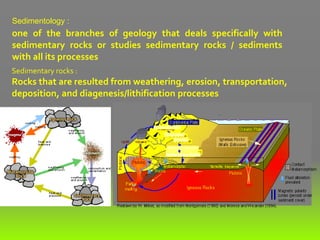
Sedimentology :
Sedimentary rocks :
Rocks that are resulted from weathering, erosion, transportation,
deposition, and diagenesis/lithification processes
Weathering/erosion
Transportation
Deposition
Sedimentary Rocks
Lithification/diagenesis
one of the branches of geology that deals specifically with
sedimentary rocks or studies sedimentary rocks / sediments
with all its processes
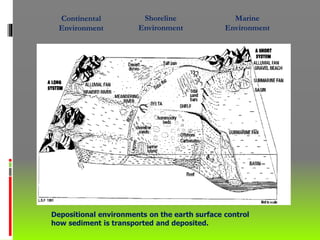
Depositional environments on the earth surface control
how sediment is transported and deposited.
Continental
Environment
Shoreline
Environment
Marine
Environment
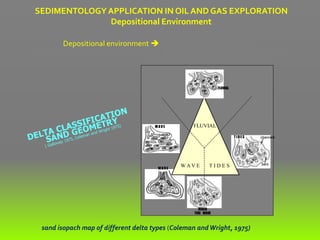
SEDIMENTOLOGYAPPLICATION IN OIL AND GAS EXPLORATION
Depositional Environment
Depositional environment  sediment body geometry 
reservoir heterogeneity  petrophysics  exploration and production strategy
sand isopach map of different delta types (Coleman andWright, 1975)
T I D E S
bars
channels
MIXED
TIDE WAVE
FLUVIAL
W A V E
FLUVIAL
W A V E
W A V E
T I D E S
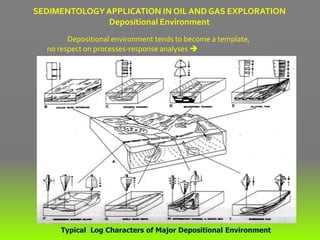
Depositional environment tends to become a template,
no respect on processes-response analyses  mis-interpretation 
failure in exploration and production strategy
Typical Log Characters of Major Depositional Environment
SEDIMENTOLOGYAPPLICATION IN OIL AND GAS EXPLORATION
Depositional Environment
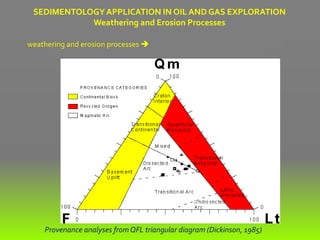
weathering and erosion processes  provenance climate & tectonic setting 
basin history  structural styles  petroleum system analyses 
exploration and production strategy
Provenance analyses from QFL triangular diagram (Dickinson, 1985)
SEDIMENTOLOGYAPPLICATION IN OIL AND GAS EXPLORATION
Weathering and Erosion Processes
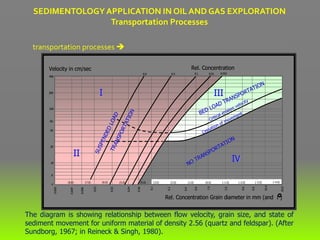
transportation processes  hydrodynamics  forward prediction of texture
 reservoir quality & distribution  exploration and production strategy
II
IIII
IIIIII
IVIV
Rel. ConcentrationVelocity in cm/sec
SUSPENDEDLOAD
SUSPENDEDLOAD
NO TRANSPORTATION
NO TRANSPORTATION
BED LOAD TRANSPORTATION
TRANSPORTATION
TRANSPORTATION
Critical erosion velocity
Cessation of movement
400
200
100
60
40
20
10
6
4
0.002
0.004
0.006
0.01
0.02
0.06
0.04
0.1
0.2
0.4
0.6
1.0
2.0
4.0
6.0
10.0
20.0
0.0010.010.10.50.9
Rel. Concentration Grain diameter in mm (and  )
o
(8.0) (7.0) (6.0) (5.0) (4.0) (3.0) (2.0) (1.0) (0.0) (-1.0) (-2.0) (-3.0) (-4.0)
II
IIII
IIIIII
IVIV
Rel. ConcentrationVelocity in cm/sec
SUSPENDEDLOAD
SUSPENDEDLOAD
NO TRANSPORTATION
NO TRANSPORTATION
BED LOAD TRANSPORTATION
TRANSPORTATION
TRANSPORTATION
Critical erosion velocity
Cessation of movement
400
200
100
60
40
20
10
6
4
0.002
0.004
0.006
0.01
0.02
0.06
0.04
0.1
0.2
0.4
0.6
1.0
2.0
4.0
6.0
10.0
20.0
0.0010.010.10.50.9
Rel. Concentration Grain diameter in mm (and  )
o
(8.0) (7.0) (6.0) (5.0) (4.0) (3.0) (2.0) (1.0) (0.0) (-1.0) (-2.0) (-3.0) (-4.0)
The diagram is showing relationship between flow velocity, grain size, and state of
sediment movement for uniform material of density 2.56 (quartz and feldspar). (After
Sundborg, 1967; in Reineck & Singh, 1980).
SEDIMENTOLOGYAPPLICATION IN OIL AND GAS EXPLORATION
Transportation Processes
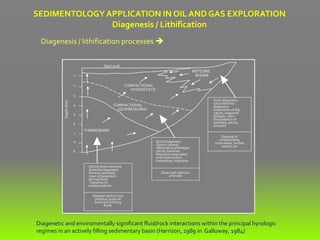
Diagenesis / lithification processes  basin fluid-flow & burial history 
petroleum system analyses  exploration and production strategy
Diagenetic and enviromentally significant fluid/rock interactions within the principal hyrologic
regimes in an actively filling sedimentary basin (Harrison, 1989 in Galloway, 1984)
Sea Level
COMPACTIONAL
HYDROSTATIC
COMPACTIONAL
GEOPRESSURED
THERMOBARIC
METEORIC
REGIME
- Dehydration reactions
- Smectite diagenesis
- Ferroan carboates
- Input of basement-
derived fluids
- Transition to
metamorphism
- Burial diagenesis
- Quartz cement
- Albitization of feldspar
calcite, kaolinite
- Reactions associated
with hydrocarbon
maturation, migration
- Early diagenesis
- Unconformity
diagenesis
- Dissolution of Mg-
calcite, aragonite
feldspar, chert
- Precipitation of
kaolinite, calcite,
smectite
Disposal of
contaminants,
mine waste, nuclear
waster, etc
Deep well injection
of brines
Deepest wells (7 km)
produce; origin of
some ore-forming
fluids
9
8
7
6
5
4
3
2
1
Depth(km)
SEDIMENTOLOGYAPPLICATION IN OIL AND GAS EXPLORATION
Diagenesis / Lithification
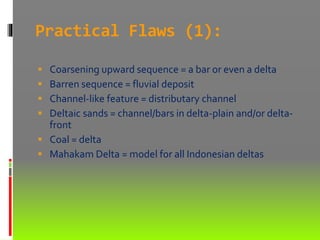
Practical Flaws (1):
 Coarsening upward sequence = a bar or even a delta
 Barren sequence = fluvial deposit
 Channel-like feature = distributary channel
 Deltaic sands = channel/bars in delta-plain and/or delta-
front
 Coal = delta
 Mahakam Delta = model for all Indonesian deltas
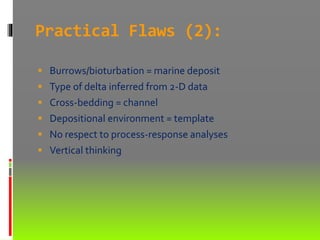
Practical Flaws (2):
 Burrows/bioturbation = marine deposit
 Type of delta inferred from 2-D data
 Cross-bedding = channel
 Depositional environment = template
 No respect to process-response analyses
 Vertical thinking
2. HYDRODYNAMICS: Sediment transport
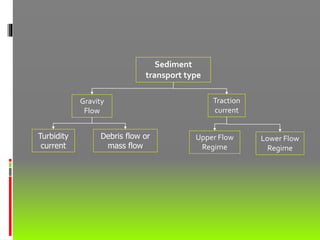
Sediment
transport type
Gravity
Flow
Traction
current
Turbidity
current
Upper Flow
Regime
Debris flow or
mass flow
Lower Flow
Regime
Water surface
Stream bed
A
Water surface
Stream bed
B
Water surface
Stream bed
C
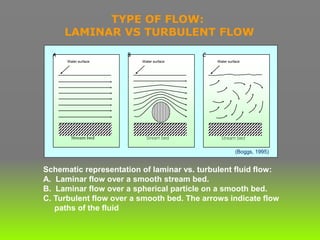
Schematic representation of laminar vs. turbulent fluid flow:
A. Laminar flow over a smooth stream bed.
B. Laminar flow over a spherical particle on a smooth bed.
C. Turbulent flow over a smooth bed. The arrows indicate flow
paths of the fluid
(Boggs, 1995)
TYPE OF FLOW:
LAMINAR VS TURBULENT FLOW
TRACTION CURRENT
Traction Current
Character: the movement of water which cause the
sediments to be carried at the bottom of the water.
Traction current  clear water, only shear stress
between H20 molecules so moving the sands below it.
TRANSPORTATION
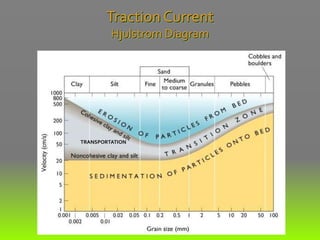
Traction Current
Hjulstrom Diagram
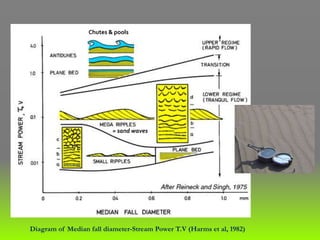
Diagram of Median fall diameter-Stream Power T.V (Harms et al, 1982)
Chutes & pools
= sand waves
Traction Current
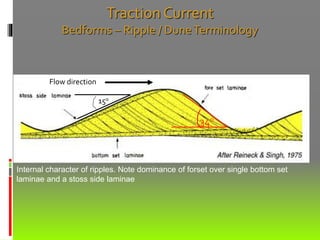
Bedforms – Ripple / DuneTerminology
Flow direction
Internal character of ripples. Note dominance of forset over single bottom set
laminae and a stoss side laminae
15o
34o
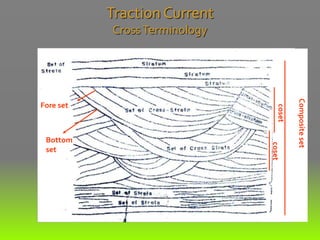
Bottom
set
Fore set
coset
Compositeset
Traction Current
CrossTerminology
coset
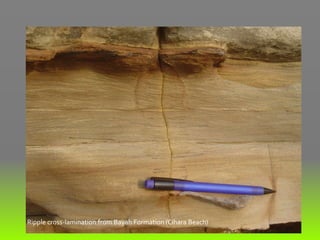
Ripple cross-lamination from Bayah Formation (Cihara Beach)
Traction Current
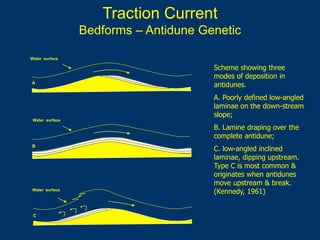
Bedforms – Antidune Genetic
A
B
C
Water surface
Water surface
Water surface
Scheme showing three
modes of deposition in
antidunes.
A. Poorly defined low-angled
laminae on the down-stream
slope;
B. Lamine draping over the
complete antidune;
C. low-angled inclined
laminae, dipping upstream.
Type C is most common &
originates when antidunes
move upstream & break.
(Kennedy, 1961)
Traction Current
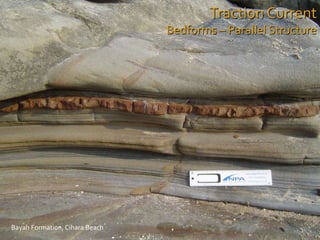
Bedforms – Parallel Structure
Bayah Formation, Cihara Beach
GRAVITY FLOW
Gravity Flow
 Gravity flow is another type of sediment which due
primarily to the difference in density between water
with suspended sediments and clear water outside
the suspension.
 It can take place in otherwise still water.
 The water contain suspended grains  grains move
with water and deposited
 Turbidity current: sediment which is carried in
suspension by turbulent current is borne out onto a
slope  gain a gravitational component become
suspension is heavier than the surrounding clear
water  turn into a density current (turbidity
current)
 Turbidity current consist of suspensions of sediment
in water.
Gravity Flow
Turbidity current
Gravity Flow
Turbidity current
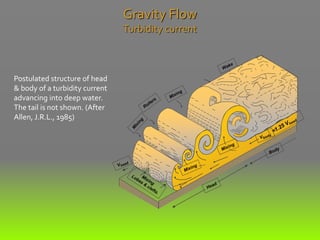
Postulated structure of head
& body of a turbidity current
advancing into deep water.
The tail is not shown. (After
Allen, J.R.L., 1985)
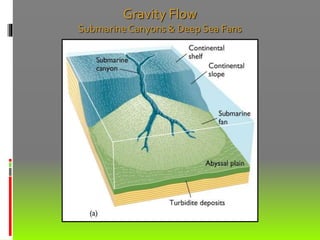
Gravity Flow
Submarine Canyons & Deep Sea Fans
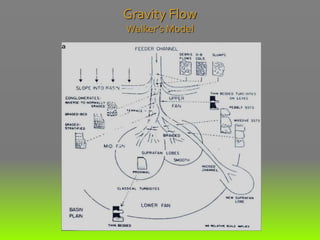
Gravity Flow
Walker’s Model
Grain
Size
Fines
up
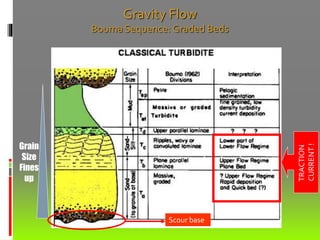
Gravity Flow
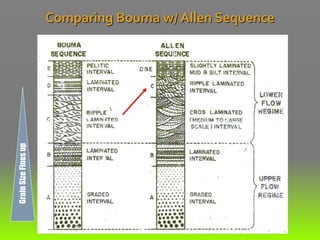
Bouma Sequence: Graded Beds
Scour base
TRACTION
CURRENT!
3. SEDIMENTARY STRUCTURES
A key to the interpretation of the
“Depositional Setting” of sedimentary rocks
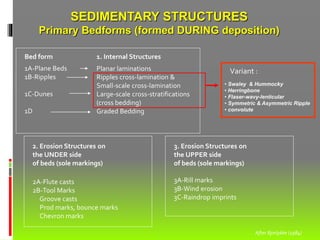
SEDIMENTARY STRUCTURES
Primary Bedforms (formed DURING deposition)
2A-Flute casts
2B-Tool Marks
Groove casts
Prod marks, bounce marks
Chevron marks
2. Erosion Structures on
the UNDER side
of beds (sole markings)
3A-Rill marks
3B-Wind erosion
3C-Raindrop imprints
3. Erosion Structures on
the UPPER side
of beds (sole markings)
1A-Plane Beds
1B-Ripples
1C-Dunes
1D
Planar laminations
Ripples cross-lamination &
Small-scale cross-lamination
Large-scale cross-stratifications
(cross bedding)
Graded Bedding
1. Internal Structures
After Bjorlykke (1984)
• Swaley & Hummocky
• Herringbone
• Flaser-wavy-lenticular
• Symmetric & Asymmetric Ripple
• convolute
Variant :
Bed form
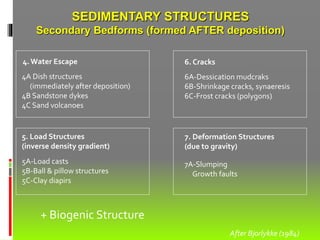
SEDIMENTARY STRUCTURES
Secondary Bedforms (formed AFTER deposition)
4A Dish structures
(immediately after deposition)
4B Sandstone dykes
4C Sand volcanoes
4. Water Escape
6A-Dessication mudcraks
6B-Shrinkage cracks, synaeresis
6C-Frost cracks (polygons)
6. Cracks
7A-Slumping
Growth faults
7. Deformation Structures
(due to gravity)
5A-Load casts
5B-Ball & pillow structures
5C-Clay diapirs
5. Load Structures
(inverse density gradient)
After Bjorlykke (1984)
+ Biogenic Structure
1.a. Primary Bedform:
Cross Stratification
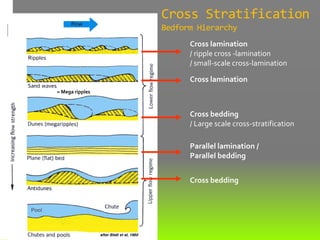
= Mega ripples
Cross lamination
/ ripple cross -lamination
/ small-scale cross-lamination
Cross lamination
Cross bedding
/ Large scale cross-stratification
Parallel lamination /
Parallel bedding
Cross bedding
Cross Stratification
Bedform Hierarchy
Cross Stratification
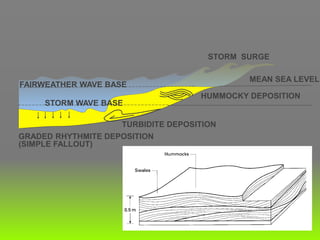
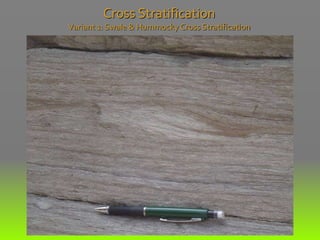
Variant 1: Swale & Hummocky Cross Stratification
STORM SURGE
MEAN SEA LEVEL
HUMMOCKY DEPOSITION
TURBIDITE DEPOSITION
FAIRWEATHER WAVE BASE
STORM WAVE BASE
GRADED RHYTHMITE DEPOSITION
(SIMPLE FALLOUT)
Cross Stratification
Variant 1: Swale & Hummocky Cross Stratification
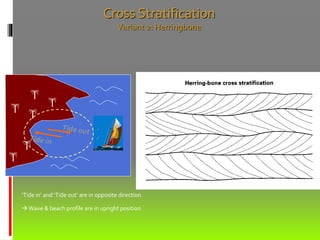
Cross Stratification
Variant 2: Herringbone
‘Tide in’ and ‘Tide out’ are in opposite direction
Wave & beach profile are in upright position
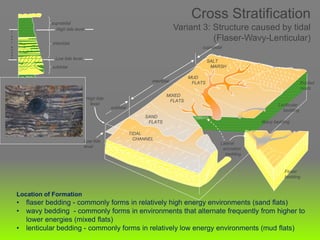
Location of Formation
• flaser bedding - commonly forms in relatively high energy environments (sand flats)
• wavy bedding - commonly forms in environments that alternate frequently from higher to
lower energies (mixed flats)
• lenticular bedding - commonly forms in relatively low energy environments (mud flats)
Cross Stratification
Variant 3: Structure caused by tidal
(Flaser-Wavy-Lenticular)
subtidal
Low tide level
intertidal
High tide level
supratidal
T
I
D
A
L
R
A
N
G
E
TIDAL
CHANNEL
SAND
FLATS
MIXED
FLATS
MUD
FLATS
SALT
MARSH
Lenticular
bedding
subtidal
Wavy bedding
Roofed
muds
Fioser
bedding
Lateral
accretion
bedding
Low tide
level
High tide
level
intertidal
supratidal
Cross Stratification
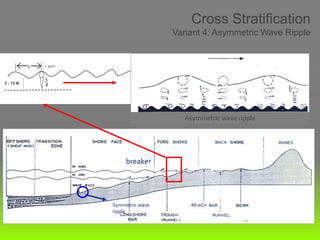
Variant 4: Asymmetric Wave Ripple
2
L
L
5 - 15 M
= 30m
Symmetric wave
ripple
Asymmetric wave ripple
breaker
1.b. Primary Bedform:
Non-Cross Stratification
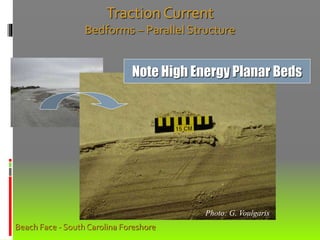
Note High Energy Planar Beds
Photo: G. Voulgaris
Beach Face - South Carolina Foreshore
Traction Current
Bedforms – Parallel Structure
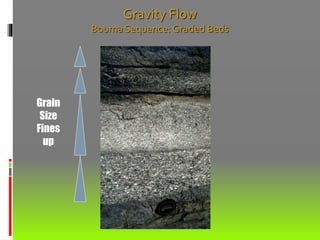
Grain
Size
Fines
up
Gravity Flow
Bouma Sequence: Graded Beds
2. Primary Bedform:
Erosion Structures on
the UNDER side
of beds (sole markings)
Flute casts,Tool Marks, Groove casts,
Crescent, Prod marks, bounce marks,
Chevron marks
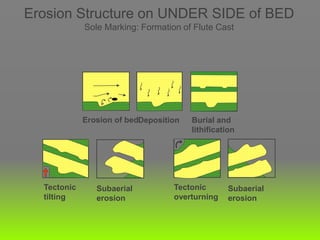
Erosion Structure on UNDER SIDE of BED
Sole Marking: Formation of Flute Cast
Erosion of bedDeposition Burial and
lithification
Subaerial
erosion
Tectonic
tilting
Tectonic
overturning
Subaerial
erosion
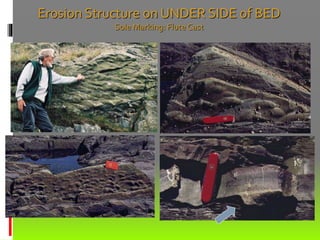
Erosion Structure on UNDER SIDE of BED
Sole Marking: Flute Cast
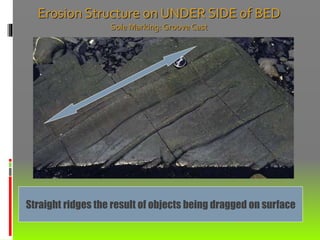
Straight ridges the result of objects being dragged on surface
Erosion Structure on UNDER SIDE of BED
Sole Marking:Groove Cast
Erosion Structure on UNDER SIDE of BED
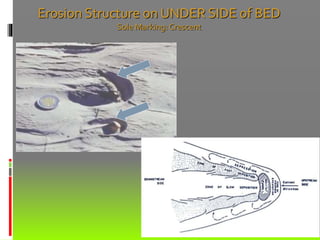
Sole Marking:Crescent
3. Primary Bedform:
Erosion Structures on
the UPPER side
of beds (sole markings)
Rill marks,Wind erosion,
Raindrop imprints
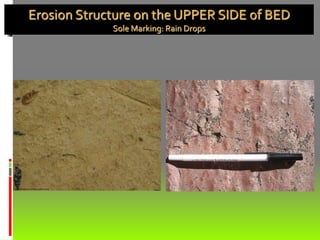
Erosion Structure on the UPPER SIDE of BED
Sole Marking: Rain Drops
4. Secondary Bedform:
Water Escape
Dish structures,
Sandstone dykes,
Sand volcanoes
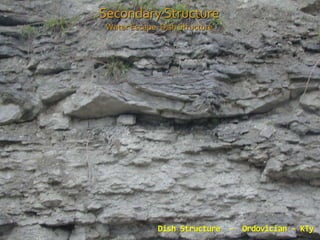
Dish Structure - Ordovician - KTy
Secondary Structure
Water Escape: Dish Structure
5. Secondary Bedform:
Load Structures
Load Casts,
Flame Structures,
Ball & Pillow Structures,
Clay Diapirs
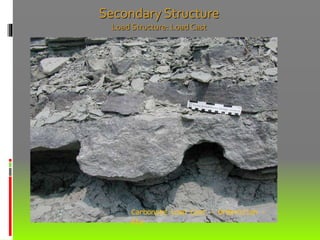
Carbonate Load Cast – Ordovician -
Kty
Secondary Structure
Load Structure: Load Cast
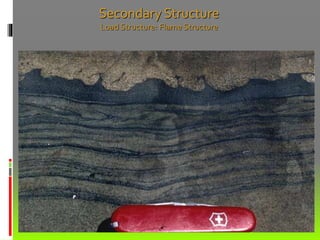
Secondary Structure
Load Structure: Flame Structure
Secondary Structure
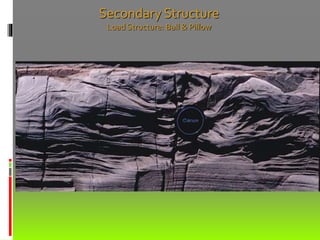
Load Structure: Ball & Pillow
6. Secondary Bedform:
Cracks
Dessication mudcraks,
Shrinkage cracks, synaeresis
Frost cracks (polygons)
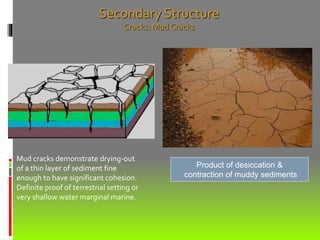
Product of desiccation &
contraction of muddy sediments
Secondary Structure
Cracks: Mud Cracks
Mud cracks demonstrate drying-out
of a thin layer of sediment fine
enough to have significant cohesion.
Definite proof of terrestrial setting or
very shallow water marginal marine.
7. Secondary Bedform:
Deformation Structures
Slumping & Growth faults
Secondary Structure
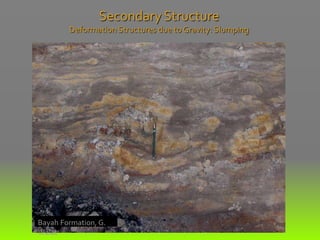
Deformation Structures due to Gravity: Slumping
Bayah Formation, G.
Walat
Secondary Structure
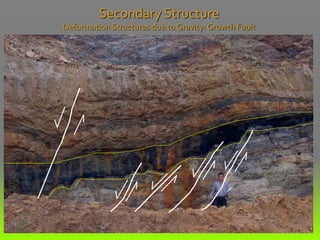
Deformation Structures due to Gravity: Growth Fault
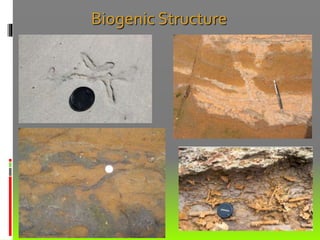
Biogenic Structure
SOME CLUES … !
GrainSizeFinesup
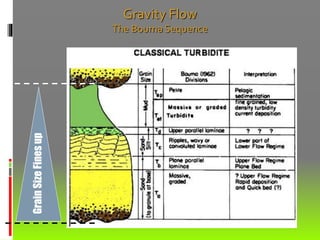
Gravity Flow
The Bouma Sequence
Comparing Bouma w/ Allen SequenceGrainSizeFinesup
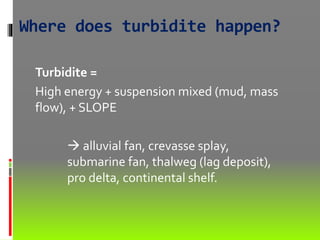
Where does turbidite happen?
Turbidite =
High energy + suspension mixed (mud, mass
flow), + SLOPE
 alluvial fan, crevasse splay,
submarine fan, thalweg (lag deposit),
pro delta, continental shelf.
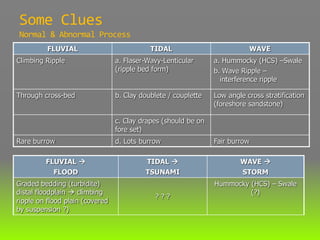
Some Clues
Normal & Abnormal Process
FLUVIAL TIDAL WAVE
Climbing Ripple a. Flaser-Wavy-Lenticular
(ripple bed form)
a. Hummocky (HCS) –Swale
b. Wave Ripple –
interference ripple
Through cross-bed b. Clay doublete / couplette Low angle cross stratification
(foreshore sandstone)
c. Clay drapes (should be on
fore set)
Rare burrow d. Lots burrow Fair burrow
FLUVIAL 
FLOOD
TIDAL 
TSUNAMI
WAVE 
STORM
Graded bedding (turbidite)
distal floodplain  climbing
ripple on flood plain (covered
by suspension ?)
? ? ?
Hummocky (HCS) – Swale
(?)
Some Clues
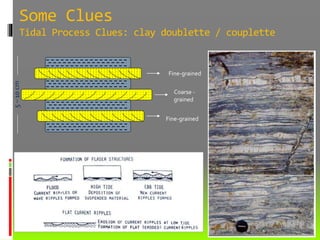
Tidal Process Clues: clay doublette / couplette
Fine-grained
Fine-grained
5–10cm
Some Clues
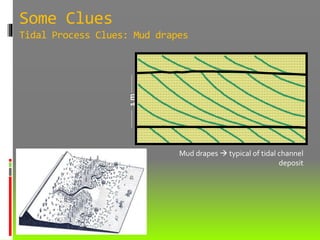
Tidal Process Clues: Mud drapes
1m
Mud drapes  typical of tidal channel
deposit
norm
al
Floo
d
Climbing
ripple
BA
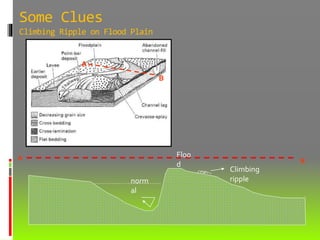
Some Clues
Climbing Ripple on Flood Plain
B
A
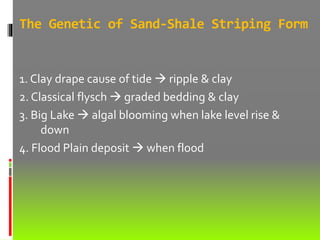
The Genetic of Sand-Shale Striping Form
1. Clay drape cause of tide  ripple & clay
2. Classical flysch  graded bedding & clay
3. Big Lake  algal blooming when lake level rise &
down
4. Flood Plain deposit  when flood
Vertical & Lateral Succession
ThreeTypes of Sediment Accumulations
Vertical Change Succession
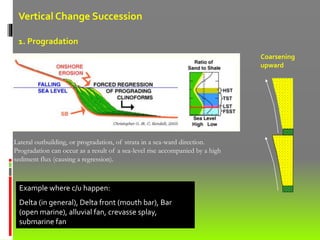
1. Progradation
Lateral outbuilding, or progradation, of strata in a sea-ward direction.
Progradation can occur as a result of a sea-level rise accompanied by a high
sediment flux (causing a regression).
Coarsening
upward
Example where c/u happen:
Delta (in general), Delta front (mouth bar), Bar
(open marine), alluvial fan, crevasse splay,
submarine fan
Vertical Change Succession
2. Aggradation
Vertical build up of a sedimentary sequence. Usually occurs when there is a relative rise
in sea level produced by subsidence and/or eustatic sea-level rise, and the rate of
sediment influx is sufficient to maintain the depositional surface at or near sea level.
Blocky
Massive, no structure: turbid / mass flow (sediment grain
size are all the same)  all to be sedimentation directly ≤ 1 m
Vertical Change Succession
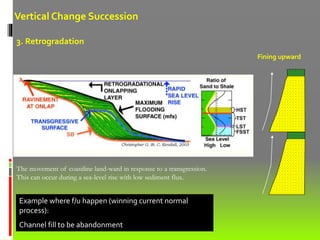
3. Retrogradation
The movement of coastline land-ward in response to a transgression.
This can occur during a sea-level rise with low sediment flux.
Fining upward
Example where f/u happen (winning current normal
process):
Channel fill to be abandonment
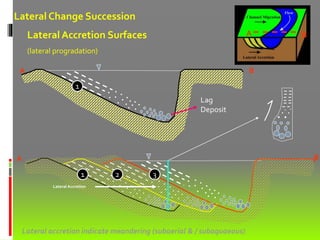
Lateral Accretion Surfaces
(lateral progradation)
..
...
..
........
..
...
..
........
..
...
..
........
..
...
..
........
1
1 2 3
. .... .
BA
Lateral Accretion
BA
BA
Lag
Deposit
Lateral accretion indicate meandering (subaerial & / subaquaeous)
Lateral Change Succession
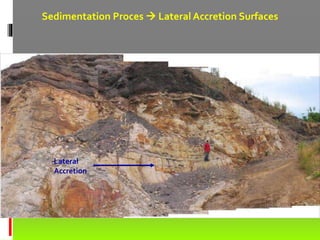
Sedimentation Proces  Lateral Accretion Surfaces
Lateral
Accretion
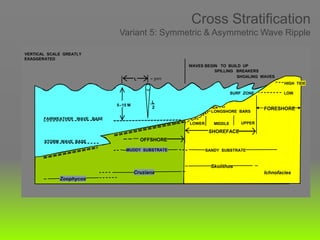
Cross Stratification
Variant 5: Symmetric & Asymmetric Wave Ripple
2
Cruziana
Zoophycos
Skolithos
MUDDY SUBSTRATE SANDY SUBSTRATE
LOWER MIDDLE UPPER
WAVES BEGIN TO BUILD UP
SHOALING WAVES
SPILLING BREAKERS
SURF ZONE LOW
HIGH TIDE
Ichnofacies
LONGSHORE BARS
SHOREFACE
OFFSHORE
FORESHORE
STORM WAVE BASE
FAIRWEATHER WAVE BASE
L
5–15 M
L
Cruziana
Zoophycos
Skolithos
MUDDY SUBSTRATE SANDY SUBSTRATE
LOWER MIDDLE UPPER
SURF ZONE LOW
HIGH TIDE
Ichnofacies
LONGSHORE BARS
SHOREFACE
OFFSHORE
FORESHORE
STORM WAVE BASE
FAIRWEATHER WAVE BASE
VERTICAL SCALE GREATLY
EXAGGERATED
L
5–15 M
L
2
= 30m
4. FLUVIAL DELTAIC SEDIMENTATION
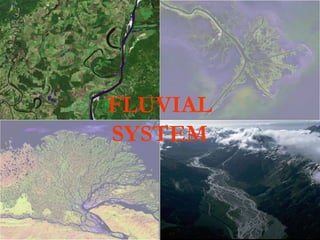
FLUVIAL
SYSTEM
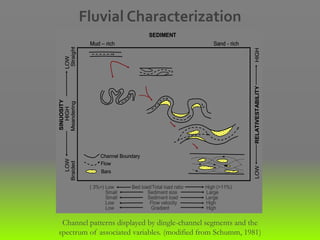
( 3%>) Low Bed load/Total load ratio High (>11%)
Small Sediment size Large
Small Sediment load Large
Low Flow velocity High
Low Gradient High
LOWHIGHLOW
SINUOSITY
BraidedMeanderingStraight
SEDIMENT
Mud – rich Sand - rich
Channel Boundary
Flow
Bars
LOWRELATIVESTABILITYHIGH
( 3%>) Low Bed load/Total load ratio High (>11%)
Small Sediment size Large
Small Sediment load Large
Low Flow velocity High
Low Gradient High
( 3%>) Low Bed load/Total load ratio High (>11%)
Small Sediment size Large
Small Sediment load Large
Low Flow velocity High
Low Gradient High
LOWHIGHLOW
SINUOSITY
BraidedMeanderingStraight
SEDIMENT
Mud – rich Sand - rich
Channel Boundary
Flow
Bars
LOWRELATIVESTABILITYHIGH
Channel patterns displayed by dingle-channel segments and the
spectrum of associated variables. (modified from Schumm, 1981)
Fluvial Characterization
Fluvial Deltaic for
Explorationist
Abandoned
Channel
sequence
Active
Channel
sequence
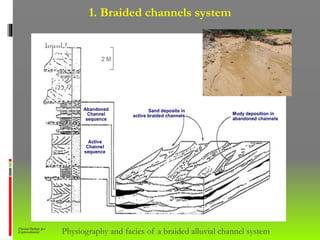
Sand deposite in
active braided channels Mudy deposition in
abandoned channels
2 M
Abandoned
Channel
sequence
Active
Channel
sequence
Sand deposite in
active braided channels Mudy deposition in
abandoned channels
2 M
Physiography and facies of a braided alluvial channel system
1. Braided channels system
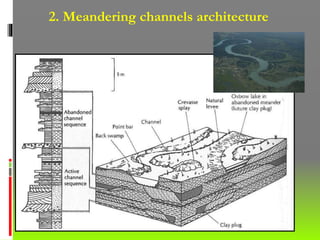
2. Meandering channels architecture
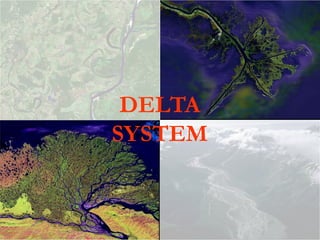
DELTA
SYSTEM
Delta
Why Delta is unique ?
 Delta contains all the petroleum system
components from Source Rock toTrap.
 Processes in Delta are composed of terrestrial
processes & marine processes marine
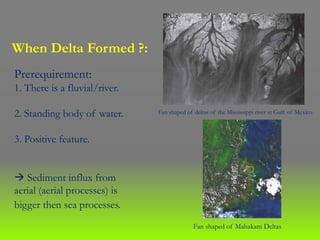
Prerequirement:
1. There is a fluvial/river.
2. Standing body of water.
3. Positive feature.
 Sediment influx from
aerial (aerial processes) is
bigger then sea processes.
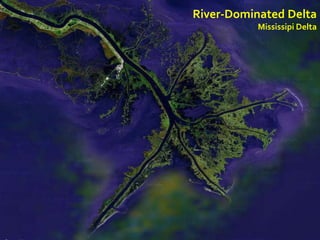
Fan shaped of deltas of the Mississippi river at Gulf of Mexico
Fan shaped of Mahakam Deltas
When Delta Formed ?:
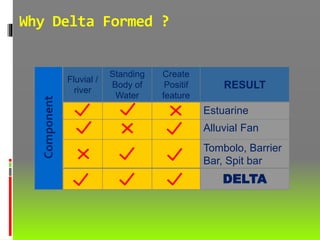
Fluvial /
river
Standing
Body of
Water
Create
Positif
feature
RESULT
Estuarine
Alluvial Fan
Tombolo, Barrier
Bar, Spit bar
DELTA
Component
Why Delta Formed ?
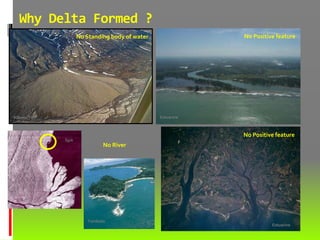
Why Delta Formed ?
Alluvial Fan Estuarine
Spit
Tombolo
Estuarine
No Standing body of water No Positive feature
No River
No Positive feature
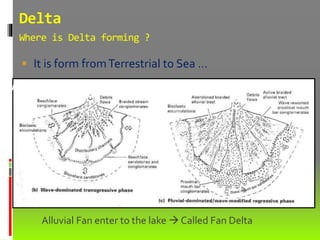
 It is form fromTerrestrial to Sea …
Delta
Where is Delta forming ?
Alluvial Fan enter to the lake  Called Fan Delta
Fan Delta (delta on terrestrial)
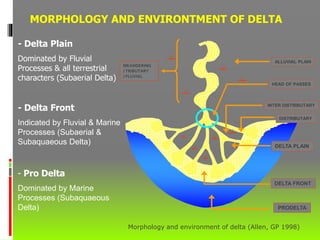
MORPHOLOGY AND ENVIRONTMENT OF DELTA
Morphology and environment of delta (Allen, GP 1998)
- Delta Plain
Dominated by Fluvial
Processes & all terrestrial
characters (Subaerial Delta)
- Delta Front
Indicated by Fluvial & Marine
Processes (Subaerial &
Subaquaeous Delta)
- Pro Delta
Dominated by Marine
Processes (Subaquaeous
Delta)
MEANDERING
/ TRIBUTARY
/ FLUVIAL
DELTA PLAIN
ALLUVIAL PLAIN
DISTRIBUTARY
PRODELTA
DELTA FRONT
INTER DISTRIBUTARY
HEAD OF PASSES
SEDIMENT INPUT
MISSISSIPPI
MAHAKAM
DANUBA
SAO FRANSISCO
COPPER
FLY
WAVE ENERGY FLUX TIDAL ENERGY FLUX
FLIVIAL
DOMINATED
WAVE
DOMINATED
TIDE
DOMINATED
Yukon?
Mahakam
Talu
Calorado
Mekang
Ganges - Brahmaputra
Klang - Langor
Niger
Nile
Ebra
Rhane
Kelantan
Sao Fransisco
Brotos
Burdenia
Si Bernard
(Miss)
Pa
Danube
Lefourch
(Miss)
Praquemines
ModernMiss
Fly
Cooper
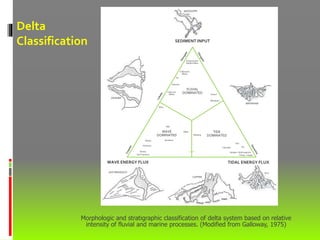
Morphologic and stratigraphic classification of delta system based on relative
intensity of fluvial and marine processes. (Modified from Galloway, 1975)
Delta
Classification
FLUVIAL-DOMINATED DELTA
(FLUVIAL INFLUENCE)
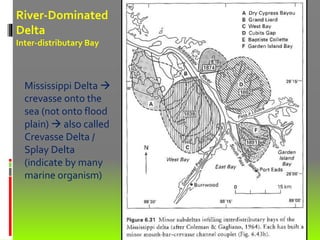
Mississippi Delta 
crevasse onto the
sea (not onto flood
plain)  also called
Crevasse Delta /
Splay Delta
(indicate by many
marine organism)
River-Dominated
Delta
Inter-distributary Bay
River-Dominated Delta
Mississipi Delta
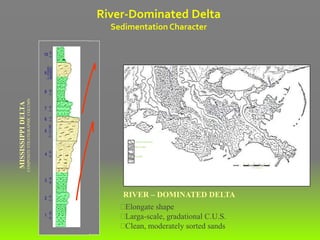
RIVER – DOMINATED DELTA
Elongate shape
Larga-scale, gradational C.U.S.
Clean, moderately sorted sands
MISSISSIPPIDELTA
COMPOSITESTRATIGRAPHICCOLUMN
0 10 20 30 40 50
Kilometers
Channel deposite
Sand ridge
Swamp
River-Dominated Delta
Sedimentation Character
10
2-24
9
8
7
6
5
4
3
2
1
3–10EACH
SEQUENCE3-243-102-612–21(>90)10-2418-443-1518-120
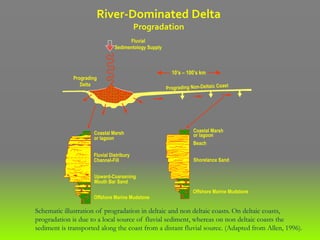
Schematic illustration of progradation in deltaic and non deltaic coasts. On deltaic coasts,
progradation is due to a local source of fluvial sediment, whereas on non deltaic coasts the
sediment is transported along the coast from a distant fluvial source. (Adapted from Allen, 1996).
Fluvial
Sedimentology Supply
Prograding
Delta
10’s – 100’s km
Coastal Marsh
or lagoon
Fluvial Distribury
Channel-Fill
Upward-Coarsening
Mouth Bar Sand
Offshore Marine Mudstone
Shorelance Sand
Beach
Coastal Marsh
or lagoon
River-Dominated Delta
Progradation
WAVE-DOMINATED DELTA
(TIDE INFLUENCE)
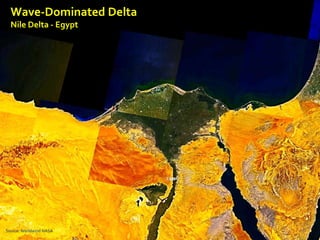
Wave-Dominated Delta
Nile Delta - Egypt
Source: Worldwind NASA
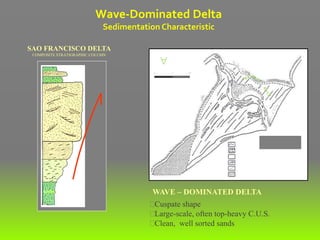
WAVE – DOMINATED DELTA
Cuspate shape
Large-scale, often top-heavy C.U.S.
Clean, well sorted sands
ATLANTIC
OCEAN
0
|
5
|
10
|

Wave-Dominated Delta
Sedimentation Characteristic
SAO FRANCISCO DELTA
COMPOSITE STRATIGRAPHIC COLUMN
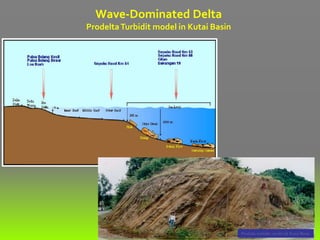
Prodelta turbidite model @ Kutei Basin
Wave-Dominated Delta
ProdeltaTurbidit model in Kutai Basin
TIDE-DOMINATED DELTA
(TIDE INFLUENCE)
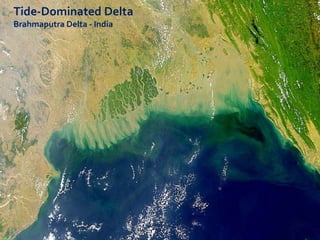
Tide-Dominated Delta
Brahmaputra Delta - India
0 5
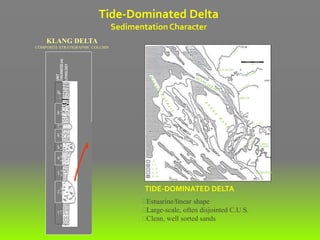
TIDE-DOMINATED DELTA
Estuarine/linear shape
Large-scale, often disjointed C.U.S.
Clean, well sorted sands
< 3
miles
T. KARANG
JERAM
K. MORIB
P. SWET-
TENHAM
3 - 5
5 - 10
10 - 20
20 - 60
KLANG DELTA
COMPOSITE STRATIGRAPHIC COLUMN
Tide-Dominated Delta
Sedimentation Character
9
8
7
6
5
4
3
2
1
3–18
3-62-53-85-246-1210-1810-24>12
UNIT
THICKNESS(m)
LITHOLOGY
RIVER & TIDE-DOMINATED DELTA
(MAHAKAM DELTA)
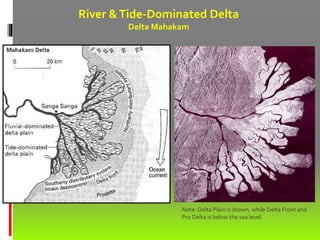
River &Tide-Dominated Delta
Delta Mahakam
Note: Delta Plain is shown, while Delta Front and
Pro Delta is below the sea level.
SOME CLUES … !
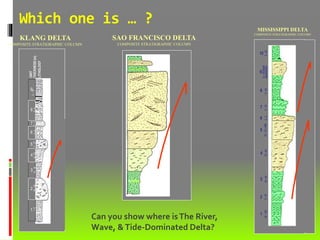
Which one is … ?
9
8
7
6
5
4
3
2
1
3–18
3-62-53-85-246-1210-1810-24>12
UNIT
THICKNESS(m)
LITHOLOGYKLANG DELTA
COMPOSITE STRATIGRAPHIC COLUMN
SAO FRANCISCO DELTA
COMPOSITE STRATIGRAPHIC COLUMN
10
2-24
9
8
7
6
5
4
3
2
1
3–10EACH
SEQUENCE3-243-102-612–21(>90)10-2418-443-1518-120
MISSISSIPPI DELTA
COMPOSITE STRATIGRAPHIC COLUMN
Can you show where isThe River,
Wave, &Tide-Dominated Delta?
Core Identification …
The core character which likely indicateWave, Fluvial &Tide-Dominated
Delta are:
 Wave-dominated Delta abundant wave processes:
wave ripple, swalley, HCS, beach deposit (low angle cross lamination),
biogenic structure,
 Tide-dominated Delta  abundant tide processes:
Herringbone cross sratification, mud drapes / clay drape on foreset,
flaser-wavy-lenticular, clay doublet, biogenic structure.
 Fluvial-dominated Delta  Fluvial character:
Climbing ripple, graded bedding, burrowing
Reference
From many Sources

Sedimentology application in petroleum industry

  • 1.
  • 2.
    CONTENT 1. INTRODUCTION TOSEDIMENTOLOGY 2. HYDRODYNAMICS: SEDIMENTTRANSPORT 3. SEDIMENTARY STRUCTURE 4. FLUVIAL DELTAIC SEDIMENTATION
  • 3.
  • 4.
    Sedimentology : Sedimentary rocks: Rocks that are resulted from weathering, erosion, transportation, deposition, and diagenesis/lithification processes Weathering/erosion Transportation Deposition Sedimentary Rocks Lithification/diagenesis one of the branches of geology that deals specifically with sedimentary rocks or studies sedimentary rocks / sediments with all its processes
  • 5.
    Depositional environments onthe earth surface control how sediment is transported and deposited. Continental Environment Shoreline Environment Marine Environment
  • 6.
    SEDIMENTOLOGYAPPLICATION IN OILAND GAS EXPLORATION Depositional Environment Depositional environment  sediment body geometry  reservoir heterogeneity  petrophysics  exploration and production strategy sand isopach map of different delta types (Coleman andWright, 1975) T I D E S bars channels MIXED TIDE WAVE FLUVIAL W A V E FLUVIAL W A V E W A V E T I D E S
  • 7.
    Depositional environment tendsto become a template, no respect on processes-response analyses  mis-interpretation  failure in exploration and production strategy Typical Log Characters of Major Depositional Environment SEDIMENTOLOGYAPPLICATION IN OIL AND GAS EXPLORATION Depositional Environment
  • 8.
    weathering and erosionprocesses  provenance climate & tectonic setting  basin history  structural styles  petroleum system analyses  exploration and production strategy Provenance analyses from QFL triangular diagram (Dickinson, 1985) SEDIMENTOLOGYAPPLICATION IN OIL AND GAS EXPLORATION Weathering and Erosion Processes
  • 9.
    transportation processes hydrodynamics  forward prediction of texture  reservoir quality & distribution  exploration and production strategy II IIII IIIIII IVIV Rel. ConcentrationVelocity in cm/sec SUSPENDEDLOAD SUSPENDEDLOAD NO TRANSPORTATION NO TRANSPORTATION BED LOAD TRANSPORTATION BED LOAD TRANSPORTATION TRANSPORTATION TRANSPORTATION Critical erosion velocity Cessation of movement 400 200 100 60 40 20 10 6 4 0.002 0.004 0.006 0.01 0.02 0.06 0.04 0.1 0.2 0.4 0.6 1.0 2.0 4.0 6.0 10.0 20.0 0.0010.010.10.50.9 Rel. Concentration Grain diameter in mm (and  ) o (8.0) (7.0) (6.0) (5.0) (4.0) (3.0) (2.0) (1.0) (0.0) (-1.0) (-2.0) (-3.0) (-4.0) II IIII IIIIII IVIV Rel. ConcentrationVelocity in cm/sec SUSPENDEDLOAD SUSPENDEDLOAD NO TRANSPORTATION NO TRANSPORTATION BED LOAD TRANSPORTATION BED LOAD TRANSPORTATION TRANSPORTATION TRANSPORTATION Critical erosion velocity Cessation of movement 400 200 100 60 40 20 10 6 4 0.002 0.004 0.006 0.01 0.02 0.06 0.04 0.1 0.2 0.4 0.6 1.0 2.0 4.0 6.0 10.0 20.0 0.0010.010.10.50.9 Rel. Concentration Grain diameter in mm (and  ) o (8.0) (7.0) (6.0) (5.0) (4.0) (3.0) (2.0) (1.0) (0.0) (-1.0) (-2.0) (-3.0) (-4.0) The diagram is showing relationship between flow velocity, grain size, and state of sediment movement for uniform material of density 2.56 (quartz and feldspar). (After Sundborg, 1967; in Reineck & Singh, 1980). SEDIMENTOLOGYAPPLICATION IN OIL AND GAS EXPLORATION Transportation Processes
  • 10.
    Diagenesis / lithificationprocesses  basin fluid-flow & burial history  petroleum system analyses  exploration and production strategy Diagenetic and enviromentally significant fluid/rock interactions within the principal hyrologic regimes in an actively filling sedimentary basin (Harrison, 1989 in Galloway, 1984) Sea Level COMPACTIONAL HYDROSTATIC COMPACTIONAL GEOPRESSURED THERMOBARIC METEORIC REGIME - Dehydration reactions - Smectite diagenesis - Ferroan carboates - Input of basement- derived fluids - Transition to metamorphism - Burial diagenesis - Quartz cement - Albitization of feldspar calcite, kaolinite - Reactions associated with hydrocarbon maturation, migration - Early diagenesis - Unconformity diagenesis - Dissolution of Mg- calcite, aragonite feldspar, chert - Precipitation of kaolinite, calcite, smectite Disposal of contaminants, mine waste, nuclear waster, etc Deep well injection of brines Deepest wells (7 km) produce; origin of some ore-forming fluids 9 8 7 6 5 4 3 2 1 Depth(km) SEDIMENTOLOGYAPPLICATION IN OIL AND GAS EXPLORATION Diagenesis / Lithification
  • 11.
    Practical Flaws (1): Coarsening upward sequence = a bar or even a delta  Barren sequence = fluvial deposit  Channel-like feature = distributary channel  Deltaic sands = channel/bars in delta-plain and/or delta- front  Coal = delta  Mahakam Delta = model for all Indonesian deltas
  • 12.
    Practical Flaws (2): Burrows/bioturbation = marine deposit  Type of delta inferred from 2-D data  Cross-bedding = channel  Depositional environment = template  No respect to process-response analyses  Vertical thinking
  • 13.
  • 14.
  • 15.
    Water surface Stream bed A Watersurface Stream bed B Water surface Stream bed C Schematic representation of laminar vs. turbulent fluid flow: A. Laminar flow over a smooth stream bed. B. Laminar flow over a spherical particle on a smooth bed. C. Turbulent flow over a smooth bed. The arrows indicate flow paths of the fluid (Boggs, 1995) TYPE OF FLOW: LAMINAR VS TURBULENT FLOW
  • 16.
  • 17.
    Traction Current Character: themovement of water which cause the sediments to be carried at the bottom of the water. Traction current  clear water, only shear stress between H20 molecules so moving the sands below it.
  • 18.
  • 19.
    Diagram of Medianfall diameter-Stream Power T.V (Harms et al, 1982) Chutes & pools = sand waves
  • 20.
    Traction Current Bedforms –Ripple / DuneTerminology Flow direction Internal character of ripples. Note dominance of forset over single bottom set laminae and a stoss side laminae 15o 34o
  • 21.
  • 22.
    Ripple cross-lamination fromBayah Formation (Cihara Beach)
  • 23.
    Traction Current Bedforms –Antidune Genetic A B C Water surface Water surface Water surface Scheme showing three modes of deposition in antidunes. A. Poorly defined low-angled laminae on the down-stream slope; B. Lamine draping over the complete antidune; C. low-angled inclined laminae, dipping upstream. Type C is most common & originates when antidunes move upstream & break. (Kennedy, 1961)
  • 24.
    Traction Current Bedforms –Parallel Structure Bayah Formation, Cihara Beach
  • 25.
  • 26.
    Gravity Flow  Gravityflow is another type of sediment which due primarily to the difference in density between water with suspended sediments and clear water outside the suspension.  It can take place in otherwise still water.  The water contain suspended grains  grains move with water and deposited
  • 27.
     Turbidity current:sediment which is carried in suspension by turbulent current is borne out onto a slope  gain a gravitational component become suspension is heavier than the surrounding clear water  turn into a density current (turbidity current)  Turbidity current consist of suspensions of sediment in water. Gravity Flow Turbidity current
  • 28.
    Gravity Flow Turbidity current Postulatedstructure of head & body of a turbidity current advancing into deep water. The tail is not shown. (After Allen, J.R.L., 1985)
  • 29.
  • 30.
  • 31.
    Grain Size Fines up Gravity Flow Bouma Sequence:Graded Beds Scour base TRACTION CURRENT!
  • 32.
    3. SEDIMENTARY STRUCTURES Akey to the interpretation of the “Depositional Setting” of sedimentary rocks
  • 33.
    SEDIMENTARY STRUCTURES Primary Bedforms(formed DURING deposition) 2A-Flute casts 2B-Tool Marks Groove casts Prod marks, bounce marks Chevron marks 2. Erosion Structures on the UNDER side of beds (sole markings) 3A-Rill marks 3B-Wind erosion 3C-Raindrop imprints 3. Erosion Structures on the UPPER side of beds (sole markings) 1A-Plane Beds 1B-Ripples 1C-Dunes 1D Planar laminations Ripples cross-lamination & Small-scale cross-lamination Large-scale cross-stratifications (cross bedding) Graded Bedding 1. Internal Structures After Bjorlykke (1984) • Swaley & Hummocky • Herringbone • Flaser-wavy-lenticular • Symmetric & Asymmetric Ripple • convolute Variant : Bed form
  • 34.
    SEDIMENTARY STRUCTURES Secondary Bedforms(formed AFTER deposition) 4A Dish structures (immediately after deposition) 4B Sandstone dykes 4C Sand volcanoes 4. Water Escape 6A-Dessication mudcraks 6B-Shrinkage cracks, synaeresis 6C-Frost cracks (polygons) 6. Cracks 7A-Slumping Growth faults 7. Deformation Structures (due to gravity) 5A-Load casts 5B-Ball & pillow structures 5C-Clay diapirs 5. Load Structures (inverse density gradient) After Bjorlykke (1984) + Biogenic Structure
  • 35.
  • 36.
    = Mega ripples Crosslamination / ripple cross -lamination / small-scale cross-lamination Cross lamination Cross bedding / Large scale cross-stratification Parallel lamination / Parallel bedding Cross bedding Cross Stratification Bedform Hierarchy
  • 37.
    Cross Stratification Variant 1:Swale & Hummocky Cross Stratification STORM SURGE MEAN SEA LEVEL HUMMOCKY DEPOSITION TURBIDITE DEPOSITION FAIRWEATHER WAVE BASE STORM WAVE BASE GRADED RHYTHMITE DEPOSITION (SIMPLE FALLOUT)
  • 38.
    Cross Stratification Variant 1:Swale & Hummocky Cross Stratification
  • 39.
    Cross Stratification Variant 2:Herringbone ‘Tide in’ and ‘Tide out’ are in opposite direction Wave & beach profile are in upright position
  • 40.
    Location of Formation •flaser bedding - commonly forms in relatively high energy environments (sand flats) • wavy bedding - commonly forms in environments that alternate frequently from higher to lower energies (mixed flats) • lenticular bedding - commonly forms in relatively low energy environments (mud flats) Cross Stratification Variant 3: Structure caused by tidal (Flaser-Wavy-Lenticular) subtidal Low tide level intertidal High tide level supratidal T I D A L R A N G E TIDAL CHANNEL SAND FLATS MIXED FLATS MUD FLATS SALT MARSH Lenticular bedding subtidal Wavy bedding Roofed muds Fioser bedding Lateral accretion bedding Low tide level High tide level intertidal supratidal
  • 41.
    Cross Stratification Variant 4:Asymmetric Wave Ripple 2 L L 5 - 15 M = 30m Symmetric wave ripple Asymmetric wave ripple breaker
  • 42.
  • 43.
    Note High EnergyPlanar Beds Photo: G. Voulgaris Beach Face - South Carolina Foreshore Traction Current Bedforms – Parallel Structure
  • 44.
  • 45.
    2. Primary Bedform: ErosionStructures on the UNDER side of beds (sole markings) Flute casts,Tool Marks, Groove casts, Crescent, Prod marks, bounce marks, Chevron marks
  • 46.
    Erosion Structure onUNDER SIDE of BED Sole Marking: Formation of Flute Cast Erosion of bedDeposition Burial and lithification Subaerial erosion Tectonic tilting Tectonic overturning Subaerial erosion
  • 47.
    Erosion Structure onUNDER SIDE of BED Sole Marking: Flute Cast
  • 48.
    Straight ridges theresult of objects being dragged on surface Erosion Structure on UNDER SIDE of BED Sole Marking:Groove Cast
  • 49.
    Erosion Structure onUNDER SIDE of BED Sole Marking:Crescent
  • 50.
    3. Primary Bedform: ErosionStructures on the UPPER side of beds (sole markings) Rill marks,Wind erosion, Raindrop imprints
  • 51.
    Erosion Structure onthe UPPER SIDE of BED Sole Marking: Rain Drops
  • 52.
    4. Secondary Bedform: WaterEscape Dish structures, Sandstone dykes, Sand volcanoes
  • 53.
    Dish Structure -Ordovician - KTy Secondary Structure Water Escape: Dish Structure
  • 54.
    5. Secondary Bedform: LoadStructures Load Casts, Flame Structures, Ball & Pillow Structures, Clay Diapirs
  • 55.
    Carbonate Load Cast– Ordovician - Kty Secondary Structure Load Structure: Load Cast
  • 56.
  • 57.
  • 58.
    6. Secondary Bedform: Cracks Dessicationmudcraks, Shrinkage cracks, synaeresis Frost cracks (polygons)
  • 59.
    Product of desiccation& contraction of muddy sediments Secondary Structure Cracks: Mud Cracks Mud cracks demonstrate drying-out of a thin layer of sediment fine enough to have significant cohesion. Definite proof of terrestrial setting or very shallow water marginal marine.
  • 60.
    7. Secondary Bedform: DeformationStructures Slumping & Growth faults
  • 61.
    Secondary Structure Deformation Structuresdue to Gravity: Slumping Bayah Formation, G. Walat
  • 62.
    Secondary Structure Deformation Structuresdue to Gravity: Growth Fault
  • 63.
  • 64.
  • 65.
  • 66.
    Comparing Bouma w/Allen SequenceGrainSizeFinesup
  • 67.
    Where does turbiditehappen? Turbidite = High energy + suspension mixed (mud, mass flow), + SLOPE  alluvial fan, crevasse splay, submarine fan, thalweg (lag deposit), pro delta, continental shelf.
  • 68.
    Some Clues Normal &Abnormal Process FLUVIAL TIDAL WAVE Climbing Ripple a. Flaser-Wavy-Lenticular (ripple bed form) a. Hummocky (HCS) –Swale b. Wave Ripple – interference ripple Through cross-bed b. Clay doublete / couplette Low angle cross stratification (foreshore sandstone) c. Clay drapes (should be on fore set) Rare burrow d. Lots burrow Fair burrow FLUVIAL  FLOOD TIDAL  TSUNAMI WAVE  STORM Graded bedding (turbidite) distal floodplain  climbing ripple on flood plain (covered by suspension ?) ? ? ? Hummocky (HCS) – Swale (?)
  • 69.
    Some Clues Tidal ProcessClues: clay doublette / couplette Fine-grained Fine-grained 5–10cm
  • 70.
    Some Clues Tidal ProcessClues: Mud drapes 1m Mud drapes  typical of tidal channel deposit
  • 71.
  • 72.
    The Genetic ofSand-Shale Striping Form 1. Clay drape cause of tide  ripple & clay 2. Classical flysch  graded bedding & clay 3. Big Lake  algal blooming when lake level rise & down 4. Flood Plain deposit  when flood
  • 73.
    Vertical & LateralSuccession ThreeTypes of Sediment Accumulations
  • 74.
    Vertical Change Succession 1.Progradation Lateral outbuilding, or progradation, of strata in a sea-ward direction. Progradation can occur as a result of a sea-level rise accompanied by a high sediment flux (causing a regression). Coarsening upward Example where c/u happen: Delta (in general), Delta front (mouth bar), Bar (open marine), alluvial fan, crevasse splay, submarine fan
  • 75.
    Vertical Change Succession 2.Aggradation Vertical build up of a sedimentary sequence. Usually occurs when there is a relative rise in sea level produced by subsidence and/or eustatic sea-level rise, and the rate of sediment influx is sufficient to maintain the depositional surface at or near sea level. Blocky Massive, no structure: turbid / mass flow (sediment grain size are all the same)  all to be sedimentation directly ≤ 1 m
  • 76.
    Vertical Change Succession 3.Retrogradation The movement of coastline land-ward in response to a transgression. This can occur during a sea-level rise with low sediment flux. Fining upward Example where f/u happen (winning current normal process): Channel fill to be abandonment
  • 77.
    Lateral Accretion Surfaces (lateralprogradation) .. ... .. ........ .. ... .. ........ .. ... .. ........ .. ... .. ........ 1 1 2 3 . .... . BA Lateral Accretion BA BA Lag Deposit Lateral accretion indicate meandering (subaerial & / subaquaeous) Lateral Change Succession
  • 78.
    Sedimentation Proces Lateral Accretion Surfaces Lateral Accretion
  • 79.
    Cross Stratification Variant 5:Symmetric & Asymmetric Wave Ripple 2 Cruziana Zoophycos Skolithos MUDDY SUBSTRATE SANDY SUBSTRATE LOWER MIDDLE UPPER WAVES BEGIN TO BUILD UP SHOALING WAVES SPILLING BREAKERS SURF ZONE LOW HIGH TIDE Ichnofacies LONGSHORE BARS SHOREFACE OFFSHORE FORESHORE STORM WAVE BASE FAIRWEATHER WAVE BASE L 5–15 M L Cruziana Zoophycos Skolithos MUDDY SUBSTRATE SANDY SUBSTRATE LOWER MIDDLE UPPER SURF ZONE LOW HIGH TIDE Ichnofacies LONGSHORE BARS SHOREFACE OFFSHORE FORESHORE STORM WAVE BASE FAIRWEATHER WAVE BASE VERTICAL SCALE GREATLY EXAGGERATED L 5–15 M L 2 = 30m
  • 80.
    4. FLUVIAL DELTAICSEDIMENTATION
  • 81.
  • 82.
    ( 3%>) LowBed load/Total load ratio High (>11%) Small Sediment size Large Small Sediment load Large Low Flow velocity High Low Gradient High LOWHIGHLOW SINUOSITY BraidedMeanderingStraight SEDIMENT Mud – rich Sand - rich Channel Boundary Flow Bars LOWRELATIVESTABILITYHIGH ( 3%>) Low Bed load/Total load ratio High (>11%) Small Sediment size Large Small Sediment load Large Low Flow velocity High Low Gradient High ( 3%>) Low Bed load/Total load ratio High (>11%) Small Sediment size Large Small Sediment load Large Low Flow velocity High Low Gradient High LOWHIGHLOW SINUOSITY BraidedMeanderingStraight SEDIMENT Mud – rich Sand - rich Channel Boundary Flow Bars LOWRELATIVESTABILITYHIGH Channel patterns displayed by dingle-channel segments and the spectrum of associated variables. (modified from Schumm, 1981) Fluvial Characterization
  • 83.
    Fluvial Deltaic for Explorationist Abandoned Channel sequence Active Channel sequence Sanddeposite in active braided channels Mudy deposition in abandoned channels 2 M Abandoned Channel sequence Active Channel sequence Sand deposite in active braided channels Mudy deposition in abandoned channels 2 M Physiography and facies of a braided alluvial channel system 1. Braided channels system
  • 84.
  • 85.
  • 86.
    Delta Why Delta isunique ?  Delta contains all the petroleum system components from Source Rock toTrap.  Processes in Delta are composed of terrestrial processes & marine processes marine
  • 87.
    Prerequirement: 1. There isa fluvial/river. 2. Standing body of water. 3. Positive feature.  Sediment influx from aerial (aerial processes) is bigger then sea processes. Fan shaped of deltas of the Mississippi river at Gulf of Mexico Fan shaped of Mahakam Deltas When Delta Formed ?:
  • 88.
    Fluvial / river Standing Body of Water Create Positif feature RESULT Estuarine AlluvialFan Tombolo, Barrier Bar, Spit bar DELTA Component Why Delta Formed ?
  • 89.
    Why Delta Formed? Alluvial Fan Estuarine Spit Tombolo Estuarine No Standing body of water No Positive feature No River No Positive feature
  • 90.
     It isform fromTerrestrial to Sea … Delta Where is Delta forming ? Alluvial Fan enter to the lake  Called Fan Delta Fan Delta (delta on terrestrial)
  • 91.
    MORPHOLOGY AND ENVIRONTMENTOF DELTA Morphology and environment of delta (Allen, GP 1998) - Delta Plain Dominated by Fluvial Processes & all terrestrial characters (Subaerial Delta) - Delta Front Indicated by Fluvial & Marine Processes (Subaerial & Subaquaeous Delta) - Pro Delta Dominated by Marine Processes (Subaquaeous Delta) MEANDERING / TRIBUTARY / FLUVIAL DELTA PLAIN ALLUVIAL PLAIN DISTRIBUTARY PRODELTA DELTA FRONT INTER DISTRIBUTARY HEAD OF PASSES
  • 92.
    SEDIMENT INPUT MISSISSIPPI MAHAKAM DANUBA SAO FRANSISCO COPPER FLY WAVEENERGY FLUX TIDAL ENERGY FLUX FLIVIAL DOMINATED WAVE DOMINATED TIDE DOMINATED Yukon? Mahakam Talu Calorado Mekang Ganges - Brahmaputra Klang - Langor Niger Nile Ebra Rhane Kelantan Sao Fransisco Brotos Burdenia Si Bernard (Miss) Pa Danube Lefourch (Miss) Praquemines ModernMiss Fly Cooper Morphologic and stratigraphic classification of delta system based on relative intensity of fluvial and marine processes. (Modified from Galloway, 1975) Delta Classification
  • 93.
  • 94.
    Mississippi Delta  crevasseonto the sea (not onto flood plain)  also called Crevasse Delta / Splay Delta (indicate by many marine organism) River-Dominated Delta Inter-distributary Bay
  • 95.
  • 96.
    RIVER – DOMINATEDDELTA Elongate shape Larga-scale, gradational C.U.S. Clean, moderately sorted sands MISSISSIPPIDELTA COMPOSITESTRATIGRAPHICCOLUMN 0 10 20 30 40 50 Kilometers Channel deposite Sand ridge Swamp River-Dominated Delta Sedimentation Character 10 2-24 9 8 7 6 5 4 3 2 1 3–10EACH SEQUENCE3-243-102-612–21(>90)10-2418-443-1518-120
  • 97.
    Schematic illustration ofprogradation in deltaic and non deltaic coasts. On deltaic coasts, progradation is due to a local source of fluvial sediment, whereas on non deltaic coasts the sediment is transported along the coast from a distant fluvial source. (Adapted from Allen, 1996). Fluvial Sedimentology Supply Prograding Delta 10’s – 100’s km Coastal Marsh or lagoon Fluvial Distribury Channel-Fill Upward-Coarsening Mouth Bar Sand Offshore Marine Mudstone Offshore Marine Mudstone Shorelance Sand Beach Coastal Marsh or lagoon River-Dominated Delta Progradation
  • 98.
  • 99.
    Wave-Dominated Delta Nile Delta- Egypt Source: Worldwind NASA
  • 100.
    WAVE – DOMINATEDDELTA Cuspate shape Large-scale, often top-heavy C.U.S. Clean, well sorted sands ATLANTIC OCEAN 0 | 5 | 10 |  Wave-Dominated Delta Sedimentation Characteristic SAO FRANCISCO DELTA COMPOSITE STRATIGRAPHIC COLUMN
  • 101.
    Prodelta turbidite model@ Kutei Basin Wave-Dominated Delta ProdeltaTurbidit model in Kutai Basin
  • 102.
  • 103.
  • 104.
    0 5 TIDE-DOMINATED DELTA Estuarine/linearshape Large-scale, often disjointed C.U.S. Clean, well sorted sands < 3 miles T. KARANG JERAM K. MORIB P. SWET- TENHAM 3 - 5 5 - 10 10 - 20 20 - 60 KLANG DELTA COMPOSITE STRATIGRAPHIC COLUMN Tide-Dominated Delta Sedimentation Character 9 8 7 6 5 4 3 2 1 3–18 3-62-53-85-246-1210-1810-24>12 UNIT THICKNESS(m) LITHOLOGY
  • 105.
    RIVER & TIDE-DOMINATEDDELTA (MAHAKAM DELTA)
  • 106.
    River &Tide-Dominated Delta DeltaMahakam Note: Delta Plain is shown, while Delta Front and Pro Delta is below the sea level.
  • 107.
  • 108.
    Which one is… ? 9 8 7 6 5 4 3 2 1 3–18 3-62-53-85-246-1210-1810-24>12 UNIT THICKNESS(m) LITHOLOGYKLANG DELTA COMPOSITE STRATIGRAPHIC COLUMN SAO FRANCISCO DELTA COMPOSITE STRATIGRAPHIC COLUMN 10 2-24 9 8 7 6 5 4 3 2 1 3–10EACH SEQUENCE3-243-102-612–21(>90)10-2418-443-1518-120 MISSISSIPPI DELTA COMPOSITE STRATIGRAPHIC COLUMN Can you show where isThe River, Wave, &Tide-Dominated Delta?
  • 109.
    Core Identification … Thecore character which likely indicateWave, Fluvial &Tide-Dominated Delta are:  Wave-dominated Delta abundant wave processes: wave ripple, swalley, HCS, beach deposit (low angle cross lamination), biogenic structure,  Tide-dominated Delta  abundant tide processes: Herringbone cross sratification, mud drapes / clay drape on foreset, flaser-wavy-lenticular, clay doublet, biogenic structure.  Fluvial-dominated Delta  Fluvial character: Climbing ripple, graded bedding, burrowing
  • 110.