MACROECONOMICS
PROJECT-
Relation between Inflation, Interest
Rate and Exchange Rate
Presented by- Group 9
Akash Ojha (pgpj02003)
Arpit Sharma (pgpj02010)
Rohit Rupani (pgpj02046)
Utkarsh Shivam (pgpj02059)
Foreign Exchange Market
• Meaning: A market for converting the currency of one country to
currency of another at an exchange rate
• Exchange rate: It is defined as the rate at which one currency is
converted to another. Determined relative to demand and supply of
one currency against the other
• Direct Quote: In a country, direct quotes are those that give units of
the home currency per unit of a foreign currency. Example: INR
48.59/USD is a direct quote in India
• Indirect Quote: Stated as number of units of a foreign currency per
unit of home currency. Example: USD 0.04132/INR is an indirect
quote in India
Functions of Foreign Exchange market
• Transfer Function: Facilitate the conversion of
one currency to another through dealers and banks.
• Credit function : obtain or provide credit for
international trade & transactions.
• Hedging Function: covering of foreign exchange
risk arising out of change in exchange rates
thereby minimising risk exposure of an investor.
Relation between Inflation, Interest rate and
Exchange rate: Theories
• Interest Rate Parity Theory
• Purchasing Power Parity Theory
• The Balance of Payments Theory
Interest Rate Parity (IRP) Theory
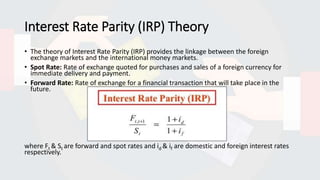
• The theory of Interest Rate Parity (IRP) provides the linkage between the foreign
exchange markets and the international money markets.
• Spot Rate: Rate of exchange quoted for purchases and sales of a foreign currency for
immediate delivery and payment.
• Forward Rate: Rate of exchange for a financial transaction that will take place in the
future.
where Ft & St are forward and spot rates and id & if are domestic and foreign interest rates
respectively.
Illustration
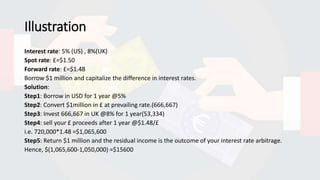
Interest rate: 5% (US) , 8%(UK)
Spot rate: £=$1.50
Forward rate: £=$1.48
Borrow $1 million and capitalize the difference in interest rates.
Solution:
Step1: Borrow in USD for 1 year @5%
Step2: Convert $1million in £ at prevailing rate.(666,667)
Step3: Invest 666,667 in UK @8% for 1 year(53,334)
Step4: sell your £ proceeds after 1 year @$1.48/£
i.e. 720,000*1.48 =$1,065,600
Step5: Return $1 million and the residual income is the outcome of your interest rate arbitrage.
Hence, $(1,065,600-1,050,000) =$15600
Purchasing Power Parity (PPP)
• The forecasted change in exchange rates between two countries is
related to the forecasted difference in inflation rates.
• The currency with the higher rate of inflation will depreciate against
the currency with the lower rate of inflation.
• The theory of purchasing power parity (PPP) attempts to quantify this
inflation - exchange rate relationship.
7
Purchasing Power Parity: Rationale
8
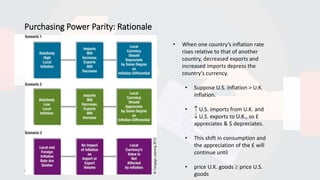
• When one country’s inflation rate
rises relative to that of another
country, decreased exports and
increased imports depress the
country’s currency.
• Suppose U.S. inflation > U.K.
inflation.
•  U.S. imports from U.K. and
 U.S. exports to U.K., so £
appreciates & $ depreciates.
• This shift in consumption and
the appreciation of the £ will
continue until
• price U.K. goods  price U.S.
goods
Two Versions of PPP
• Absolute Form of PPP: without international barriers, consumers shift their demand to
wherever prices are lower. Prices of the same basket of products in two different countries
should be equal when measured in common currency. (“Law of One Price”)
• Relative Form of PPP: Due to market imperfections, prices of the same basket of products in
different countries will not necessarily be the same, but the rate of change in prices should be
similar when measured in common currency
9
Law of One Price
• If the identical product or service can be:
• sold in two different markets; and
• no restrictions exist on the sale; and
• transportation costs of moving the product between markets are equal,
• then
• the products price should be the same in both markets; and
• Big Mac should cost the same (once you convert money) no matter where you
go; and
• an asset must have the same value regardless of the currency in which value is
measured.
• This is called the law of one price.
• This is called “absolute” version of PPP.
10
11
Law of One Price
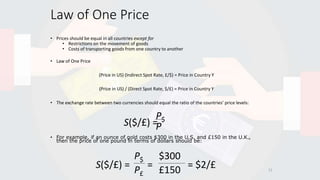
• Prices should be equal in all countries except for
• Restrictions on the movement of goods
• Costs of transporting goods from one country to another
• Law of One Price
(Price in US) (Indirect Spot Rate, £/$) = Price in Country Y
(Price in US) / (Direct Spot Rate, $/£) = Price in Country Y
• The exchange rate between two currencies should equal the ratio of the countries’ price levels:
• For example, if an ounce of gold costs $300 in the U.S. and £150 in the U.K.,
then the price of one pound in terms of dollars should be:
S($/£) =P
P$
S($/£) = P£
P$
£150
$300
= = $2/£
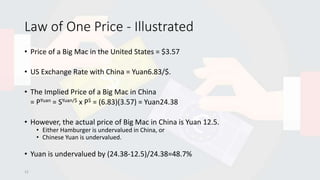
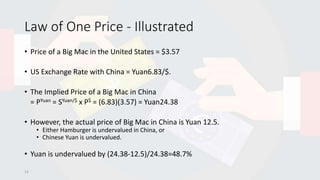
Law of One Price - Illustrated
• Price of a Big Mac in the United States = $3.57
• US Exchange Rate with China = Yuan6.83/$.
• The Implied Price of a Big Mac in China
= PYuan = SYuan/$ x P$ = (6.83)(3.57) = Yuan24.38
• However, the actual price of Big Mac in China is Yuan 12.5.
• Either Hamburger is undervalued in China, or
• Chinese Yuan is undervalued.
• Yuan is undervalued by (24.38-12.5)/24.38=48.7%
12
Law of One Price - Illustrated
• Price of a Big Mac in the United States = $3.57
• US Exchange Rate with China = Yuan6.83/$.
• The Implied Price of a Big Mac in China
= PYuan = SYuan/$ x P$ = (6.83)(3.57) = Yuan24.38
• However, the actual price of Big Mac in China is Yuan 12.5.
• Either Hamburger is undervalued in China, or
• Chinese Yuan is undervalued.
• Yuan is undervalued by (24.38-12.5)/24.38=48.7%
13
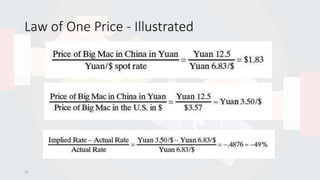
Law of One Price - Illustrated
14
Past Events
• During the early eighties, the Federal Reserve Bank of USA adopted a
tight money policy to fight inflation which caused very high interest
rates in USA. These high interest rates attracted a lot of foreign
capital, particularly from Japanese firms which due to high saving rate
in Japan had a large amount of funds to make investment in American
bonds. To purchase American bonds Japanese had to convert Yens
into dollars.
• This caused the increase in demand for dollars and caused a sharp
rise in the price of dollar. It is thus clear that like the relative price
levels, relative interest rates can also have a significant effect on the
exchange rate.
A case study of-
Albania Kenya
Relation between Interest rate and exchange
rate: An analysis of Albania
• We needed to test the following hypothesis: An increase in interest
rates of domestic currency will cause the domestic currency to
appreciate against other foreign currencies.
• For analysis, two models are taken into consideration-
• First model has dependent variable exchange rate of USD/ALL
• Second model has a dependent variable exchange rate of EUR/ALL
• Data used correspond to period from Jan 2002 until Dec 2014
Source: Bank of Albania
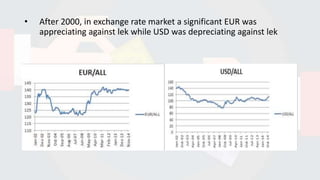
• After 2000, in exchange rate market a significant EUR was
appreciating against lek while USD was depreciating against lek
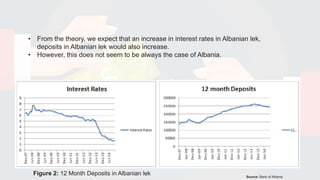
• From the theory, we expect that an increase in interest rates in Albanian lek,
deposits in Albanian lek would also increase.
• However, this does not seem to be always the case of Albania.
Source: Bank of Albania
Figure 2: 12 Month Deposits in Albanian lek
Reasons for abnormality
• A logical explanation behind this may be that interest rate is not the
only factor that affects changes in exchange rates. It maybe due to the
other factors such as inflation rate, future expectations in exchange
rates.
• Another reason may the economical and political instability of
Albania. The levels of informal economy and corruption are relatively
very high.
Relation between Interest rate and exchange
rate: An analysis of Kenya
• The objective was to analyze the relationship between interest rate,
inflation rate and the exchange rates in Kenya.
• Exchange rates (Forex) were established as the dependent variable
while the independent variables were interest rates and inflation
rates.
• Our group wanted to understand the relationship between the
independent variables and dependent variable.
Relation between Interest rate and exchange
rate: An analysis of Kenya
• To establish the effect of interest rate and inflation rate on exchange
rates in Kenya.
• We have used the Kenya Bureau of Statistics (KBA) and the Central
Bank of Kenya to study effects of interest rate and inflation on
exchange rates in Kenya.
• Data used was in the form of secondary data collected from Central
Bank and Kenya National Bureau of Statistics.
Relation between Interest rate and exchange
rate: An analysis of Kenya
• KES/USD Forex Rates = 71.658 + 1.006Int. Rates + 0.342 Inf. Rates
• We conclude from the analysis that, the KES/USD Annualized Average
Exchange Rates (Forex) and Annualized Average CBK Interest Rates (in %)
increased with increase in years.
• We also conclude that, KES/USD Annualized Average Exchange Rates
(Forex) rose from 67.46 in 2007 to 84.52 in 2012. The Annualized Average
CBK Interest Rates (in %) rose from 8.63 in 2007 to 16.50 in 2012.
• There is a very strong correlation between interest rates, inflation and
exchange rates in the economy. A very high percentage of changes in the
exchange rates is affected by the inflation or exchange rates in the
country(87% in case of Kenya).
Impact on Indian Economy
• The short-run impact of a real depreciation on firm’s output growth is
likely to be negative since it is the import cost channel that dominates
in the short run.
• As the impact is asymmetric, with real depreciation having a stronger
impact as compared to real appreciation. This indicates the need for
an effective reserve management policy that allows monetary
authorities to meet the challenges posed by sudden episodes of
sharp Rupee depreciation, as happened recently.
• It also implies that the call for the RBI to ‘assist’ with the revival of
economic growth in the presence of uncertainties in the domestic
and external policy environment is likely to be counterproductive if it
leads to a downward pressure on the domestic currency.
Future Policy Suggestions
• Improving the investment climate and ensuring policy changes lead to
actual flow of funds in a reasonable timeframe.
• Changes in foreign direct investment and other policies can lead to
real investment only if backed by fast-track clearances, stability and
clarity in the tax regime and effective labour and land acquisition
laws.

Relation between interest and exchange rate

  • 1.
    MACROECONOMICS PROJECT- Relation between Inflation,Interest Rate and Exchange Rate Presented by- Group 9 Akash Ojha (pgpj02003) Arpit Sharma (pgpj02010) Rohit Rupani (pgpj02046) Utkarsh Shivam (pgpj02059)
  • 2.
    Foreign Exchange Market •Meaning: A market for converting the currency of one country to currency of another at an exchange rate • Exchange rate: It is defined as the rate at which one currency is converted to another. Determined relative to demand and supply of one currency against the other • Direct Quote: In a country, direct quotes are those that give units of the home currency per unit of a foreign currency. Example: INR 48.59/USD is a direct quote in India • Indirect Quote: Stated as number of units of a foreign currency per unit of home currency. Example: USD 0.04132/INR is an indirect quote in India
  • 3.
    Functions of ForeignExchange market • Transfer Function: Facilitate the conversion of one currency to another through dealers and banks. • Credit function : obtain or provide credit for international trade & transactions. • Hedging Function: covering of foreign exchange risk arising out of change in exchange rates thereby minimising risk exposure of an investor.
  • 4.
    Relation between Inflation,Interest rate and Exchange rate: Theories • Interest Rate Parity Theory • Purchasing Power Parity Theory • The Balance of Payments Theory
  • 5.
    Interest Rate Parity(IRP) Theory • The theory of Interest Rate Parity (IRP) provides the linkage between the foreign exchange markets and the international money markets. • Spot Rate: Rate of exchange quoted for purchases and sales of a foreign currency for immediate delivery and payment. • Forward Rate: Rate of exchange for a financial transaction that will take place in the future. where Ft & St are forward and spot rates and id & if are domestic and foreign interest rates respectively.
  • 6.
    Illustration Interest rate: 5%(US) , 8%(UK) Spot rate: £=$1.50 Forward rate: £=$1.48 Borrow $1 million and capitalize the difference in interest rates. Solution: Step1: Borrow in USD for 1 year @5% Step2: Convert $1million in £ at prevailing rate.(666,667) Step3: Invest 666,667 in UK @8% for 1 year(53,334) Step4: sell your £ proceeds after 1 year @$1.48/£ i.e. 720,000*1.48 =$1,065,600 Step5: Return $1 million and the residual income is the outcome of your interest rate arbitrage. Hence, $(1,065,600-1,050,000) =$15600
  • 7.
    Purchasing Power Parity(PPP) • The forecasted change in exchange rates between two countries is related to the forecasted difference in inflation rates. • The currency with the higher rate of inflation will depreciate against the currency with the lower rate of inflation. • The theory of purchasing power parity (PPP) attempts to quantify this inflation - exchange rate relationship. 7
  • 8.
    Purchasing Power Parity:Rationale 8 • When one country’s inflation rate rises relative to that of another country, decreased exports and increased imports depress the country’s currency. • Suppose U.S. inflation > U.K. inflation. •  U.S. imports from U.K. and  U.S. exports to U.K., so £ appreciates & $ depreciates. • This shift in consumption and the appreciation of the £ will continue until • price U.K. goods  price U.S. goods
  • 9.
    Two Versions ofPPP • Absolute Form of PPP: without international barriers, consumers shift their demand to wherever prices are lower. Prices of the same basket of products in two different countries should be equal when measured in common currency. (“Law of One Price”) • Relative Form of PPP: Due to market imperfections, prices of the same basket of products in different countries will not necessarily be the same, but the rate of change in prices should be similar when measured in common currency 9
  • 10.
    Law of OnePrice • If the identical product or service can be: • sold in two different markets; and • no restrictions exist on the sale; and • transportation costs of moving the product between markets are equal, • then • the products price should be the same in both markets; and • Big Mac should cost the same (once you convert money) no matter where you go; and • an asset must have the same value regardless of the currency in which value is measured. • This is called the law of one price. • This is called “absolute” version of PPP. 10
  • 11.
    11 Law of OnePrice • Prices should be equal in all countries except for • Restrictions on the movement of goods • Costs of transporting goods from one country to another • Law of One Price (Price in US) (Indirect Spot Rate, £/$) = Price in Country Y (Price in US) / (Direct Spot Rate, $/£) = Price in Country Y • The exchange rate between two currencies should equal the ratio of the countries’ price levels: • For example, if an ounce of gold costs $300 in the U.S. and £150 in the U.K., then the price of one pound in terms of dollars should be: S($/£) =P P$ S($/£) = P£ P$ £150 $300 = = $2/£
  • 12.
    Law of OnePrice - Illustrated • Price of a Big Mac in the United States = $3.57 • US Exchange Rate with China = Yuan6.83/$. • The Implied Price of a Big Mac in China = PYuan = SYuan/$ x P$ = (6.83)(3.57) = Yuan24.38 • However, the actual price of Big Mac in China is Yuan 12.5. • Either Hamburger is undervalued in China, or • Chinese Yuan is undervalued. • Yuan is undervalued by (24.38-12.5)/24.38=48.7% 12
  • 13.
    Law of OnePrice - Illustrated • Price of a Big Mac in the United States = $3.57 • US Exchange Rate with China = Yuan6.83/$. • The Implied Price of a Big Mac in China = PYuan = SYuan/$ x P$ = (6.83)(3.57) = Yuan24.38 • However, the actual price of Big Mac in China is Yuan 12.5. • Either Hamburger is undervalued in China, or • Chinese Yuan is undervalued. • Yuan is undervalued by (24.38-12.5)/24.38=48.7% 13
  • 14.
    Law of OnePrice - Illustrated 14
  • 19.
    Past Events • Duringthe early eighties, the Federal Reserve Bank of USA adopted a tight money policy to fight inflation which caused very high interest rates in USA. These high interest rates attracted a lot of foreign capital, particularly from Japanese firms which due to high saving rate in Japan had a large amount of funds to make investment in American bonds. To purchase American bonds Japanese had to convert Yens into dollars. • This caused the increase in demand for dollars and caused a sharp rise in the price of dollar. It is thus clear that like the relative price levels, relative interest rates can also have a significant effect on the exchange rate.
  • 20.
    A case studyof- Albania Kenya
  • 21.
    Relation between Interestrate and exchange rate: An analysis of Albania • We needed to test the following hypothesis: An increase in interest rates of domestic currency will cause the domestic currency to appreciate against other foreign currencies. • For analysis, two models are taken into consideration- • First model has dependent variable exchange rate of USD/ALL • Second model has a dependent variable exchange rate of EUR/ALL • Data used correspond to period from Jan 2002 until Dec 2014 Source: Bank of Albania
  • 22.
    • After 2000,in exchange rate market a significant EUR was appreciating against lek while USD was depreciating against lek
  • 23.
    • From thetheory, we expect that an increase in interest rates in Albanian lek, deposits in Albanian lek would also increase. • However, this does not seem to be always the case of Albania. Source: Bank of Albania Figure 2: 12 Month Deposits in Albanian lek
  • 24.
    Reasons for abnormality •A logical explanation behind this may be that interest rate is not the only factor that affects changes in exchange rates. It maybe due to the other factors such as inflation rate, future expectations in exchange rates. • Another reason may the economical and political instability of Albania. The levels of informal economy and corruption are relatively very high.
  • 25.
    Relation between Interestrate and exchange rate: An analysis of Kenya • The objective was to analyze the relationship between interest rate, inflation rate and the exchange rates in Kenya. • Exchange rates (Forex) were established as the dependent variable while the independent variables were interest rates and inflation rates. • Our group wanted to understand the relationship between the independent variables and dependent variable.
  • 26.
    Relation between Interestrate and exchange rate: An analysis of Kenya • To establish the effect of interest rate and inflation rate on exchange rates in Kenya. • We have used the Kenya Bureau of Statistics (KBA) and the Central Bank of Kenya to study effects of interest rate and inflation on exchange rates in Kenya. • Data used was in the form of secondary data collected from Central Bank and Kenya National Bureau of Statistics.
  • 27.
    Relation between Interestrate and exchange rate: An analysis of Kenya • KES/USD Forex Rates = 71.658 + 1.006Int. Rates + 0.342 Inf. Rates • We conclude from the analysis that, the KES/USD Annualized Average Exchange Rates (Forex) and Annualized Average CBK Interest Rates (in %) increased with increase in years. • We also conclude that, KES/USD Annualized Average Exchange Rates (Forex) rose from 67.46 in 2007 to 84.52 in 2012. The Annualized Average CBK Interest Rates (in %) rose from 8.63 in 2007 to 16.50 in 2012. • There is a very strong correlation between interest rates, inflation and exchange rates in the economy. A very high percentage of changes in the exchange rates is affected by the inflation or exchange rates in the country(87% in case of Kenya).
  • 28.
    Impact on IndianEconomy • The short-run impact of a real depreciation on firm’s output growth is likely to be negative since it is the import cost channel that dominates in the short run. • As the impact is asymmetric, with real depreciation having a stronger impact as compared to real appreciation. This indicates the need for an effective reserve management policy that allows monetary authorities to meet the challenges posed by sudden episodes of sharp Rupee depreciation, as happened recently. • It also implies that the call for the RBI to ‘assist’ with the revival of economic growth in the presence of uncertainties in the domestic and external policy environment is likely to be counterproductive if it leads to a downward pressure on the domestic currency.
  • 29.
    Future Policy Suggestions •Improving the investment climate and ensuring policy changes lead to actual flow of funds in a reasonable timeframe. • Changes in foreign direct investment and other policies can lead to real investment only if backed by fast-track clearances, stability and clarity in the tax regime and effective labour and land acquisition laws.