
What is Cloud Computing? 
Various forms of Cloud Computing 
Benefits of Cloud computing 
Why we need cloud security? 
 Cloud Security Concerns 
 Cloud Security Threats 
 Cloud Security Mechanisms
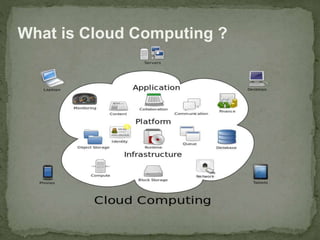
What is Cloud Computing ?
What is Cloud Computing ? 
Cloud computing is a type of 
computing that relies on sharing computing 
resources rather than having local servers or 
personal devices to handle applications .
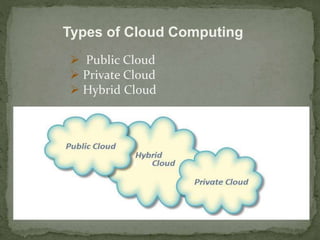
Types of Cloud Computing 
 Public Cloud 
 Private Cloud 
 Hybrid Cloud
Various Forms of Cloud Computing 
 Cloud Computing is some kind of hosted service 
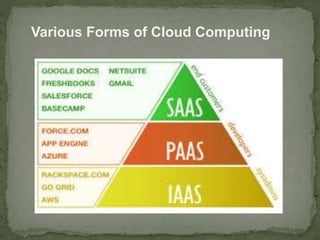
Cloud Computing models down into : 
 Infrastructure as a Service 
 Platform as a Service 
 Software as a Service
Various Forms of Cloud Computing
Benefits of Cloud Computing 
 Cost (Pay as You Go) 
Multi-tenancy 
Accessibility 
Elasticity 
Easily upgraded
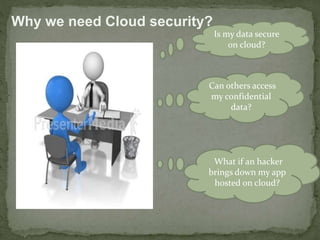
Is my data secure 
on cloud? 
Why we need Cloud security? 
Can others access 
my confidential 
data? 
What if an hacker 
brings down my app 
hosted on cloud?
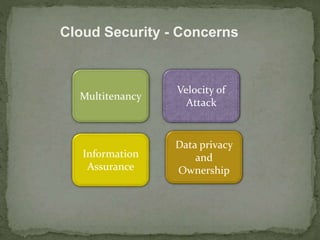
Cloud Security - Concerns 
Multitenancy 
Velocity of 
Attack 
Information 
Assurance 
Data privacy 
and 
Ownership
Security Concern - Multitenancy 
 Multitenancy is a key security concern in cloud 
o For Cloud Clients 
 Co-location of multiple VMs in single server and sharing 
the same resources increases the attack surface 
o For CSPs 
 Enforcing uniform security controls and measures is difficult 
 Mutual client isolation is key measure against multitenancy 
- related concerns
Security Concern – Velocity of Attack 
 Security threats amplify and spread quickly in a Cloud – 
Known as “Velocity – of – Attack” (VOA) factor 
 Cloud infrastructure is comparatively larger 
 Similarity in the platforms/components employed by a CSP 
increases the speed at which an attack can spread 
 Effects of high VOA 
Potential loss due to an attack is comparatively higher 
It is comparatively difficult to mitigate the spread of the 
attack
Security Concern – Information Assurance 
and Data Ownership 
• Information assurance concern s for Cloud user involve 
CIA 
Authenticity 
Authorized use 
• Data ownership concerns for Cloud Clients 
In Cloud, Data belonging to client is maintained by a CSP who 
has access to the data but is not the legitimate owner of it 
Data should be protected using encryption and access control 
mechanism
Security Concern – Data Privacy 
• Private data may include 
 Individual identity of client 
 Details of services requested by client 
 Proprietary data of client 
• A CSP needs to ensure that private data of its client is 
protected from unauthorized user 
 A CSP needs to deploy data privacy mechanism, 
which are compliant with the regional legal 
regulations
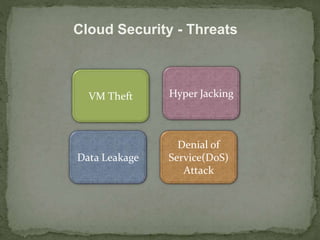
Cloud Security - Threats 
VM Theft Hyper Jacking 
Data Leakage 
Denial of 
Service(DoS) 
Attack
Security Threat – VM Theft 
• What is VM Theft ? 
 A Vulnerability that enables an attacker to copy 
or move VM in an unauthorized manner 
• Result of inadequate controls on VM files allowing 
unauthorized copy or move operations
Security Threat – Hyper Jacking 
• What is Hyper Jacking ? 
It enables an attacker to install a rogue hypervisor or 
Virtual Machine Monitor that can take control of the 
underlying server resources. 
• An attacker can run unauthorized application on a 
guest OS without the OS realizing it 
• An attacker could control the interaction between 
the VMs and underlying servers 
• Regular security measures are ineffective against 
hyper jacking
Security Threat – Data Leakage 
• Confidential data stored on third party Cloud is Potentially 
vulnerable to unauthorized access or manipulation 
Attacks on service provider’s control system( for example 
password lists) could make all the client s’ data vulnerable 
• Side Channel Attacks (SCA) can be used for data leakage 
in Cloud 
An SCA extracts information by monitoring indirect actives; 
for example cache data
Security Threat – Denial of Service 
Attacks 
• What is DoS attack? 
It is an attempt to prevent legitimate user from 
accessing a resource or service 
• Dos attack might affect software application and 
network component 
• DoS involves 
 Exhausting resources 
Exploiting weakness in communication protocols
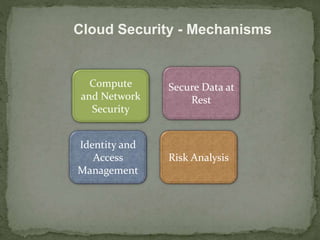
Cloud Security - Mechanisms 
Compute 
and Network 
Security 
Secure Data at 
Rest 
Identity and 
Access 
Management 
Risk Analysis
Security at Compute Level 
• Securing a compute system includes 
 Securing physical server 
 Securing hypervisor 
Security at guest OS level 
 Guest OS Hardening 
 Security at application level
Securing Data-at -Rest 
• Data-at-rest 
 Data which is not being transferred over a network 
• Encryption of Data-at-rest 
 provides confidentiality 
Provides integrity services 
• Full disk encryption is a key method to encrypt 
data-at-rest residing on a disk
Identity Management (IM) in Cloud 
• One-time password 
 Every new access request requires new password 
 A measure against “password compromises” 
• Federated Identity Management is provided as a 
service on cloud 
In it user identities across different organization can 
be managed together to enable collaboration on Cloud
Risk Analysis 
• Risk refers to the effect of uncertainty on business 
objectives 
•Risk management is a coordinated activity that direct 
and control an organization 
Risk Assessment 
• Aim to identify potential risks while operating in a Cloud 
environment 
Should be performed before moving to cloud 
Used to determine the actual scope for Cloud adoption
Cloud computing

Cloud computing

  • 2.
    What is CloudComputing? Various forms of Cloud Computing Benefits of Cloud computing Why we need cloud security?  Cloud Security Concerns  Cloud Security Threats  Cloud Security Mechanisms
  • 3.
    What is CloudComputing ?
  • 4.
    What is CloudComputing ? Cloud computing is a type of computing that relies on sharing computing resources rather than having local servers or personal devices to handle applications .
  • 5.
    Types of CloudComputing  Public Cloud  Private Cloud  Hybrid Cloud
  • 6.
    Various Forms ofCloud Computing  Cloud Computing is some kind of hosted service Cloud Computing models down into :  Infrastructure as a Service  Platform as a Service  Software as a Service
  • 7.
    Various Forms ofCloud Computing
  • 8.
    Benefits of CloudComputing  Cost (Pay as You Go) Multi-tenancy Accessibility Elasticity Easily upgraded
  • 9.
    Is my datasecure on cloud? Why we need Cloud security? Can others access my confidential data? What if an hacker brings down my app hosted on cloud?
  • 10.
    Cloud Security -Concerns Multitenancy Velocity of Attack Information Assurance Data privacy and Ownership
  • 11.
    Security Concern -Multitenancy  Multitenancy is a key security concern in cloud o For Cloud Clients  Co-location of multiple VMs in single server and sharing the same resources increases the attack surface o For CSPs  Enforcing uniform security controls and measures is difficult  Mutual client isolation is key measure against multitenancy - related concerns
  • 12.
    Security Concern –Velocity of Attack  Security threats amplify and spread quickly in a Cloud – Known as “Velocity – of – Attack” (VOA) factor  Cloud infrastructure is comparatively larger  Similarity in the platforms/components employed by a CSP increases the speed at which an attack can spread  Effects of high VOA Potential loss due to an attack is comparatively higher It is comparatively difficult to mitigate the spread of the attack
  • 13.
    Security Concern –Information Assurance and Data Ownership • Information assurance concern s for Cloud user involve CIA Authenticity Authorized use • Data ownership concerns for Cloud Clients In Cloud, Data belonging to client is maintained by a CSP who has access to the data but is not the legitimate owner of it Data should be protected using encryption and access control mechanism
  • 14.
    Security Concern –Data Privacy • Private data may include  Individual identity of client  Details of services requested by client  Proprietary data of client • A CSP needs to ensure that private data of its client is protected from unauthorized user  A CSP needs to deploy data privacy mechanism, which are compliant with the regional legal regulations
  • 15.
    Cloud Security -Threats VM Theft Hyper Jacking Data Leakage Denial of Service(DoS) Attack
  • 16.
    Security Threat –VM Theft • What is VM Theft ?  A Vulnerability that enables an attacker to copy or move VM in an unauthorized manner • Result of inadequate controls on VM files allowing unauthorized copy or move operations
  • 17.
    Security Threat –Hyper Jacking • What is Hyper Jacking ? It enables an attacker to install a rogue hypervisor or Virtual Machine Monitor that can take control of the underlying server resources. • An attacker can run unauthorized application on a guest OS without the OS realizing it • An attacker could control the interaction between the VMs and underlying servers • Regular security measures are ineffective against hyper jacking
  • 18.
    Security Threat –Data Leakage • Confidential data stored on third party Cloud is Potentially vulnerable to unauthorized access or manipulation Attacks on service provider’s control system( for example password lists) could make all the client s’ data vulnerable • Side Channel Attacks (SCA) can be used for data leakage in Cloud An SCA extracts information by monitoring indirect actives; for example cache data
  • 19.
    Security Threat –Denial of Service Attacks • What is DoS attack? It is an attempt to prevent legitimate user from accessing a resource or service • Dos attack might affect software application and network component • DoS involves  Exhausting resources Exploiting weakness in communication protocols
  • 20.
    Cloud Security -Mechanisms Compute and Network Security Secure Data at Rest Identity and Access Management Risk Analysis
  • 21.
    Security at ComputeLevel • Securing a compute system includes  Securing physical server  Securing hypervisor Security at guest OS level  Guest OS Hardening  Security at application level
  • 22.
    Securing Data-at -Rest • Data-at-rest  Data which is not being transferred over a network • Encryption of Data-at-rest  provides confidentiality Provides integrity services • Full disk encryption is a key method to encrypt data-at-rest residing on a disk
  • 23.
    Identity Management (IM)in Cloud • One-time password  Every new access request requires new password  A measure against “password compromises” • Federated Identity Management is provided as a service on cloud In it user identities across different organization can be managed together to enable collaboration on Cloud
  • 24.
    Risk Analysis •Risk refers to the effect of uncertainty on business objectives •Risk management is a coordinated activity that direct and control an organization Risk Assessment • Aim to identify potential risks while operating in a Cloud environment Should be performed before moving to cloud Used to determine the actual scope for Cloud adoption