
Peter Wood
Chief Executive Officer
First•Base Technologies
Advanced Threat Protection
and Big Data
An Ethical Hacker’s View
Slide 2 © First Base Technologies 2013
Who is Peter Wood?
Worked in computers & electronics since 1969
Founded First Base in 1989 (one of the first ethical hacking firms)
CEO First Base Technologies LLP
Social engineer & penetration tester
Conference speaker and security ‗expert‘
Member of ISACA Security Advisory Group
Vice Chair of BCS Information Risk Management and Audit Group
UK Chair, Corporate Executive Programme
FBCS, CITP, CISSP, MIEEE, M.Inst.ISP
Registered BCS Security Consultant
Member of ACM, ISACA, ISSA, Mensa
Slide 3 © First Base Technologies 2013
Agenda
• Big Data elevator pitch
• Advanced Threats – really?
• Why Big Data for security?
• How can Big Data help?
• Can we do it now?
• Summing up
Slide 4 © First Base Technologies 2013
Big Data elevator pitch
Slide 5 © First Base Technologies 2013
Big Data is quite large
Every day, we create 2.5 quintillion bytes of data — so much that
90% of the data in the world today has been created in the last
two years alone. This data comes from everywhere: sensors used
to gather climate information, posts to social media sites, digital
pictures and videos, purchase transaction records, and cell phone
GPS signals to name a few.
http://www-01.ibm.com/software/data/bigdata/
2.5 quintillion = 2.5 exabytes = 2.5x1018 bytes
IDC projects that the digital universe will reach 40 zettabytes
by 2020, resulting in a 50-fold growth from the beginning of
2010 http://uk.emc.com/about/news/press/2012/20121211-01.htm
40 zettabytes = 40x1021 bytes = 57 times all the
grains of sand on all the beaches on earth
Slide 6 © First Base Technologies 2013
Big Data can be useful
• Creating transparency by making relevant data more
accessible
• Enabling experimentation to discover needs, expose
variability and improve performance - use data to
analyse variability in performance and understand the
root causes
• Segmenting populations to customise actions and tailor
products and services to meet specific needs
• Replacing/supporting human decision-making with
automated algorithms in order to minimise risk
• Innovating new business models, products and services
McKinsey Global Institute: “Big data: The next frontier for innovation,
competition, and productivity”, May 2011
Slide 7 © First Base Technologies 2013
Where are we with Big Data in general?
• Mainstream adoption? Early days
• Skills and risks underestimated
• IT professionals say:
- Over-hyped
- Has a lot of potential
- Vendors may not deliver on promises
Slide 8 © First Base Technologies 2013
Advanced Threats – really?
Slide 9 © First Base Technologies 2013
Advanced Threats
• Massive increase in advanced malware bypassing
traditional security defenses
• Volumes vary substantially among different industries
• Email-based attacks are growing, with link- and
attachment-based malware presenting significant risks
• Cybercriminals are increasingly employing limited-use
domains in their spear phishing emails
• Malicious email attachments growing more diverse,
evading traditional security defenses
FireEye Advanced Threat Report – 1H 2012
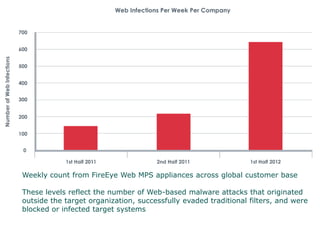
Weekly count from FireEye Web MPS appliances across global customer base
These levels reflect the number of Web-based malware attacks that originated
outside the target organization, successfully evaded traditional filters, and were
blocked or infected target systems
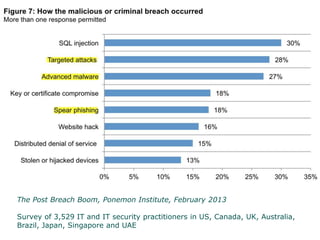
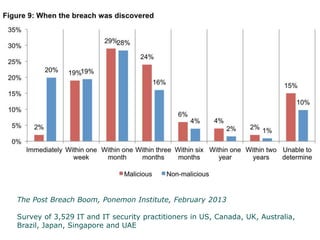
The Post Breach Boom, Ponemon Institute, February 2013
Survey of 3,529 IT and IT security practitioners in US, Canada, UK, Australia,
Brazil, Japan, Singapore and UAE
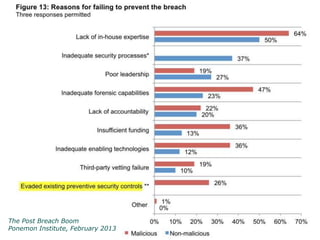
The Post Breach Boom, Ponemon Institute, February 2013
Survey of 3,529 IT and IT security practitioners in US, Canada, UK, Australia,
Brazil, Japan, Singapore and UAE
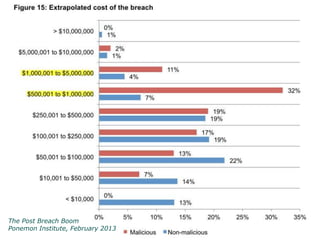
The Post Breach Boom
Ponemon Institute, February 2013
The Post Breach Boom
Ponemon Institute, February 2013
Slide 15 © First Base Technologies 2013
Why Big Data for security?
Slide 16 © First Base Technologies 2013
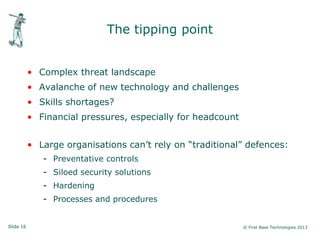
The tipping point
• Complex threat landscape
• Avalanche of new technology and challenges
• Skills shortages?
• Financial pressures, especially for headcount
• Large organisations can‘t rely on ―traditional‖ defences:
- Preventative controls
- Siloed security solutions
- Hardening
- Processes and procedures
Slide 17 © First Base Technologies 2013
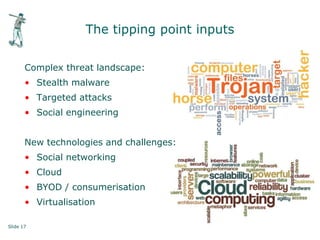
The tipping point inputs
Complex threat landscape:
• Stealth malware
• Targeted attacks
• Social engineering
New technologies and challenges:
• Social networking
• Cloud
• BYOD / consumerisation
• Virtualisation
Slide 18 © First Base Technologies 2013
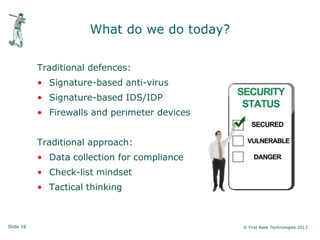
What do we do today?
Traditional defences:
• Signature-based anti-virus
• Signature-based IDS/IDP
• Firewalls and perimeter devices
Traditional approach:
• Data collection for compliance
• Check-list mindset
• Tactical thinking
Slide 19 © First Base Technologies 2013
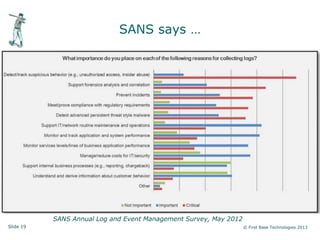
SANS says …
SANS Annual Log and Event Management Survey, May 2012
Slide 20 © First Base Technologies 2013
How can Big Data help?
Slide 21 © First Base Technologies 2013
How can Big Data help?
• SIEM on steroids?
• Fraud detection
• APT detection?
• Integration of IT and physical security?
• SIEM + IDS/IPS?
• Predictive analysis
Slide 22 © First Base Technologies 2013
Big Data to Collect
• Logs
• Network traffic
• IT assets
• Senstitive / valuable information
• Vulnerabilities
• Threat intelligence
• Application behaviour
• User behaviour
Slide 23 © First Base Technologies 2013
Big Data Analytics
• Real-time updates
• Behaviour models
• Correlation
• Heuristic capability
• Interoperability
• … advising the analysts?
• … active defence?
Slide 24 © First Base Technologies 2013
Can we do it now?
Slide 25 © First Base Technologies 2013
Big Data = Big Investment, but …
• Today: Big Data for Big Organisations with Big Budgets
News from RSA Conference 2013:
• HP say about 3% of companies are doing this today
• Analysts expect 40% adoption by 2016
• Cloud-based Big Data may enhance existing SIEM
• … and overcome the skills gap
• Enhancing SIEM with threat intelligence
• Augmenting SIEM with IT asset information
More Improvements To SIEM Than Big Data – DarkReading.com, 22/02/2013
Slide 26 © First Base Technologies 2013
Big Data Last Year
Gartner said:
Sourcefire's FireAMP technology and the technology from Prevx (acquired
by Webroot in 2010) are examples of security providers that determine
malicious intent by analysing vast amounts of observed executable
behaviors and metadata
Vendors such as NetWitness (acquired by RSA), Global DataGuard, Narus
(acquired by Boeing), Solera and Fidelus Technologies, and network
behavior analysis solutions, such as Lancope, collect large amounts of
network packets and/or flows to support the analysis for anomalous
activities
In addition, some SIEM vendors, such as Q1 Labs (acquired by IBM) and
HP ArcSight, can directly consume and analyze NetFlow data
Information Security Is Becoming a Big Data Analytics Problem – Gartner, 23/03/2012
Slide 27 © First Base Technologies 2013
Big Data Tomorrow
RSA says:
Within the next two years, we predict big data analytics
will disrupt the status quo in most information security
product segments, including SIEM; network monitoring;
user authentication and authorization; identity
management; fraud detection; and governance, risk &
compliance.
Big Data Holds Big Promise For Security – RSA Security Brief, January 2013
Slide 28 © First Base Technologies 2013
Big Data Skills
• Big Data is more about the processing techniques and
outputs than the size of the data set itself, so specific
skills are required to use Big Data effectively
• There is a general shortage of specialist skills for Big
Data analysis, in particular when it comes to using some
of the less mature technologies
Slide 29 © First Base Technologies 2013
Summary
• All organisations need to invest in research and study of
the emerging Big Data Security Analytics landscape
• Big Data has the potential to defend against advanced
threats, but requires a Big Re-think of approach
• Relevant skills are key to successful deployment, only
the largest organisations can invest in this now
• Offerings exist for the other 97% that can enhance
existing technologies using cloud-based solutions
Slide 30 © First Base Technologies 2013
Peter Wood
Chief Executive Officer
First Base Technologies LLP
peterw@firstbase.co.uk
http://firstbase.co.uk
http://white-hats.co.uk
http://peterwood.com
Twitter: peterwoodx
Need more information?

Advanced threat protection and big data

  • 1.
    Peter Wood Chief ExecutiveOfficer First•Base Technologies Advanced Threat Protection and Big Data An Ethical Hacker’s View
  • 2.
    Slide 2 ©First Base Technologies 2013 Who is Peter Wood? Worked in computers & electronics since 1969 Founded First Base in 1989 (one of the first ethical hacking firms) CEO First Base Technologies LLP Social engineer & penetration tester Conference speaker and security ‗expert‘ Member of ISACA Security Advisory Group Vice Chair of BCS Information Risk Management and Audit Group UK Chair, Corporate Executive Programme FBCS, CITP, CISSP, MIEEE, M.Inst.ISP Registered BCS Security Consultant Member of ACM, ISACA, ISSA, Mensa
  • 3.
    Slide 3 ©First Base Technologies 2013 Agenda • Big Data elevator pitch • Advanced Threats – really? • Why Big Data for security? • How can Big Data help? • Can we do it now? • Summing up
  • 4.
    Slide 4 ©First Base Technologies 2013 Big Data elevator pitch
  • 5.
    Slide 5 ©First Base Technologies 2013 Big Data is quite large Every day, we create 2.5 quintillion bytes of data — so much that 90% of the data in the world today has been created in the last two years alone. This data comes from everywhere: sensors used to gather climate information, posts to social media sites, digital pictures and videos, purchase transaction records, and cell phone GPS signals to name a few. http://www-01.ibm.com/software/data/bigdata/ 2.5 quintillion = 2.5 exabytes = 2.5x1018 bytes IDC projects that the digital universe will reach 40 zettabytes by 2020, resulting in a 50-fold growth from the beginning of 2010 http://uk.emc.com/about/news/press/2012/20121211-01.htm 40 zettabytes = 40x1021 bytes = 57 times all the grains of sand on all the beaches on earth
  • 6.
    Slide 6 ©First Base Technologies 2013 Big Data can be useful • Creating transparency by making relevant data more accessible • Enabling experimentation to discover needs, expose variability and improve performance - use data to analyse variability in performance and understand the root causes • Segmenting populations to customise actions and tailor products and services to meet specific needs • Replacing/supporting human decision-making with automated algorithms in order to minimise risk • Innovating new business models, products and services McKinsey Global Institute: “Big data: The next frontier for innovation, competition, and productivity”, May 2011
  • 7.
    Slide 7 ©First Base Technologies 2013 Where are we with Big Data in general? • Mainstream adoption? Early days • Skills and risks underestimated • IT professionals say: - Over-hyped - Has a lot of potential - Vendors may not deliver on promises
  • 8.
    Slide 8 ©First Base Technologies 2013 Advanced Threats – really?
  • 9.
    Slide 9 ©First Base Technologies 2013 Advanced Threats • Massive increase in advanced malware bypassing traditional security defenses • Volumes vary substantially among different industries • Email-based attacks are growing, with link- and attachment-based malware presenting significant risks • Cybercriminals are increasingly employing limited-use domains in their spear phishing emails • Malicious email attachments growing more diverse, evading traditional security defenses FireEye Advanced Threat Report – 1H 2012
  • 10.
    Weekly count fromFireEye Web MPS appliances across global customer base These levels reflect the number of Web-based malware attacks that originated outside the target organization, successfully evaded traditional filters, and were blocked or infected target systems
  • 11.
    The Post BreachBoom, Ponemon Institute, February 2013 Survey of 3,529 IT and IT security practitioners in US, Canada, UK, Australia, Brazil, Japan, Singapore and UAE
  • 12.
    The Post BreachBoom, Ponemon Institute, February 2013 Survey of 3,529 IT and IT security practitioners in US, Canada, UK, Australia, Brazil, Japan, Singapore and UAE
  • 13.
    The Post BreachBoom Ponemon Institute, February 2013
  • 14.
    The Post BreachBoom Ponemon Institute, February 2013
  • 15.
    Slide 15 ©First Base Technologies 2013 Why Big Data for security?
  • 16.
    Slide 16 ©First Base Technologies 2013 The tipping point • Complex threat landscape • Avalanche of new technology and challenges • Skills shortages? • Financial pressures, especially for headcount • Large organisations can‘t rely on ―traditional‖ defences: - Preventative controls - Siloed security solutions - Hardening - Processes and procedures
  • 17.
    Slide 17 ©First Base Technologies 2013 The tipping point inputs Complex threat landscape: • Stealth malware • Targeted attacks • Social engineering New technologies and challenges: • Social networking • Cloud • BYOD / consumerisation • Virtualisation
  • 18.
    Slide 18 ©First Base Technologies 2013 What do we do today? Traditional defences: • Signature-based anti-virus • Signature-based IDS/IDP • Firewalls and perimeter devices Traditional approach: • Data collection for compliance • Check-list mindset • Tactical thinking
  • 19.
    Slide 19 ©First Base Technologies 2013 SANS says … SANS Annual Log and Event Management Survey, May 2012
  • 20.
    Slide 20 ©First Base Technologies 2013 How can Big Data help?
  • 21.
    Slide 21 ©First Base Technologies 2013 How can Big Data help? • SIEM on steroids? • Fraud detection • APT detection? • Integration of IT and physical security? • SIEM + IDS/IPS? • Predictive analysis
  • 22.
    Slide 22 ©First Base Technologies 2013 Big Data to Collect • Logs • Network traffic • IT assets • Senstitive / valuable information • Vulnerabilities • Threat intelligence • Application behaviour • User behaviour
  • 23.
    Slide 23 ©First Base Technologies 2013 Big Data Analytics • Real-time updates • Behaviour models • Correlation • Heuristic capability • Interoperability • … advising the analysts? • … active defence?
  • 24.
    Slide 24 ©First Base Technologies 2013 Can we do it now?
  • 25.
    Slide 25 ©First Base Technologies 2013 Big Data = Big Investment, but … • Today: Big Data for Big Organisations with Big Budgets News from RSA Conference 2013: • HP say about 3% of companies are doing this today • Analysts expect 40% adoption by 2016 • Cloud-based Big Data may enhance existing SIEM • … and overcome the skills gap • Enhancing SIEM with threat intelligence • Augmenting SIEM with IT asset information More Improvements To SIEM Than Big Data – DarkReading.com, 22/02/2013
  • 26.
    Slide 26 ©First Base Technologies 2013 Big Data Last Year Gartner said: Sourcefire's FireAMP technology and the technology from Prevx (acquired by Webroot in 2010) are examples of security providers that determine malicious intent by analysing vast amounts of observed executable behaviors and metadata Vendors such as NetWitness (acquired by RSA), Global DataGuard, Narus (acquired by Boeing), Solera and Fidelus Technologies, and network behavior analysis solutions, such as Lancope, collect large amounts of network packets and/or flows to support the analysis for anomalous activities In addition, some SIEM vendors, such as Q1 Labs (acquired by IBM) and HP ArcSight, can directly consume and analyze NetFlow data Information Security Is Becoming a Big Data Analytics Problem – Gartner, 23/03/2012
  • 27.
    Slide 27 ©First Base Technologies 2013 Big Data Tomorrow RSA says: Within the next two years, we predict big data analytics will disrupt the status quo in most information security product segments, including SIEM; network monitoring; user authentication and authorization; identity management; fraud detection; and governance, risk & compliance. Big Data Holds Big Promise For Security – RSA Security Brief, January 2013
  • 28.
    Slide 28 ©First Base Technologies 2013 Big Data Skills • Big Data is more about the processing techniques and outputs than the size of the data set itself, so specific skills are required to use Big Data effectively • There is a general shortage of specialist skills for Big Data analysis, in particular when it comes to using some of the less mature technologies
  • 29.
    Slide 29 ©First Base Technologies 2013 Summary • All organisations need to invest in research and study of the emerging Big Data Security Analytics landscape • Big Data has the potential to defend against advanced threats, but requires a Big Re-think of approach • Relevant skills are key to successful deployment, only the largest organisations can invest in this now • Offerings exist for the other 97% that can enhance existing technologies using cloud-based solutions
  • 30.
    Slide 30 ©First Base Technologies 2013 Peter Wood Chief Executive Officer First Base Technologies LLP peterw@firstbase.co.uk http://firstbase.co.uk http://white-hats.co.uk http://peterwood.com Twitter: peterwoodx Need more information?

Editor's Notes

  • #4 The deployment of Big Data for fraud detection, and in place of security incident and event management (SIEM) systems, is attractive to many organisations. The overheads of managing the output of traditional SIEM and logging systems are proving too much for most IT departments and Big Data is seen as a potential saviour. There are commercial replacements available for existing log management systems, or the technology can be deployed to provide a single data store for security event management and enrichment. Taking the idea a step further, the challenge of detecting and preventing advanced persistent threats may be answered by using Big Data style analysis. These techniques could play a key role in helping detect threats at an early stage, using more sophisticated pattern analysis, and combining and analysing multiple data sources. There is also the potential for anomaly identification using feature extraction. Today logs are often ignored unless an incident occurs. Big Data provides the opportunity to automatically consolidate and analyse logs from multiple sources rather than in isolation. This could provide insight that individual logs cannot, and potentially enhance intrusion detection systems (IDS) and intrusion prevention systems (IPS) through continual adjustment and effectively learning “good” and “bad” behaviours. Integrating information from physical security systems, such as building access controls and even CCTV, could also significantly enhance IDS and IPS to a point where insider attacks and social engineering are factored in to the detection process. This presents the possibility of significantly more advanced detection of fraud and criminal activities. We know that organisational silos often reduce the effectiveness of security systems, so businesses must be aware that the potential effectiveness of Big Data style analysis can also be diluted unless these issues are addressed. At the very least, Big Data could result in far more practical and successful SIEM, IDS and IPS implementations.
  • #7 In reality, Big Data is more about the processing techniques and outputs than the size of the data set itself, so specific skills are required to use Big Data effectively. There is a general shortage of specialist skills for Big Data analysis, in particular when it comes to using some of the less mature technologies. The growing use of Hadoop and related technologies is driving demand for staff with very specific skills. People with backgrounds in multivariate statistical analysis, data mining, predictive modelling, natural language processing, content analysis, text analysis and social network analysis are all in demand. These analysts and scientists work with structured and unstructured data to deliver new insights and intelligence to the business. Platform management professionals are also needed to implement Hadoop clusters, secure, manage and optimise them.Vendors such as Cloudera, MapR, Hortonworks and IBM offer training courses in Hadoop, offering organisations the opportunity to build their in-house skills to address Big Data challenges.